|
recaplica
Mechanical and Organic Solidarity: Durkheim's Division of Labor in Society | ||||||||||||||||||
| © 2026 Recaplica · recaplica.com — All rights reserved | ||||||||||||||||||
Mechanical and Organic Solidarity: Durkheim's Division of Labor in SocietyWhat to print Page numbers appear when printing with default margins. SlidesChoose a cut Flash10 slidesThe essential thread, to present in classFull17 slidesEvery chapter and the deeper detailBoth come with speaker notes. In 30 seconds quick readIn The Division of Labor in Society, published in 1893, Émile Durkheim asks what holds a society together. He finds two kinds of bond. Mechanical solidarity grows out of people being alike, while organic solidarity grows out of each person doing a different job and needing everyone else's work. To tell which bond dominates he looks at the law, because the punishments of criminal law and the remedies of civil law show which one a society relies on. The book ends with the abnormal forms, cases where divided labor fails to produce solidarity, and one of them is anomie, a lack of rules. Key Points
Key figures
Deep DiveThe 1893 book and the question behind itThe Division of Labor in Society was published in Paris in 1893 by Félix Alcan, with the subtitle “A Study of the Organization of Higher Societies.” According to the Internet Encyclopedia of Philosophy, it was the doctoral thesis of the sociologist Émile Durkheim. Durkheim was born in Épinal, in the Vosges, in 1858 and died in Paris in 1917. He published the book during his Bordeaux years. From 1887 he had been teaching the first official sociology courses in France there, and on the title page he describes himself as in charge of a course in social science at the Faculty of Letters. In the preface he presents the book as an attempt to study moral facts with the method of the positive sciences. The work is split into three books. Book One deals with the function of the division of labor, Book Two with its causes and conditions, Book Three with its abnormal forms. Michele Salvati, writing in Treccani’s Encyclopedia of the Social Sciences, calls it Durkheim’s first major work and finds it still marked by the social evolutionism of the late nineteenth century. That current, together with organicism, supplied words such as “mechanical,” “organic,” “physiological” and “pathological”; the problems the book raises, Salvati writes, already belong to modern sociology. Treccani’s entry on Durkheim adds that he argued against those who reduced industrial society to a sum of individual interests meeting in the market. Law as the visible sign of solidaritySocial solidarity can’t be observed directly. So Durkheim looks for an outward fact that makes it visible and measurable, and he finds it in law: every legal rule carries a sanction, and the kind of sanction reveals which bond the rule protects. He sorts sanctions into two families. Repressive sanctions inflict suffering on whoever broke the rule, and they make up criminal law. Restitutive sanctions aim to put things back as they were and to restore relationships that were disturbed. They belong to civil, commercial, procedural, administrative and constitutional law, leaving aside any penal provisions those branches contain.
At the beginning, Durkheim argues, all law was repressive. In the societies of his own day the balance had flipped, and what he calls “cooperative” law had overtaken criminal law. Mechanical solidarity and Durkheim’s examplesEverything starts from the collective or common consciousness. By this Durkheim means the beliefs and feelings that the average member of a society shares with the others, and he treats them as a system with a life of its own. He defines a crime as an act that offends “the strong, well-defined states” of that consciousness. This is why he reads in the rules of criminal law a society’s most essential likenesses, the ones that the solidarity of resemblance grows from. When the collective consciousness comes to fill the individual’s entirely, this bond peaks and individuality is reduced to nothing. In the Internet Encyclopedia of Philosophy’s summary, individual consciousness depends on the collective one so closely that the two almost merge, in small groups of people who resemble one another. The name can mislead. Durkheim takes it from the cohesion that holds inanimate bodies together, which he contrasts with the unity of living bodies, and he warns that the word has nothing to do with mechanical or artificial means. In his analytical table of contents he lists the conditions this solidarity depends on: how much room the collective consciousness takes up compared with the individual one, how intense its states are, and how definite, meaning how precise, they are. As societies evolve, the first stays constant at most, while the other two decline. Durkheim pairs this bond with a social type he calls “segmental,” a society made by repeating similar groups, like the rings of an annelid worm. As examples of segmental societies based purely on clans he names the Iroquois and the ancient Hebrews described in the Pentateuch. These are the societies that Treccani, summing up the book, calls “primitive,” in the vocabulary of the period. Salvati also reports that Durkheim saw class consciousness as a form of mechanical solidarity, limited to people who share the same condition. What is organic solidarity?The solidarity produced by the division of labor requires the opposite of likeness, because individuals have to differ. Durkheim states it as two proportions. The more labor is divided, the more each person depends on society; the more specialized an activity, the more personal it becomes. The image behind the name comes from biology. In higher animals each organ has a degree of autonomy, and the organism becomes more unified as its parts become more distinct. The societies Durkheim calls “organized” work the same way. They are a system of different organs, each with its own role, where segmental societies repeat identical units.
In the Internet Encyclopedia of Philosophy’s reading, specialization left individuals with more say over their own work. Salvati sees this as the point where Durkheim parts ways with Karl Marx: in Durkheim’s view, specialized work benefits the person doing it. Why labor divides: volume and moral densityThe most popular theory in Durkheim’s time, which he attributes to the economists, explained the division of labor by people’s wish to be happier. Durkheim rejects it. He doubts that people actually become happier, and he points out that happiness has a ceiling: if labor divided for its sake alone, the process would have stopped long ago. His own explanation runs through “dynamic or moral density,” the drawing together of individuals and the active relationships that follow. The Internet Encyclopedia of Philosophy sums it up as the frequency of meaningful contact between people. It rises along with material density, which can be used to measure it. Over history societies have grown denser in three ways: population concentrates, towns appear and grow, and routes of communication become more numerous and faster. His thesis is that labor divides further as societies become denser and, as a rule, larger in volume. Competition is what drives it. In large, dense societies the struggle for existence grows fiercer, and Durkheim turns to Darwin, for whom two organisms compete harder the more alike they are. The Internet Encyclopedia of Philosophy reads specialization as the way individuals ease that competition.
When he turns to the concrete effects of density and the division of labor, the Internet Encyclopedia of Philosophy notes, Durkheim mostly analyzes Europe. The abnormal forms: anomie, forced division, insufficient activityBook Three gathers the cases in which divided labor stops producing solidarity. The first is industrial and commercial crises, bankruptcies included, which Durkheim reads as partial breaks in organic solidarity; he reports that bankruptcies in France rose by 70% between 1845 and 1869. An even clearer case, to his mind, is the conflict between labor and capital. In all of these the relations between functions are unregulated, a state Durkheim calls “anomie.” According to the table of contents, anomie arises when parts that depend on each other are not in close enough contact, or not for long enough. According to Treccani it was Durkheim who introduced the concept, which describes an individual uprooted by the loss of the shared norms that once guided them. The second pathological form is the forced division of labor. Classes and castes organize work under strict rules and still often breed conflict. Durkheim speaks of constraint when rules have lost touch with reality and custom and are held up by force alone. In his view solidarity comes out of divided labor only when the division is spontaneous, and only as far as it is. The third form, in the chapter titled “Another Abnormal Form,” is the one where every worker has too little to do.
Much of what Marx had analyzed in the capitalist factory, Salvati observes, reappears in these abnormal forms. Occupational groups in the 1902 prefaceIn 1902 Durkheim moved to the Sorbonne in Paris, and for the second edition of the book, published that year, he wrote a new preface on occupational groups. There he argues that only an organized group has the moral and material authority to lay down rules for individuals, and that ending anomie requires a group within which the missing rules can take shape. Neither political society as a whole nor the State can do this job, in his view. The right group is the occupational one, which Durkheim also calls the corporation. Economic life in his day, he observes, has neither occupational groups nor a professional ethics. Salvati reads these pages as a political proposal for broad regulation built around the corporations, and observes that in it organic solidarity needs a widely shared sense of justice to hold. What the critics object toSalvati, who refers to Lukes (1973), considers Durkheim’s confidence that the division of labor produces solidarity on its own rather poorly grounded, in theory and in evidence alike. He also faults him for not explaining why the forms in Book Three count as “abnormal,” or why the normal form should prevail. Then there’s the vocabulary. According to the Internet Encyclopedia of Philosophy, Durkheim used the terms mechanical and organic solidarity only in his early works and dropped them soon after this book. “Conscience collective” also appears mostly here, and English renders it both as “collective conscience” and as “collective consciousness.” Slide deckSlides ready to download and make your own in PowerPoint or Google Slides, with speaker notes. Pick the Flash cut or the Full one.   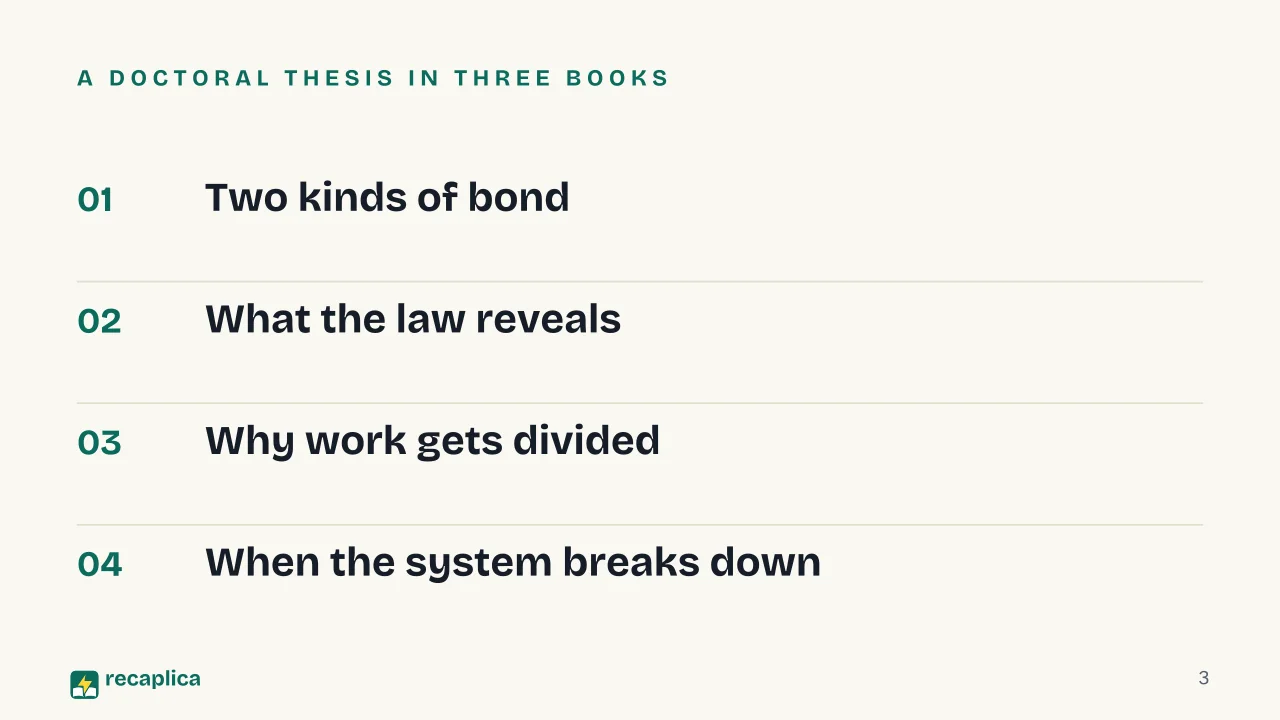 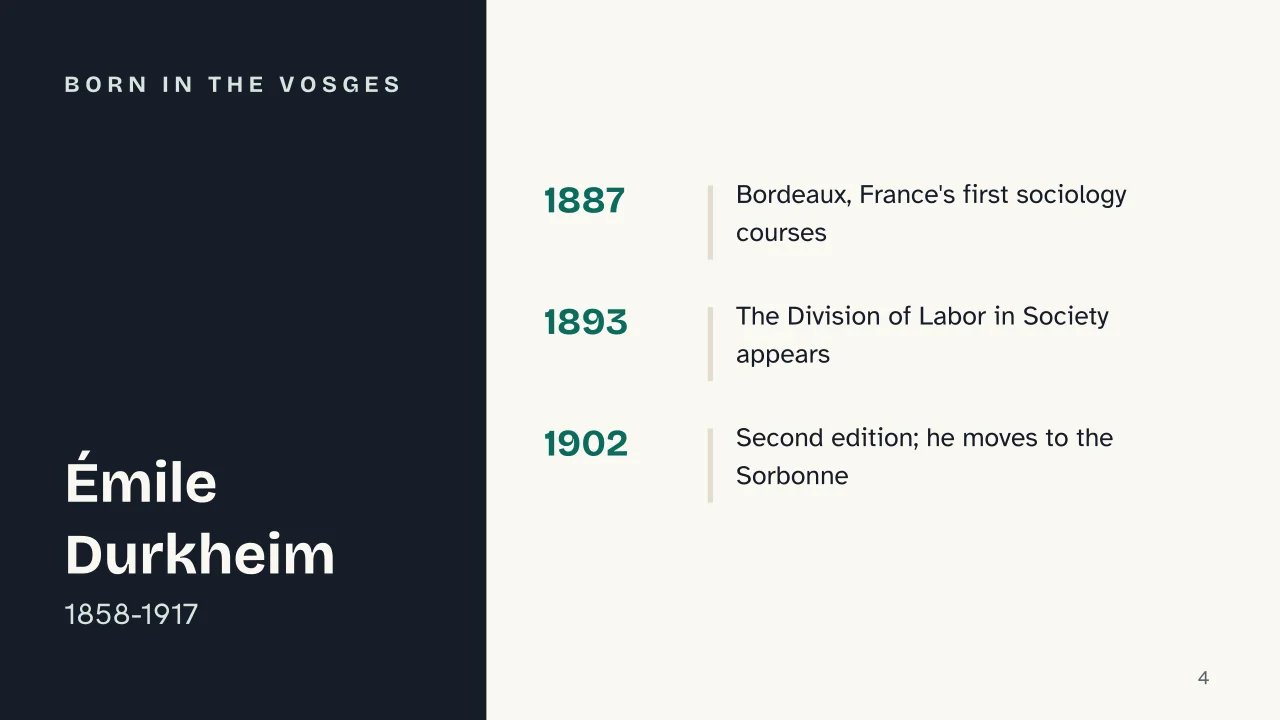  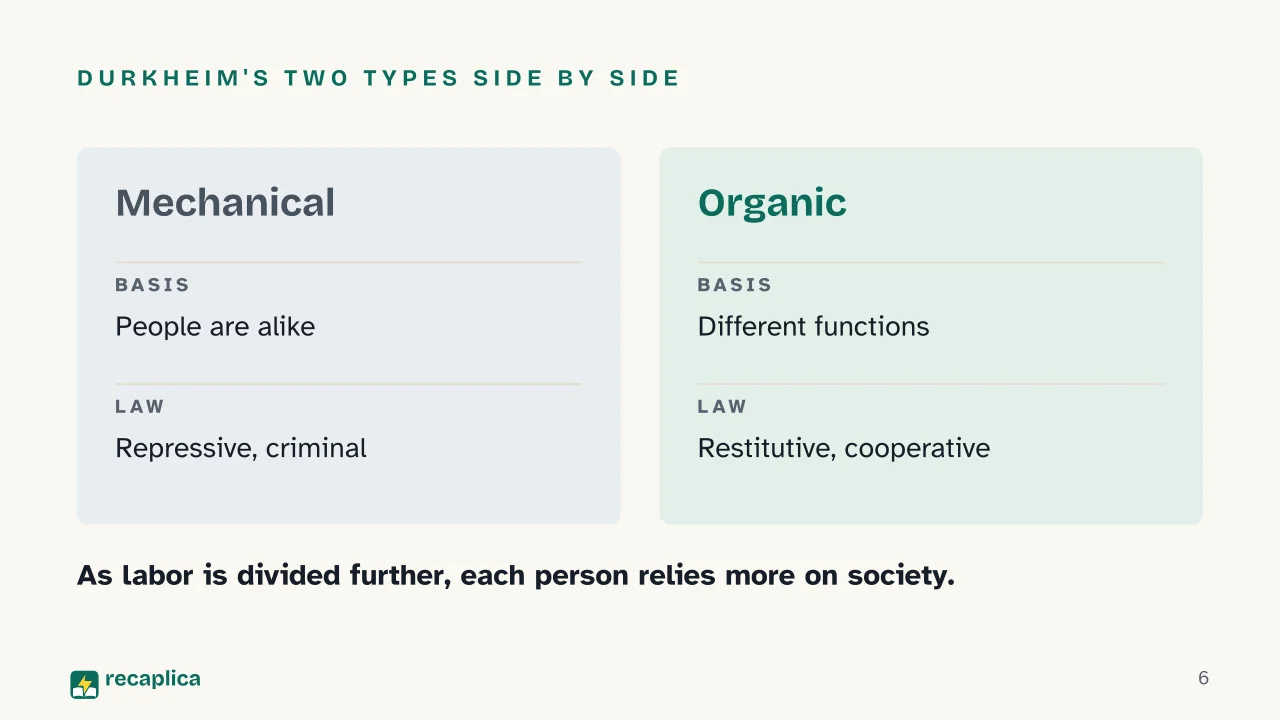  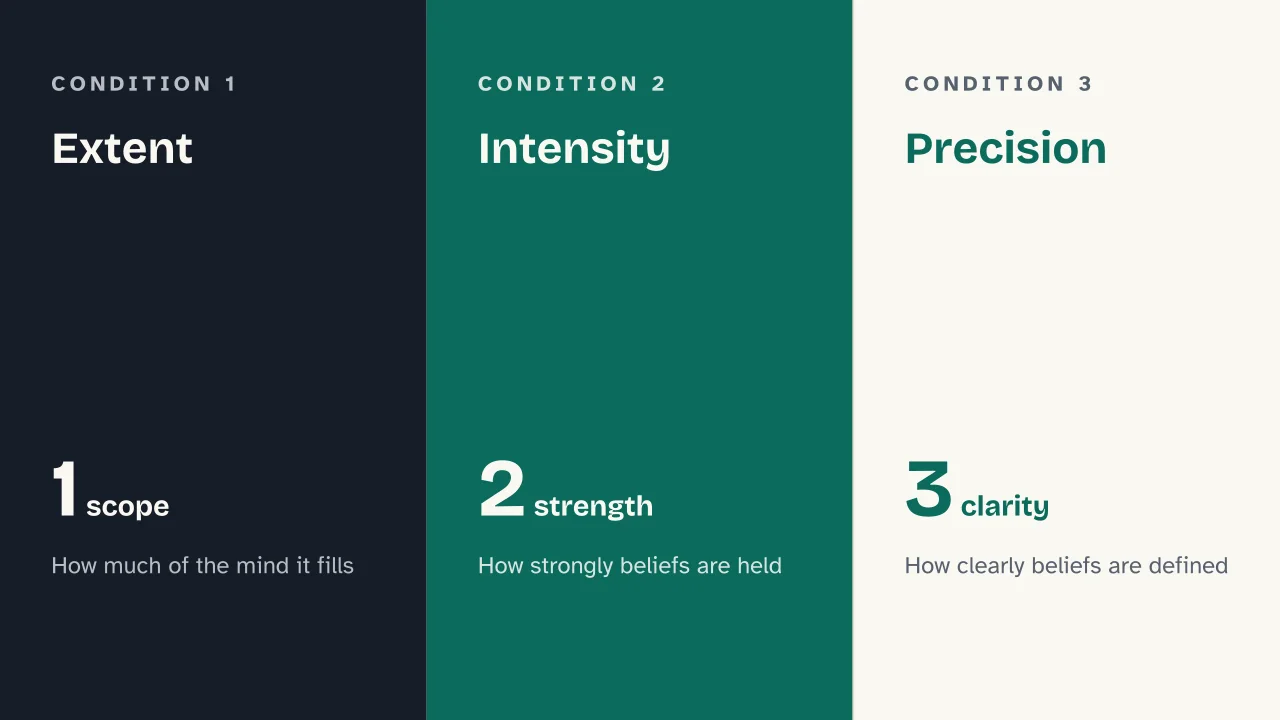 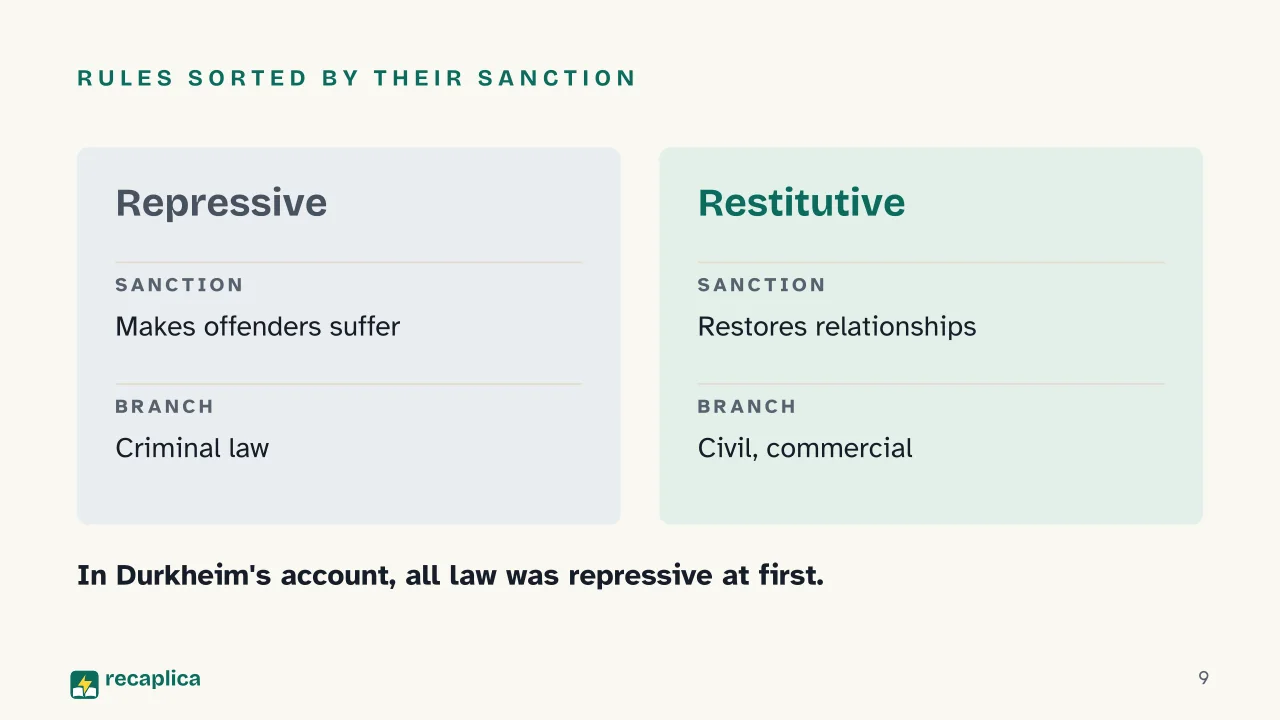  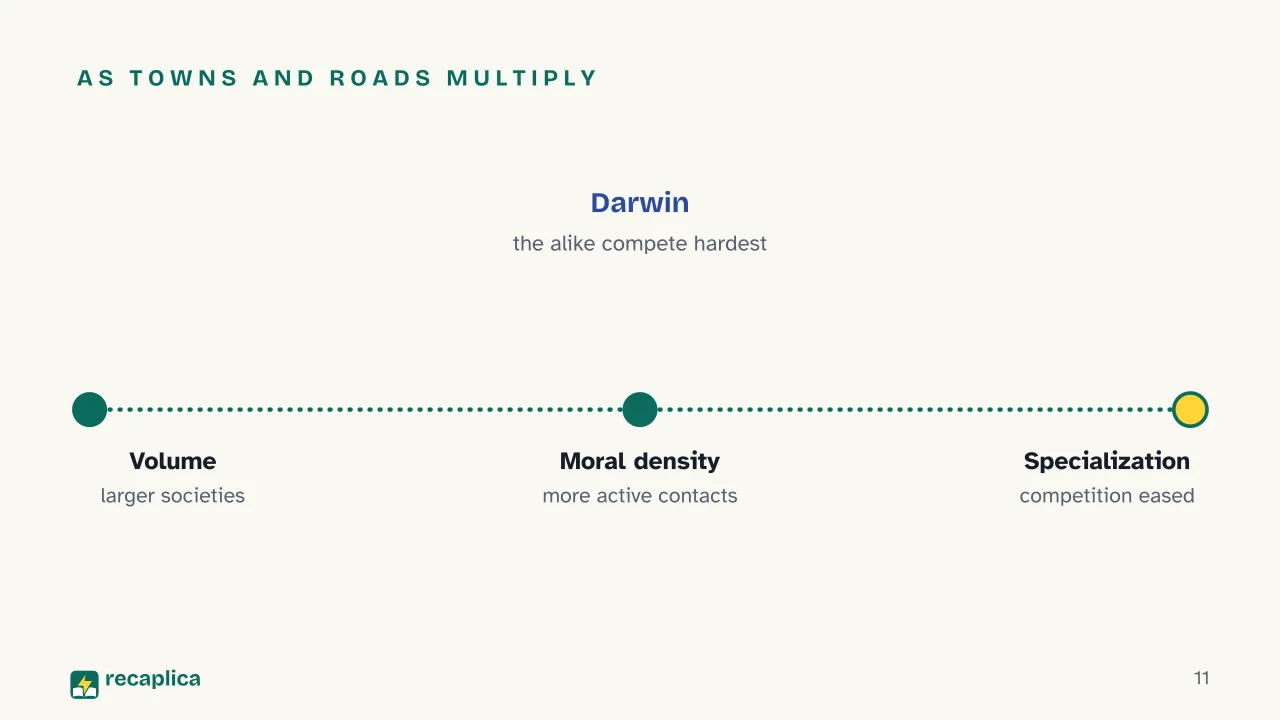  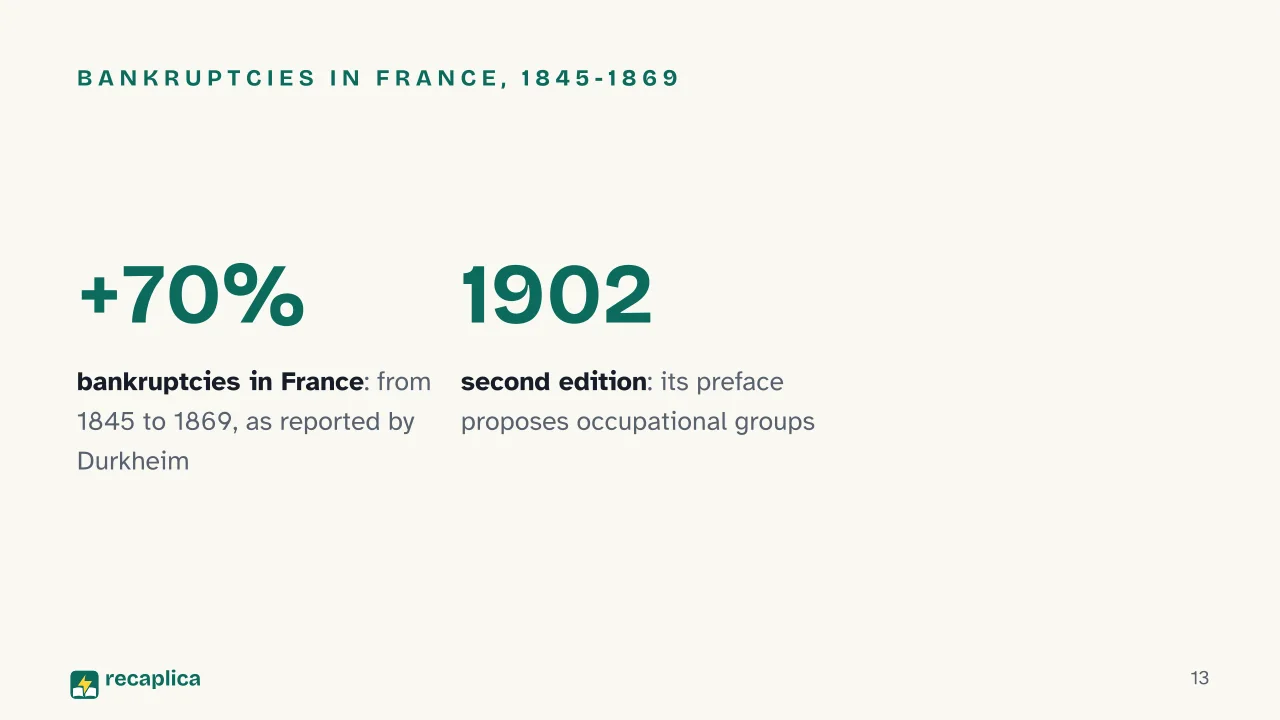 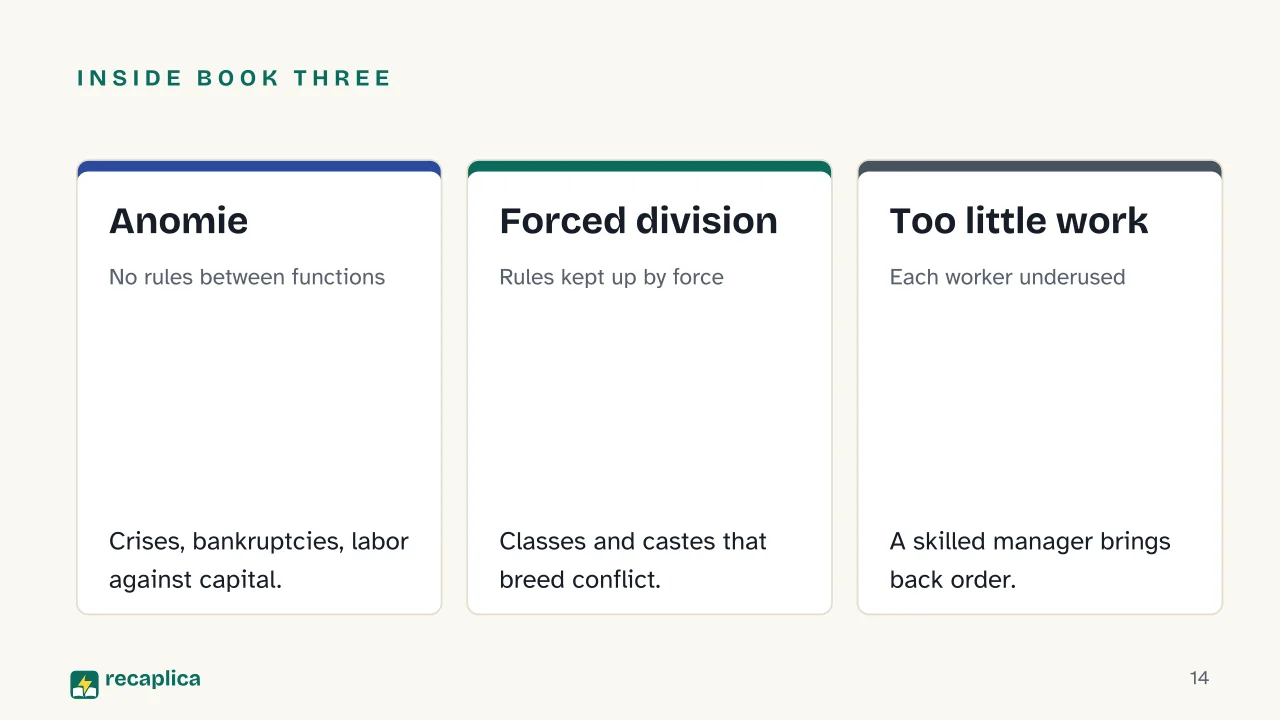 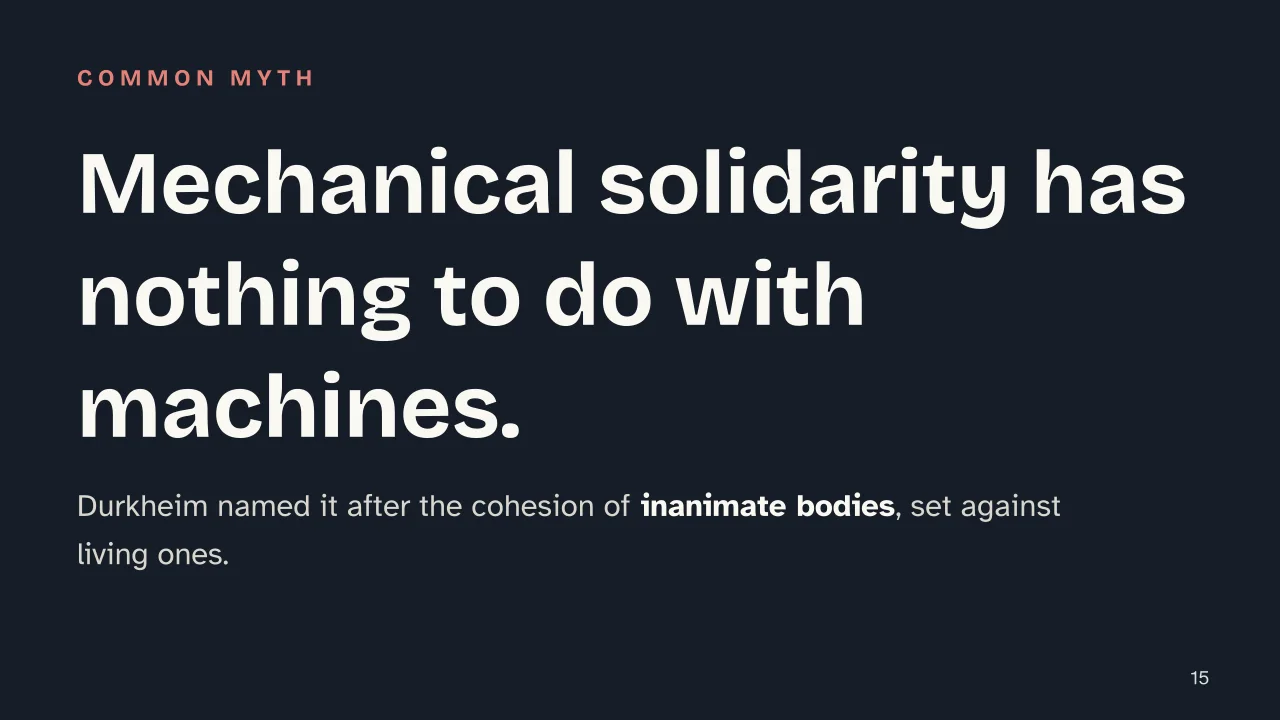 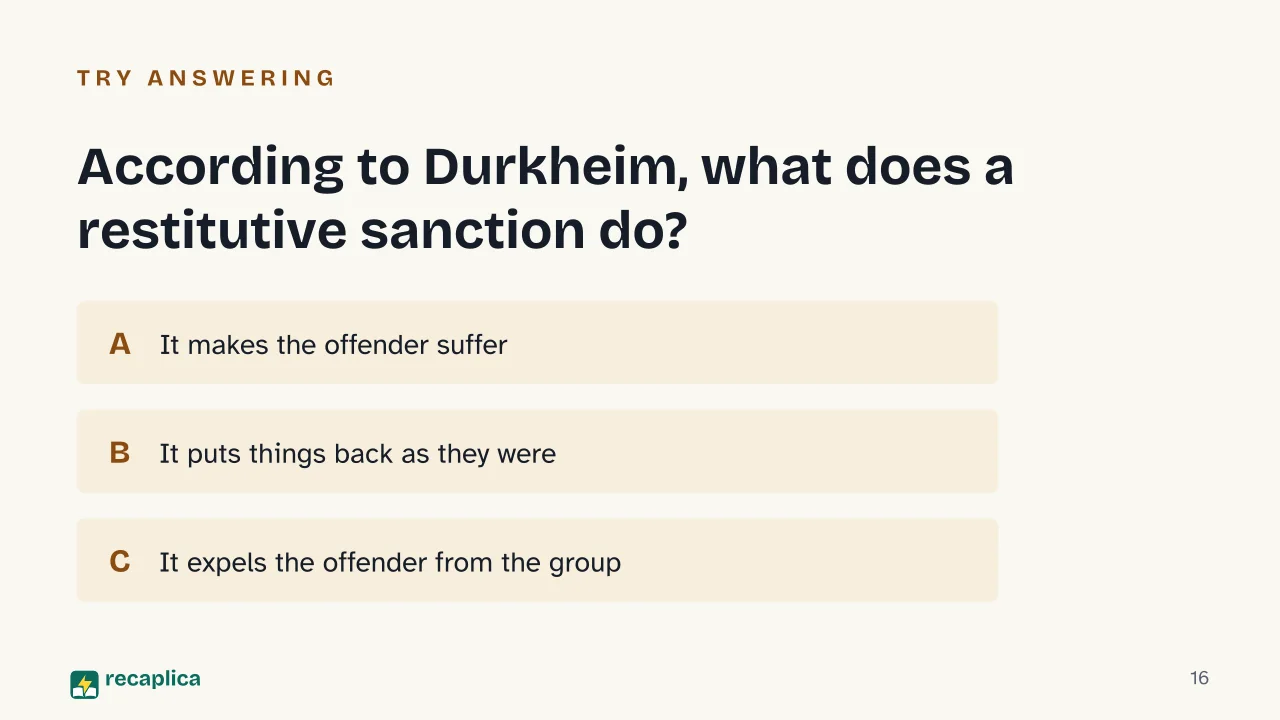  Common myths
Mind mapDrag the background to move around and the nodes to reposition them; use − and + to collapse and expand branches. 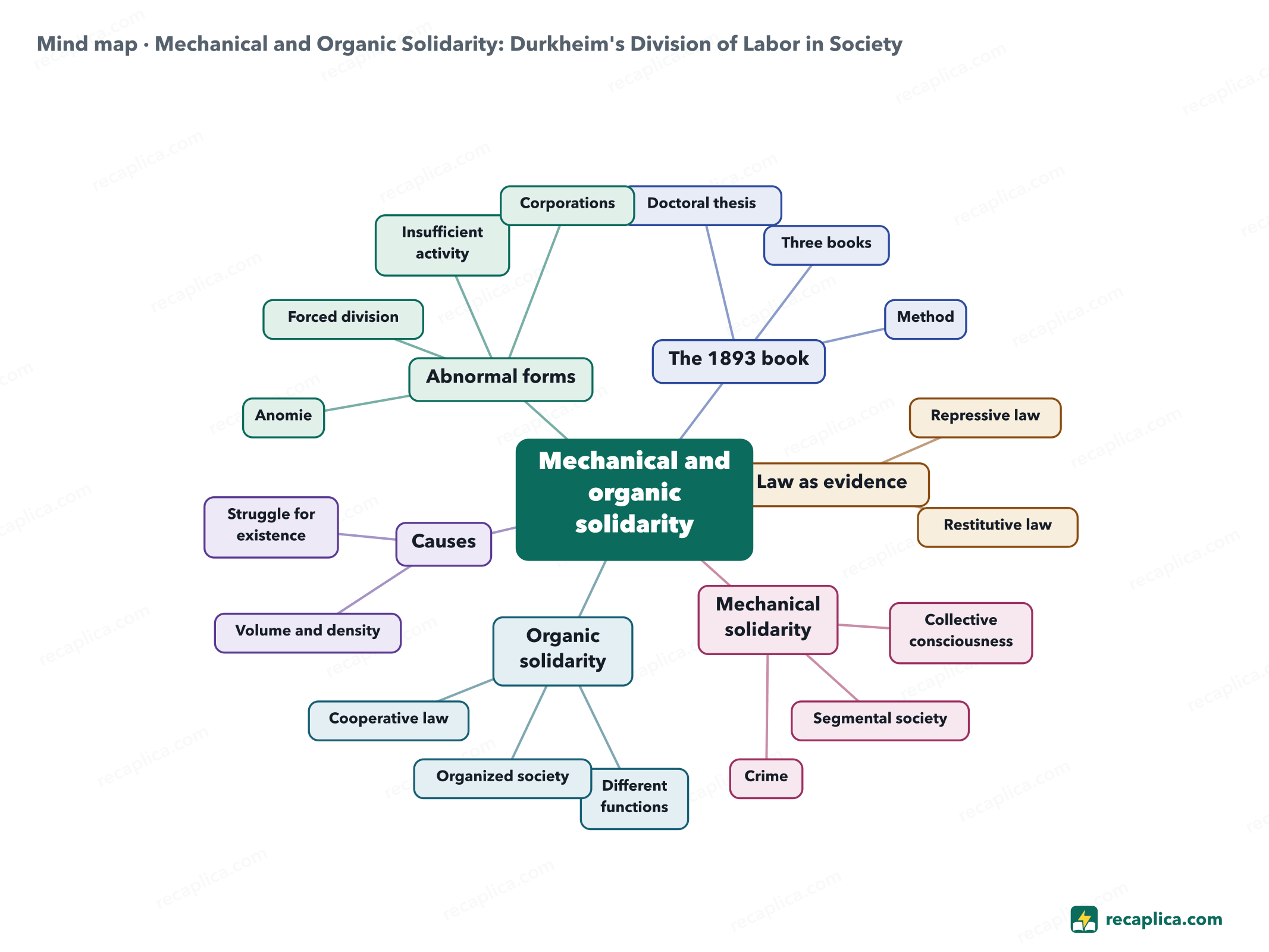
Quiz: test yourselfAnswer the questions to check what you have learned: you get instant feedback and a short explanation. Grade 0/10 0/5
FlashcardsTap the card to flip it and check whether you remember the answer, then move to the next one. 1 / 7 Explain it in your own wordsThe ultimate test: if you can explain it in simple words, you've truly understood it. Write your explanation, then compare it with the Recap. Your explanation is saved only on this device.
Frequently asked questionsWhat is mechanical and organic solidarity?They are the two kinds of social bond Émile Durkheim describes in The Division of Labor in Society (1893). Mechanical solidarity holds together people who are alike and share the same beliefs, in small societies made of similar groups. Organic solidarity holds together people who do different work and therefore need each other. Durkheim named it after higher animals, in which each organ is autonomous and the organism is more unified the more its parts differ. What is an example of mechanical solidarity?Durkheim's own examples are clan-based segmental societies, among them the Iroquois and the ancient Hebrews described in the Pentateuch. In such groups the individual mind depends almost entirely on the collective one. The legal sign of the bond is criminal law, since an act becomes a crime when it offends strong, well-defined feelings of the collective consciousness. According to Michele Salvati, Durkheim even counted class consciousness as a form of mechanical solidarity among people in the same condition. What is an example of organic solidarity?Durkheim lists the soldier, the priest, the statesman, the industrialist and the scientist. Because they chase different ends, none of them blocks the others. In his scheme the law shows the same bond at work: a merchant who fails to deliver goods is asked to repair the deal with the customer. What is the difference between repressive and restitutive law?Durkheim separates them by the sanction they carry. Repressive law inflicts suffering on whoever breaks the rule, and it is the same thing as criminal law. Restitutive law tries to bring the situation back to where it was, and it includes civil, commercial, procedural, administrative and constitutional law. What is anomie in The Division of Labor in Society?It is the first abnormal form described in Book Three. Economic activities need one another, but they are in contact too little and for too short a time, so no rules form between them. Durkheim's examples are commercial crises, bankruptcies and the conflict between labor and capital. Every Recap goes through an independent review before publication. |