|
recaplica
Descartes' Method: Doubt, Four Rules, and the Cogito |
| © 2026 Recaplica · recaplica.com — All rights reserved |
Descartes' Method: Doubt, Four Rules, and the CogitoWhat to print Page numbers appear when printing with default margins. SlidesChoose a cut Flash10 slidesThe essential thread, to present in classFull15 slidesEvery chapter and the deeper detailBoth come with speaker notes. In 30 seconds quick readDescartes realizes that his education, thorough as it was for its time, has left him with nothing but doubts and an awareness of his own ignorance. He decides to clear his mind of every opinion he had accepted before, doubting even his own senses, which sometimes deceive. To rebuild knowledge on solid ground he sets out a method in four rules, published in the 1637 Discourse on Method. Applying it, he reaches one certainty that no doubt can shake: the cogito, "I think, therefore I am." Key Points
Key figures
Deep DiveDescartes arrives at the problem of method by a concrete route. After the most thorough schooling his time could offer, he finds himself, by his own account, with no more than doubts about everything and a clear sense of how little he actually knows, as the Stanford Encyclopedia of Philosophy reports. The problem of knowledge: tradition and the senses on trialScholastic tradition, built on Aristotle, held that every person is born with an empty mind and that all the material of intellectual knowledge must come from the senses, according to the Internet Encyclopedia of Philosophy. It is the same theoretical frame that, centuries earlier, had driven early Greek thinkers to search for the arché, the first principle of things: even then, philosophers were looking for a secure foundation from which every other piece of knowledge could follow. Descartes turns that starting point around. If knowledge comes from the senses, and the senses can sometimes deceive, then their reliability as a source of knowledge becomes doubtful: this is the position the Internet Encyclopedia of Philosophy attributes to him. It traces the opening move of the Cartesian project to the decision to clear the mind of every opinion accepted before, ahead of rebuilding anything new.
Questioning belief by belief, stripping away one claim at a time until something holds firm, recalls from a distance how Socrates tested his interlocutors’ definitions, question after question, to see which ones survived. Methodic doubtThe Stanford Encyclopedia of Philosophy calls Descartes’ doubt “methodic,” and notes that it reaches beyond knowledge drawn from the senses alone. The Internet Encyclopedia of Philosophy describes the basic strategy in precise terms: treat as false any belief that can be doubted even slightly. The filter rejects anything doubtable even a little, and keeps only what survives the next round of questioning. Descartes’ doubt aims at a final certainty, a different use from the one often attributed to the Sophists, who in fifth-century Athens were said to give up looking for a shared truth. The Discourse on Method: four rules from 1637According to the Stanford Encyclopedia of Philosophy, the Discourse on Method also served a pedagogical and demonstrative purpose, and the method it describes was meant, for Descartes, to yield knowledge useful to life. The same encyclopedia, in its entry on Descartes’ method, lists four rules set out in Part II of the work. The first rule calls for accepting as true nothing that is not known with clear evidence. The second calls for dividing every difficulty under examination into as many parts as possible, the better to resolve it. The third calls for conducting thoughts in order, starting from the simplest and easiest objects to know and rising gradually toward knowledge of the most complex. The fourth, finally, calls for reviews so complete and exhaustive that one can be certain nothing has been left out. Together the four rules form a general procedure for guiding reason, meant to apply beyond the metaphysical questions where it first takes shape. From doubt to the first certainty: the cogitoIn the Meditations, Descartes notes that everything he had accepted as most true had come to him from the senses or through the senses, hence the need to doubt that source of knowledge as well, according to the Stanford Encyclopedia of Philosophy. Pushing methodic doubt to its limit, Descartes goes so far, in the second Meditation, as to imagine a deceiving demon able to falsify everything else: not even that demon, the Stanford Encyclopedia of Philosophy notes, could make him believe he is nothing, so long as he thinks he is something. From this core of reasoning the cogito follows. Descartes concludes that the very act of thinking, in the moment it happens, is enough to make him certain he exists: that is how the Internet Encyclopedia of Philosophy puts it. The Stanford Encyclopedia of Philosophy reports the Latin formula “Ego cogito, ergo sum,” which Descartes himself calls a proposition necessarily true whenever it is stated or conceived in the mind. For the Stanford Encyclopedia of Philosophy, Descartes treats the cogito as certain because the intellect perceives it clearly and distinctly. The cogito is a partial endpoint in the Cartesian project: the first stone that methodic doubt cannot dislodge. From there the process starts over to rebuild everything else. Anyone tracing the question of a foundation for knowledge back further, into Greek philosophy, finds an echo of it in Plato’s theory of forms, which places true knowledge in an order distinct from the sensible world, beyond the reach of the senses. The intellectual climate in which Descartes was formed, in turn, is the one the Renaissance had already shaken a century earlier, calling inherited authorities into question across more than one field of knowledge. Slide deckSlides ready to download and make your own in PowerPoint or Google Slides, with speaker notes. Pick the Flash cut or the Full one.   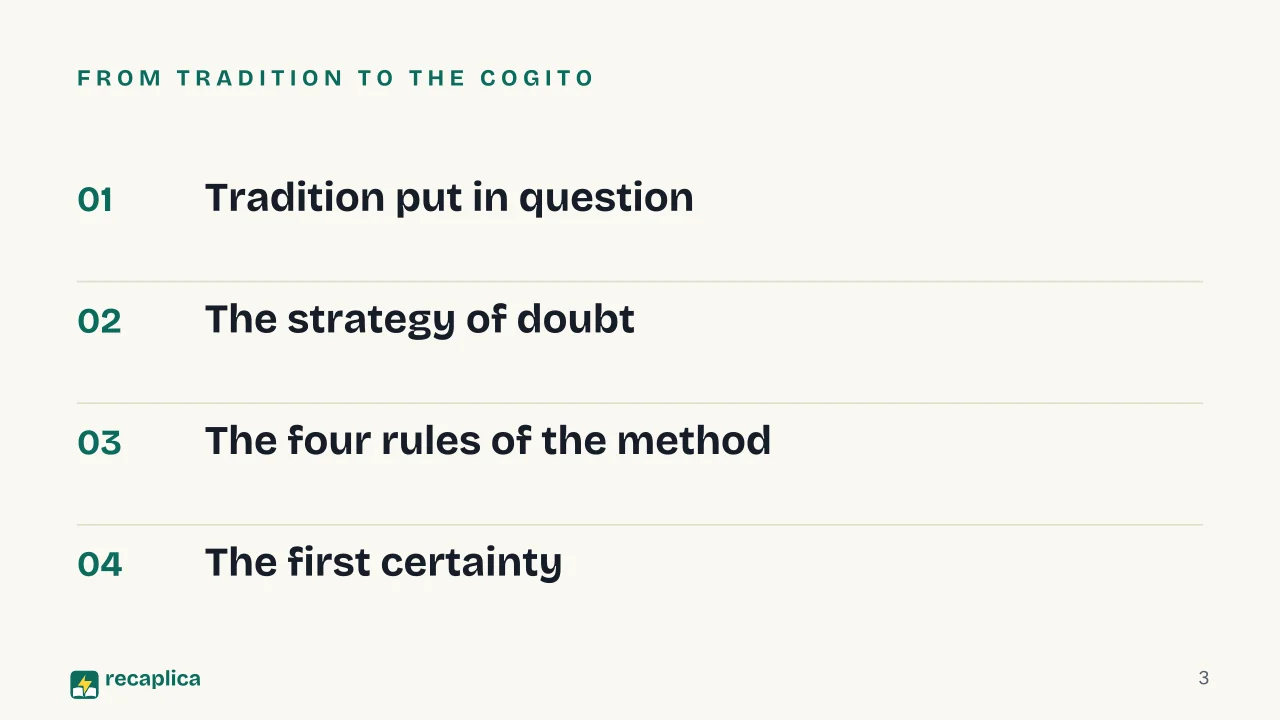  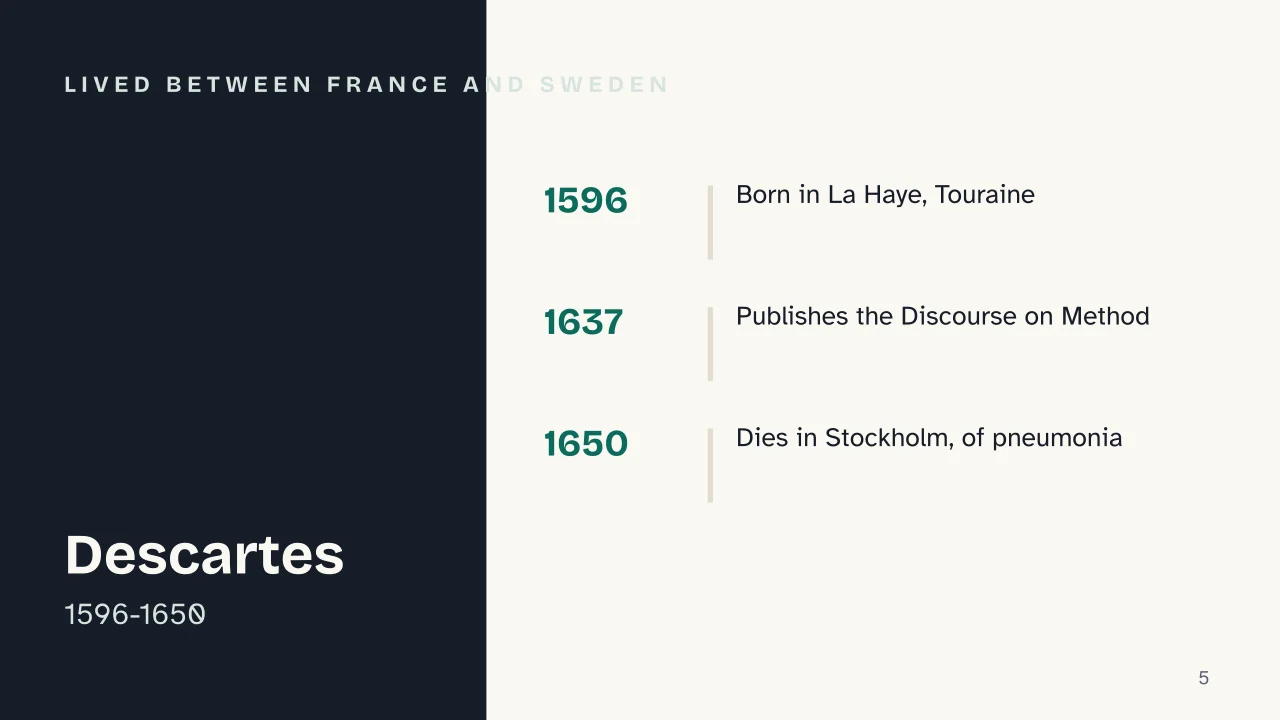 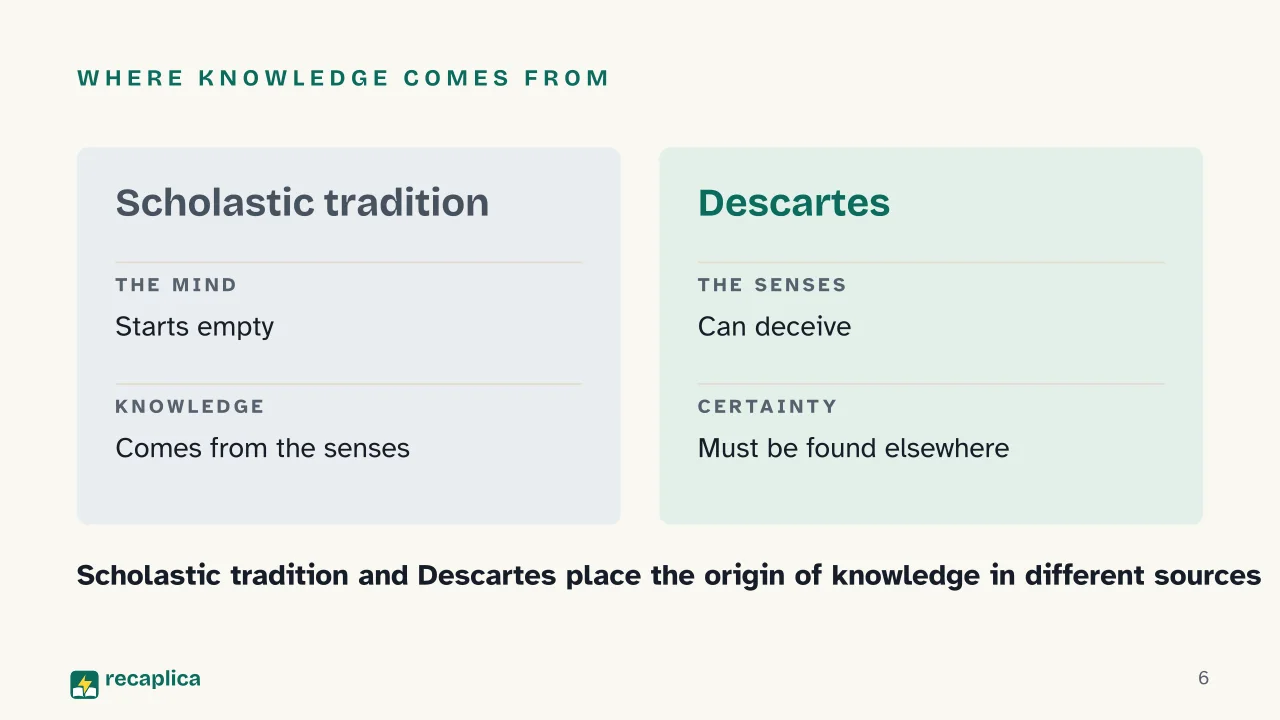  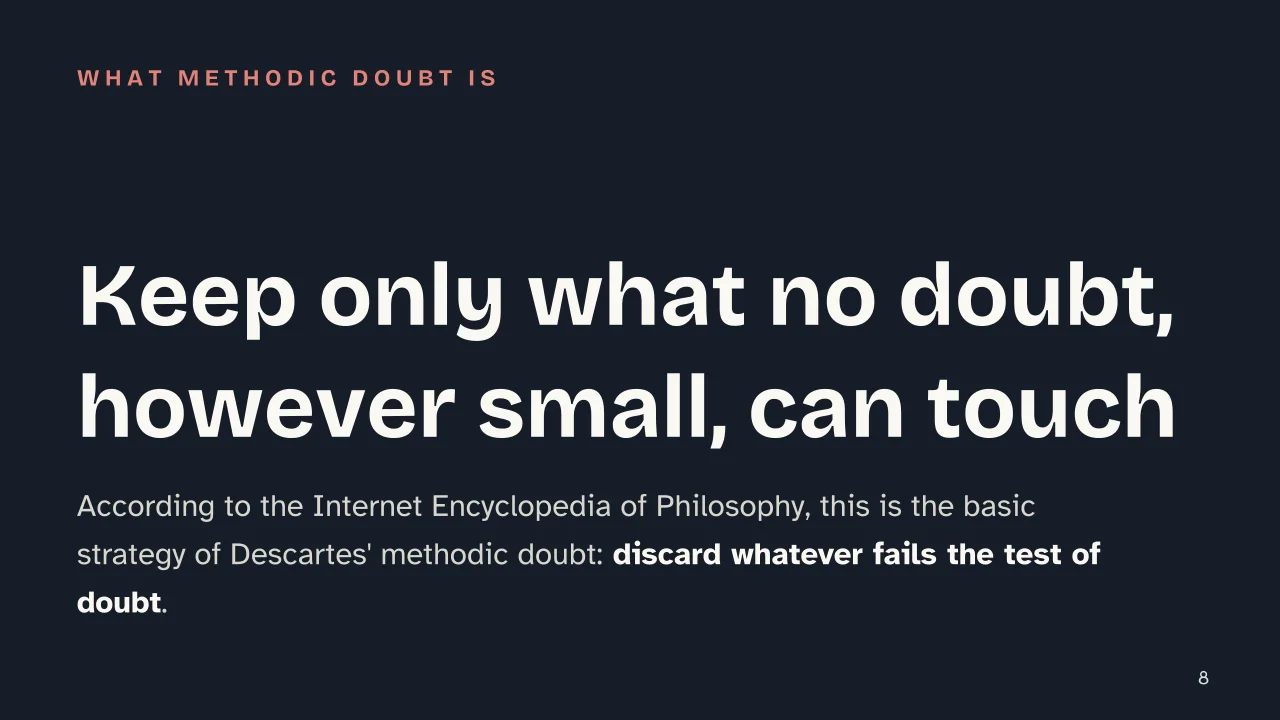 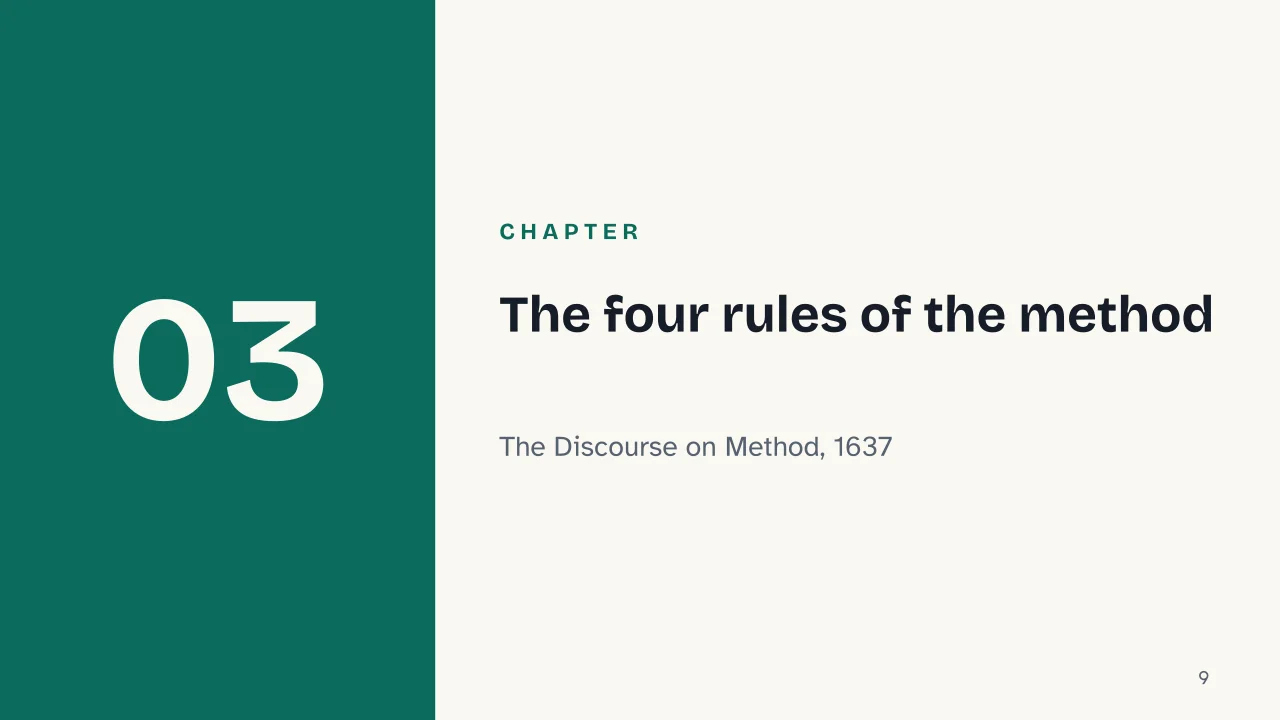 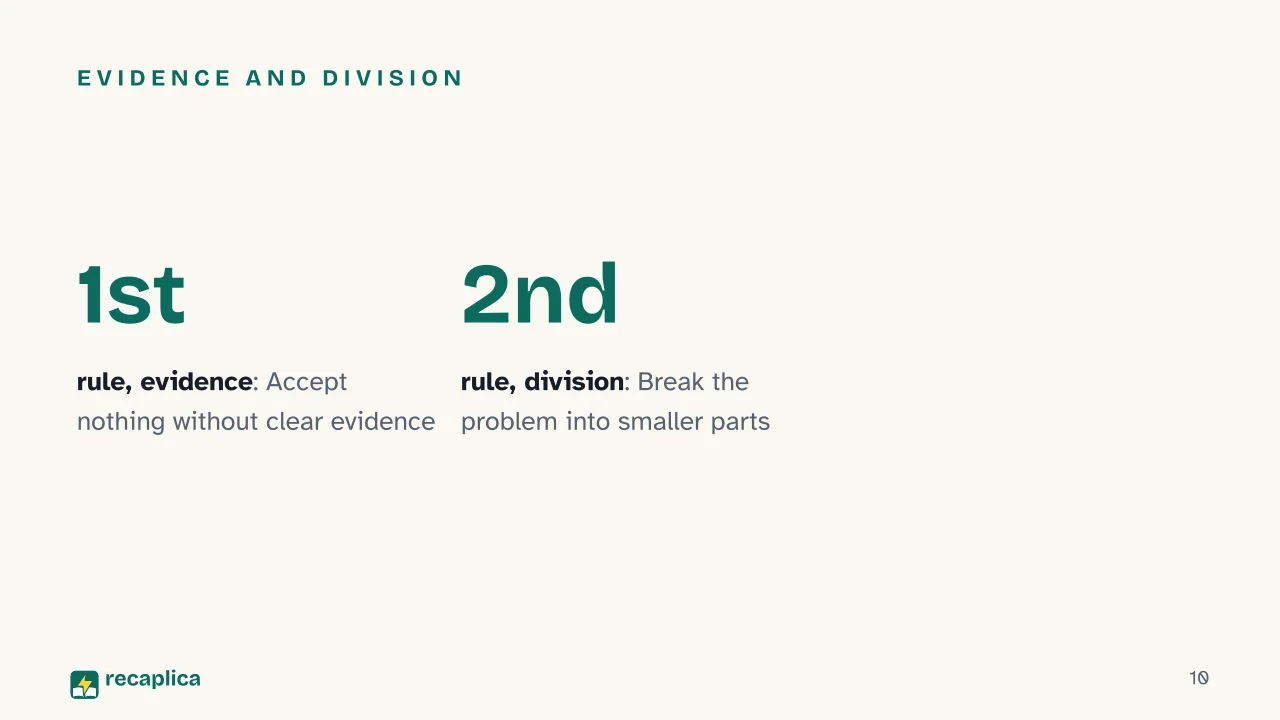 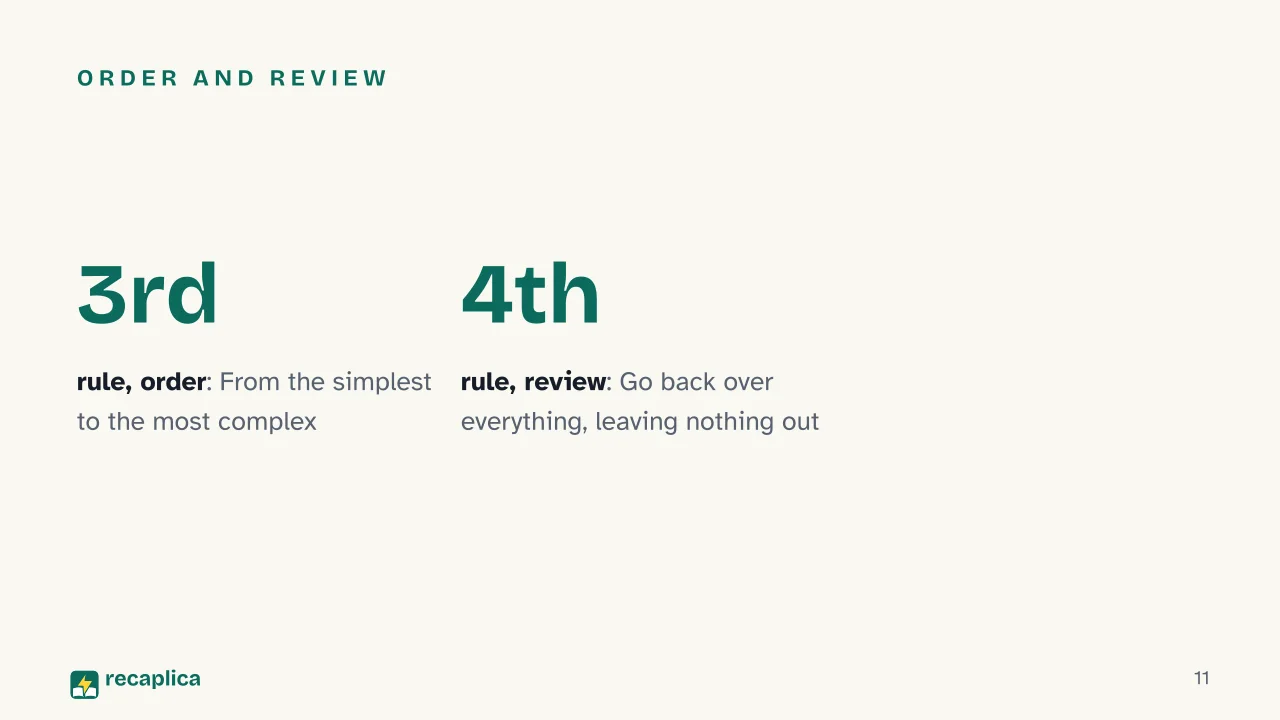 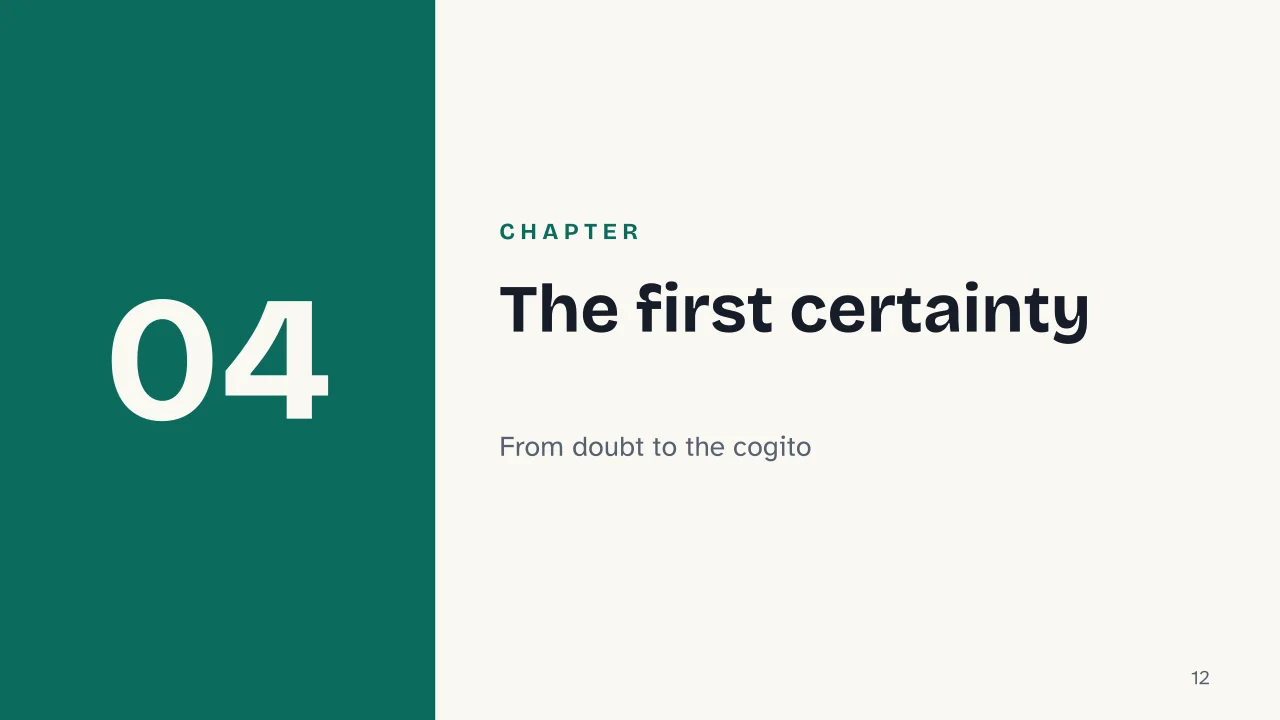 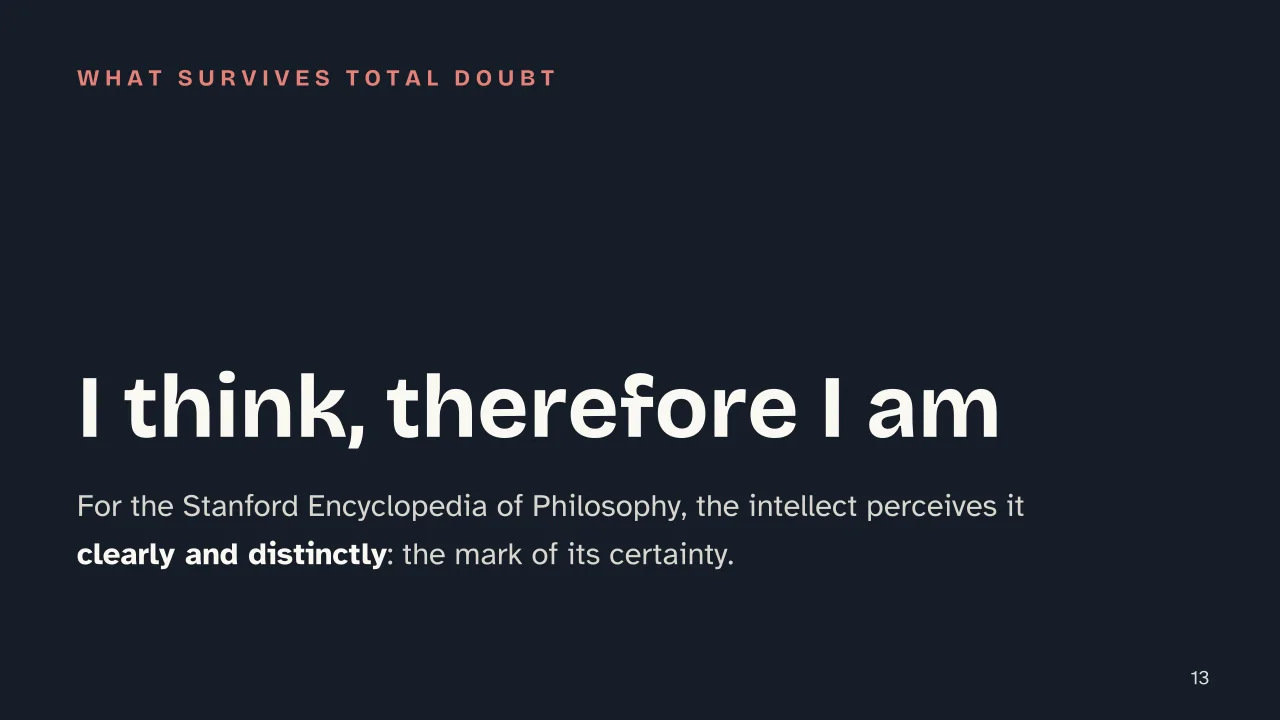 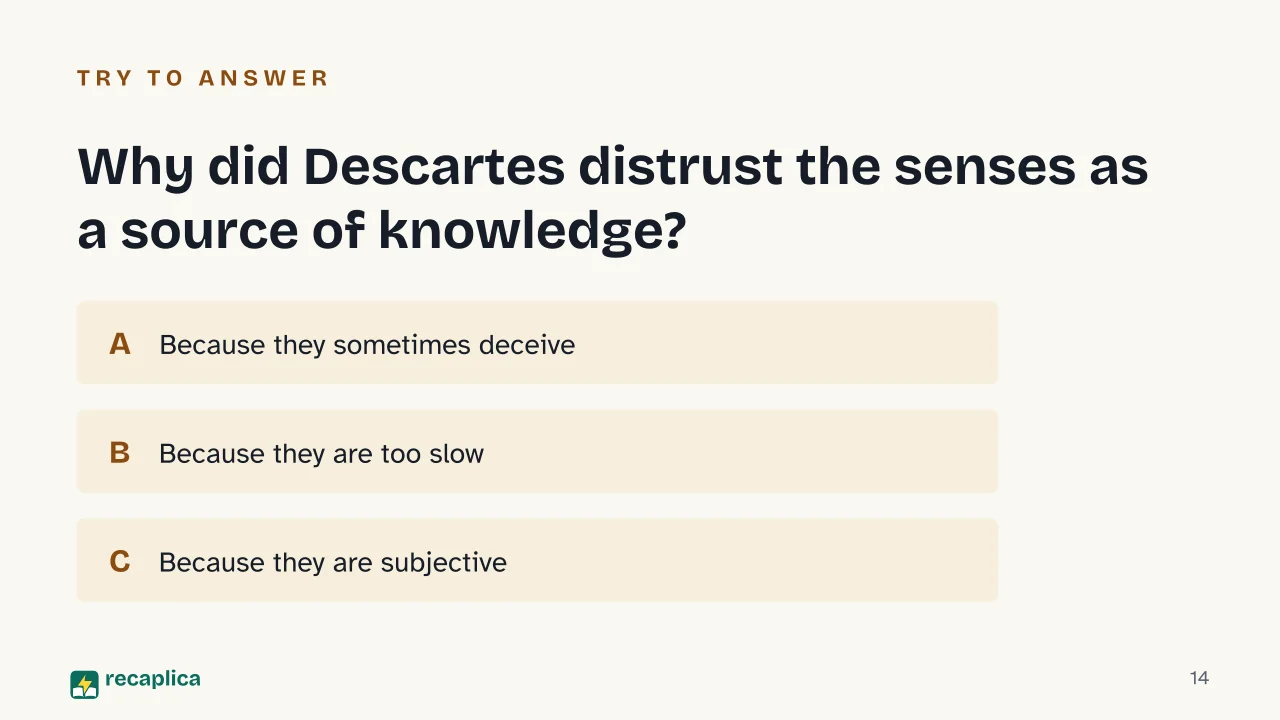  Common myths
Mind mapDrag the background to move around and the nodes to reposition them; use − and + to collapse and expand branches. 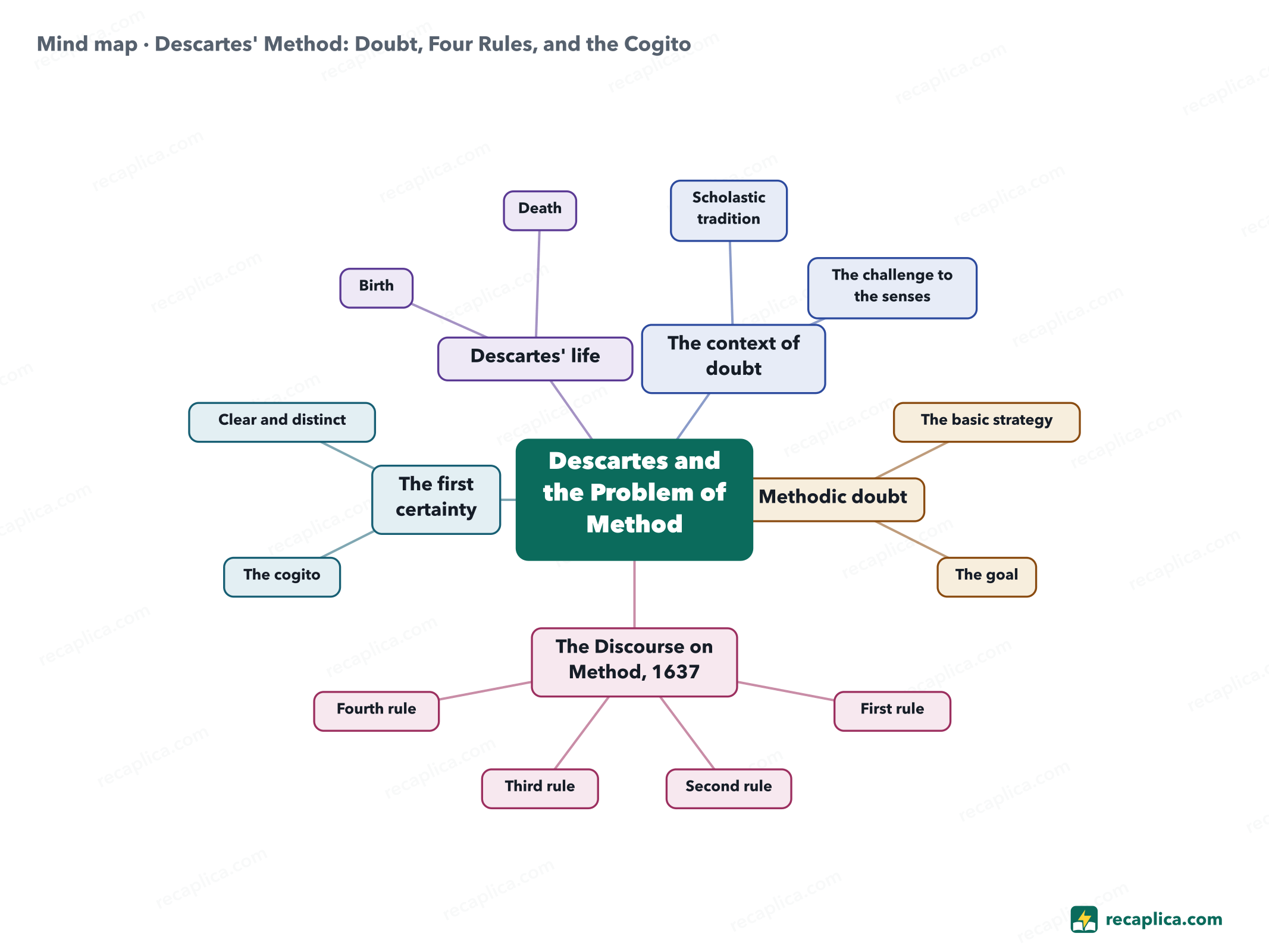
Quiz: test yourselfAnswer the questions to check what you have learned: you get instant feedback and a short explanation. Grade 0/10 0/5
FlashcardsTap the card to flip it and check whether you remember the answer, then move to the next one. 1 / 8 Explain it in your own wordsThe ultimate test: if you can explain it in simple words, you've truly understood it. Write your explanation, then compare it with the Recap. Your explanation is saved only on this device.
Frequently asked questionsWhat is the Discourse on Method?It is the 1637 work in which Descartes sets out the four rules for conducting his reason: evidence, division, order, and review. According to the Stanford Encyclopedia of Philosophy it also served a pedagogical and demonstrative purpose. What is the Descartes method, in short?The Descartes method is a procedure in four rules — evidence, division, order, review — meant to rebuild knowledge piece by piece after doubting both the senses and inherited tradition, as described in the Discourse on Method of 1637. Who was Descartes?René Descartes (1596-1650) was a French philosopher and mathematician. He is known for questioning the reliability of the senses and for the method he used to reconstruct certain knowledge, which led him to the cogito, according to the Stanford Encyclopedia of Philosophy. Why did Descartes doubt the senses?According to the Internet Encyclopedia of Philosophy, because the senses can sometimes deceive: a source that deceives even occasionally cannot be trusted to build certain knowledge. What are the four rules of the Descartes method?First, accept as true only what is known with full evidence. Second, break a problem down into as many parts as needed to handle it one piece at a time. Third, move from the simplest matters to the most complex, step by step. Fourth, review everything carefully, so nothing is left out. Every Recap goes through an independent review before publication. |