|
recaplica
Declaration of the Rights of Man: What It Is and What It Says |
| © 2026 Recaplica · recaplica.com — All rights reserved |
Declaration of the Rights of Man: What It Is and What It SaysWhat to print Page numbers appear when printing with default margins. SlidesChoose a cut Flash10 slidesThe essential thread, to present in classFull15 slidesEvery chapter and the deeper detailBoth come with speaker notes. In 30 seconds quick readThe Declaration of the Rights of Man and of the Citizen is the text that France's National Constituent Assembly adopted on August 26, 1789, at the start of the French Revolution. Its preamble and 17 articles set out rights such as liberty, property, security and resistance to oppression, alongside principles like national sovereignty and the separation of powers. The Marquis de Lafayette put forward a personal first draft, which five deputies appointed by the Assembly then reworked before the final vote. It should not be confused with the Universal Declaration of Human Rights, adopted by the UN in 1948: a similar name, but a different document in era, authorship and content. Key Points
Key figures
Deep DiveSetting the Scene: the French Revolution and the Tennis Court OathThe Declaration of the Rights of Man and of the Citizen took shape in the opening months of the French Revolution. On June 20, 1789, deputies of the Third Estate, gathered in a tennis court at Versailles, swore not to disband before giving France a Constitution: that Tennis Court Oath is the immediate lead-up to the text that would follow two months later. By early July 1789 the Constituent Assembly had already begun work on a declaration of rights meant to ground the new Constitution. Among the project’s influences were the American Declaration of Independence of 1776 and Enlightenment thought: the idea that human beings hold natural rights independent of a sovereign didn’t originate in France in 1789, but found there one of its most influential expressions. Readers curious how the same era produced a parallel path across the Atlantic can turn to the Recap on the American Revolution. Who Put the Text TogetherThe Marquis de Lafayette presented a personal first draft of the declaration to the National Assembly on July 11, 1789, three days before the storming of the Bastille and the formal start of the French Revolution. He wrote it with help from Thomas Jefferson, then the American ambassador to France. That draft, though, isn’t the document read in history books today. The Assembly assigned five deputies — Démeunier, La Luzerne, Tronchet, Mirabeau and Redon — to review the various proposals in circulation and produce a unified version. The final text, voted on August 26, 1789, came out of several compromises and the Assembly’s collective work, with contributions from other deputies including Jean-Joseph Mounier and the abbé Grégoire. What the 17 Articles SayThe document opens with a preamble that blames “ignorance, neglect or contempt of the rights of man” for public misfortunes and government corruption — the reason its authors give for laying out those rights in a solemn declaration. Seventeen articles follow. The first articles list the natural, inalienable rights of man: liberty, property, security and resistance to oppression. Article 1 states that men are born and remain free and equal in rights; Article 2 defines the purpose of political association as the preservation of those natural rights. A second cluster of articles addresses how power is organized. Article 3 sets out the principle of national sovereignty; Article 6 defines law as an expression of the general will; Article 14 introduces consent to taxation. A third cluster protects individuals before the justice system and in matters of belief: Article 9 is linked to the presumption of innocence (a response to the old lettres de cachet, which let the king order someone’s arrest without trial), Article 10 protects freedom of opinion, religious belief in particular, and Article 11 protects the free communication of thoughts and opinions, called one of the most valuable rights of man.
Finally, Article 16 holds that a society without guaranteed rights and a defined separation of powers has no real Constitution: a principle still central to debates over forms of state and government today. From Vote to Constitution: Ratification and Standing TodayThe Assembly voted the final text between August 20 and 26, 1789. Louis XVI ratified it on October 5, 1789, and the document was placed as a preamble to the French Constitution of 1791. The text didn’t stay locked in 1789: according to the French presidency, it underpinned the French Constitutions of 1852, 1946 and 1958, and as of 2026 the Conseil constitutionnel still treats it as carrying full constitutional force. Over the 19th century it also inspired similar texts across several European and Latin American countries. In 2003 UNESCO added it to its Memory of the World register, among the most emblematic texts of the French Revolution. One Declaration, Two Similar NamesThe Declaration of the Rights of Man and of the Citizen is sometimes confused with a different, far more searched-for document: the Universal Declaration of Human Rights. They are two separate texts. The French one dates to 1789, runs to a preamble plus 17 articles, and was voted by France’s National Constituent Assembly in the thick of the French Revolution. The UN one dates to 1948: it was proclaimed by the UN General Assembly in Paris on December 10, 1948, under resolution 217 A, has 30 articles, and has been translated into more than 500 languages. The 1948 document comes from a different assembly and isn’t a newer version of the French one. For the history and content of the 1948 document, see the Recap on the Universal Declaration of Human Rights, the right reference for anyone looking for that text. Slide deckSlides ready to download and make your own in PowerPoint or Google Slides, with speaker notes. Pick the Flash cut or the Full one.     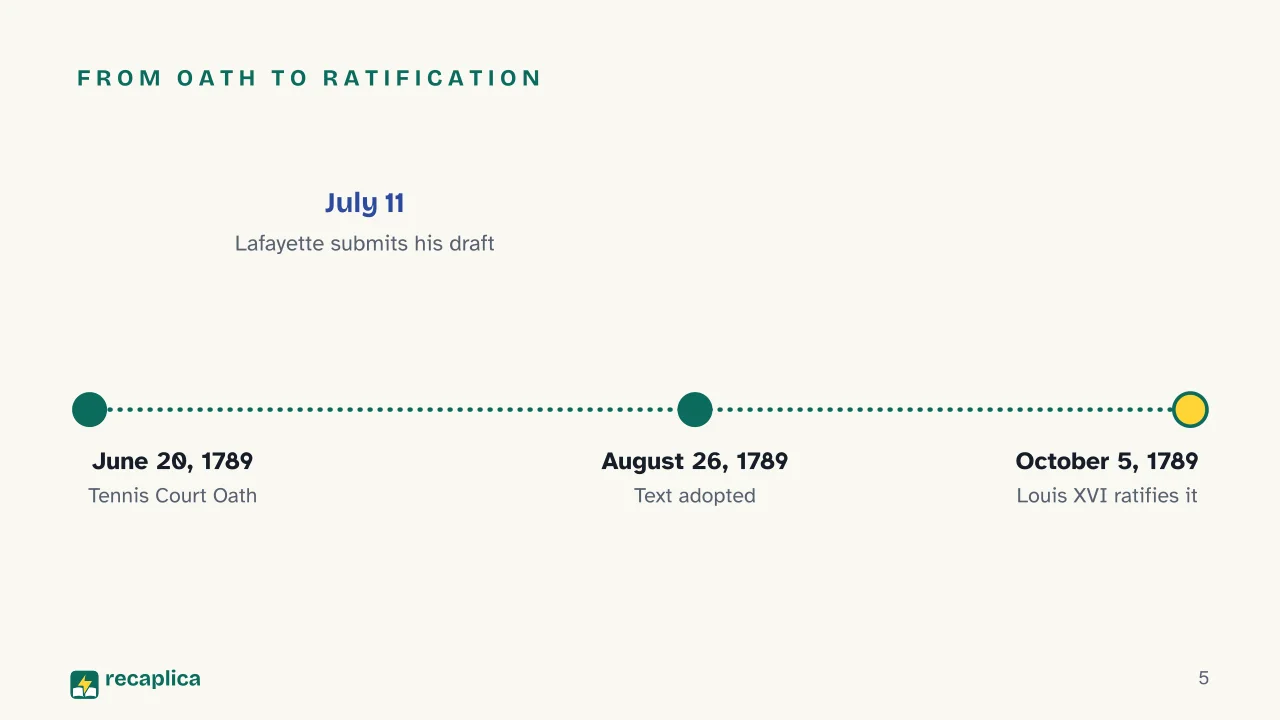  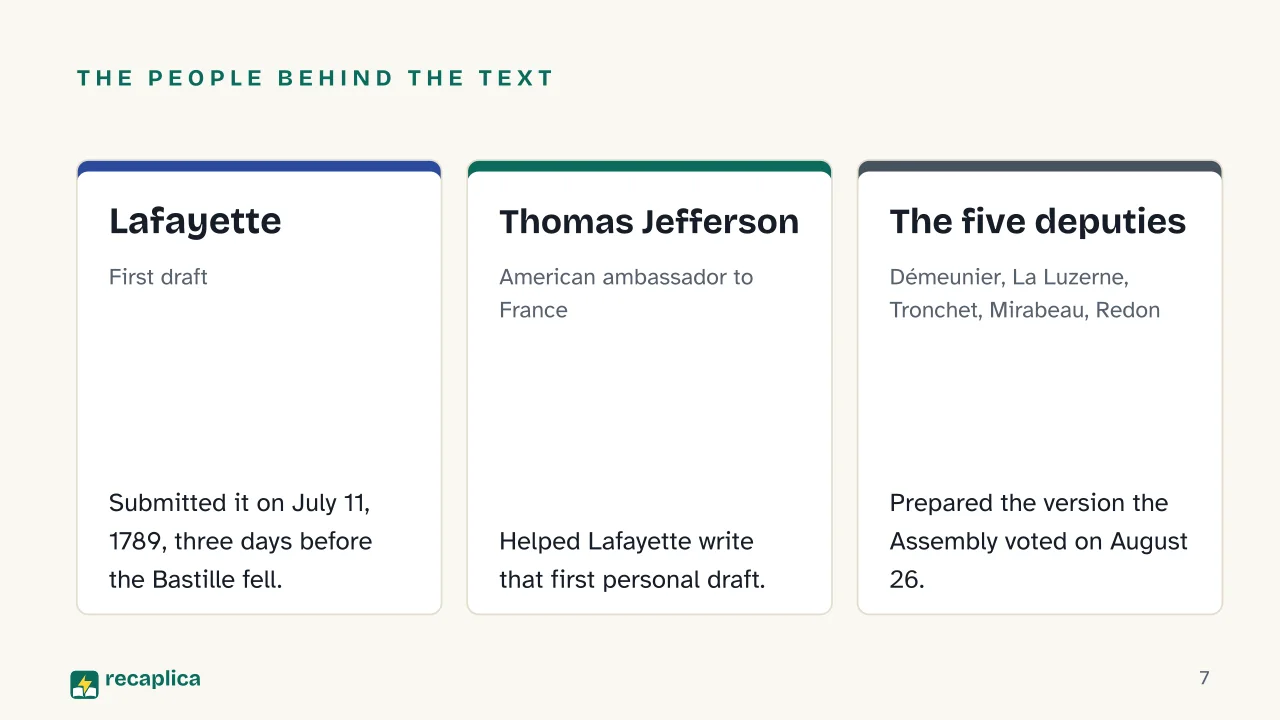  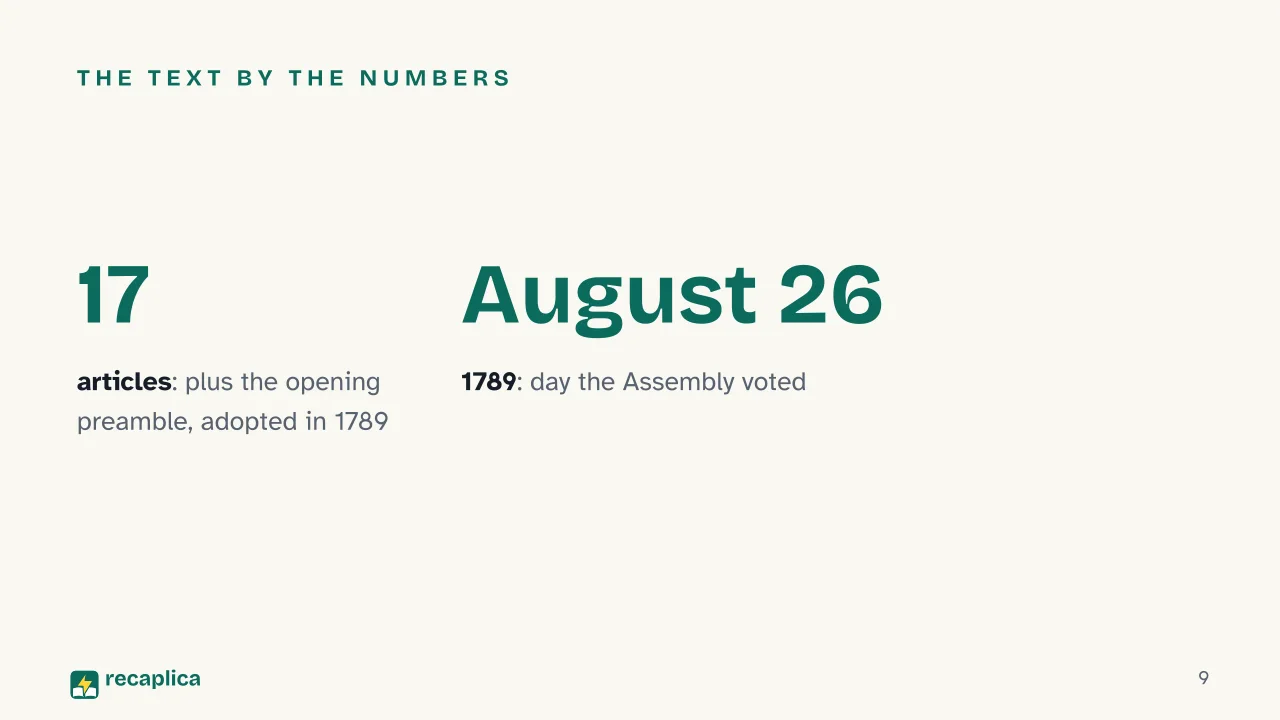 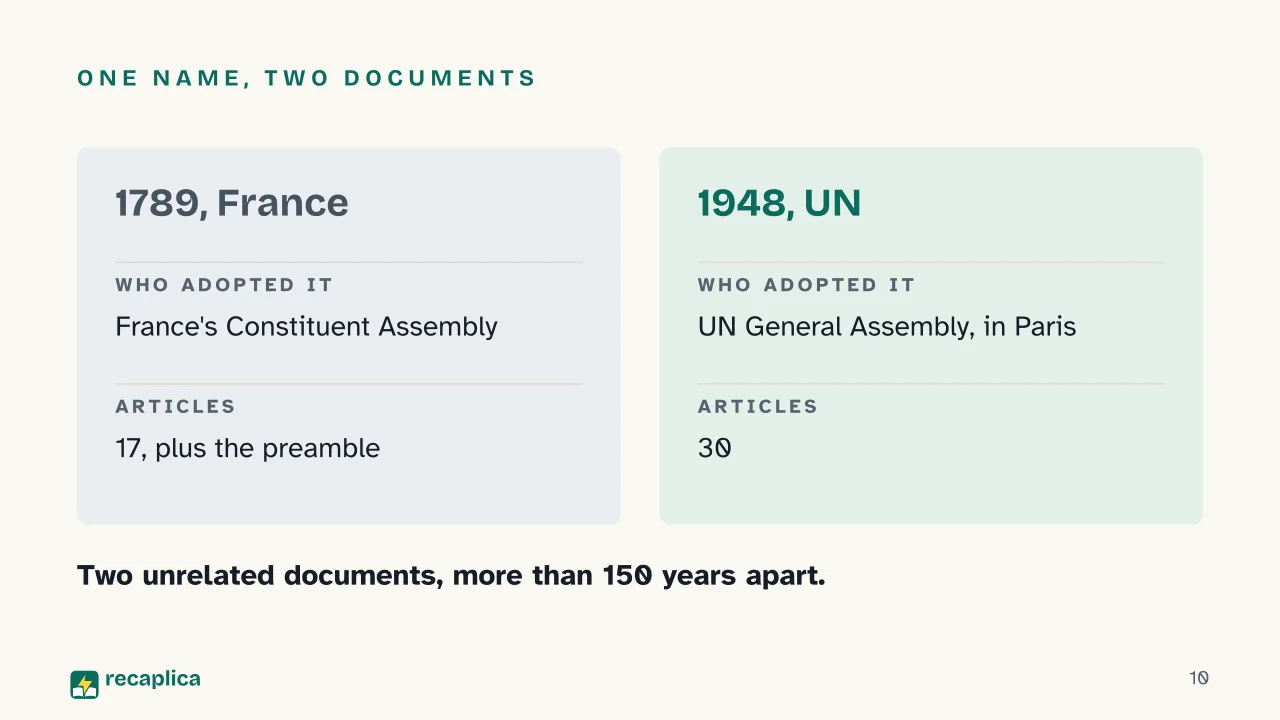 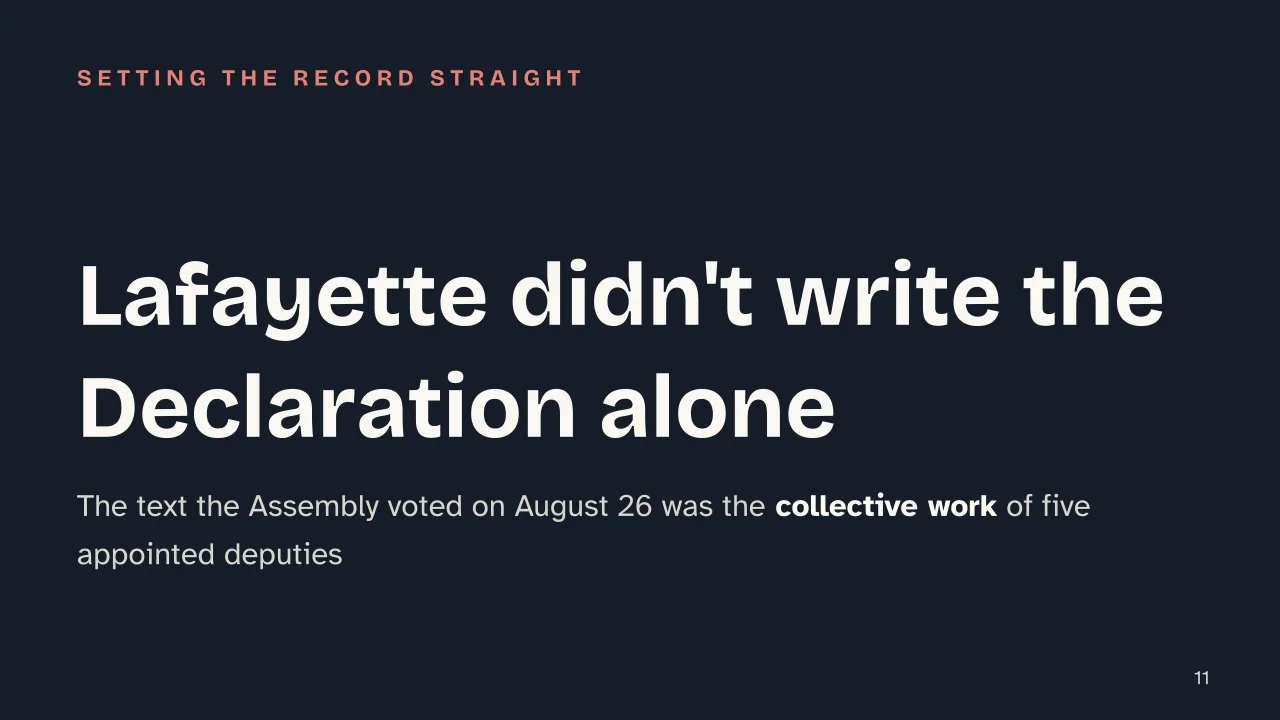  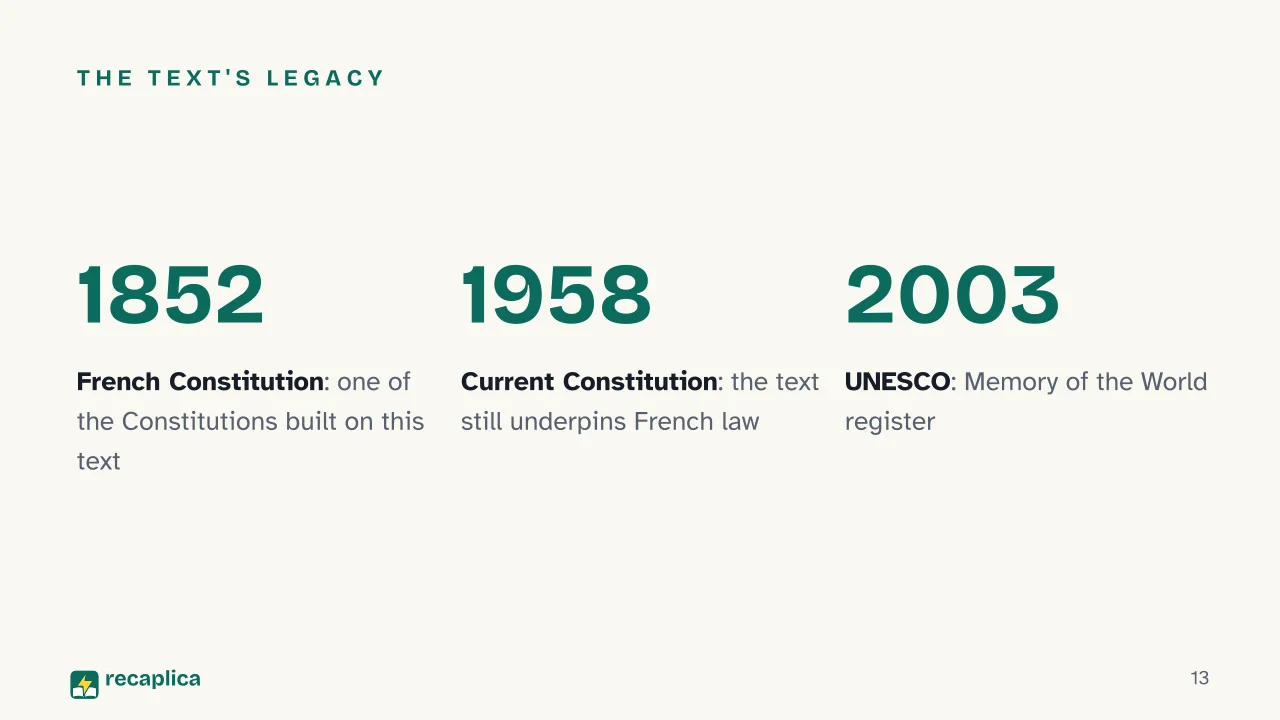 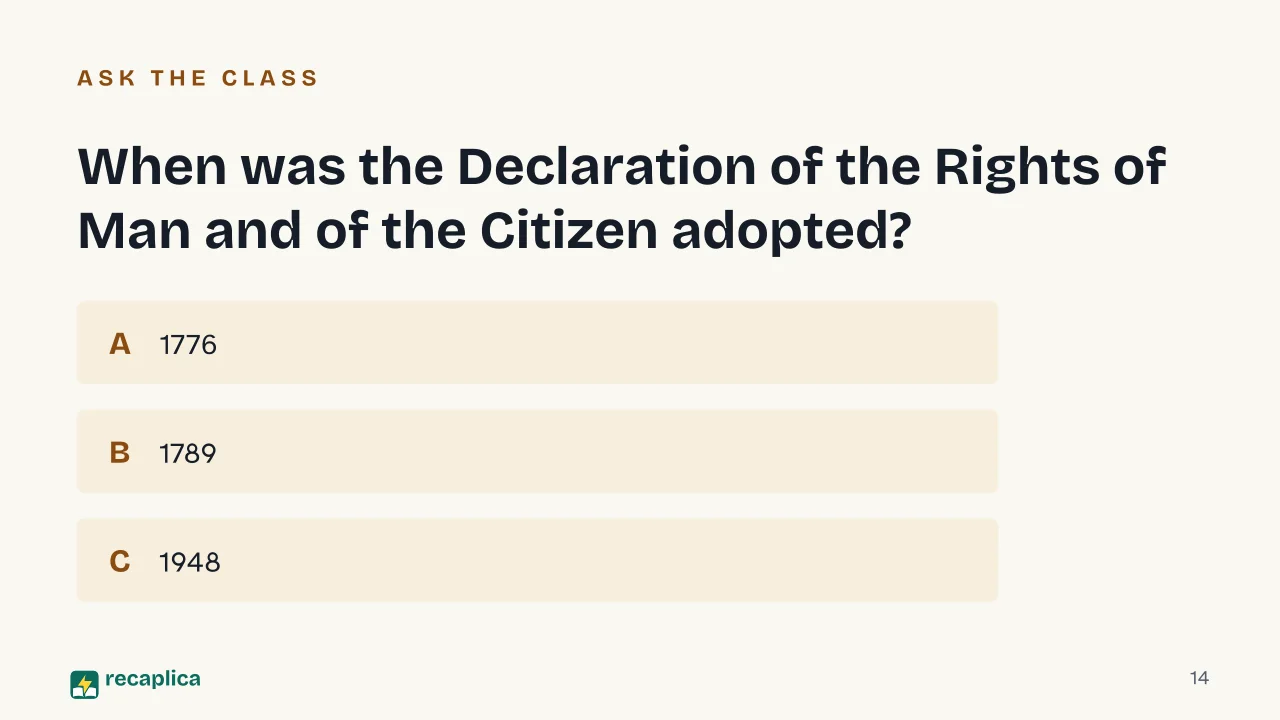  Common myths
Mind mapDrag the background to move around and the nodes to reposition them; use − and + to collapse and expand branches. 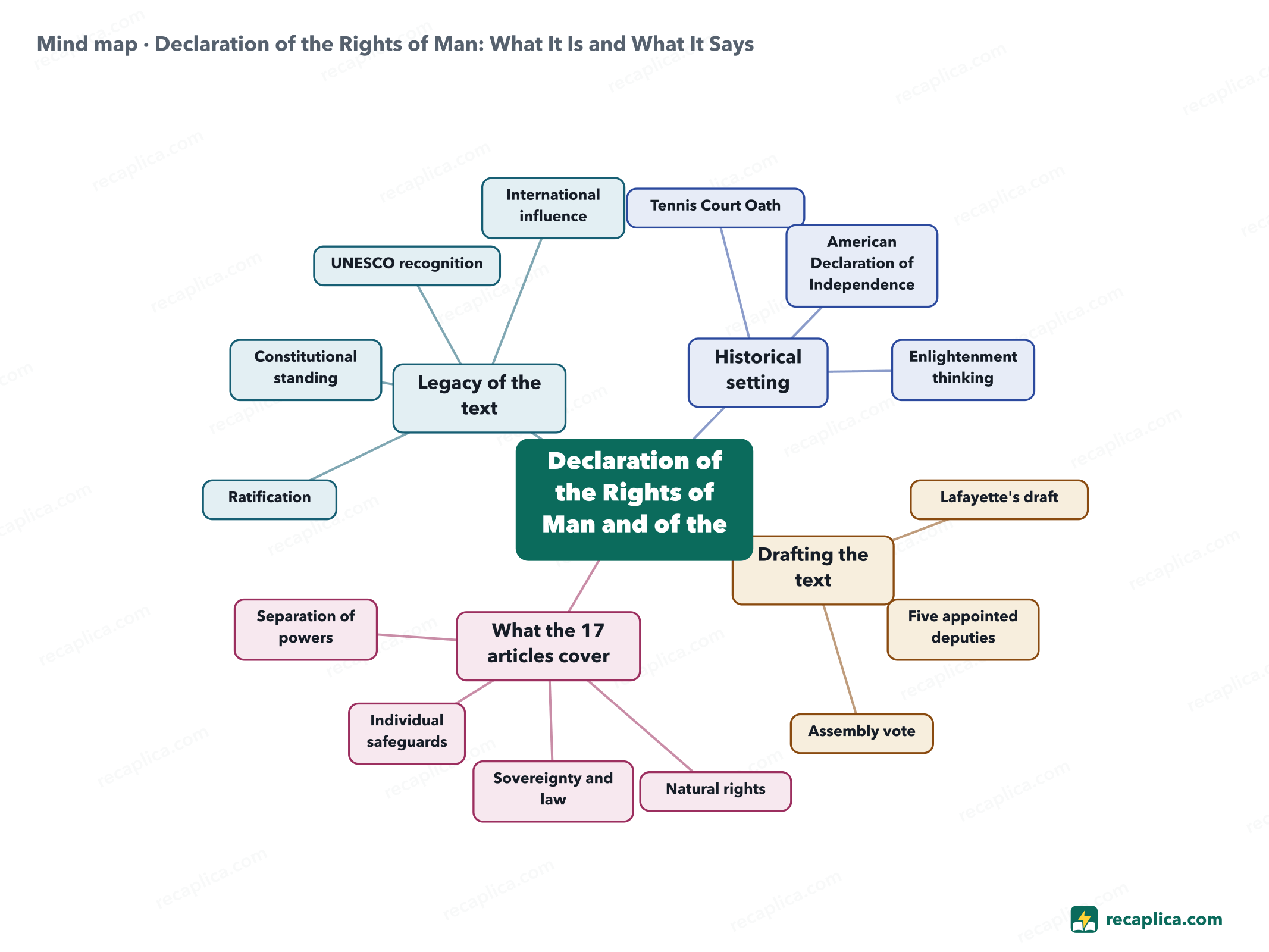
Quiz: test yourselfAnswer the questions to check what you have learned: you get instant feedback and a short explanation. Grade 0/10 0/5
FlashcardsTap the card to flip it and check whether you remember the answer, then move to the next one. 1 / 7 Explain it in your own wordsThe ultimate test: if you can explain it in simple words, you've truly understood it. Write your explanation, then compare it with the Recap. Your explanation is saved only on this device.
Frequently asked questionsWhat's the difference between the Declaration of the Rights of Man and the Universal Declaration of Human Rights?They're two separate documents despite the similar names: the Declaration of the Rights of Man and of the Citizen was adopted by France's National Constituent Assembly on August 26, 1789, and runs to a preamble plus 17 articles; the Universal Declaration of Human Rights was proclaimed instead by the UN General Assembly in Paris on December 10, 1948 (resolution 217 A) and has 30 articles. For that later text, see the Recap on the [Universal Declaration of Human Rights](/en/civics/universal-declaration-of-human-rights/). Who wrote the Declaration of the Rights of Man and of the Citizen?It has no single author. The Marquis de Lafayette presented a personal first draft on July 11, 1789, written with help from Thomas Jefferson, then the American ambassador to France; the text put to a vote on August 26, 1789 was instead the work of five deputies the Assembly appointed: Démeunier, La Luzerne, Tronchet, Mirabeau and Redon. What rights does the Declaration of the Rights of Man and of the Citizen list?Liberty, property, security and resistance to oppression as natural rights; national sovereignty, law as an expression of the general will, consent to taxation, the presumption of innocence, freedom of belief and opinion, free expression, and the separation of powers. Does the Declaration of the Rights of Man still carry legal weight today?Yes: France's Conseil constitutionnel treats it as carrying full constitutional force, and the text underpins the French Constitutions of 1852, 1946 and 1958. In 2003 UNESCO added it to its Memory of the World register. Did the Declaration of the Rights of Man draw on the American Declaration of Independence?Among the text's influences were the American Declaration of Independence of 1776 and Enlightenment thought more broadly. The more direct American link runs through Lafayette's collaboration with Thomas Jefferson on the July 11, 1789 draft: two separate facts, not one continuous thread. Every Recap goes through an independent review before publication. |