Skip to content
recaplica

    One moment: security check

    Cloudflare wants to make sure you're not a robot. Tick the box below and your search will continue on its own.

    IT
    recaplica Types of Government: Forms of State vs. Forms of Government
    © 2026 Recaplica · recaplica.com — All rights reserved
    Home › Civics

    Types of Government: Forms of State vs. Forms of Government

    By Recaplica Newsroom · Updated on September 23, 2026

    What to print

    Page numbers appear when printing with default margins.

    Slides

    Choose a cut

    Flash10 slidesThe essential thread, to present in classFull15 slidesEvery chapter and the deeper detail

    Both come with speaker notes.

    Telegram channel
    recaplica Clear in 30 seconds, yours in 10 minutes.
    In 30 seconds Key points Deep dive Slides Myths Mind map Quiz Flashcards FAQ

    In 30 seconds quick read

    A form of state and a type of government answer two different questions about how a country is organized. The form of state is about how a people, a territory and a government fit together, while the type of government is about which constitutional body actually steers political direction. Aristotle was among the first to classify governments, sorting six constitutional forms by whether power serves the common good or only those who hold it. The most common types of government today are parliamentary, presidential, semi-presidential, constitutional monarchy and the rare directorial system used in Switzerland, while territorially a state can be unitary or federal.

    Key Points

    • A form of state is about how a people, a territory and a government fit together; a type of government is about which constitutional body steers political direction — two separate classifications, according to Treccani.
    • Aristotle set out six constitutional forms, three he judged correct (kingship, aristocracy, polity) and three deviant (tyranny, oligarchy, democracy), depending on whether power aims at the common advantage or only at the advantage of the rulers.
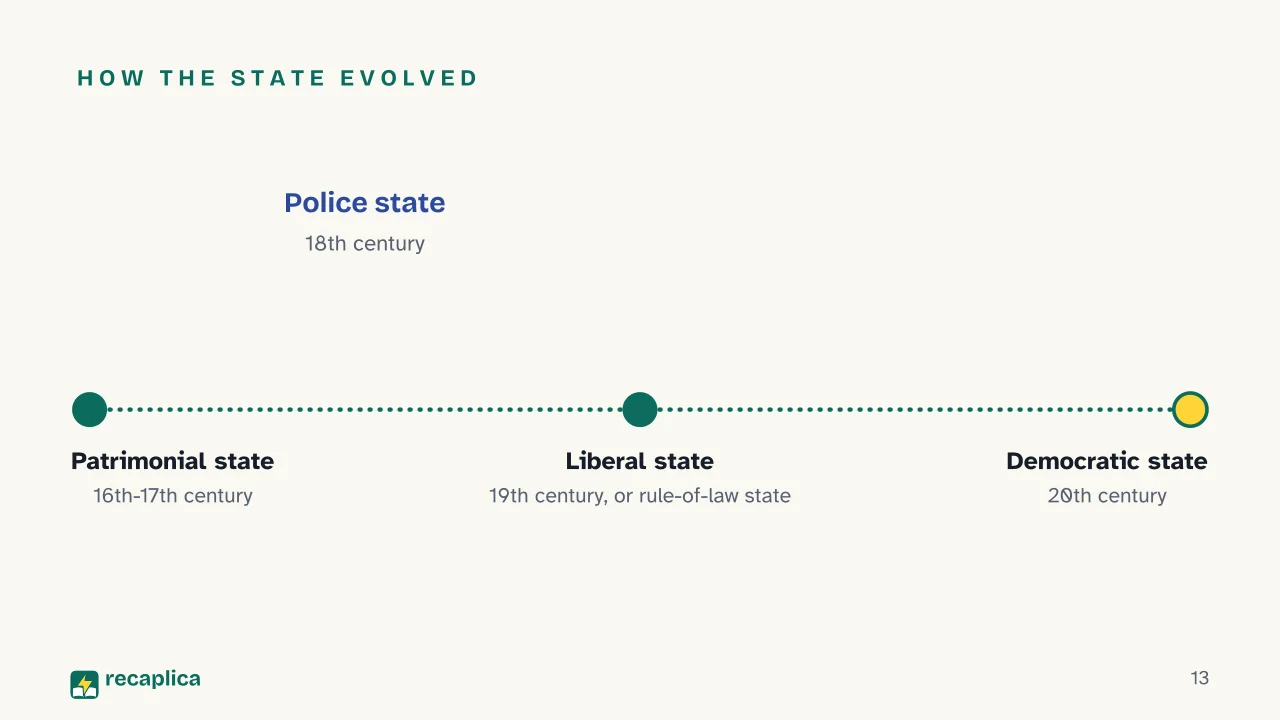
    • On the historical axis, Treccani traces four forms of state by era: the patrimonial state of the 16th-17th centuries, the police state of the 18th century, the liberal or rule-of-law state of the 19th century, and the democratic state of the 20th century.
    • Territorially, a state can be unitary or federal — a distinction that runs independently of its type of government.
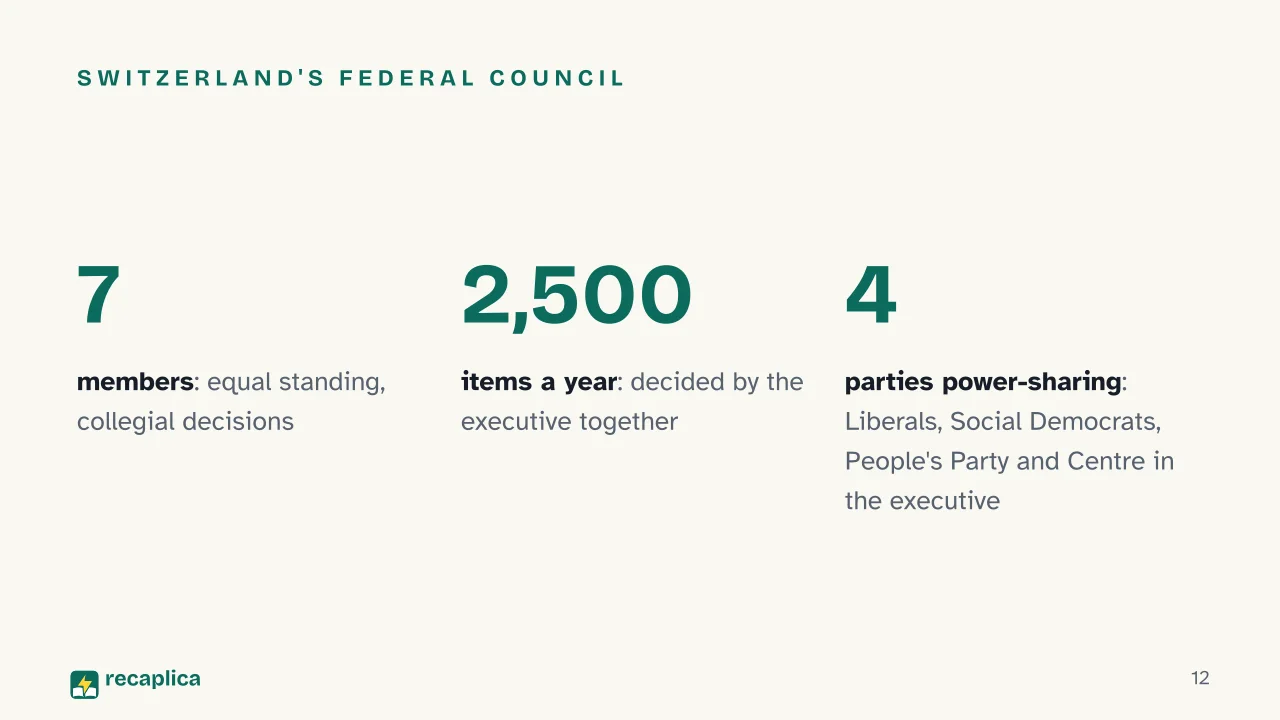
    • In Switzerland's directorial system, the Federal Council is a seven-member collegial body with equal standing that handles roughly 2,500 items of business a year, and every member must publicly defend decisions taken together even when they clash with their own party's line.
    • In France's Fifth Republic, an example of a semi-presidential system, the executive is dual: the President, elected directly by voters, plays an arbitrating role, while the Government determines and conducts the nation's policy.

    Deep Dive

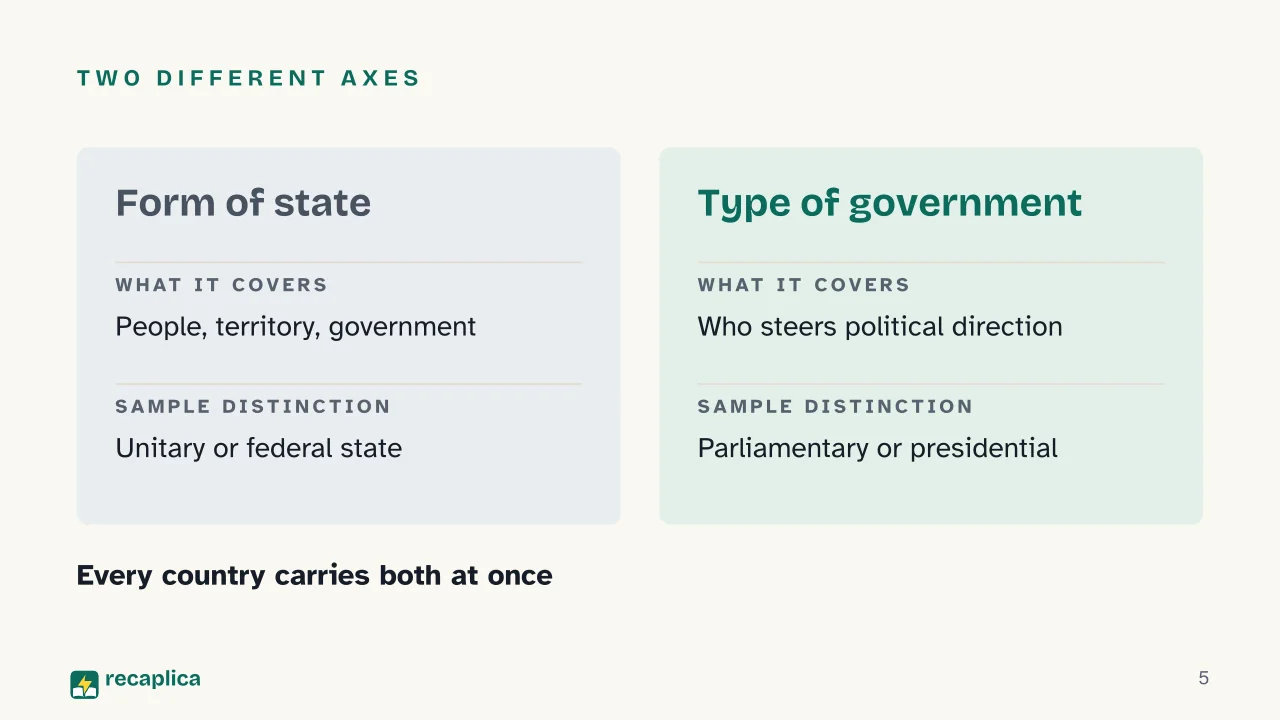
    Someone who says “Italy is a parliamentary republic” is actually talking about two different things at once, without realizing it. According to Treccani, a form of state is “the different ways in which a state’s three constitutive elements — people, territory and government — combine,” while a type of government is “the different ways in which political direction is exercised among a country’s constitutional bodies.” The first is about the nature of the state as a whole, the second is only about the relationship among the bodies that run it, and the two axes can shift independently of each other.

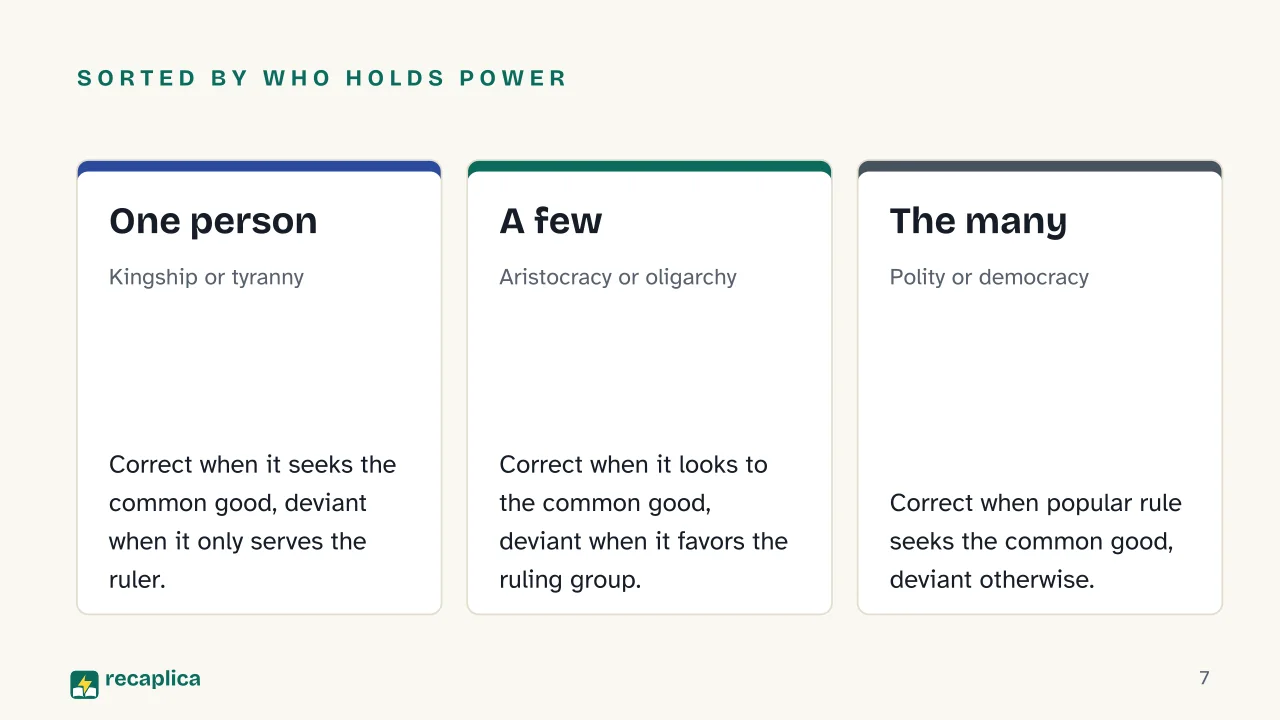
    The oldest split among types of government, per Treccani, is Machiavelli’s division between monarchies and republics. Earlier still, though, Aristotle had proposed a finer criterion, based on the number of people who hold power. The Stanford Encyclopedia of Philosophy’s entry on Aristotle’s political thought notes that the philosopher distinguished six possible constitutional forms, a classification “doubtless adapted from Plato’s Statesman,” and that the dividing line wasn’t purely a headcount: a constitution was correct when it aimed at the common advantage, deviant when it served only those in power.

    Number of rulersCorrect formDeviant form
    One personKingshipTyranny
    A fewAristocracyOligarchy
    The manyPolityDemocracy

    Worked example: calling a government “democratic” isn’t enough for Aristotle to call it good. In his classification, democracy is the deviant version of rule by the many, the one where the majority chases its own advantage; the correct version of that same rule by the many, the one aimed at the common good, is what he called polity.

    Forms of state through history

    On the historical axis, Treccani traces four forms of state across the centuries: “the patrimonial state (16th-17th century), the police state (18th century), the liberal state or rule-of-law state (19th century) and the democratic state (20th century).” Each phase reflects a different way of framing the relationship between rulers and the ruled, moving from a sovereign’s private accumulation of wealth to the recognition of rights and legal limits on public power.

    Alongside that timeline sits a second, independent distinction: the territorial one. A state can be unitary, with a single center of legislative power, or federal, with multiple layers of government that each hold their own areas of competence. Treccani explicitly lists “federal states and unitary states” among the forms of state, next to the classification by historical era.

    Types of government today

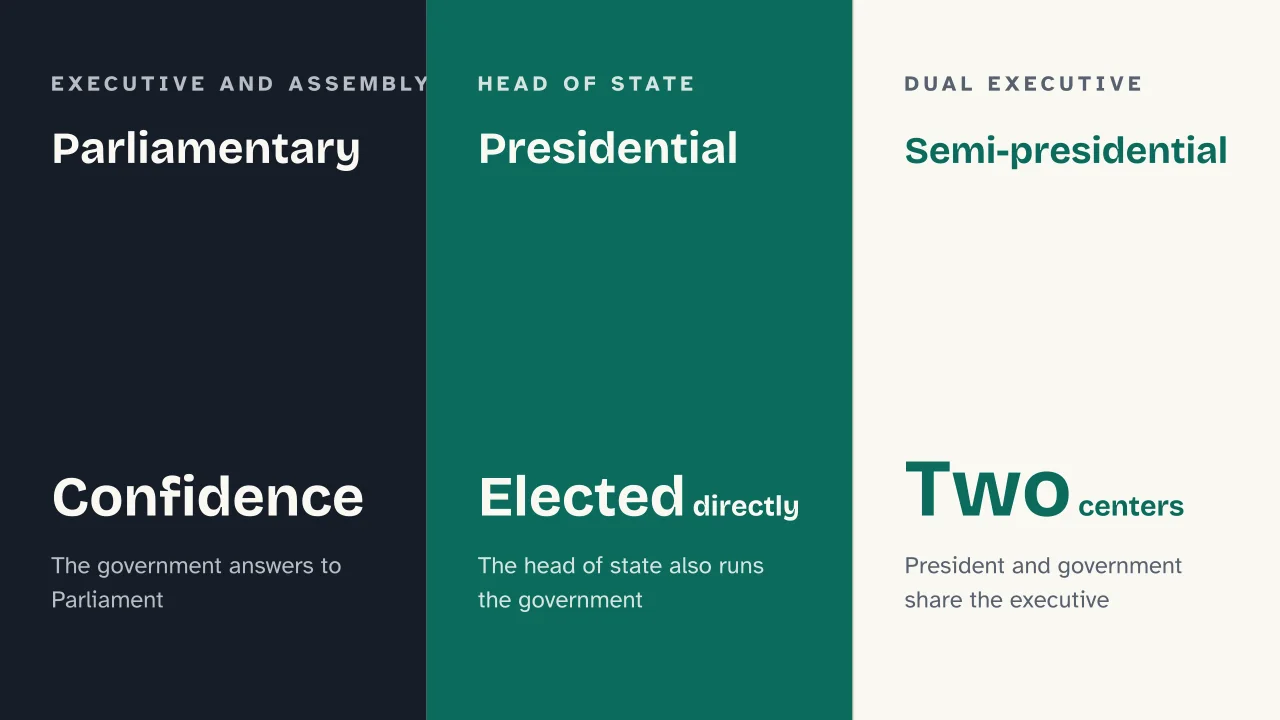
    Among contemporary types of government, the Treccani entry names five: “parliamentary, presidential, constitutional monarchy, directorial and semi-presidential.” In a parliamentary system, the executive must hold the confidence of the legislative assembly to stay in office. In a presidential system, the head of state is elected independently of parliament and also runs the government. A constitutional monarchy keeps a monarch as head of state but pairs the crown with representative bodies that exercise political direction. The remaining two, directorial and semi-presidential, are worth a concrete example each, since they are the least common and the easiest to mix up.

    The directorial system survives today in essentially one place: Switzerland. The Swiss federal government is the Federal Council, a seven-member body — the Federal Department of Foreign Affairs’ page for an international audience puts it plainly, “le gouvernement suisse se compose de sept membres égaux en droit” (the Swiss government is made up of seven members with equal standing). Decisions belong to the whole council, not to any one person, and the official federal government site states it bluntly: “the Federal Council reaches its decisions as a collegial body.” Anyone who sits on it must then defend those decisions in public even when they don’t personally agree, since “all Federal Council members must stand by the decisions in their external dealings, even if a decision may not accord with their personal views or the policy of their party.”

    Worked example: in a single year, Switzerland’s Federal Council decides “some 2,500 items of business,” according to admin.ch. No one of the seven members could get through a workload like that alone: the business is split across each member’s department, but it’s always signed off together by the council.

    The Federal Council’s makeup follows a mechanism known as the concordance system, under which the main parties govern together instead of trading places between majority and opposition: “en vertu du système de concordance, les partis de tous bords sont appelés à collaborer au sein du gouvernement” (under the concordance system, parties across the spectrum are called on to work together inside the government). The same source lists the 2026 split as two seats for the Liberal Party, two for the Social Democrats, two for the Swiss People’s Party and one for the Centre.

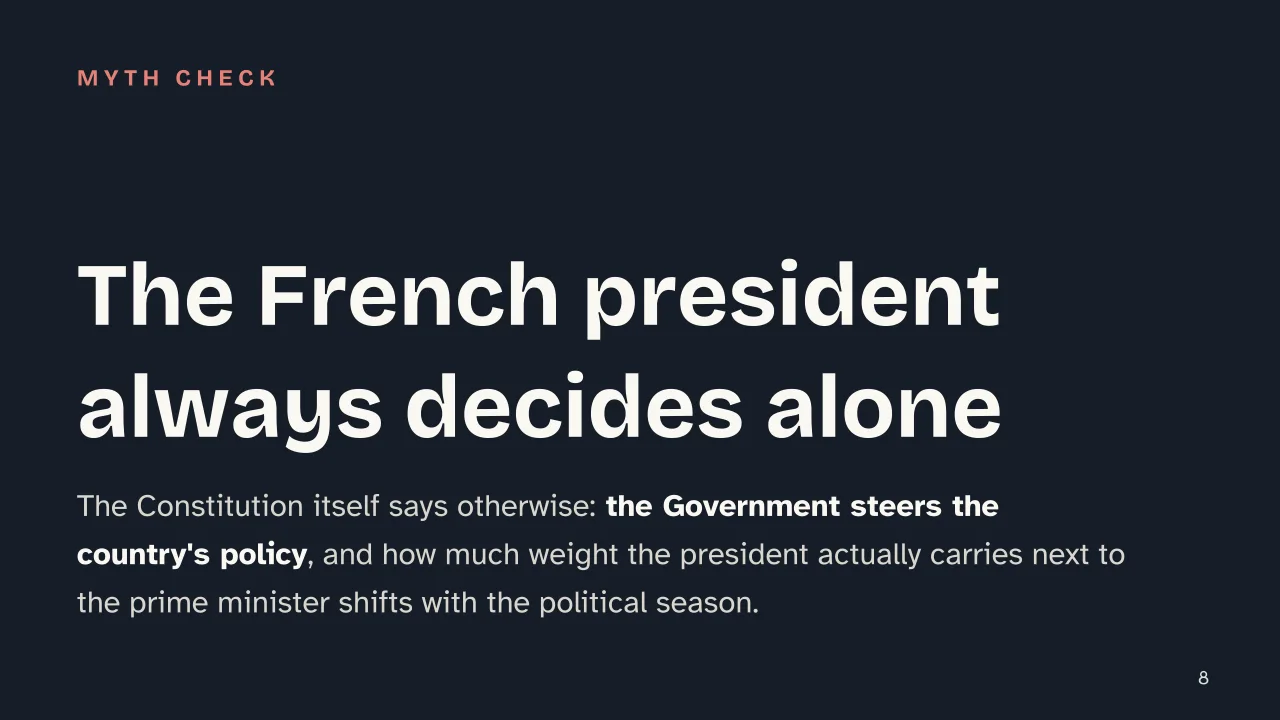
    The semi-presidential system, by contrast, shows up in France’s Fifth Republic. The Conseil constitutionnel describes the executive as dual, “l’exécutif est bicéphale avec, d’un côté, le Président de la République élu directement par le peuple, de l’autre, le Premier ministre” (the executive is two-headed, with the President elected directly by the people on one side and the Prime Minister on the other). The President doesn’t govern alone: under Article 20 of the Constitution, as cited by the same source, “le Gouvernement détermine et conduit la politique de la Nation” (the Government determines and conducts the nation’s policy), while Article 5 gives the President “un rôle d’arbitre” (an arbitrating role).

    PresidentGovernment
    OriginElected directly by votersAppointed, also answers to Parliament
    Role under the ConstitutionArbitrator (Art. 5)Determines and conducts the nation’s policy (Art. 20)
    DefenseHead of the armed forcesHas the armed forces at its disposal (Art. 20), the Prime Minister is accountable for them (Art. 21)

    How much weight one actually carries against the other isn’t settled once and for all in the French Constitution: the same institutional source notes that the balance between President and Prime Minister depends on political circumstances and institutional practice, not on a fixed rule. Readers curious how a similar balancing act between different bodies gets drawn up in another constitution can compare it with the Italian case described in the Recap on the Italian Constitution, where the relationship between Government and Parliament follows its own rules.

    The line between monarchy and republic, the oldest according to Treccani, has run through the history of individual states too: Rome, covered in the Recap on the Roman Empire, moved from a kingdom to a republic and finally to an empire, three different forms on the same territory over the course of several centuries. The reasoning that separates the number of rulers from the quality of their rule, meanwhile, was born in the Greek world covered in the Recap on Ancient Greece, where Aristotle wrote his work on politics after observing dozens of city-states with different constitutions. Another historical threshold between forms of state, the one between the 19th-century liberal state and the 20th-century democratic state, sits at the center of the French Revolution story too, which toppled absolute monarchy and paved the way, in the decades that followed, to the Fifth Republic.

    Slide deck

    Slides ready to download and make your own in PowerPoint or Google Slides, with speaker notes. Pick the Flash cut or the Full one.
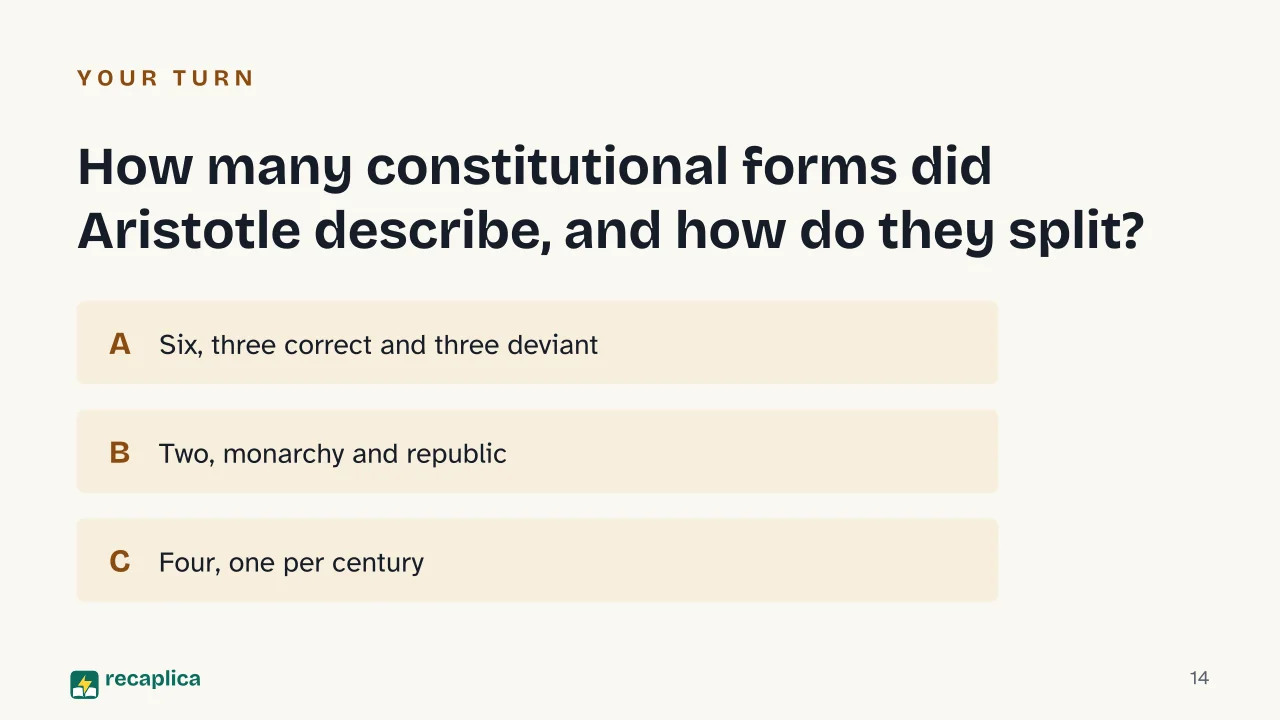
    Slide 1 of the presentation on Types of Government: Types of GovernmentSlide 2 of the presentation on Types of Government: What's the difference between a form of state and a type of government?Slide 3 of the presentation on Types of Government: What's aheadSlide 4 of the presentation on Types of Government: Chapter 01: Two definitionsSlide 5 of the presentation on Types of Government: Two different axesSlide 6 of the presentation on Types of Government: Chapter 02: Where the classification comes fromSlide 7 of the presentation on Types of Government: Sorted by who holds power: One person, A few, The manySlide 8 of the presentation on Types of Government: The French president always decides aloneSlide 9 of the presentation on Types of Government: Chapter 03: Types of government todaySlide 10 of the presentation on Types of Government: Parliamentary · Presidential · Semi-presidentialSlide 11 of the presentation on Types of Government: Chapter 04: Switzerland and FranceSlide 12 of the presentation on Types of Government: Switzerland's Federal CouncilSlide 13 of the presentation on Types of Government: How the state evolvedSlide 14 of the presentation on Types of Government: How many constitutional forms did Aristotle describe, and how do they split?Slide 15 of the presentation on Types of Government: Read more
    Flash10 slidesThe essential thread, to present in classFull15 slidesEvery chapter and the deeper detail

    Common myths

    • ✗ Myth Forms of state and types of government are often treated as two labels for the same classification.

      ✓ Reality Treccani treats them as two separate axes: the form of state describes how a people, a territory and a government combine, the type of government describes which body exercises political direction. A country can switch its type of government while keeping the same form of state, or the other way around.

    • ✗ Myth Switzerland is often assumed to have a president with powers similar to a traditional head of state.

      ✓ Reality Switzerland runs a directorial system led by a collegial Federal Council of seven members with equal standing; decisions belong to the whole body, and every member must defend them publicly even when they disagree personally, under a power-sharing arrangement that, as of 2026, gives two seats to the Liberal Party, two to the Social Democrats, two to the Swiss People's Party and one to the Centre.

    • ✗ Myth In France's semi-presidential system, real power is assumed to sit with the President no matter what.

      ✓ Reality The Conseil constitutionnel describes a dual executive: the President plays an arbitrating role and the Government determines and conducts the nation's policy, and how much each one weighs in practice changes with the political moment.

    Mind map

    Drag the background to move around and the nodes to reposition them; use − and + to collapse and expand branches.
    Customize
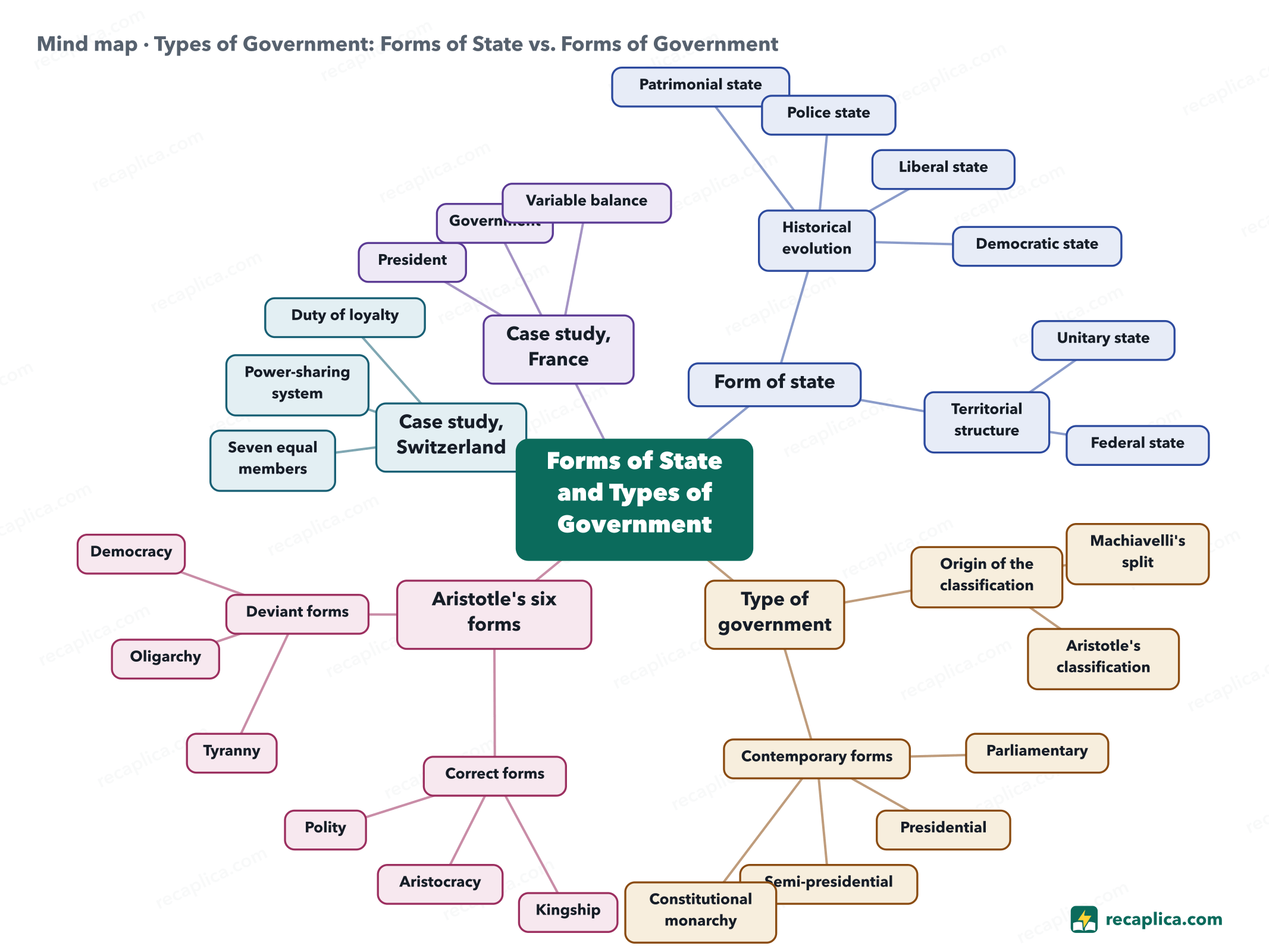
    Mind map: Types of Government: Forms of State vs. Forms of Government
    • Forms of State and Types of Government
      • Form of state How a people, a territory and a government fit together
        • Historical evolution
          • Patrimonial state 16th-17th century
          • Police state 18th century
          • Liberal state 19th century, also called rule-of-law state
          • Democratic state 20th century
        • Territorial structure
          • Unitary state
          • Federal state
      • Type of government Which body exercises political direction
        • Origin of the classification
          • Machiavelli's split Monarchies or republics
          • Aristotle's classification Six forms, sorted by who governs
        • Contemporary forms
          • Parliamentary
          • Presidential
          • Semi-presidential
          • Constitutional monarchy
      • Aristotle's six forms Correct or deviant, by whose advantage they serve
        • Correct forms
          • Kingship
          • Aristocracy
          • Polity
        • Deviant forms
          • Tyranny
          • Oligarchy
          • Democracy
      • Case study, Switzerland Directorial system
        • Seven equal members Decide as a collegial body
        • Power-sharing system Main parties are represented in the executive
        • Duty of loyalty Each member defends collective decisions even when in disagreement
      • Case study, France Semi-presidential system
        • President Elected directly by voters, plays an arbitrating role
        • Government Determines and conducts the nation's policy
        • Variable balance Shifts with the political moment

    Quiz: test yourself

    Answer the questions to check what you have learned: you get instant feedback and a short explanation.

    Grade 0/10 0/5
    1 According to Treccani, what is the difference between a form of state and a type of government?

    Treccani defines a form of state as how a people, a territory and a government combine, and a type of government as how political direction is exercised among constitutional bodies — two distinct axes.

    2 How many constitutional forms did Aristotle distinguish, according to the Stanford Encyclopedia of Philosophy?

    The entry describes a six-fold classification (Politics III.7), adapted from Plato's Statesman, with three correct forms when power aims at the common advantage and three deviant forms when it aims only at the rulers' advantage.

    3 What sets Switzerland's directorial system apart?

    Switzerland's Federal Council decides as a collegial body; its seven members have equal standing and must publicly defend decisions taken together, even when they diverge from their own party's line.

    4 In France's Fifth Republic, a semi-presidential system, who determines and conducts the nation's policy under the Constitution?

    The Conseil constitutionnel explains that the executive is dual: the President plays an arbitrating role while the Government determines and conducts the nation's policy, under Article 20 of the French Constitution.

    5 True or false: Treccani places the liberal state, or rule-of-law state, in the 19th century.

    Treccani places the liberal state, or rule-of-law state, in the 19th century, after the patrimonial state of the 16th-17th centuries and the police state of the 18th century, and before the democratic state of the 20th century.

    Answers: 1-A · 2-A · 3-A · 4-A · 5-A

    Flashcards

    Tap the card to flip it and check whether you remember the answer, then move to the next one.

    1 / 8

    Explain it in your own words

    The ultimate test: if you can explain it in simple words, you've truly understood it. Write your explanation, then compare it with the Recap.

    Your explanation is saved only on this device.

    A form of state and a type of government answer two different questions about how a country is organized. The form of state is about how a people, a territory and a government fit together, while the type of government is about which constitutional body actually steers political direction. Aristotle was among the first to classify governments, sorting six constitutional forms by whether power serves the common good or only those who hold it. The most common types of government today are parliamentary, presidential, semi-presidential, constitutional monarchy and the rare directorial system used in Switzerland, while territorially a state can be unitary or federal.

    Frequently asked questions

    What is the difference between a form of state and a type of government?

    They are two separate classifications. A form of state describes how a people, a territory and a government combine; a type of government describes which constitutional body steers political direction. Every state has both at once.

    What are the main types of government today?

    Treccani lists parliamentary, presidential, constitutional monarchy, directorial and semi-presidential systems, each applied today in different countries with a different balance among constitutional bodies.

    What is a directorial system of government?

    It is the system Switzerland uses: executive power belongs to a collegial Federal Council of seven members with equal standing, who decide together and must publicly defend collective decisions even when those decisions don't match their own views.

    What is a semi-presidential system of government?

    It is the system used by France's Fifth Republic, with a dual executive: a President elected directly by voters who plays an arbitrating role, and a Government that determines and conducts the nation's policy. Their relative weight is not the same under every government.

    Where does the classification of government types come from?

    Treccani traces the oldest classification to Machiavelli's split between monarchies and republics, later refined by Aristotle's sorting by who holds power, in six variants split between correct and deviant forms.

    Sources

    • Forme di stato e forme di governo (Enciclopedia Treccani)
    • Aristotle's Political Theory (Stanford Encyclopedia of Philosophy)
    • Federal Council, decision-making (admin.ch, Swiss Confederation)
    • Le Conseil fédéral (aboutswitzerland.eda.admin.ch, Swiss Confederation)
    • Quel partage des pouvoirs entre le Président et le Premier ministre ? (Conseil constitutionnel, France)

    Every Recap goes through an independent review before publication.

    Every evening, the day's new Recaps on our Telegram channel. Join the channel →

    Keep learning

    • Civics Carabinieri Ranks: The Four-Role Hierarchy of the Corps Every member of the Carabinieri sits inside one of four legally defined roles, in force since a 2000 law: Officers, Inspectors, Supervisors, and Corporals and Privates. Promotion happens inside a role first, and the four roles themselves run from the most operational to the most senior. The lowest rank is Carabiniere; the highest is Generale di Corpo d'Armata, in the Officer role. Two abbreviations, Q.S. and C.S., show up next to a handful of ranks — they aren't extra rungs on the ladder, just a qualification attached to the top rank already sitting there. Read the Recap →
    • Civics Codice Fiscale: What It Is, Structure and Everyday Uses The codice fiscale is the code that uniquely identifies a person in every dealing with Italian public bodies and administrations, from healthcare to official paperwork. It is made up of 16 alphanumeric characters derived from the holder's personal data. Only the Agenzia delle Entrate, Italy's tax agency, can issue a valid one: any code generated by an outside tool has no official standing. The system dates back to 1973, created by the same decree that set up Italy's taxpayer register. It is a different thing from the partita IVA, which identifies an economic activity. Read the Recap →
    • Civics Italian Government Structure: Which Bodies Do What The Italian state rests on five bodies that the Constitution sets up and regulates directly: Parliament makes the laws, the Government carries them out, the President of the Republic represents national unity, the judiciary applies the law to individual cases, and the Constitutional Court checks that laws respect the Constitution. Alongside them sit four bodies of constitutional relevance — the High Council of the Judiciary, the Court of Auditors, the CNEL and the Council of State — auxiliary bodies the Constitution sets up but keeps in a separate category from the five essential ones. Knowing who does what, and which bodies the system cannot run without, is the fastest way into how Italy is actually governed. Read the Recap →

    recaplica

    Clear in 30 seconds, yours in 10 minutes.

    Recaps Mind maps Request a Recap Telegram channel Mind map maker Our method About Privacy & cookies Legal notes & terms of use

    © 2026 Recaplica · A project by Curi S.r.l. — VAT IT05472000750

    Statistics, only if you say so

    To learn which Recaps help most we would use Google Analytics, with aggregate, anonymous data. It starts only with your OK, and you can change your mind anytime. Privacy policy