Skip to content
recaplica

    One moment: security check

    Cloudflare wants to make sure you're not a robot. Tick the box below and your search will continue on its own.

    IT
    recaplica Principles of Communism: Engels's 1847 Catechism Before the Manifesto
    © 2026 Recaplica · recaplica.com — All rights reserved
    Home › History

    Principles of Communism: Engels's 1847 Catechism Before the Manifesto

    By Recaplica Newsroom · Updated on October 15, 2026

    What to print

    Page numbers appear when printing with default margins.

    Slides

    Choose a cut

    Flash10 slidesThe essential thread, to present in classFull15 slidesEvery chapter and the deeper detail

    Both come with speaker notes.

    Telegram channel
    recaplica Clear in 30 seconds, yours in 10 minutes.
    In 30 seconds Key points Figures Deep dive Slides Myths Mind map Quiz Flashcards FAQ

    In 30 seconds quick read

    The Principles of Communism is a text Friedrich Engels writes in 1847 for the Communist League, shaped as a catechism, twenty-five numbered questions followed by their answers. It explains who the proletarians are, where their condition comes from, and what sets communism apart from other currents of the era's labour movement. A few weeks later Engels proposes to Marx that they drop that form and tell a piece of history instead, and from that proposal comes the Communist Manifesto, published in 1848. Engels's original text, meanwhile, stays unpublished for almost seventy years.

    Key Points

    • Written in 1847 by Friedrich Engels as a programme for the Communist League.
    • Structured as a catechism, twenty-five numbered questions with their answers.
    • The proletariat traces back to the English industrial revolution of the eighteenth century, a class that lives on wages alone.
    • Sets communism apart from three other currents of the labour movement: reactionary, bourgeois and democratic socialists.
    • In a November 1847 letter to Marx, Engels proposes a change of form, the starting point for the Communist Manifesto.
    • The original text stays unpublished until 1914, when Eduard Bernstein prints it in the journal Vorwärts!.

    Key figures

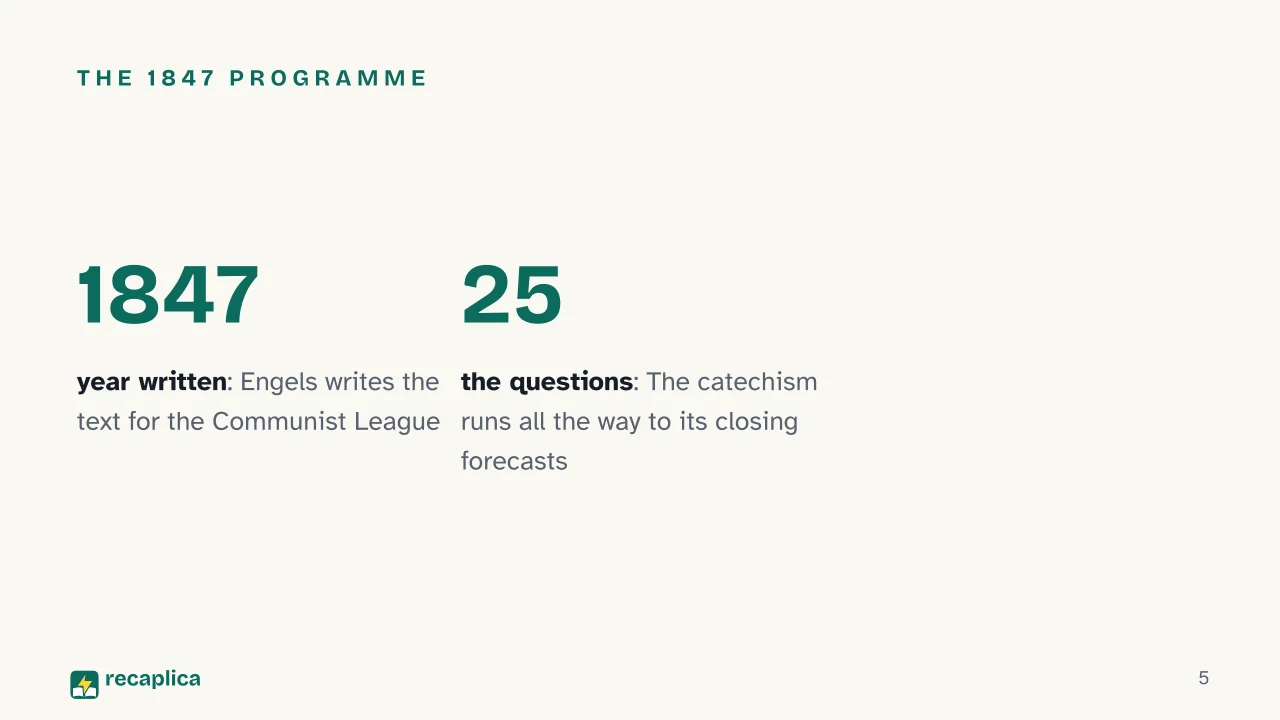
    • 1847 Year Friedrich Engels writes The Principles of Communism as a programme for the Communist League. Source: Marxists Internet Archive
    • 25 Numbered questions that make up the catechism, from the nature of communism to forecasts about future society. Source: Marxists Internet Archive
    • 1914 Year Engels's text is published for the first time, by Eduard Bernstein, in the journal Vorwärts!. Source: Marxists Internet Archive

    Deep Dive

    In November 1847 the Communist League meets in London and hands Karl Marx and Friedrich Engels a specific assignment: a theoretical and practical party programme. Engels, in Paris at the time, drafts the text as a catechism: twenty-five numbered questions, each with its answer laid out underneath. The piece carries the title The Principles of Communism, and it will sit almost unread for nearly seventy years.

    A form built for a programme

    The catechism was a familiar genre, built for memorisation, one question at a time.

    Practical example: the text’s first question asks what communism is, and the answer calls it the doctrine of the conditions for the liberation of the proletariat. The questions that follow examine who the proletarian is, where that condition comes from, and what sets it apart from the slaves and serfs of earlier ages, down to the final pages, which cover the communists’ stance toward the political parties of England, France, America, Switzerland and Germany.

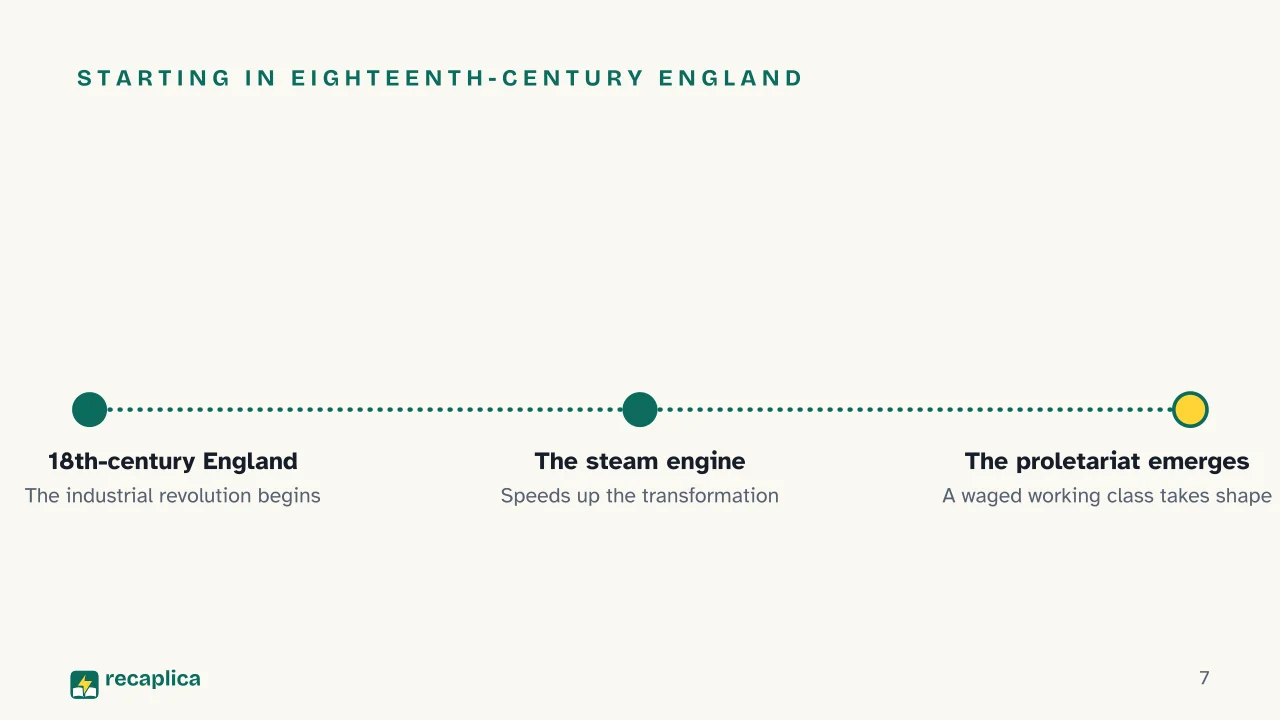
    The proletariat, the text explains, is whoever makes a living by selling their own labour: no factories, no land, no other capital, and their fate follows the market’s demand for labour. The text traces its birth to the industrial revolution that unfolded in England in the second half of the eighteenth century, set off by the invention of the steam engine.

    Communism among the other labour currents

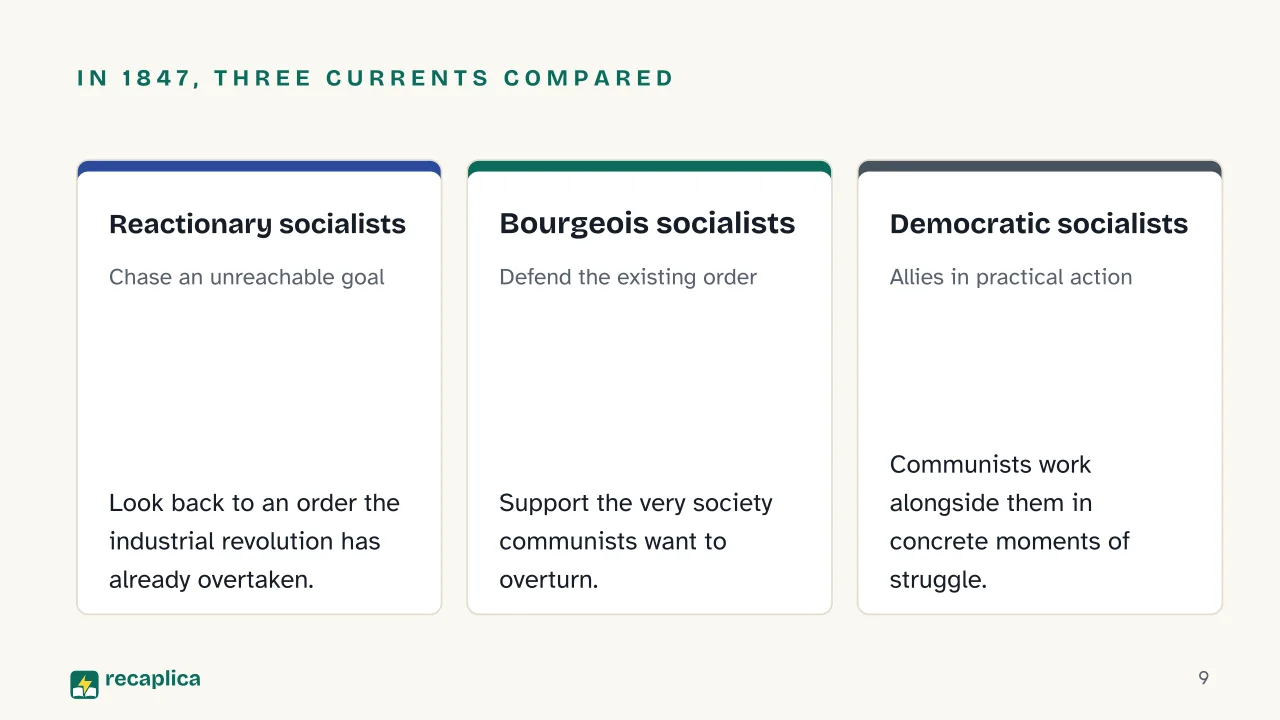
    The text does not treat communism as an isolated label. It sets the doctrine against three other currents of the era’s labour movement: reactionary socialists, who aim at a goal that cannot be reached; bourgeois socialists, who defend the very society communists want to overturn; and democratic socialists, with whom communists are willing to cooperate in moments of practical action.

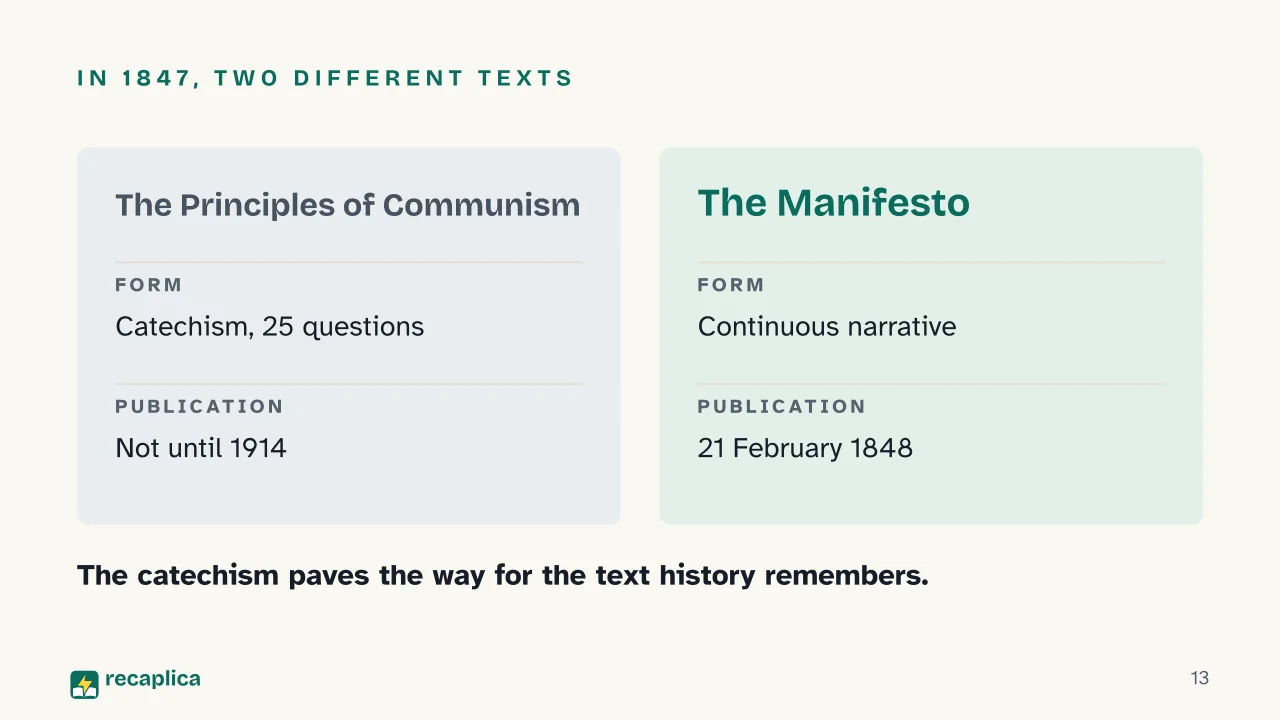
    The Principles of CommunismThe Communist Manifesto
    Year written18471847-1848
    FormCatechism, 25 questions and answersContinuous narrative
    Lead authorFriedrich EngelsKarl Marx
    First publication191421 February 1848

    A letter gives rise to the Manifesto

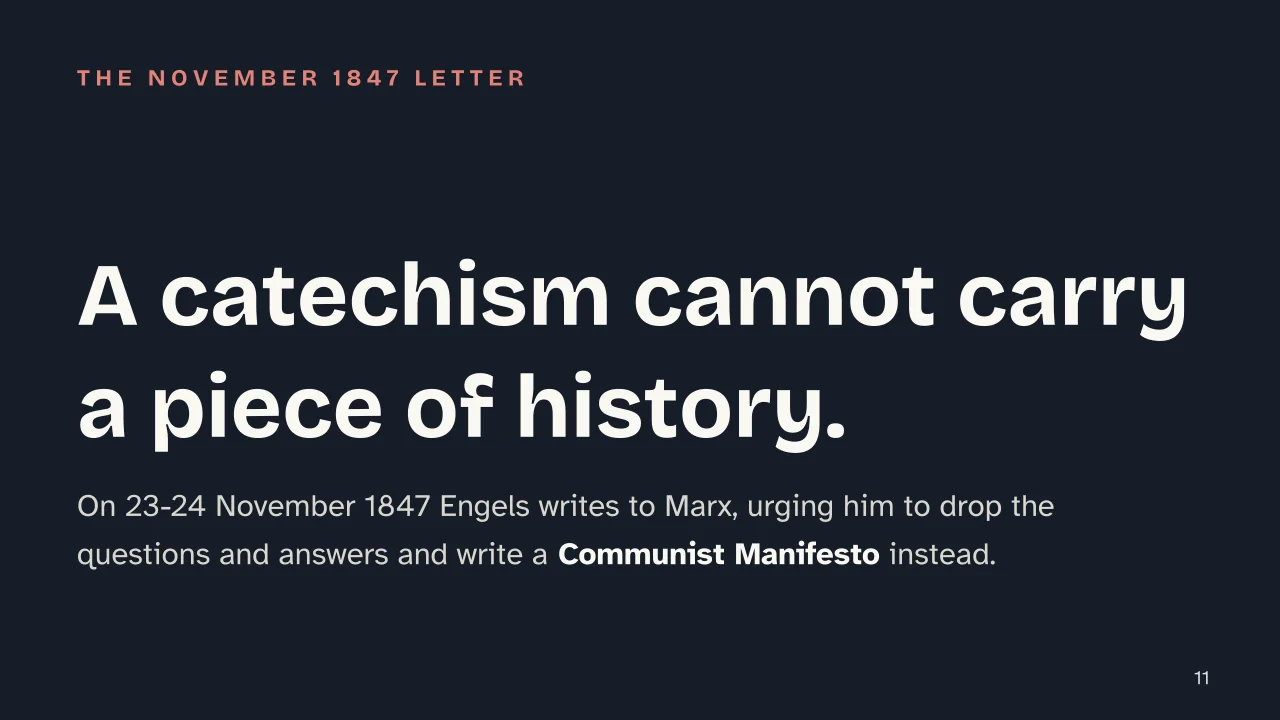
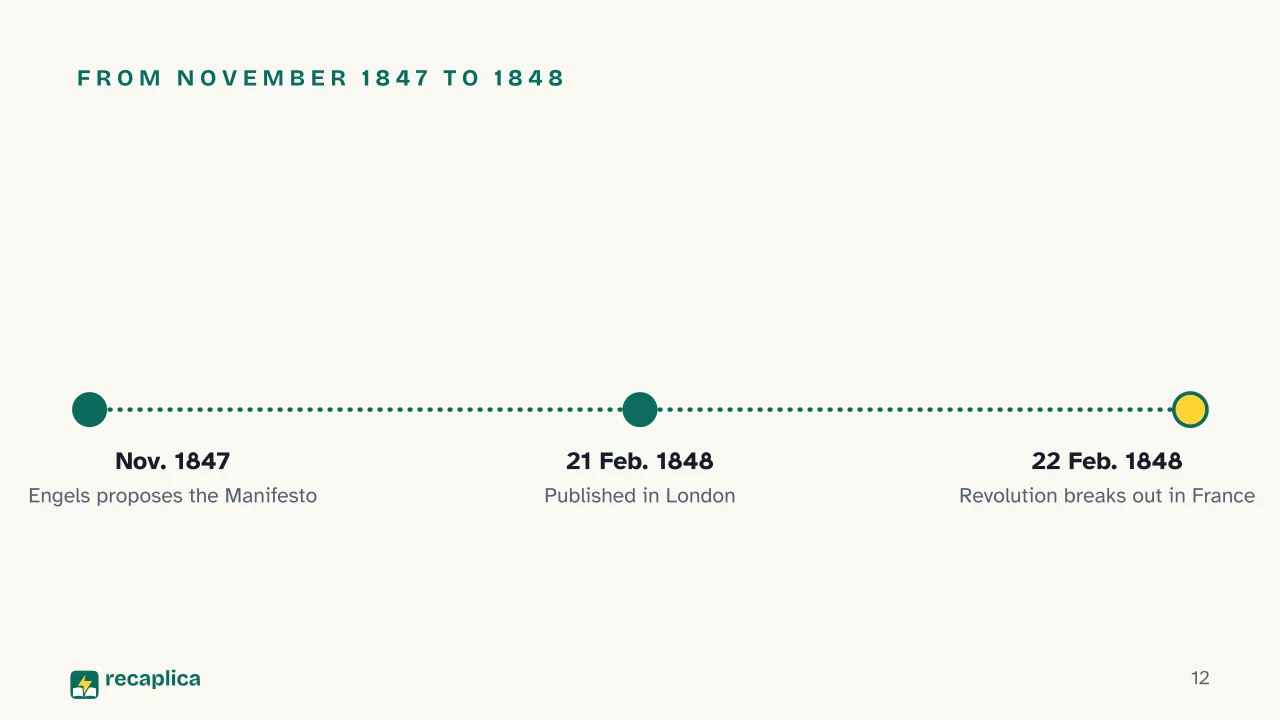
    A few weeks after finishing the draft, Engels changes his mind about its form. In a letter to Marx dated 23-24 November 1847, sent from Paris to Brussels, he proposes dropping the catechism and naming the new text a Communist Manifesto: the reason he gives is that a piece of history needed telling, something the question-and-answer format did not render well. The letter arrives just as the Communist League’s London congress draws near, the gathering where the party programme would be settled.

    Out of that exchange between the two, documented in the correspondence that traces their partnership, comes the text Marx writes in January 1848, using The Principles of Communism itself as a model. The manuscript reaches London for printing only weeks before the February 1848 revolution in France, and the Communist Manifesto is published on 21 February 1848. The next day, revolt breaks out across France and spreads quickly across the rest of continental Europe.

    The Principles of Communism, by contrast, stays in the drawer. Engels’s catechism remains unpublished until 1914, when Eduard Bernstein prints it in Vorwärts!, the journal of the German Social Democratic Party. It reaches readers decades after the Manifesto had already become the best-known text of the communist movement.

    Slide deck

    Slides ready to download and make your own in PowerPoint or Google Slides, with speaker notes. Pick the Flash cut or the Full one.
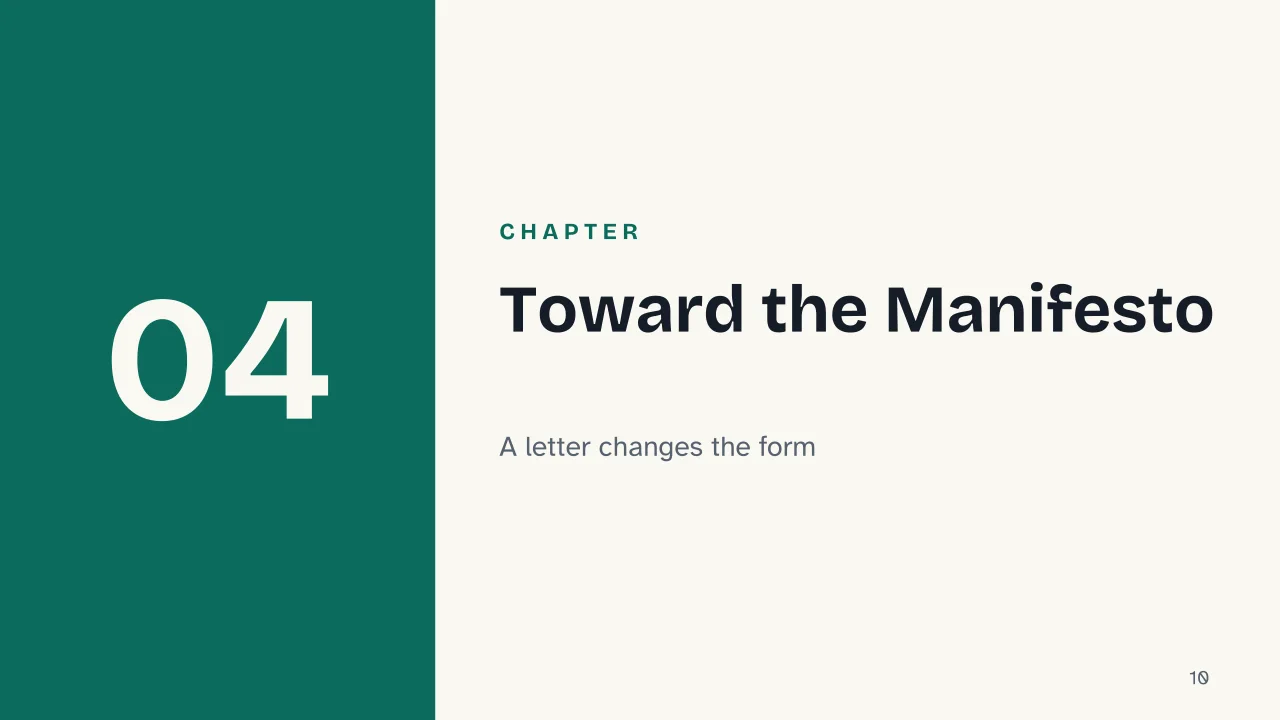
    Slide 1 of the presentation on Principles of Communism: The Principles of CommunismSlide 2 of the presentation on Principles of Communism: What does the Communist League ask of Marx and Engels?Slide 3 of the presentation on Principles of Communism: Before the Manifesto, in 1847Slide 4 of the presentation on Principles of Communism: Chapter 01: The 1847 mandateSlide 5 of the presentation on Principles of Communism: The 1847 programmeSlide 6 of the presentation on Principles of Communism: Chapter 02: A catechism in 25 questionsSlide 7 of the presentation on Principles of Communism: Starting in eighteenth-century EnglandSlide 8 of the presentation on Principles of Communism: Chapter 03: Three currents comparedSlide 9 of the presentation on Principles of Communism: In 1847, three currents compared: Reactionary socialists, Bourgeois socialists, Democratic socialistsSlide 10 of the presentation on Principles of Communism: Chapter 04: Toward the ManifestoSlide 11 of the presentation on Principles of Communism: A catechism cannot carry a piece of history.Slide 12 of the presentation on Principles of Communism: From November 1847 to 1848Slide 13 of the presentation on Principles of Communism: In 1847, two different textsSlide 14 of the presentation on Principles of Communism: What form does The Principles of Communism take?Slide 15 of the presentation on Principles of Communism: Time to review
    Flash10 slidesThe essential thread, to present in classFull15 slidesEvery chapter and the deeper detail

    Common myths

    • ✗ Myth Many assume The Principles of Communism is just an early draft of the Manifesto, nearly the same text under a different title.

      ✓ Reality It stands as a separate work, a catechism of questions and answers. Engels himself, in a letter to Marx, proposed dropping that form to write something different, because he needed to tell a piece of history, and a catechism was not built for that.

    • ✗ Myth Many assume the Communist Manifesto is Marx's work alone, without Engels's contribution.

      ✓ Reality The mandate came from the Communist League at its London congress in November 1847, and according to History.com, Marx wrote the Manifesto in January 1848 using as his model the very text Engels had written the year before for the League.

    • ✗ Myth Many assume The Principles of Communism was published alongside the Manifesto, in 1848.

      ✓ Reality It stayed unpublished for almost seventy years. Its first printing dates to 1914, by Eduard Bernstein, in Vorwärts!, the journal of the German Social Democratic Party.

    Mind map

    Drag the background to move around and the nodes to reposition them; use − and + to collapse and expand branches.
    Customize
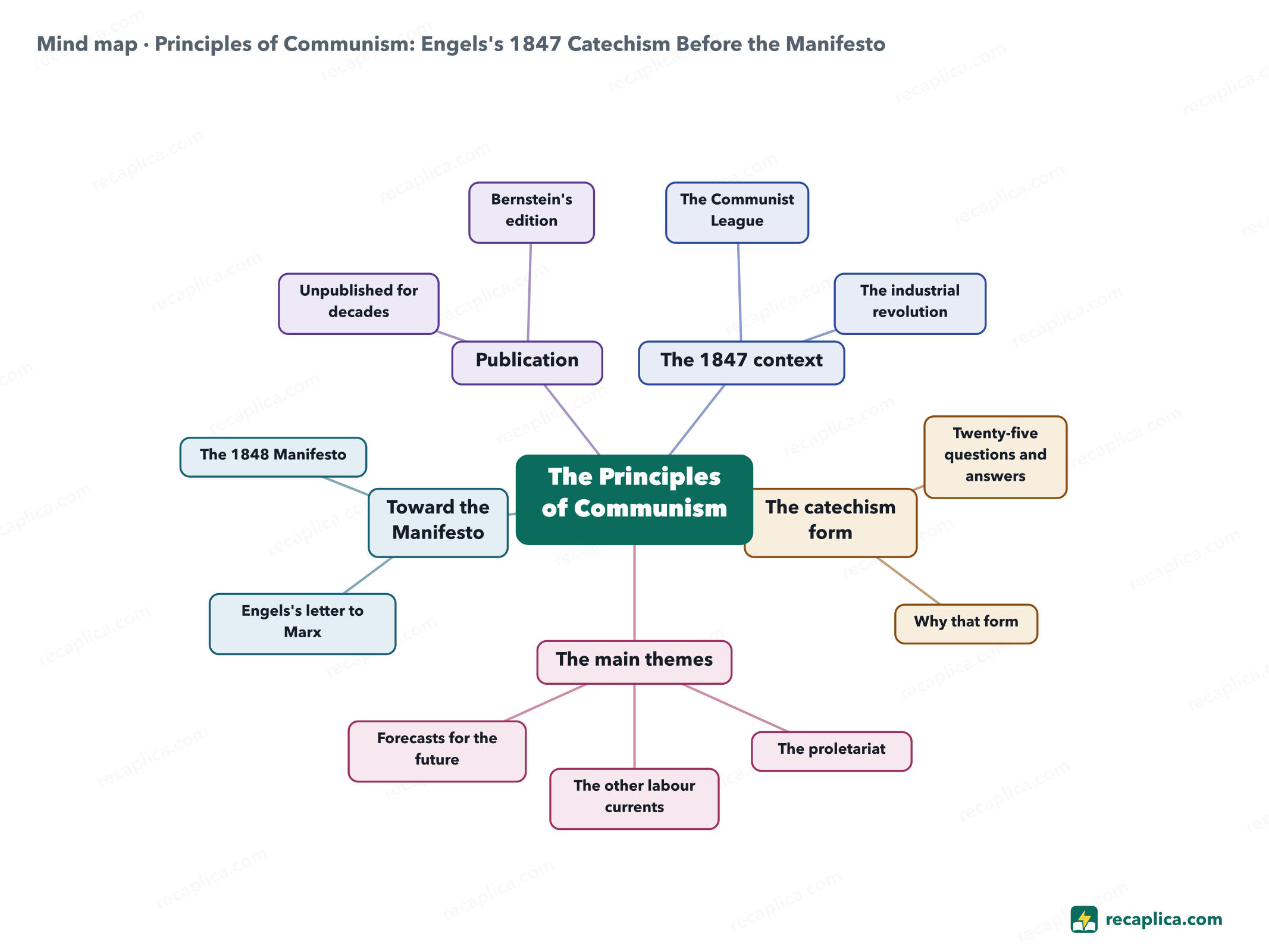
    Mind map: Principles of Communism: Engels's 1847 Catechism Before the Manifesto
    • The Principles of Communism
      • The 1847 context
        • The Communist League Commissions a party programme at the London congress, November 1847
        • The industrial revolution Gives rise to the proletariat in England, in the late eighteenth century
      • The catechism form
        • Twenty-five questions and answers
        • Why that form A party programme meant to be clear and direct, read point by point
      • The main themes
        • The proletariat Lives on the wages of its own labour, without property or capital
        • The other labour currents Reactionary, bourgeois, democratic
        • Forecasts for the future
      • Toward the Manifesto
        • Engels's letter to Marx November 1847, proposes a change of form
        • The 1848 Manifesto Published in London on 21 February
      • Publication
        • Unpublished for decades
        • Bernstein's edition 1914, journal Vorwärts!

    Quiz: test yourself

    Answer the questions to check what you have learned: you get instant feedback and a short explanation.

    Grade 0/10 0/5
    1 Who wrote The Principles of Communism, and in what year?

    The text was written by Friedrich Engels in 1847 as a programme for the Communist League.

    2 What form does the text take?

    The text is built as a catechism, a sequence of twenty-five numbered questions followed by their answers.

    3 How does the text define the proletariat?

    The text calls proletarians those who can only make a living by selling their labour, since they own no capital: demand for their work decides their fate.

    4 True or false: Engels personally proposed to Marx that they abandon the catechism form.

    In a letter dated 23-24 November 1847, Engels proposed to Marx that they change form and call the new text a Communist Manifesto, because a piece of history needed telling.

    5 When was Engels's original text first published?

    The text stayed unpublished until 1914, when Eduard Bernstein printed it in Vorwärts!, the journal of the German Social Democratic Party.

    Answers: 1-B · 2-B · 3-B · 4-A · 5-C

    Flashcards

    Tap the card to flip it and check whether you remember the answer, then move to the next one.

    1 / 8

    Explain it in your own words

    The ultimate test: if you can explain it in simple words, you've truly understood it. Write your explanation, then compare it with the Recap.

    Your explanation is saved only on this device.

    The Principles of Communism is a text Friedrich Engels writes in 1847 for the Communist League, shaped as a catechism, twenty-five numbered questions followed by their answers. It explains who the proletarians are, where their condition comes from, and what sets communism apart from other currents of the era's labour movement. A few weeks later Engels proposes to Marx that they drop that form and tell a piece of history instead, and from that proposal comes the Communist Manifesto, published in 1848. Engels's original text, meanwhile, stays unpublished for almost seventy years.

    Frequently asked questions

    What is the difference between The Principles of Communism and the Communist Manifesto?

    They are two separate texts. The first is a catechism of twenty-five questions and answers Engels wrote in 1847 for the Communist League. Engels's own proposal to change form, so the League could tell a piece of history the catechism did not render well, led to the Manifesto, written by Marx and published on 21 February 1848.

    What roles did Marx and Engels play in the text's origin?

    The Communist League, at its London congress in November 1847, commissioned Marx and Engels to write a party programme. Engels drafted it as a catechism, then proposed to Marx, in a letter dated 23-24 November 1847, that they change form. That exchange produced the Manifesto.

    How many questions does The Principles of Communism contain?

    The text has twenty-five numbered questions, from the definition of communism to forecasts about the future of society, plus the communists' position toward the political parties of England, France, America, Switzerland and Germany.

    Why was The Principles of Communism published so late?

    Engels wrote it in 1847 but it never went to print in those years. The text stayed unpublished until 1914, when Eduard Bernstein printed it in Vorwärts!, the journal of the German Social Democratic Party.

    How does the text define the proletariat?

    The text describes the proletariat as the class that lives solely on wages earned from its own labour, a class that emerged with the English industrial revolution of the eighteenth century.

    Sources

    • The Principles of Communism — Marxists Internet Archive
    • Engels to Marx, 23-24 November 1847 — Connexions Archive (Marx-Engels Internet Archive)
    • Manifesto of the Communist Party, preface — Marxists Internet Archive
    • This Day in History — Marx publishes Communist Manifesto — History.com

    Every Recap goes through an independent review before publication.

    Every evening, the day's new Recaps on our Telegram channel. Join the channel →

    Keep learning

    • History Communist Manifesto: What It Says and How It Was Written The Communist Manifesto is the text Karl Marx and Friedrich Engels write at the request of the Communist League, after its leaders had already warmed to the pair's ideas at an earlier congress. The writing runs from late 1847 into January 1848 (sources differ slightly on the exact dates), and the pamphlet comes off the press in London on February 21, 1848, one day before revolution breaks out in Paris — a timing that overlaps without one event causing the other. The text reads history as a long run of class conflicts and reduces the society of its own day to two classes, the bourgeoisie and the proletariat, naming the proletariat the only truly revolutionary class of its time. Despite opening with the most quoted line in socialist writing, the Manifesto spends years as a minor pamphlet; it finds a real audience only after the founding of the International Workingmen's Association in 1864. Read the Recap →
    • History Social Contract Theory: What Hobbes, Locke, and Rousseau Argued Social contract theory is a thought experiment that explains why individuals accept a shared political authority, starting from how life would look with no government at all. Hobbes describes a universal war that only a sovereign with absolute power can end. Locke starts from a freedom already ordered by reason and limits government to a revocable assignment, with a right of resistance if it betrays that trust. For Rousseau, laws come from the general will of citizens gathered together, with no sovereign standing outside them. The three thinkers share the same reasoning but reach opposite conclusions about freedom and authority. Read the Recap →
    • History Declaration of the Rights of Man: What It Is and What It Says The Declaration of the Rights of Man and of the Citizen is the text that France's National Constituent Assembly adopted on August 26, 1789, at the start of the French Revolution. Its preamble and 17 articles set out rights such as liberty, property, security and resistance to oppression, alongside principles like national sovereignty and the separation of powers. The Marquis de Lafayette put forward a personal first draft, which five deputies appointed by the Assembly then reworked before the final vote. It should not be confused with the Universal Declaration of Human Rights, adopted by the UN in 1948: a similar name, but a different document in era, authorship and content. Read the Recap →

    recaplica

    Clear in 30 seconds, yours in 10 minutes.

    Recaps Mind maps Request a Recap Telegram channel Mind map maker Our method About Privacy & cookies Legal notes & terms of use

    © 2026 Recaplica · A project by Curi S.r.l. — VAT IT05472000750

    Statistics, only if you say so

    To learn which Recaps help most we would use Google Analytics, with aggregate, anonymous data. It starts only with your OK, and you can change your mind anytime. Privacy policy