|
recaplica
Ancient Greek Education: How Paideia Shaped a Citizen | |||||||||
| © 2026 Recaplica · recaplica.com — All rights reserved | |||||||||
Ancient Greek Education: How Paideia Shaped a CitizenWhat to print Page numbers appear when printing with default margins. SlidesChoose a cut Flash10 slidesThe essential thread, to present in classFull16 slidesEvery chapter and the deeper detailBoth come with speaker notes. In 30 seconds quick readPaideia was the Greek idea that the city itself was a community built to educate, across a person's entire life: its goal was to make a free person useful to friends, family and the city. In Athens, boys first learned to read, write and count, then moved on to literature, music and physical training, before entering civic service between eighteen and twenty. In Sparta, physical training outweighed every other subject from early childhood. From age six, Athenian boys had a pedagogue, almost always a slave, who guarded them without teaching them, while girls followed a path with more room for dance and music. The sophists, Protagoras among the first, were the earliest to charge a fee for education, and centuries later the scholar Werner Jaeger put the word paideia back at the center of classical studies. Key Points
Key figures
Deep DiveThe City That EducatesAccording to the Stanford Encyclopedia of Philosophy, the ancient Greeks didn’t see the polis as just a political organization: they also thought of it as an educating community, and the word that captured this idea was paideia. It wasn’t schooling that ended with childhood. It was a process that accompanied a person — in practice, the free man — for a lifetime, with one clear aim: to make them useful to friends, family and above all the city. The polis was the ground this idea grew in; to see how this kind of community came about, see Ancient Greece: What Is a Polis and How Athenian Democracy Began. Paideia drew together several fields at once: the arts, philosophy, rhetoric, history, science and mathematics. It also included athletic and military training, together with the customs of the city — religious practice as much as political and professional life. Rounding out the picture was the shaping of character through the virtues. For the Greeks, this whole package was inseparable from another word, arete, excellence that concerned not just reputation but every part of life. Paideia and arete, in this reading, were a single process: becoming a complete person meant becoming a citizen. The Basics, in AthensThe sons of Athenian citizens — girls followed a different path, covered further below — attended schools where they learned to read, write and do arithmetic. Once the basics were done, the schooling changed pace. Students moved on to literature, with Homer as the model. Poetry and music followed, especially lyre playing. Physical activity wasn’t an optional extra: the World History Encyclopedia describes it as an essential part of a young man’s formation.
Around age eighteen, Athenian schooling entered a new phase. For the next two years, young citizens owed the city both civic and military duty, while their studies turned toward politics, public speaking and the wider culture of the polis. In Sparta, a Different ModelSparta followed a different path within the same Greek culture. According to the World History Encyclopedia, boys were grouped together from age seven under the guidance of an older teenager, to be toughened through harsh physical training.
Historical sources also document another practice widespread in the upbringing of Greek youths: pederasty, a bond pairing a grown man with a teenage boy, which included sexual relations alongside the older partner’s role as a mentor. The Pedagogue: Not a Teacher, a GuardIn Athenian households, a particular role fell to the pedagogue. According to the dictionary of Greek and Roman antiquities from the Perseus Digital Library, sons were assigned a pedagogue once they reached age six. His main job wasn’t teaching: it was protecting the boy from physical and moral danger, walking him to school, to the gymnasium, and on every outing from home. The pedagogue was a slave, and for that reason typically a foreigner — often Thracian or Asian — speaking Greek with an accent recognizable as non-native. In many households the role went to slaves considered unfit for other tasks; in wealthier families, though, it could fall to a trusted servant, who stayed with the children into old age. The Girls: A Different Path, a Stated GoalGreek girls received an education similar to boys’ in many respects, but weighted differently: more room for dance, gymnastics and musical skill, displayed in musical contests and at festivals and religious ceremonies. The World History Encyclopedia also points to the final goal of this education: preparing the girl for the role of raising a family. It’s one of the places where paideia, despite spanning several fields at once, drew a sharp line in practice: the Stanford Encyclopedia of Philosophy notes that the subject of paideia was, in practice, the free man. The Sophists: Teaching Arete, for a FeeAnother strand of Greek educational culture ran outside the channels of family and city: that of the sophists. According to the Internet Encyclopedia of Philosophy, the sophists offered young men from wealthy families an education in arete in exchange for payment — unlike family or civic education, which cost nothing. The core of their teaching was rhetoric. The movement’s leading figure was Protagoras of Abdera, who lived roughly between 490 and 420 BCE: according to what Plato reports, he was the first to charge for it under the title «sophist». The sophistic model assumed something new for the time: that arete could be taught to any free citizen, rather than being a trait of birth reserved for the aristocracy. Plato saw it differently. According to this same source, he can hardly mention the sophists without a dismissive jab at their paid trade: in the critical reading he offers, the sophists treated knowledge as a ready-made product, sold to whoever was willing to pay. Isocrates and the Art of SpeechAmong the educators working outside traditional channels, Isocrates stands apart. In 392 BCE he founded a school in Athens, near the Lyceum, which drew students from across Greece; he kept teaching there past 351 BCE. Isocrates was never a politician himself, but he believed that a proper education should prepare a person to act correctly in both public and private life. For Isocrates, education meant cultivating the art of speech — a discipline that embraced reason, feeling and imagination alongside verbal expression. According to Encyclopedia.com, he was the one who shaped the form of rhetorical prose that would go on to influence the Greek world and, through Cicero, the Roman one too. An Idea That Returns in the Twentieth CenturyThe word paideia didn’t stay locked in antiquity. Werner Jaeger put it back at the center of classical studies with a three-volume work, published between 1934 and 1947 (a third edition followed in 1954-55), titled in German «Paideia: Die Formung des griechischen Menschen». Jaeger presented Greek paideia as an aristocratic, educational and humanistic idea, broader than mere instruction. For Jaeger it was the synthesis of thought and values, poetry and philosophy, history and action: a category able to embrace the whole of Greek culture. According to Rutgers University’s Database of Classical Scholars, he named the motivation behind the work himself: the crisis he perceived in the humanistic tradition of his own time, in the 1930s, in Germany. Already during his lifetime, «Paideia» was regarded as his principal work. Readers who want to follow the philosophical thread that paideia carried with it can start with the pre-socratic philosophers and move on to the comparison between Aristotle and Plato: two different stops on the same culture’s inquiry into how a human being is formed. Slide deckSlides ready to download and make your own in PowerPoint or Google Slides, with speaker notes. Pick the Flash cut or the Full one.     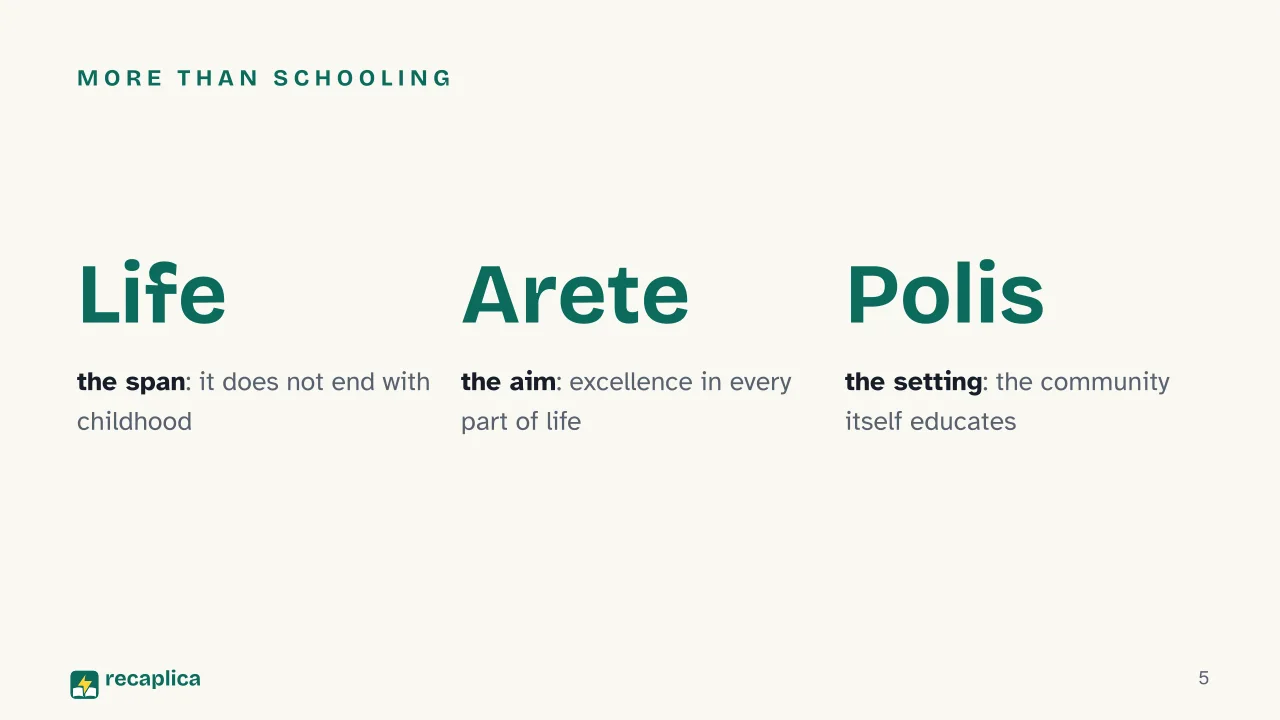  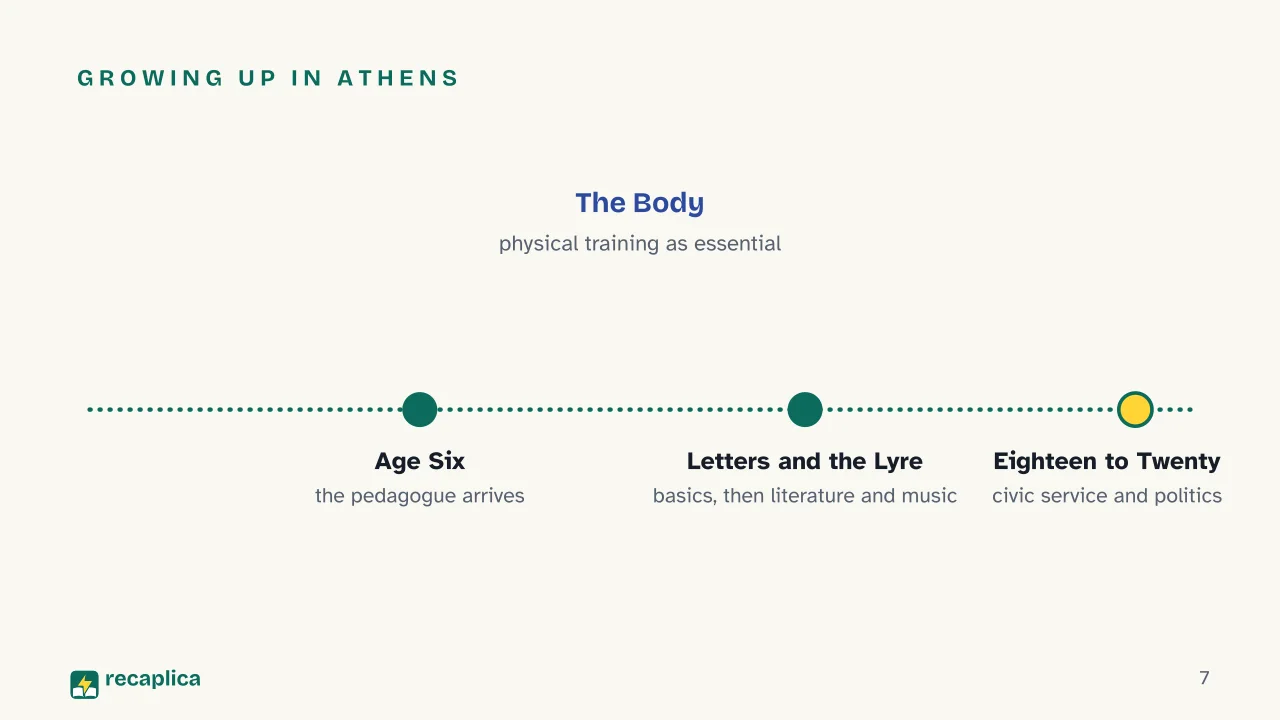 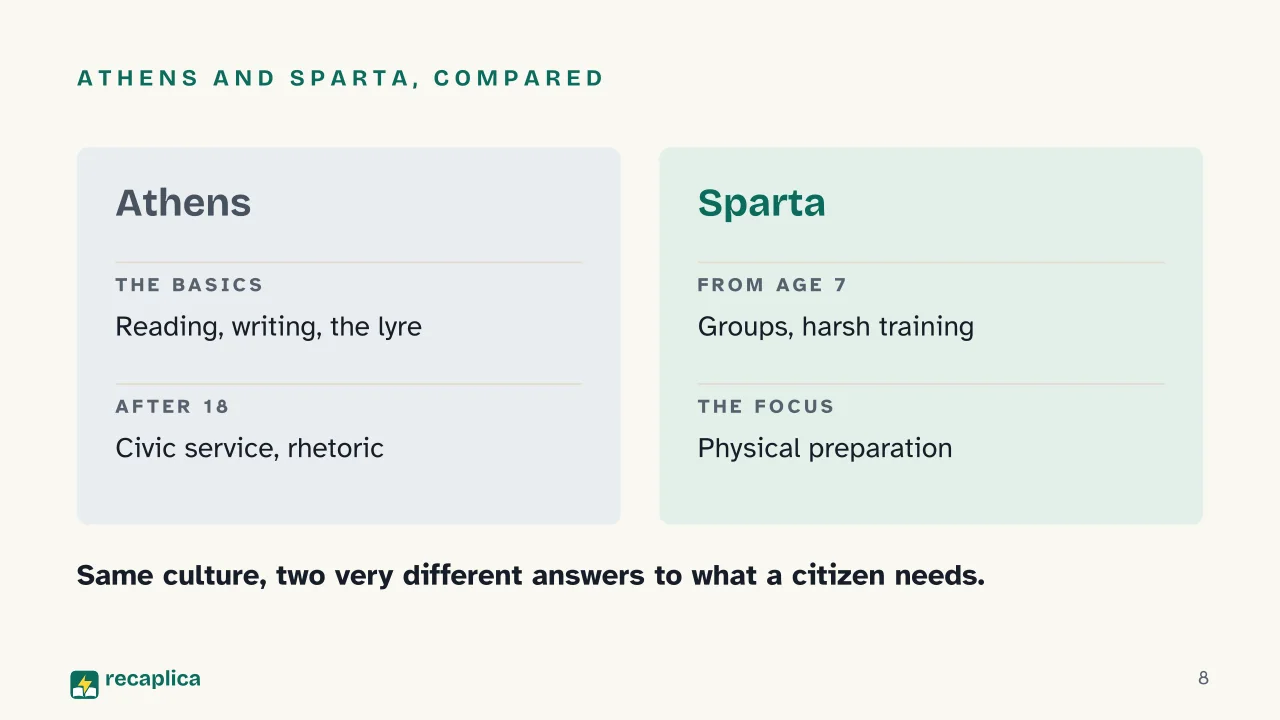  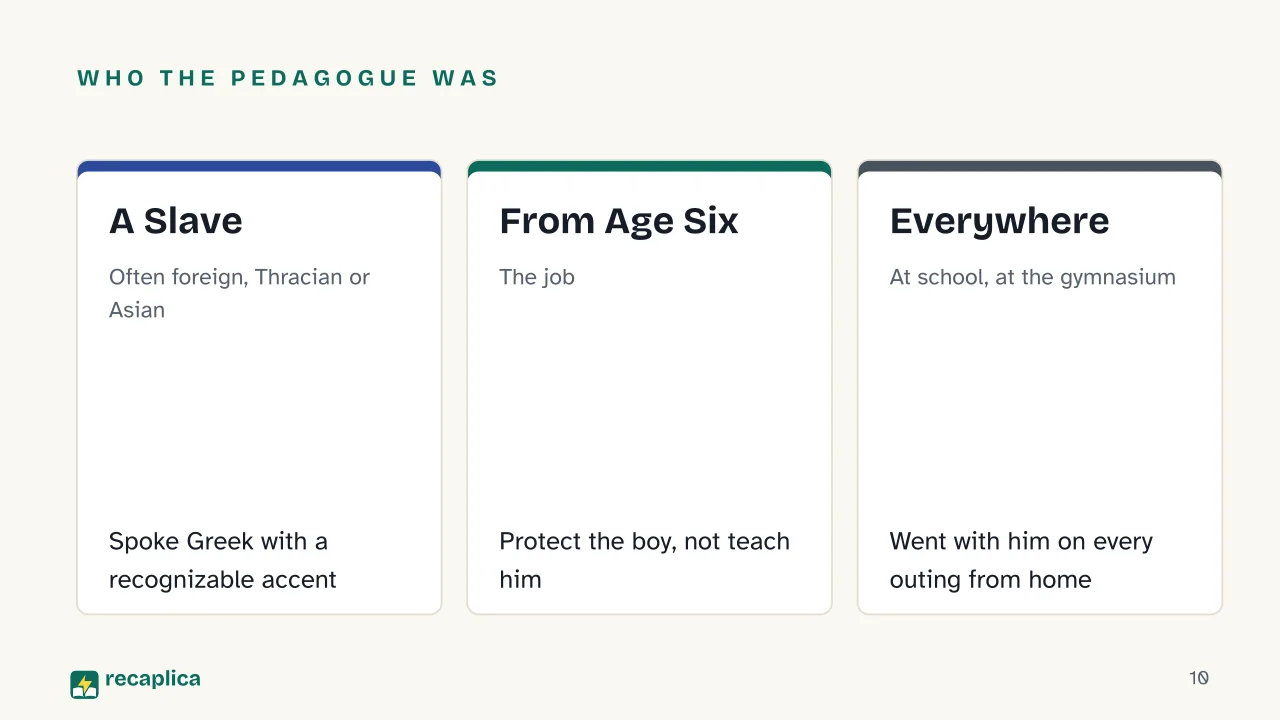  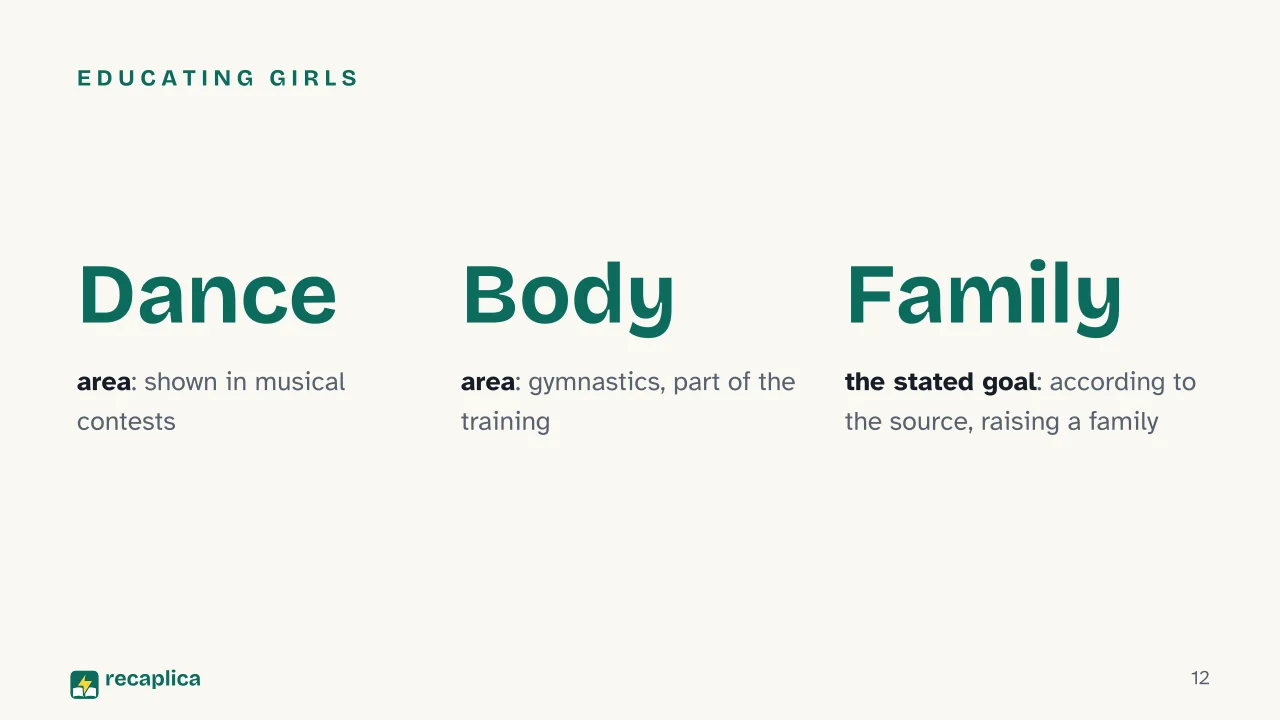  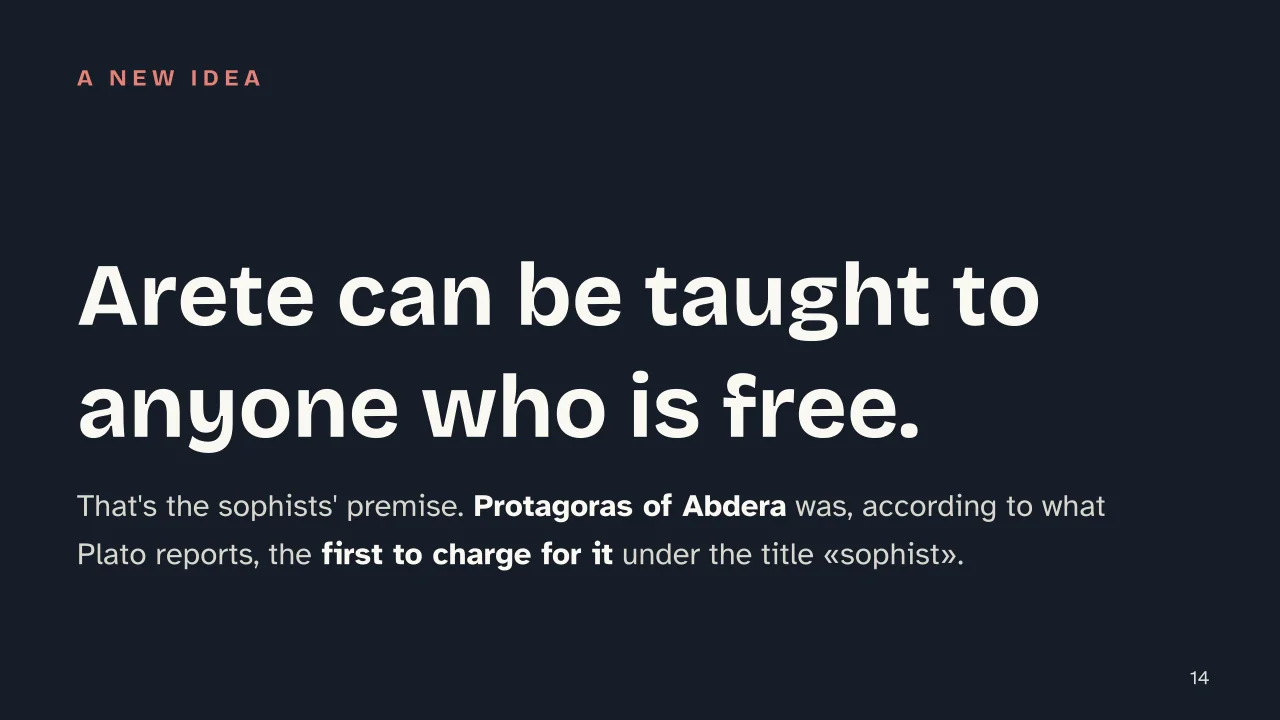 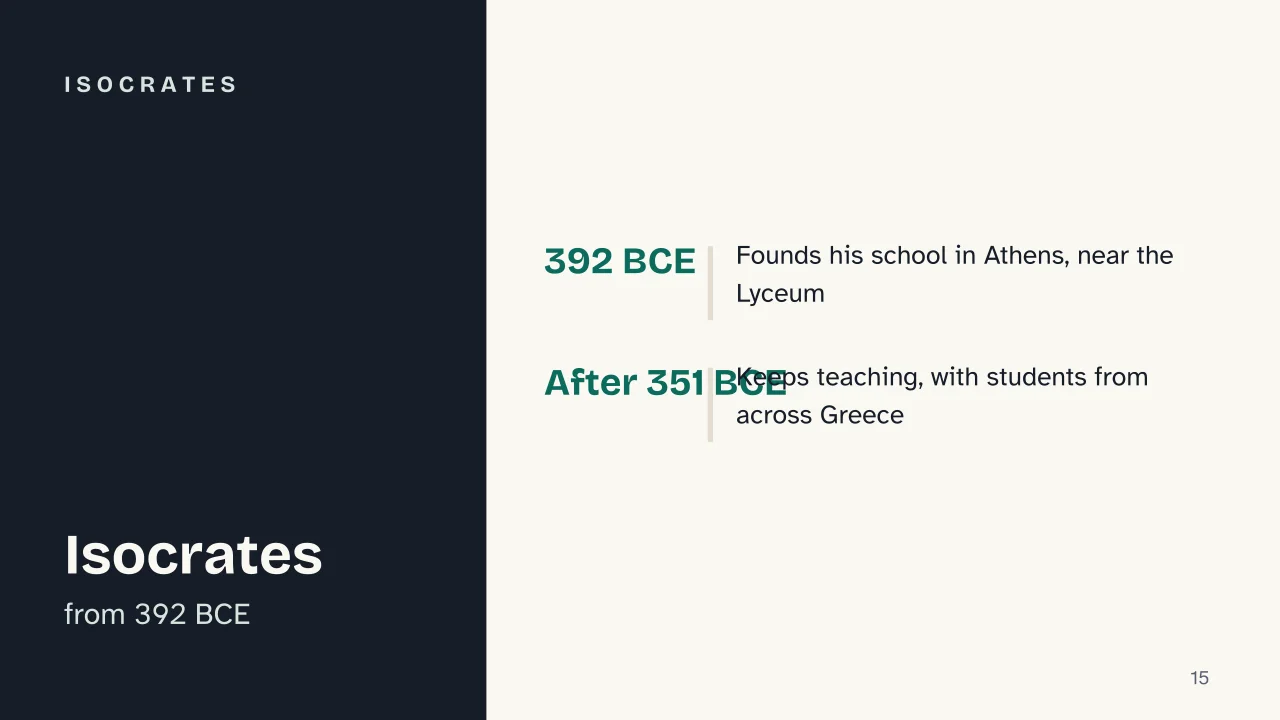  Common myths
Mind mapDrag the background to move around and the nodes to reposition them; use − and + to collapse and expand branches. 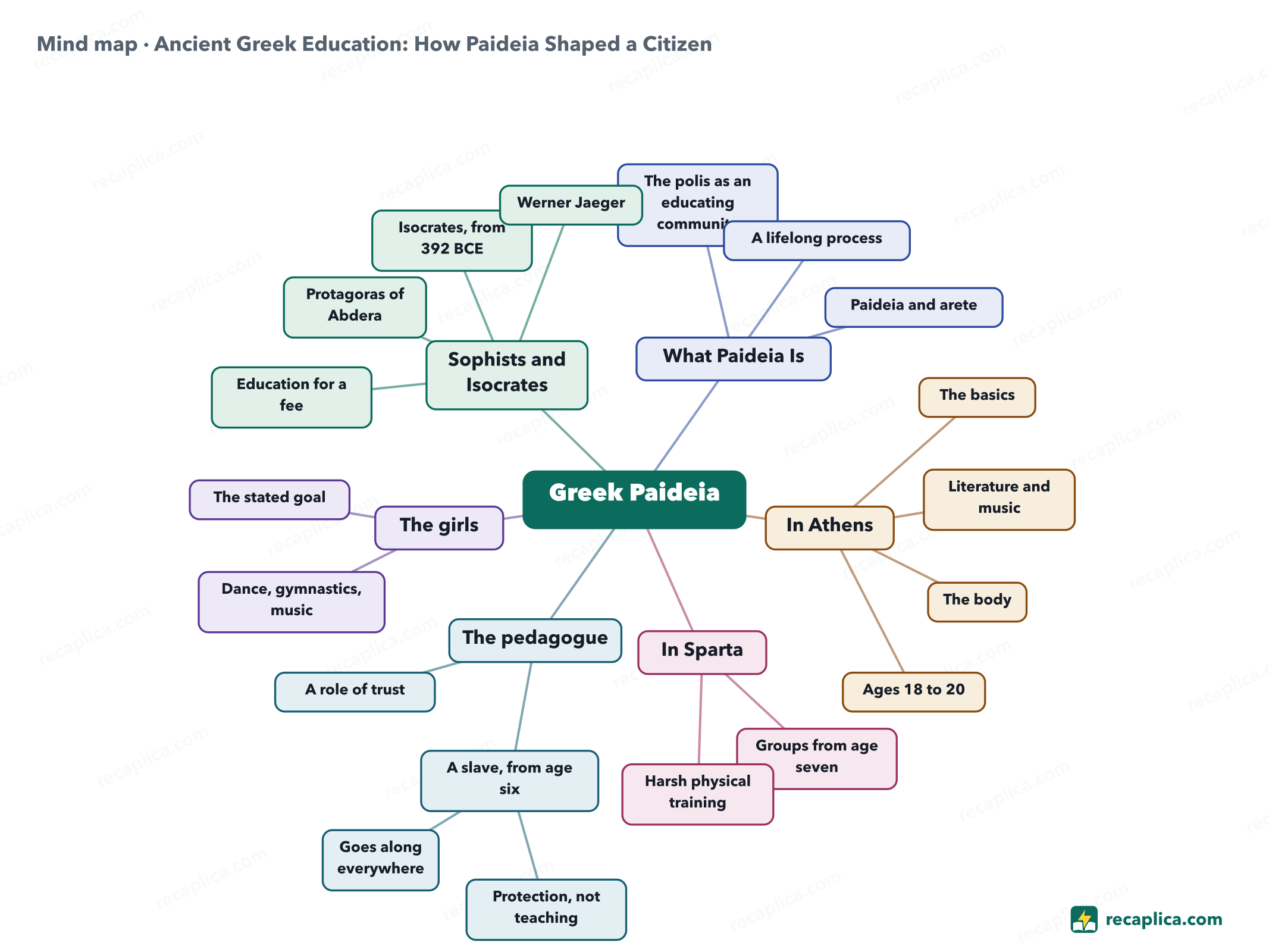
Quiz: test yourselfAnswer the questions to check what you have learned: you get instant feedback and a short explanation. Grade 0/10 0/5
FlashcardsTap the card to flip it and check whether you remember the answer, then move to the next one. 1 / 8 Explain it in your own wordsThe ultimate test: if you can explain it in simple words, you've truly understood it. Write your explanation, then compare it with the Recap. Your explanation is saved only on this device.
Frequently asked questionsWhat is Greek paideia?It's the idea, described by the Stanford Encyclopedia of Philosophy, that the city itself was an educating community. Paideia lasted a lifetime and brought together the arts and letters, physical and military training, the customs of the city and a person's moral growth, aiming at a fully formed citizen. Who was the pedagogue in ancient Greece?In Athenian households, according to Perseus Digital Library's dictionary of antiquities, the pedagogue was a slave assigned to sons from age six. He watched over their physical and moral safety and followed them everywhere they went outside the house, to school as much as to the gymnasium: teaching them was not his role. How were girls educated in ancient Greece?In ways similar to boys in many respects, but with more room for dance, gymnastics and music, shown publicly during festivals and religious rites. According to the World History Encyclopedia, this training ultimately aimed at preparing a girl to raise a family. Who were the sophists and how did they teach?They were educators who, according to the Internet Encyclopedia of Philosophy, taught arete to young men from wealthy families for a fee, focusing above all on rhetoric. Protagoras of Abdera was, according to what Plato reports, the first to charge for it under the name «sophist». Why is paideia still discussed in the twentieth century?Because the scholar Werner Jaeger put the term back at the center of classical studies with his three-volume work «Paideia», published between 1934 and 1947. According to Rutgers University's Database of Classical Scholars, Jaeger presented it as an aristocratic, educational and humanistic idea: the synthesis of thought, values, poetry, philosophy, history and action. Every Recap goes through an independent review before publication. |