|
recaplica
Ancient Egypt Summary: Pharaohs, Pyramids and Gods | ||||||||||||||||||||||
| © 2026 Recaplica · recaplica.com — All rights reserved | ||||||||||||||||||||||
Ancient Egypt Summary: Pharaohs, Pyramids and GodsWhat to print Page numbers appear when printing with default margins. SlidesChoose a cut Flash10 slidesThe essential thread, to present in classFull18 slidesEvery chapter and the deeper detailBoth come with speaker notes. In 30 seconds quick readAncient Egyptian civilization grew up along the Nile and lasted for thousands of years, from prehistory to the Islamic conquest of the 7th century AD. Its founding moment is the unification of Upper and Lower Egypt under a king called Menes, identified by many scholars with Narmer, around 3150 BC. From there came a system ruled by the pharaoh, seen as a living god and guarantor of the world's balance (ma'at), an original writing system, hieroglyphics, and monuments such as the pyramids of Giza that remain among the most famous works in human history. It was not a static civilization: it went through periods of great strength and periods of crisis before merging into Ptolemaic Egypt and, later, the Roman province. Key Points
Key figures
Deep DiveA river, black soil, and a kingdom is bornThe ancient Egyptians did not call their country “Egypt”: they called it Kemet, “the Black Land”, after the colour of the fertile soil the Nile left behind with every flood along its banks. It was there, in that narrow strip of farmland squeezed between deserts, that one of the longest-running civilizations in human history took shape. The predynastic period starts around 6000 BC, with farming villages scattered along the river. The turning point comes around 3150 BC, when a king called Menes, identified by many scholars with the ruler Narmer, unifies Upper and Lower Egypt, a conquest recorded on the so-called Narmer Palette. Before him, scholars have identified the names of several regional kings, a period conventionally labelled “Dynasty 0”. Written history begins in those very centuries, between 3400 and 3200 BC, with the emergence of hieroglyphic writing. It was an Egyptian priest named Manetho who, around 300 BC, first grouped the kings into numbered dynasties starting from the unification: historians still use his system to find their way through an extremely long chronology. Three thousand years of historyThe chronology of ancient Egypt splits into broad periods, alternating between strong central power and phases of political fragmentation known as “intermediate periods”. The earliest dates, especially those for the Old Kingdom, vary from source to source by decades in some cases: that is normal for such a remote chronology and should always be read with an implicit “roughly” attached.
The Middle Kingdom opens when the ruler Nebhepetre Mentuhotep II reunites Upper and Lower Egypt, ushering in what the Metropolitan Museum describes as a second great flowering of Egyptian culture. The New Kingdom begins with a second reunification, under Ahmose I, and brings with it a long stretch of economic and artistic prosperity. Dynastic Egypt ends when the country falls to the Persian king Artaxerxes III; Ptolemaic Egypt, born from Alexander the Great’s conquest, lasts until 30 BC. Egyptian culture itself, though, stays alive for centuries afterward, up to the Islamic conquest of the 7th century AD. The pharaoh: a god running the stateThe pharaoh was, quite literally, “Lord of the Two Lands”: he made the laws, owned every acre of Egyptian soil, collected the taxes and decided whether to declare war or defend the country. He was not just a political leader: he was seen as a god on Earth, the go-between linking the gods and the people, and he also carried the title of High Priest of every temple.
Interestingly, the term “pharaoh” is later than most people assume: it dates specifically to the New Kingdom. Rulers from earlier periods, including those who commissioned the first pyramids, were simply called “king”. Already in the 3rd dynasty, King Djoser had enough wealth and resources to build himself a monumental eternal home; in the New Kingdom, Hatshepsut was a woman ruler, among the most significant figures in the whole of pharaonic history, and she had her own mortuary temple built on Thebes’ west bank. The succession of kings is not reconstructed from modern sources but from lists the ancient Egyptians compiled themselves: the Palermo Stone, the Abydos King List and the Turin King List. A crowded pantheon: the gods of EgyptThe Egyptian pantheon counted over 2,000 deities, woven into daily life for more than 3,000 years. A handful, though, stood above the rest. Osiris was the lord and judge of the dead, god of fertility and rebirth: killed by his brother Set and brought back to life by his wife Isis, he became the supreme judge of the afterlife, with his cult centred at Abydos. The cult of Isis was among the most widespread and long-lasting in the whole of Egyptian religion: it reached beyond Egypt’s borders as far as Greece and Rome, where it survived for a long time in direct competition with early Christianity. Horus, the falcon-headed sky god, was the son of Osiris and Isis: Egypt’s kings identified with Horus in life and with Osiris after death, a link already attested under the 1st dynasty. Ra, the great sun god, steered his solar barque across the sky by day and fought off the serpent Apep by night; his cult became the most popular one by the 5th dynasty. Amun’s cult, centred on Thebes, grew so central in the New Kingdom that historians compare it to a form of monotheism. Other gods handled more specific duties. Anubis, shown with a jackal’s head, presided over the weighing of the dead’s hearts. Thoth watched over writing and wisdom, and was the patron of librarians and scribes. Hathor was tied to love, music and fertility. Set’s name, the god of war and chaos, means “Instigator of Confusion”. Ptah, lord of Memphis, was regarded as the creator god and the patron of sculptors and craftsmen. Hieroglyphics: a script built from sounds and picturesHieroglyphic writing emerged around 3200 BC, in the Naqada III period, which historians also call “Dynasty 0”. The earliest confirmed examples come from funerary contexts: in tomb U-j at Abydos, around 150 labels, dated to about 3100 BC, count as the oldest writing ever found in Egypt. The system combined three kinds of signs: logograms, standing for whole words; phonograms, standing for sounds; and determinatives, which clarified meaning. More than a thousand different hieroglyphs were in use at first, a number that fell to around 750 during the Middle Kingdom. They were not reserved for sacred inscriptions: hieroglyphics and the cursive script derived from them covered everything from poetry to shopping lists, from tax labels to international treaties. For three thousand years, though, nobody could read them anymore. The breakthrough came with the Rosetta Stone, a priestly decree from 196 BC discovered at Rosetta in 1799 — the same decade in which, across Europe, the French Revolution was overturning another chapter of history. The stone carried the same text in three scripts: hieroglyphics, demotic and ancient Greek. By comparing them, Jean-François Champollion announced in 1822 that he had cracked the system, recognizing the names Ptolemy V and Cleopatra and showing that hieroglyphics were not a simple alphabet but a combination of signs for sounds, ideas and words. The Rosetta Stone is now held at the British Museum, where it is one of the most-visited objects: that decipherment reopened access to three thousand years of Egyptian history, language, literature, religion, art and architecture, locked until then inside a writing system nobody could read anymore. The pyramids: state building sites, not slave prisonsThe first pyramid in history is the Step Pyramid at Saqqara, commissioned by King Djoser around 2670 BC and designed by the architect Imhotep: it is the earliest large-scale stone monument in Egyptian history. From there the form evolved, moving from the flat-roofed “mastaba” tomb to the true pyramid shape. The high point came with the Great Pyramid of Giza, built for the pharaoh Khufu (Cheops), of the 4th dynasty, completed around 2560 BC. Its original height was 146 metres, its base measured 230 metres on each side, and the structure was made of more than two million blocks of stone, each weighing between 2 and over 60 tonnes. The architect was Hemiunu, Khufu’s own nephew.
And it is precisely the workforce that the most stubborn myth gets wrong. The pyramids were not built by slaves: they were public works, carried out by paid Egyptian labourers. Tens of thousands of workers gathered mainly during the Nile’s annual flood, when the fields stayed underwater for about two months and farm work stopped, in exchange for food and the promise of favourable treatment in the afterlife. The Great Pyramid remained the tallest structure ever built by human hands for over 3,000 years, until the Eiffel Tower was completed in Paris in 1889. Giza: pyramids, the Sphinx and the necropolis of MemphisThe whole area, from the Giza plateau to Dahshur, taking in Zawyet Elarian, Abu Ghurab, Abusir and Saqqara, forms the necropolis of the ancient capital Memphis: a field of funerary monuments stretching roughly 30 km along the Nile’s west bank, with more than 38 pyramids recorded. The site was added to the UNESCO World Heritage List in 1979; of the ancient Seven Wonders of the World, Khufu’s Great Pyramid is the only one you can still visit today. Within the same complex stands the Great Sphinx of Giza: 73 metres long, 20 metres tall, carved from the same type of limestone used for Khafre’s pyramid. The most widely accepted theory places it in the reign of Khafre, Khufu’s son: according to historians Brier and Hobbs, the workers digging out his pyramid ran into a vein of rock too hard to remove and left it standing like a small hill; Khafre then had the outcrop carved into the shape of a crouching lion, bearing his own face. Not every scholar agrees: researcher Dobrev has argued the work should be credited to Khafre’s brother Djedefre, honouring their father Khufu, while other researchers, pointing to erosion patterns, argue for a date earlier than the traditional one. The ancient Egyptians, in any case, never called it a “sphinx”: that word is Greek and came much later; the original name was “shesep-ankh”, “living image”. The Valley of the Kings and the tomb that escaped the lootersWest of the Nile, in Upper Egypt, the Valley of the Kings served as the burial ground for the pharaohs of the 18th, 19th and 20th dynasties, roughly between 1539 and 1075 BC. It holds 62 tombs, with descending corridors, deep shafts, pillared halls and burial chambers containing stone sarcophagi; the walls were decorated with the dead ruler alongside the gods and with magical texts meant to guide the journey through the afterlife. Since 1979 the valley has been part of the UNESCO-listed Theban Necropolis. Nearly every tomb was looted in antiquity. Only one escaped: that of Tutankhamun, the pharaoh who came to the throne around age 8-9 and died around 17-18, after roughly 11 years of rule. Howard Carter discovered it on 4 November 1922, between the First and Second World Wars: it is the most intact royal tomb ever found in Egypt. Inside were a gilded sarcophagus, the mummies of two stillborn daughters of Tutankhamun and his wife Ankhesenamun, miniature royal regalia such as the crook and flail, and numerous ceremonial objects. The skull injuries once cited as evidence of murder are now attributed to the embalmers’ work on the body: among scholars, there is no longer a real mystery surrounding his death. His own name, “Tutankhamun”, means “living image of the god Amun”. Why we still study itThe British Museum alone holds over 100,000 objects spanning the whole of ancient Egyptian history, from the predynastic period to the Coptic era: a collection that tells, among other things, five thousand years of hieroglyphic history. To put the scale in perspective: less than forty years separate the end of the Cold War from today, while Egypt’s dynastic history alone covers more than two thousand five hundred, packed with reunifications, crises, revivals and a religion that stayed at the centre of public life the entire time. Ancient Egypt did not end overnight. It went through crises, reunifications and changes of dynasty for more than twenty-five hundred years, holding on to the same territory, the same figure of the pharaoh and the same idea of ma’at, until the Ptolemaic and then the Roman period gradually folded it into a wider Mediterranean world. Slide deckSlides ready to download and make your own in PowerPoint or Google Slides, with speaker notes. Pick the Flash cut or the Full one.     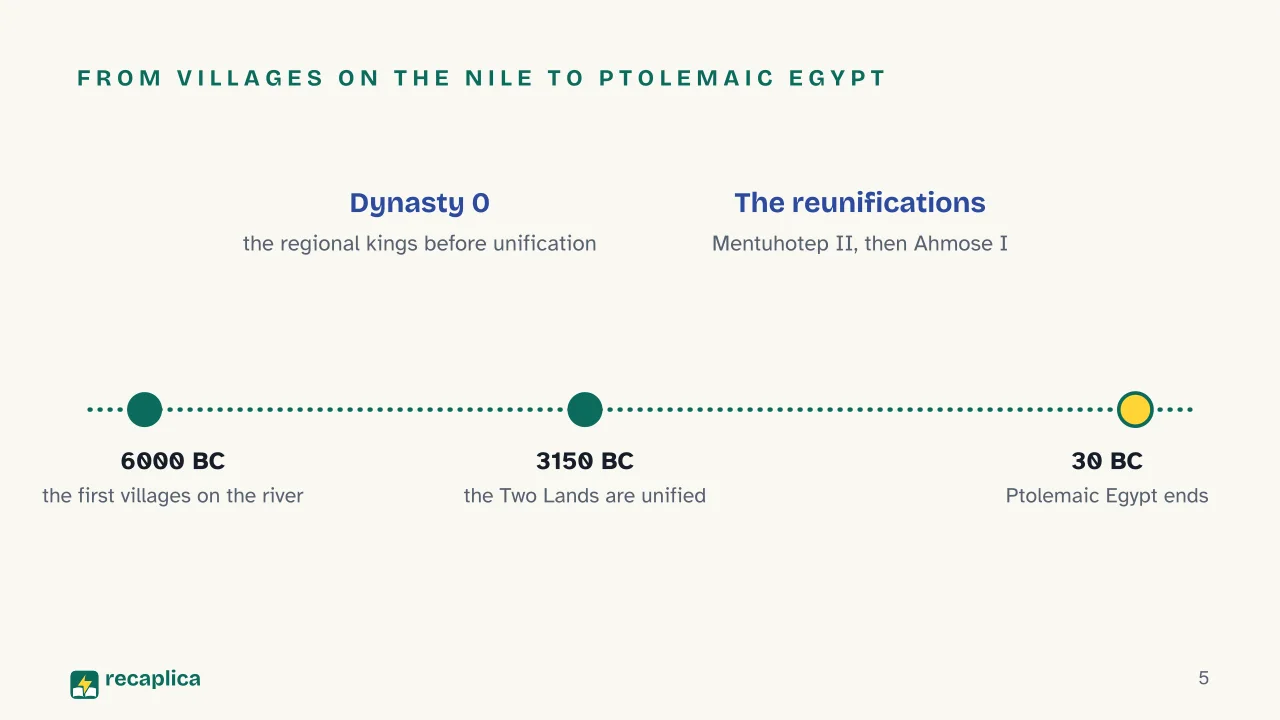 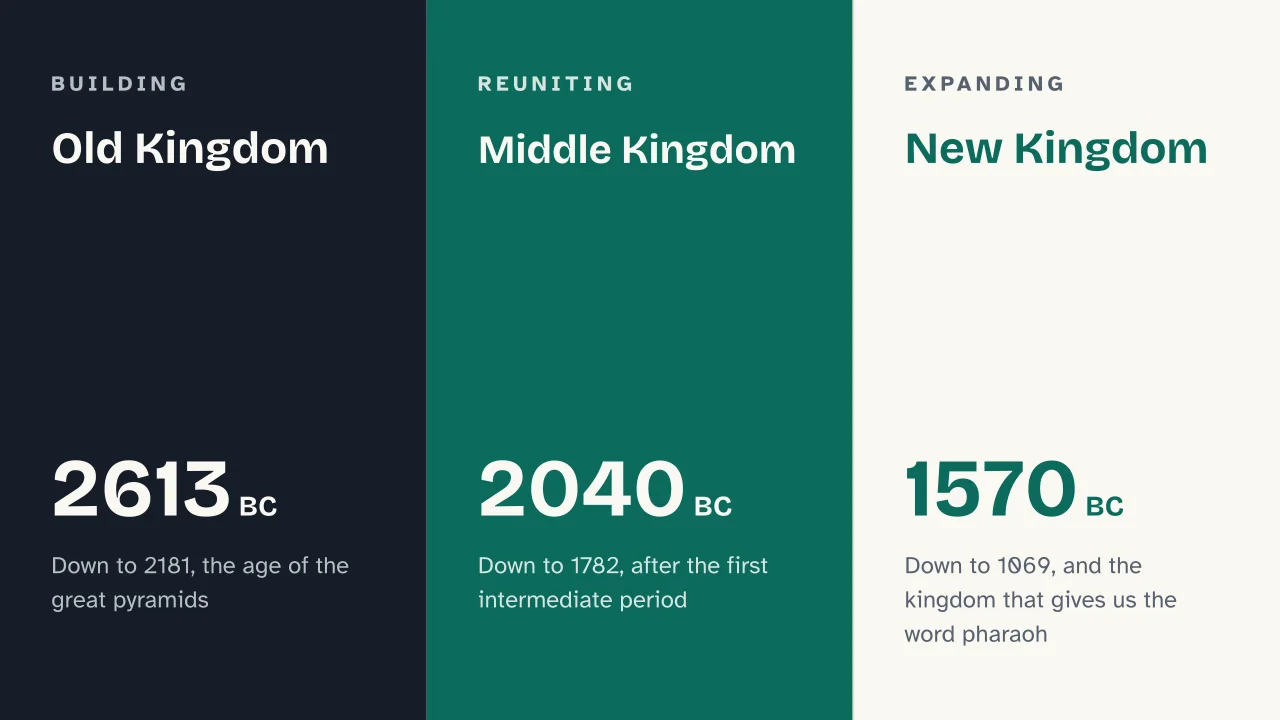  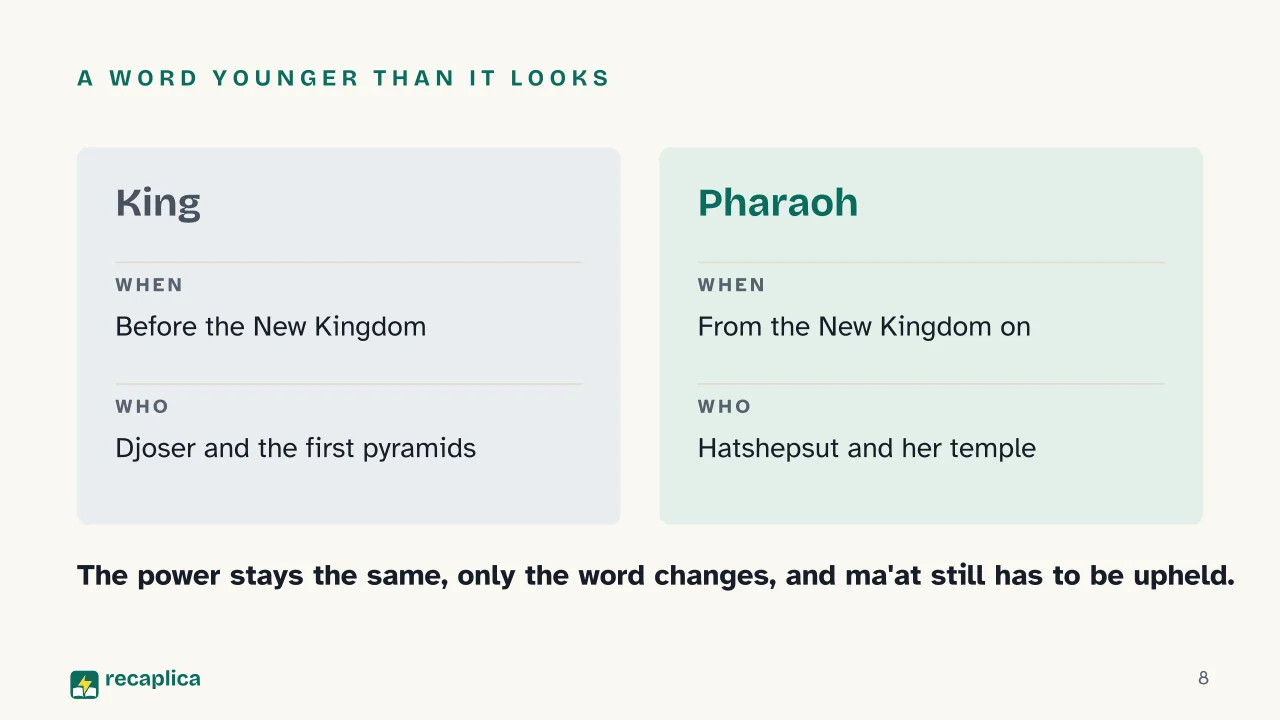 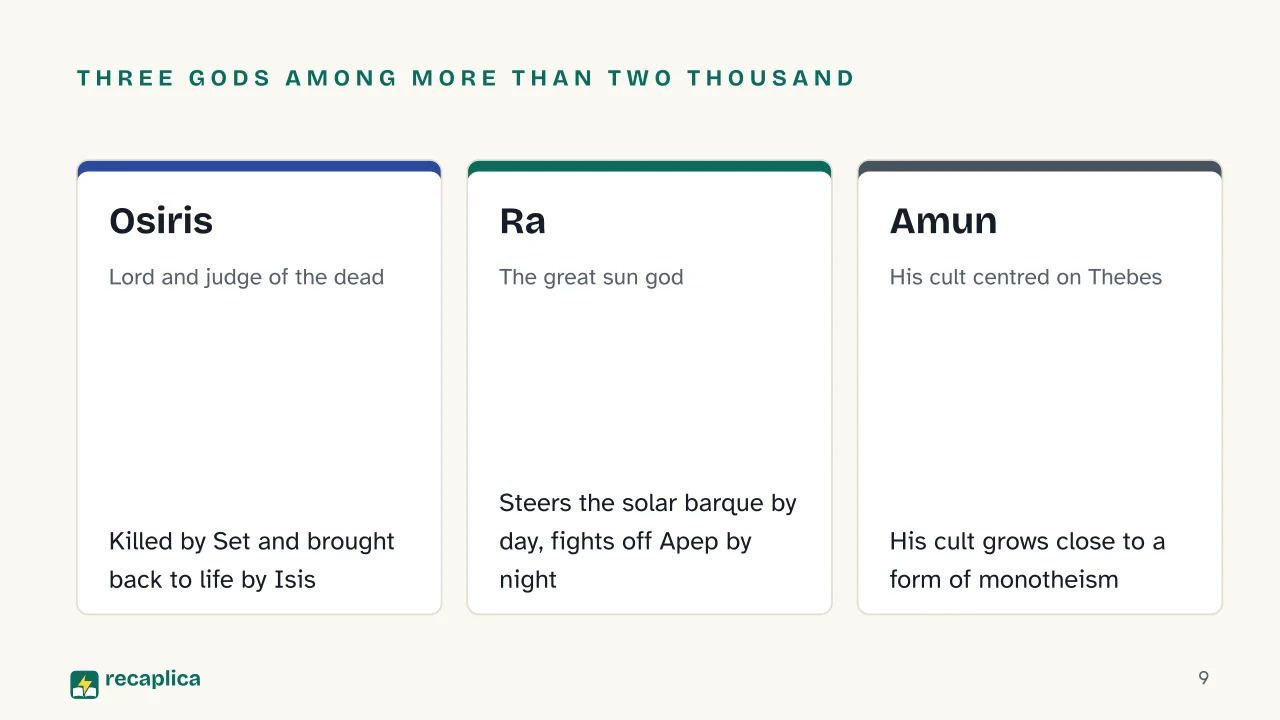  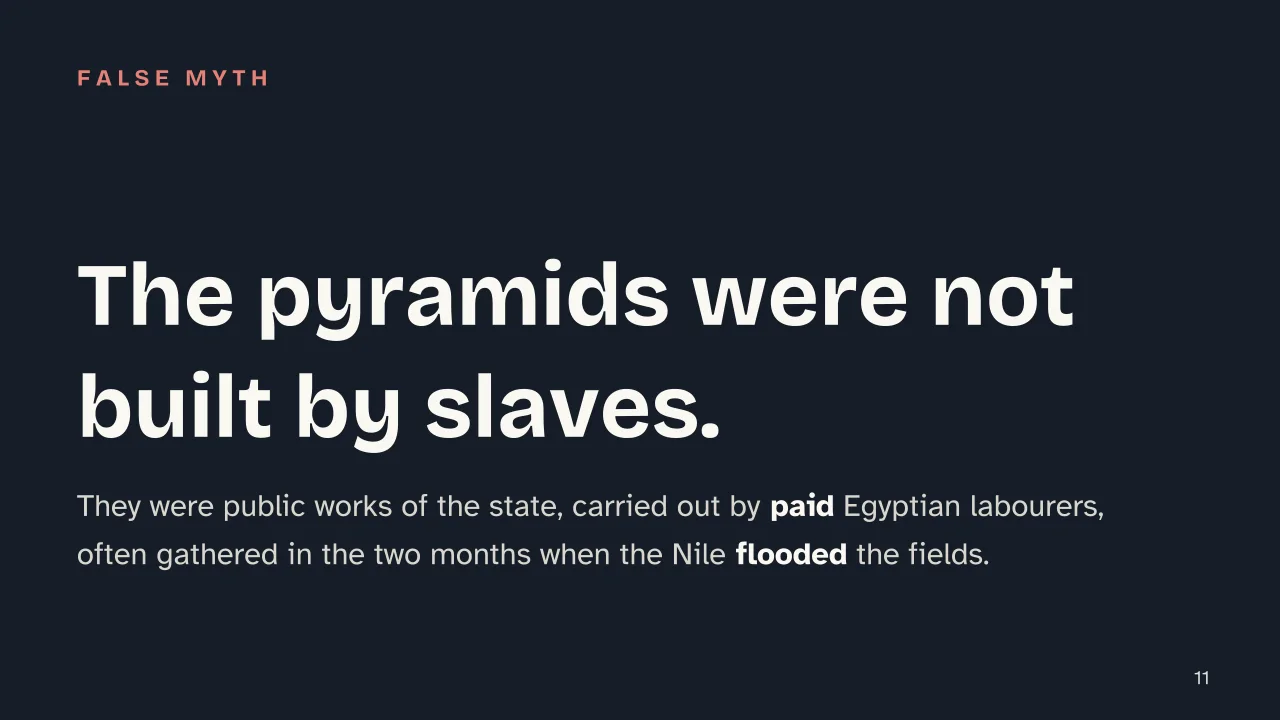 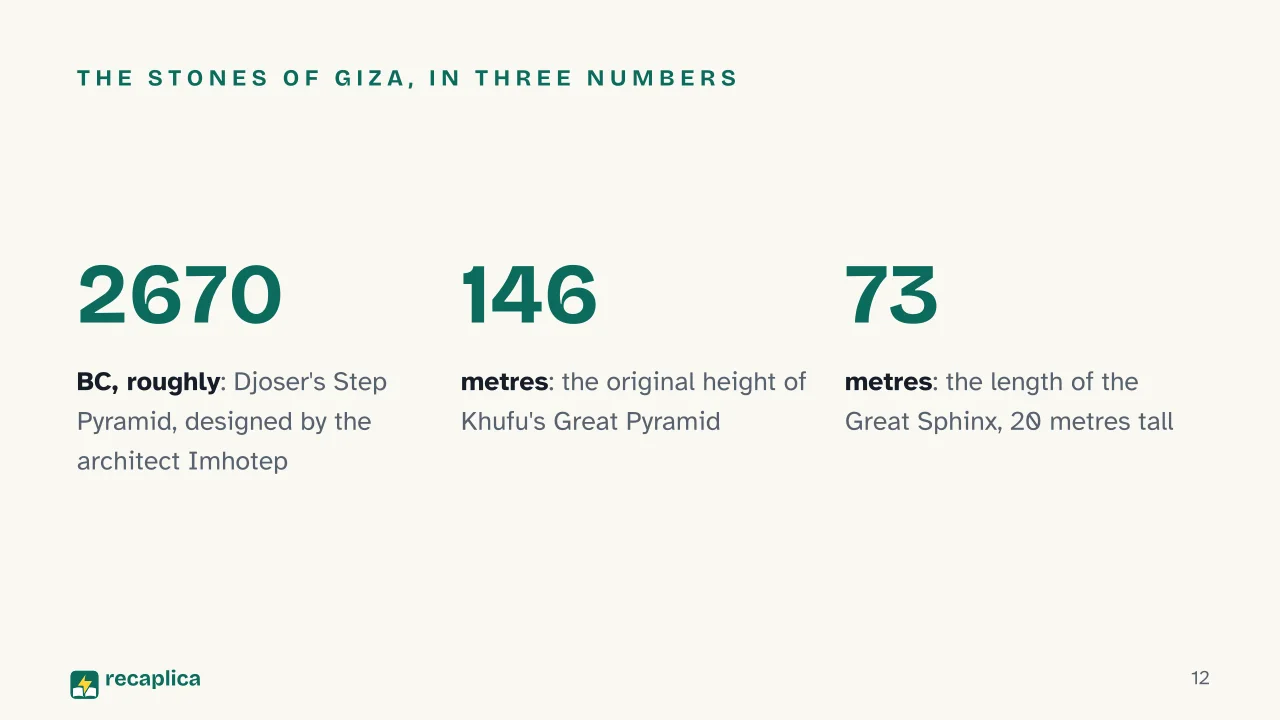   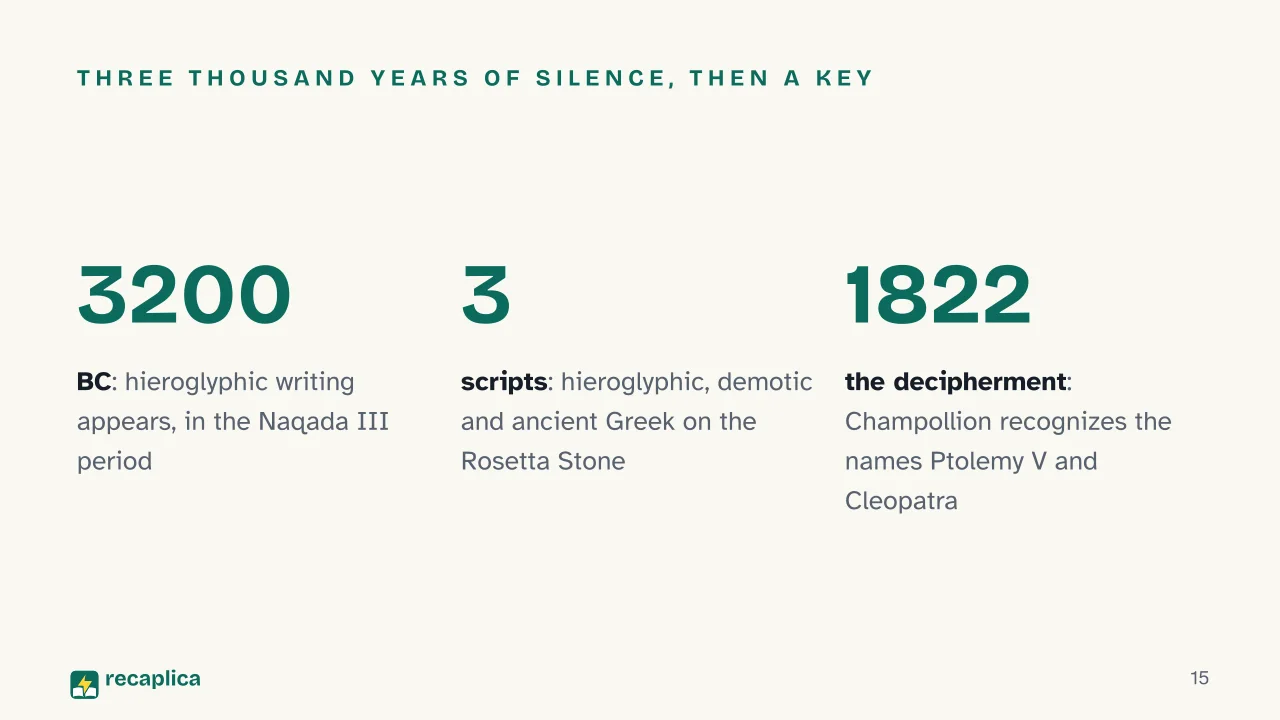 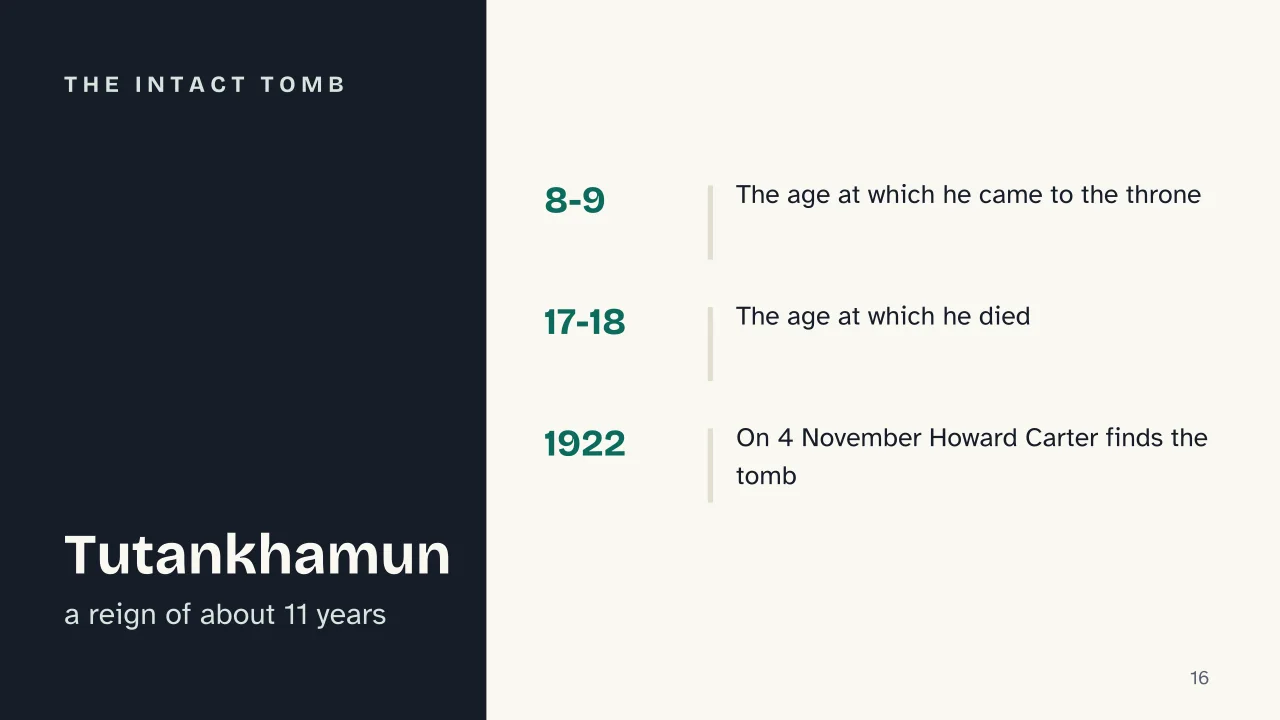 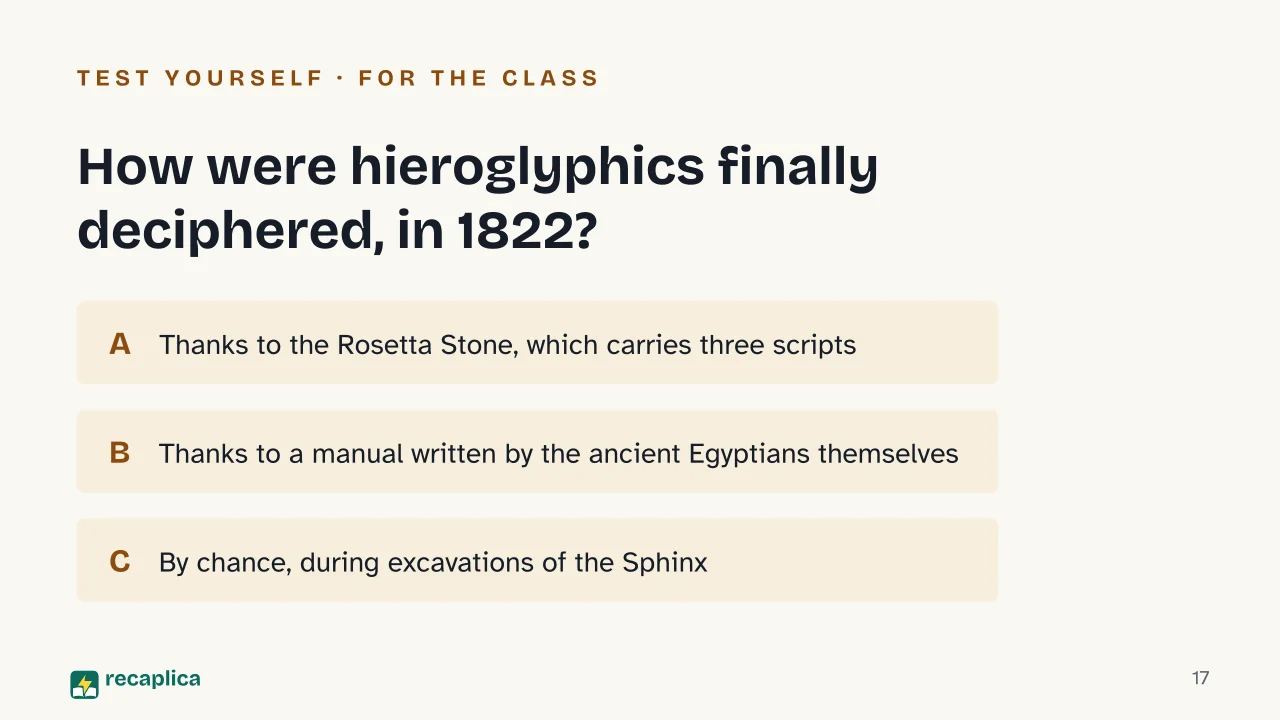  Common myths
Mind mapDrag the background to move around and the nodes to reposition them; use − and + to collapse and expand branches. 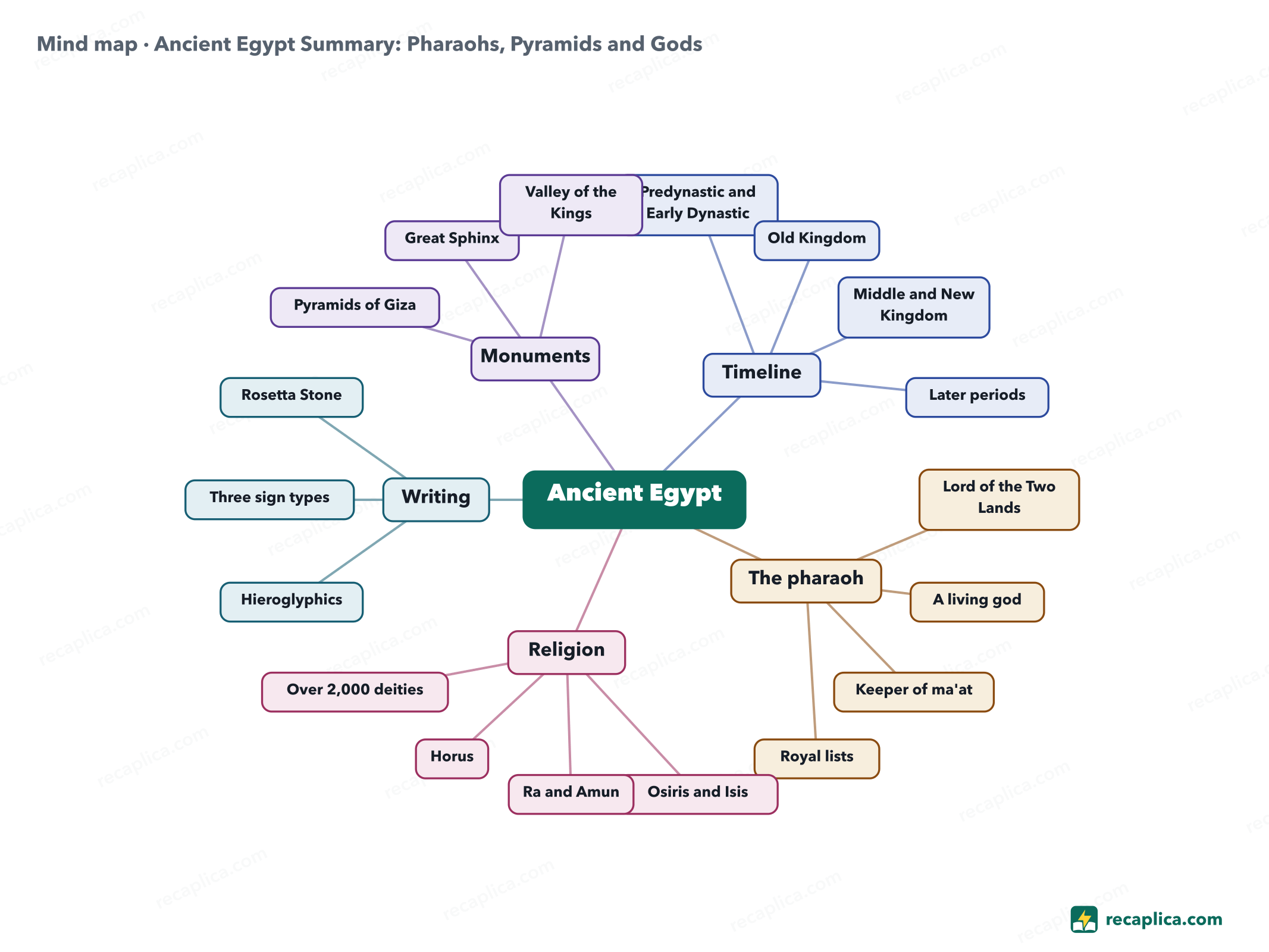
Quiz: test yourselfAnswer the questions to check what you have learned: you get instant feedback and a short explanation. Grade 0/10 0/5
FlashcardsTap the card to flip it and check whether you remember the answer, then move to the next one. 1 / 8 Explain it in your own wordsThe ultimate test: if you can explain it in simple words, you've truly understood it. Write your explanation, then compare it with the Recap. Your explanation is saved only on this device.
Frequently asked questionsWhen did Egyptian civilization begin and end?There is no clean start or end date. The predynastic period begins around 6000 BC, the unification under Menes around 3150 BC opens the age of the pharaohs, and dynastic history runs through the Persian conquest and then Alexander the Great's: Ptolemaic Egypt lasts until 30 BC. Egyptian culture, though, stayed alive well beyond that, up to the Islamic conquest of the 7th century AD. Were the pyramids built by slaves?No. They were public works commissioned by the state and carried out by paid Egyptian labourers, often during the two months of the year when the Nile flooded the fields and farm work stopped. In return, the workers received food and the promise of favourable treatment in the afterlife. What was ma'at?It was the principle of balance and harmony that, according to Egyptian religion, held the entire cosmos together, alongside the concept of heka, magic. Upholding ma'at was the pharaoh's central duty, by divine mandate. How were hieroglyphics deciphered?Thanks to the Rosetta Stone, a priestly decree from 196 BC discovered in 1799, which carried the same text in three scripts: hieroglyphics, demotic and ancient Greek. By comparing them, Jean-François Champollion announced in 1822 that he had cracked the system, showing it combined signs for sounds, ideas and words. Who was Tutankhamun and why is he so famous?He was a pharaoh who came to the throne around age 8-9 and died around 17-18, after roughly 11 years of rule. He is famous mainly because his tomb, discovered in the Valley of the Kings in 1922 by Howard Carter, is the only Egyptian royal burial to survive to modern times almost intact, complete with its full funerary goods. Every Recap goes through an independent review before publication. |