Skip to content
recaplica

    One moment: security check

    Cloudflare wants to make sure you're not a robot. Tick the box below and your search will continue on its own.

    IT
    recaplica Critical Minerals: Why the Energy Transition Runs on Them
    © 2026 Recaplica · recaplica.com — All rights reserved
    Home › Economics

    Critical Minerals: Why the Energy Transition Runs on Them

    By Recaplica Newsroom · Updated on September 19, 2026

    What to print

    Page numbers appear when printing with default margins.

    Slides

    Choose a cut

    Flash10 slidesThe essential thread, to present in classFull16 slidesEvery chapter and the deeper detail

    Both come with speaker notes.

    Telegram channel
    recaplica Clear in 30 seconds, yours in 10 minutes.
    In 30 seconds Key points Figures Deep dive Slides Myths Mind map Quiz Flashcards FAQ

    In 30 seconds quick read

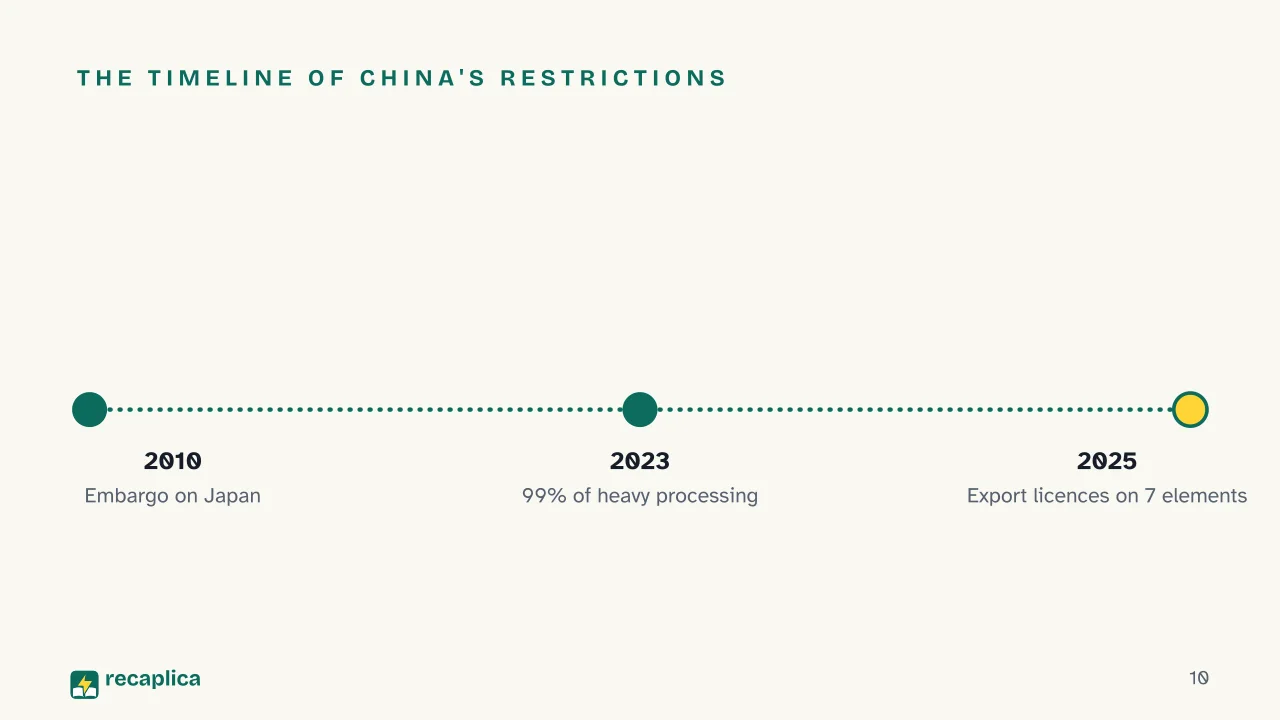
    Solar panels, wind turbines, batteries and electric motors run on materials that fossil-fuel technology barely needs: lithium, cobalt, nickel, copper, graphite and rare earths. Mining, and especially refining, these minerals is concentrated in a small number of countries — by 2024 the top three refining nations controlled 86% of world output, up from 82% in 2020, according to the International Energy Agency. China has already used that position as leverage, from the 2010 embargo on Japan to export licences imposed in 2025 on seven heavy rare-earth elements. The European Union answers with the Critical Raw Materials Act, which sets domestic extraction, processing and recycling targets and caps dependence on any single supplier outside the bloc by 2030.

    Key Points

    • Clean-energy technology needs far more minerals than the fossil-fuel equivalents it replaces: a typical electric car uses six times as much, according to the IEA.
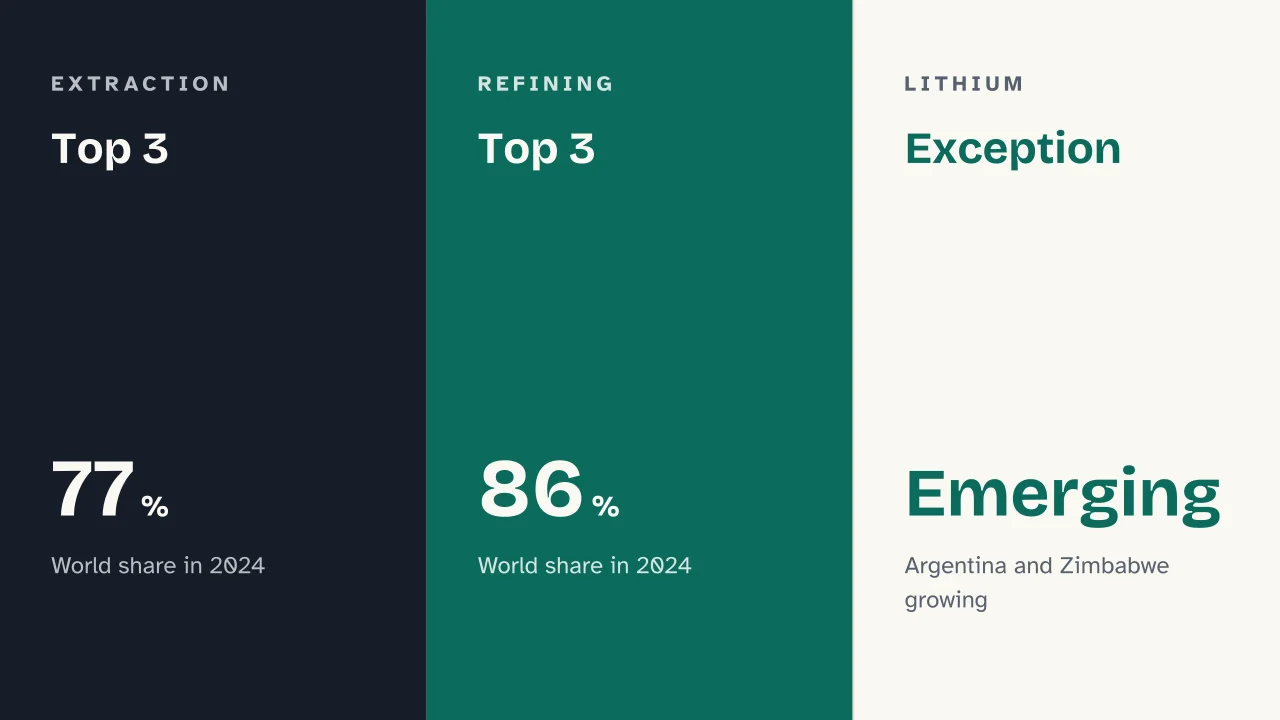
    • By 2024 the world's top three refining countries controlled 86% of critical mineral output, up from 82% in 2020.
    • Lithium is the exception: between 2020 and 2024 much of the new supply came from emerging producers such as Argentina and Zimbabwe.
    • In April 2025 China introduced mandatory export licences on seven heavy rare-earth elements and added 16 US companies to an export control list.
    • The EU has listed 34 critical raw materials since 2023 and, under the Critical Raw Materials Act, set 2030 targets for domestic extraction, processing and recycling.
    • The same regulation caps dependence: no country outside the EU may supply more than 65% of the annual consumption of a strategic raw material by 2030.

    Key figures

    • 86% share of world refining held by the top three countries in 2024, up from 82% in 2020 Source: IEA, Global Critical Minerals Outlook 2025
    • 65% cap on the share of annual consumption a single non-EU country may supply for each strategic raw material, by 2030 Source: Regulation (EU) 2024/1252
    • 7 heavy rare-earth elements covered by China's mandatory export licences, announced in April 2025 Source: CSIS

    Deep Dive

    Why clean technology needs so many more minerals

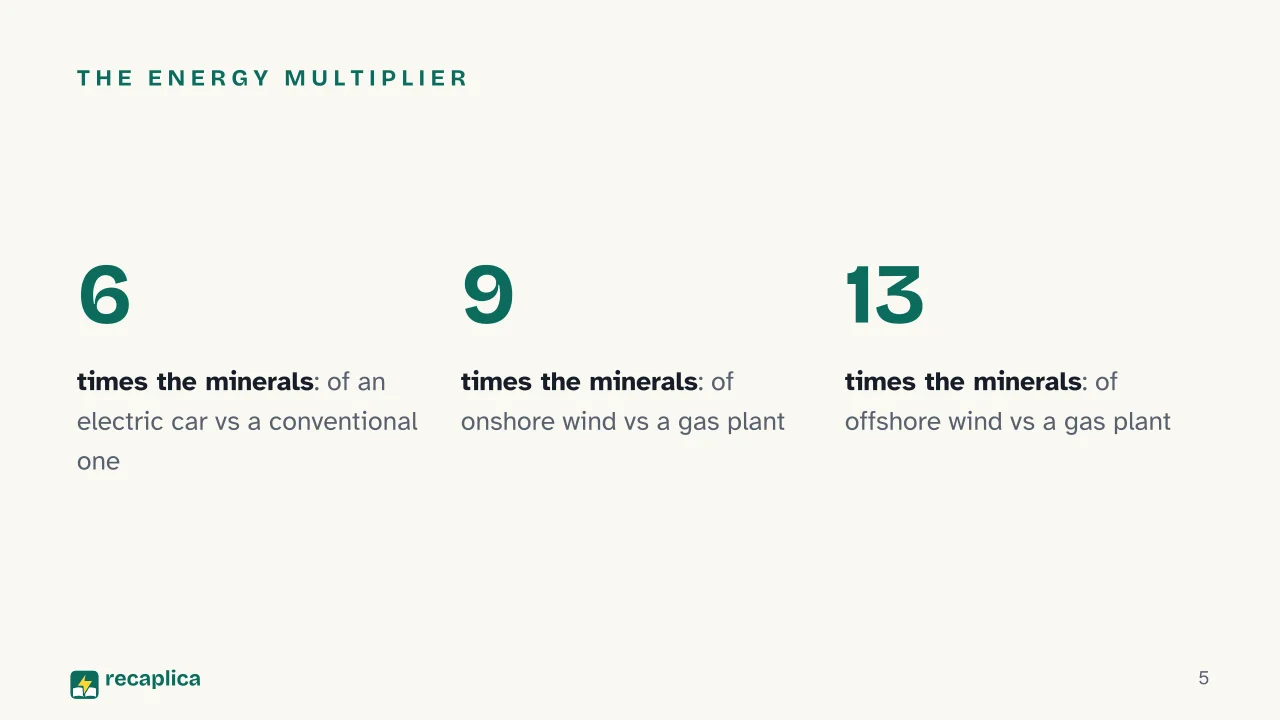
    A solar panel, a wind turbine or an electric car burns no fuel, but each is built from materials that a petrol car or a gas plant barely touches, or uses in far smaller amounts. According to the International Energy Agency (IEA), a typical electric car requires six times the mineral inputs of a conventional car; an onshore wind plant needs nine times more mineral resources than a gas-fired plant of the same size, and an offshore plant needs up to thirteen times more. The energy transition shifts that dependence from one set of materials to another: from oil, mined across dozens of countries and traded on deep, liquid global markets, to lithium, cobalt, nickel, graphite, copper and rare earths, whose processing sits in relatively few hands.

    Real-world example: a mid-range electric sedan carries a battery pack built on lithium, cobalt and nickel, a motor with rare-earth permanent magnets, and kilometres of copper wiring. The combustion version of the same car uses a fraction of these materials, because it has neither the battery pack nor the magnet motor.

    Raw materialMain use in the energy transition
    LithiumBatteries for electric vehicles and energy storage
    CobaltCathodes in lithium-ion batteries
    NickelHigh-density battery chemistries
    GraphiteBattery anodes
    CopperWiring, electric motors, power grids
    Rare earthsPermanent magnets in motors and wind turbines

    Anyone installing a solar power system at home rarely thinks about the supply chain sitting behind the panels. Yet every energy-transition technology raises the same question: where do these minerals come from, and how resilient is that supply chain really?

    The concentration behind the price

    The IEA’s answer is that critical mineral production is concentrating, not spreading out. In 2020 the top three extracting countries accounted for 73% of world output; by 2024 that had risen to 77%. Refining, the most delicate stage of the chain, is even more concentrated: from 82% in 2020 to 86% in 2024, in the top three refining countries.

    The pattern isn’t uniform. For cobalt, graphite and rare earths, the IEA finds that roughly 90% of production growth between 2020 and 2024 came from a single dominant supplier for each mineral: the Democratic Republic of Congo for cobalt mining (with China dominating its refining), China for graphite and rare earths. Nickel also has a dominant producer, Indonesia. Lithium is the exception: a significant share of new production over the same period came from emerging producers such as Argentina and Zimbabwe, a sign that concentration isn’t a fact of geology but the outcome of decades of industrial and investment choices.

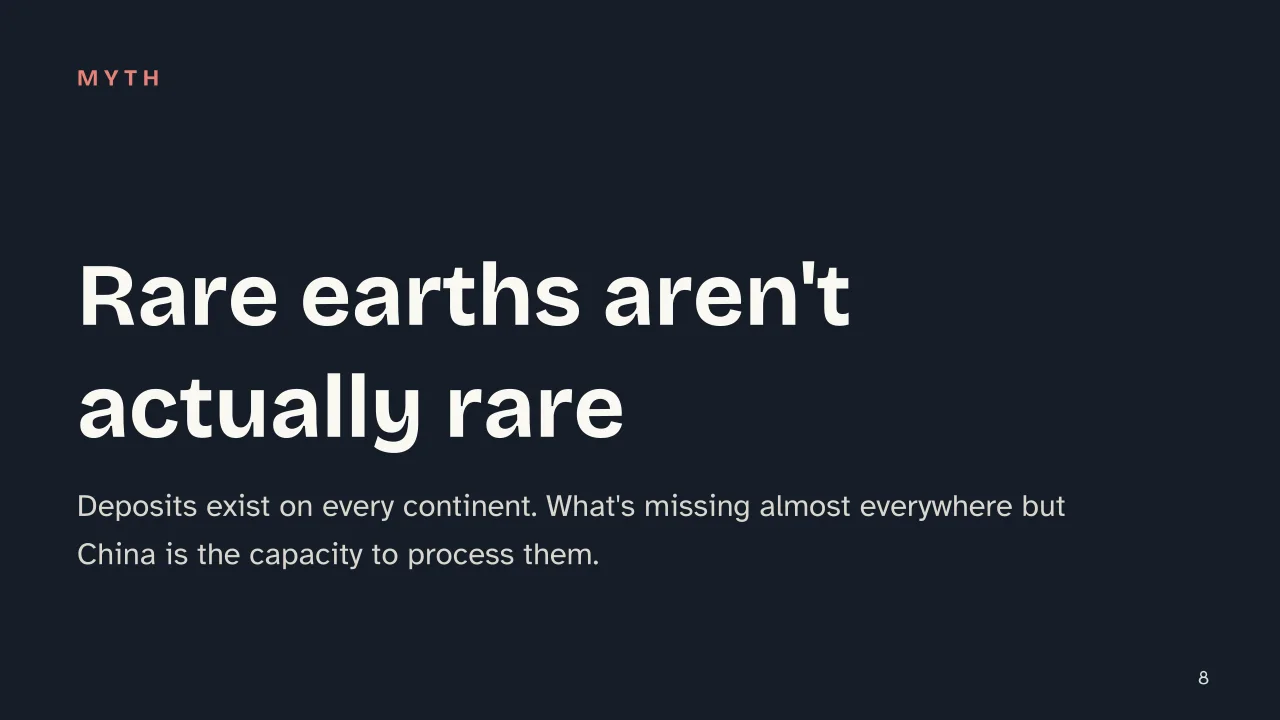
    Refining, more than raw extraction, is what explains the focus on China. According to the US think tank CSIS, China accounted for as much as 99% of global heavy rare-earth processing through 2023, an edge reinforced further after a competing plant in Vietnam shut down. Despite the name, rare earths aren’t geologically scarce: they turn up fairly widely across the earth’s crust in multiple countries. The bottleneck is industrial — turning ore into usable material requires costly, polluting plants that have been built at scale almost nowhere but China.

    Export as leverage

    Concentration this heavy in a single country can become, and already has become, a tool of foreign policy. The first documented case dates to 2010, when China halted rare-earth exports to Japan after a diplomatic incident involving a Chinese fishing trawler detained by the Japanese coast guard. Fifteen years later, in April 2025, China’s Ministry of Commerce imposed mandatory export licences on seven heavy rare-earth elements — samarium, gadolinium, terbium, dysprosium, lutetium, scandium and yttrium: not an outright ban, but a licensing mechanism that slows shipments and makes supply uncertain. At the same time, 16 US companies, mostly in the defense and aerospace sectors, were added to an export control list.

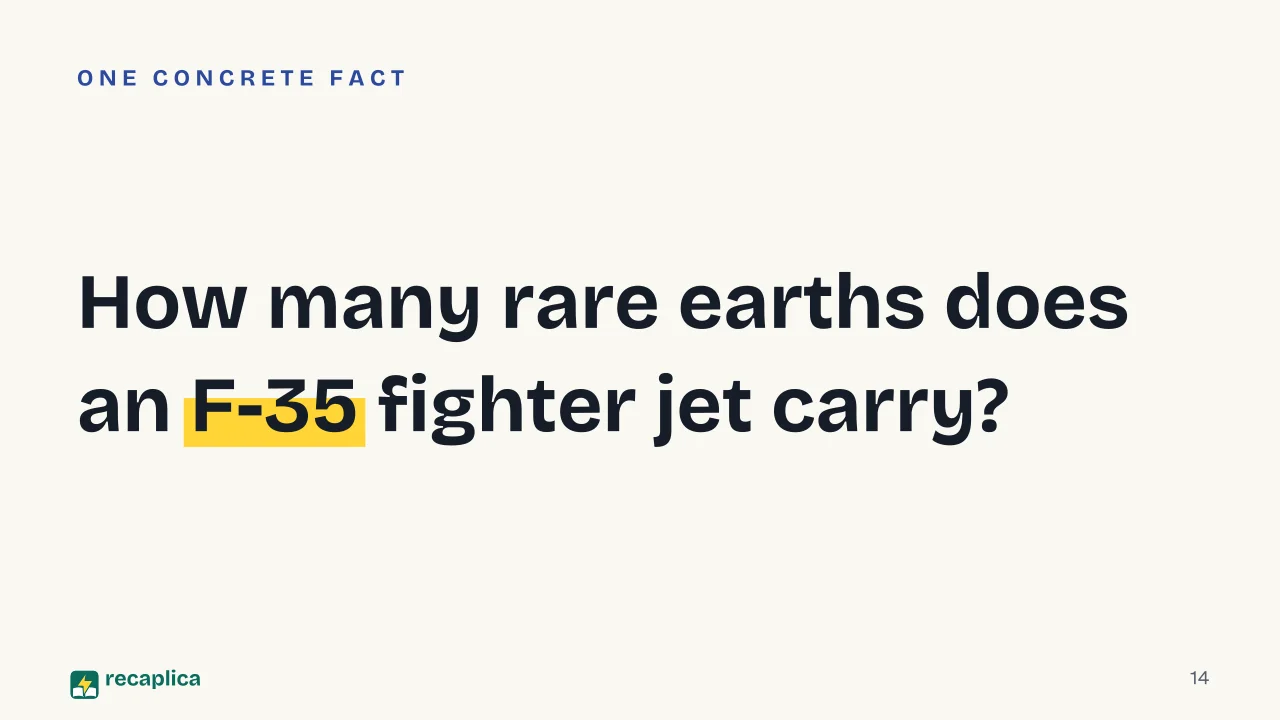
    Military dependence makes the issue concrete: according to CSIS, an F-35 fighter jet carries over 400 kg of rare earths, a Virginia-class submarine around 4,170 kg, and a DDG-51 destroyer around 2,360 kg. On the industrial side, world production of neodymium-iron-boron magnets stood at roughly 138,000 tonnes in 2018; by 2024 China alone was producing roughly 300,000 tonnes, while the United States was expected to produce only around 1,000 tonnes by the end of 2025, according to CSIS. That gap in industrial scale, on top of the geological one, is part of what drives this dependence.

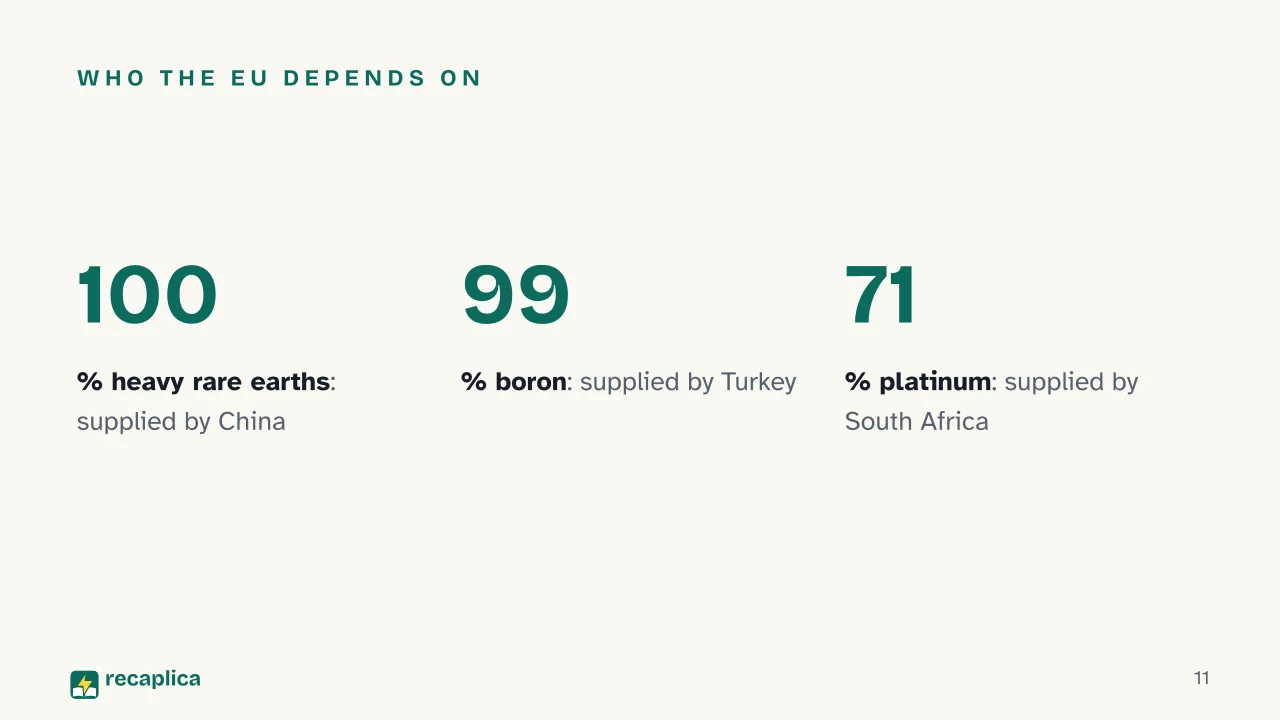
    For the European Union the dependence is already measurable country by country: according to the European Commission, in a snapshot covering 2023-2024, China supplies 100% of the heavy rare earths used in the EU, Turkey 99% of its boron, and South Africa 71% of its platinum. A trade freeze, or even a slowdown in licensing, can ripple through entire industrial sectors, with effects that also show up as inflation when supplies stall and prices jump.

    Europe’s answer: the Critical Raw Materials Act

    The European Union has responded by steadily expanding its list of critical raw materials — the way the bloc decides and legislates runs through exactly this kind of regulation, adopted by Parliament and Council on a Commission proposal. The list grew from 14 entries in 2011 to 20 in 2014, 27 in 2017, 30 in 2020, and 34 in the 2023 revision, a subset of which is classified as “strategic.”

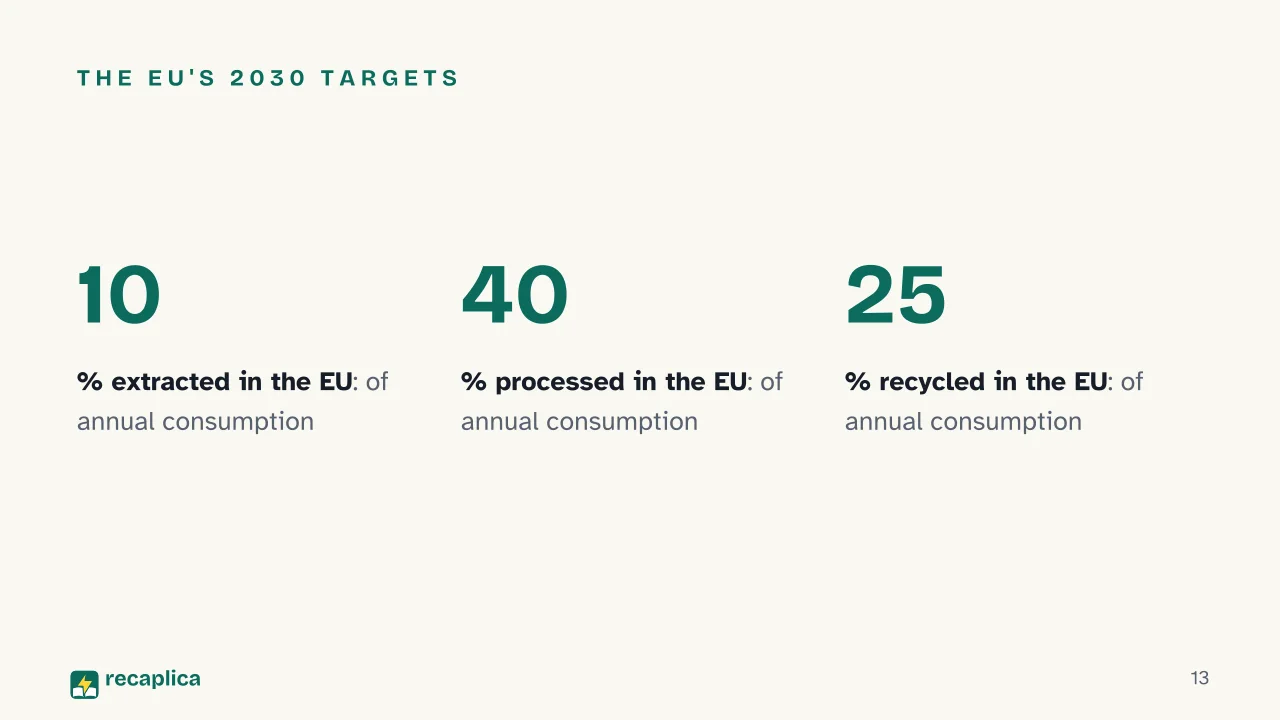
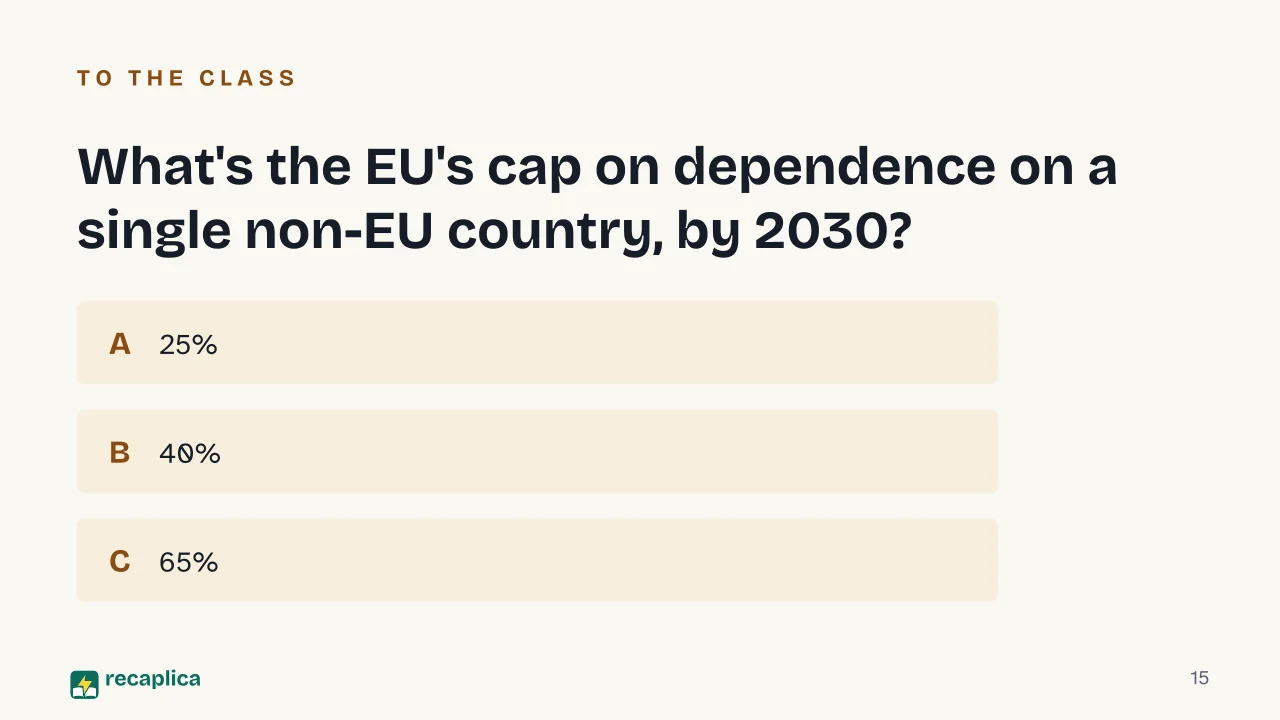
    The Critical Raw Materials Act, Regulation (EU) 2024/1252, which entered into force on 23 May 2024, sets three quantitative targets to be met by 2030: extract at least 10% of the EU’s annual consumption of strategic raw materials domestically, process at least 40% internally, and recycle at least 25%. On top of that sits a dependence cap: by 2030, no single non-EU country may supply more than 65% of the EU’s annual consumption of any given strategic raw material.

    These are ambitious goals relative to where the EU starts, even if the 65% cap still leaves room for very heavy reliance on a single supplier. The IEA’s own projection for 2035, in fact, is that global refining concentration will decline only marginally from 2024 levels, drifting back close to where it stood in 2020.

    What it means for industry and the energy transition

    The most exposed supply chains are the ones already built around batteries and electric motors. Europe’s car industry, still working through the crisis that hit several manufacturers in the 2020s, competes in a market where the cost and availability of critical minerals feed directly into the sticker price of electric cars. A single export licence denied or delayed on one rare-earth element can stall a motor production line thousands of kilometres away.

    For countries building out renewable power, from solar to wind, the logic runs the same way: installed capacity depends on a chain that starts in a handful of mines and narrows further through even fewer refining plants. Diversifying that chain — new lithium producers, more recycling, more processing capacity outside China — is where much of the energy security of the coming years will be decided.

    Slide deck

    Slides ready to download and make your own in PowerPoint or Google Slides, with speaker notes. Pick the Flash cut or the Full one.
    Slide 1 of the presentation on Critical Minerals: Critical MineralsSlide 2 of the presentation on Critical Minerals: How many extra minerals does an electric car need?Slide 3 of the presentation on Critical Minerals: The roadmapSlide 4 of the presentation on Critical Minerals: Chapter 01: More minerals, more demandSlide 5 of the presentation on Critical Minerals: The energy multiplierSlide 6 of the presentation on Critical Minerals: Chapter 02: Where production concentratesSlide 7 of the presentation on Critical Minerals: Top 3 · Top 3 · ExceptionSlide 8 of the presentation on Critical Minerals: Rare earths aren't actually rareSlide 9 of the presentation on Critical Minerals: Chapter 03: China's export leverageSlide 10 of the presentation on Critical Minerals: The timeline of China's restrictionsSlide 11 of the presentation on Critical Minerals: Who the EU depends onSlide 12 of the presentation on Critical Minerals: Chapter 04: The EU's responseSlide 13 of the presentation on Critical Minerals: The EU's 2030 targetsSlide 14 of the presentation on Critical Minerals: How many rare earths does an F-35 fighter jet carry?Slide 15 of the presentation on Critical Minerals: What's the EU's cap on dependence on a single non-EU country, by 2030?Slide 16 of the presentation on Critical Minerals: The takeaway
    Flash10 slidesThe essential thread, to present in classFull16 slidesEvery chapter and the deeper detail

    Common myths

    • ✗ Myth Rare earths are scarce, that's why they're called that

      ✓ Reality The name is misleading: rare earths occur in workable concentrations on every continent. What's actually scarce is something else entirely — the industrial capacity to turn ore into usable material, a costly, polluting process most countries have never built at scale.

    • ✗ Myth China leads in rare earths because it holds most of the world's deposits

      ✓ Reality China's edge is industrial, not geological. According to CSIS, China accounted for as much as 99% of global heavy rare-earth processing through 2023, built over decades of investment in refining plants, not a lock on the ore itself. Lithium shows the difference: newcomers such as Argentina and Zimbabwe are already winning market share there, proof that concentration is a choice, not a law of geology.

    • ✗ Myth Electrifying transport and power ends dependence on foreign raw materials

      ✓ Reality The IEA finds that a typical electric car needs six times the mineral inputs of a conventional one, and an offshore wind farm up to thirteen times those of a gas plant of the same size — materials concentrated among fewer suppliers than oil ever was.

    Mind map

    Drag the background to move around and the nodes to reposition them; use − and + to collapse and expand branches.
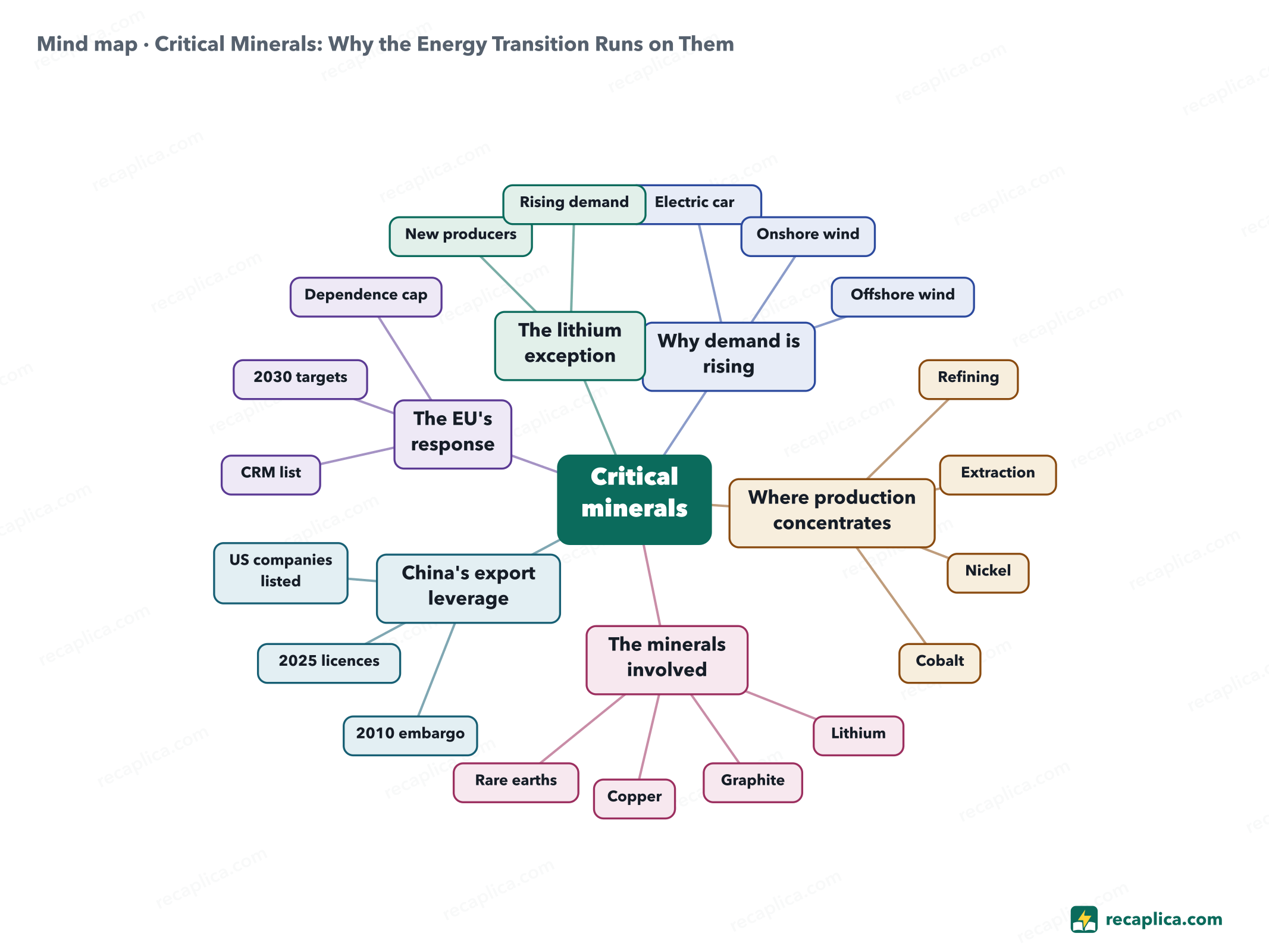
    Customize
    Mind map: Critical Minerals: Why the Energy Transition Runs on Them
    • Critical minerals
      • Why demand is rising
        • Electric car Six times the minerals of a conventional car
        • Onshore wind Nine times the minerals of a gas plant
        • Offshore wind Thirteen times the minerals of a gas plant
      • Where production concentrates
        • Refining 86% of world output in the top three countries, 2024
        • Extraction 77% of world output in the top three countries, 2024
        • Nickel Indonesia is the leading producer
        • Cobalt Mined in the DRC, refined mostly in China
      • The minerals involved
        • Lithium Batteries, emerging producers growing
        • Graphite Battery anodes
        • Copper Wiring and electric motors
        • Rare earths Permanent magnets
      • China's export leverage
        • 2010 embargo Exports to Japan blocked
        • 2025 licences Controlled exports on seven elements
        • US companies listed Sixteen firms placed under export control
      • The EU's response
        • CRM list 34 critical raw materials, since 2023
        • 2030 targets 10% extracted, 40% processed, 25% recycled
        • Dependence cap Maximum 65% from a single non-EU country
      • The lithium exception
        • New producers Argentina and Zimbabwe expanding
        • Rising demand Nearly 30% growth in 2024

    Quiz: test yourself

    Answer the questions to check what you have learned: you get instant feedback and a short explanation.

    Grade 0/10 0/5
    1 Which raw material breaks the pattern of production concentrating around one dominant country, between 2020 and 2024?

    For cobalt, graphite and rare earths, the IEA estimates that about 90% of production growth between 2020 and 2024 came from a single dominant supplier. Lithium is the exception, with emerging producers adding meaningful new supply.

    2 How many heavy rare-earth elements did China place under mandatory export licences in April 2025?

    China's Ministry of Commerce imposed licences on 7 elements: samarium, gadolinium, terbium, dysprosium, lutetium, scandium and yttrium, according to CSIS.

    3 What cap does the EU's critical raw materials regulation set on dependence on a single non-EU supplier, by 2030?

    The Critical Raw Materials Act sets a limit: by 2030, no single non-EU country may supply more than 65% of the EU's annual consumption of any given strategic raw material.

    4 According to the IEA, how many times more minerals does a typical electric car require than a conventional one?

    The IEA estimates a typical electric car needs six times the mineral inputs of a conventional car with a combustion engine.

    5 True or false: rare earth elements are geologically scarce in the earth's crust.

    False: rare earths occur in workable concentrations worldwide. The scarce resource is processing capacity, not the ore itself.

    Answers: 1-A · 2-B · 3-C · 4-C · 5-B

    Flashcards

    Tap the card to flip it and check whether you remember the answer, then move to the next one.

    1 / 8

    Explain it in your own words

    The ultimate test: if you can explain it in simple words, you've truly understood it. Write your explanation, then compare it with the Recap.

    Your explanation is saved only on this device.

    Solar panels, wind turbines, batteries and electric motors run on materials that fossil-fuel technology barely needs: lithium, cobalt, nickel, copper, graphite and rare earths. Mining, and especially refining, these minerals is concentrated in a small number of countries — by 2024 the top three refining nations controlled 86% of world output, up from 82% in 2020, according to the International Energy Agency. China has already used that position as leverage, from the 2010 embargo on Japan to export licences imposed in 2025 on seven heavy rare-earth elements. The European Union answers with the Critical Raw Materials Act, which sets domestic extraction, processing and recycling targets and caps dependence on any single supplier outside the bloc by 2030.

    Frequently asked questions

    What are the main critical minerals for the energy transition?

    Lithium, cobalt, nickel, graphite, copper and rare earths are among the most cited: they go into batteries, electric motors, wind turbines and solar panels. The European Union listed 34 of them in its 2023 update.

    Why is there so much concern about dependence on China for critical minerals?

    Because China leads not just in mining some of these minerals but especially in refining them: according to CSIS, it accounted for as much as 99% of global heavy rare-earth processing through 2023, and in April 2025 used that position to impose export licences on seven elements.

    What does the EU's Critical Raw Materials Act require?

    Regulation (EU) 2024/1252 sets 2030 targets for the EU to extract at least 10%, process at least 40% and recycle at least 25% of its annual consumption of strategic raw materials, plus a cap limiting any single non-EU supplier to 65% of that consumption.

    Are rare earths really rare in nature?

    No: workable deposits exist on every continent. What's scarce is processing capacity — an expensive, polluting business built at real scale in very few places, mostly China.

    What does Europe risk if it doesn't reduce its dependence on critical minerals?

    Disruption to supplies it can't easily replace: according to the European Commission, in the 2023-2024 snapshot China supplies 100% of the heavy rare earths used in the EU, Turkey 99% of its boron, and South Africa 71% of its platinum.

    Sources

    • IEA — Global Critical Minerals Outlook 2025 (Executive summary)
    • European Commission — Critical raw materials
    • European Commission — European Critical Raw Materials Act
    • CSIS — The Consequences of China's New Rare Earths Export Restrictions
    • IEA — The Role of Critical Minerals in Clean Energy Transitions (Executive summary)

    Every Recap goes through an independent review before publication.

    Every evening, the day's new Recaps on our Telegram channel. Join the channel →

    Keep learning

    • Economics Labor Market: How Supply, Demand and Unemployment Work The labor market is where businesses that need workers to produce goods and services meet the people willing to work for them. In the textbook model, that meeting sets wages and employment levels the way any other market would, but imperfect information, bargaining power and legal rules push the real market away from pure competition. Those gaps are where unemployment comes from, and economists split it into frictional, structural, cyclical and technological types depending on the cause. Official statistics, such as Italy's ISTAT, measure it against the labor force — people employed plus people actively looking for work — not the whole population. As of July 2026, Italy's unemployment rate stood at 5.8%, provisional, against 6.4% for the euro area. Read the Recap →
    • Economics Mercantilism: History, Examples, and Definition Mercantilism was the dominant economic doctrine in Western Europe from the 16th to the 18th century: a state grew powerful by selling more abroad than it bought, building up reserves of gold and silver. Britannica Money describes it as "an economic practice by which governments used their economies to augment state power at the expense of other countries." Colonies had one job under this system: supply raw materials to the mother country and buy finished goods back from it, while at home tariffs and monopolies shielded domestic industry. The name itself came later, from the doctrine's most famous critic: Adam Smith made it current in The Wealth of Nations, published in 1776. Read the Recap →
    • Economics Keynesianism explained: the theory born from the Great Depression Keynesianism is the body of economic thinking named after John Maynard Keynes, the British economist who in the 1930s offered a different way of reading a slump. The IMF notes that when the Great Depression hit, the economic theory of the day could neither explain the collapse nor say how to restart production and employment. Keynes put aggregate demand at the centre — the total spending of households, businesses and government — and argued that full employment is a special case rather than something markets deliver on their own. That is where the idea comes from that public spending can step in when private demand stalls. Keynesianism guided economic policy from the end of the Second World War until the 1970s, then lost ground. Read the Recap →

    recaplica

    Clear in 30 seconds, yours in 10 minutes.

    Recaps Mind maps Request a Recap Telegram channel Mind map maker Our method About Privacy & cookies Legal notes & terms of use

    © 2026 Recaplica · A project by Curi S.r.l. — VAT IT05472000750

    Statistics, only if you say so

    To learn which Recaps help most we would use Google Analytics, with aggregate, anonymous data. It starts only with your OK, and you can change your mind anytime. Privacy policy