recaplica
Clear in 30 seconds, yours in 10 minutes.
In 30 seconds quick read
Rare earth elements are a group of 17 chemical elements: the 15 lanthanides plus scandium and yttrium. The name is misleading — these elements are fairly common in the Earth's crust, but they rarely occur in deposits concentrated enough to mine profitably. China produces the largest share by far, followed by the United States, Australia, and Myanmar. Their main use is in powerful permanent magnets, alongside catalysts, lasers, specialty glass, and some medical applications.
Key Points
Rare earth elements are 17 in total: the 15 lanthanides (lanthanum through lutetium) plus scandium and yttrium.
The word 'rare' is misleading: these elements are widespread in the Earth's crust, but hard to find in concentrations worth mining.
In 2025 global production reached about 390,000 tonnes, according to the USGS; China supplied roughly 270,000 of those.
Worldwide, the leading use is in permanent magnets, followed by catalysts, batteries, glass, and metal alloys.
Neodymium, praseodymium, terbium, and dysprosium are the key elements in high-performance permanent magnets.
Most rare earths are extracted from two minerals, monazite and bastnaesite, through complex separation processes.
Key figures
390,000 t Global rare earth production (rare earth oxide equivalent, REO) in 2025 Source: USGS, Mineral Commodity Summaries 2026 (February 2026)
~69% China's share of global rare earth production in 2025 (270,000 t out of 390,000 t) Source: USGS, Mineral Commodity Summaries 2026 (February 2026)
over 85 million t Estimated global rare earth reserves (oxide equivalent, REO) in 2025 Source: USGS, Mineral Commodity Summaries 2026 (February 2026)
Deep Dive
Rare earth elements aren’t a single mineral but a family of 17 elements occupying one specific corner of the periodic table: the 15 lanthanides, from lanthanum to lutetium, joined by scandium and yttrium because of closely matching chemical behavior. Several were first isolated from a quarry near the Swedish village of Ytterby, which lent its name to four of them — ytterbium, yttrium, terbium, and erbium all trace back to that one site.
Element
Symbol
Lanthanum
La
Cerium
Ce
Praseodymium
Pr
Neodymium
Nd
Promethium
Pm
Samarium
Sm
Europium
Eu
Gadolinium
Gd
Terbium
Tb
Dysprosium
Dy
Holmium
Ho
Erbium
Er
Thulium
Tm
Ytterbium
Yb
Lutetium
Lu
Scandium
Sc
Yttrium
Y
The name “rare earths” dates back to a period when these elements seemed scarce, since they turned up in only a few uncommon minerals. Chemists now know they’re fairly widespread in the Earth’s crust. The real bottleneck is geological, not chemical: these atoms rarely settle into deposits rich enough to mine at a profit, while other, more “ordinary” resources form workable deposits far more often.
Global production in 2025 reached roughly 390,000 tonnes of oxide equivalent, according to the USGS. China remains the top producer at about 270,000 tonnes — nearly seven-tenths of the total — though it’s not the only country in the game.
Country
2025 production (tonnes REO)
China
270,000
United States
51,000
Australia
29,000
Myanmar (Burma)
22,000
Thailand
4,800
India
2,900
Madagascar
2,700
Russia
2,600
Brazil
2,000
Nigeria
1,500
Vietnam
150
Malaysia
110
In the United States, most output comes from the Mountain Pass mine in California, where bastnaesite is extracted. Bastnaesite and monazite are the two minerals that yield most of the lanthanides, processed through chemical separation methods like ion exchange and solvent extraction — though refining still happens almost entirely in China.
So what are they actually for? Worldwide, the leading application is permanent magnets; in the United States, domestic demand leans more heavily on catalysts. Of the 17 elements, four in particular — neodymium, praseodymium, terbium, and dysprosium — are considered essential for high-performance permanent magnets, the kind that pack a strong magnetic field into a compact size.
Practical example: the motor in an electric car or the generator inside a wind turbine often relies on neodymium-iron-boron permanent magnets. Small amounts of dysprosium or terbium get added to the alloy so it can withstand the heat the motor generates during operation, keeping the magnet from losing its strength.
Magnets aren’t the whole story. Cerium, the most abundant element in the group, goes into catalytic converters and self-cleaning oven glass; yttrium forms the YAG crystal used in lasers that cut metal, and one of its isotopes shows up in certain medical treatments; dysprosium also appears in halogen discharge lamps and nuclear reactor control rods; scandium, alloyed with aluminum, strengthens bicycle frames and aerospace components. Many of these uses lean on the same magnetic and electrical properties that come into play whenever electric current passes through a magnet or a motor.
Estimated global reserves in 2025 top 85 million tonnes of oxide equivalent, with China holding the largest share, followed by Brazil. These numbers explain why elements that are far from impossible to find in nature have still become a matter of international concern: extraction, and especially processing, is concentrated in very few hands, which is why rare earths keep coming up in discussions of critical minerals and the security of industrial supply chains — a question of economics and geopolitics, separate from the chemistry itself.
Common myths
✗ Myth Rare earth elements are extremely scarce, almost impossible to find on Earth.
✓ Reality They're actually fairly common in the Earth's crust. What's genuinely scarce is a deposit rich enough to be worth mining, since most rare earth atoms are scattered thinly through ordinary rock. The name dates back centuries, to a time when only a handful of unusual minerals were known to contain them, and it has stuck ever since even though it no longer fits.
✗ Myth Rare earth elements are only mined in China.
✓ Reality China is the top producer, with about 270,000 tonnes out of a 2025 global total of 390,000, but it isn't the only one: the United States produced 51,000 tonnes, Australia 29,000, and Myanmar 22,000, with smaller amounts coming from Thailand, India, Madagascar, Russia, Brazil, Nigeria, Vietnam, and Malaysia.
✗ Myth Rare earths are only used to make magnets for smartphones.
✓ Reality Permanent magnets are the single biggest use worldwide, but far from the only one: dysprosium also shows up in halogen discharge lamps and in nuclear reactor control rods, cerium in catalytic converters and self-cleaning oven glass, and yttrium in medical and industrial YAG-crystal lasers.
Mind map
Drag the background to move around and the nodes to reposition them; use − and + to collapse and expand branches.
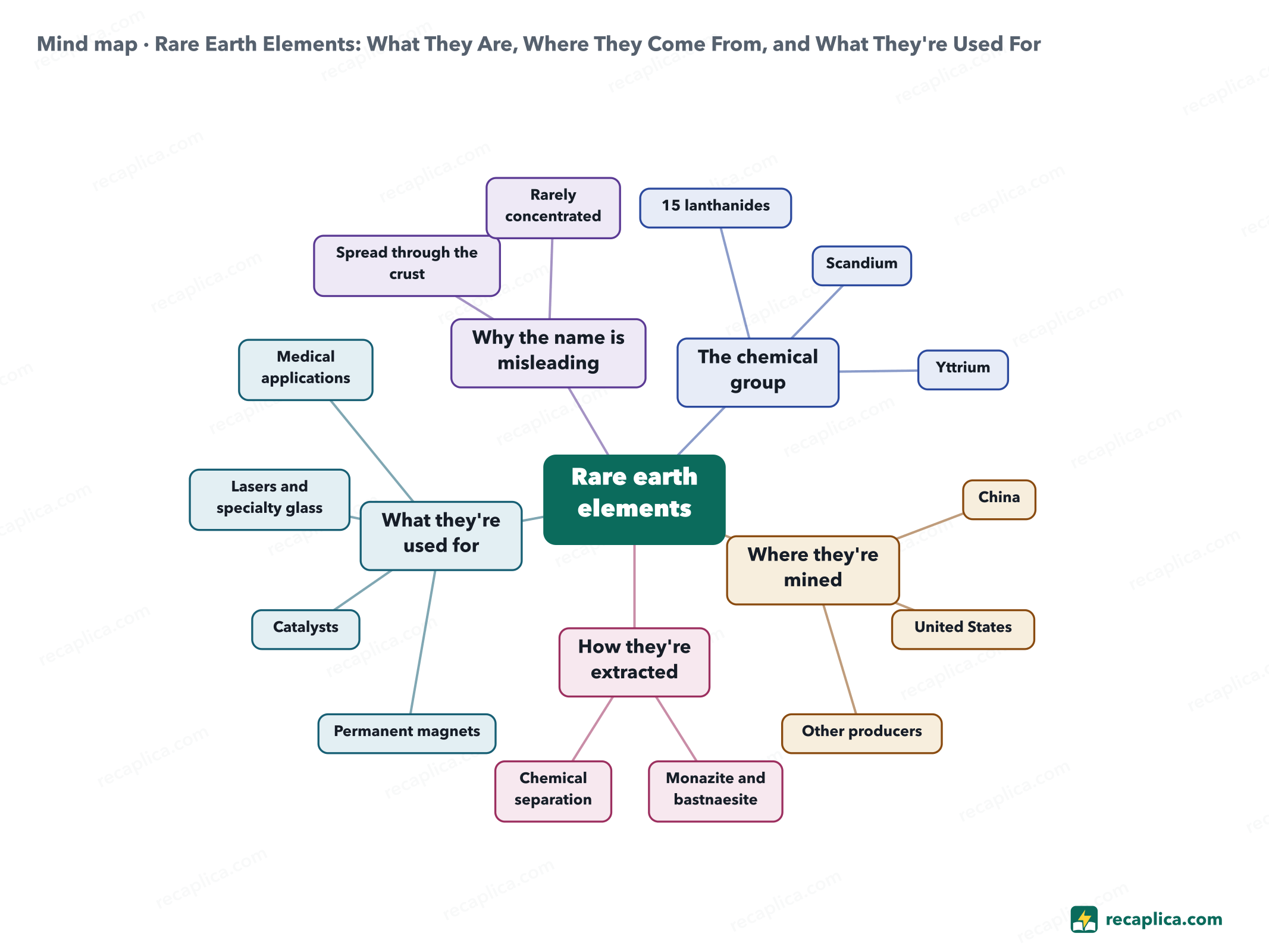
Other producersAustralia, Myanmar, Thailand, India, and others
How they're extractedminerals and processes
Monazite and bastnaesitethe two main source minerals for most lanthanides
Chemical separationion exchange and solvent extraction
What they're used formain industrial applications
Permanent magnetsthe leading use worldwide, neodymium-iron-boron
Catalyststhe main use in the United States, including cerium
Lasers and specialty glassyttrium, neodymium
Medical applicationsisotopes such as yttrium-90
Why the name is misleadingabundance versus concentration
Spread through the crustpresent in small amounts almost everywhere
Rarely concentratedfew deposits are economical to mine
Quiz: test yourself
Answer the questions to check what you have learned: you get instant feedback and a short explanation.
Grade0/100/5
Answers: 1-B · 2-A · 3-B · 4-B · 5-A
Flashcards
Tap the card to flip it and check whether you remember the answer, then move to the next one.
1 / 7
Explain it in your own words
The ultimate test: if you can explain it in simple words, you've truly understood it. Write your explanation, then compare it with the Recap.
Your explanation is saved only on this device.
Rare earth elements are a group of 17 chemical elements: the 15 lanthanides plus scandium and yttrium. The name is misleading — these elements are fairly common in the Earth's crust, but they rarely occur in deposits concentrated enough to mine profitably. China produces the largest share by far, followed by the United States, Australia, and Myanmar. Their main use is in powerful permanent magnets, alongside catalysts, lasers, specialty glass, and some medical applications.
Frequently asked questions
What is rare earth elements, in simple terms?
It's a group of 17 chemical elements on the periodic table: the 15 lanthanides, from lanthanum to lutetium, plus scandium and yttrium. They share similar chemical properties and are usually found together in the same minerals.
What is the full rare earth elements list?
The 15 lanthanides (lanthanum, cerium, praseodymium, neodymium, promethium, samarium, europium, gadolinium, terbium, dysprosium, holmium, erbium, thulium, ytterbium, lutetium) plus scandium and yttrium, for a total of 17 elements.
Where are rare earth elements found?
The leading producer is China, with about 270,000 tonnes in 2025 out of a 390,000-tonne global total. The United States, Australia, and Myanmar follow, with smaller amounts from Thailand, India, Madagascar, Russia, Brazil, Nigeria, Vietnam, and Malaysia.
What are some real-world rare earth elements examples of use?
Their biggest use worldwide is in permanent magnets for electric motors and wind turbines. They also go into catalysts, batteries, specialty glass and ceramics, metal alloys, lasers, and some medical applications.
Are rare earth elements actually rare?
Not in the everyday sense of the word: they're relatively abundant in the Earth's crust. What's rare is finding a deposit concentrated enough to mine economically.
Every Recap goes through an independent review before publication.
Statistics, only if you say so
To learn which Recaps help most we would use Google Analytics, with aggregate, anonymous data. It starts only with your OK, and you can change your mind anytime. Privacy policy