Skip to content
recaplica

    One moment: security check

    Cloudflare wants to make sure you're not a robot. Tick the box below and your search will continue on its own.

    IT
    recaplica Europe's automotive industry crisis: causes and numbers
    © 2026 Recaplica · recaplica.com — All rights reserved
    Home › Economics

    Europe's automotive industry crisis: causes and numbers

    By Recaplica Newsroom · Updated on September 5, 2026

    What to print

    Page numbers appear when printing with default margins.

    Slides

    Choose a cut

    Flash10 slidesThe essential thread, to present in classFull18 slidesEvery chapter and the deeper detail

    Both come with speaker notes.

    Telegram channel
    recaplica Clear in 30 seconds, yours in 10 minutes.
    In 30 seconds Key points Figures Deep dive Slides Myths Mind map Quiz Flashcards FAQ

    In 30 seconds quick read

    Europe's automotive industry is going through a rough patch: Volkswagen is weighing up to 100,000 job cuts worldwide, Renault up to 2,400 engineering positions, and Stellantis up to 500 voluntary departures at its Melfi plant. There is no single cause: the shift to electric vehicles, higher production costs than in China, competition from Chinese brands, US tariffs and demand that is struggling to recover are all intertwined. The European Union has responded with tariffs on Chinese electric cars and an industrial plan with funding for batteries and research, but the results so far are only partial.

    Key Points

    • The car industry employs around 13 million people in Europe, directly and indirectly — 7% of total EU employment (ACEA).
    • Building a car in the EU is estimated to cost around 30% more than in China, according to the European Parliament.
    • Volkswagen is weighing up to 100,000 job cuts worldwide; Renault up to 2,400 engineering jobs; Stellantis up to 500 voluntary departures at Melfi.
    • Since 30 October 2024, the EU has applied countervailing tariffs (from 7.8% to 35.3%, depending on the manufacturer) on electric cars imported from China, for five years.
    • The causes overlap: the shift to electric vehicles, Chinese competition, energy costs, US tariffs and weak demand — no single one explains the crisis on its own.
    • The impact is uneven: within Stellantis alone, Melfi lost 47.2% of production in 2025 while Mirafiori grew by 16%.

    Key figures

    • 13 million the number of people employed in Europe by the automotive supply chain, directly and indirectly — 7% of total EU employment Source: ACEA
    • 30% how much more it costs to build a car in the European Union than in China, according to the European Parliament's estimate Source: European Parliament (EPRS)
    • 100,000 the jobs worldwide Volkswagen is weighing cutting, about 16% of its global workforce Source: Euronews, July 2026

    Deep Dive

    A sector that carries the weight of an entire country

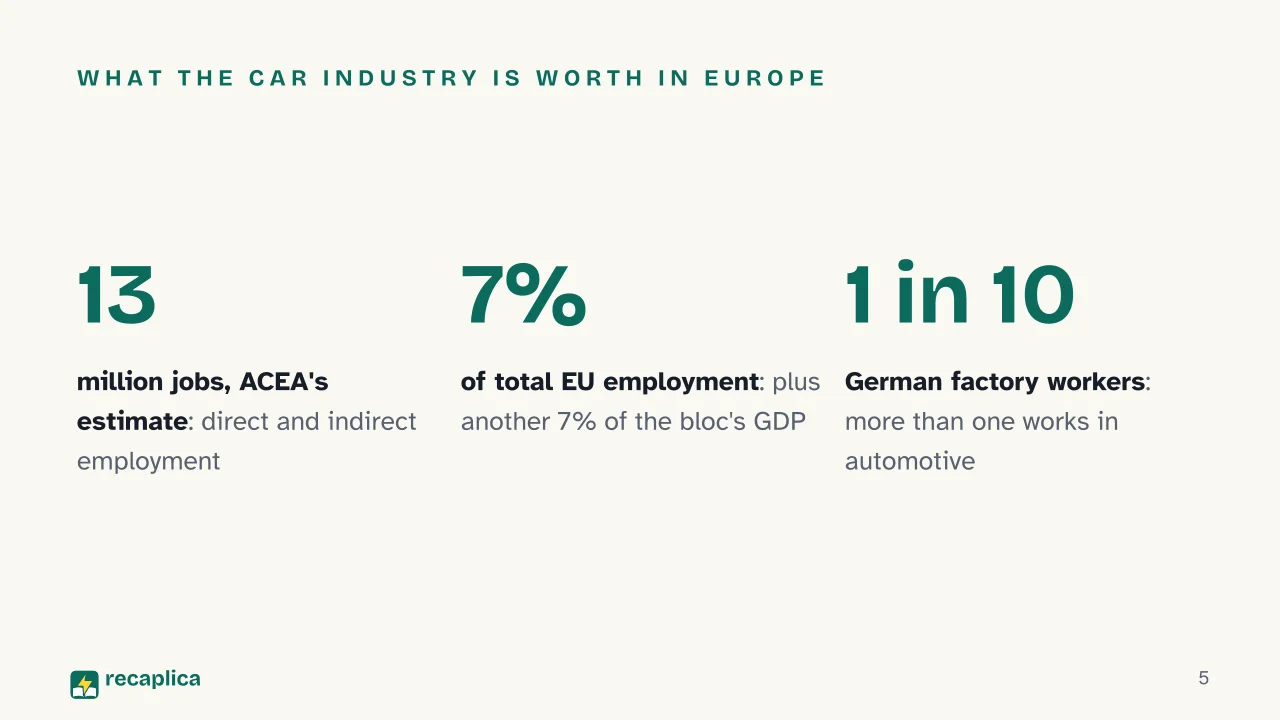
    In Europe, the car industry is not just one sector among many: according to ACEA, the manufacturers’ association, it employs about 13 million people, directly and indirectly — 7% of all jobs in the European Union — and generates a further 7% of the bloc’s GDP. The European Parliament, in an October 2024 briefing, arrives at a similar figure — 13.8 million jobs — and notes that the sector accounts for 8% of Europe’s manufacturing value added. That is why, when major groups announce cuts, the news is not just about shareholders: in Germany, more than one in ten manufacturing workers is employed in the automotive sector.

    In July 2026, EU Commissioner Stéphane Séjourné described the industry as facing “mortal danger” from Chinese production overcapacity — a strong statement that reflects how much pressure had built up in the preceding months.

    The tangled causes

    There is no single culprit. The European Parliament’s briefing lists a set of factors that compound one another: the shift toward low-emission vehicles, weaker supply chains, growing competition from Asia, falling demand for electric models, sluggish economic growth, high energy costs, and the industrial policies of other governments, from US incentives to Chinese subsidies.

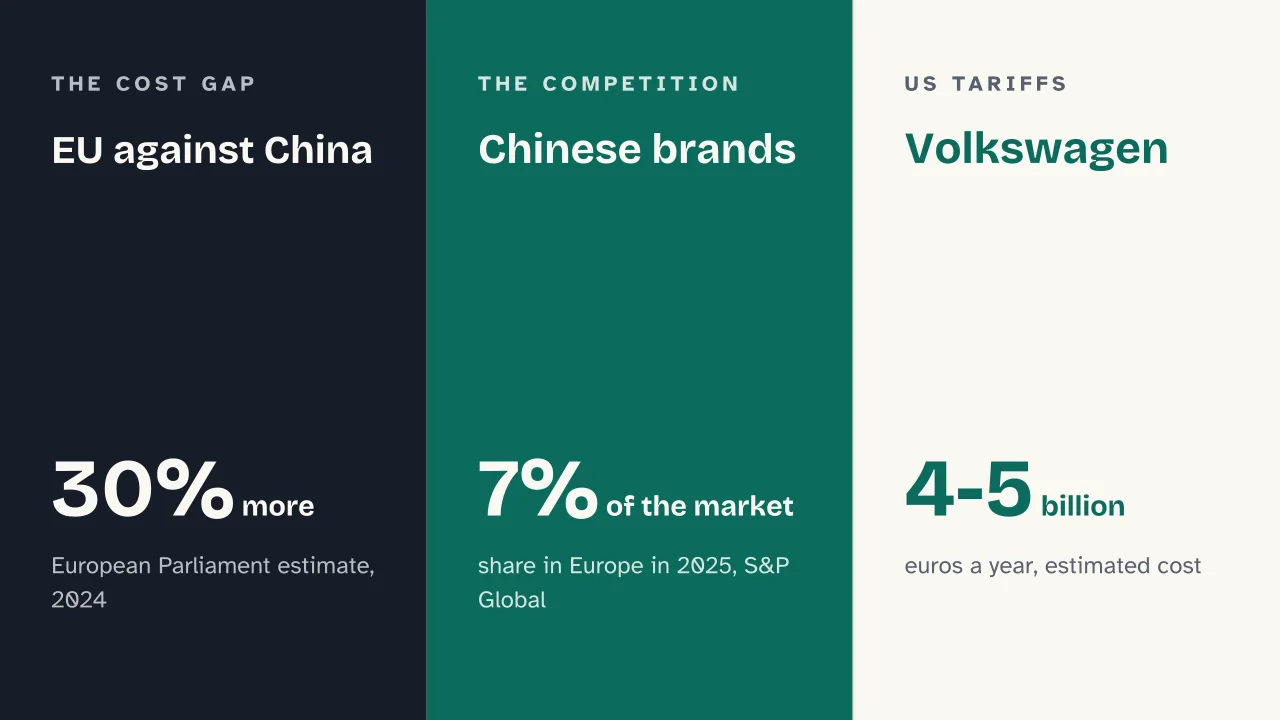
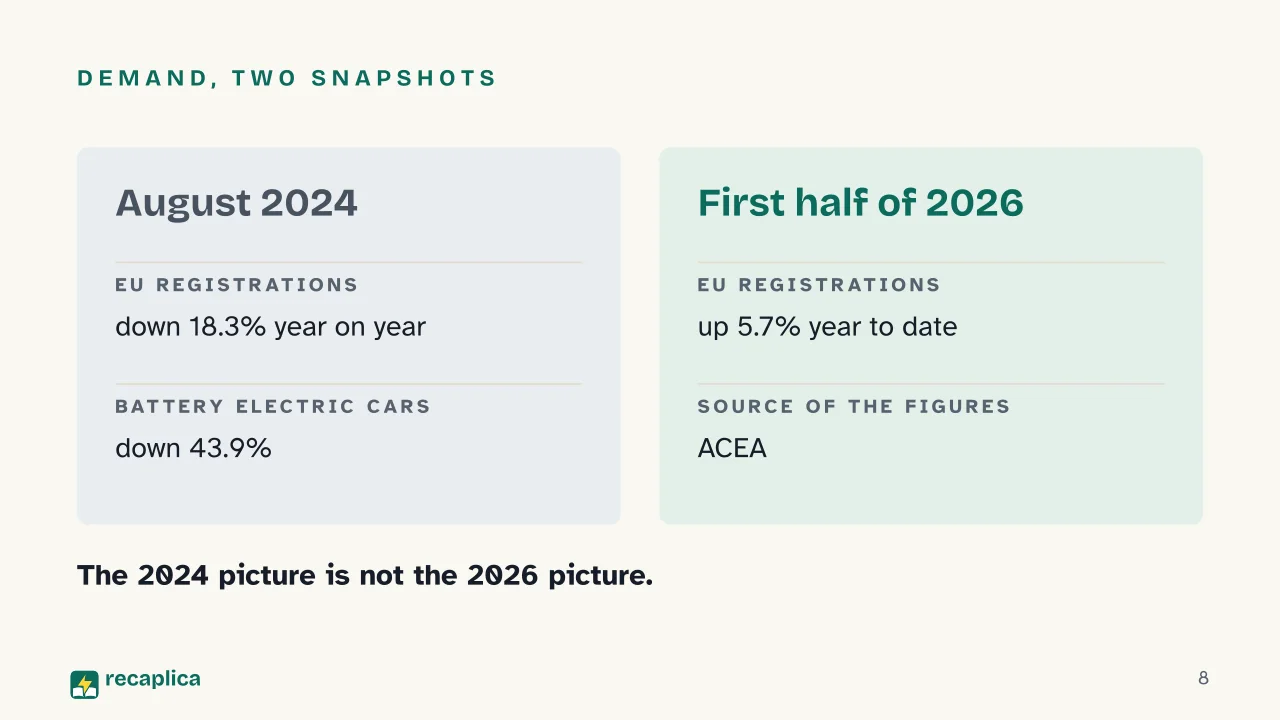
    Among these factors, one is particularly measurable: according to the European Parliament’s estimate, building a car in the European Union costs about 30% more than building it in China. It is one of the central competitive bottlenecks, not the only one: it overlaps with demand that, as of August 2024, had already shown signs of weakness (EU registrations down 18.3% year on year, with battery electric cars down 43.9%), even though the picture in the first half of 2026 turned positive again, with registrations up 5.7% since the start of the year, according to ACEA.

    On top of production costs and Chinese competition come US tariffs on car and component imports, introduced the year before 2026: for the Volkswagen group alone, the estimated annual cost runs between 4 and 5 billion euros, depending on the source. Brands such as Audi and Porsche, which have no production plants in the United States, feel the impact more than others.

    Practical example: picture a group that has to sell the same electric car in three different markets. In Europe, production costs are higher than in China, so margins get squeezed; if that same car is also sold in the United States, an additional tariff like the ones introduced in this period eats further into the bottom line; and if sales in China are falling — as happened to Volkswagen, with deliveries at their lowest since 2011 — there is not much room left to make up the difference elsewhere. None of these three problems on its own would explain a restructuring plan affecting thousands of jobs; together, they do.

    Who is cutting jobs, and where

    The restructuring plans announced in 2026 show just how widespread the pressure is, even if the intensity varies from group to group.

    GroupWhat was announcedDetail
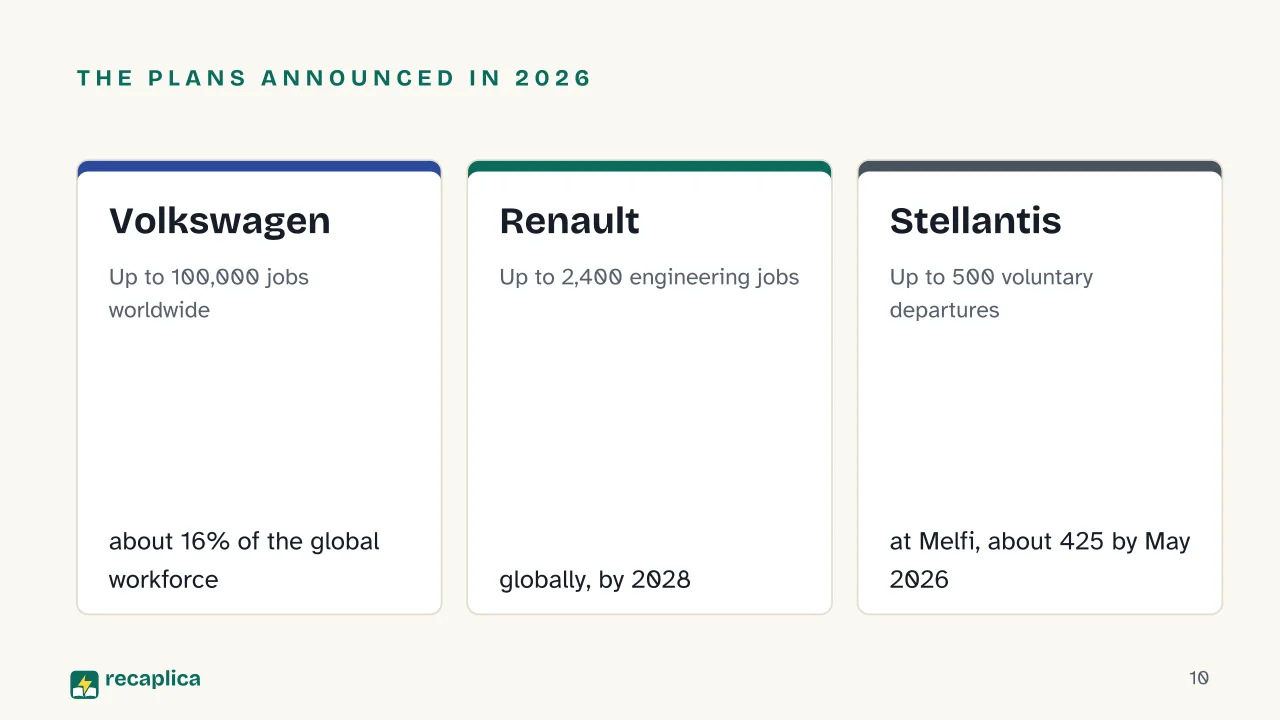
    VolkswagenUp to 100,000 jobs worldwide (about 16% of the global workforce)Four German plants at risk: Hannover, Emden, Zwickau, Audi Neckarsulm
    RenaultUp to 2,400 engineering jobs globally by 2028Separate announcement: 800 jobs cut in France, mostly in Île-de-France, by the end of 2027
    StellantisUp to 500 voluntary departures at Melfi (Basilicata)About 425 departures registered by May 2026, at a plant employing around 5,000 workers

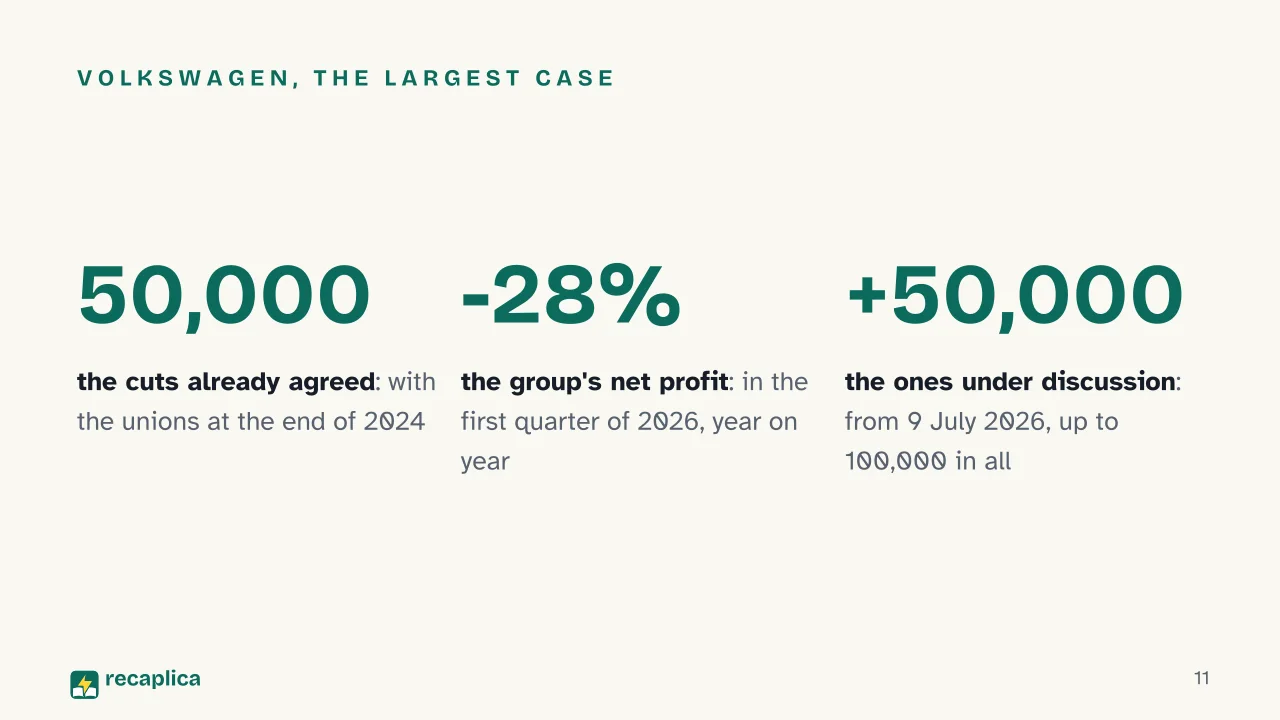
    The Volkswagen case is the largest: on top of the 50,000 cuts already agreed with unions at the end of 2024 (targeting 2030), another 50,000 would be added. CEO Oliver Blume summed up the situation bluntly during the supervisory board meeting on 9 July 2026: the business model of past decades “no longer works,” and the company has to change or risk disappearing. Around the same time, the group’s net profit for the first quarter of 2026 had already fallen 28% year on year.

    Renault points to a specific figure to justify its cuts: Chinese manufacturers are said to have more than tripled their market share in Europe between 2024 and 2026, pushing technologically advanced products at very competitive prices.

    An uneven impact, even within the same group

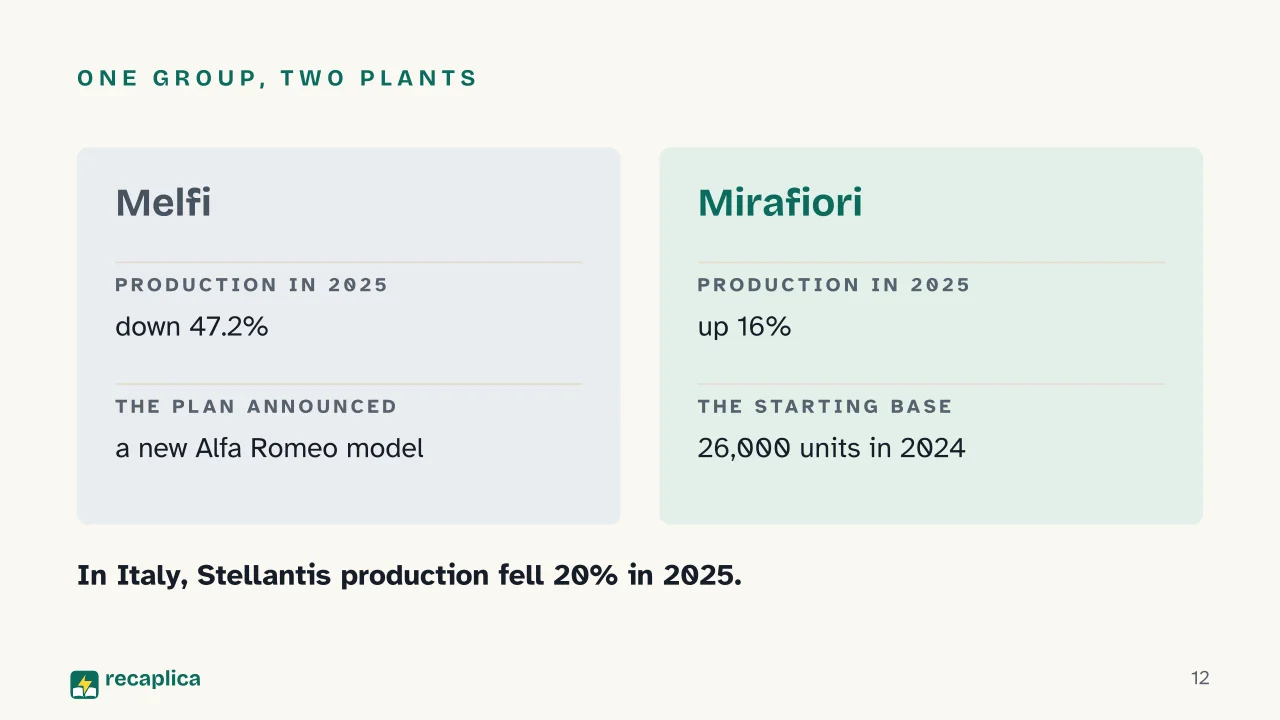
    Not all European production is falling at the same pace, which undercuts the idea of a uniform crisis. In Italy, Stellantis’s overall production fell 20% in 2025 compared with the previous year, with the Melfi plant losing 47.2% — the sharpest decline of any of the group’s Italian sites. In the same year, however, Mirafiori grew 16%, even though it started from a very low base of just 26,000 units produced in 2024. Stellantis has nonetheless confirmed a 2-billion-euro investment plan for Italy, including a new Alfa Romeo model at Melfi and an electric-vehicle program at Pomigliano.

    A crisis that hits unevenly is harder to read than a broad-based downturn; understanding the difference can help explain what a recession actually is and how it is measured — a phenomenon that affects an entire economy, not just one sector.

    Brussels’ response

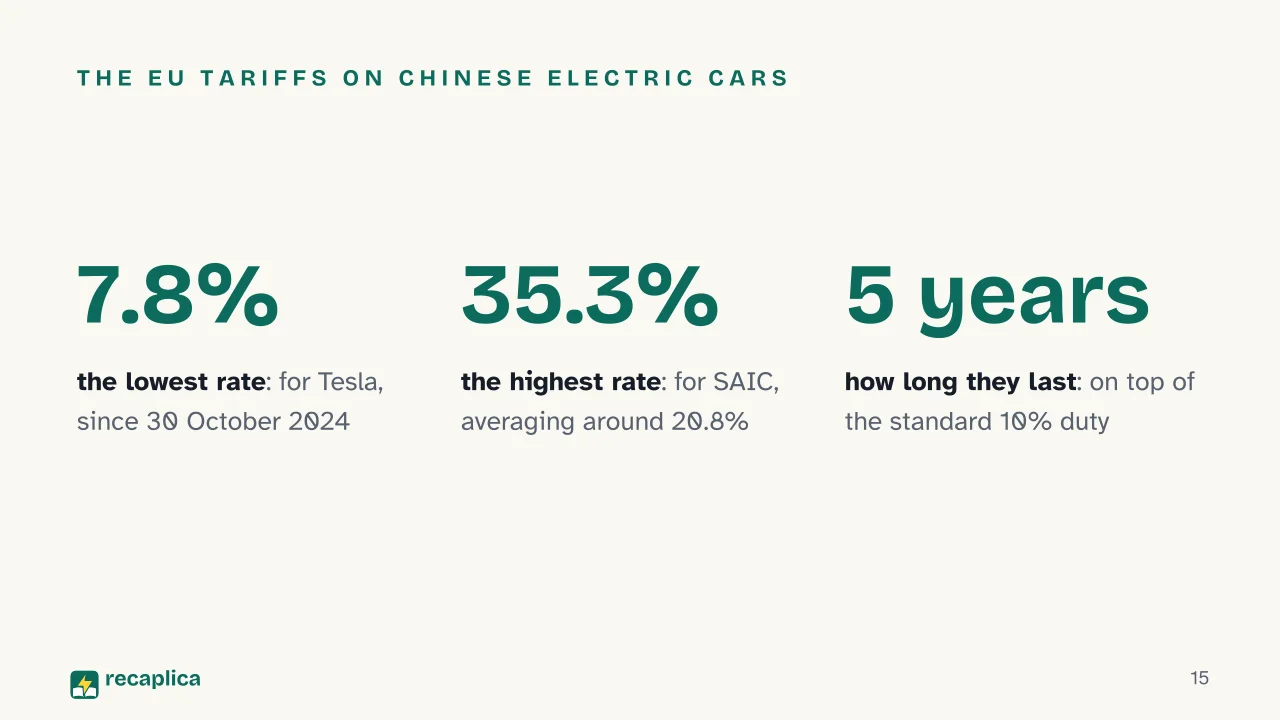
    The European Union has not stood still. Since 30 October 2024 it has applied final countervailing tariffs on battery electric cars imported from China, on top of the existing standard 10% customs duty: the rate varies by manufacturer, from 7.8% for Tesla to 35.3% for SAIC, averaging around 20.8%, and will remain in place for five years. It is the first time the European Commission has launched an anti-subsidy investigation of this kind on its own initiative, without a prior complaint from the industry.

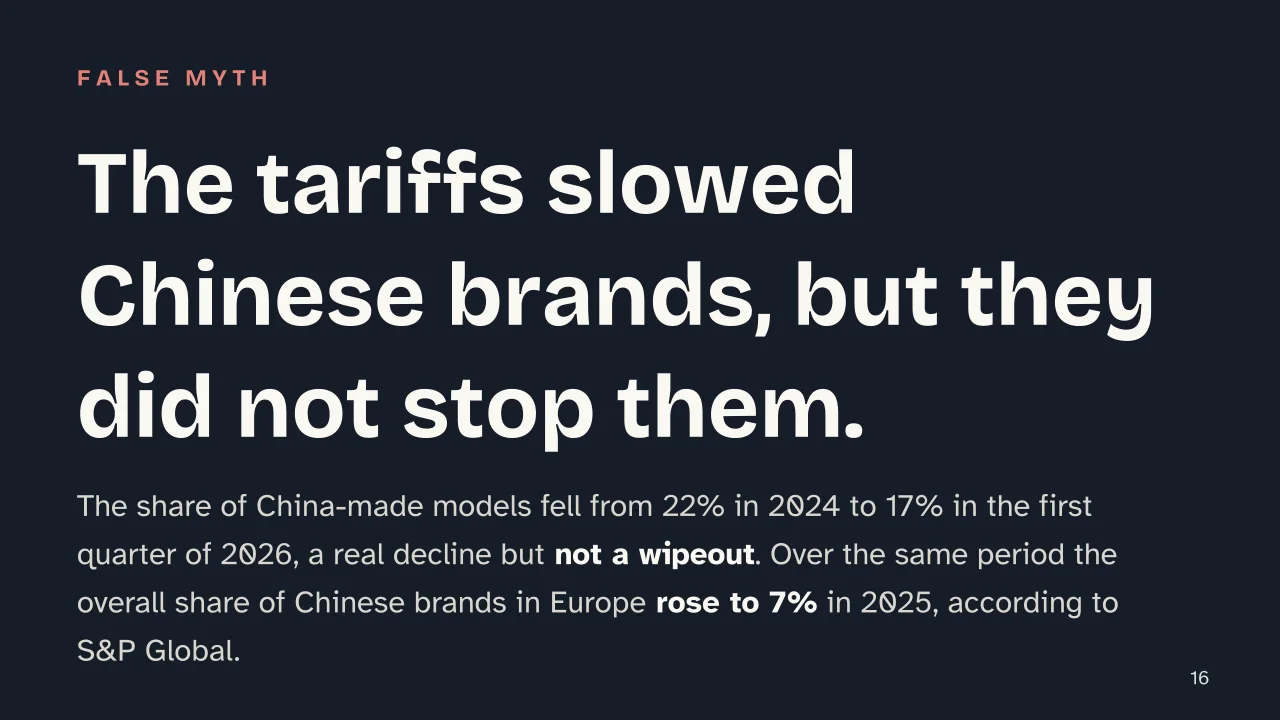
    The results, according to Il Sole 24 Ore, are only partial: the share of China-made models in the European market fell from 22% in 2024 to 17% in the first quarter of 2026 — a five-point drop, but not a wipeout. Meanwhile, according to S&P Global Ratings, the overall share of Chinese brands in Europe (including those also made outside China) still rose to 7% in 2025.

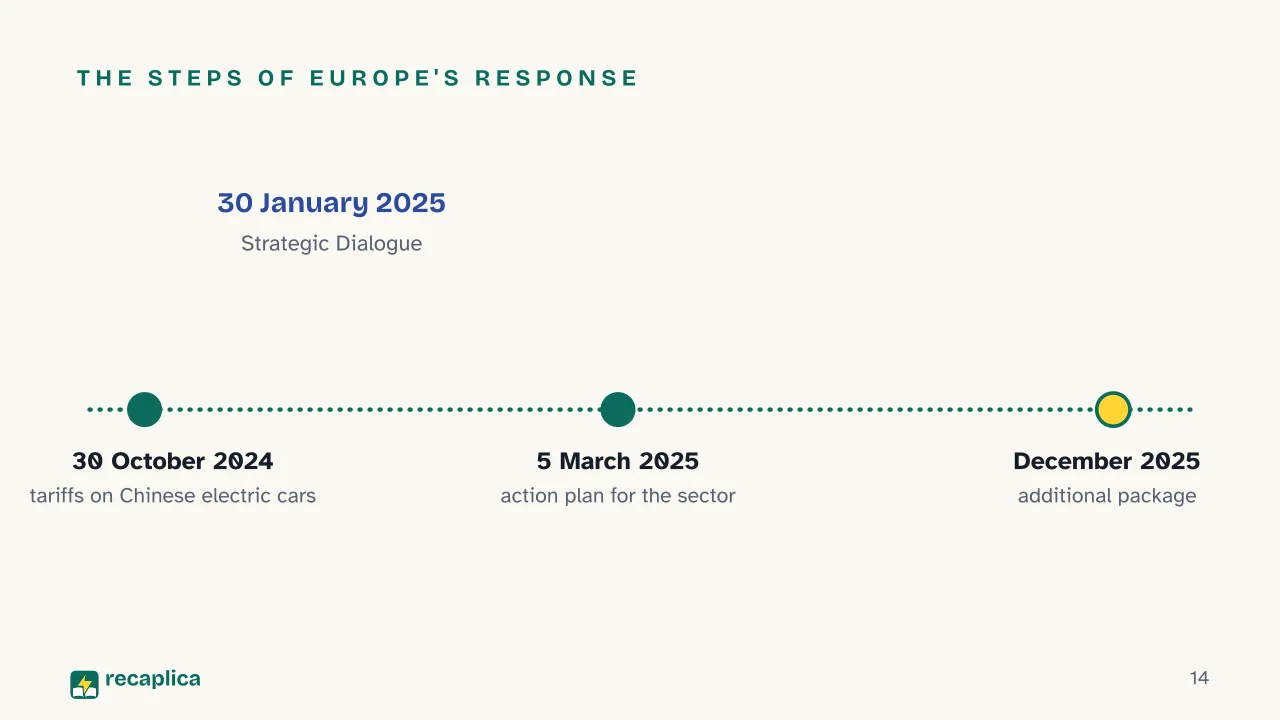
    On the industrial front, the European Commission, led by Ursula von der Leyen, launched a “Strategic Dialogue” on the sector on 30 January 2025 and presented an action plan on 5 March 2025, with an additional package in December 2025. Measures include 1.8 billion euros for battery manufacturing in 2025-2026, 1 billion euros of public-private investment in innovation, 570 million euros for charging infrastructure, and 90 million euros for worker training. Manufacturers also gained more flexibility on CO2 targets, allowing them to average compliance over three years (2025-2027) instead of year by year — though the ban on selling new internal combustion vehicles from 2035 remains unchanged.

    Anyone following the pricing and market dynamics of this kind of industrial crisis may also find it useful to read about how inflation and energy costs work, or about interest rates, which affect carmakers’ ability to finance the shift to electric vehicles. To put the sector’s weight in the broader economy into perspective, the article on GDP is also a good starting point.

    Slide deck

    Slides ready to download and make your own in PowerPoint or Google Slides, with speaker notes. Pick the Flash cut or the Full one.
    Slide 1 of the presentation on Europe's automotive industry crisis: Europe's car industry crisisSlide 2 of the presentation on Europe's automotive industry crisis: How many jobs in Europe depend on the automotive industry?Slide 3 of the presentation on Europe's automotive industry crisis: What we will coverSlide 4 of the presentation on Europe's automotive industry crisis: Chapter 01: What the sector is worthSlide 5 of the presentation on Europe's automotive industry crisis: What the car industry is worth in EuropeSlide 6 of the presentation on Europe's automotive industry crisis: Chapter 02: The tangled causesSlide 7 of the presentation on Europe's automotive industry crisis: EU against China · Chinese brands · VolkswagenSlide 8 of the presentation on Europe's automotive industry crisis: Demand, two snapshotsSlide 9 of the presentation on Europe's automotive industry crisis: Chapter 03: Who is cutting, and whereSlide 10 of the presentation on Europe's automotive industry crisis: The plans announced in 2026: Volkswagen, Renault, StellantisSlide 11 of the presentation on Europe's automotive industry crisis: Volkswagen, the largest caseSlide 12 of the presentation on Europe's automotive industry crisis: One group, two plantsSlide 13 of the presentation on Europe's automotive industry crisis: Chapter 04: Brussels' responseSlide 14 of the presentation on Europe's automotive industry crisis: The steps of Europe's responseSlide 15 of the presentation on Europe's automotive industry crisis: The EU tariffs on Chinese electric carsSlide 16 of the presentation on Europe's automotive industry crisis: The tariffs slowed Chinese brands, but they did not stop them.Slide 17 of the presentation on Europe's automotive industry crisis: Which Italian Stellantis plant grew in 2025?Slide 18 of the presentation on Europe's automotive industry crisis: And now, the review
    Flash10 slidesThe essential thread, to present in classFull18 slidesEvery chapter and the deeper detail

    Common myths

    • ✗ Myth Europe's car industry crisis is caused only by the mandatory shift to electric vehicles.

      ✓ Reality The sources point to several intertwined factors: EU production costs estimated at around 30% more than in China, high energy costs, weak demand, US tariffs (up to 5 billion euros a year in costs for the Volkswagen group alone) and aggressive Chinese price competition. The shift to electric is one factor, not the only one.

    • ✗ Myth The EU's tariffs on Chinese electric cars have stopped Chinese brands' advance in Europe.

      ✓ Reality The share of China-made models fell from 22% (2024) to 17% (first quarter of 2026): a real decline, but not a wipeout. Over the same period the overall market share of Chinese brands in Europe rose to 7% in 2025, according to S&P Global — the tariffs are slowing the advance, not stopping it.

    • ✗ Myth The crisis is hitting every European plant in the same way.

      ✓ Reality The impact is very uneven, even within the same group: at Stellantis, while Melfi lost 47.2% of production in 2025, Mirafiori grew by 16% (albeit from a low base); at Volkswagen, some German plants risk closure while the group keeps investing in new models.

    Mind map

    Drag the background to move around and the nodes to reposition them; use − and + to collapse and expand branches.
    Customize
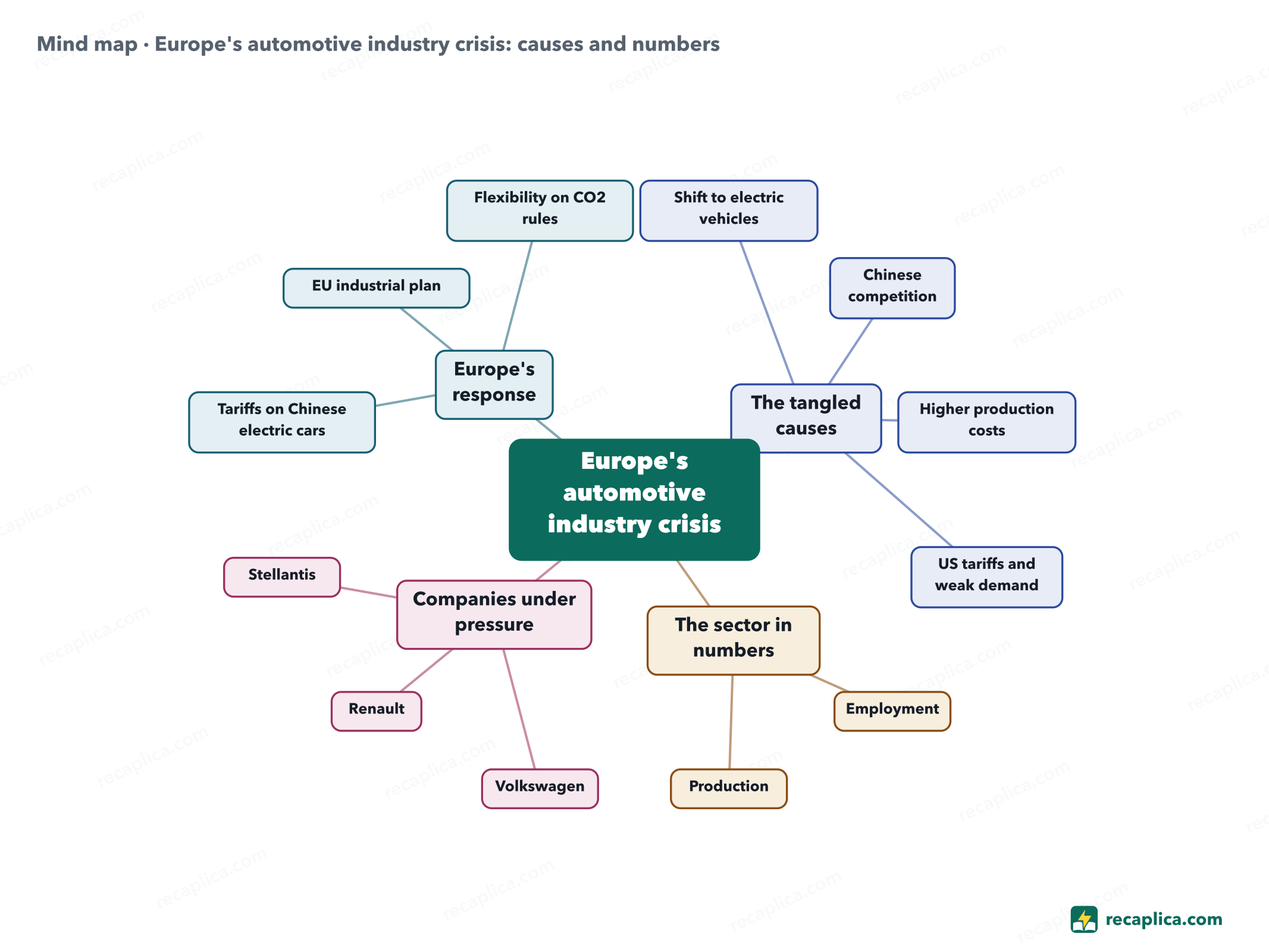
    Mind map: Europe's automotive industry crisis: causes and numbers
    • Europe's automotive industry crisis
      • The tangled causes
        • Shift to electric vehicles
        • Chinese competition Chinese brands' market share rose to 7% in 2025
        • Higher production costs About 30% more than in China
        • US tariffs and weak demand
      • The sector in numbers
        • Employment 13 million jobs, 7% of EU employment
        • Production 14.4 million units in 2025, broadly stable
      • Companies under pressure
        • Volkswagen Up to 100,000 job cuts weighed worldwide
        • Renault Up to 2,400 engineering jobs
        • Stellantis Melfi -47.2%, Mirafiori +16% in 2025
      • Europe's response
        • Tariffs on Chinese electric cars Since 30 October 2024, for five years
        • EU industrial plan Funding for batteries, research, charging (from March 2025)
        • Flexibility on CO2 rules Averaged over three years, 2025-2027

    Quiz: test yourself

    Answer the questions to check what you have learned: you get instant feedback and a short explanation.

    Grade 0/10 0/5
    1 Which of these is NOT among the causes of the crisis cited by the sources?

    The sources cite the shift to electric vehicles, Chinese competition, production and energy costs, US tariffs and weak demand. Population decline is not among the factors listed in the dossier.

    2 According to the European Parliament's estimate, how much more does it cost to build a car in the EU than in China?

    The European Parliament's EPRS briefing puts the overall cost gap at around 30%, a central competitive issue for the EU industry.

    3 How many jobs worldwide is Volkswagen weighing cutting, according to Euronews (July 2026)?

    The supervisory board discussed a plan reaching up to 100,000 jobs, about 16% of the group's global workforce, adding another 50,000 to the 50,000 already agreed in 2024.

    4 True or false: the EU tariffs on Chinese electric cars, in force since 2024, have wiped out Chinese brands' presence in the European market.

    The share of China-made models fell from 22% (2024) to 17% (first quarter of 2026) — a real decline, but not a wipeout; the overall share of Chinese brands actually rose to 7% in 2025, according to S&P Global.

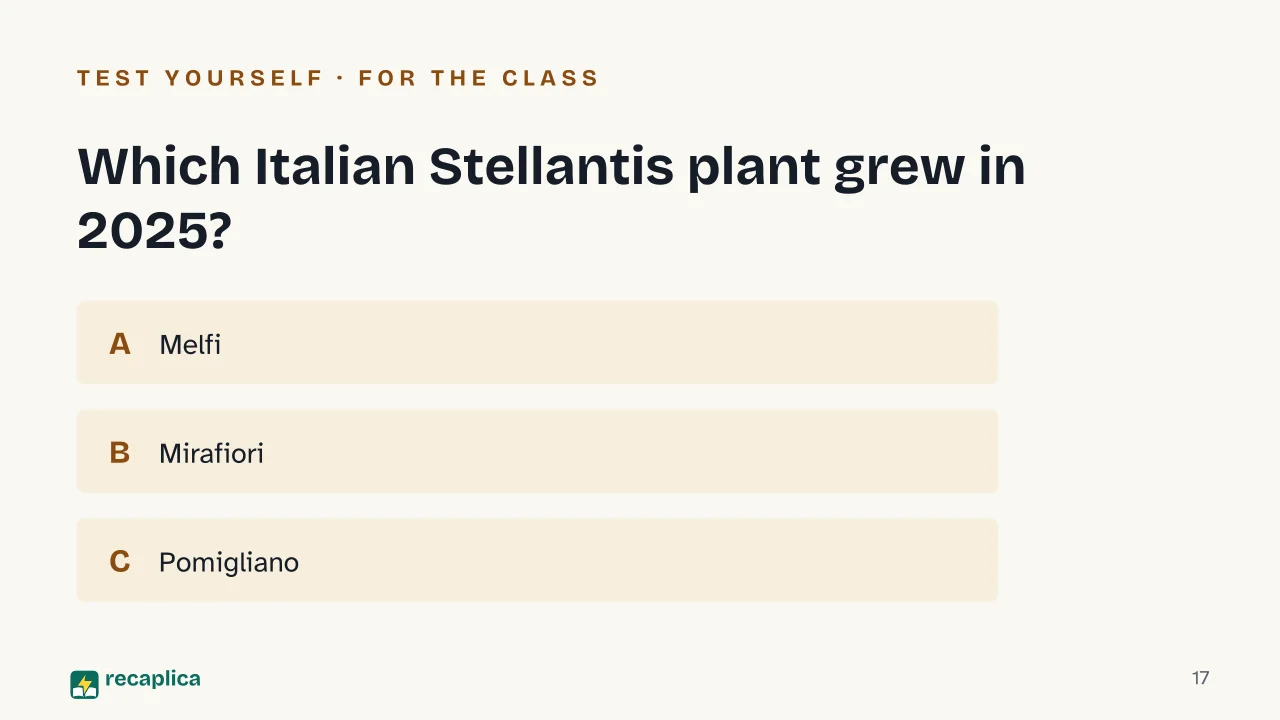
    5 Which Italian Stellantis plant grew in 2025, bucking the trend in the rest of national production?

    Mirafiori produced 16% more in 2025, even starting from a very low base (26,000 units in 2024); Melfi, in the same year, lost 47.2% of its production.

    Answers: 1-C · 2-B · 3-C · 4-B · 5-B

    Flashcards

    Tap the card to flip it and check whether you remember the answer, then move to the next one.

    1 / 7

    Explain it in your own words

    The ultimate test: if you can explain it in simple words, you've truly understood it. Write your explanation, then compare it with the Recap.

    Your explanation is saved only on this device.

    Europe's automotive industry is going through a rough patch: Volkswagen is weighing up to 100,000 job cuts worldwide, Renault up to 2,400 engineering positions, and Stellantis up to 500 voluntary departures at its Melfi plant. There is no single cause: the shift to electric vehicles, higher production costs than in China, competition from Chinese brands, US tariffs and demand that is struggling to recover are all intertwined. The European Union has responded with tariffs on Chinese electric cars and an industrial plan with funding for batteries and research, but the results so far are only partial.

    Frequently asked questions

    How many jobs depend on the automotive industry in Europe?

    According to ACEA, around 13 million jobs, direct and indirect, or 7% of total employment in the European Union; the European Parliament cites a similar figure, 13.8 million jobs, and a weight of 8% of Europe's manufacturing value added.

    Which carmakers announced job cuts in 2026?

    Volkswagen is weighing up to 100,000 job cuts worldwide and the closure of four German plants; Renault is weighing up to 2,400 engineering jobs globally and, separately, has announced 800 cuts in France; Stellantis expects up to 500 voluntary departures at its Melfi plant in Italy.

    What has the European Union done about competition from Chinese electric cars?

    Since 30 October 2024 it has applied additional countervailing tariffs, between 7.8% and 35.3% depending on the manufacturer, on battery electric cars imported from China, for a period of five years, following an anti-subsidy investigation opened by the European Commission.

    Is the car industry crisis only a German problem?

    No. It also affects France, with the job cuts announced by Renault in engineering, and Italy, where Stellantis production fell 20% in 2025 compared with the previous year, although the impact varies widely from one plant to another.

    Is the European Union supporting the sector with public funding?

    Yes. The industrial action plan for the automotive sector presented by the European Commission in March 2025, with an additional package in December 2025, puts forward, among other things, 1.8 billion euros for battery manufacturing and 1 billion euros of public-private investment in innovation, plus greater flexibility (2025-2027) on meeting CO2 targets.

    Sources

    • ACEA — Facts about the automobile industry
    • ACEA — Economic and Market Report, full year 2025
    • European Parliament (EPRS) — The crisis facing the EU's automotive industry
    • Euronews — Volkswagen faces crunch talks over 100,000 job cuts and factory closures
    • Il Sole 24 Ore (English edition) — Automotive demand still weak and scenario uncertain
    • Il Sole 24 Ore (English edition) — EU imposes duties on Chinese electric cars
    • European Commission — Action Plan for the Future of the EU Automotive Sector
    • Il Sole 24 Ore (English edition) — Stellantis loses a fifth of production in Italy in 2025

    Every Recap goes through an independent review before publication.

    Every evening, the day's new Recaps on our Telegram channel. Join the channel →

    Keep learning

    • Economics Labor Market: How Supply, Demand and Unemployment Work The labor market is where businesses that need workers to produce goods and services meet the people willing to work for them. In the textbook model, that meeting sets wages and employment levels the way any other market would, but imperfect information, bargaining power and legal rules push the real market away from pure competition. Those gaps are where unemployment comes from, and economists split it into frictional, structural, cyclical and technological types depending on the cause. Official statistics, such as Italy's ISTAT, measure it against the labor force — people employed plus people actively looking for work — not the whole population. As of July 2026, Italy's unemployment rate stood at 5.8%, provisional, against 6.4% for the euro area. Read the Recap →
    • Economics Mercantilism: History, Examples, and Definition Mercantilism was the dominant economic doctrine in Western Europe from the 16th to the 18th century: a state grew powerful by selling more abroad than it bought, building up reserves of gold and silver. Britannica Money describes it as "an economic practice by which governments used their economies to augment state power at the expense of other countries." Colonies had one job under this system: supply raw materials to the mother country and buy finished goods back from it, while at home tariffs and monopolies shielded domestic industry. The name itself came later, from the doctrine's most famous critic: Adam Smith made it current in The Wealth of Nations, published in 1776. Read the Recap →
    • Economics Keynesianism explained: the theory born from the Great Depression Keynesianism is the body of economic thinking named after John Maynard Keynes, the British economist who in the 1930s offered a different way of reading a slump. The IMF notes that when the Great Depression hit, the economic theory of the day could neither explain the collapse nor say how to restart production and employment. Keynes put aggregate demand at the centre — the total spending of households, businesses and government — and argued that full employment is a special case rather than something markets deliver on their own. That is where the idea comes from that public spending can step in when private demand stalls. Keynesianism guided economic policy from the end of the Second World War until the 1970s, then lost ground. Read the Recap →

    recaplica

    Clear in 30 seconds, yours in 10 minutes.

    Recaps Mind maps Request a Recap Telegram channel Mind map maker Our method About Privacy & cookies Legal notes & terms of use

    © 2026 Recaplica · A project by Curi S.r.l. — VAT IT05472000750

    Statistics, only if you say so

    To learn which Recaps help most we would use Google Analytics, with aggregate, anonymous data. It starts only with your OK, and you can change your mind anytime. Privacy policy