|
recaplica
Solar panel systems: panel types, incentives, and the best tilt angle | ||||||||||||||||||||||||||||||||||||||||||||||||
| © 2026 Recaplica · recaplica.com — All rights reserved | ||||||||||||||||||||||||||||||||||||||||||||||||
Solar panel systems: panel types, incentives, and the best tilt angleWhat to print Page numbers appear when printing with default margins. SlidesChoose a cut Flash10 slidesThe essential thread, to present in classFull19 slidesEvery chapter and the deeper detailBoth come with speaker notes. In 30 seconds quick readA photovoltaic system turns sunlight into electricity through the photovoltaic effect, a physical process that happens inside cells made of semiconductor material, usually silicon. There are several families of cells (crystalline, thin-film, emerging technologies) and several types of installation, from a rooftop at home to agrivoltaic and floating systems. In Italy, as of 2026, anyone who installs a system can claim a personal income tax deduction and sell the electricity fed into the grid through the GSE's Ritiro Dedicato (Dedicated Withdrawal) scheme. Output depends largely on two practical choices: orientation, ideally facing south, and tilt angle, which can be calculated for any address with the European Commission's free PVGIS tool. Key Points
Key figures
Deep DiveWhat a photovoltaic system is: the photovoltaic effectA photovoltaic system produces electricity through the photovoltaic effect: when sunlight strikes a semiconductor material, typically chemically treated silicon, it frees up electrons and generates a direct current. Individual cells are assembled into a panel (the module), several panels are wired together in series to form a string, and an inverter finally turns the direct current produced into the alternating current used by household appliances and fed into the grid. It’s a physical process completely different from the photosynthesis plants rely on: there, light becomes chemical energy stored in a sugar molecule; here, it becomes a flow of electrons that registers immediately as electric current, with no chemical steps in between. Cell types: from crystalline silicon to thin filmPhotovoltaic cells fall into three generations, following a classification used in a 2020 technical report from ENEA, Italy’s national energy research agency, with market figures dated to 2017:
Back in 2017, crystalline silicon covered about 90% of the world market (40% monocrystalline, 48% polycrystalline, 2% ribbon silicon), with the remaining 9% split among thin-film technologies (5% cadmium telluride, 2% amorphous silicon, 2% CIGS). The picture has shifted dramatically in under a decade: according to the Photovoltaics Report from the Fraunhofer Institute for Solar Energy Systems (ISE), updated as of July 2026, world module production in 2025 totaled around 706 GWp, of which 690 GWp was monocrystalline silicon and zero was polycrystalline silicon, which has practically disappeared from large-scale industrial production; thin film accounted for between 2 and 3% of the market. Wafer-based silicon as a whole covered about 98% of total production. Efficiency has climbed in step: average commercial efficiency of monocrystalline modules has risen from about 17% to just under 25% between roughly 2016 and 2026, while the laboratory record for a single monocrystalline silicon cell, as of May 2026, stands at 28.1%. The n-type TOPCon and Heterojunction (HJT) technologies are replacing the older p-type PERC technology as the market standard for commercial modules.
Laboratory record efficiency figures shouldn’t be confused with the efficiency of commercial panels, which is always lower: the two are different measurements, one obtained under controlled conditions on single cells, the other on modules produced at scale. System types: from rooftop to floating panelsBeyond cell technology, a photovoltaic system can also be classified by how it’s installed. The most widely used terminology — integrated, partially integrated, non-integrated — comes from Italy’s old Conto Energia, the incentive program closed for good in 2013 and no longer active: that program’s tariffs no longer mean anything, but the three categories are still useful for describing how a system is physically installed. An integrated system uses modules or components designed to replace an architectural element (solar roof tiles, canopies, brise-soleil panels); a partially integrated system rests on the roof slope without replacing anything; a non-integrated system is typically a large ground-mounted installation. A second distinction concerns the connection to the electrical grid. The large majority of systems in Italy are grid-connected (98% of Italian systems are connected at low voltage, according to the 2024 IEA-PVPS report): electricity produced and not consumed right away is fed into the grid and, as covered further below, can be sold. Stand-alone (off-grid) systems also exist: they aren’t connected to the grid and generate direct current used directly for specific needs, such as water pumping, lighting, or refrigeration, typically at sites without a grid connection. More recent setups add to this picture, as noted in the Fraunhofer ISE 2026 Photovoltaics Report: agrivoltaic systems, which combine electricity generation with farming on the same land (with modules arranged between crop rows, above the rows, or vertically between them), floating solar systems on bodies of water, and the first products of photovoltaics integrated into vehicles.
Solar incentives in Italy in 2026The first tool available in Italy in 2026 is fiscal: the personal income tax deduction for building renovation (article 16-bis of Italy’s Tuir tax code) explicitly covers the installation of photovoltaic systems too, provided the system directly serves the home’s energy needs. Italy’s 2026 budget law (law no. 199/2025) extended the higher deduction rates into 2026, on this schedule:
Anyone installing a photovoltaic system or a storage battery must notify ENEA, Italy’s national energy research agency; for storage systems alone, this requirement has applied since January 1, 2019. A missing or late notification, though, doesn’t cause the loss of the tax deduction, according to a 2019 ruling by the Italian Revenue Agency. The second tool concerns selling the electricity fed into the grid. The Ritiro Dedicato (RID) scheme lets producers sell electricity fed into the grid to the GSE, Italy’s energy services operator, at administered prices, and it’s open to a photovoltaic system of any size; the application must be filed within 60 days of the system coming online, the contract runs for a solar calendar year, and it renews automatically. For systems up to 100 kW, limited to the first 1.5 million kWh withdrawn each year, a guaranteed minimum price also applies, updated every year since 2014 based on the annual change in Istat consumer prices: if the market price is higher than the minimum, the GSE still pays the difference at year-end settlement, so producers always receive whichever value is more favorable. The exact guaranteed minimum price for 2026 hasn’t been verified against a primary source here; trade sources report a figure of around €0.0475/kWh, which should be treated with caution until confirmed by the official ARERA notice. Anyone who installed a system in previous years may instead still have an active Scambio sul Posto (SSP) agreement, the net-metering mechanism that offset electricity fed in against electricity drawn from the grid: it has been closed to new applicants since 2025 (the last window was reserved for systems that came online by May 29, 2025, with applications filed with the GSE by September 26, 2025), though existing agreements continue until their natural expiration, never more than 15 years from the original signing. For anyone installing a system in 2026, then, the available option for grid-fed electricity is Ritiro Dedicato, not Scambio sul Posto. How much solar power Italy has installedUnlike a fossil-fuel power plant, a photovoltaic system burns nothing to produce electricity: the current comes directly from the photovoltaic effect in the cells, with no combustion and no direct emissions during operation — a difference that matters for the greenhouse effect, even though manufacturing the panels themselves has its own environmental footprint, discussed further below regarding end-of-life materials. According to the IEA-PVPS report on Italy, cumulative national photovoltaic capacity stood at 37 GW at the end of 2024, with 6.7 GW of new capacity added during the year and 278,423 new systems, for a total of 1.88 million installations across the country; 55% of systems are located in northern Italy. In 2024, solar power generated 36 TWh of electricity, about 11.5% of national electricity consumption; the national plan cited in the report targets 80 GW of photovoltaic capacity by 2030. The most recent data, reported by trade outlet PV Tech based on Terna/GSE figures, show that Italy installed 1.4 GW of new capacity in the first quarter of 2026: 560 MW from large ground-mounted systems (down 9% year on year), 313 MW residential (down 13%), and 566 MW commercial and industrial (up 24%). By the end of March 2026, cumulative national capacity had nearly reached 45 GW: it took about seven months to go from 40 to 45 GW. The figures above mostly describe concrete industrial growth, not yet even across every segment of the market. Where and how to orient panels for the best outputOnce the technology and system type are chosen, energy output depends largely on two practical variables: the panels’ orientation and tilt. In Italy, the optimal orientation is generally south (180° azimuth), because at this latitude that’s the direction from which the most direct sunlight arrives over the course of the day. The optimal tilt, on the other hand, isn’t a single number that works everywhere: it varies with the latitude of the specific site, following a basic principle of solar geometry, and it also shifts slightly with small local obstacles (trees, nearby buildings, mountains on the horizon) that can cast shade on the panels at certain times of day. To calculate the exact value for a specific address, the reference tool is PVGIS (Photovoltaic Geographical Information System), developed by the Joint Research Centre of the European Commission and available online for free, without registration, in several European languages. PVGIS estimates expected electricity output for any point on the globe except the poles, based on satellite irradiance data covering 2014-2024, and it includes two functions built exactly for this purpose: “Optimize slope,” which calculates the optimal tilt for a given orientation, and “Optimize slope and azimuth,” which calculates the optimal tilt and orientation together for the chosen location. The tool also lets users upload a horizon profile of local obstacles, useful for anyone with nearby trees or buildings that cast shade at certain hours of the day.
Straying far from the optimal orientation carries a measurable cost: according to simulations based on PVGIS data, orienting panels purely east or west, instead of south, brings an estimated production loss of 15-20% compared with the optimum. A southeast- or southwest-facing roof, more common than one facing perfectly south, loses far less: output stays relatively close to the optimum as long as the deviation from due south stays within a few dozen degrees. Materials, lifespan, and end of lifeA crystalline silicon module, the most common type in 2025, is built as a layered structure: an outer covering of tempered glass, an EVA (ethylene vinyl acetate) sealant in front of and behind the cells, cells connected to each other by metal ribbons made of copper, a rear backsheet made of polyvinyl fluoride (commercially known as Tedlar), and a perimeter frame made of aluminum — the same metal that, for its own properties, also shows up in window and door frames at home, valued for being lightweight and for being meltable and recyclable without losing its mechanical properties. By weight, a crystalline silicon panel is made mostly of glass (65.8%, recyclable at a 97% rate) and aluminum (17.5%, recyclable at 100%), plus EVA (12.8%), silicon (2.9%, recyclable at 85%), and copper (1.0%, recyclable at 78%), according to a 2020 ENEA technical report: overall, about 90% of a panel’s weight is made of materials classified as non-hazardous, and modern technology can recover between 75 and 100% of the materials at end of life. On lifespan, the harmonized assumptions Fraunhofer ISE uses to calculate energy payback time assume a system service life of 25 years, with an average production degradation rate of 0.70% per year and an average Performance Ratio, including degradation over time, of 73.6%. The energy payback time itself is surprisingly short: a system in Sicily using crystalline silicon modules recovers the energy spent building it in about a year; over the following 20 years of service, it can go on to produce up to 20 times the energy invested in building it. Slide deckSlides ready to download and make your own in PowerPoint or Google Slides, with speaker notes. Pick the Flash cut or the Full one.     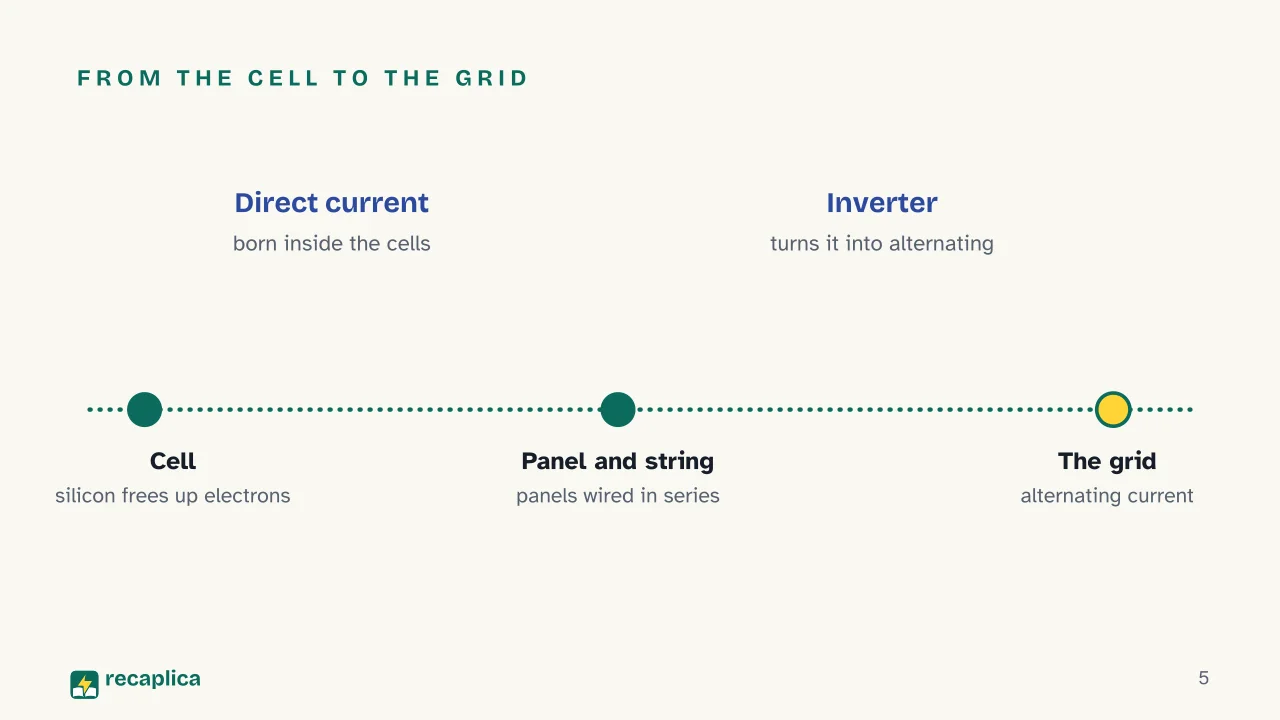 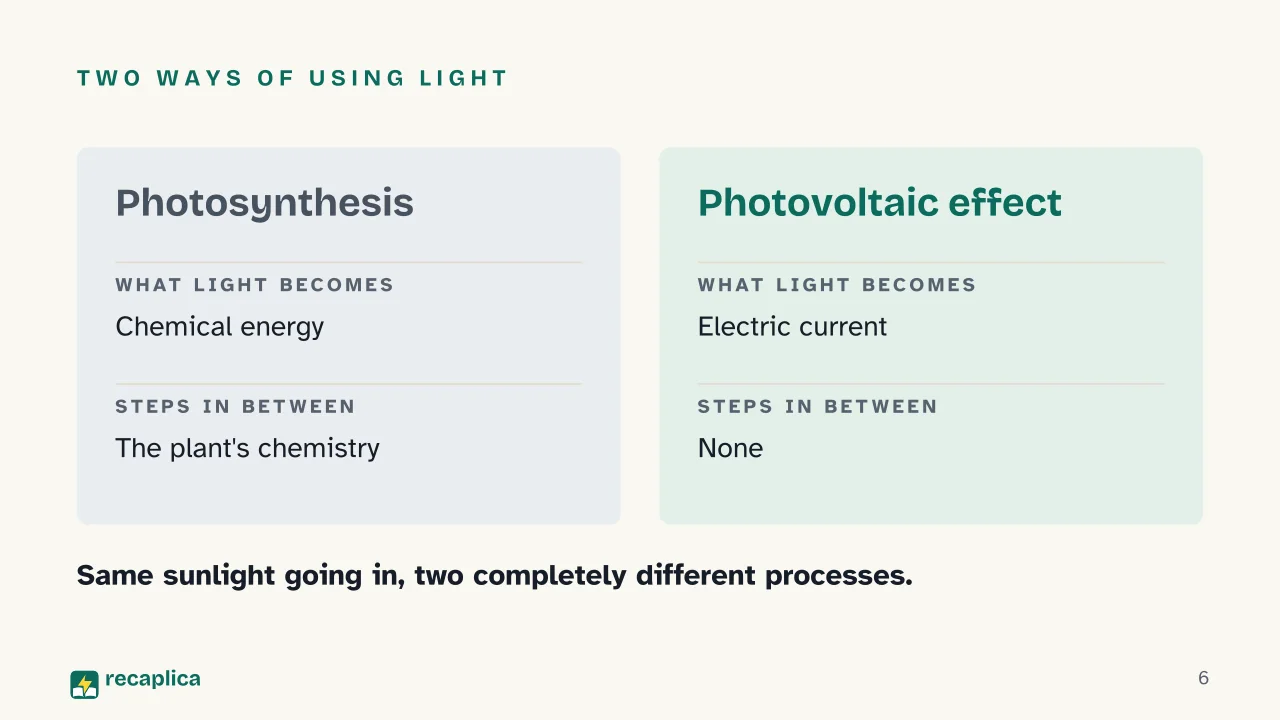  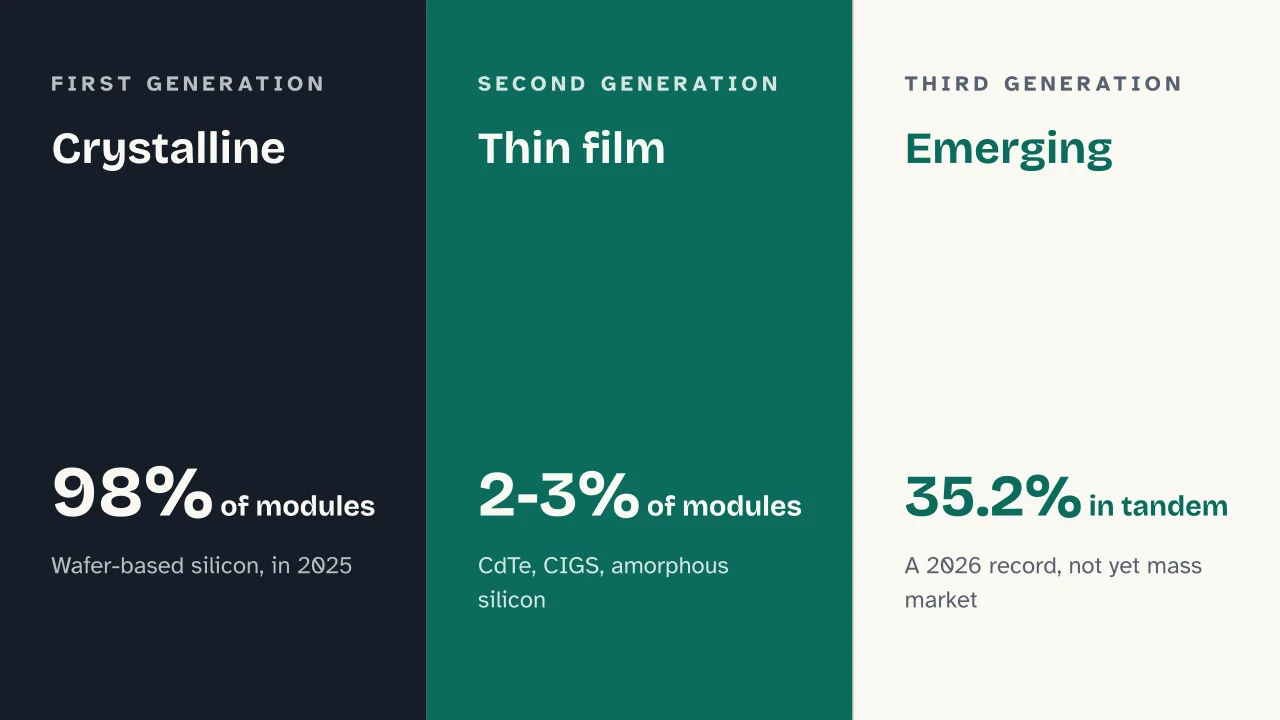 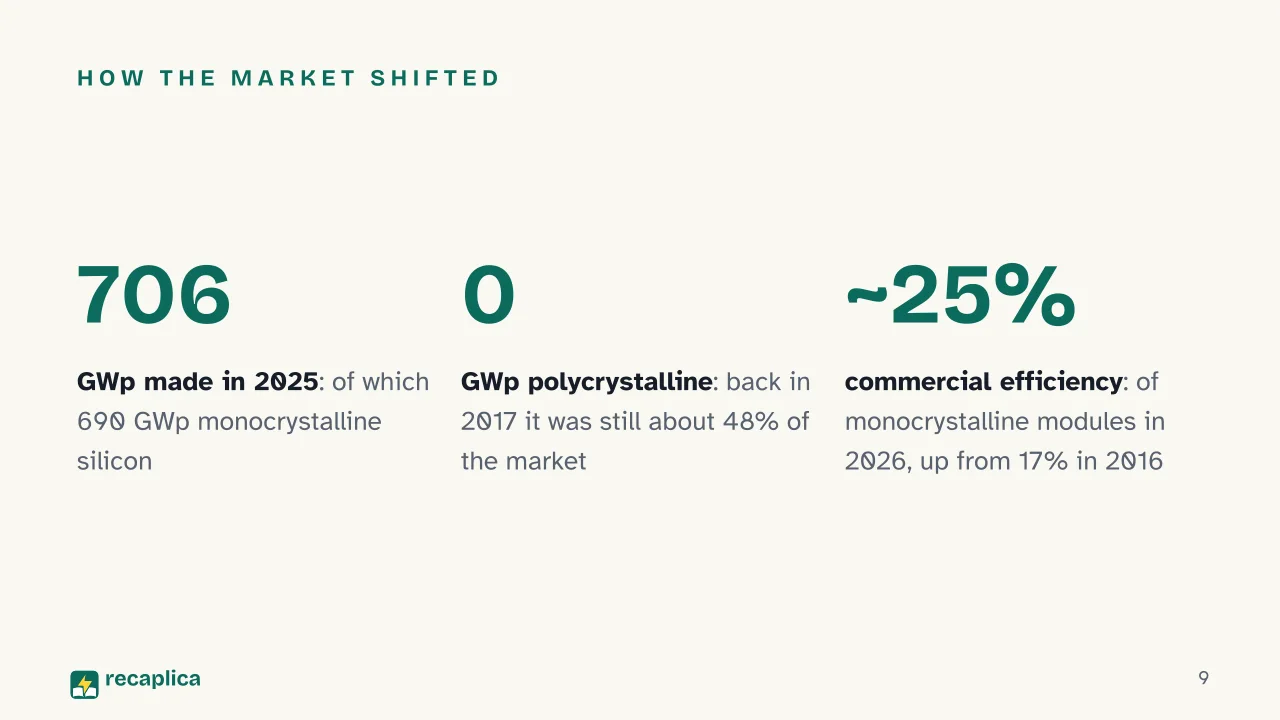  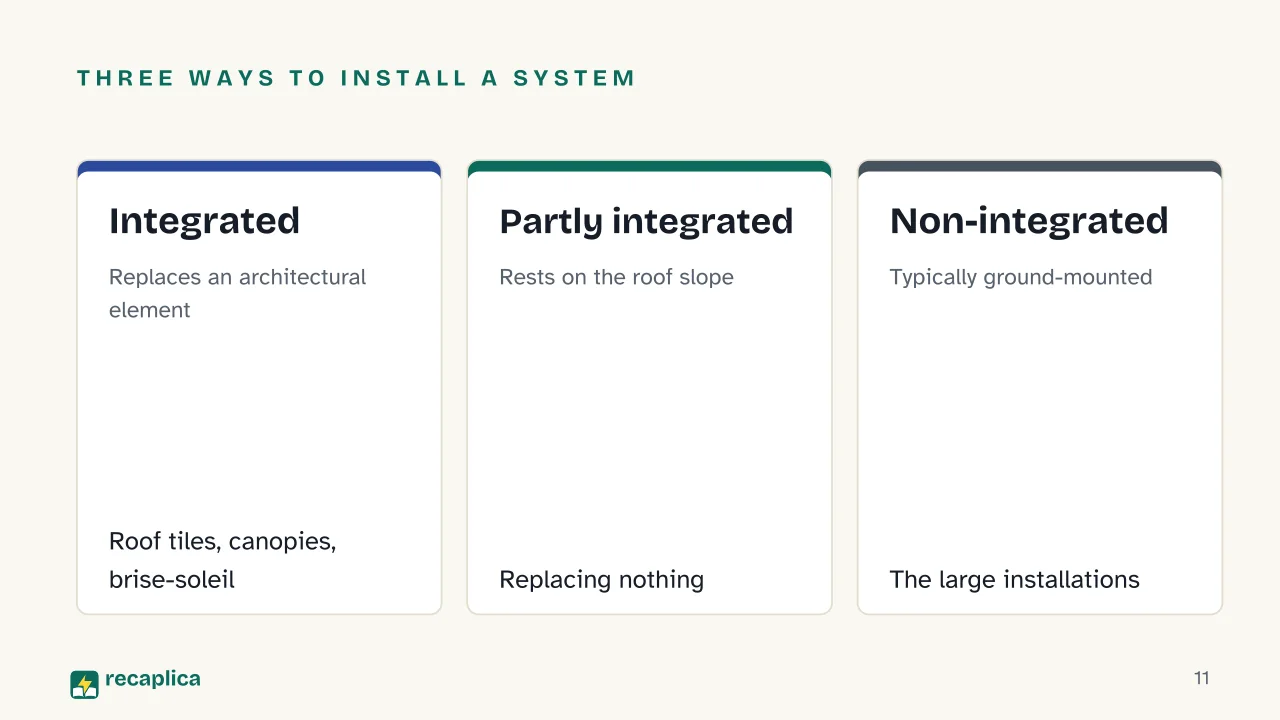 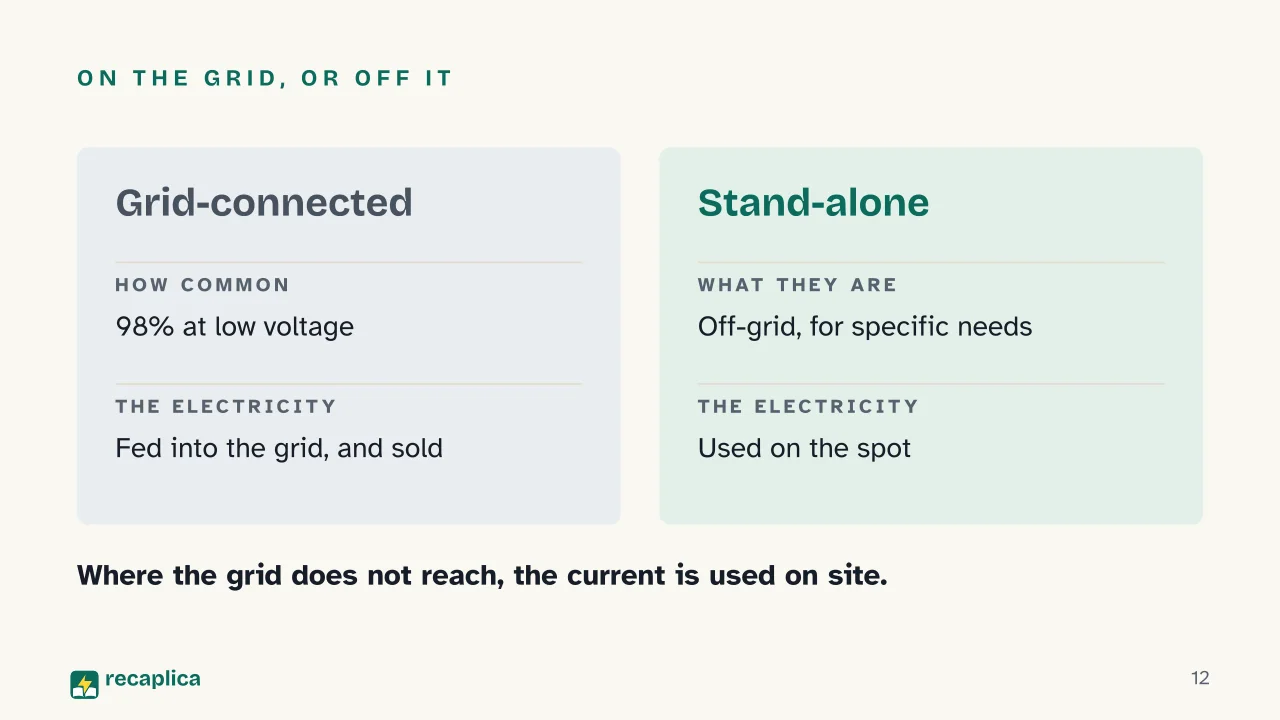 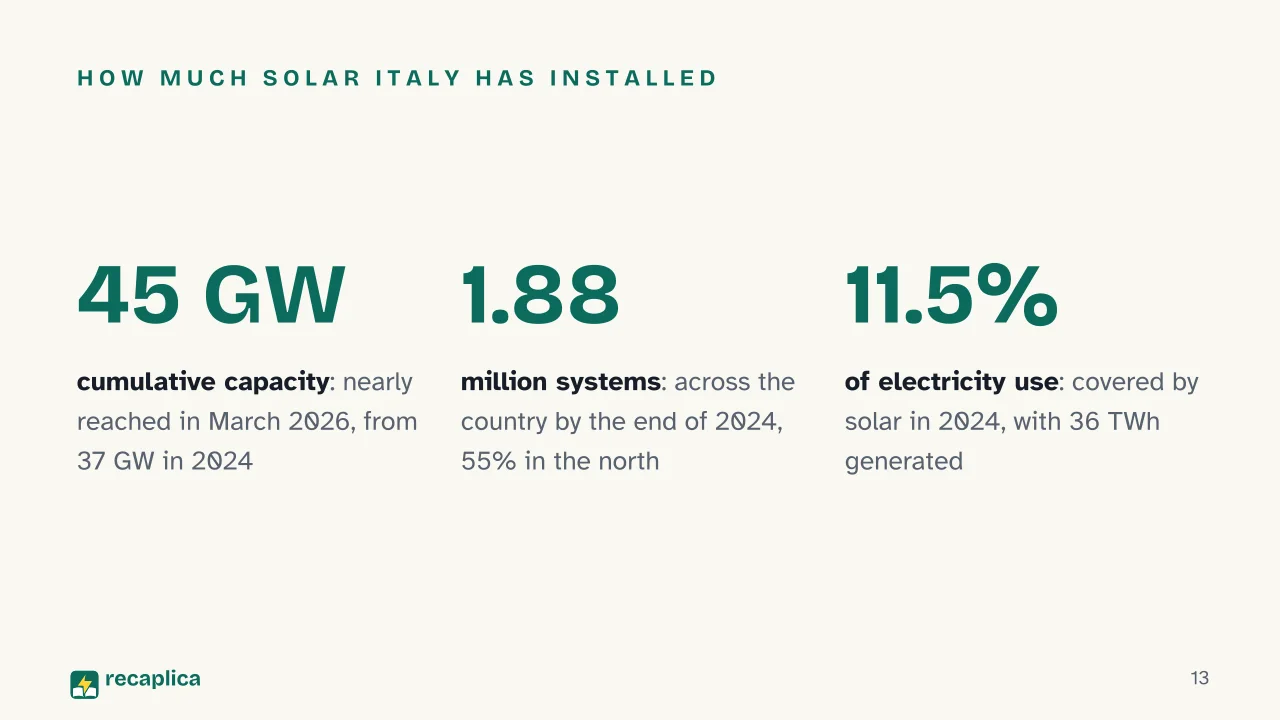  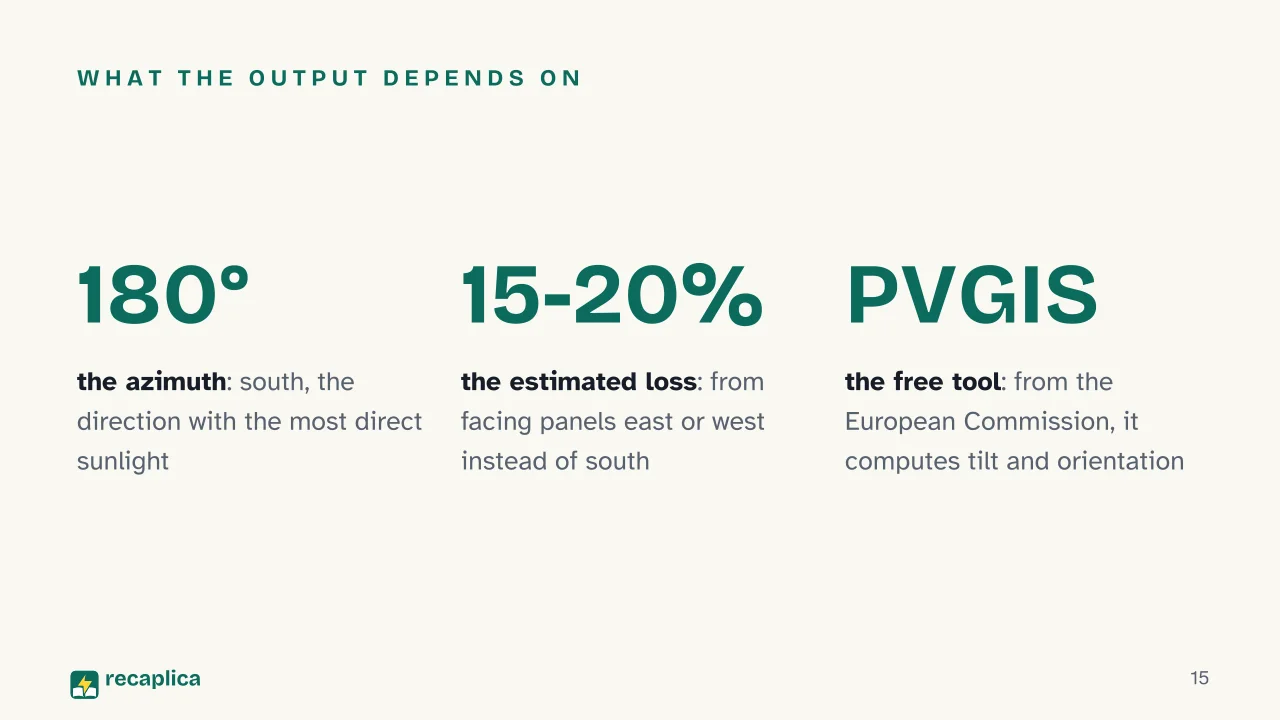  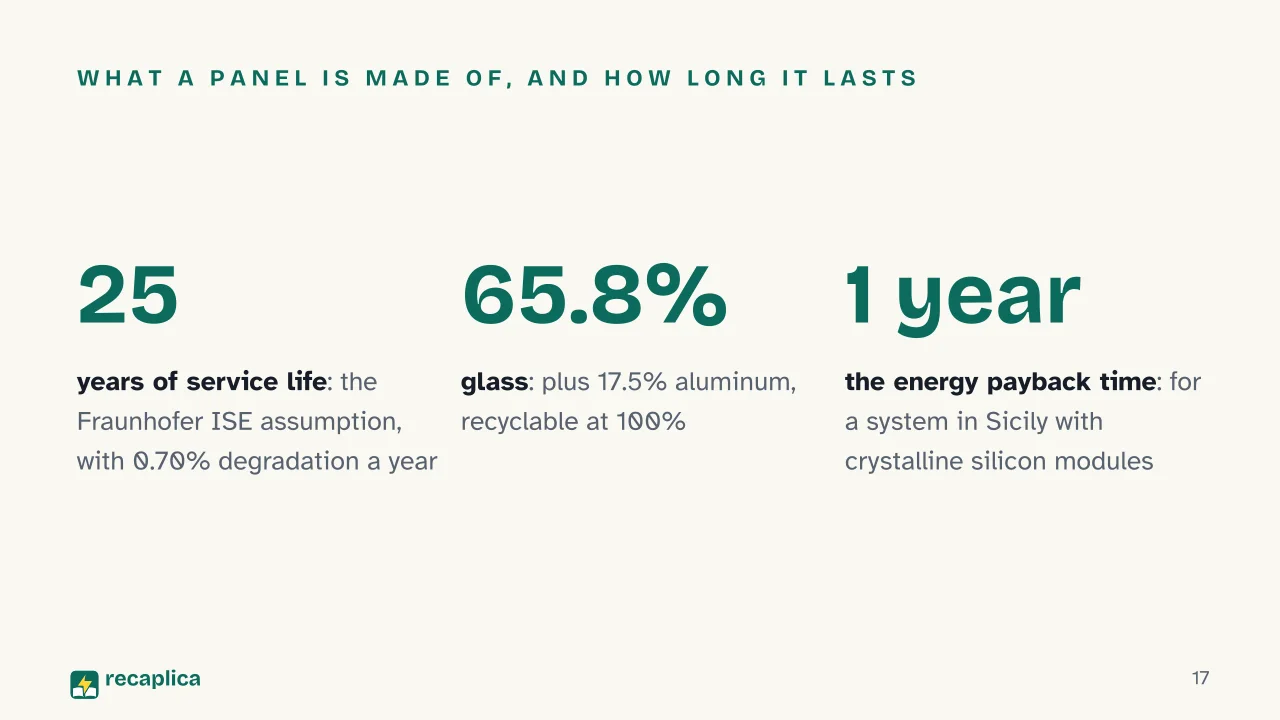 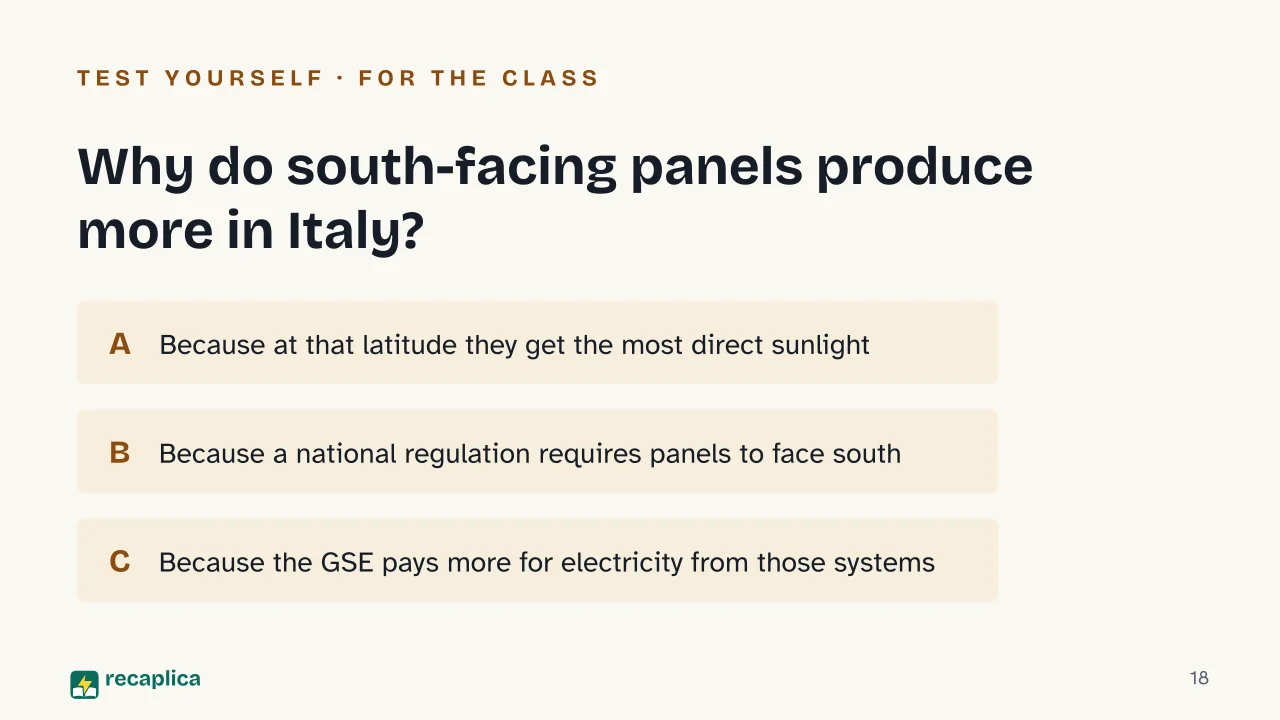  Common myths
Mind mapDrag the background to move around and the nodes to reposition them; use − and + to collapse and expand branches. 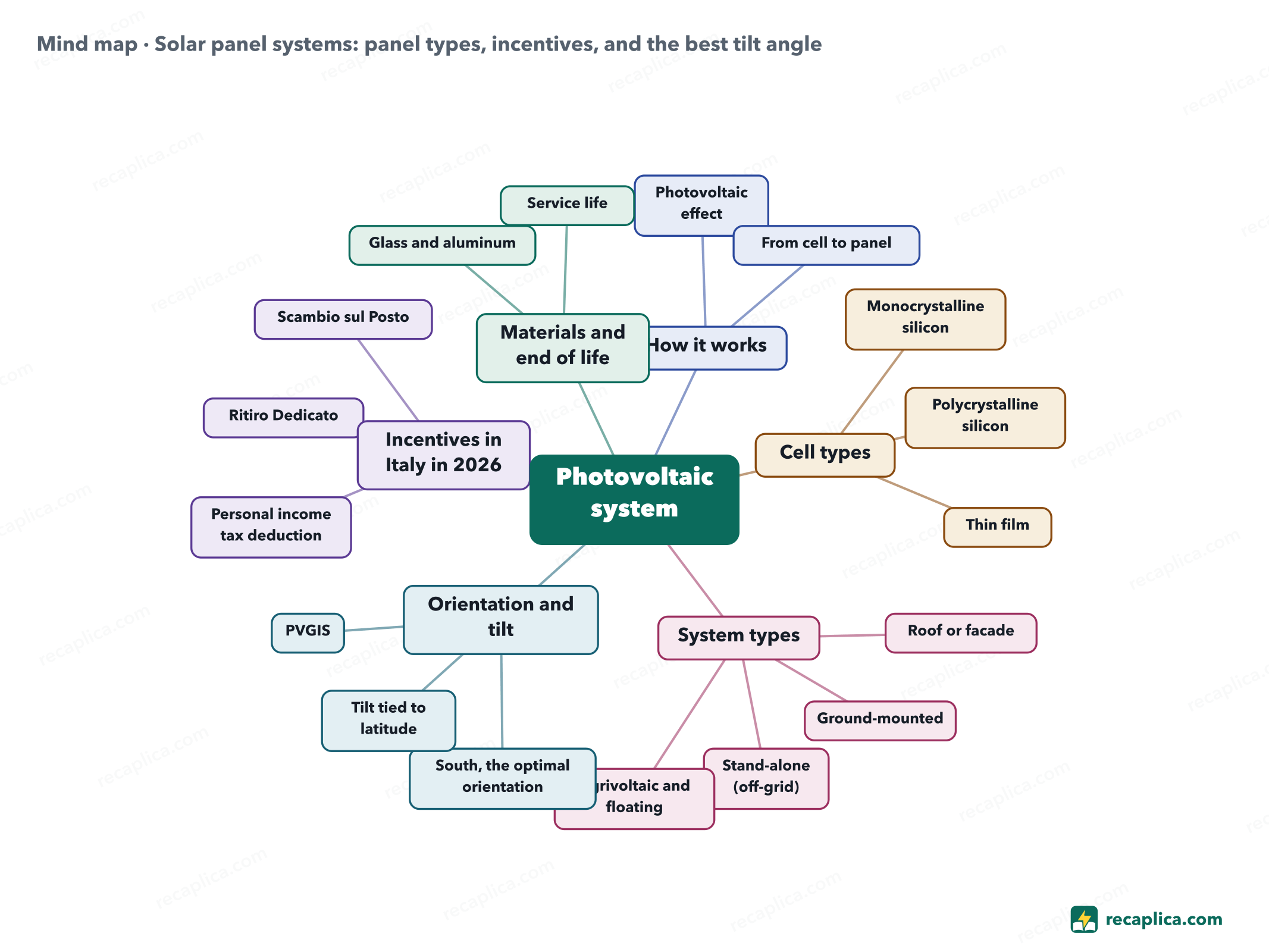
Quiz: test yourselfAnswer the questions to check what you have learned: you get instant feedback and a short explanation. Grade 0/10 0/5
FlashcardsTap the card to flip it and check whether you remember the answer, then move to the next one. 1 / 8 Explain it in your own wordsThe ultimate test: if you can explain it in simple words, you've truly understood it. Write your explanation, then compare it with the Recap. Your explanation is saved only on this device.
Frequently asked questionsWhat's the difference between Ritiro Dedicato and Scambio sul Posto?They're two different GSE mechanisms for handling electricity fed into the grid. Ritiro Dedicato (RID) lets producers sell electricity to the GSE at administered prices and is open to systems of any size. Scambio sul Posto (SSP), which offset electricity fed in against electricity drawn from the grid, is closed to new applicants: the last window was reserved for systems that came online by May 29, 2025. Anyone installing in 2026 can therefore rely only on RID, or on selling directly on the open market. What's the best orientation for solar panels in Italy?Generally south (180° azimuth), because at Italy's latitude that's the direction from which the most direct sunlight arrives over the course of the day. The optimal tilt angle, on the other hand, isn't a single number that works everywhere: it varies with the latitude of the specific site. The European Commission's free PVGIS tool calculates the optimal tilt and orientation for any address, using its 'Optimize slope and azimuth' function. What incentives exist for solar power in Italy in 2026?Two main mechanisms. The first is fiscal: the personal income tax deduction (article 16-bis of Italy's Tuir tax code), which for expenses incurred in 2025-2026 is worth 50% (cap €96,000) if the system serves the owner's primary residence, or 36% in other cases; the percentages drop again in 2027 and further in 2028-2033, under the 2026 budget law (law 199/2025). The second is the GSE's Ritiro Dedicato scheme, which buys electricity fed into the grid at administered prices; for systems up to 100 kW, a guaranteed minimum price also applies, updated every year based on Istat inflation data. How long does a photovoltaic system last?The most commonly cited technical estimates (Fraunhofer ISE) assume a system lifespan of 25 years, with an average production degradation rate of 0.70% per year. The energy payback time, on the other hand, is remarkably short: a system in Sicily using crystalline silicon modules recovers the energy spent building it in about a year, and over the following 20 years of service it can produce up to 20 times the energy invested in it. Does solar power still make sense without the incentives of the past, like Italy's old Conto Energia?Conto Energia, the old program with fixed feed-in tariffs per kWh produced, closed for good in 2013 and is no longer active. Two other tools remain active in Italy in 2026, though: the personal income tax deduction and the GSE's Ritiro Dedicato scheme for selling electricity into the grid. Market data meanwhile show continued growth in installations: from 37 GW at the end of 2024, Italy reached nearly 45 GW of cumulative capacity by the end of March 2026, even though the residential segment slowed in the first quarter of 2026 compared with the year before. Every Recap goes through an independent review before publication. |