|
recaplica
Usufruct: Definition and How It Works | ||||||||||||||||||||||||
| © 2026 Recaplica · recaplica.com — All rights reserved | ||||||||||||||||||||||||
Usufruct: Definition and How It WorksWhat to print Page numbers appear when printing with default margins. SlidesChoose a cut Flash10 slidesThe essential thread, to present in classFull15 slidesEvery chapter and the deeper detailBoth come with speaker notes. In 30 seconds quick readUsufruct is the right to use someone else's property and collect what it produces, while the underlying title — called bare ownership — stays with someone else, who can't use the asset until the usufruct ends. It typically arises from a sale or a gift in which the original owner keeps the usufruct: parents who sign a house over to their children but carry on living in it are the most common example. The bare owner can still sell or mortgage the property while the usufruct runs, just not live in it or rent it out. Usufruct normally ends when the usufructuary dies, and at that point bare ownership expands on its own into full ownership, with no new deed required. Key Points
Deep DiveWhat usufruct and bare ownership meanArticle 832 of the Italian Civil Code defines full ownership as the right to “use and dispose of things in a full and exclusive way.” Usufruct and bare ownership are what’s left once that single right is split in two: the right to use the asset moves to one person, the usufructuary, while the other, the bare owner, keeps title and the power to dispose of it — sell it, mortgage it — but not to use it. Article 981 states the mirror image: the usufructuary “has the right to enjoy the thing, but must respect its economic purpose” — they can live in a house, rent it out, collect its produce, but they cannot sell it or repurpose it however they like. How it’s createdUnder Article 978, usufruct, and with it the bare ownership that complements it, arises by law, by the will of the parties, or by adverse possession. It’s the second case that concerns most families: a sale contract or a deed of gift in which the owner transfers the asset while reserving the usufruct, a private application of the same legal norm that leaves room for individual choice. The case where it arises directly by law, with no deed at all, is the surviving spouse’s right of habitation, reserved by Article 540 of the Italian Civil Code to whoever outlives their spouse on the family home, leaving the heirs as bare owners. The most common case, according to the practical guide published by Notaio Facile, is parents who sign the house over to their children while continuing to live in it: they give away the bare ownership and keep the usufruct for themselves, the right to live there for the rest of their lives.
Who can do what: a comparison table
How usufruct ends (and what happens to bare ownership)The most common cause is the usufructuary’s death: Article 979 states that “the duration of usufruct cannot exceed the life of the usufructuary” (thirty years for a legal entity, a different case from a family situation). When usufruct ends, the bare owner doesn’t need to request or sign any new transfer: according to Notaio Facile, “once the usufruct’s term expires, the bare ownership automatically expands into full ownership,” typically through a simple land-registry update, with no deed required. Article 1014 lists three further causes of extinction. They’re rarer, but written into the law: prescription after twenty years of non-use, merger, when usufruct and bare ownership end up in the same person’s hands — through inheritance, for instance — and the total loss of the asset the usufruct was created on. A dispute between a bare owner and a usufructuary, like any other civil matter, is settled by the Italian court system under its ordinary rules of jurisdiction. Usufruct and the common-law life estateCommon-law countries don’t have bare ownership and usufruct as such, but they have a close cousin: the life estate. Cornell Law School’s Legal Information Institute defines it as “an interest in property that lasts only for the life of a specific person, usually the possessor of the estate.” A life estate is typically created by a deed that spells out what happens next — the Institute’s own example is a grant “to John Doe for life, then to Jane Doe,” which gives John a life estate and Jane a remainder, the right to take full ownership once John’s interest ends. The resemblance to usufruct is real: someone gets to use the property for a lifetime, someone else is waiting to receive it in full. But the two aren’t the same institute wearing different names. A life estate is a common-law creature, shaped by case law and, in the United States, different from state to state; usufruct is a civil-law right defined by a code, with its own rules on registration, taxation, and what counts as an economic purpose. Anyone comparing the two across borders should check the local rules directly, since the terms don’t map onto each other one to one. Can bare ownership be sold?Yes. It’s as common as gifting it to children: whoever holds a bare ownership can sell it even while the usufruct is still running, because the power to dispose of the asset, guaranteed by Article 832, stays theirs. The buyer becomes the new bare owner in the seller’s place, but doesn’t gain the right to live in or rent out the property — that stays with the usufructuary, for as long as their right lasts. The property rights article covers the same power of disposal in its undivided form, held by a single owner. Tax treatmentAccording to the Italian Revenue Agency, the “price-value” regime — which taxes the cadastral income instead of the price stated in the deed — applies to purchases of full ownership and to purchases of bare ownership and usufruct as well. The taxable value of the two rights is calculated separately, with a coefficient that depends on the usufructuary’s age: the younger the usufructuary, the longer their right of use is expected, in theory, to last, and the lower the value of the corresponding bare ownership. Anyone looking for the current coefficients can find them on specialized legal portals such as Federnotizie, which calculates them from the minimum rate set specifically for this calculation — not Italy’s general statutory interest rate, which follows its own separate path. Article 46, paragraph 5-ter, of Presidential Decree 131/1986, as amended by Legislative Decree 139/2024, sets a rate of no less than 2.5% for valuing usufruct and bare ownership for tax purposes, applied by an Italian Ministry of Economy and Finance decree dated December 24, 2025. The Revenue Agency itself doesn’t publish that table, though: it works as a practical reference, and it isn’t first-hand official data. Slide deckSlides ready to download and make your own in PowerPoint or Google Slides, with speaker notes. Pick the Flash cut or the Full one.     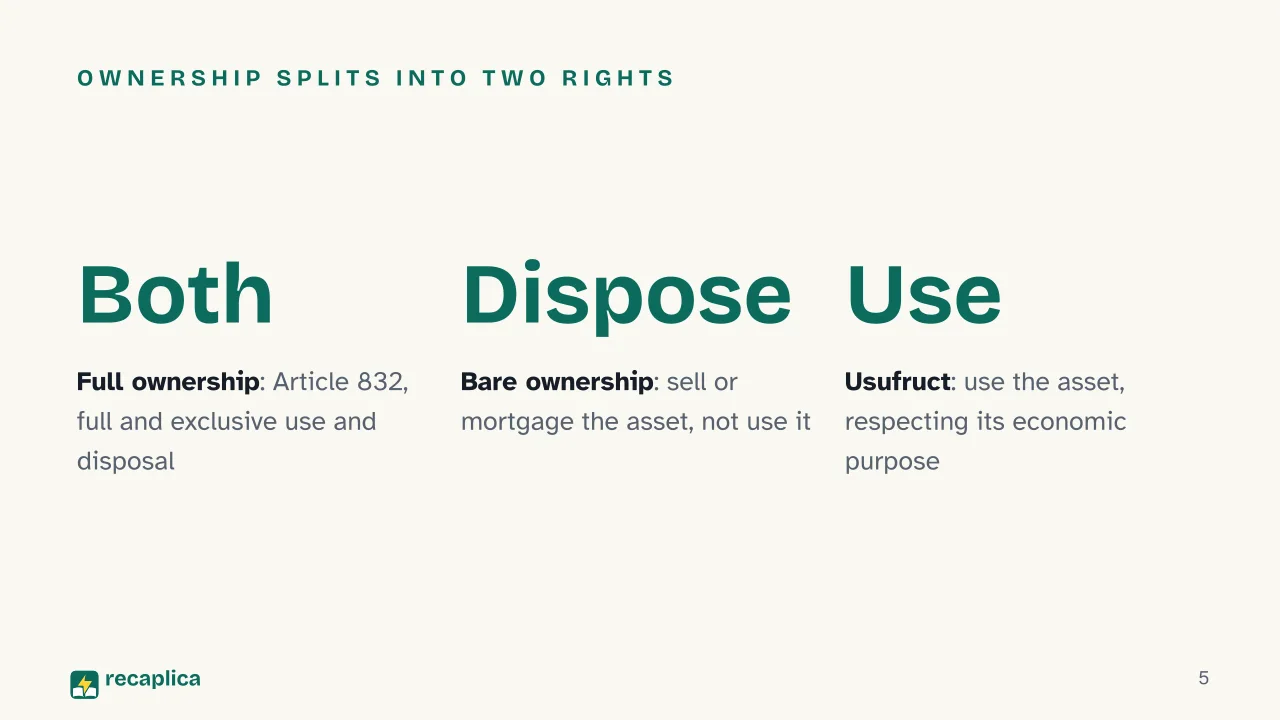 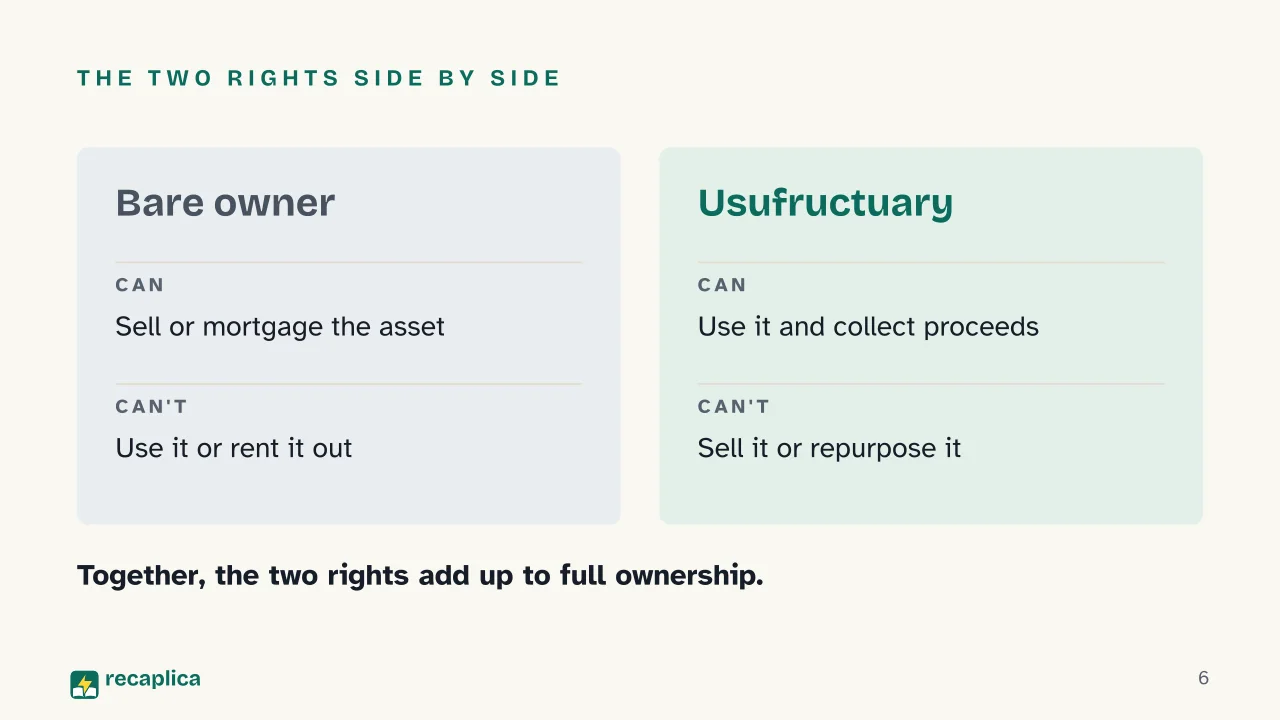  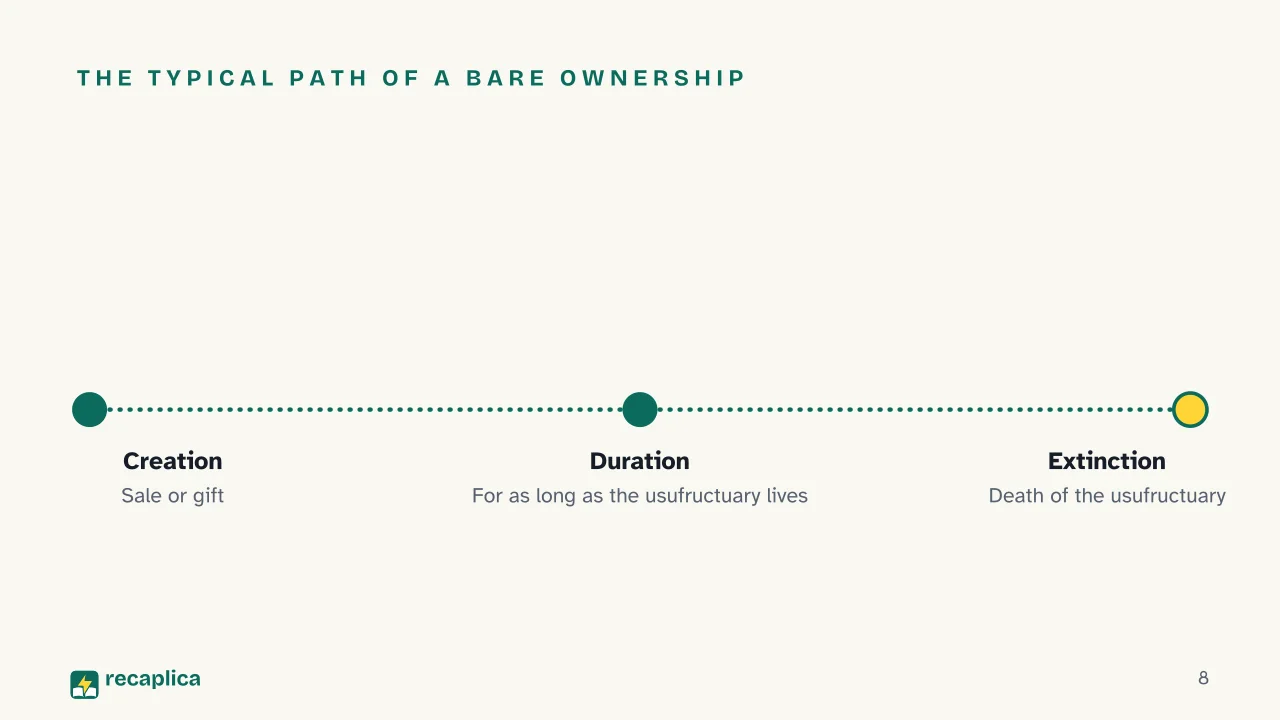  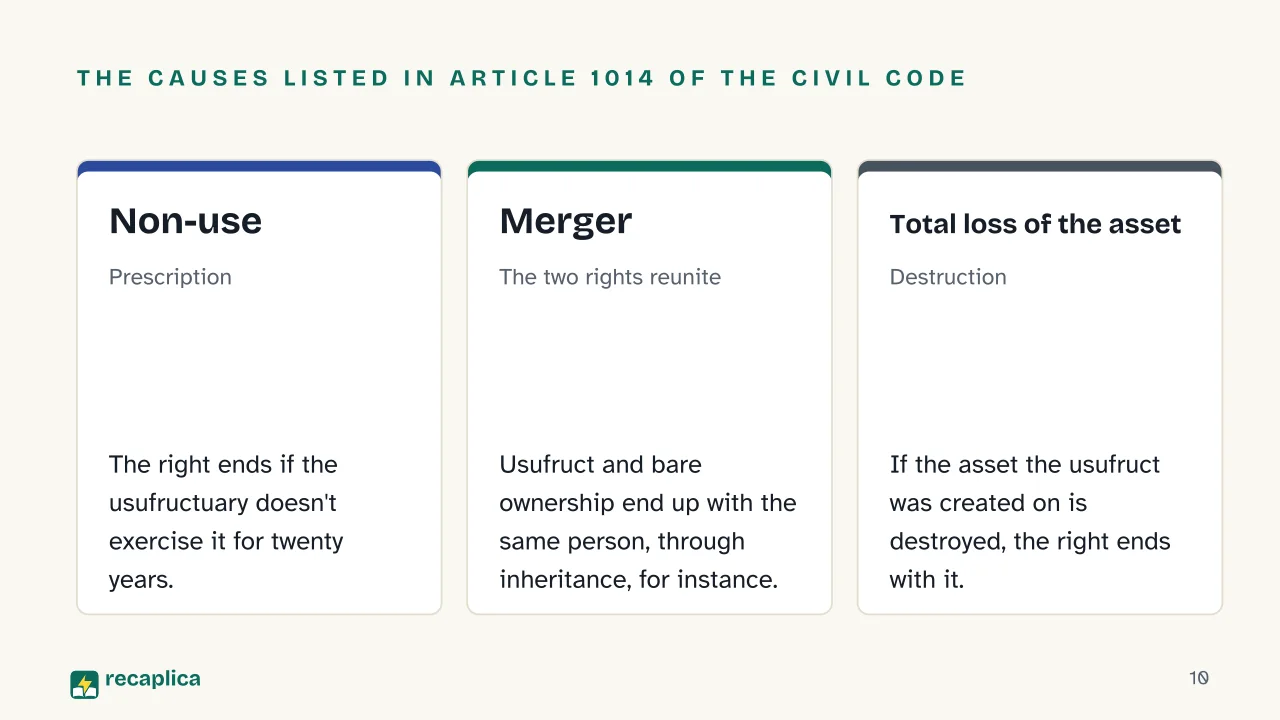 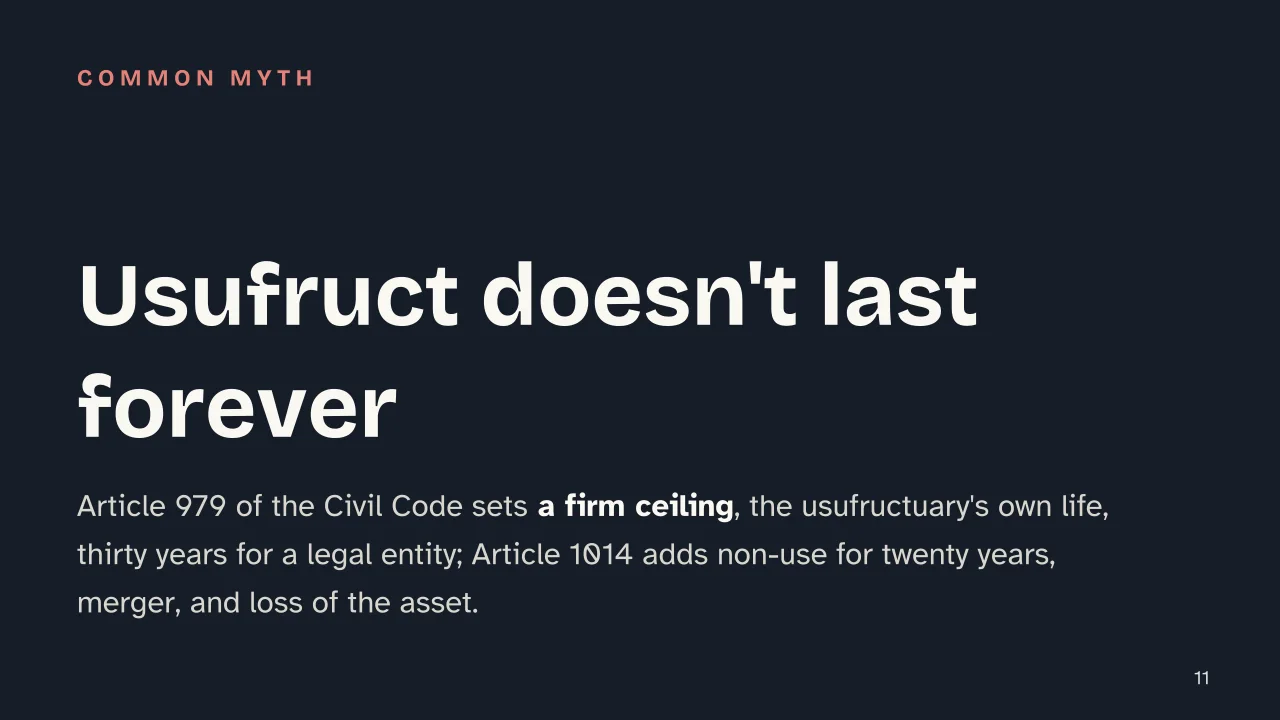  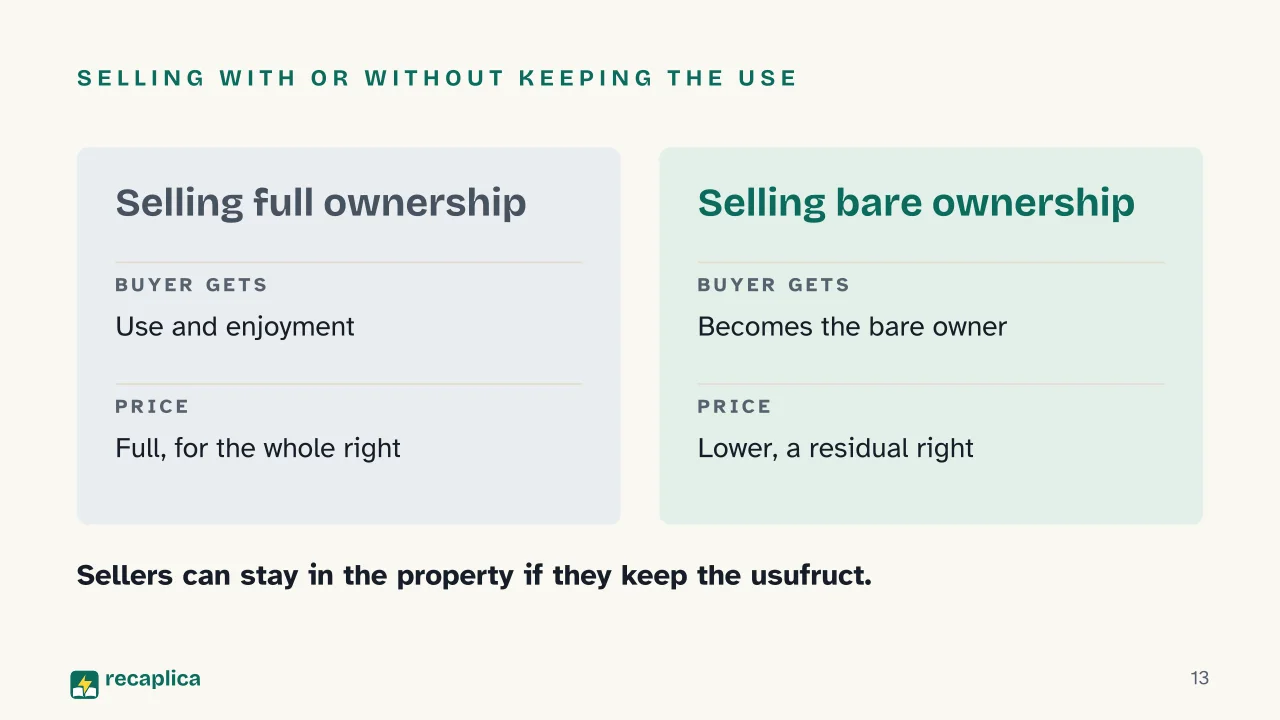 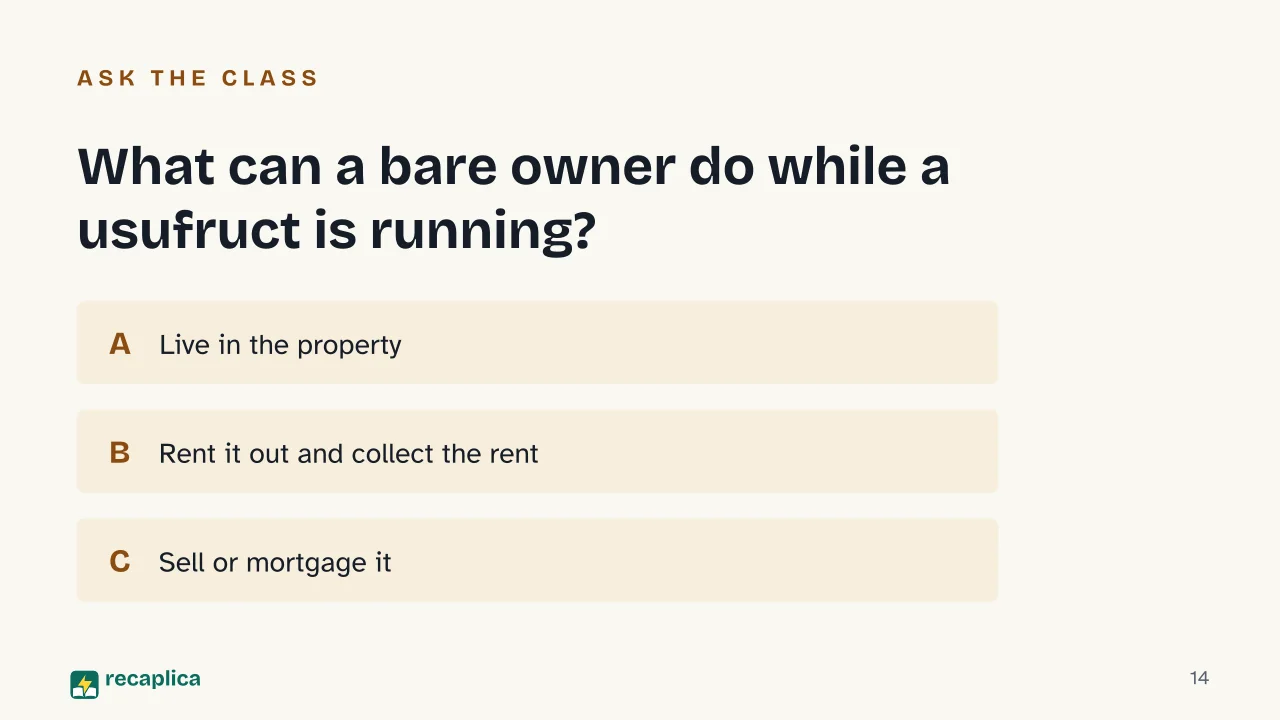  Common myths
Mind mapDrag the background to move around and the nodes to reposition them; use − and + to collapse and expand branches. 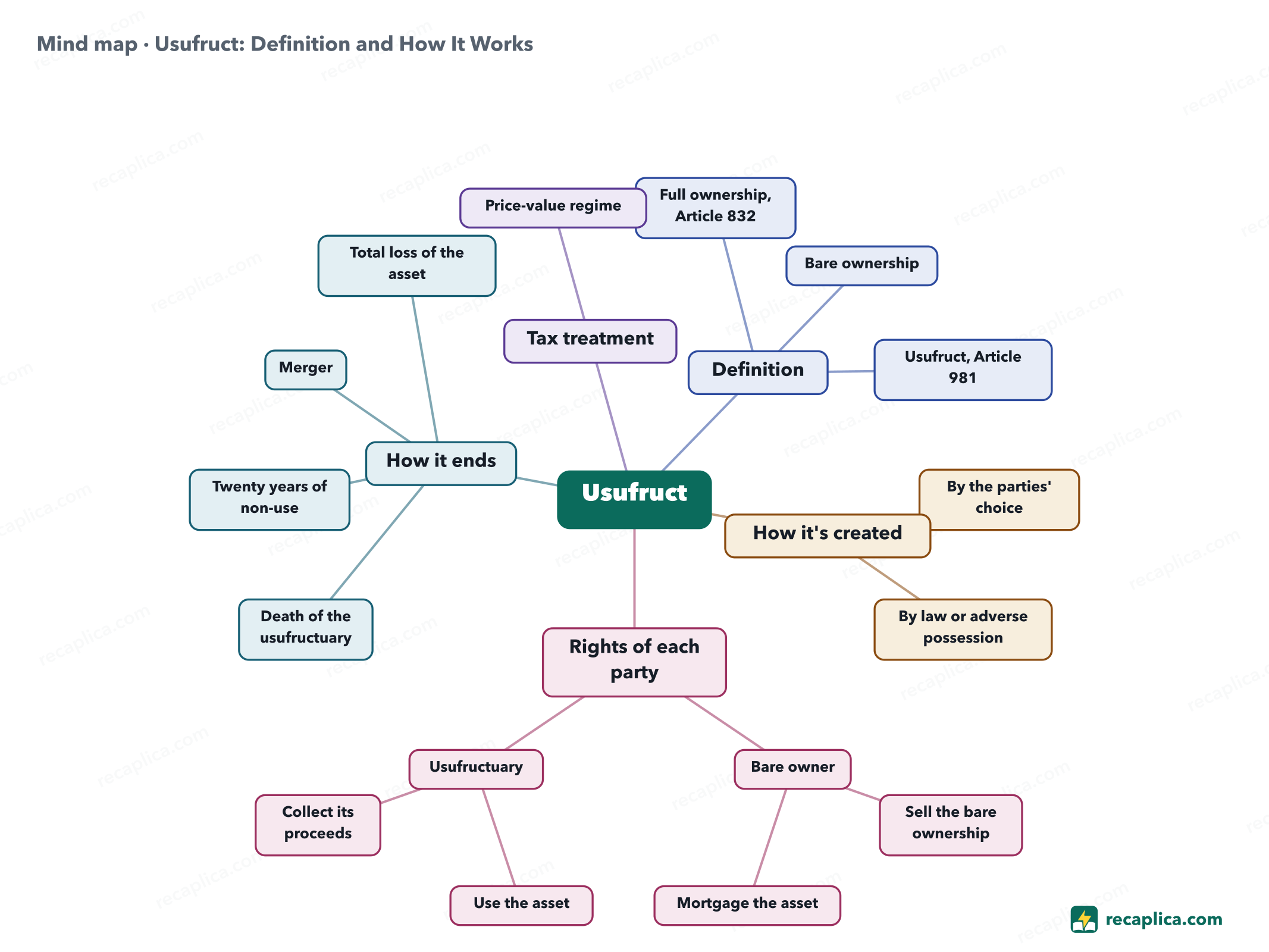
Quiz: test yourselfAnswer the questions to check what you have learned: you get instant feedback and a short explanation. Grade 0/10 0/5
FlashcardsTap the card to flip it and check whether you remember the answer, then move to the next one. 1 / 7 Explain it in your own wordsThe ultimate test: if you can explain it in simple words, you've truly understood it. Write your explanation, then compare it with the Recap. Your explanation is saved only on this device.
Frequently asked questionsWhat is usufruct?Usufruct lets one person use an asset that belongs to someone else and keep what it produces — rent, crops, and so on — as long as they respect its economic purpose. Title stays with the bare owner, who can dispose of the asset but not use it (Articles 832 and 981 of the Italian Civil Code). Can bare ownership be sold?Yes. A bare ownership can change hands while the usufruct is still running: the buyer becomes the new bare owner, but the right to use the property stays with the original usufructuary. What happens when the usufructuary dies?The usufruct ends (Article 979) and the bare owner becomes the full owner. As a rule, a land-registry update is the only formality; no new deed is needed. What's the difference between usufruct and bare ownership?They're the two rights that together make up full ownership: the usufructuary uses the asset and keeps its proceeds, while the bare owner holds title and can dispose of it, but can't use it while the usufruct lasts. Does usufruct last forever?No. Under Article 979 of the Civil Code it ends at the latest when the usufructuary dies, and a legal entity can hold it for thirty years at most. It can also end sooner: after twenty years of non-use, when the two rights merge in one person, or when the asset is lost. Every Recap goes through an independent review before publication. |