Skip to content
recaplica

    One moment: security check

    Cloudflare wants to make sure you're not a robot. Tick the box below and your search will continue on its own.

    IT
    recaplica Italian Legal System: How Courts and Judges Are Organized
    © 2026 Recaplica · recaplica.com — All rights reserved
    Home › Civics

    Italian Legal System: How Courts and Judges Are Organized

    By Recaplica Newsroom · Updated on September 25, 2026

    What to print

    Page numbers appear when printing with default margins.

    Slides

    Choose a cut

    Flash10 slidesThe essential thread, to present in classFull18 slidesEvery chapter and the deeper detail

    Both come with speaker notes.

    Telegram channel
    recaplica Clear in 30 seconds, yours in 10 minutes.
    In 30 seconds Key points Figures Deep dive Slides Myths Mind map Quiz Flashcards FAQ

    In 30 seconds quick read

    The Italian legal system has two branches: the ordinary judiciary, staffed by career magistrates, and special jurisdictions for public administration, public accounts, and military offenses. A case can move through up to three levels of judgment: a first instance, an appeal, and the Court of Cassation, which does not re-examine the facts but checks only whether the law was applied correctly. Magistrates are also split by function rather than rank: those who judge, and public prosecutors, who are required by law to bring criminal charges. The independence of the judiciary from every other branch of the state is safeguarded by the Superior Council of the Judiciary, chaired by the President of the Republic.

    Key Points

    • Article 101 of the Constitution states that justice is administered in the name of the people and that judges are subject only to the law.
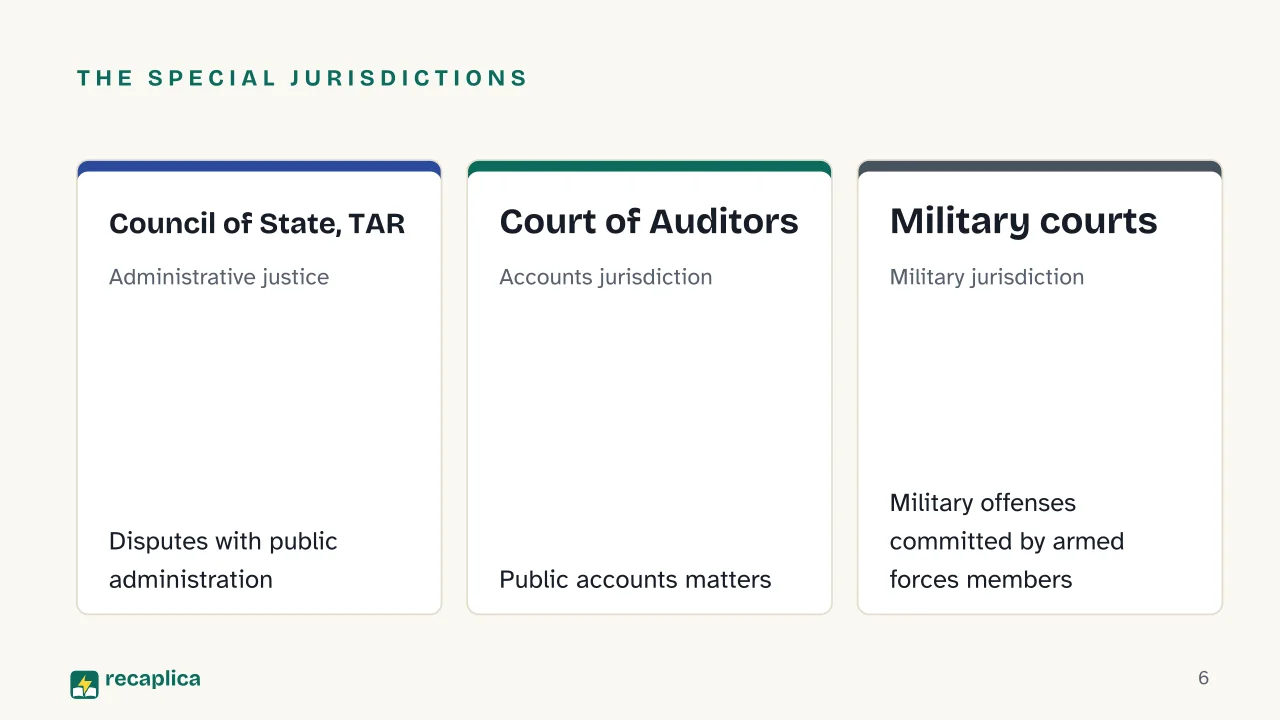
    • The ordinary judiciary (Arts. 101-102, 104-111) is staffed by career magistrates; special jurisdictions (Art. 103) cover administrative justice (Council of State and TAR regional tribunals), public accounts (Court of Auditors), and military courts.
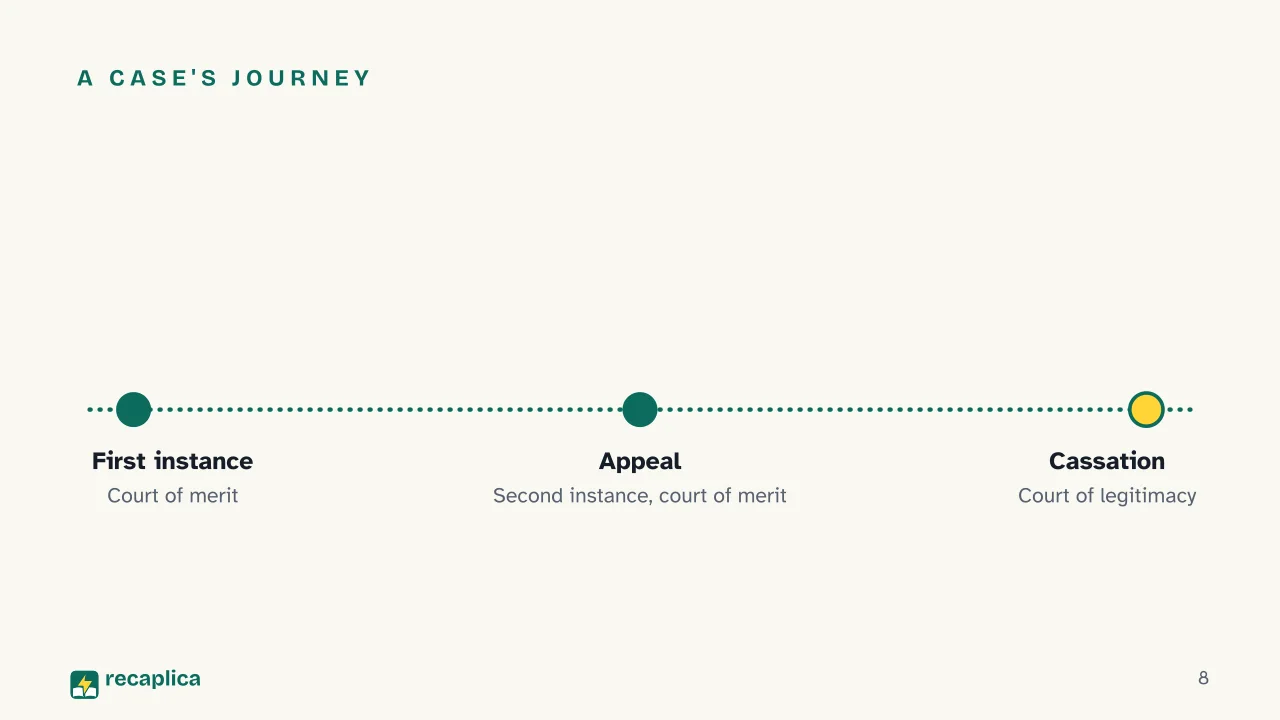
    • A case can go through three levels: a first instance, an appeal (second instance), and the Court of Cassation. The first two are courts of merit, which weigh the facts; the Cassation is a court of legitimacy that checks only whether the law was applied correctly.
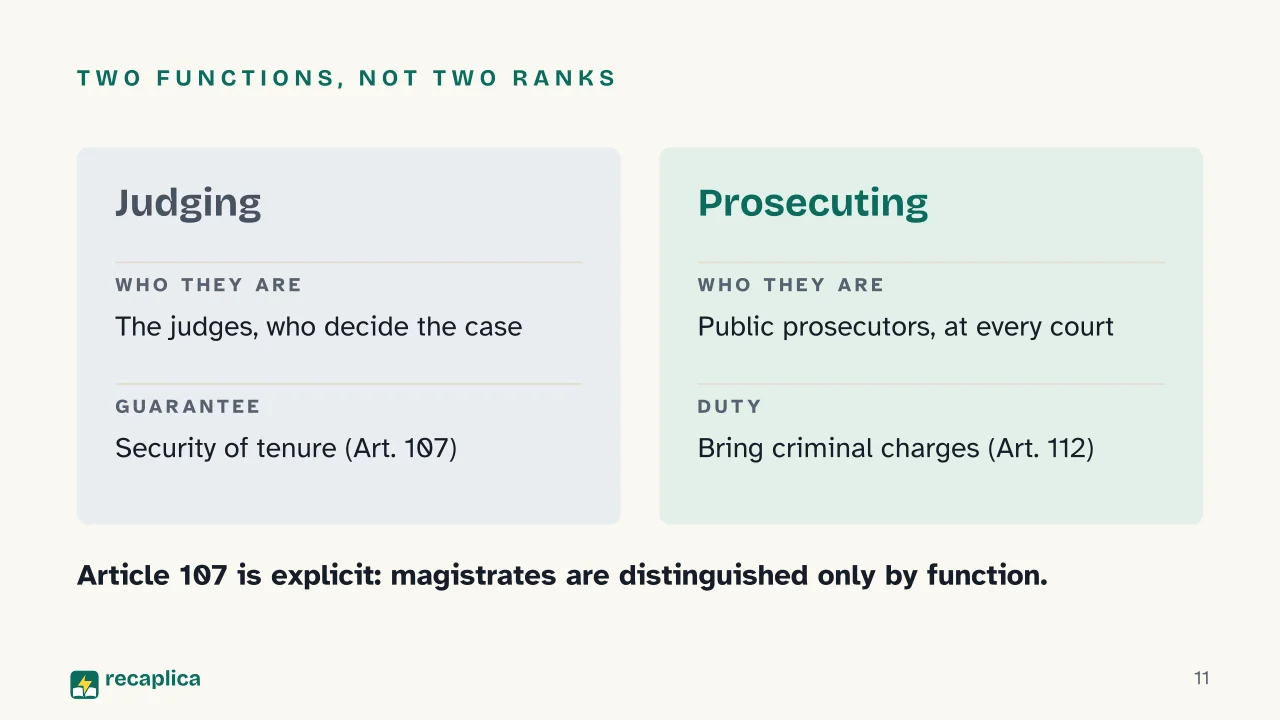
    • Magistrates are distinguished by function, not by rank (Art. 107): those who judge (the judging magistracy) and public prosecutors, who are required by law to bring criminal charges (Art. 112).
    • The justice of the peace is a lay, non-career magistrate: in office since May 1, 1995, replacing the former conciliating judge, with broader civil jurisdiction and, from January 1, 2002, criminal jurisdiction over minor offenses.
    • The Superior Council of the Judiciary (Art. 104) is the judiciary's self-governing body, chaired by the President of the Republic. Its ex officio members are the first president and the prosecutor-general of the Cassation, while the other members are elected: two-thirds by magistrates and one-third by Parliament from among law professors and lawyers with fifteen years of practice.

    Key figures

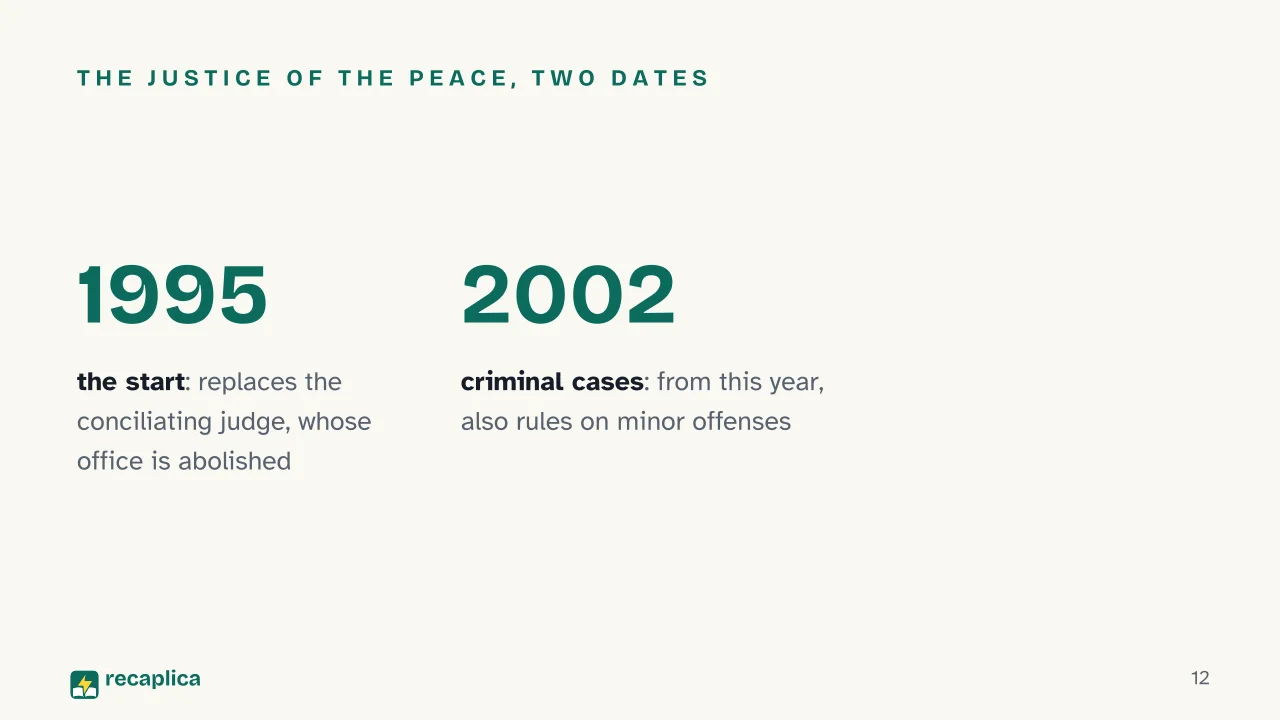
    • 1995 year the justice of the peace began operating, replacing the former conciliating judge, whose office was abolished Source: Italian Ministry of Justice, institutional glossary
    • 2002 year from which the justice of the peace also took on criminal jurisdiction, for minor offenses Source: Italian Ministry of Justice, institutional glossary

    Deep Dive

    Justice administered in the name of the people

    Article 101 of the Constitution opens the title dedicated to the judiciary this way: justice is administered in the name of the people, and judges are subject only to the law. Two short lines, but they carry the rest of the system: no judge answers to a boss, a party, or another branch of the state when deciding a case. The only constraint is the law itself.

    This framework is tied to the rules of the Italian Constitution: the legal system isn’t a self-contained body of rules, but flows directly from the principles the 1948 Charter sets out, which define who can judge, under what guarantees, and within what limits.

    Two paths in the Constitution: ordinary and special

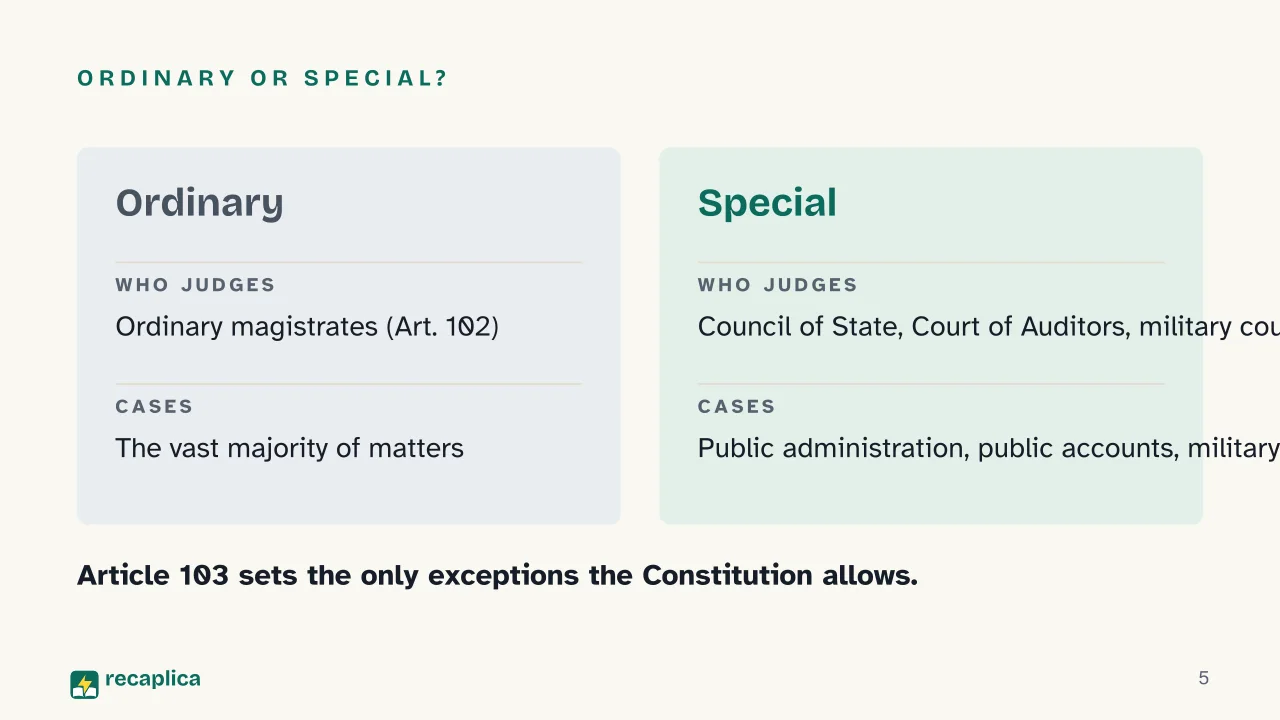
    Article 102 establishes that judicial power is exercised by ordinary magistrates, appointed and regulated under the rules on the judicial system, and it bars the creation of new extraordinary or special courts. Only specialized sections within ordinary judicial bodies are allowed, and even those may include citizens who are not magistrates.

    Article 103, however, sets three exceptions directly in the Constitution, which sit outside the ordinary judiciary:

    JurisdictionBodiesMatters
    AdministrativeCouncil of State and other administrative justice bodies (including the TAR regional tribunals)Protection of legitimate interests against public administration and, in cases set by law, of subjective rights
    AccountsCourt of AuditorsPublic accounts matters and others set by law
    MilitaryMilitary courtsMilitary offenses committed by members of the armed forces; jurisdiction is broader in wartime

    Every “rule” that governs these bodies is, in a sense, a legal norm: a general and abstract rule, backed by the state, different from good manners or social customs precisely because breaking it carries consequences set by law.

    The three levels of judgment

    The Italian Ministry of Justice’s glossary describes the Italian system as built on the principle of the “double level of judgment,” structured into three levels: a first-instance trial, a second-instance (or appeal) trial, and a legitimacy ruling, which takes place before the Court of Cassation.

    Practical example: a civil case begins before a trial court (first instance). Whoever loses can appeal the ruling before a court of appeal (second instance), which re-examines the facts and evidence again. If the appeal still doesn’t settle the matter, one path remains: an appeal to the Court of Cassation, which does not, however, revisit facts already established. It checks only whether the law was applied correctly.

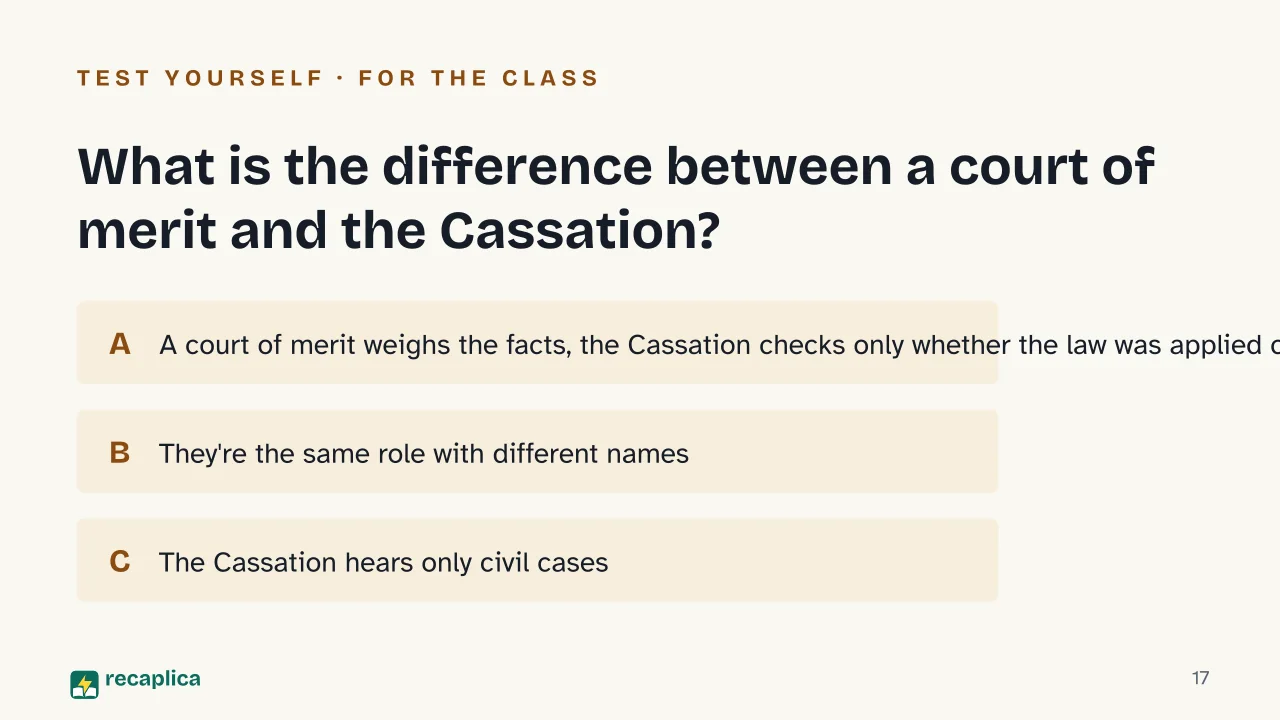
    Here lies the distinction a class assignment asks about most often: the first instance and the appeal are courts of merit, because they weigh the facts of a case. The Cassation is a court of legitimacy. According to its own institutional website, its task is to ensure the law is correctly observed and uniformly interpreted, to preserve the unity of national law, and to respect the boundaries between different jurisdictions: it rules on errors of substantive or procedural law and flawed reasoning, setting principles that bind the court the case is sent back to. Beyond this, the Cassation also has non-judicial duties, such as determining which court has jurisdiction over a case or weighing in on legislative elections and abrogative referendums.

    Who judges and who prosecutes: judging and prosecuting magistrates

    Within the ordinary judiciary lies another distinction, often mistaken for a rank but not one at all. Article 107 of the Constitution states it directly: magistrates are distinguished from one another only by function. On one side is the judging magistracy, the judges who decide cases. On the other is the prosecuting magistracy: the public prosecutor, who represents the accusation in a criminal trial, organized into public prosecutor’s offices attached to the Cassation, the courts of appeal, the ordinary trial courts, and the juvenile courts.

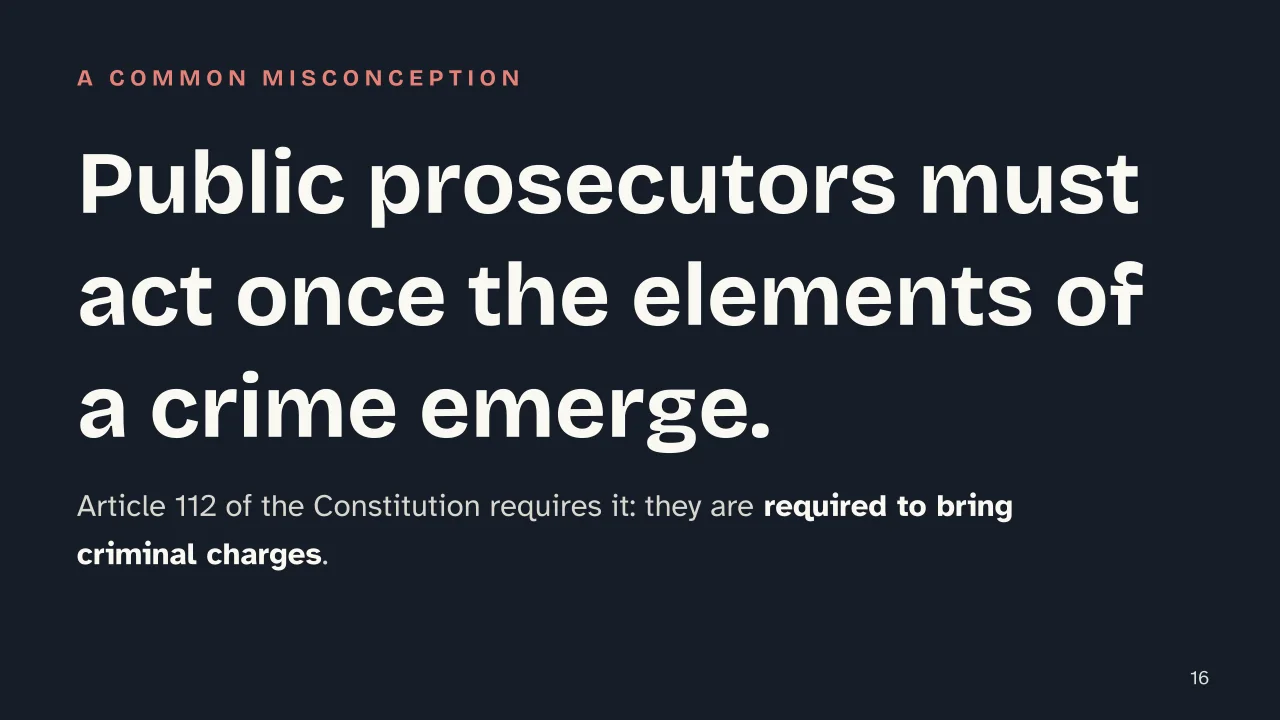
    What sets the Italian public prosecutor apart from those in some other countries is Article 112: the public prosecutor is required to bring criminal charges. Prosecutors cannot decide, out of convenience or expediency, not to proceed: if the elements of a crime emerge, they must act. It’s a duty, not a discretion.

    The justice of the peace

    Alongside career magistrates, who enter the profession through a competitive exam, another figure operates: the justice of the peace. The Italian Ministry of Justice’s glossary defines it as a lay magistrate, temporarily assigned judicial functions. The role carries no employment relationship with the state, and the term lasts four years and can be renewed once.

    The justice of the peace began operating on May 1, 1995, replacing the conciliating judge, whose office was abolished. Its civil jurisdiction is much broader than that of the former conciliating judge; from January 1, 2002, criminal jurisdiction was added as well, for minor offenses that don’t require complex investigation.

    Judicial self-governance: the CSM

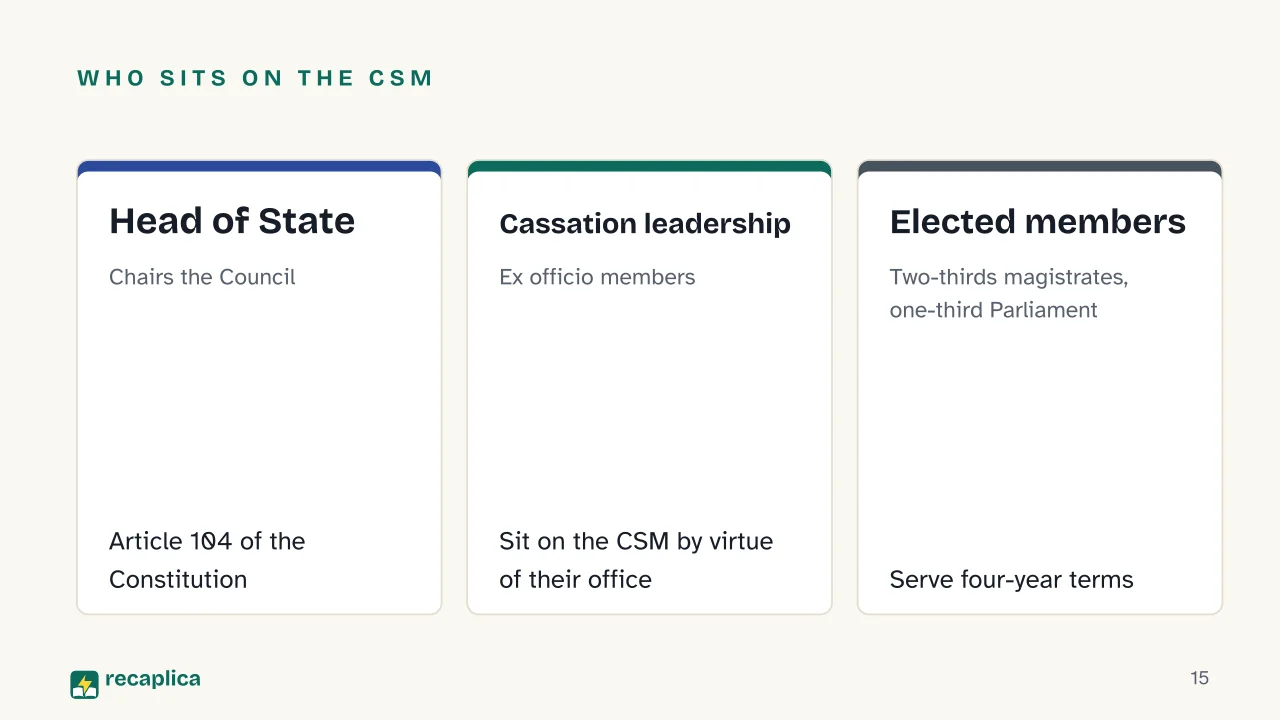
    The independence of judges would count for little without a body to safeguard it from within. That is the task of the Superior Council of the Judiciary, established by Article 104: the judiciary is an autonomous branch, independent of every other power, and the CSM is its self-governing body.

    The Council is chaired by the President of the Republic. Its ex officio members are the first president and the prosecutor-general of the Court of Cassation. The other members are elected: two-thirds by all ordinary magistrates, from among their various categories, and one-third by Parliament in joint session, chosen from among tenured university law professors and lawyers with at least fifteen years of practice. Elected members serve four-year terms and cannot be immediately re-elected. The exact number of members is set by ordinary law, not by the constitutional text, and it has changed more than once over time.

    Independence, tenure, and a fair trial

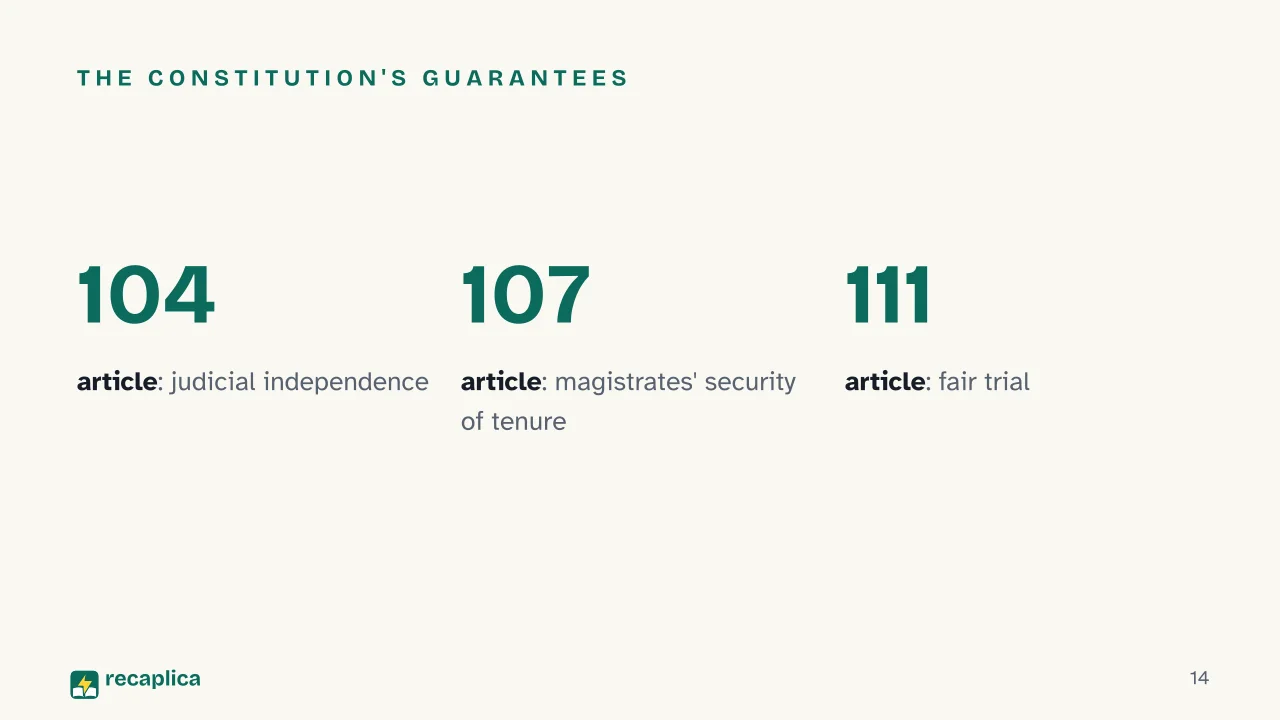
    Three articles round out the guarantees. Article 104 sets the judiciary’s independence from every other branch of the state. Article 107 adds security of tenure: magistrates cannot be transferred, suspended, or dismissed from service except under the guarantees the rules on the judicial system provide, or with their own consent; the power to bring disciplinary proceedings belongs to the Minister of Justice.

    Article 111, finally, describes the fair trial: jurisdiction is exercised through a fair trial regulated by law. Every trial takes place in an adversarial process between the parties, on equal terms, before a third-party and impartial judge, and the law guarantees its reasonable length. These are the minimum conditions for a trial, at any level, to be called fair.

    Slide deck

    Slides ready to download and make your own in PowerPoint or Google Slides, with speaker notes. Pick the Flash cut or the Full one.
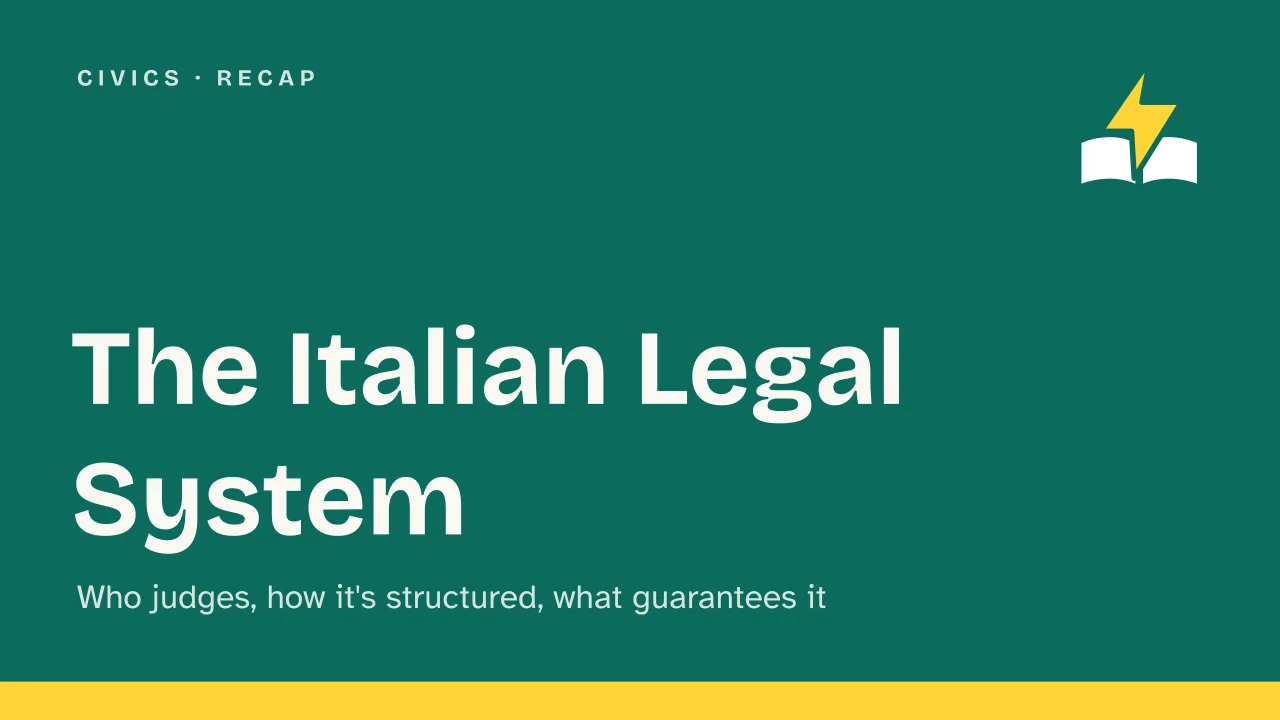
    Slide 1 of the presentation on Italian Legal System: The Italian Legal SystemSlide 2 of the presentation on Italian Legal System: Why doesn't the Cassation retry a case?Slide 3 of the presentation on Italian Legal System: What we'll coverSlide 4 of the presentation on Italian Legal System: Chapter 01: Two courts, one ConstitutionSlide 5 of the presentation on Italian Legal System: Ordinary or special?Slide 6 of the presentation on Italian Legal System: The special jurisdictions: Council of State, TAR, Court of Auditors, Military courtsSlide 7 of the presentation on Italian Legal System: Chapter 02: The three levels of judgmentSlide 8 of the presentation on Italian Legal System: A case's journeySlide 9 of the presentation on Italian Legal System: Can a factual error be fixed at the Cassation?Slide 10 of the presentation on Italian Legal System: Chapter 03: Who judges, who prosecutesSlide 11 of the presentation on Italian Legal System: Two functions, not two ranksSlide 12 of the presentation on Italian Legal System: The justice of the peace, two datesSlide 13 of the presentation on Italian Legal System: Chapter 04: Independence and self-governanceSlide 14 of the presentation on Italian Legal System: The Constitution's guaranteesSlide 15 of the presentation on Italian Legal System: Who sits on the CSM: Head of State, Cassation leadership, Elected membersSlide 16 of the presentation on Italian Legal System: Public prosecutors must act once the elements of a crime emerge.Slide 17 of the presentation on Italian Legal System: What is the difference between a court of merit and the Cassation?Slide 18 of the presentation on Italian Legal System: Now for the review
    Flash10 slidesThe essential thread, to present in classFull18 slidesEvery chapter and the deeper detail

    Common myths

    • ✗ Myth You can ask the Court of Cassation for a new trial if you disagree with the facts established in the first two levels of judgment.

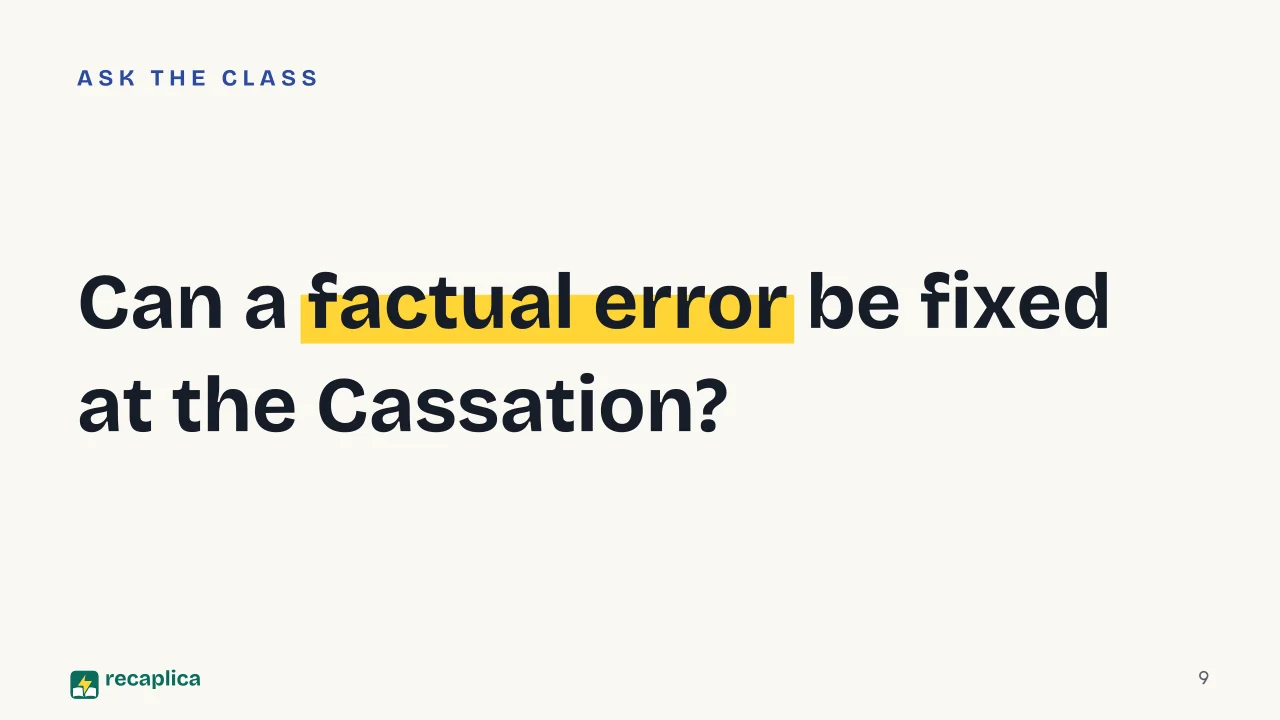
      ✓ Reality In reality, the Cassation is a court of legitimacy, not of merit: according to its own institutional website, it checks that the law was correctly observed and uniformly interpreted, and does not re-examine the facts of the case. Anyone who wants to challenge a ruling before the Cassation can only do so for errors of law, procedural defects, or flawed reasoning, not because they disagree with how the facts played out.

    • ✗ Myth Public prosecutors decide, case by case, whether it is worth starting a criminal trial.

      ✓ Reality In reality, Article 112 of the Constitution requires them to bring criminal charges: they cannot choose to drop a case for convenience or expediency.

    • ✗ Myth The justice of the peace is simply the old conciliating judge under a different name.

      ✓ Reality In reality, the office of conciliating judge was abolished when the justice of the peace began operating on May 1, 1995, and the new role is a lay magistrate with much broader civil jurisdiction; from January 1, 2002, it also handles minor criminal offenses, a function the conciliating judge never had.

    Mind map

    Drag the background to move around and the nodes to reposition them; use − and + to collapse and expand branches.
    Customize
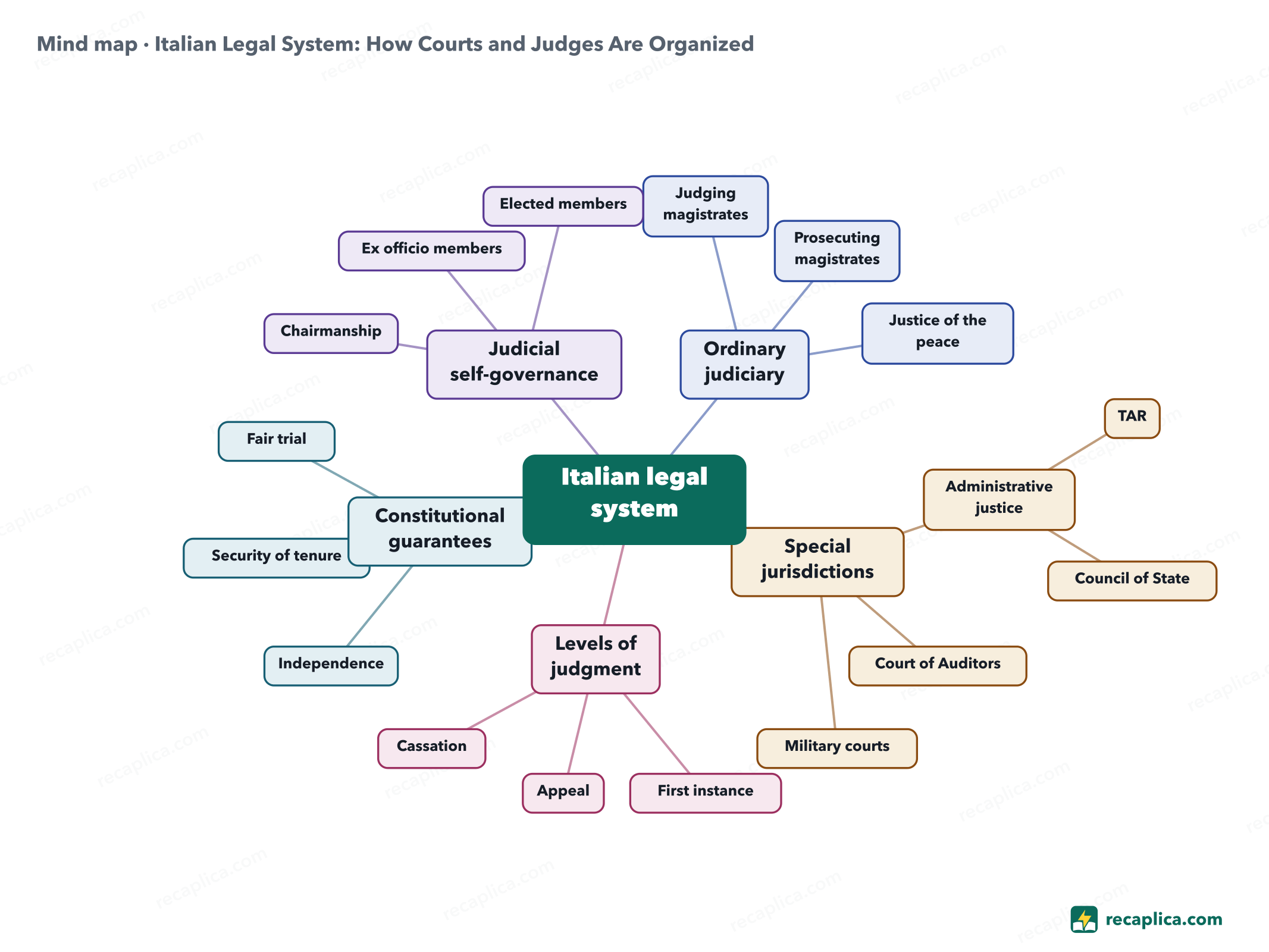
    Mind map: Italian Legal System: How Courts and Judges Are Organized
    • Italian legal system
      • Ordinary judiciary Arts. 101-102, 104-111
        • Judging magistrates The judges who decide the case
        • Prosecuting magistrates Public prosecutors, required to bring charges
        • Justice of the peace Lay magistrate, in office since 1995
      • Special jurisdictions Art. 103
        • Administrative justice
          • TAR First-instance administrative courts
          • Council of State Administrative appeals
        • Court of Auditors Public accounts matters
        • Military courts Military offenses
      • Levels of judgment
        • First instance Court of merit
        • Appeal Second instance, court of merit
        • Cassation Court of legitimacy, does not re-examine facts
      • Constitutional guarantees
        • Independence Art. 104, from every other branch of the state
        • Security of tenure Art. 107, magistrates cannot be removed arbitrarily
        • Fair trial Art. 111, adversarial process and an impartial judge
      • Judicial self-governance
        • Chairmanship The Superior Council, chaired by the President of the Republic
        • Ex officio members First president and prosecutor-general of the Cassation
        • Elected members Two-thirds magistrates, one-third Parliament

    Quiz: test yourself

    Answer the questions to check what you have learned: you get instant feedback and a short explanation.

    Grade 0/10 0/5
    1 What is the difference between a court of merit and the Court of Cassation?

    The first instance and the appeal are courts of merit, which establish the facts. The Cassation is a court of legitimacy: according to its own institutional website, it ensures the law is correctly observed and uniformly interpreted, without re-examining the facts of the case.

    2 What does Article 112 of the Constitution require of public prosecutors?

    Article 112 is unambiguous: 'the public prosecutor is required to bring criminal charges.'

    3 Which special jurisdictions does Article 103 of the Constitution provide for?

    Article 103 assigns the Council of State and the other administrative justice bodies jurisdiction over disputes with public administration, the Court of Auditors jurisdiction over public accounts, and military courts jurisdiction over military offenses.

    4 True or false: since it began operating in 1995, the justice of the peace has always handled criminal cases.

    False: the justice of the peace began operating on May 1, 1995, replacing the conciliating judge, with expanded civil jurisdiction; criminal jurisdiction over minor offenses arrived only on January 1, 2002.

    5 Who chairs the Superior Council of the Judiciary?

    Article 104 of the Constitution establishes that the Superior Council of the Judiciary is chaired by the President of the Republic; its ex officio members also include the first president and the prosecutor-general of the Court of Cassation.

    Answers: 1-A · 2-B · 3-B · 4-B · 5-C

    Flashcards

    Tap the card to flip it and check whether you remember the answer, then move to the next one.

    1 / 8

    Explain it in your own words

    The ultimate test: if you can explain it in simple words, you've truly understood it. Write your explanation, then compare it with the Recap.

    Your explanation is saved only on this device.

    The Italian legal system has two branches: the ordinary judiciary, staffed by career magistrates, and special jurisdictions for public administration, public accounts, and military offenses. A case can move through up to three levels of judgment: a first instance, an appeal, and the Court of Cassation, which does not re-examine the facts but checks only whether the law was applied correctly. Magistrates are also split by function rather than rank: those who judge, and public prosecutors, who are required by law to bring criminal charges. The independence of the judiciary from every other branch of the state is safeguarded by the Superior Council of the Judiciary, chaired by the President of the Republic.

    Frequently asked questions

    What does it mean that judges are "subject only to the law"?

    It is the principle set out in Article 101 of the Constitution: when deciding a case, a judge must apply the law and cannot follow orders from another branch of the state, a superior, or anyone else. It is one of the foundations of judicial independence, alongside the security of tenure the Constitution grants magistrates under Article 107.

    What is the difference between judging and prosecuting magistrates?

    Judging magistrates are the judges who decide cases. Prosecuting magistrates are the public prosecutors, working out of a public prosecutor's office, who represent the accusation in a criminal trial and who, under Article 112 of the Constitution, are required to bring criminal charges. Under Article 107, magistrates are distinguished from one another only by function, never by rank.

    Why can't the facts of a case be re-argued before the Court of Cassation?

    Because the Cassation is a court of legitimacy, not of merit. According to its own institutional website, its task is to ensure the law is correctly observed and uniformly interpreted and that the boundaries between jurisdictions are respected, ruling only on errors of law, procedural defects, or flawed reasoning. The facts of the case have already been established in the earlier stages.

    Who sits on the Superior Council of the Judiciary?

    It is chaired by the President of the Republic. Its ex officio members are the first president and the prosecutor-general of the Court of Cassation. The other members are elected: two-thirds by ordinary magistrates from among their various categories, one-third by Parliament in joint session from among tenured law professors and lawyers with at least fifteen years of practice. They serve four-year terms and cannot be immediately re-elected.

    What is a justice of the peace, and since when has the role existed?

    It is a lay, non-career magistrate who has been in office since May 1, 1995, replacing the former conciliating judge, whose office was abolished. The role carries much broader civil jurisdiction than the old conciliating judge and, from January 1, 2002, also handles minor criminal offenses that do not require complex investigation. The term lasts four years and can be renewed once.

    Sources

    • Constitution of the Italian Republic, Art. 101 (Normattiva, Italian)
    • Constitution of the Italian Republic, Art. 102 (Normattiva, Italian)
    • Constitution of the Italian Republic, Art. 103 (Normattiva, Italian)
    • Constitution of the Italian Republic, Art. 104 (Normattiva, Italian)
    • Constitution of the Italian Republic, Art. 107 (Normattiva, Italian)
    • Constitution of the Italian Republic, Art. 111 (Normattiva, Italian)
    • Constitution of the Italian Republic, Art. 112 (Normattiva, Italian)
    • Italian Ministry of Justice, institutional glossary - Level of judgment (Italian)
    • Italian Ministry of Justice, institutional glossary - Superior Council of the Judiciary (Italian)
    • Italian Ministry of Justice, institutional glossary - Justice of the peace (Italian)
    • Italian Ministry of Justice, institutional glossary - Public prosecutor's office (Italian)
    • Italian Supreme Court of Cassation - The Court's functions (Italian)

    Every Recap goes through an independent review before publication.

    Every evening, the day's new Recaps on our Telegram channel. Join the channel →

    Keep learning

    • Civics Carabinieri Ranks: The Four-Role Hierarchy of the Corps Every member of the Carabinieri sits inside one of four legally defined roles, in force since a 2000 law: Officers, Inspectors, Supervisors, and Corporals and Privates. Promotion happens inside a role first, and the four roles themselves run from the most operational to the most senior. The lowest rank is Carabiniere; the highest is Generale di Corpo d'Armata, in the Officer role. Two abbreviations, Q.S. and C.S., show up next to a handful of ranks — they aren't extra rungs on the ladder, just a qualification attached to the top rank already sitting there. Read the Recap →
    • Civics Codice Fiscale: What It Is, Structure and Everyday Uses The codice fiscale is the code that uniquely identifies a person in every dealing with Italian public bodies and administrations, from healthcare to official paperwork. It is made up of 16 alphanumeric characters derived from the holder's personal data. Only the Agenzia delle Entrate, Italy's tax agency, can issue a valid one: any code generated by an outside tool has no official standing. The system dates back to 1973, created by the same decree that set up Italy's taxpayer register. It is a different thing from the partita IVA, which identifies an economic activity. Read the Recap →
    • Civics Italian Government Structure: Which Bodies Do What The Italian state rests on five bodies that the Constitution sets up and regulates directly: Parliament makes the laws, the Government carries them out, the President of the Republic represents national unity, the judiciary applies the law to individual cases, and the Constitutional Court checks that laws respect the Constitution. Alongside them sit four bodies of constitutional relevance — the High Council of the Judiciary, the Court of Auditors, the CNEL and the Council of State — auxiliary bodies the Constitution sets up but keeps in a separate category from the five essential ones. Knowing who does what, and which bodies the system cannot run without, is the fastest way into how Italy is actually governed. Read the Recap →

    recaplica

    Clear in 30 seconds, yours in 10 minutes.

    Recaps Mind maps Request a Recap Telegram channel Mind map maker Our method About Privacy & cookies Legal notes & terms of use

    © 2026 Recaplica · A project by Curi S.r.l. — VAT IT05472000750

    Statistics, only if you say so

    To learn which Recaps help most we would use Google Analytics, with aggregate, anonymous data. It starts only with your OK, and you can change your mind anytime. Privacy policy