|
recaplica
Surviving Spouse's Right of Habitation in Italy: What It Is and How It Works |
| © 2026 Recaplica · recaplica.com — All rights reserved |
Surviving Spouse's Right of Habitation in Italy: What It Is and How It WorksWhat to print Page numbers appear when printing with default margins. SlidesChoose a cut Flash10 slidesThe essential thread, to present in classFull15 slidesEvery chapter and the deeper detailBoth come with speaker notes. In 30 seconds quick readUnder Italian law, a surviving spouse has a guaranteed right to keep living in the home the couple shared, thanks to Article 540 of the Italian Civil Code. That right also covers the furniture inside the house. It arises automatically the moment the estate opens, with no need for a contract or a will to set it up. It applies to a home the deceased spouse owned alone or jointly with the surviving spouse, but not to one shared with an outside third party. The heirs, often the couple's children, keep ownership of the property, but that ownership is limited by the spouse's right: lawyers call this reduced form of ownership "bare ownership." An unmarried partner who outlives their cohabitant gets a different, much shorter right, created by a 2016 law known as the Cirinnà Law. Key Points
Deep DiveWhat Article 540 of the Italian Civil Code saysArticle 540, second paragraph, of the Italian Civil Code states that a spouse, even alongside other heirs, is entitled to the right of habitation in the home used as the family residence and the right to use the furniture in it, provided the home belonged to the deceased spouse or was jointly owned by both spouses. This reserve sits on top of the inheritance share the spouse is entitled to by law under the first paragraph of the same article, and it draws first on the portion of the estate free of other reserved shares, then, if that isn’t enough, on the spouse’s own reserved share and, where relevant, on the children’s. The condition on ownership is stricter than it sounds: it’s enough that the home belonged to the deceased alone, or to both spouses together, as often happens with a home bought during the marriage and registered under joint private ownership. The right does not arise, however, if a third party also owned a share of the home, such as a brother of the deceased who co-owned the property with him.
How it comes into being: a right created by law, not by an actA surviving spouse’s right of habitation requires no separate legal act: no contract, no clause in a will, no application to file with anyone. It arises on its own the moment the estate opens, as a direct consequence of a legal norm that imposes it regardless of what the deceased or the heirs want. That marks an important difference from the general right of habitation, set out in Article 1021 and the following articles of the Italian Civil Code: that version can be created by anyone, in favor of anyone, through a contract, a will, or adverse possession, and has no connection to marriage. Someone who holds this general right of habitation can use the home within the limits of what they and their family need, and Article 1023 of the Italian Civil Code clarifies that “family” also includes children born after the right began, adopted or legally recognized children, and people who live with the right-holder to provide them with services. That same boundary applies to a surviving spouse’s right, since both are rights of habitation under the same section of the code. The difference from the heirs’ bare ownershipWhen a surviving spouse acquires the right of habitation in the family home, the other heirs, typically the couple’s children, inherit ownership of the property already limited by that right: they become bare owners, holding title to the home but unable to use or rent it out for as long as the spouse lives there. This split between using a property and owning it outright is the same logic behind usufruct, the broader arrangement that separates use from bare ownership. The arrangement here isn’t symmetrical: the spouse has full use of the house, while the heirs hold only its underlying value, which turns into full ownership once the right of habitation ends. This arrangement lasts for the rest of the surviving spouse’s life. Unlike the general right of habitation, which the parties can limit in time through the act that creates it, the right reserved by Article 540 carries no built-in expiration date of its own. The surviving unmarried cohabitantLaw 76 of 2016, known as the Cirinnà Law, introduced a separate protection for someone who lived steadily with a home’s owner without being married to them. Under Article 1, paragraph 42, of that law, a surviving cohabitant is entitled to keep living in the shared home for two years, or for a period equal to the length of the cohabitation if that exceeded two years, though never for more than five years in total. The gap with a spouse’s right isn’t just about duration. The Italian Revenue Agency, ruling on a taxpayer’s request in 2018, clarified that a surviving cohabitant does not become an heir or a legatee of the property, because their claim is a personal right of enjoyment, a different thing from a property right; for that reason, it isn’t listed in the estate’s inheritance filing. The same ruling cites a principle from the Supreme Court of Cassation, holding that this right stems from cohabitation as a factual relationship and exists for one purpose: to give the surviving partner time to find another place to live; a permanent guarantee of the house lies outside that purpose. Proving the cohabitation relies on residency records, or on a self-declaration made under the ordinary rules for such statements. This framework covers unmarried cohabitants only. For civil unions in the strict legal sense, no equally solid sources were found, so the comparison here stops at unmarried cohabitation. In practice, anyone facing an inheritance involving a house, whether spouse, cohabitant, or heir, does well to clarify their position with a notary or a lawyer: the practical consequences, from the inheritance filing to dealings with the other heirs, depend on concrete details a professional can check case by case. Slide deckSlides ready to download and make your own in PowerPoint or Google Slides, with speaker notes. Pick the Flash cut or the Full one.     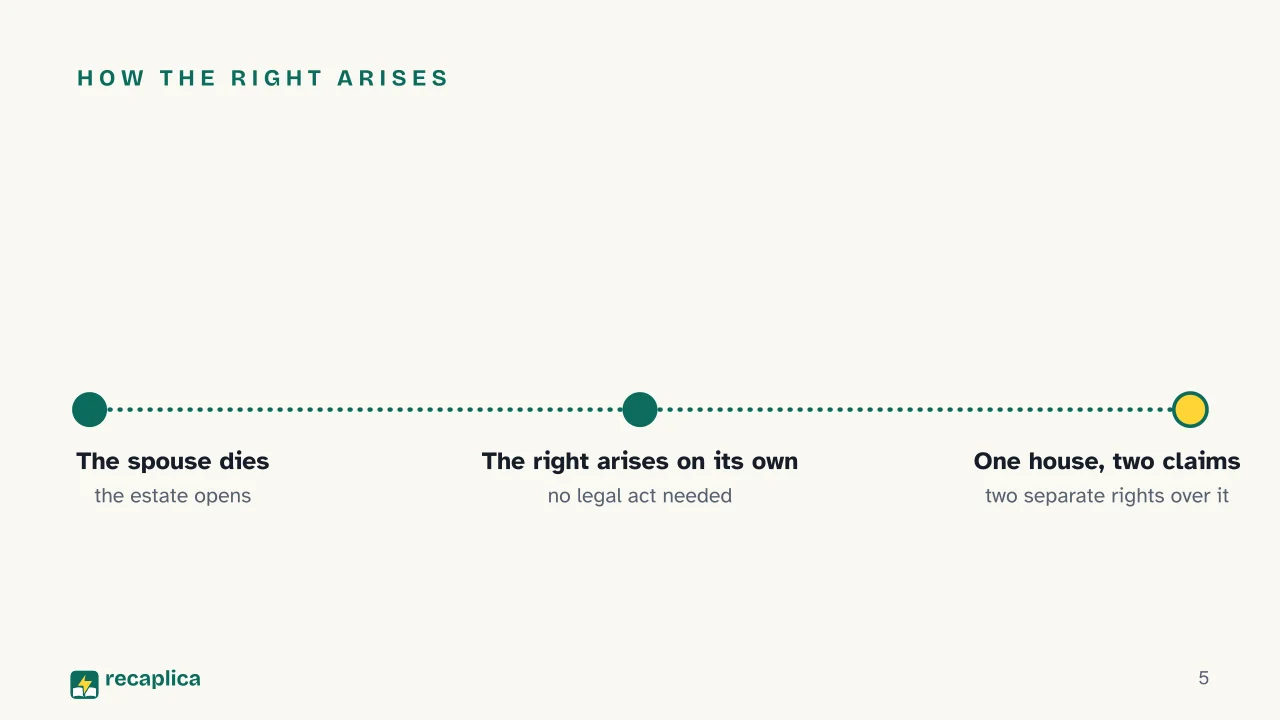 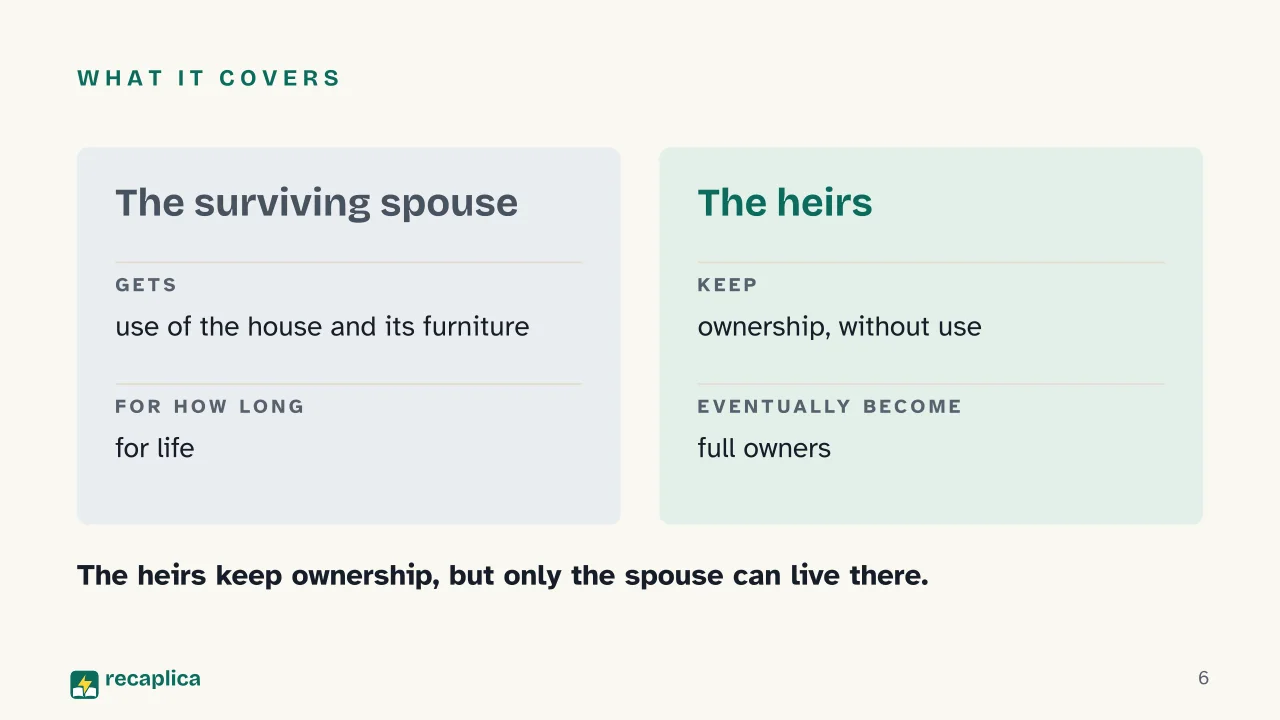  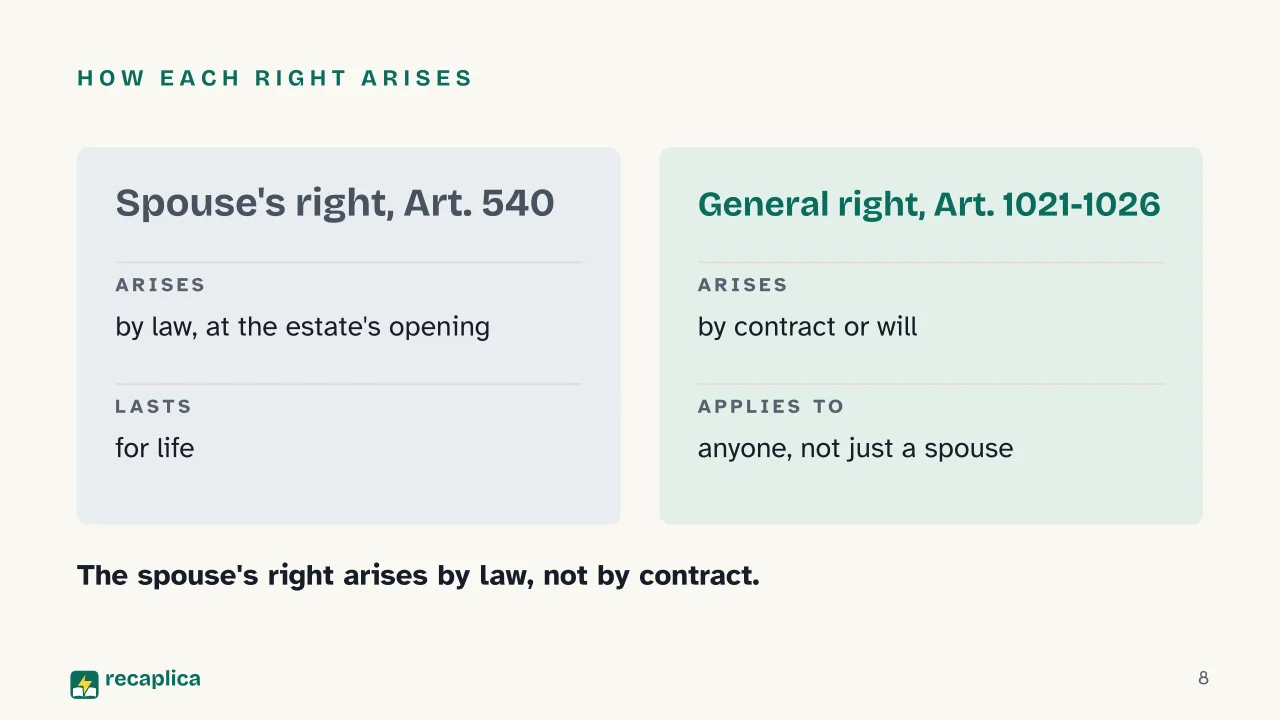 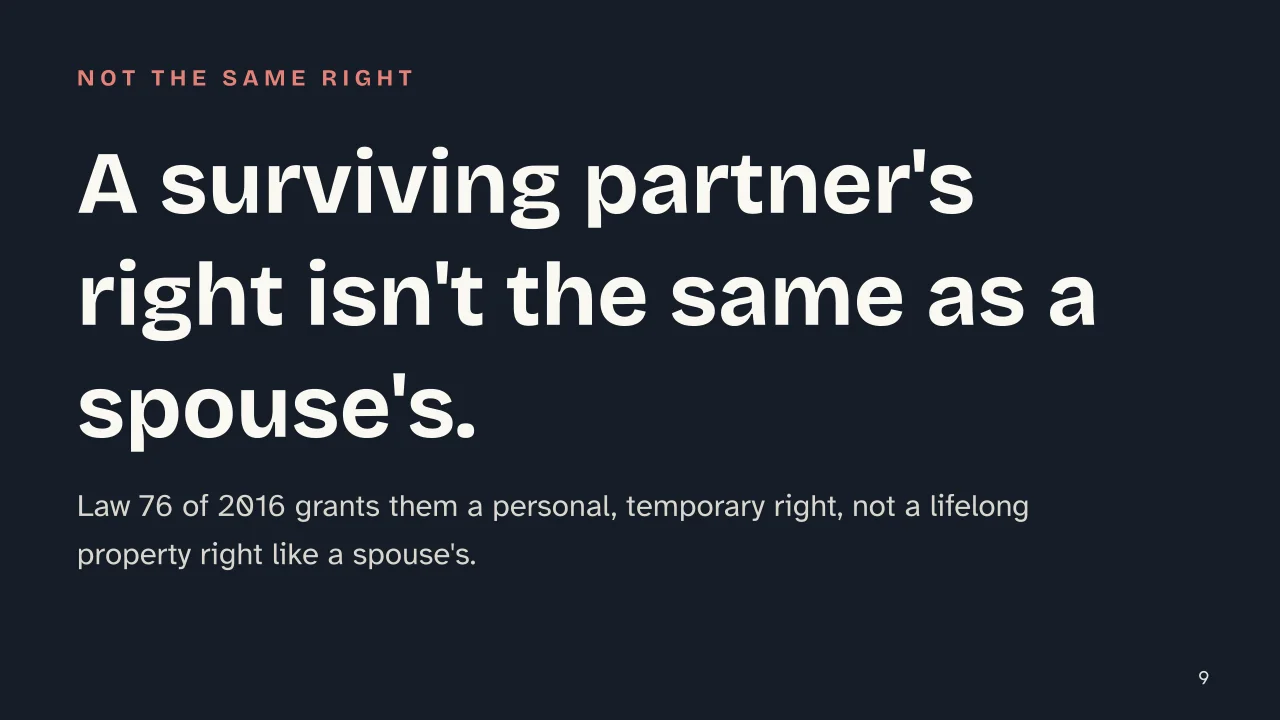 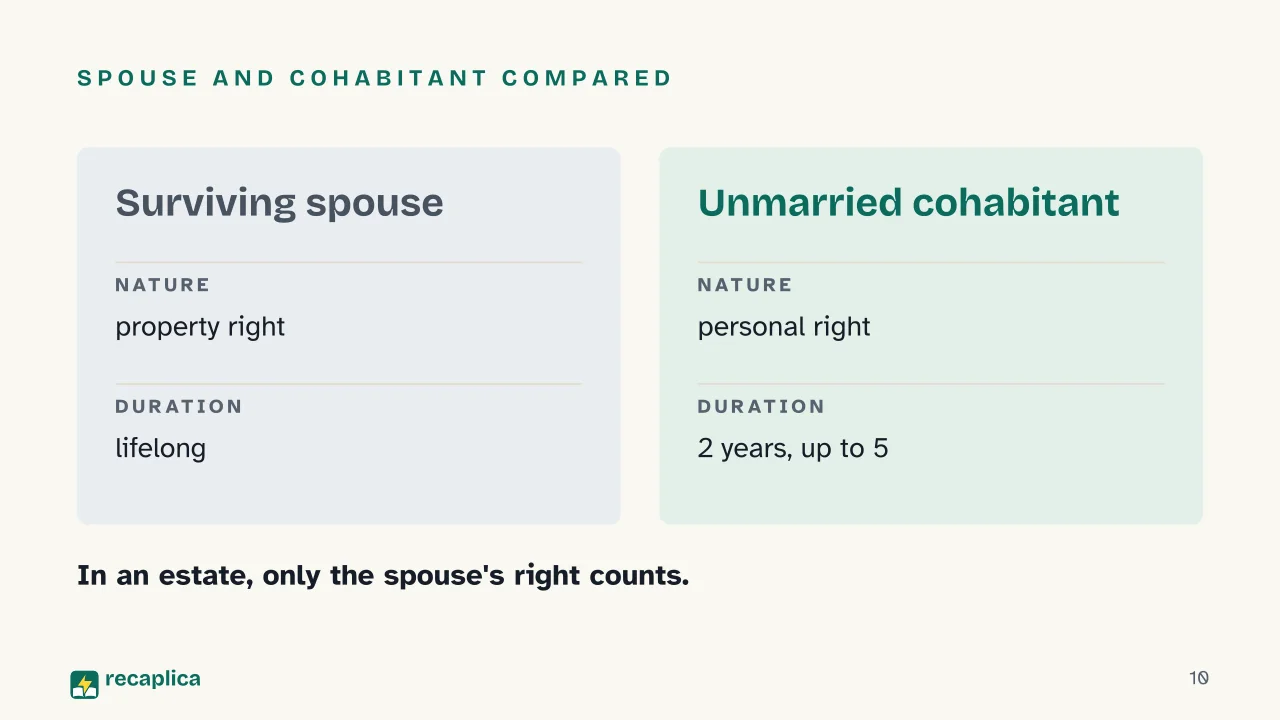  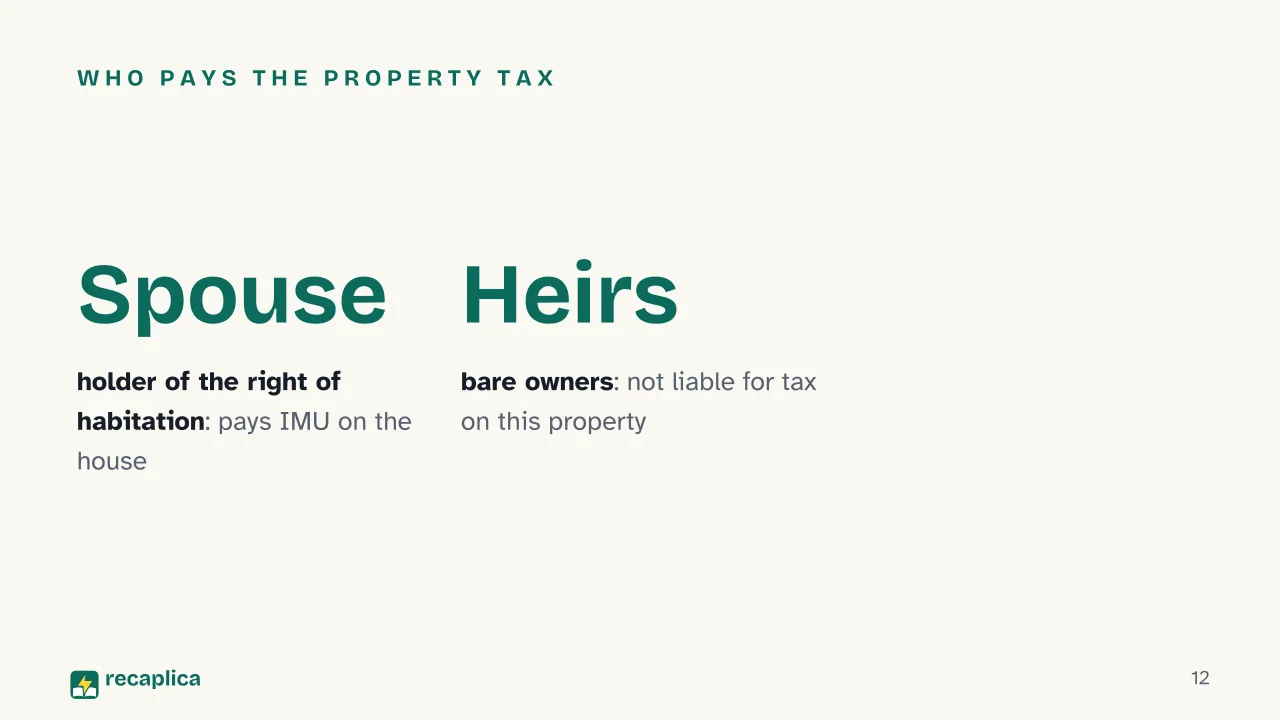 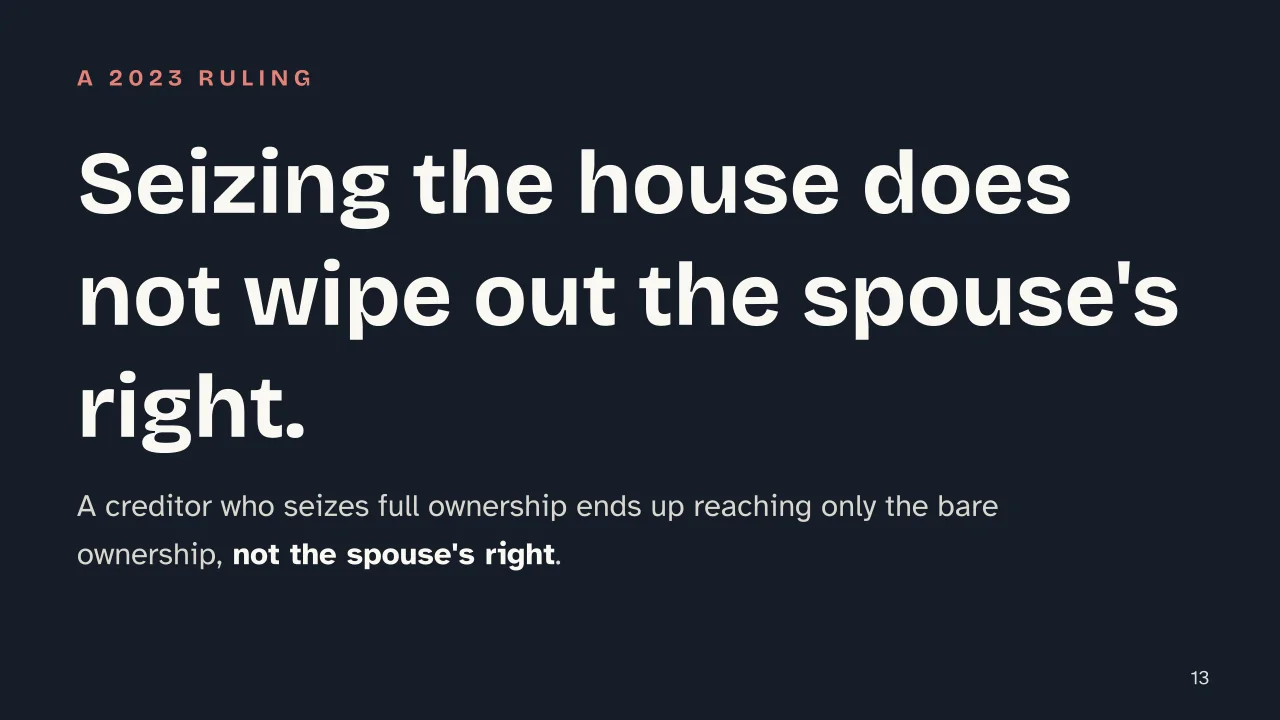 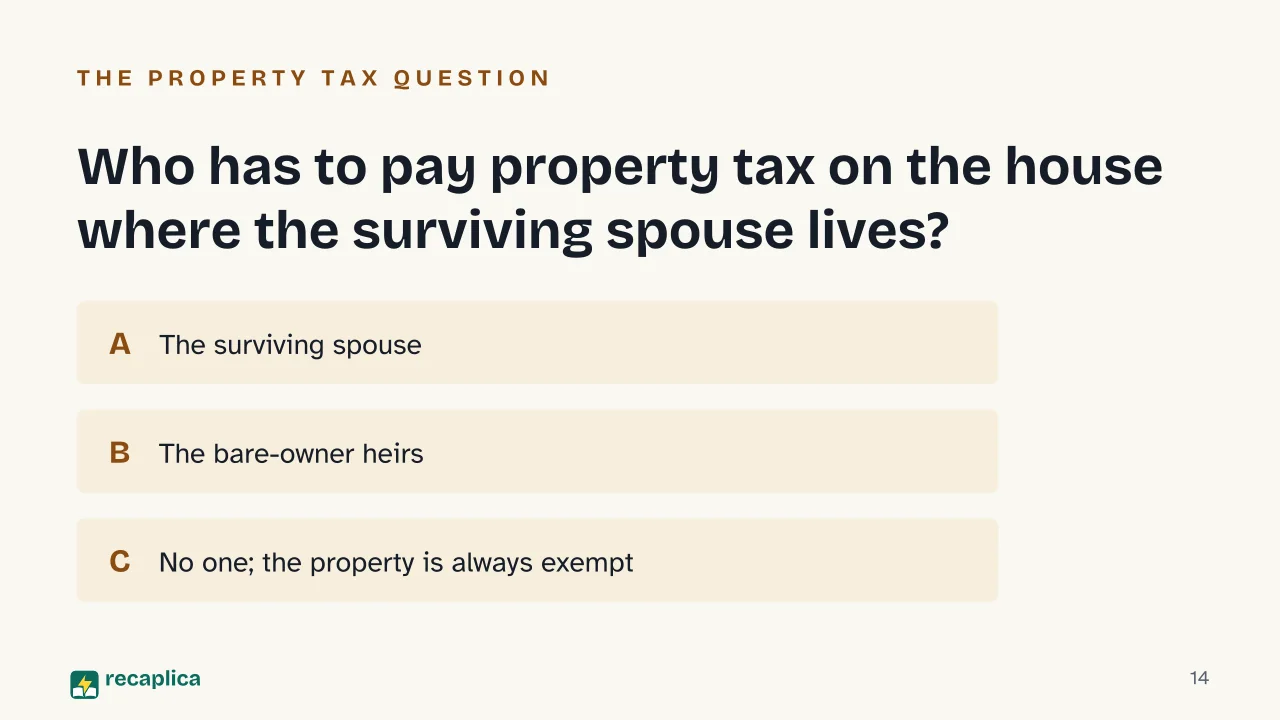  Common myths
Mind mapDrag the background to move around and the nodes to reposition them; use − and + to collapse and expand branches. 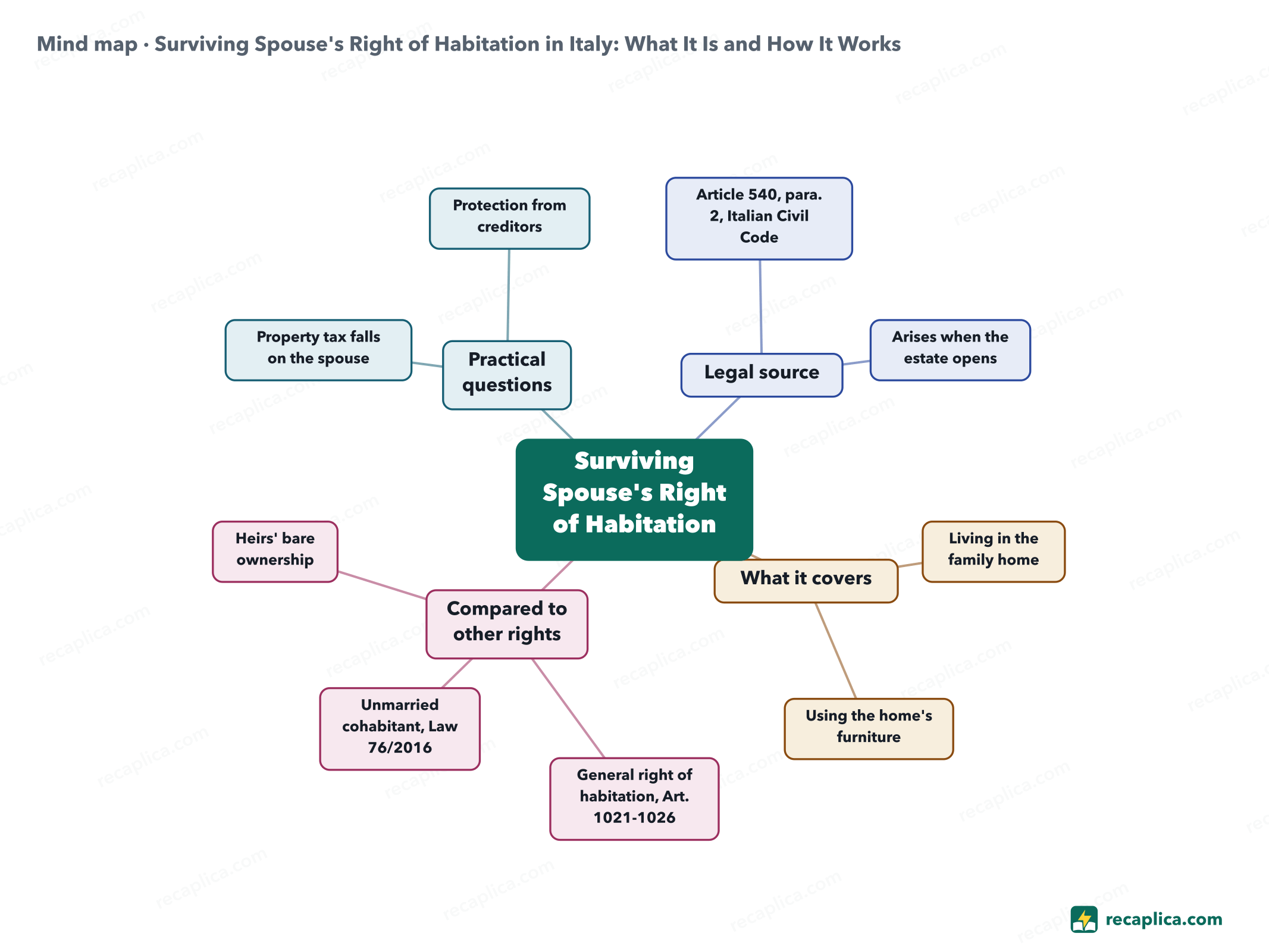
Quiz: test yourselfAnswer the questions to check what you have learned: you get instant feedback and a short explanation. Grade 0/10 0/5
FlashcardsTap the card to flip it and check whether you remember the answer, then move to the next one. 1 / 8 Explain it in your own wordsThe ultimate test: if you can explain it in simple words, you've truly understood it. Write your explanation, then compare it with the Recap. Your explanation is saved only on this device.
Frequently asked questionsDoes the surviving spouse pay property tax on the house?Yes. Under Law 160 of 2019, Article 1, paragraph 743, IMU, Italy's municipal property tax, is owed by whoever holds a real right of habitation over the property, and a surviving spouse who inherits that right under Article 540 of the Italian Civil Code falls into that category, so the IMU on that home is the spouse's bill, and the bare-owner heirs are left out of it. Can creditors seize a surviving spouse's right of habitation?According to a 2023 ruling of the Italian Supreme Court of Cassation (decision no. 4092), a surviving spouse's right of habitation remains enforceable even against a creditor who has seized full ownership of the inherited house: the seizure effectively shrinks to the bare ownership alone, leaving the spouse's right of habitation untouched. Does the surviving spouse still get the right of habitation if they never owned the house?Yes, and this is actually the most common case. The right under Article 540 belongs to a spouse who wasn't an owner, as long as the house belonged exclusively to the deceased spouse or jointly to both spouses. The right does not arise if a third party outside the marriage also owned a share of the house. Does an unmarried, cohabiting partner get the same right of habitation as a spouse?No. Law 76 of 2016 gives an unmarried cohabitant a personal right of enjoyment that runs for two years, or for the length of the cohabitation if it was longer, capped at five years. A spouse's right under Article 540 of the Italian Civil Code is a property right and lasts for life. Every Recap goes through an independent review before publication. |