|
recaplica
Unfair Competition: What It Is and Common Cases |
| © 2026 Recaplica · recaplica.com — All rights reserved |
Unfair Competition: What It Is and Common CasesWhat to print Page numbers appear when printing with default margins. SlidesChoose a cut Flash10 slidesThe essential thread, to present in classFull14 slidesEvery chapter and the deeper detailBoth come with speaker notes. In 30 seconds quick readUnfair competition is the legal term under Italian law for dishonest conduct between businesses competing in the same market, governed by Article 2598 of the Civil Code. The provision sets out three groups of prohibited acts: confusion between products (which covers slavish imitation), denigration or the misappropriation of a rival's merits, and a general closing clause. Courts have built further categories on that last clause over time, such as parasitic competition and employee poaching. To judge conduct like customer diversion, judges weigh the pattern of behavior built up over time more than any single episode. Key Points
Deep DiveArticle 2598 of the Italian Civil Code is the rule behind what Italian law calls unfair competition: dishonest dealings between rival businesses in the same market, with the end consumer sitting outside its direct scope. The text and purpose of Article 2598 of the Italian Civil CodeThe rule distinguishes three groups of prohibited acts. The first concerns confusion between products, which includes the slavish imitation of a competitor’s distinctive features. The second covers denigration — spreading news capable of discrediting a rival business — together with the misappropriation of merits, meaning claiming credit that actually belongs to a competitor. The third group is a general clause: it bans every other means contrary to professional fairness that is capable of harming a rival business, even outside the first two categories. Courts have built further categories on this third group over time, categories not written explicitly into the rule, such as parasitic competition and employee poaching, covered further below. The purpose of the whole article is to keep competing businesses fair with one another, preventing a company from gaining ground by methods contrary to commercial ethics. The topic sits, on a different plane, alongside the Recap on consumer rights: there the protected party is the buyer, here it is businesses dealing with each other. Customer diversionCustomer diversion is the conduct in which a former employee or manager brings over the customers of their former employer to their own new business. It becomes unlawful when, after starting a competing business, the former employee wins over the previous employer’s customers in a systematic, organized way instead of through an occasional contact. The line between the two situations depends on what the former employee uses to attract those customers. Offering better commercial terms, based on one’s own experience, remains an allowed practice even toward people already known from the previous job. The conduct crosses into unlawful territory when it relies on confidential information from the former employer: details about customer relationships, built up during the employment, that were normally accessible to employees but not meant to leave the company. On this point, courts size up the whole course of conduct over time instead of fixating on one isolated episode. A single customer who switches supplier proves little on its own.
Slavish imitationSlavish imitation consists of faithfully reproducing the forms that make a competitor’s product distinctive in the market, to the point of confusing consumers about which company makes it. It concerns a product’s recognizable appearance. The function behind it stays free for anyone to copy. This case falls under the acts of confusion in the first paragraph of Article 2598. For that reason, the ban applies regardless of whether a patent or a registered trademark exists: even a product with no formal protection can be shielded by the distinctive form that sets it apart in the market. Readers looking for a broader framework on trademarks and patents will find the topic developed in the Recap on intellectual property, dedicated to the protection of creations and distinctive signs as a right of its own. Denigration and misappropriation of meritsDenigration, covered by Article 2598 no. 2, consists of spreading news or judgments about a competitor’s products or business that could hurt its standing with the public or with customers. Misappropriation of merits is its mirror behavior: claiming credit for merits or qualities that actually belong to a competitor, for example presenting another company’s certifications or product features as one’s own. Both kinds of conduct target commercial reputation, a different target from the product itself, which is what slavish imitation works on. Parasitic competitionParasitic competition is a category built by the courts on the basis of the general clause in the third paragraph, absent from the written text of the rule. It consists of systematically and continuously imitating a competitor’s business choices considered as a whole: packaging, advertising, commercial policy, and product range, copied one after another over time. This is exactly where the difference with slavish imitation lies. A single copied product can fall under slavish imitation; an entire strategy, copied progressively over time, falls under parasitic competition. The line between the two categories comes down to how continuous the conduct is. A single resemblance, on its own, says less than a sustained pattern. The disloyal employee and employee poachingEmployee poaching is the practice of pushing a competitor’s employees toward resignation so they can be hired away, with the aim of damaging the rival business. It must be kept distinct from simply hiring staff that comes from a competitor, which remains lawful: a company can offer a job to someone employed elsewhere. What makes the conduct unfair is the inducement, combined with the intent to cause harm. An employee can leave a company on their own initiative, and another business can hire them: on its own, that step stays lawful. The problem arises when the recruitment is organized specifically to weaken the rival, stripping it of skills or customer relationships built up over time, all at once. Readers looking for the broader framework of market rules between businesses can read the Recap on antitrust, which deals with dominant positions and agreements between companies, on a different plane from individual unfair acts against a rival.
Unfair competition remains, like every case under Article 2598, a legal norm of civil law. Someone harmed by it can go to court to obtain an injunction against the conduct and compensation for damages: the sanction is up to a civil judge, and criminal proceedings don’t start on their own. Slide deckSlides ready to download and make your own in PowerPoint or Google Slides, with speaker notes. Pick the Flash cut or the Full one.   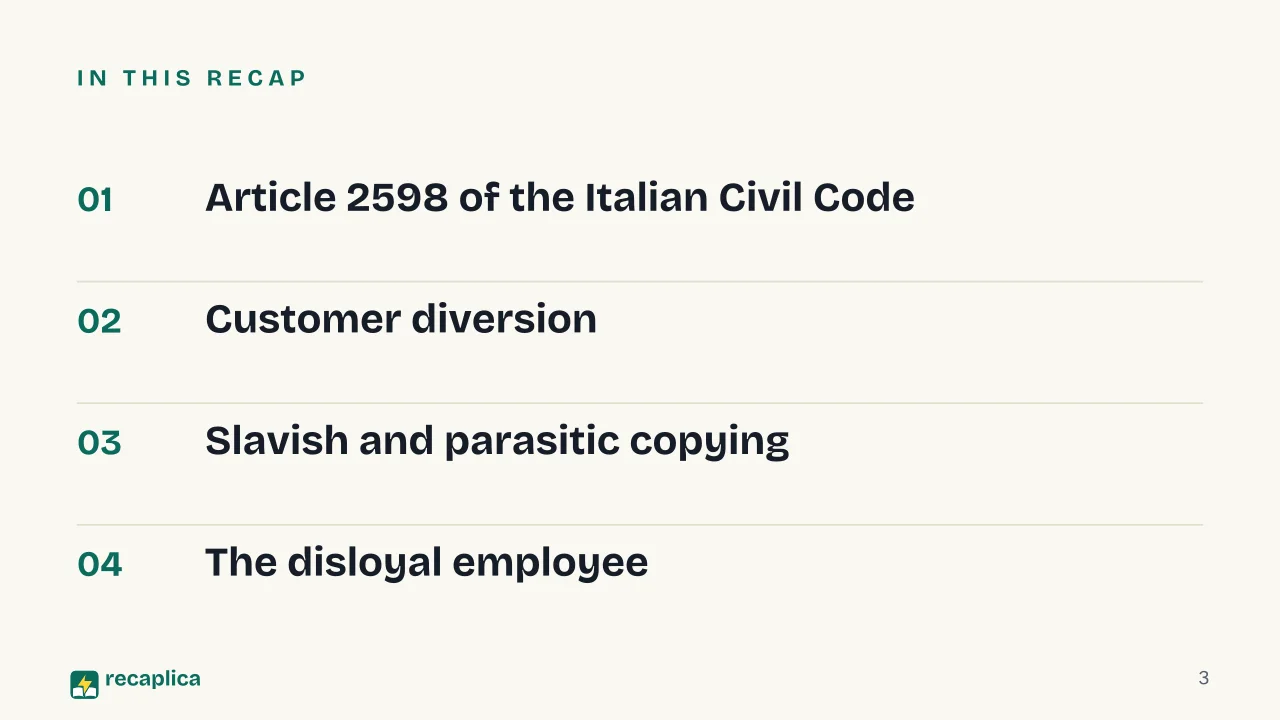  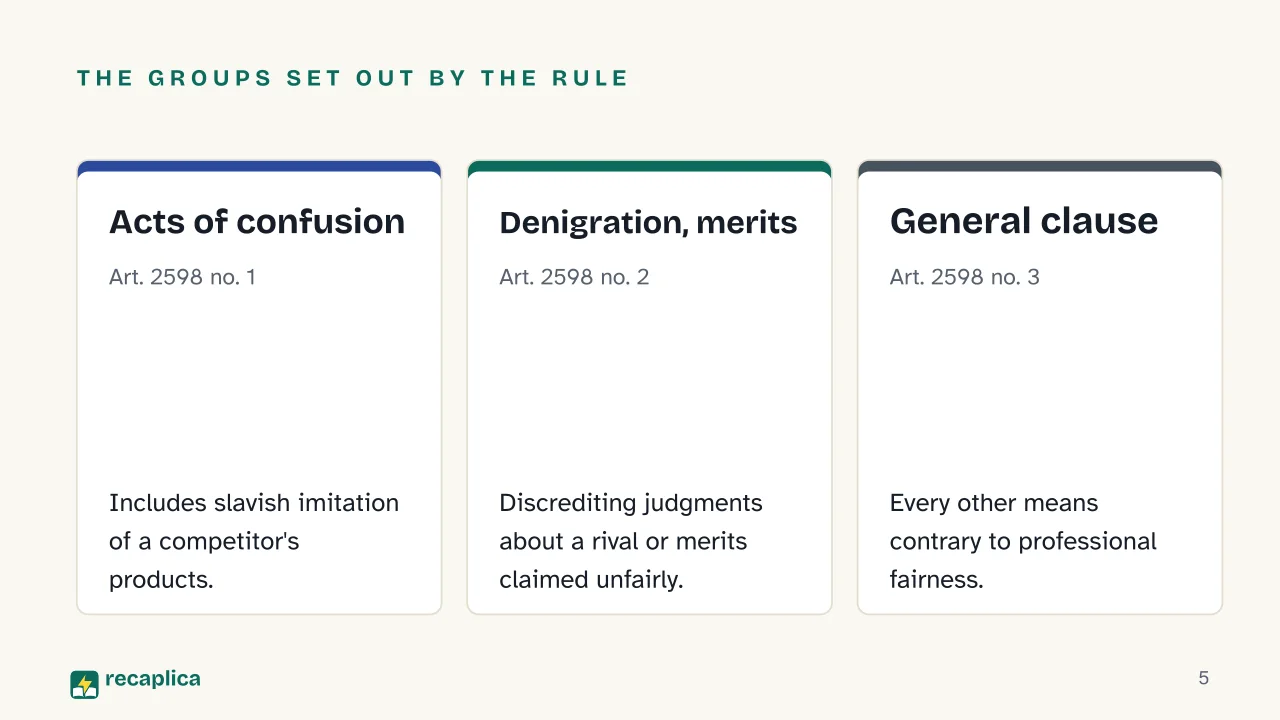  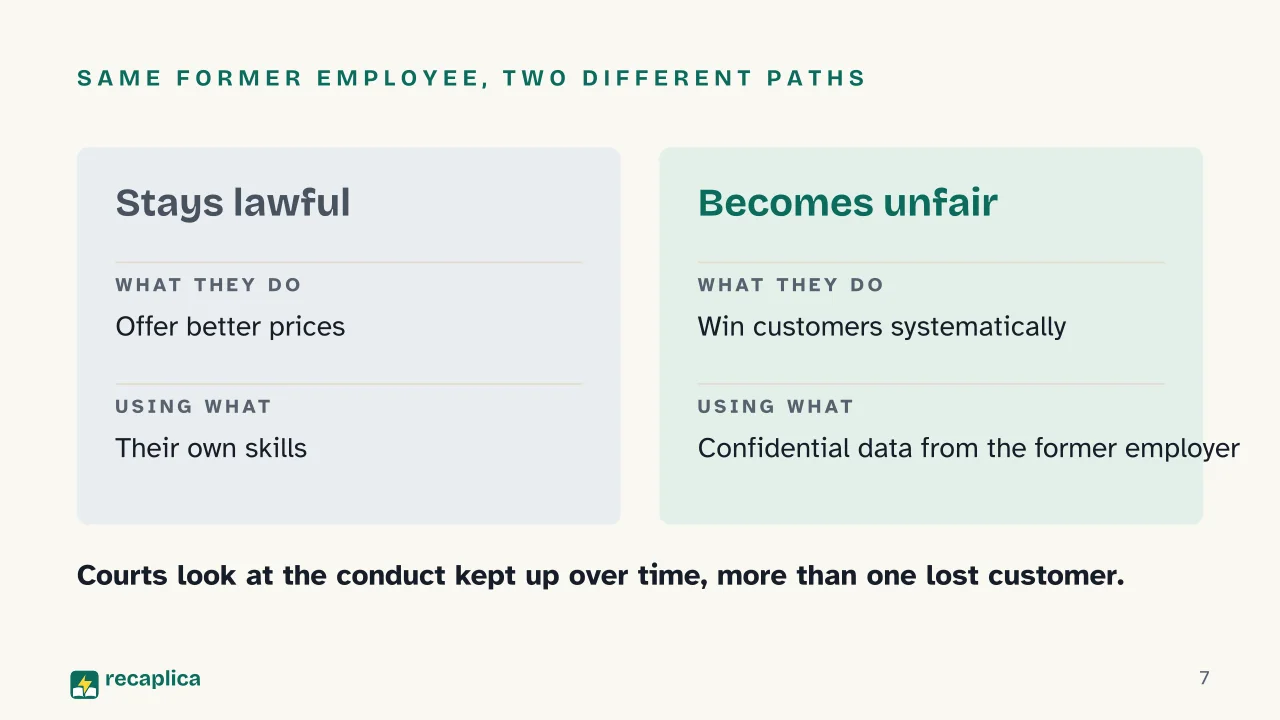  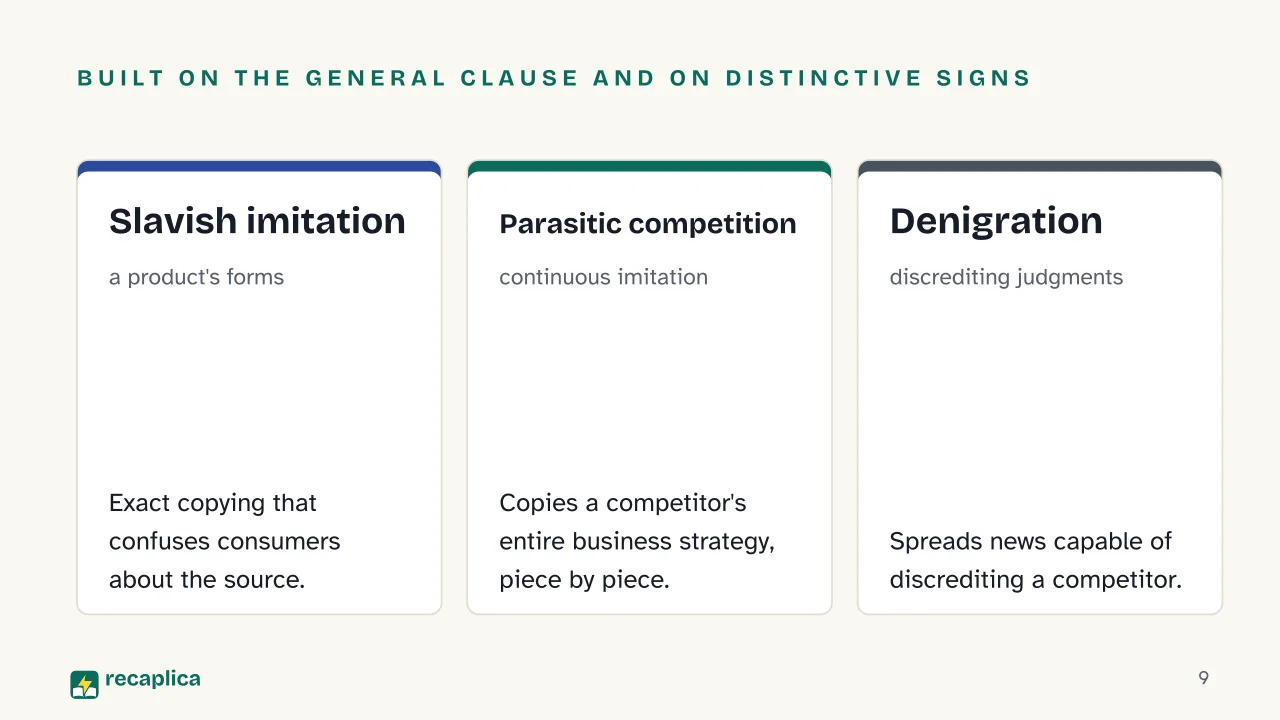  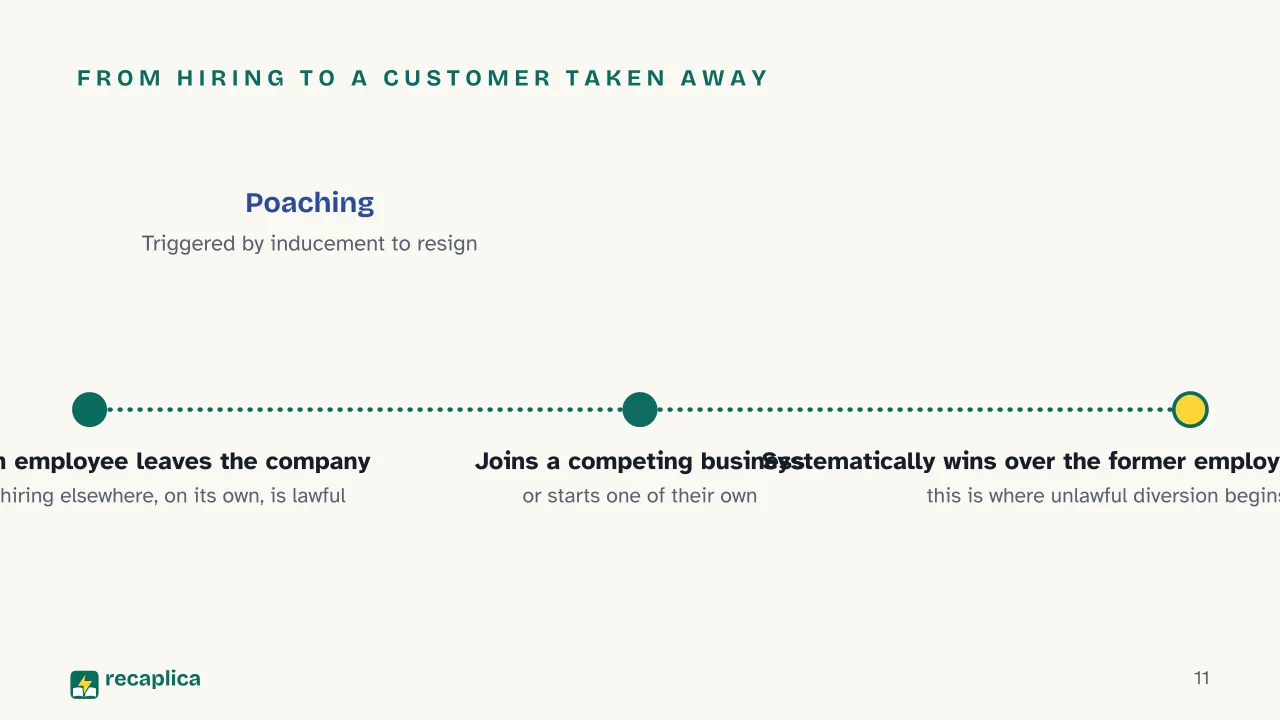 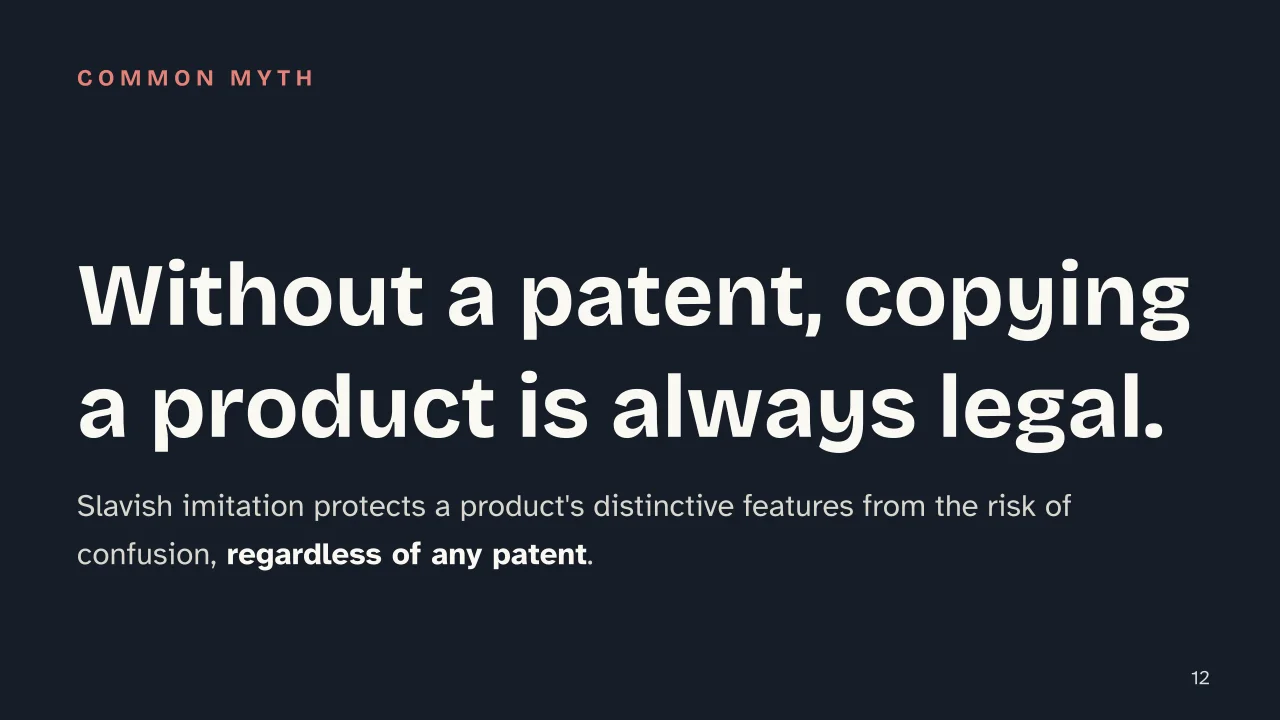 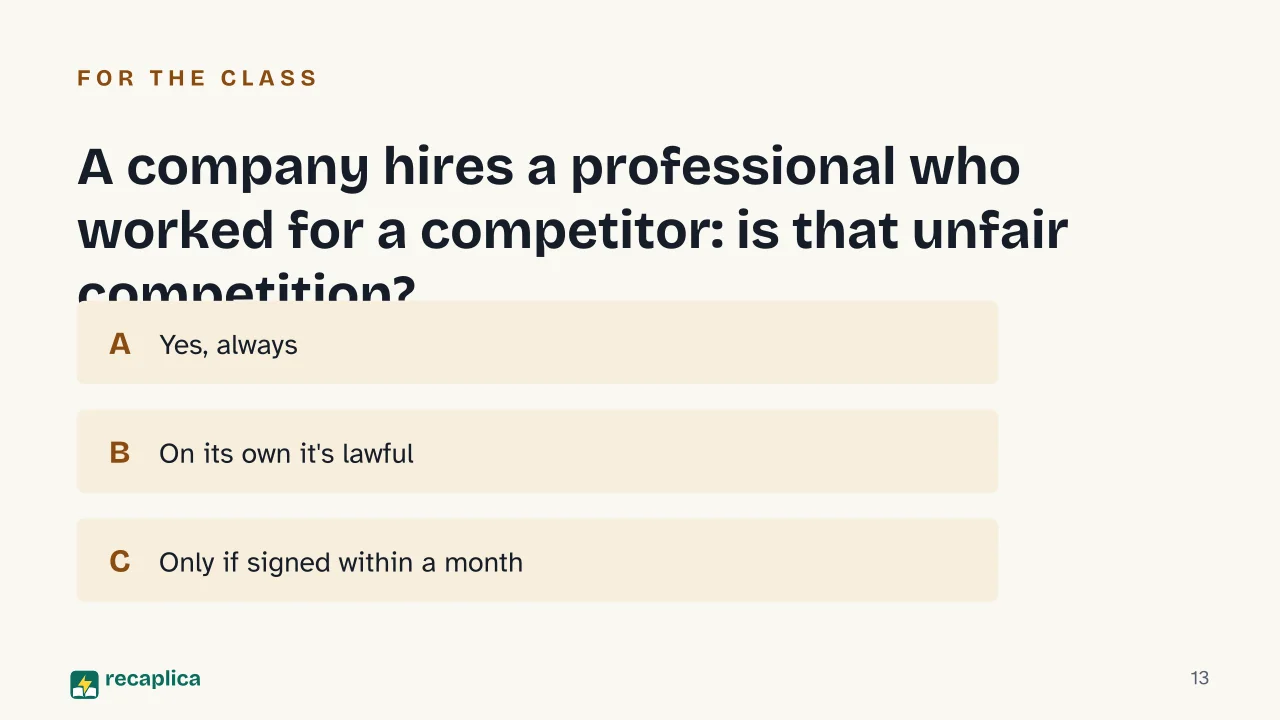  Common myths
Mind mapDrag the background to move around and the nodes to reposition them; use − and + to collapse and expand branches. 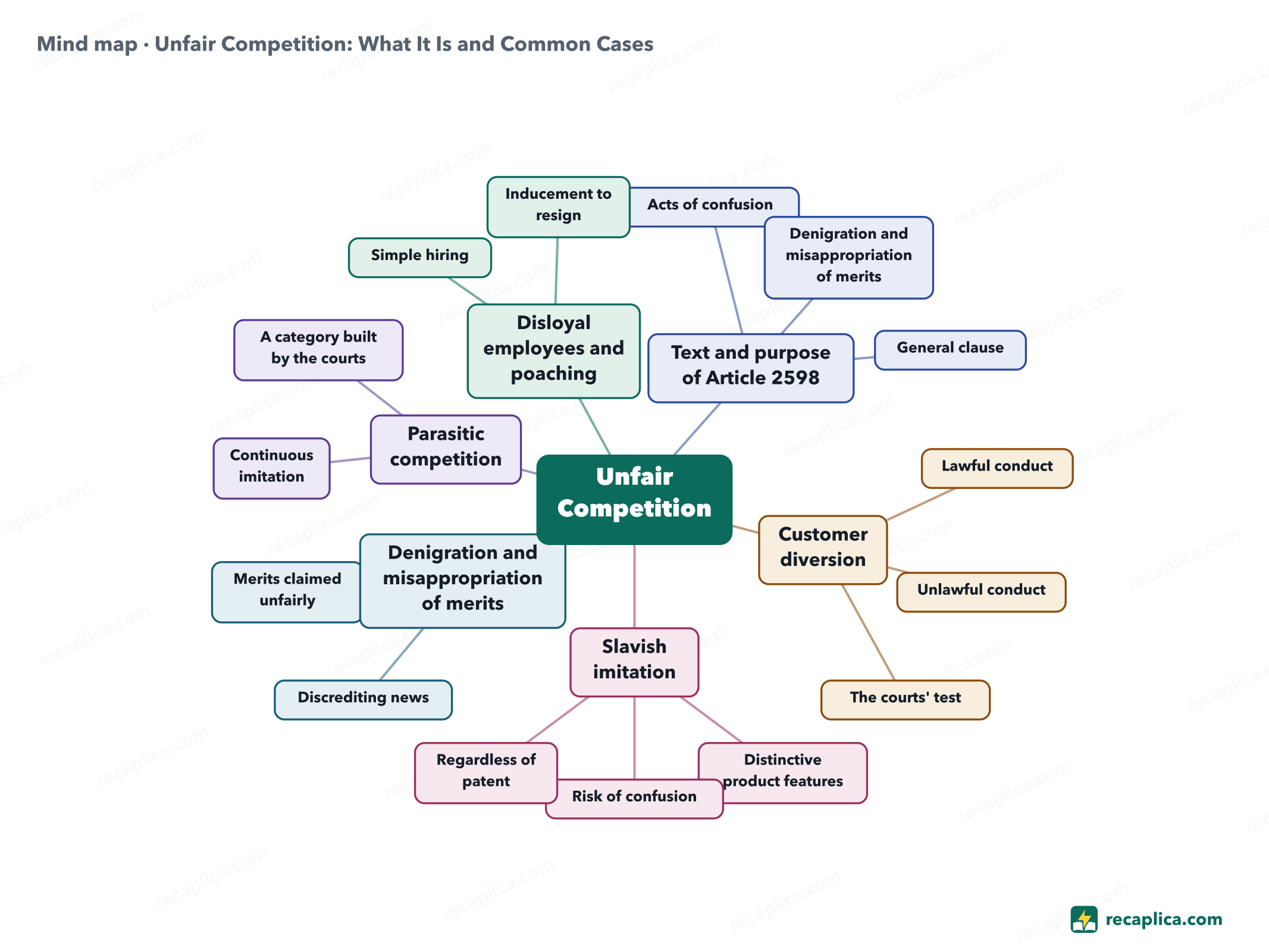
Quiz: test yourselfAnswer the questions to check what you have learned: you get instant feedback and a short explanation. Grade 0/10 0/5
FlashcardsTap the card to flip it and check whether you remember the answer, then move to the next one. 1 / 8 Explain it in your own wordsThe ultimate test: if you can explain it in simple words, you've truly understood it. Write your explanation, then compare it with the Recap. Your explanation is saved only on this device.
Frequently asked questionsWhat does Article 2598 of the Italian Civil Code say?It lists three groups of prohibited acts between competing businesses: confusion over products (including slavish imitation), denigration together with the misappropriation of merits, and a final clause that closes the circle on every other professional unfairness that harms a rival. Its purpose is to keep the relationship fair between companies competing for the same market. What is customer diversion?It is when someone who has left a company takes away that company's customers in an organized way, using confidential information about business relationships built up while they were an employee. Offering better terms using personal experience and skills, instead, remains an allowed practice. What is slavish imitation?It is reproducing, point for point, the forms that make a product distinctive in the market, to the point that consumers struggle to tell which company it belongs to. The prohibition in Article 2598 no. 1 applies regardless of a registered patent. What is parasitic competition?A category built by the courts on the general clause of Article 2598 no. 3: it concerns someone who copies, product after product and choice after choice, a competitor's entire strategy instead of imitating just a single item. Is hiring an employee who came from a rival company unfair competition?No, the hiring itself remains a lawful act. It becomes unlawful only when it is preceded by inducement to resign organized specifically to harm the competitor: that is the case of employee poaching. Every Recap goes through an independent review before publication. |