Skip to content
recaplica

    One moment: security check

    Cloudflare wants to make sure you're not a robot. Tick the box below and your search will continue on its own.

    IT
    recaplica Antitrust Law: What It Is and How It Works
    © 2026 Recaplica · recaplica.com — All rights reserved
    Home › Civics

    Antitrust Law: What It Is and How It Works

    By Recaplica Newsroom · Updated on October 2, 2026

    What to print

    Page numbers appear when printing with default margins.

    Slides

    Choose a cut

    Flash10 slidesThe essential thread, to present in classFull15 slidesEvery chapter and the deeper detail

    Both come with speaker notes.

    Telegram channel
    recaplica Clear in 30 seconds, yours in 10 minutes.
    In 30 seconds Key points Figures Deep dive Slides Myths Mind map Quiz Flashcards FAQ

    In 30 seconds quick read

    Antitrust law is the set of rules that stops companies from shutting down competition, at the expense of buyers, sellers and anyone who wants to enter a market. The United States wrote the first version, the Sherman Antitrust Act, in 1890; in the European Union the same ground is covered by Articles 101 and 102 of the Treaty on the Functioning of the EU, enforced by the European Commission and, in Italy, by the AGCM, an independent authority created in 1990. In the US, the Department of Justice's Antitrust Division and the Federal Trade Commission share the job of enforcing the law. The goal regulators describe is the same everywhere: open competition keeps prices down and pushes businesses to innovate.

    Key Points

    • Antitrust law bans agreements among competitors that carve up markets, fix prices, or keep new rivals out.
    • It also bans abuse of a dominant position, when a company that controls a market exploits that power against would-be competitors.
    • It covers mergers and acquisitions, to stop a deal from concentrating too much power in one company.
    • In the US, the Sherman Antitrust Act of 1890 is the founding law, enforced today by the DOJ's Antitrust Division and the FTC's Bureau of Competition.
    • In the European Union, Articles 101 and 102 of the Treaty on the Functioning of the EU cover the same ground, enforced by the European Commission.
    • In Italy, the AGCM has applied those rules independently of the government since 1990.

    Key figures

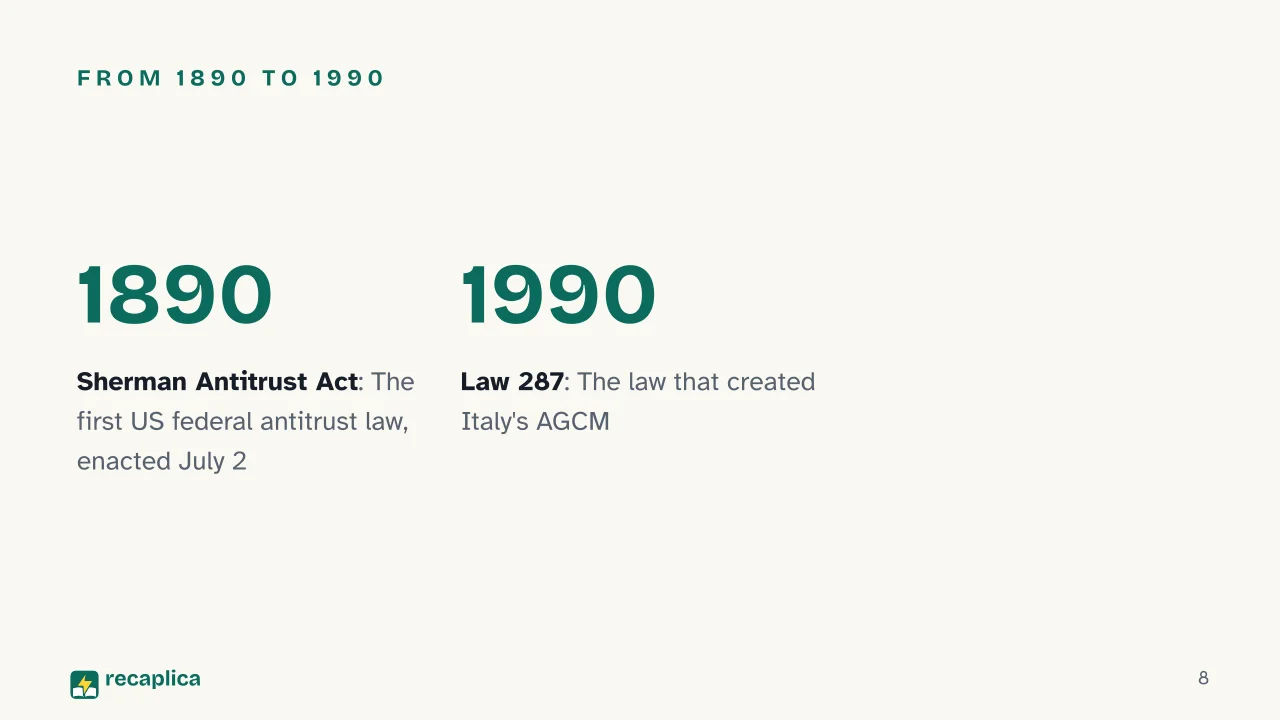
    • 1890 The year the Sherman Antitrust Act, the first US federal antitrust law, was enacted Source: Cornell Law School, Legal Information Institute
    • 1990 The year Italy's AGCM was established, under law no. 287 of October 10 Source: AGCM

    Deep Dive

    What antitrust law is

    Antitrust law is the body of rules that keeps companies from choking off competition, at the cost of sellers, buyers and anyone hoping to enter a market. The name comes from “trust”, the large concentrations of economic power the first antitrust law in the world, written in the United States in 1890, was aimed at breaking up. The basic idea hasn’t changed much since, even if authorities around the world describe it in different words: a market where companies genuinely compete tends to produce lower prices and better products for buyers. That’s why antitrust law sits close to consumer rights: a market where nobody can shut out competition is already a first layer of protection for shoppers, well before any rule written specifically for consumers.

    Restrictive agreements between competitors

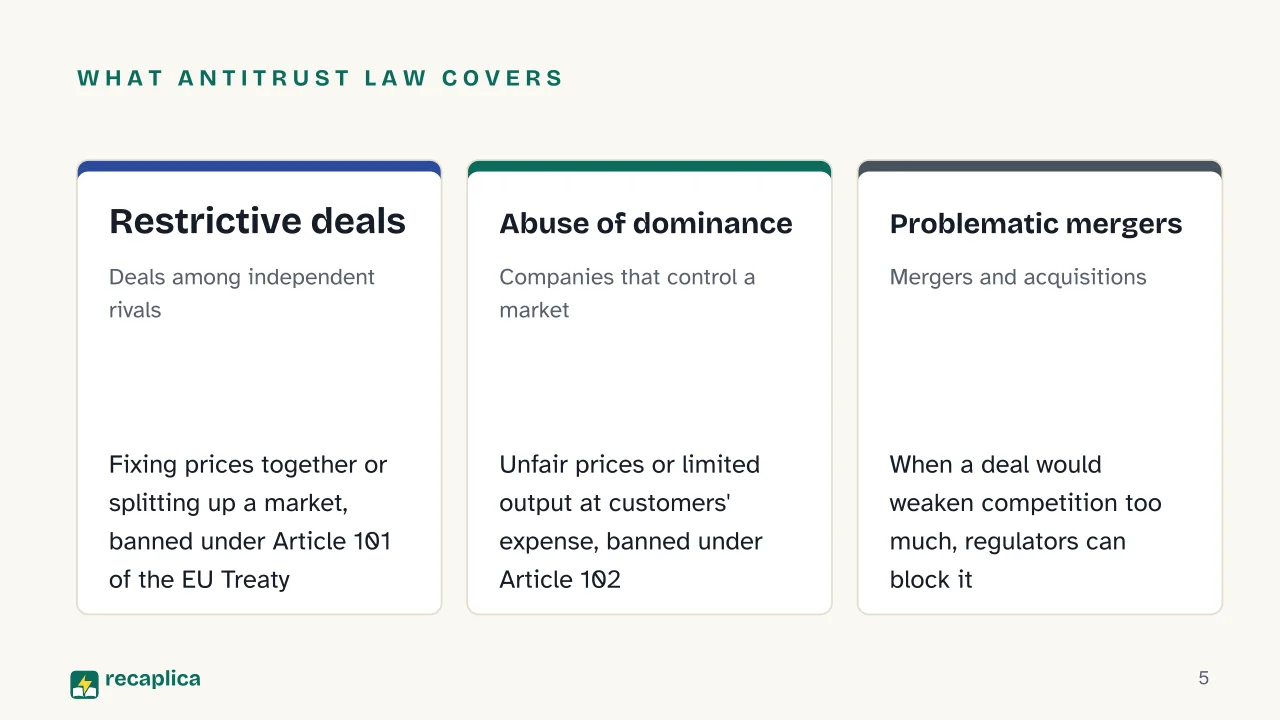
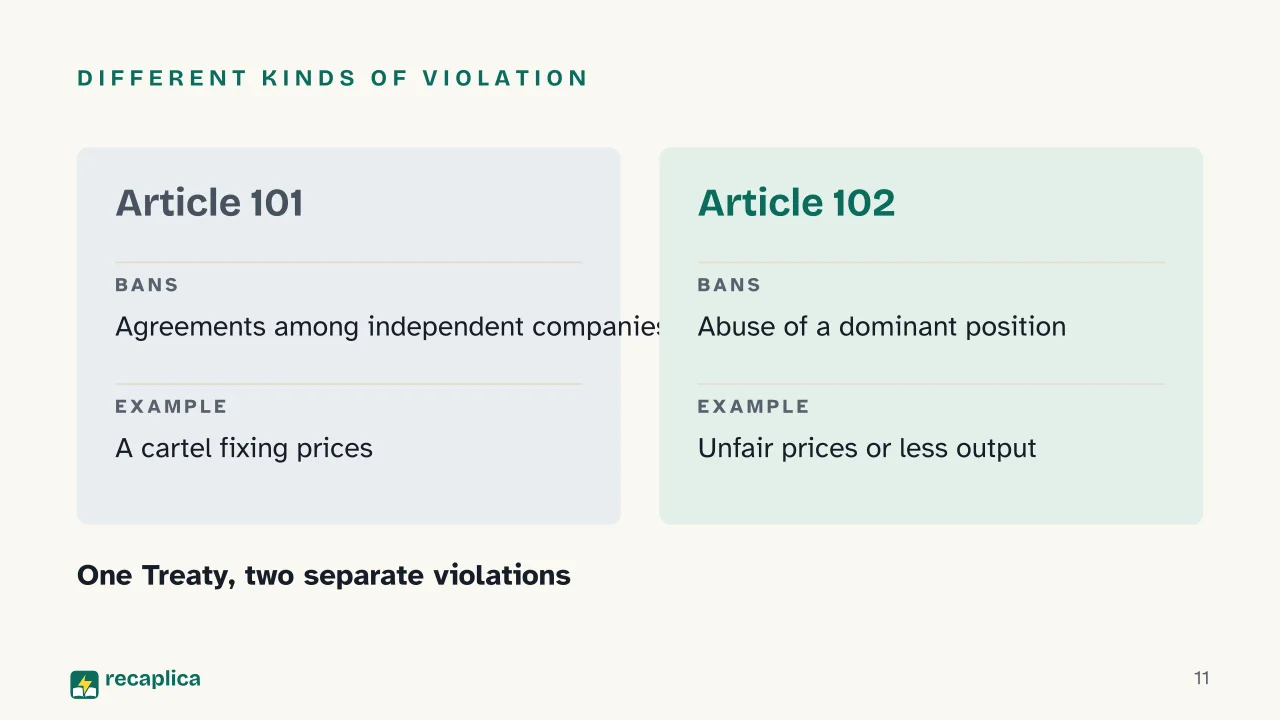
    The first kind of conduct antitrust law bans involves agreements among rivals. According to Italy’s AGCM, when companies coordinate instead of competing — carving up a market, raising prices together, or blocking new rivals from entering — they harm consumers. In the European Union, the same conduct is banned under Article 101 of the Treaty on the Functioning of the EU, which targets agreements among two or more independent companies that restrict competition. According to the European Commission, the clearest example of a violation of Article 101 is a cartel among competitors, which can involve fixing prices or splitting up a market.

    Practical example: two companies selling the same kind of product agree not to undercut each other on price in a given area, dividing up customers instead of competing for them. That’s the kind of conduct a restrictive agreement describes, per the AGCM: coordinating instead of competing, at the expense of buyers.

    In the United States the same conduct is a crime, not just a regulatory violation: the Department of Justice prosecutes it as such whenever rivals join forces on pay or pricing, steer the outcome of a bid, or carve up who gets which customers, workers or territory.

    Abuse of a dominant position

    The second banned conduct doesn’t involve an agreement among several companies, but the behavior of just one. Article 102 of the EU Treaty bans companies in a dominant market position from abusing it, for example by charging unfair prices, limiting output, or refusing to innovate at consumers’ expense. The AGCM steps in for the same reason when a company that controls a market abuses that power, for instance by keeping potential rivals from entering it.

    In the United States, the law uses different words to describe something similar: federal law bans holding a monopoly over a market for goods or services, plotting with others to get one, or trying to build one alone.

    Merger control: three possible outcomes

    The third area antitrust law covers is mergers and acquisitions. The European Commission’s merger control checks whether a proposed deal would harm competition: some mergers can reduce competition by creating or strengthening a dominant player, hurting consumers through higher prices, less choice or quality, and less innovation. The outcome of that review can go one of three ways.

    Outcome of the reviewWhat happens
    No harm to competitionThe Commission clears the deal with no conditions
    Harm to competition, with adequate commitmentsThe companies propose fixes to remove the harm, and the deal can proceed
    Harm to competition, without adequate commitmentsThe Commission must block the deal

    In Italy, the same check falls to the AGCM, which verifies that a merger or acquisition won’t give the resulting company excessive market power or shrink the room left for competition. In the United States, according to the Department of Justice, a merger is illegal when combining two companies may substantially reduce competition or tend to create a monopoly.

    The Sherman Antitrust Act: where it all began

    The first antitrust law is American, and predates Italy’s AGCM by exactly a century. The Sherman Antitrust Act was enacted on July 2, 1890, and its first section declares illegal every contract, combination in the form of a trust or otherwise, or conspiracy that restrains trade among the states or with foreign nations. The original text still stands, codified at 15 U.S. Code § 1.

    Who enforces antitrust law in the US: the DOJ and FTC

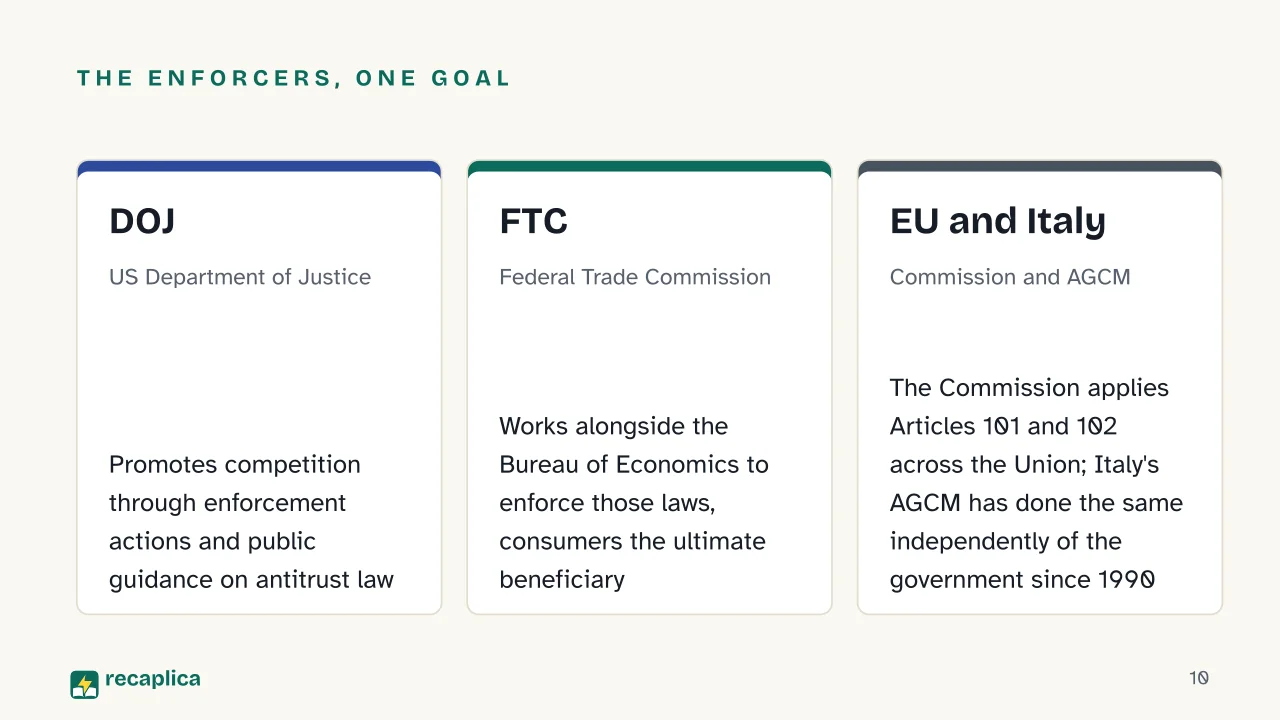
    Two federal agencies share the job of enforcing that law. The Department of Justice’s Antitrust Division exists to keep markets competitive, bringing enforcement actions and publishing guidance on how the antitrust laws apply. The Federal Trade Commission’s Bureau of Competition polices the same ground, working with the Bureau of Economics, with consumers as the intended beneficiary. The two agencies split up sectors and cases between them, but the stated goal is the one every antitrust authority in the world shares.

    Antitrust law in the European Union and Italy

    At the European level, the same subject falls to the European Commission, one of the institutions covered in how the European Union works. EU antitrust rules ban both agreements among companies that restrict competition and abuse of a dominant position, with Articles 101 and 102 applied across every member state, Italy included.

    In Italy, the authority in charge is the AGCM, the Competition and Market Authority, sometimes just called Antitrust. It’s an independent administrative authority, ruling with full autonomy from the government: it doesn’t answer to a minister or take instructions on individual cases from the executive branch. It was created by an ordinary legal norm, law no. 287 of October 10, 1990, devoted specifically to protecting competition and the market. Its remit covers the same three grounds seen above — restrictive agreements, abuse of a dominant position, and mergers — the same ground the European Commission and the AGCM work side by side, at different scales.

    Why it matters for shoppers, not just businesses

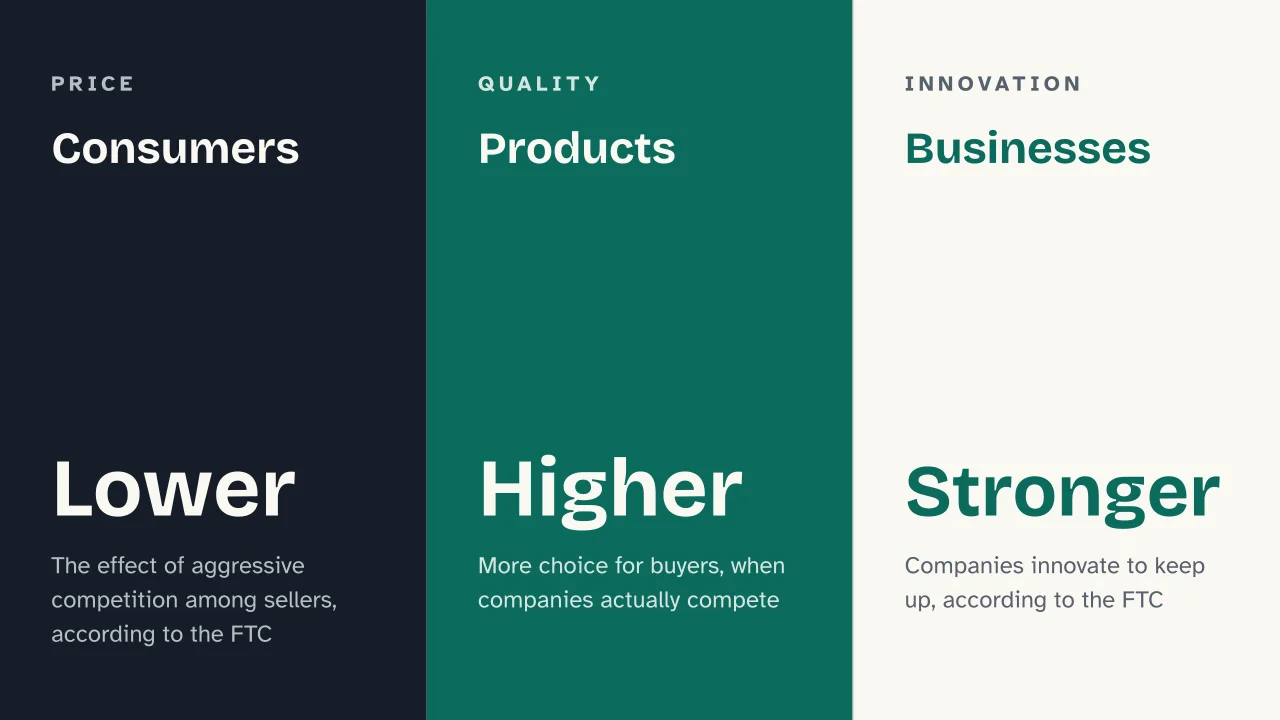
    US regulators also explain antitrust law from the buyer’s side. According to the FTC, vigorous competition among sellers lowers prices for buyers, both individuals and businesses. It also raises the quality of products and services, widens the choices on offer, and pushes companies to innovate more.

    It’s the same principle that runs through the study of microeconomics and macroeconomics: competition pushes companies to improve so they don’t lose customers, and antitrust law exists to stop an agreement, an abuse, or a merger from removing that pressure.

    Slide deck

    Slides ready to download and make your own in PowerPoint or Google Slides, with speaker notes. Pick the Flash cut or the Full one.
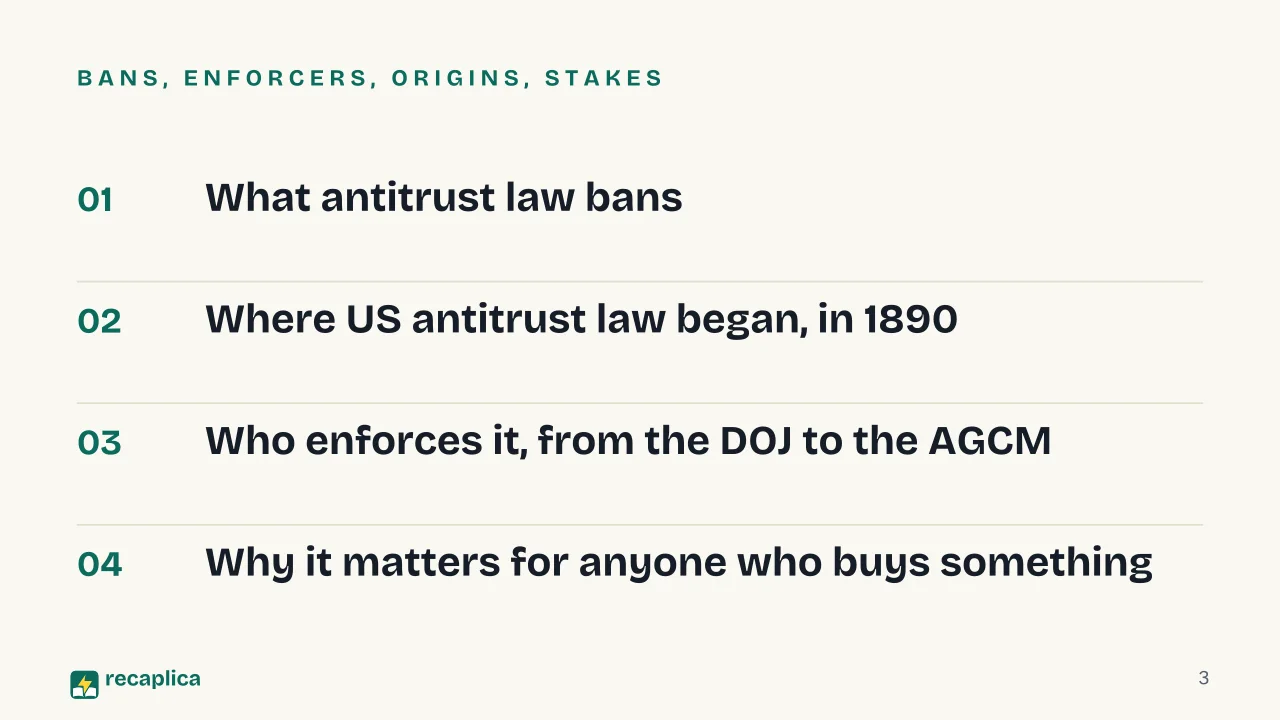
    Slide 1 of the presentation on Antitrust Law: Antitrust Law: What It Is and How It WorksSlide 2 of the presentation on Antitrust Law: What happens when two rivals agree on a price?Slide 3 of the presentation on Antitrust Law: Bans, enforcers, origins, stakesSlide 4 of the presentation on Antitrust Law: Chapter 01: What antitrust law bansSlide 5 of the presentation on Antitrust Law: What antitrust law covers: Restrictive deals, Abuse of dominance, Problematic mergersSlide 6 of the presentation on Antitrust Law: A merger between two large companies isn't banned automaticallySlide 7 of the presentation on Antitrust Law: Chapter 02: Where US antitrust law beganSlide 8 of the presentation on Antitrust Law: From 1890 to 1990Slide 9 of the presentation on Antitrust Law: Chapter 03: Who enforces antitrust lawSlide 10 of the presentation on Antitrust Law: The enforcers, one goal: DOJ, FTC, EU and ItalySlide 11 of the presentation on Antitrust Law: Different kinds of violationSlide 12 of the presentation on Antitrust Law: Chapter 04: Why it matters for shoppersSlide 13 of the presentation on Antitrust Law: Consumers · Products · BusinessesSlide 14 of the presentation on Antitrust Law: What does Article 101 of the EU Treaty ban?Slide 15 of the presentation on Antitrust Law: Now, the recap
    Flash10 slidesThe essential thread, to present in classFull15 slidesEvery chapter and the deeper detail

    Common myths

    • ✗ Myth Antitrust law only targets giant tech companies and huge multinationals.

      ✓ Reality According to Italy's AGCM, businesses that coordinate on price or carve up customers harm consumers: restrictive agreements cover any company that coordinates instead of competing, regardless of size, not just the largest ones.

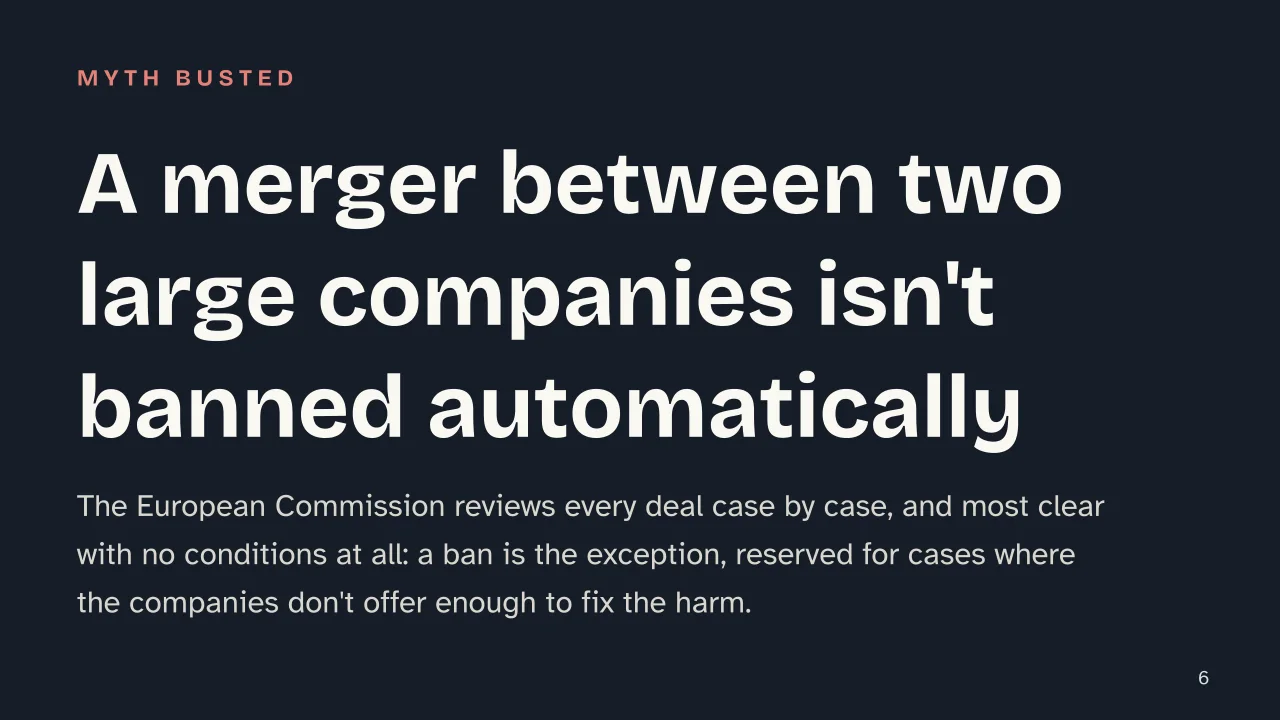
    • ✗ Myth A merger between two big companies gets blocked automatically.

      ✓ Reality According to the European Commission, a merger that doesn't harm competition is cleared with no conditions; a ban only comes when there's real harm to the market and no adequate fix on the table.

    • ✗ Myth Italy's AGCM is a government body that follows political instructions.

      ✓ Reality The AGCM is an independent administrative authority: it rules on its own, doesn't answer to the government, and doesn't take instructions on a case from a minister.

    Mind map

    Drag the background to move around and the nodes to reposition them; use − and + to collapse and expand branches.
    Customize
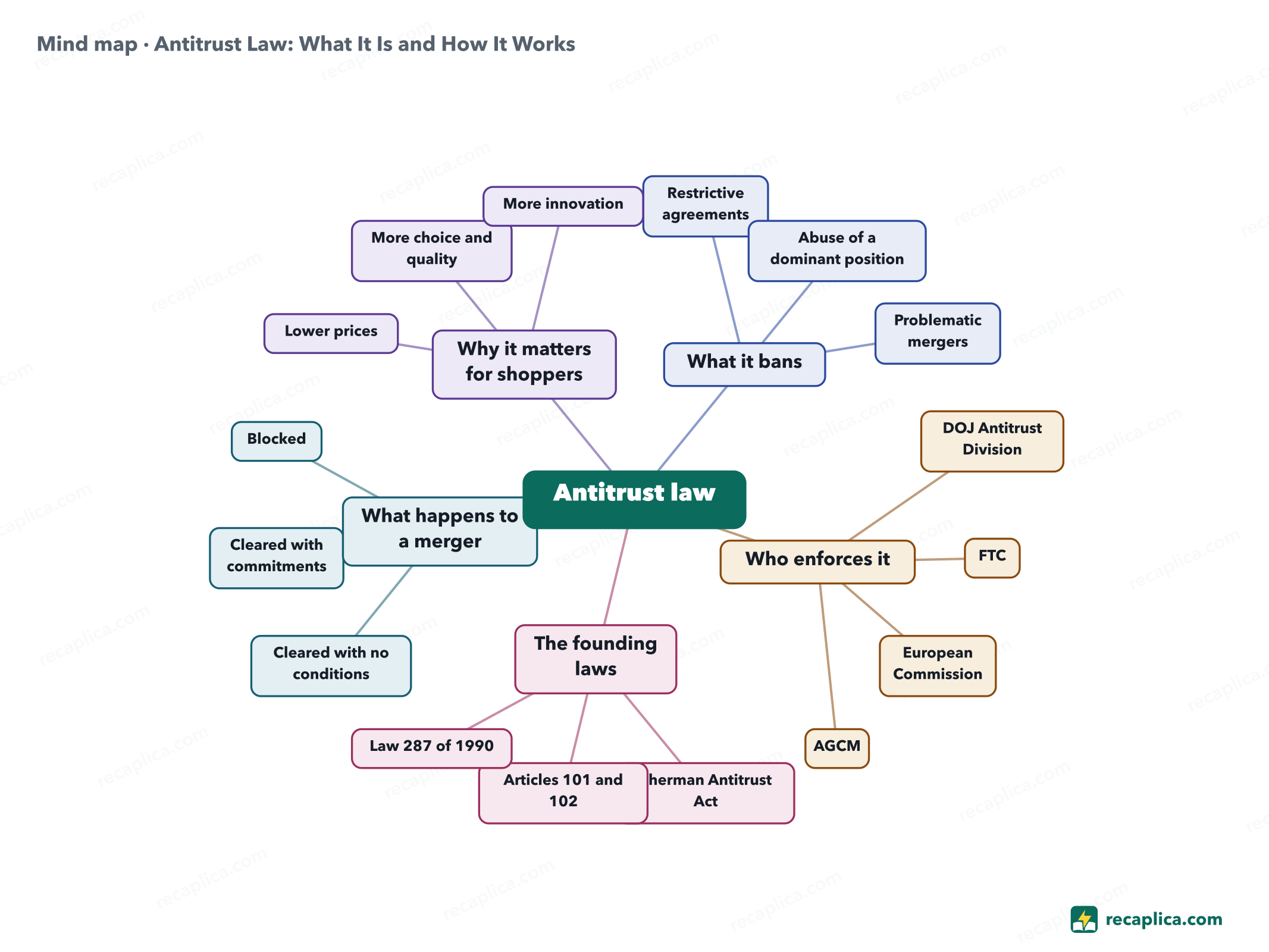
    Mind map: Antitrust Law: What It Is and How It Works
    • Antitrust law
      • What it bans The conduct businesses aren't allowed
        • Restrictive agreements Deals among independent companies that limit competition
        • Abuse of a dominant position Exploiting market power by whoever holds it
        • Problematic mergers Mergers and acquisitions that reduce competition too much
      • Who enforces it
        • DOJ Antitrust Division US Department of Justice
        • FTC Bureau of Competition
        • European Commission Applies Articles 101 and 102 of the EU Treaty
        • AGCM Italy's independent authority, since 1990
      • The founding laws
        • Sherman Antitrust Act The first US federal antitrust law, 1890
        • Articles 101 and 102 The EU Treaty's antitrust rules
        • Law 287 of 1990 The law that created the AGCM in Italy
      • What happens to a merger
        • Cleared with no conditions When competition isn't harmed
        • Cleared with commitments Fixes the companies propose
        • Blocked When no adequate fix is offered
      • Why it matters for shoppers
        • Lower prices An effect of open competition, according to the FTC
        • More choice and quality Cited by both the FTC and the European Commission
        • More innovation Cited by the same sources

    Quiz: test yourself

    Answer the questions to check what you have learned: you get instant feedback and a short explanation.

    Grade 0/10 0/5
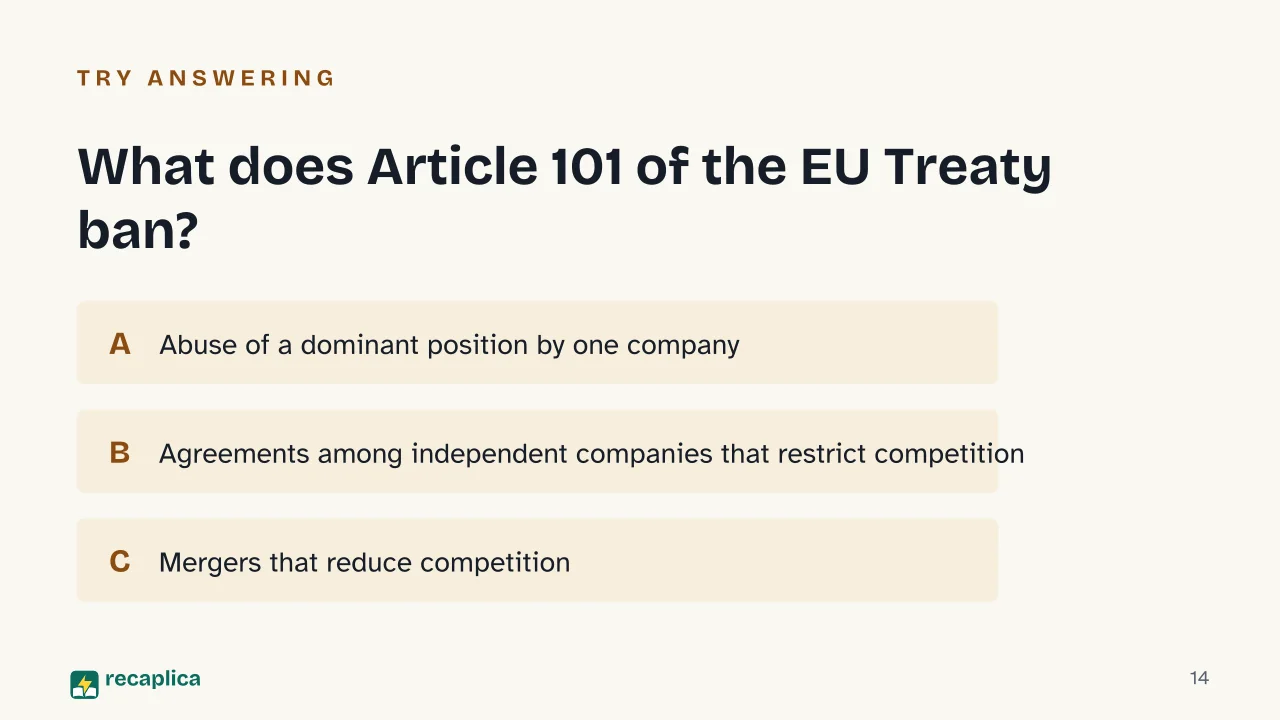
    1 What does Article 101 of the Treaty on the Functioning of the EU ban, according to the European Commission?

    Article 101 covers agreements among independent companies; abuse of a dominant position by a single company is banned instead under Article 102.

    2 According to the European Commission, what's the clearest example of a violation of Article 101?

    A cartel is an agreement among competitors designed specifically to restrict competition, by fixing prices together or dividing up the market.

    3 In Italy, which authority enforces antitrust rules?

    The AGCM is an independent administrative authority, established in 1990 under law no. 287, that rules independently of the government.

    4 True or false: according to the European Commission, a merger that doesn't harm competition is always blocked as a precaution.

    The Commission reviews every merger case by case: it blocks a deal only when the harm to competition is real and the companies involved don't offer enough to fix it.

    5 Which law, enacted on July 2, 1890, is considered the historical foundation of antitrust law in the United States?

    The Sherman Antitrust Act declared illegal any contract or combination that restrained trade between US states or with other countries: it's the first federal antitrust law in the United States.

    Answers: 1-B · 2-C · 3-A · 4-B · 5-C

    Flashcards

    Tap the card to flip it and check whether you remember the answer, then move to the next one.

    1 / 8

    Explain it in your own words

    The ultimate test: if you can explain it in simple words, you've truly understood it. Write your explanation, then compare it with the Recap.

    Your explanation is saved only on this device.

    Antitrust law is the set of rules that stops companies from shutting down competition, at the expense of buyers, sellers and anyone who wants to enter a market. The United States wrote the first version, the Sherman Antitrust Act, in 1890; in the European Union the same ground is covered by Articles 101 and 102 of the Treaty on the Functioning of the EU, enforced by the European Commission and, in Italy, by the AGCM, an independent authority created in 1990. In the US, the Department of Justice's Antitrust Division and the Federal Trade Commission share the job of enforcing the law. The goal regulators describe is the same everywhere: open competition keeps prices down and pushes businesses to innovate.

    Frequently asked questions

    What does antitrust mean?

    Antitrust law is the body of rules that bans agreements restricting competition, abuse of a dominant market position, and mergers that would concentrate too much power in one company. The name comes from the 'trusts', the large concentrations of economic power the first US antitrust law, in 1890, was written to break up.

    How is antitrust law different from unfair competition law?

    Antitrust law is a public framework that protects competition across a whole market, enforced by authorities such as the European Commission, the DOJ or Italy's AGCM. Unfair competition law is a separate area: it deals with disputes between individual rival businesses, not the health of the market as a whole.

    What does antitrust law prohibit?

    It prohibits agreements that restrict competition, abuse of a dominant position by whoever controls a market, and mergers or acquisitions that would reduce competition too much.

    Who enforces antitrust law in the US?

    Two federal agencies share the job: the DOJ's Antitrust Division, which keeps markets competitive through enforcement actions and public guidance, and the FTC's Bureau of Competition, which polices the same ground together with the Bureau of Economics to protect consumers.

    How old is antitrust law?

    In the United States, it dates back to 1890, with the Sherman Antitrust Act. In Italy, antitrust enforcement began in 1990, when law no. 287 established the AGCM.

    Sources

    • European Commission — DG Competition, Antitrust
    • European Commission — DG Competition, Merger control
    • AGCM — Who we are
    • AGCM — Protection of competition
    • US Department of Justice — Antitrust Division, About the Division
    • US Department of Justice — Antitrust Laws and You
    • Federal Trade Commission — Guide to Antitrust Laws
    • Cornell Law School — Legal Information Institute, 15 U.S. Code § 1 (Sherman Antitrust Act)

    Every Recap goes through an independent review before publication.

    Every evening, the day's new Recaps on our Telegram channel. Join the channel →

    Keep learning

    • Civics EU Charter of Fundamental Rights: What It Is and What It Protects The Charter of Fundamental Rights of the European Union, often called the Nice Charter for the city where it was signed, brings civil, political, economic and social rights together in a single text for anyone living in the EU. It was proclaimed on 7 December 2000, but only gained legal force on 1 December 2009, when the Treaty of Lisbon entered into force. The document runs to 54 articles across seven titles, from human dignity to justice. It should not be confused with the European Convention on Human Rights (ECHR), an older treaty from a different organization, or with the United Nations' Universal Declaration of Human Rights, which predates it by more than five decades. Read the Recap →
    • Civics Treaty of Lisbon: What It Is and How It Reshaped the EU The Treaty of Lisbon is the treaty that reformed how the European Union works, signed on 13 December 2007 and in force since 1 December 2009, without replacing the treaties already in place. It draws heavily on the failed EU Constitution, rejected by French and Dutch voters in 2005, but it is not a constitution: it amends the Treaty on European Union and the Treaty establishing the European Community, the same technique already used by the Amsterdam and Nice treaties. It gives the European Parliament more legislative power, creates a permanent presidency of the European Council and the post of High Representative for foreign affairs, and makes the Charter of Fundamental Rights of the European Union legally binding. It also introduces the European Citizens' Initiative and a new double-majority voting system in the Council, which only took full effect on 1 November 2014. Read the Recap →
    • Civics Passport Requirements for International Travel: When an ID Card Is Enough Which document you need to enter another country depends on where you're going. Inside the Schengen area, plus Iceland, Liechtenstein, Norway and Switzerland, a valid national ID card or a passport is enough. Outside that area, most countries require a passport, often with a minimum validity beyond the travel dates, and sometimes an additional visa. Children always need their own travel document, never an entry on a parent's. Read the Recap →

    recaplica

    Clear in 30 seconds, yours in 10 minutes.

    Recaps Mind maps Request a Recap Telegram channel Mind map maker Our method About Privacy & cookies Legal notes & terms of use

    © 2026 Recaplica · A project by Curi S.r.l. — VAT IT05472000750

    Statistics, only if you say so

    To learn which Recaps help most we would use Google Analytics, with aggregate, anonymous data. It starts only with your OK, and you can change your mind anytime. Privacy policy