|
recaplica
Media Literacy: What It Is and How to Judge a Source's Credibility |
| © 2026 Recaplica · recaplica.com — All rights reserved |
Media Literacy: What It Is and How to Judge a Source's CredibilityWhat to print Page numbers appear when printing with default margins. SlidesChoose a cut Flash10 slidesThe essential thread, to present in classFull15 slidesEvery chapter and the deeper detailBoth come with speaker notes. In 30 seconds quick readMedia literacy is the set of skills that lets people read, judge, and use articles, websites, and encyclopedia entries with a critical eye. The University of Chicago Library lists five practical criteria for judging a source: currency, relevance, authority, accuracy, and purpose. FactCheck.org published an eight-step method for spotting fabricated news in 2016, later translated and distributed worldwide by IFLA. Wikipedia works the same way, with reliability resting on the quality of the sources cited in its footnotes. Key Points
Key figures
Deep DiveAnyone who searches for information online runs into articles, websites, and encyclopedia entries of wildly different quality every day. Media literacy is the set of skills that lets you read, judge, and use those sources with a critical eye. What Media Literacy MeansUNESCO defines media and information literacy as the set of skills that lets people access, analyze, evaluate, and create content critically across different platforms. The UN’s education agency treats it as an essential skill for facing the challenges of the twenty-first century, including the spread of misinformation, hate speech, and declining trust in media and digital tools, generative AI included. Building this skill means learning to tell a fact from an opinion, recognize misinformation, and take part in civic life with more awareness. A Five-Point Checklist for Judging a SourceThe University of Chicago Library lists a five-point checklist, known as the CRAAP test, that traces back to Sarah Blakeslee, a librarian at California State University, Chico’s Meriam Library; in 2026 it’s one of the most widely used tools in university libraries.
Online, the authority criterion gets more complicated, because it’s no longer an editor deciding what reaches readers first, but a recommendation algorithm that often rewards whatever drives clicks, not necessarily what’s accurate. Text drafted with the help of generative AI can look just as polished without that saying anything about its accuracy: the same five criteria still apply, starting with who published it and why. FactCheck.org’s Eight Steps for Spotting a Fabricated StoryFactCheck.org, a U.S. fact-checking site, published an eight-step method in 2016, written by Eugene Kiely and Lori Robertson. In 2017, IFLA, the International Federation of Library Associations, translated it into dozens of languages and distributed it as an infographic to libraries worldwide, an example of how a method born on a single site becomes a standard an international body adopts.
These eight steps focus mainly on news stories. For the difference between misinformation, disinformation, and malinformation, and for the lateral-reading technique, the Recap How to Spot Fake News: A Practical Guide goes into more depth. Is Wikipedia a Reliable Source?The Wikipedia:Reliable sources guideline, written by the community that maintains the encyclopedia, asks entries to rest on published, independent sources with a reputation for fact-checking and accuracy, favoring secondary sources over primary or self-published ones. An entry’s reliability, then, doesn’t depend on the platform itself but on the quality of the sources cited in its footnotes: an entry with many citations to independent publications is a different thing from one with thin sourcing. The same guideline allows tertiary sources such as introductory university textbooks or encyclopedias, but stays cautious about self-published sources: they can be considered reliable only when the author is a recognized expert whose work on the subject has already been published by reliable, independent outlets, and never for information about living people. How Wikipedia’s editorial review actually works, entry by entry, is the subject of the Recap Is Wikipedia a Credible Source? How the Fact-Checking Works. Finding Sources for School or University ResearchThe same five criteria apply when you’re gathering material for a school or university assignment: a site with an identifiable author, a stated date, verifiable references, and an informative purpose passes the test better than an anonymous blog or a sponsored page dressed up as an in-depth piece. Which tools work best for finding that kind of source in practice is the subject of a dedicated Recap on credible sources for research. To get oriented among the institutions that produce official information, it can also help to understand how the Italian Constitution works or how the European Union is organized: both are examples of primary sources, often cited to verify news stories and encyclopedia entries about them. Slide deckSlides ready to download and make your own in PowerPoint or Google Slides, with speaker notes. Pick the Flash cut or the Full one.     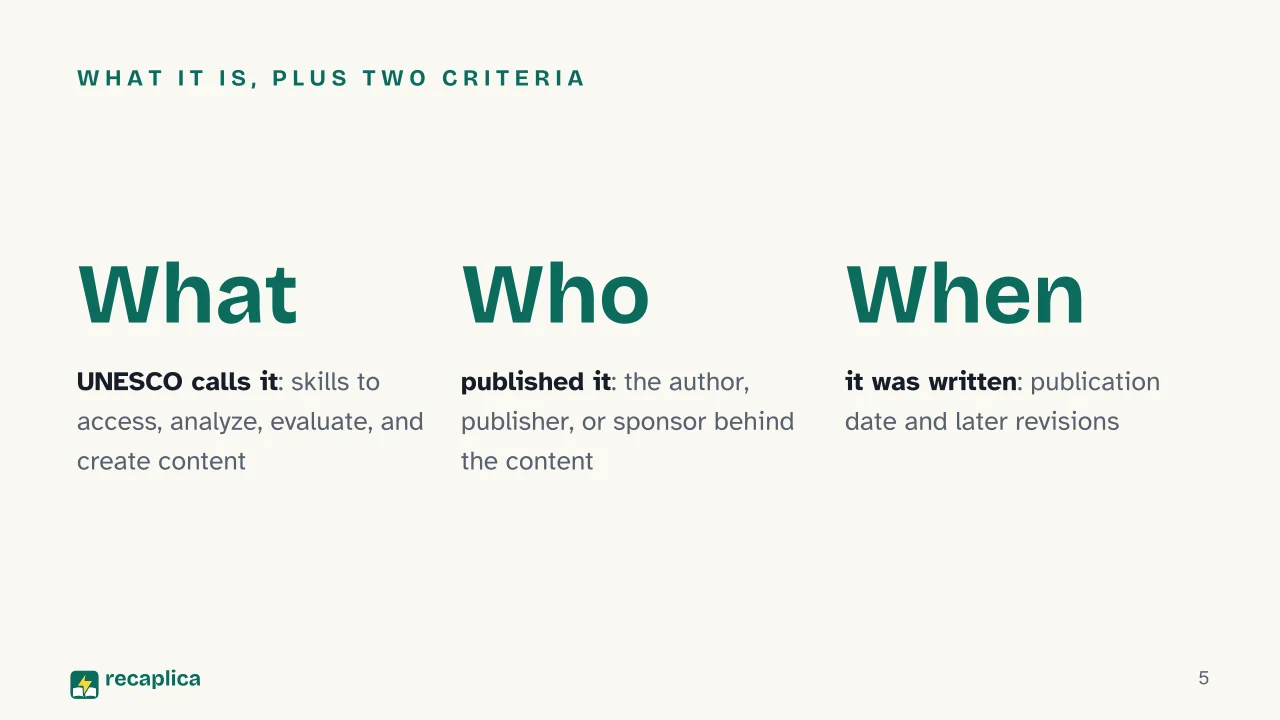  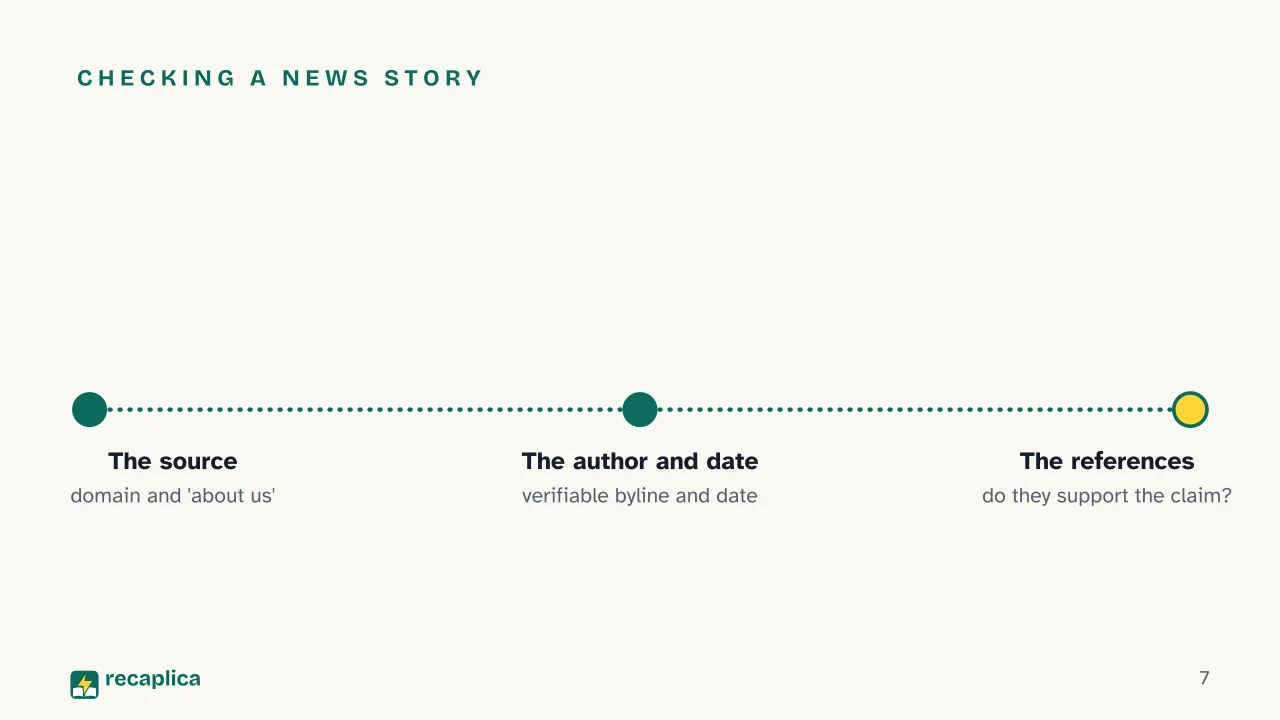 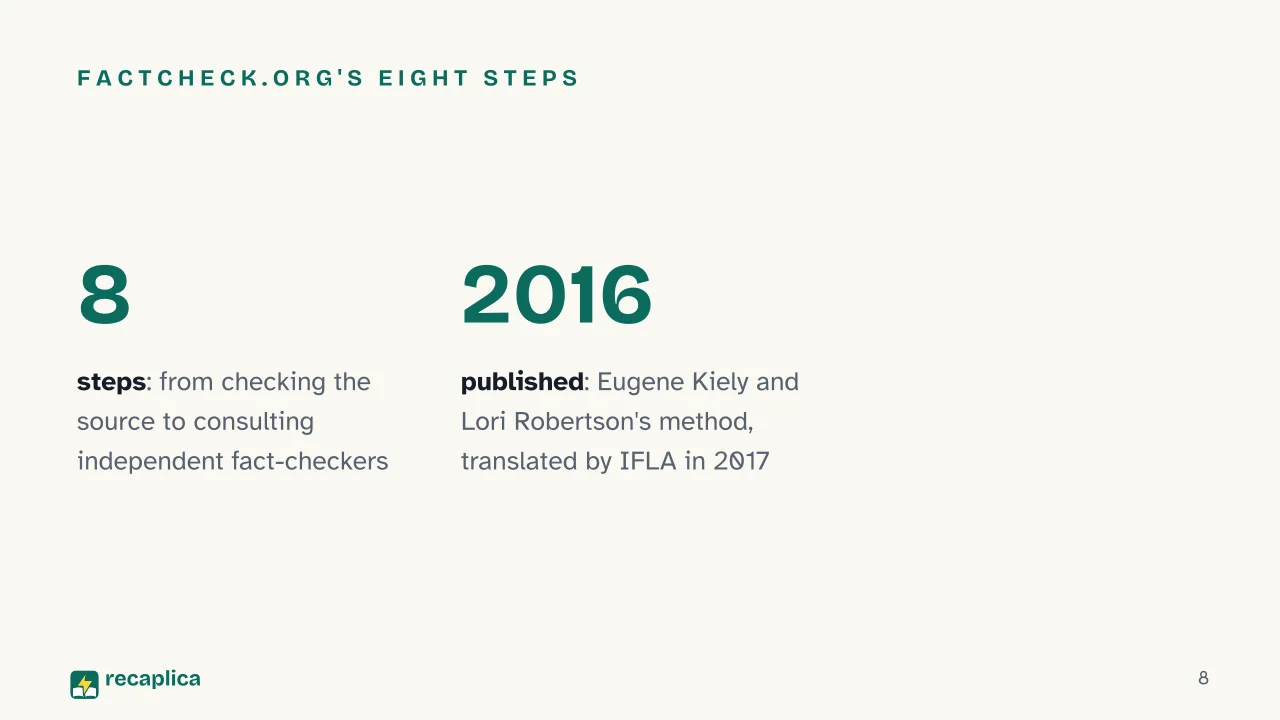  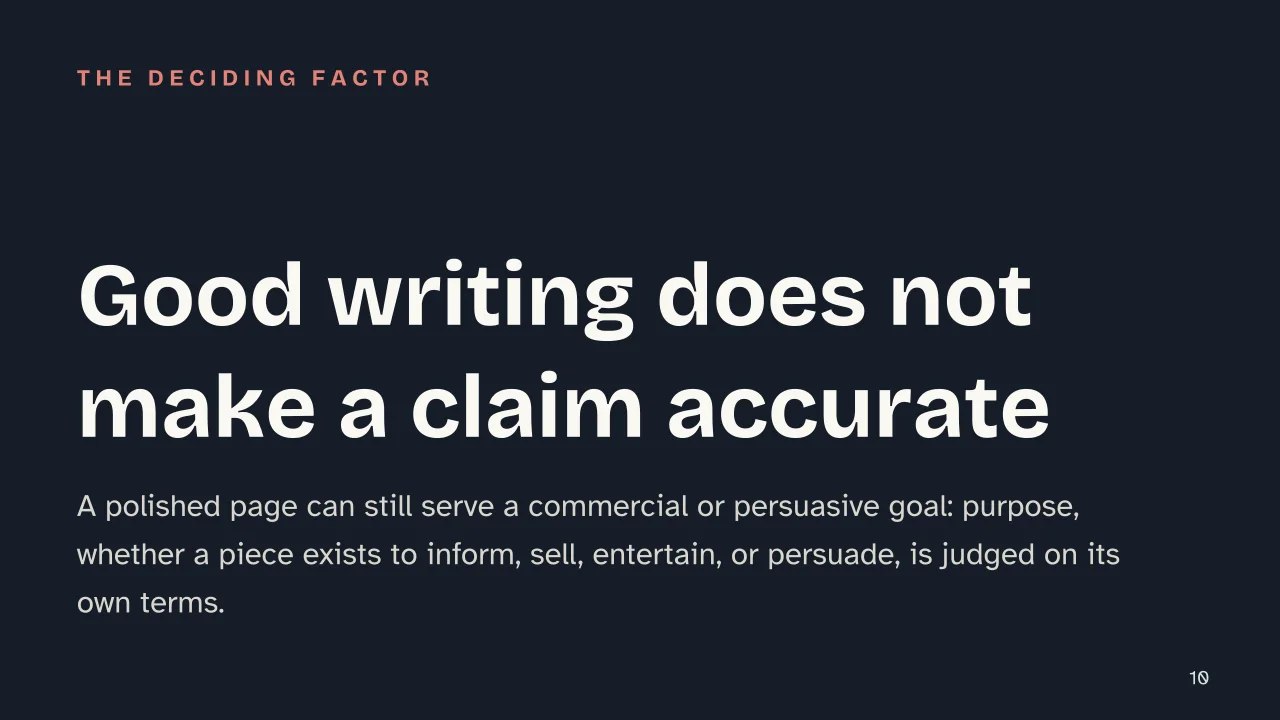  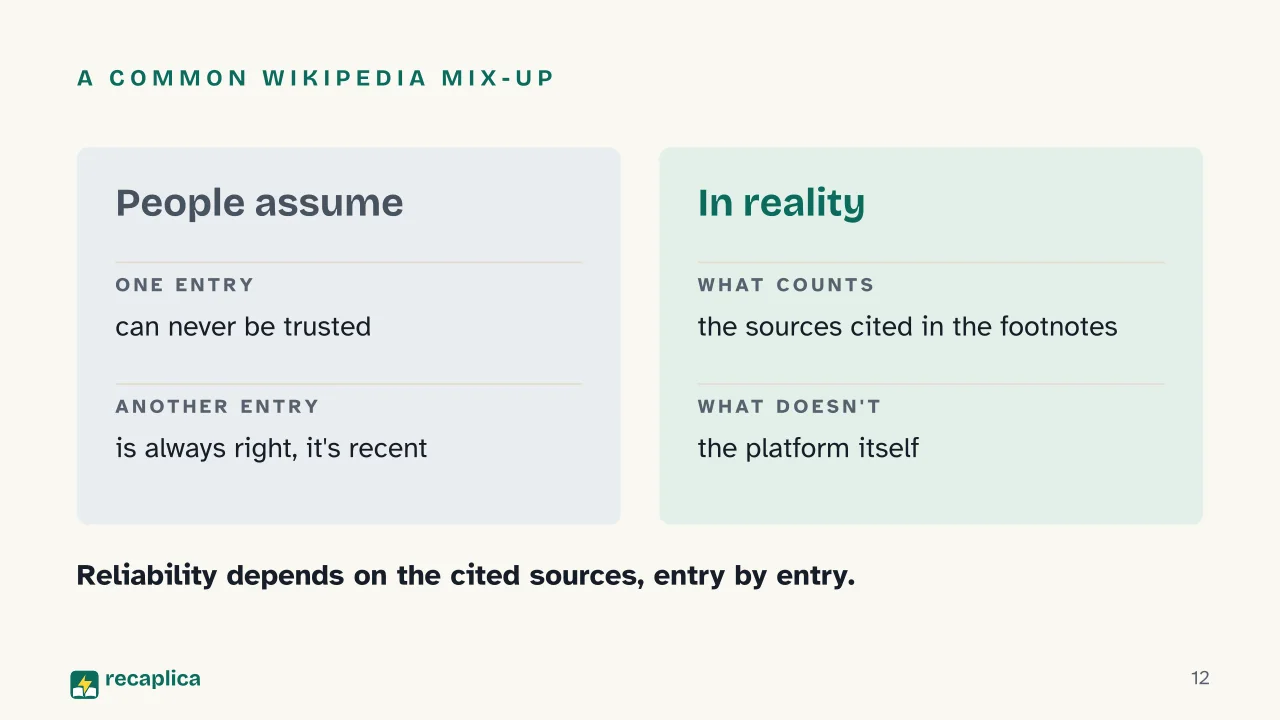 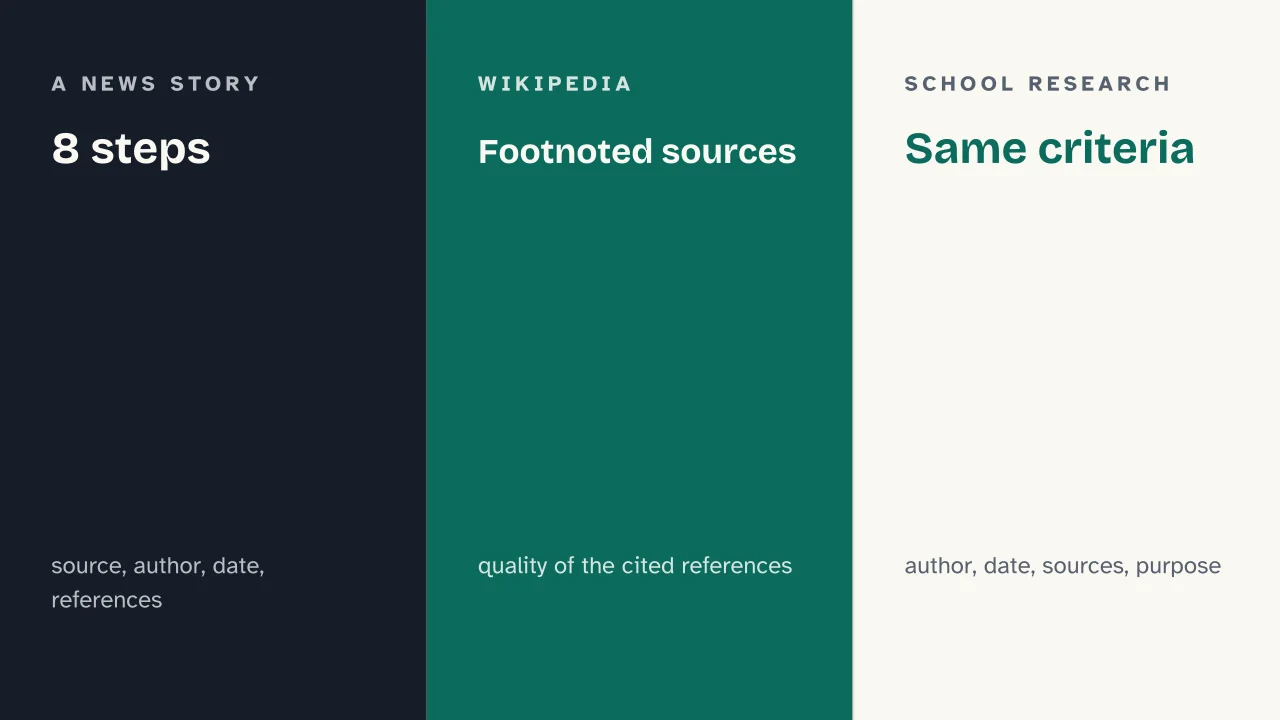 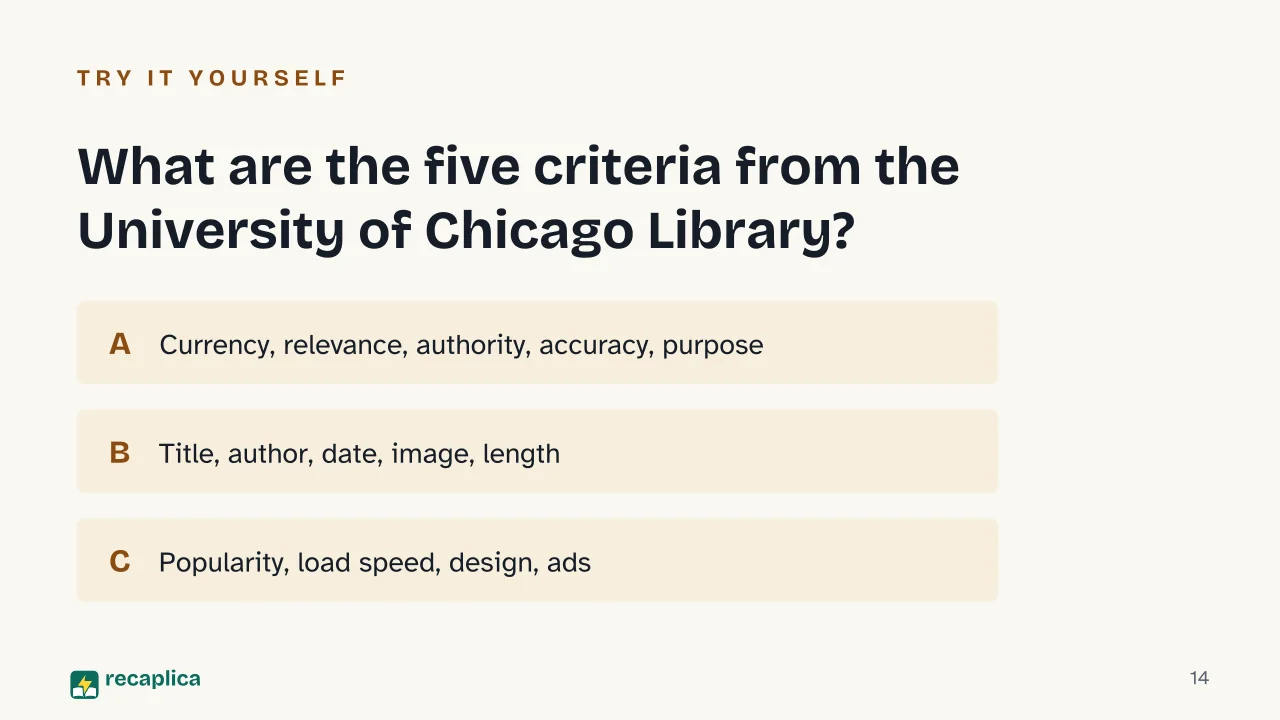  Common myths
Mind mapDrag the background to move around and the nodes to reposition them; use − and + to collapse and expand branches. 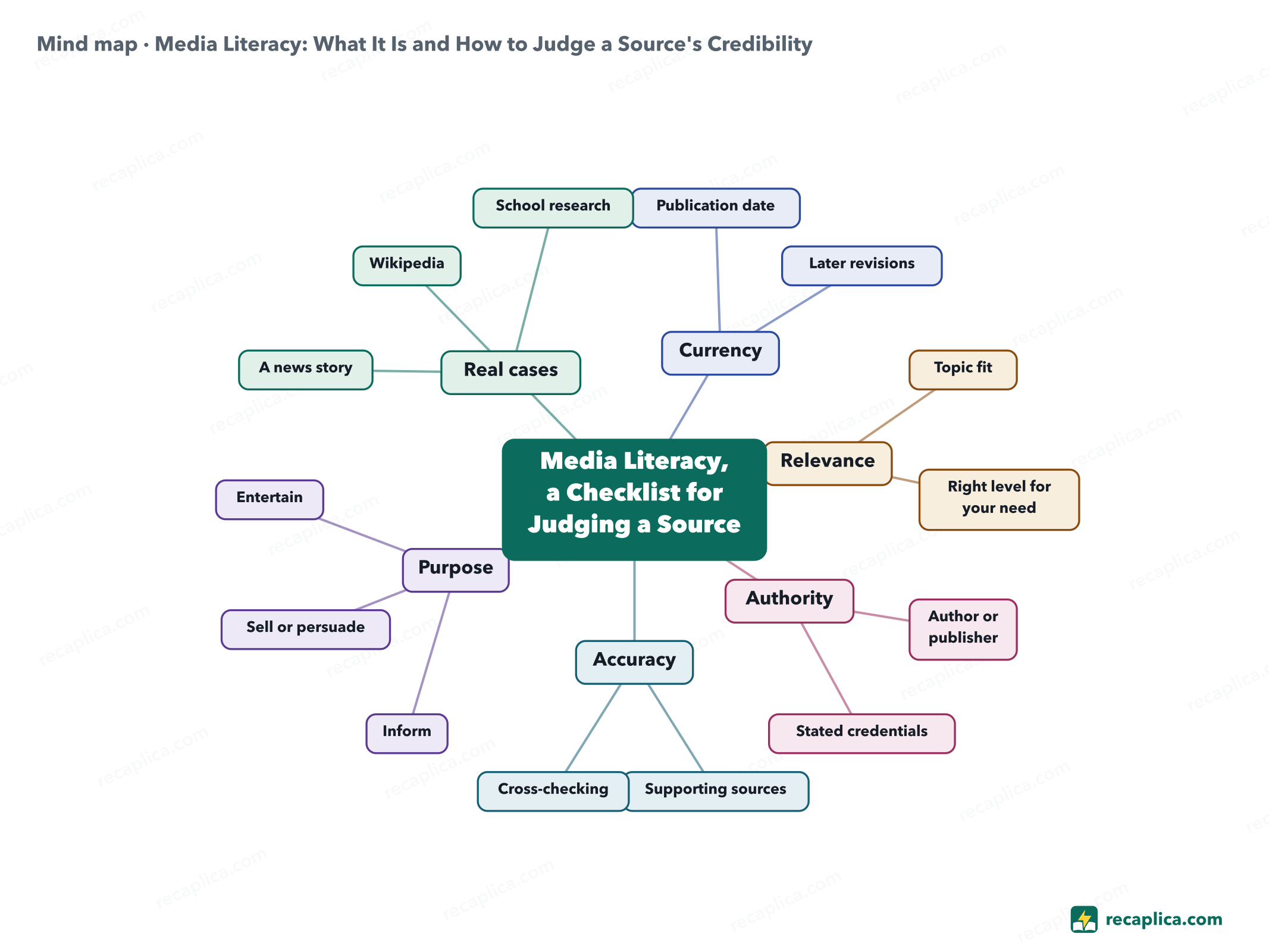
Quiz: test yourselfAnswer the questions to check what you have learned: you get instant feedback and a short explanation. Grade 0/10 0/5
FlashcardsTap the card to flip it and check whether you remember the answer, then move to the next one. 1 / 7 Explain it in your own wordsThe ultimate test: if you can explain it in simple words, you've truly understood it. Write your explanation, then compare it with the Recap. Your explanation is saved only on this device.
Frequently asked questionsWhat is media literacy?It's the set of skills that lets people access, analyze, evaluate, and create content critically across different platforms, as UNESCO defines it: it helps tell a fact from an opinion and recognize misinformation. What are the main criteria for judging a source?The University of Chicago Library lists five: currency (when it was published or updated), relevance (does it answer what you're looking for), authority (who wrote it), accuracy (is the content correct and verifiable), and purpose (why it exists). Is Wikipedia a reliable source?It depends on the individual entry: the Wikipedia community guideline asks for independent, verifiable sources cited in the footnotes. A well-referenced entry is as reliable as the sources it cites; a poorly-sourced one is not. How can you spot a fabricated news story?FactCheck.org suggests eight checks: who publishes the site, read past the headline, check the byline, verify whether the cited references actually support the claim, check the date, ask whether it's satire, recognize your own biases, and consult independent fact-checking sites. Does a recently updated site automatically mean it's reliable?No. Currency is just one of the five criteria in the checklist: without a stated authority, verifiable sources, and an informative purpose, a recent update alone isn't enough. Every Recap goes through an independent review before publication. |