recaplica
Clear in 30 seconds, yours in 10 minutes.
In 30 seconds quick read
Since 2020, Italian law has allowed a real 'signature with SPID': a button on a public body's or company's website that lets someone sign a document with the same legal weight as a handwritten signature, without needing a separate qualified digital signature. In practice, though, this free and direct service is offered almost only to public bodies and partner companies, not to a private citizen who wants to sign a contract on their own. What providers like InfoCert and Poste sell to the public as 'digital signature with SPID' is usually something else entirely: SPID used just to verify identity, then a separate qualified digital signature, often paid. Knowing the difference keeps people from paying for a product they assume is the free one the guidelines describe.
Key Points
Since 23 March 2020, AgID Determination no. 157/2020 has established the 'signature with SPID', based on Article 20 of Italy's Digital Administration Code (CAD): a document signed this way carries the same legal weight as a handwritten signature and produces the effects of Article 2702 of the Italian Civil Code.
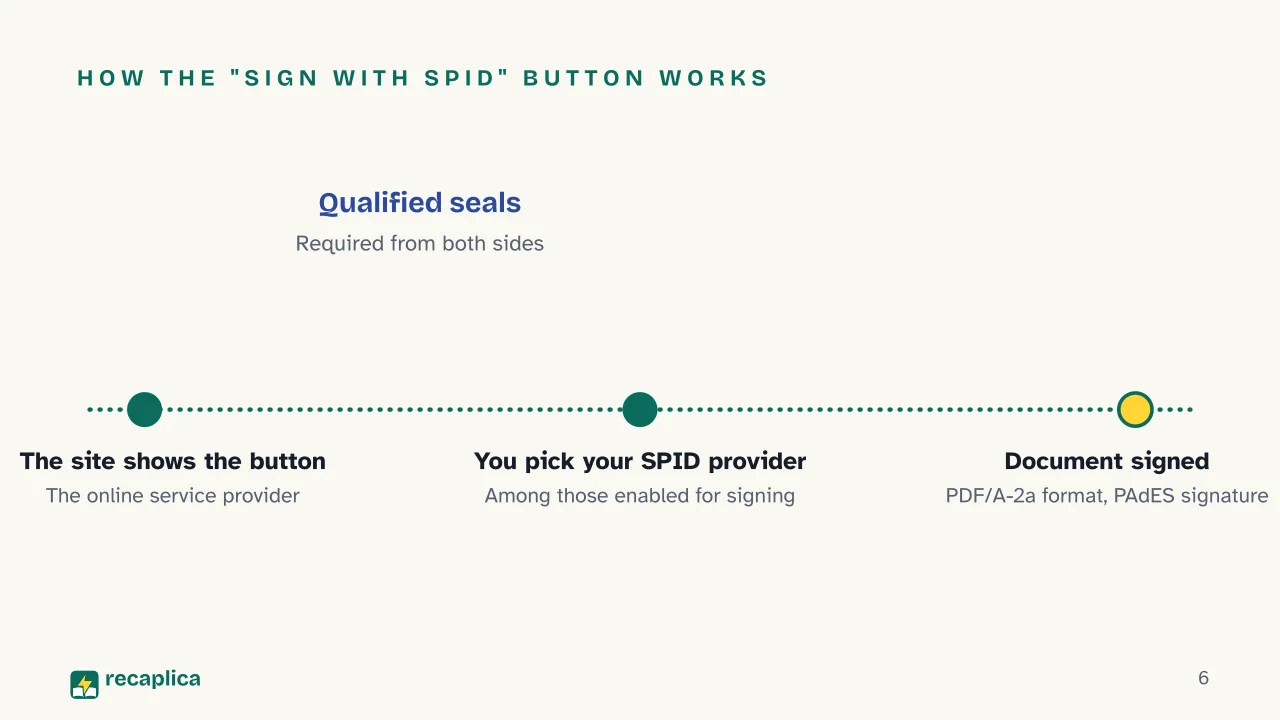
Technically, the service provider (a municipality, a company) shows a 'Sign with SPID' button; the user picks their SPID identity provider, which applies the signature to a document in PDF/A-2a format, unmodifiable and unencrypted.
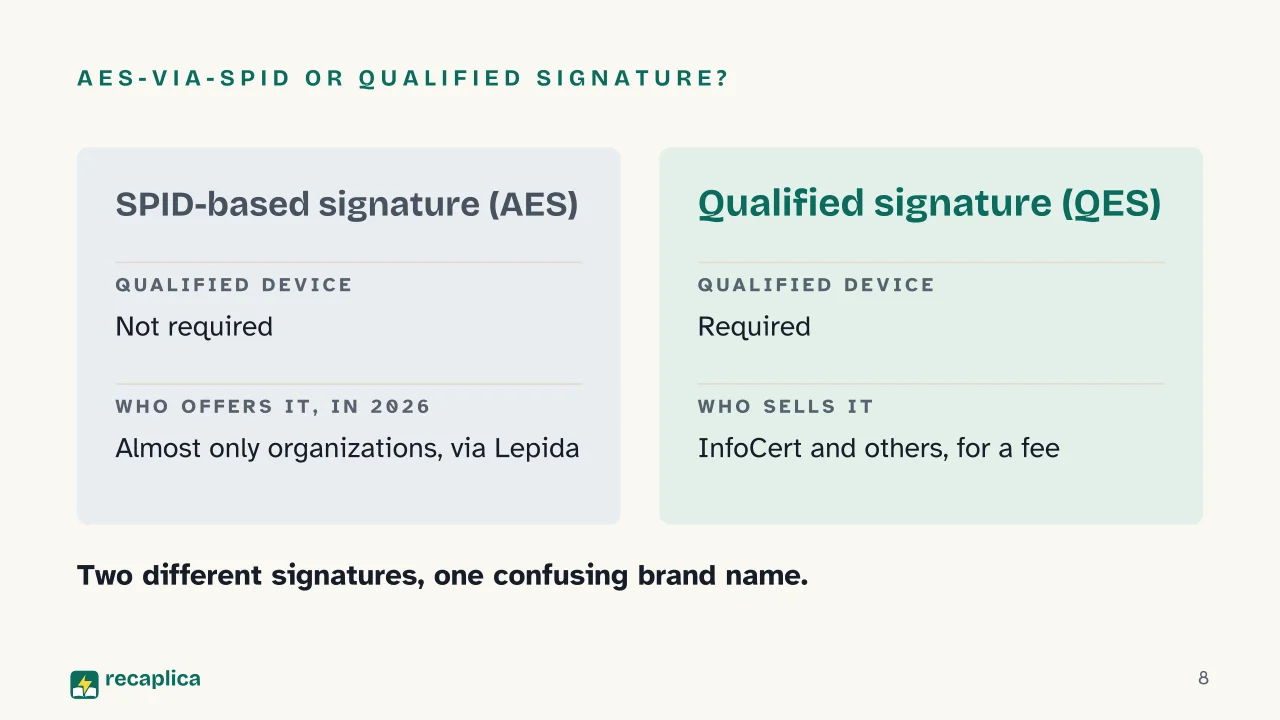
Under the EU eIDAS regulation of 2014, this counts as an Advanced Electronic Signature (AES) — a different category from a Qualified Electronic Signature (QES), which requires a qualified signature creation device and a qualified certificate.
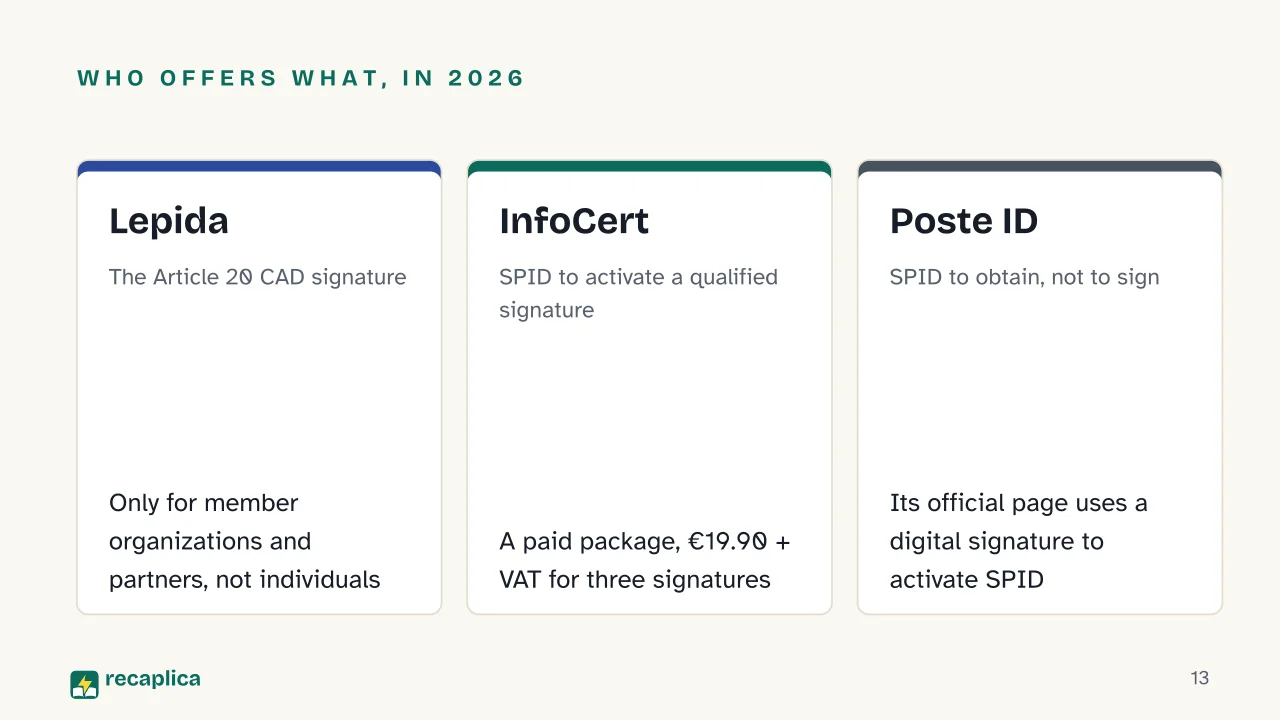
Among SPID providers, Lepida documents the Article 20 CAD service most clearly, but only for member and partner organizations: it is not a product available to private citizens.
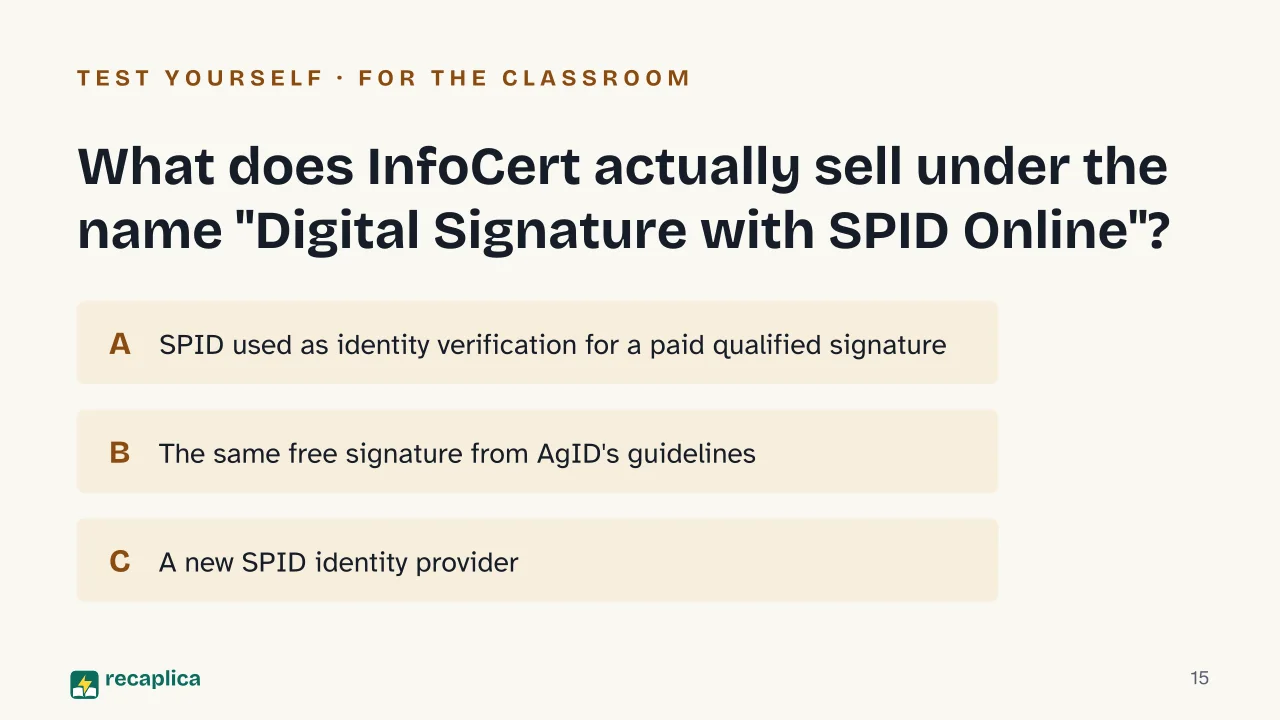
InfoCert sells a product it calls 'digital signature with SPID' that is something else: SPID is used only to verify identity, and the actual signature is a paid qualified (or advanced) digital signature — for example, 19.90 euros plus VAT for a pack of three signatures.
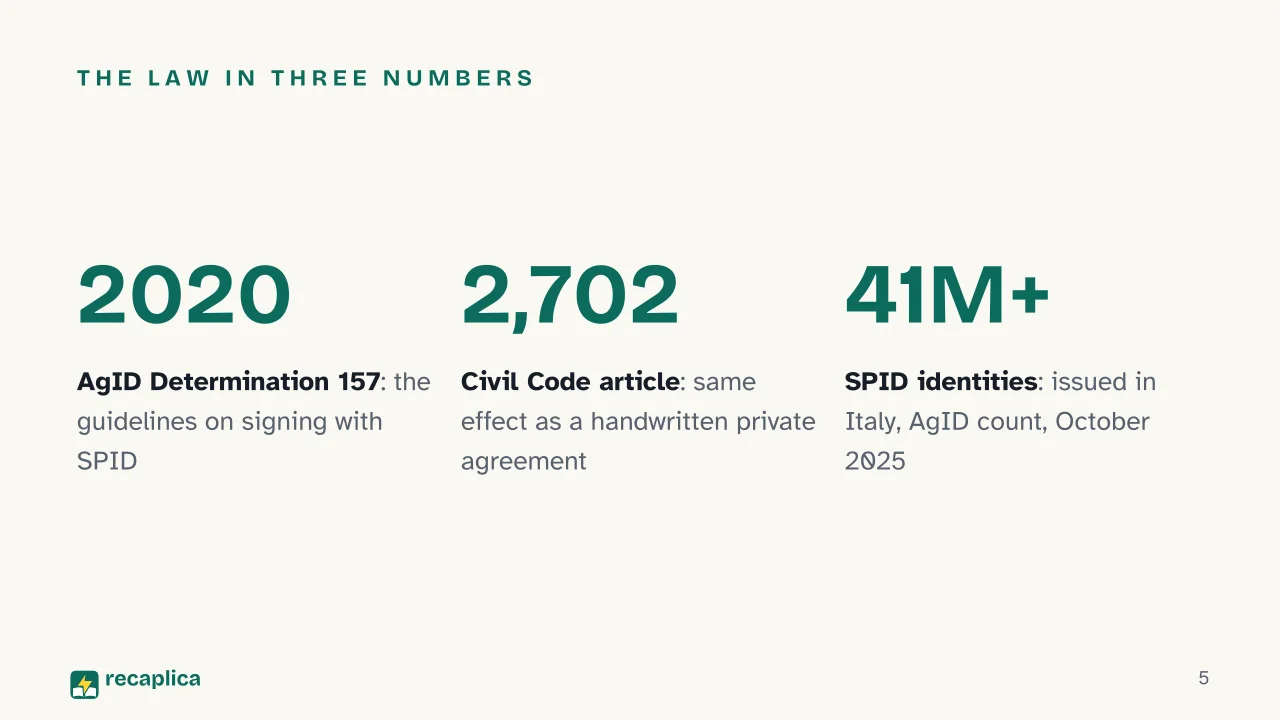
As of October 2025, AgID counted over 41 million SPID digital identities issued in Italy: a widely used login system whose free, law-mandated signing feature remains little used in practice.
Key figures
157/2020 the AgID Determination that established the SPID-based signature, issued 23 March 2020 under Article 20 of the CAD Source: AgID
Over 41 million SPID digital identities issued in Italy, according to AgID's most recent direct public count, in October 2025 Source: AgID
€19.90 + VAT the price of a pack of three qualified digital signatures activated through SPID, recorded in 2026 Source: InfoCert
Deep Dive
A signature the law has recognized since 2020
On 23 March 2020, AgID issued Determination no. 157/2020, establishing
the signature with SPID under Article 20 of Italy’s Digital
Administration Code (CAD) — a legal norm that
governs the electronic execution of deeds and contracts through the
SPID digital identity system. A document
signed this way carries the same legal weight as a handwritten
signature: it satisfies the requirement of written form and produces
the effects of Article 2702 of the Italian Civil Code, the rule that
governs the evidentiary force of a privately signed agreement. AgID’s
stated goal was to support the completion of document digitization,
giving citizens another tool alongside the already existing qualified
digital signature.
Adoption, however, remains voluntary: digital identity providers are
not required to activate the signing service. That detail explains a
lot of what follows.
How the technical process works
The technical flow is specific. A “service provider” — in the
guidelines’ terminology, the website or app of a public body or a
company, the same kind of actor that handles a request when someone
browses online, as described in How the internet works —
shows a “Sign with SPID” button. The user picks, among the Identity
Providers (the SPID providers), the one offering the signing service.
The document to be signed must meet precise requirements: PDF/A-2a
format, no password protection, unencrypted, and modifiable only to
apply the signature in PAdES format.
The guarantee of authenticity does not rely on a distributed public
ledger, as with blockchain:
here, trust rests on two verified parties, who must both hold qualified
electronic seals that comply with AgID’s recommendations and the eIDAS
regulation. The signed document must guarantee “security, integrity and
unmodifiability” and clearly and unambiguously link back to its author.
Advanced or qualified electronic signature: not the same thing
The EU’s eIDAS regulation, from 2014, distinguishes three levels of
electronic signature. The simple electronic signature is the weakest:
electronic data used by the signer to sign, with no further
requirements. An Advanced Electronic Signature (AES) must meet four
conditions under Article 26: it must be uniquely linked to the signer,
capable of identifying the signer, created using data the signer can
use under their sole control, and linked to the document in a way that
any later change can be detected. The SPID-based signature, under
AgID’s guidelines, falls into this category.
A Qualified Electronic Signature (QES) — what most people simply call
“digital signature” — is a step above: an AES created with a qualified
signature creation device and based on a qualified certificate. Two
extra technical requirements, which also bring a different activation
process.
Feature
SPID-based signature (AES)
Qualified digital signature (QES)
Legal basis
Article 20 CAD, AgID Determination 157/2020
eIDAS regulation, Article 3.12
Qualified signature creation device
Not required
Required
Qualified certificate
Not required
Required
Available in 2026 to private citizens
Rarely, only through Lepida for organizations
Yes, from several providers, usually for a fee
Document format
PDF/A-2a, PAdES signature
Varies by provider
Who actually offers the SPID-based signature
Among the SPID providers listed on the official spid.gov.it website —
including TIM id, Poste ID, InfoCert ID, Aruba, Sielte id, and Lepida —
Lepida documents the Article 20 CAD signing service most clearly. Its
official page, though, is explicit on one point: “the service cannot be
contracted by individual private users.” The intended customers are
Lepida’s member organizations and partner entities that sign a specific
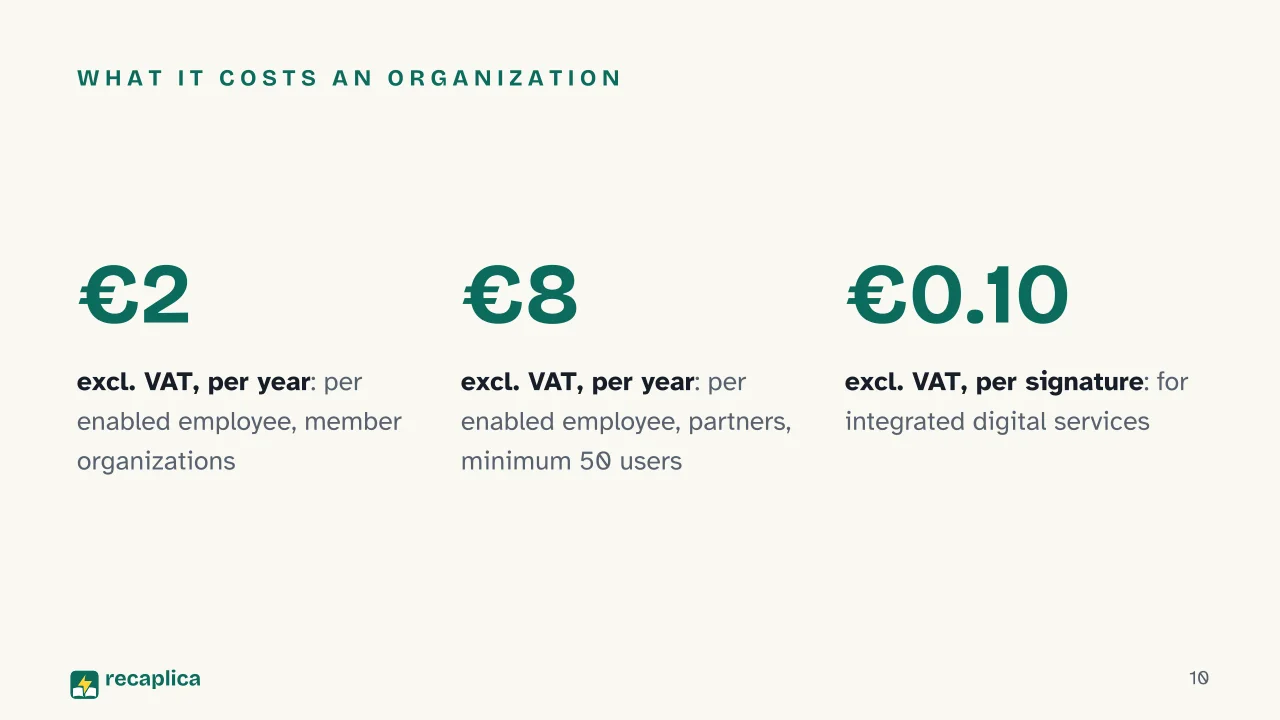
contract, with rates built for organizations — 2 euros plus VAT a year
per enabled employee for member organizations, 8 euros plus VAT for
partner entities with a minimum of 50 users — not for a citizen who
wants to sign a personal document on their own.
A practical example: picture a municipality that wants residents
to sign an enrollment form for a local service online. If the
municipality has partnered with Lepida, it can show citizens the
“Sign with SPID” button described in the guidelines: anyone who
already has SPID signs the form at no extra cost and without
activating anything else. But if a private citizen wants to sign a
personal contract alone — say, a freelance work agreement — that
exact mechanism is not available to them as of 2026: they would need
to turn to a service like InfoCert’s, which is a different thing.
What InfoCert, Poste, and other providers actually sell
Searching online for “digital signature with SPID” mostly turns up
pages like InfoCert’s, titled “Digital Signature with SPID Online.” The
product described, though, is not the SPID-based signature from AgID’s
guidelines: SPID is used as an authentication method to apply a
qualified digital signature — or, as an alternative within the same
flow, an advanced signature — to a document. No separate activation is
required beyond holding a valid SPID identity, but the service is
paid: a pack of three signatures, valid for one year, cost 19.90 euros
plus VAT, with a timestamp that keeps the signature valid for twenty
years.
PosteID’s official page describes a different, almost opposite path: it
explains how to use a digital signature that has been active for more
than 180 days to obtain SPID credentials, not how to use SPID to sign a
document. It is a useful reminder that many services turning up when
searching “SPID” and “digital signature” together link the two tools in
a way that is not what Article 20 of the CAD describes.
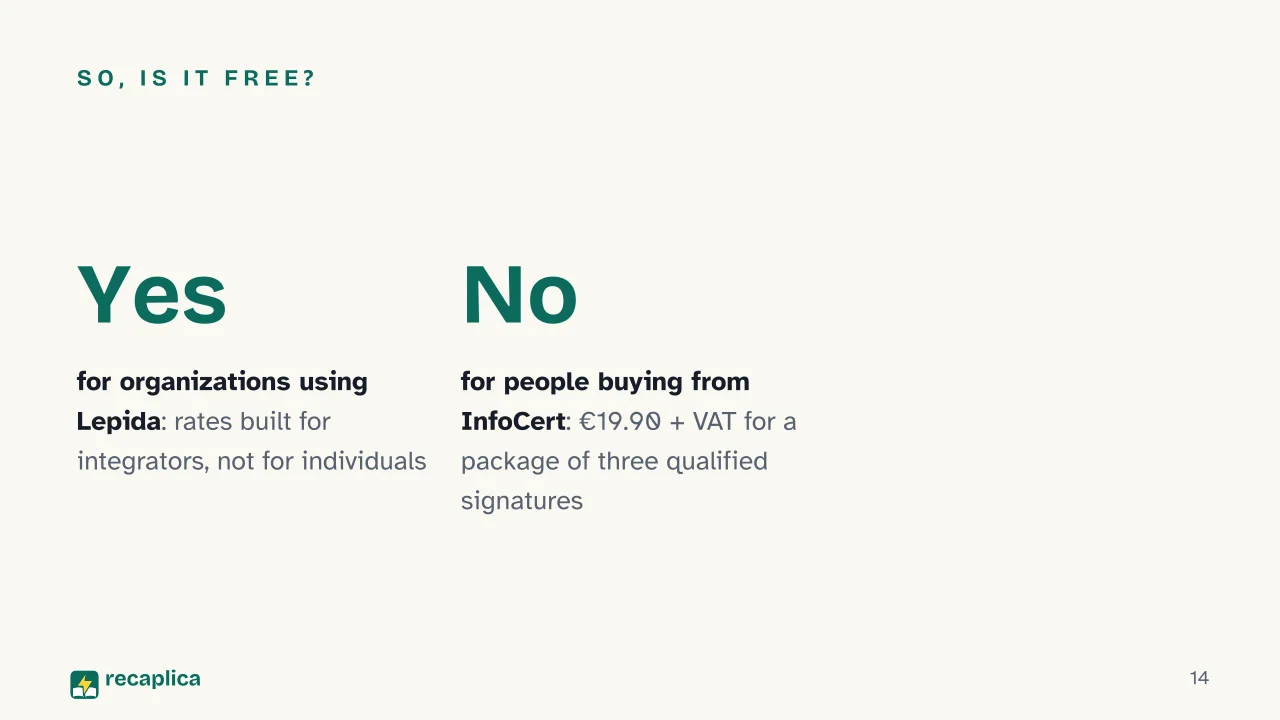
So, what does it actually cost
The answer depends on who is asking. For an organization integrating
the Article 20 CAD service through Lepida, the SPID-based signature has
a modest, predictable cost, built for the organization rather than the
individual signer. For a private citizen looking in 2026 for a way to
sign their own document, the more common route runs through a product
like InfoCert’s: SPID as the access key, and a qualified or advanced
digital signature purchased separately. Knowing which of the two is
being searched for — and which one is actually being bought — keeps
someone from paying for a service believing it is free, or expecting a
product for free that, in 2026 practice, providers reserve for
organizations.
Slide deck
Slides ready to download and make your own in PowerPoint or Google Slides, with speaker notes. Pick the Flash cut or the Full one.
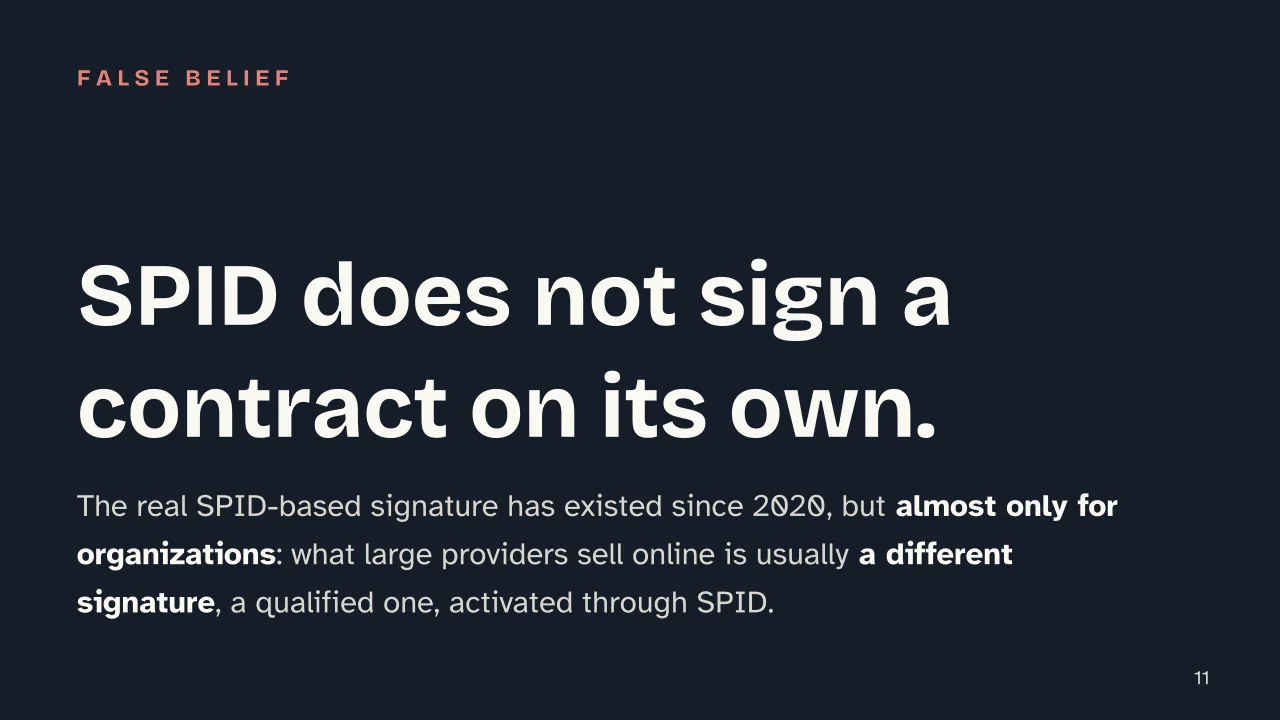
✗ Myth A SPID-based signature and a qualified digital signature are the same thing.
✓ Reality Under EU law, they are not. The SPID-based signature described in AgID's guidelines is an Advanced Electronic Signature (AES): it meets the requirements of eIDAS Article 26, but without a qualified signature creation device or a qualified certificate. A qualified digital signature (QES) requires both, making it the highest level recognized under EU law — two tools with different technical foundations, even if in many everyday cases they produce a similar effect on a document.
✗ Myth Anyone with SPID can sign their own contracts for free with one click.
✓ Reality As of 2026, in documented practice the Article 20 CAD service remains almost entirely aimed at public bodies and partner companies: Lepida, the provider that describes it most clearly, bills it to member organizations and to entities that have signed a specific contract, not to an individual wanting to sign a personal document.
✗ Myth The 'digital signature with SPID' packages sold online by InfoCert and similar providers are the free service described in the guidelines.
✓ Reality In those products, SPID only verifies the user's identity: the actual signature is a separate qualified or advanced digital signature, often paid. It is a different service, even though the commercial name echoes the same phrase used in AgID's guidelines.
Mind map
Drag the background to move around and the nodes to reposition them; use − and + to collapse and expand branches.
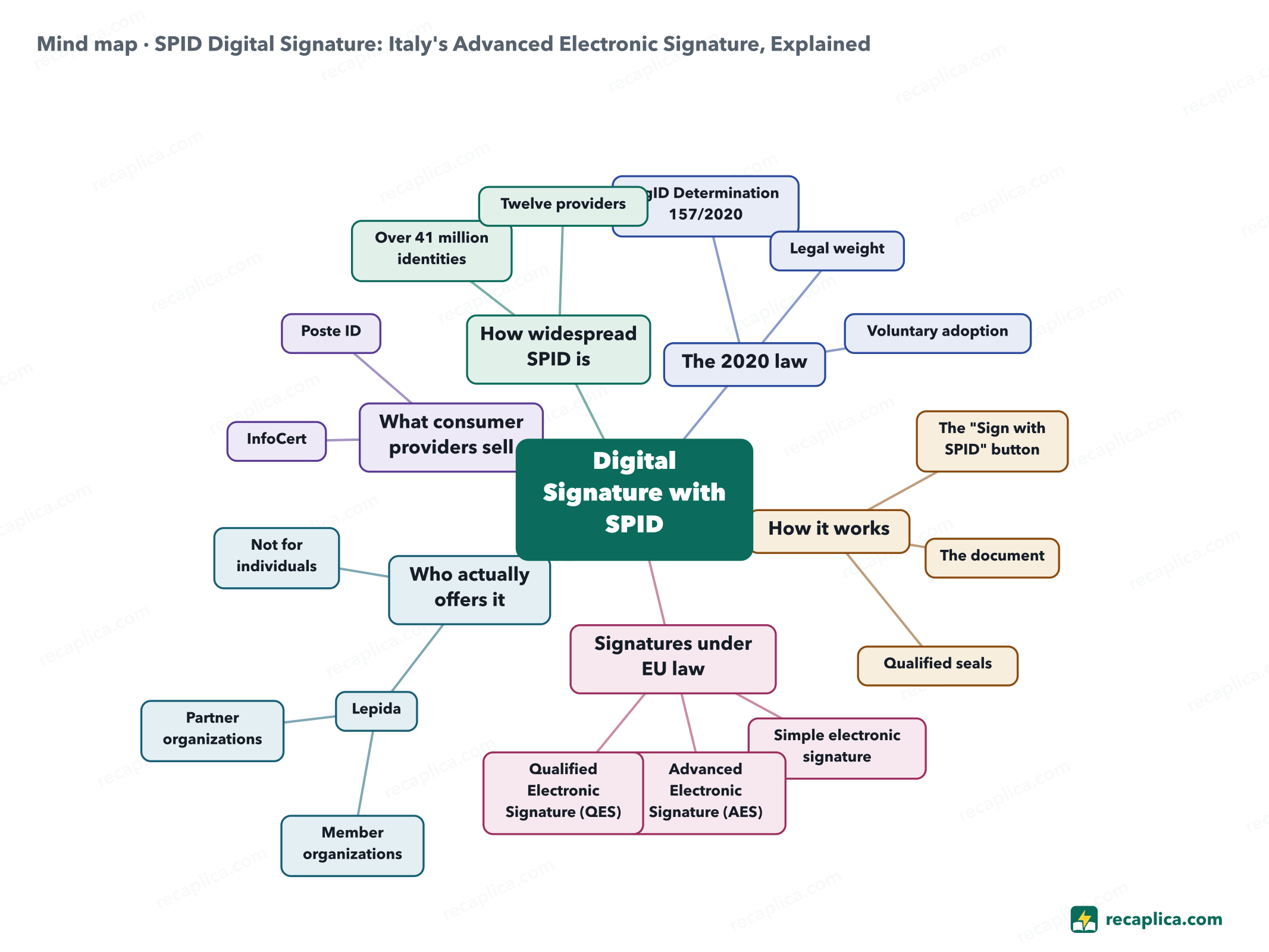
AgID Determination 157/2020Issued 23 March, based on Article 20 of the CAD
Legal weightSame as a handwritten signature, effects of Civil Code Article 2702
Voluntary adoptionProviders are not required to offer the service
How it works
The "Sign with SPID" buttonShown by the online service provider
The documentPDF/A-2a format, signature in PAdES format
Qualified sealsRequired from both the service and the identity provider
Signatures under EU law
Simple electronic signature
Advanced Electronic Signature (AES)The category of the SPID-based signature
Qualified Electronic Signature (QES)Requires a qualified device and certificate
Who actually offers it
LepidaDocuments the Article 20 CAD service
Member organizations2 euros plus VAT a year per enabled employee
Partner organizations8 euros plus VAT a year, minimum 50 users
Not for individualsThe service cannot be contracted by private users
What consumer providers sell
InfoCertSPID for identity verification, paid qualified signature
Poste IDIts official page describes using a digital signature to obtain SPID
How widespread SPID is
Over 41 million identitiesAgID count, October 2025
Twelve providersListed on spid.gov.it
Quiz: test yourself
Answer the questions to check what you have learned: you get instant feedback and a short explanation.
Grade0/100/5
Answers: 1-B · 2-B · 3-B · 4-B · 5-C
Flashcards
Tap the card to flip it and check whether you remember the answer, then move to the next one.
1 / 8
Explain it in your own words
The ultimate test: if you can explain it in simple words, you've truly understood it. Write your explanation, then compare it with the Recap.
Your explanation is saved only on this device.
Since 2020, Italian law has allowed a real 'signature with SPID': a button on a public body's or company's website that lets someone sign a document with the same legal weight as a handwritten signature, without needing a separate qualified digital signature. In practice, though, this free and direct service is offered almost only to public bodies and partner companies, not to a private citizen who wants to sign a contract on their own. What providers like InfoCert and Poste sell to the public as 'digital signature with SPID' is usually something else entirely: SPID used just to verify identity, then a separate qualified digital signature, often paid. Knowing the difference keeps people from paying for a product they assume is the free one the guidelines describe.
Frequently asked questions
Is a digital signature with SPID free?
It depends on which product is meant. The actual SPID-based signature from AgID's 2020 guidelines is designed as a direct service with no extra cost to the signer, but in documented practice it is offered almost only to organizations: Lepida bills it to member organizations or contracted partners, not to private individuals. What large providers like InfoCert sell to the public as 'signature with SPID' is instead a paid package of qualified digital signatures (for example, 19.90 euros plus VAT for three signatures at InfoCert): there, SPID only verifies identity — it is not the free signature described in the guidelines.
Which providers actually offer the SPID-based signature?
Among the SPID identity providers listed on spid.gov.it — including TIM id, Poste ID, InfoCert ID, Aruba, Sielte id, and Lepida — Lepida documents the Article 20 CAD service most clearly, but only for member organizations and contracted partners. InfoCert offers a different product: it uses SPID as identity verification to activate a separate, paid qualified or advanced digital signature.
Does a SPID-based signature carry the same legal weight as a handwritten one?
Yes, under AgID's 2020 guidelines: a document signed with SPID through the Article 20 CAD mechanism produces the same effects as a private agreement signed by hand, governed by Article 2702 of the Italian Civil Code.
What is the difference between a SPID-based signature and a qualified digital signature?
The gap is technical, not about legal validity: both carry legal weight, but only a qualified signature (QES) has to be created with dedicated hardware and a certificate issued for that purpose. A SPID-based signature (AES) reaches a similar result with lighter requirements, which is why some document types accept only the qualified kind by law.
Every Recap goes through an independent review before publication.
Statistics, only if you say so
To learn which Recaps help most we would use Google Analytics, with aggregate, anonymous data. It starts only with your OK, and you can change your mind anytime. Privacy policy