recaplica
Clear in 30 seconds, yours in 10 minutes.
In 30 seconds quick read
Not every source that turns up in a search engine belongs in a research paper, a school assignment or a thesis. The CRAAP test breaks the question into five checks, currency, relevance, authority, accuracy and purpose, that a student can run on any source before citing it. It also helps separate a primary source, the original document, from a secondary one that comments on it, and clarifies that Google Scholar applies no peer-review filter to the results it returns. Curated databases such as Scopus and Web of Science, by contrast, flag peer review at the journal level. With these tools a student can judge a source on its merits instead of trusting whatever ranks first.
Key Points
The CRAAP test scores a source on five criteria: currency, relevance, authority, accuracy and purpose.
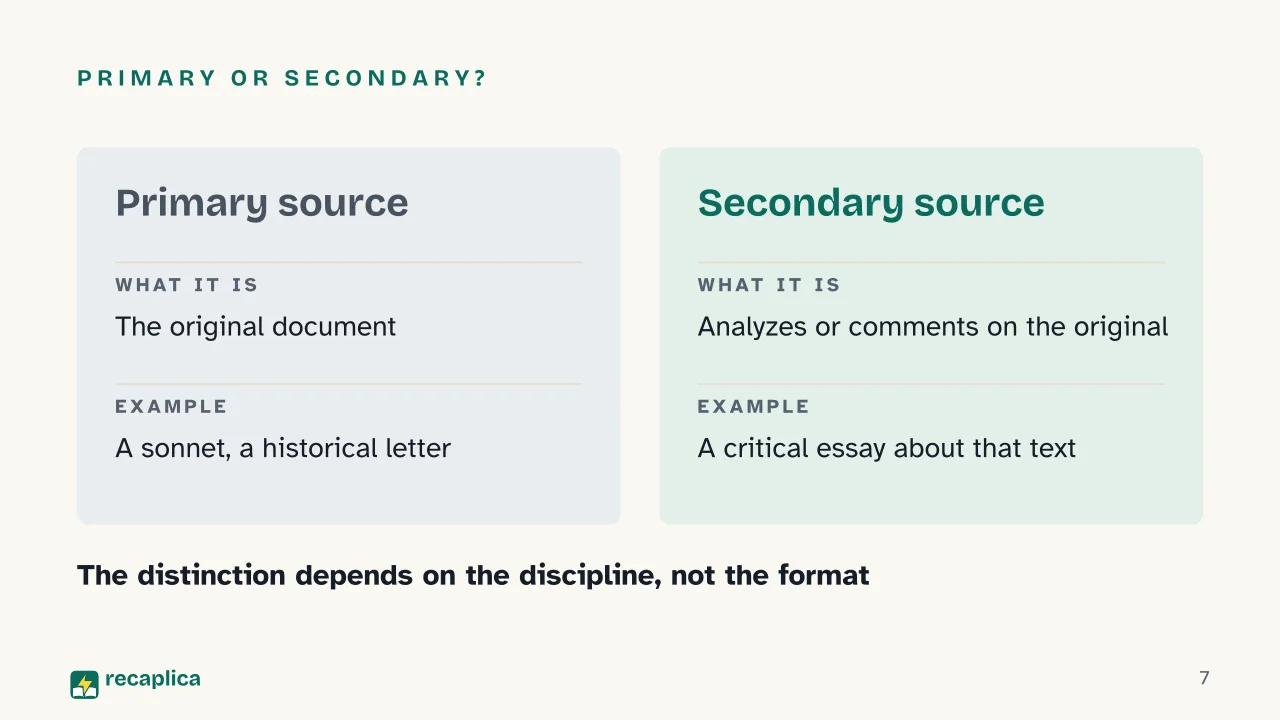
A primary source is the original document (an experiment, a letter, a literary work); a secondary source analyzes or comments on it, and which is which depends on the discipline.
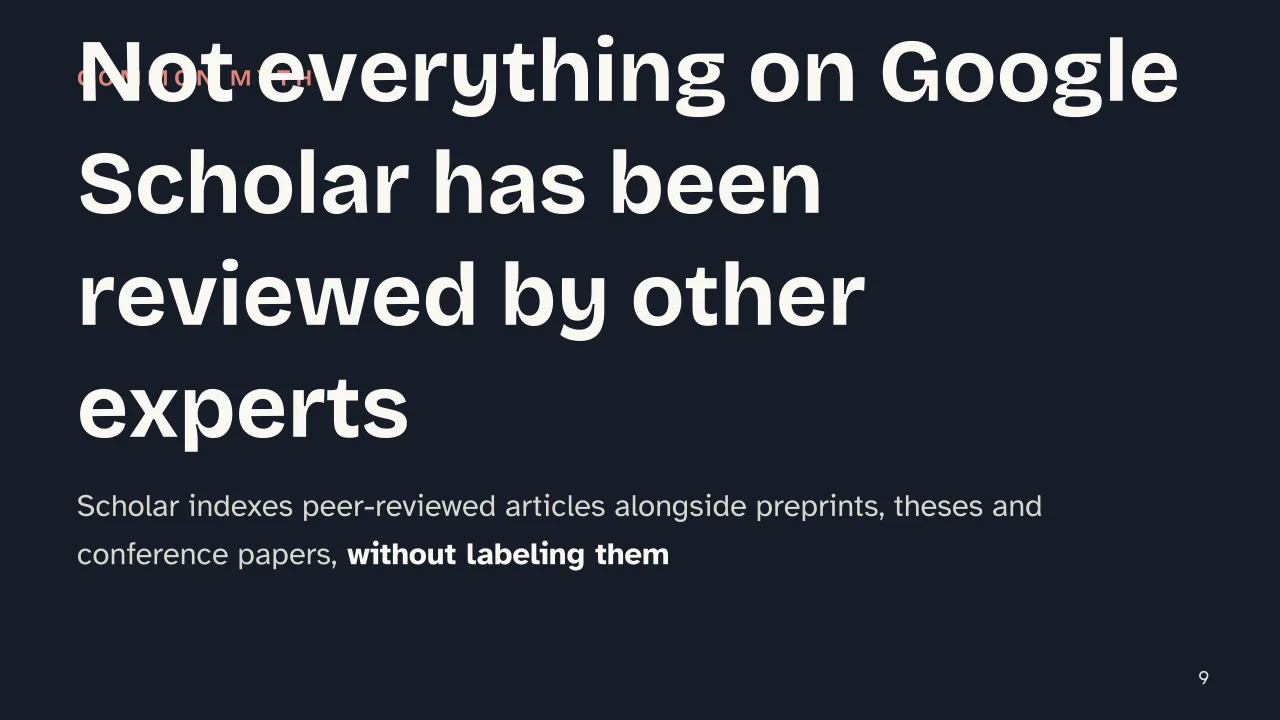
Google Scholar indexes peer-reviewed articles alongside preprints, theses and conference papers without labeling them: showing up on Scholar does not certify peer review.
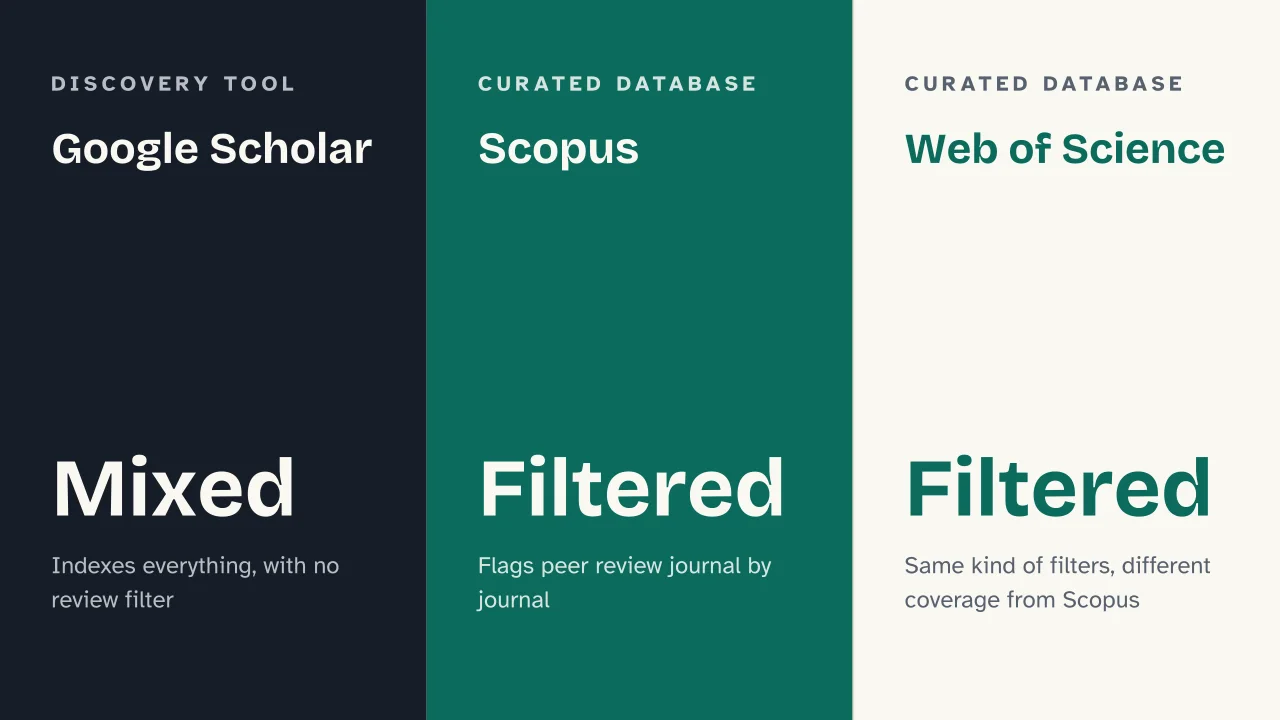
Scopus and Web of Science flag peer review at the journal level and offer dedicated filters to isolate reviewed content only.
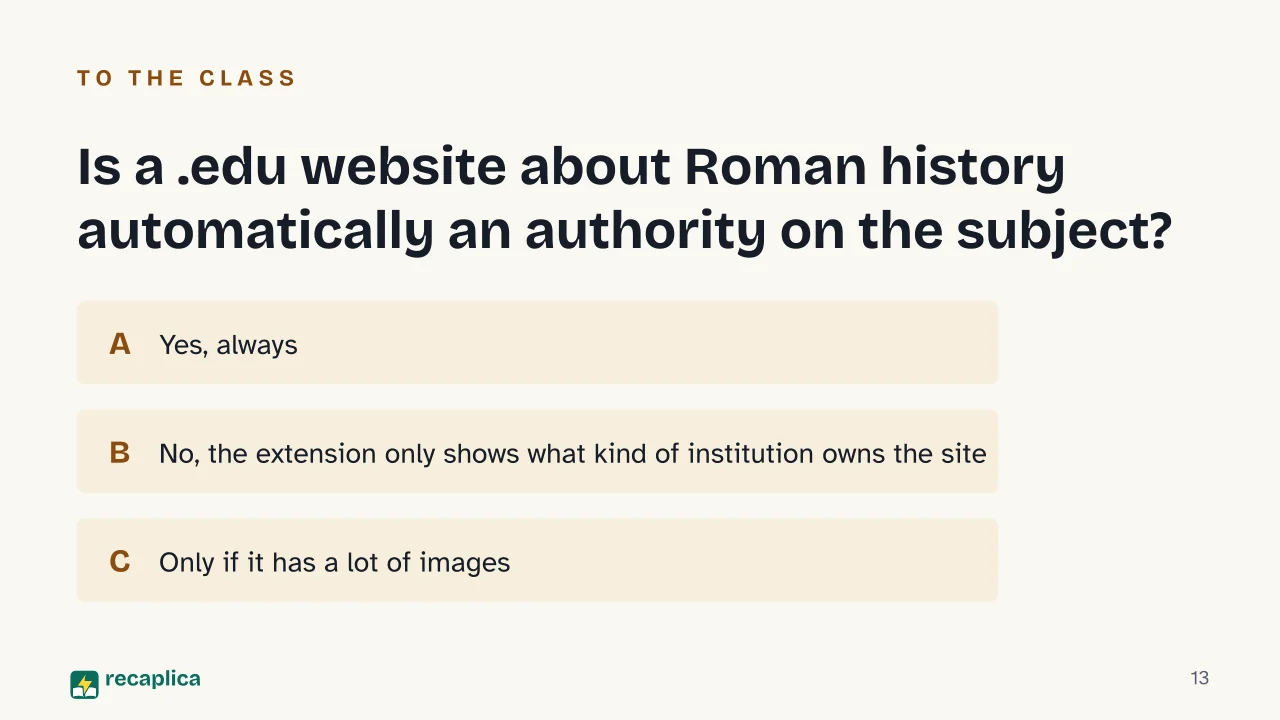
A .edu or .gov domain only shows what kind of institution owns the site, not whether a given page's content is reliable.
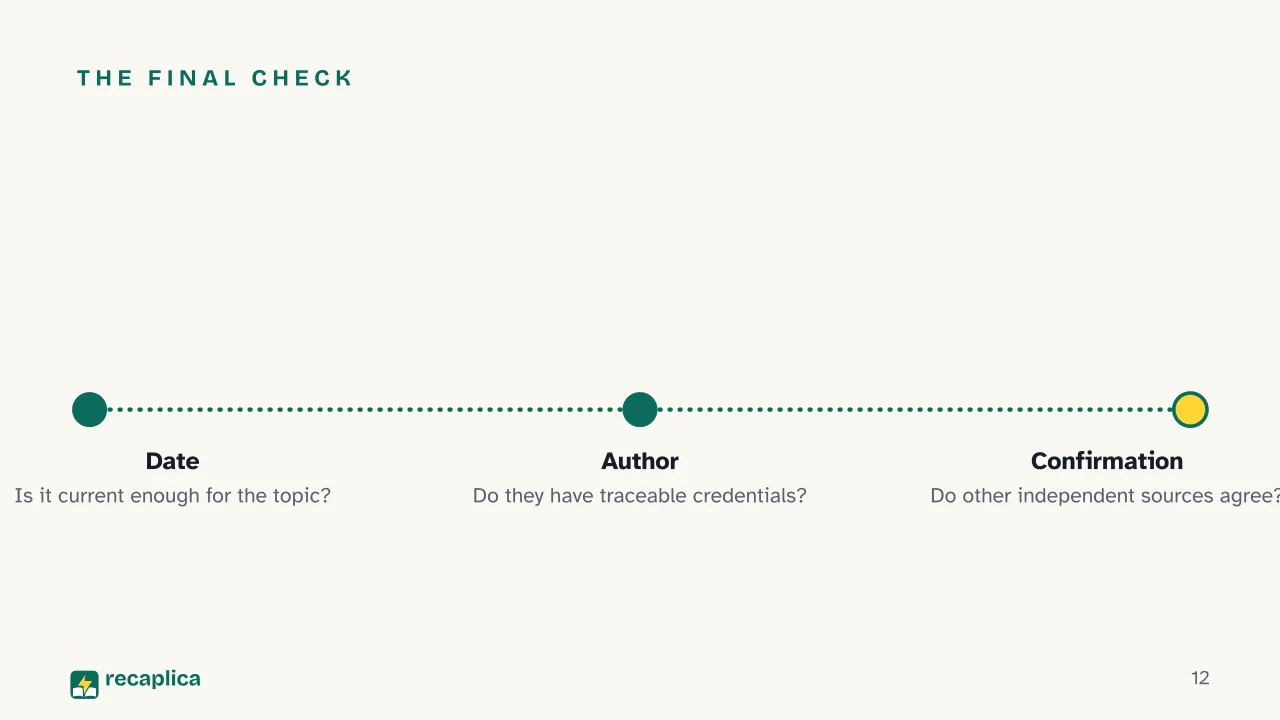
Before citing a source, check the publication date, the author's credentials, and whether other independent sources confirm the same claim.
Key figures
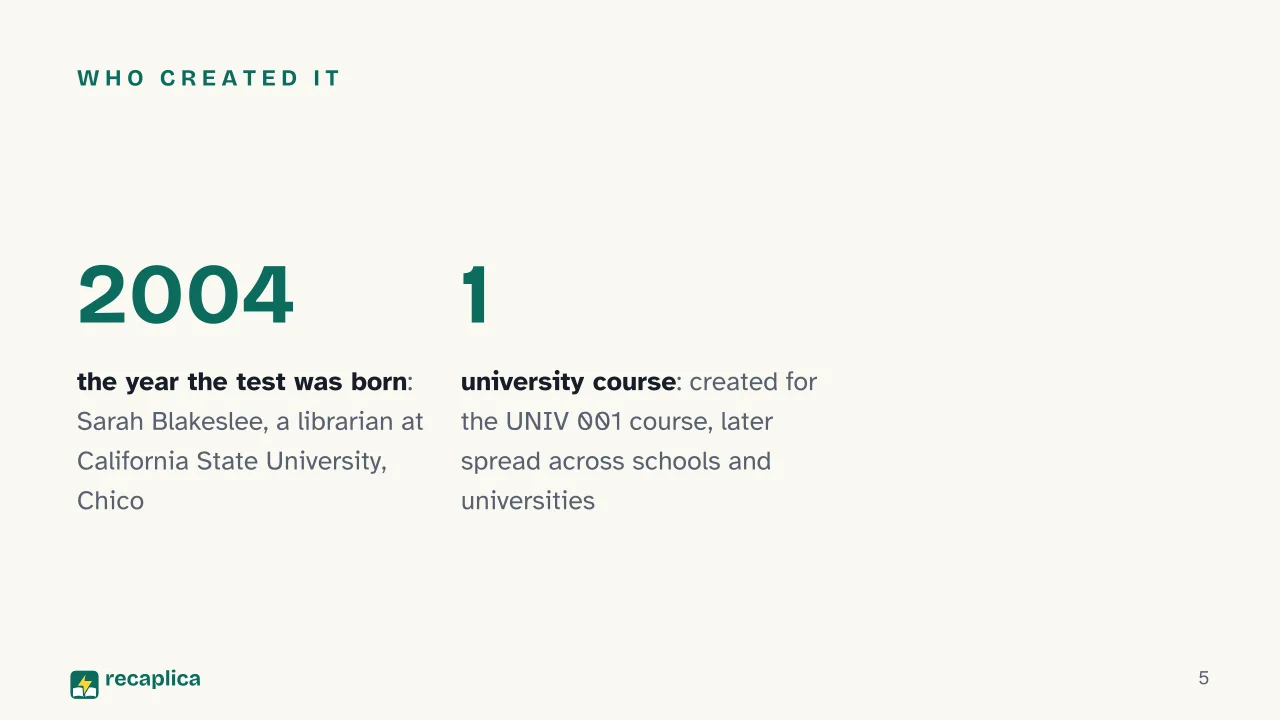
2004 Year librarian Sarah Blakeslee designed the CRAAP test at California State University, Chico's Meriam Library, for the UNIV 001 course. Source: Chico State Today
Deep Dive
Why a source found in a hurry isn’t enough
A search engine ranks results by its own algorithm, not by how reliable the content is: the top link isn’t automatically the strongest one for a school assignment, a paper or a thesis. The CRAAP test gives a student a practical checklist instead of a gut call, and it covers five aspects of a source: when it was published, who it’s written for, who wrote it, how well its claims are backed by evidence, and why it was written.
The CRAAP test, criterion by criterion
Librarian Sarah Blakeslee designed it in 2004 at California State University, Chico’s Meriam Library, for the UNIV 001 course; from there it spread to other schools and universities across the US, as far as Australia. The acronym packs in five questions:
Currency: when was the source published or updated, and does the date matter for this topic? A ten-year-old figure about a fast-moving technology carries different weight than one about a closed historical event.
Relevance: does the source match the level, general-audience or specialist, that the assignment calls for? A general encyclopedia entry doesn’t stand in for a scientific paper when a technical figure is needed.
Authority: who wrote or published the text, and with what credentials or affiliation? A site with no listed author and no way to trace who runs it is already a warning sign.
Accuracy: are the claims backed by verifiable data or citations, or do they stay opinions with nothing behind them?
Purpose: does the text aim to inform, or to sell, persuade or entertain? A commercial purpose doesn’t automatically disqualify a source, but it should factor into how you read what it says, and what it leaves out.
Practical example: a student researching ocean plastic pollution finds two pages: a blog post from a company selling “plastic free” products, and a report from an environmental agency with a stated methodology and references at the bottom. Running Purpose and Accuracy on both, the second page holds up: it explains how the data was gathered and has no product to sell at the end.
The same label changes meaning depending on the subject. In the humanities, a primary source is a document from the period under study, a sonnet, a letter, a political manifesto: in a paper on nineteenth-century Europe, a treatise written in that era is primary, while a critical essay analyzing it today is secondary. In the sciences, a primary source is typically an original empirical study published in a peer-reviewed journal, the experiment itself, not a piece commenting on it elsewhere.
A tertiary source, such as a textbook or an encyclopedia entry, summarizes and organizes other people’s work without adding original research. It’s useful for getting a general picture at the start of a project, less so for backing a specific claim in the paper, where it’s better to trace the claim to a primary source or an authoritative secondary one.
Google Scholar doesn’t certify peer review
One of the most common misunderstandings among students starting a research project is assuming that “found on Google Scholar” means “reviewed by other experts.” Google Scholar indexes peer-reviewed articles alongside preprints that haven’t been reviewed yet, theses, conference papers, books and other so-called grey literature, without labeling which is which: it’s a tool for discovering content, not a body that certifies its quality.
Journals selected with its own criteria, different coverage from Scopus
Yes, with dedicated, manually verified filters
The same cross-checking applies to a text written with a generative AI system: fluent writing is no guarantee of accuracy or of verified sources behind it, and the CRAAP test’s Authority criterion applies just as well there, asking who, or what, actually wrote the text. The Accuracy criterion, in particular, is what helps take apart content built to mislead rather than inform: if the claims aren’t backed by verifiable data, the rest of the source doesn’t count for much.
The domain doesn’t make the source
The .edu and .gov extensions are reserved for educational and government institutions respectively, but they only show what kind of organization owns the site: they don’t certify that a specific page, perhaps written by a student on a university server, is authoritative on that particular topic. The reverse also holds: solid content can appear on a generic .com or .org domain, and it’s the source itself that needs evaluating, not the address hosting it.
Before you cite it, a three-step check
Before a source goes into a bibliography, it’s worth closing the loop with three practical questions: does the date hold up for the topic, does the author have traceable credentials, and does another independent source confirm the same claim. Two students typing the same search phrase can see different results partly because recommendation algorithms work inside a personalized filter bubble: another reason to run the CRAAP test on a source before citing it.
Slide deck
Slides ready to download and make your own in PowerPoint or Google Slides, with speaker notes. Pick the Flash cut or the Full one.
✗ Myth If a paper shows up on Google Scholar, it must be peer-reviewed.
✓ Reality Google Scholar indexes peer-reviewed articles alongside preprints that haven't been reviewed yet, theses, conference papers and other so-called grey literature, without telling them apart. Scopus and Web of Science, on the other hand, flag peer review at the journal level and offer a dedicated filter for it.
✗ Myth A .edu or .gov website is always an authoritative source on whatever topic it covers.
✓ Reality Those extensions are reserved for educational or government institutions, but they only tell you what kind of organization owns the domain: they don't certify that the author of a specific page has expertise on that topic, or that the content is current or accurate.
✗ Myth The CRAAP test is a universal scientific method for evaluating any source.
✓ Reality It was created in 2004 by one librarian, Sarah Blakeslee, for a university course at California State University, Chico, and from there it reached other schools and universities, as far as Australia: it remains the practical tool built for that one course, without the status of a scientific standard vetted by an outside body.
Mind map
Drag the background to move around and the nodes to reposition them; use − and + to collapse and expand branches.
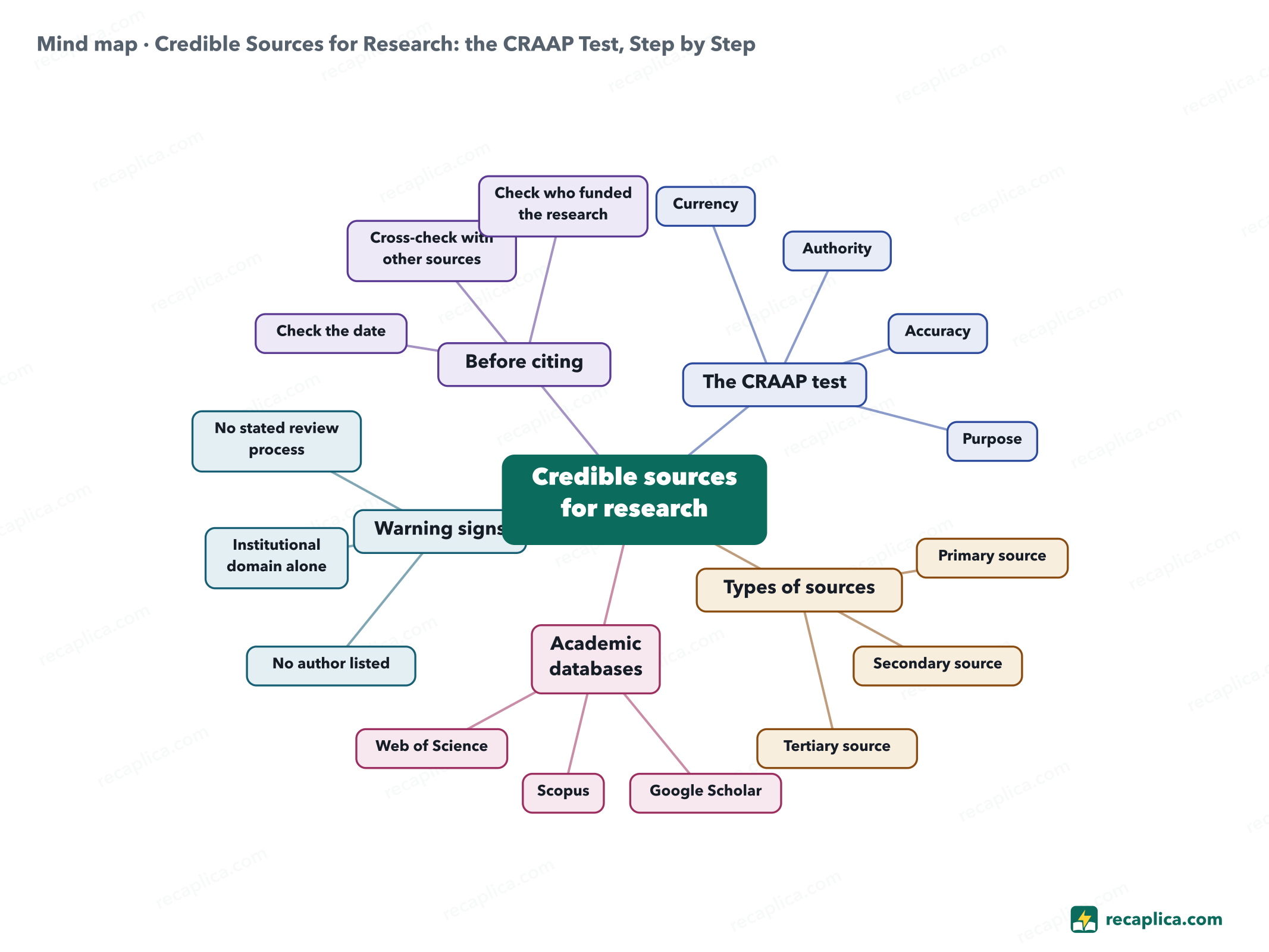
CurrencyHow much the publication date matters for the topic
AuthorityWho wrote it and with what credentials
AccuracyWhether claims are backed by verifiable evidence
PurposeWhether the text informs, sells, persuades or entertains
Types of sources
Primary sourceThe original document, such as an experiment or a historical letter
Secondary sourceAnalyzes or comments on a primary source
Tertiary sourceSummarizes and organizes other people's work, like a textbook
Academic databases
Google ScholarIndexes everything, without labeling peer review
ScopusFlags peer review journal by journal
Web of ScienceSimilar filters to Scopus, different coverage
Warning signs
No author listed
Institutional domain alone.edu or .gov alone doesn't guarantee the content
No stated review process
Before citing
Check the date
Cross-check with other sources
Check who funded the research
Quiz: test yourself
Answer the questions to check what you have learned: you get instant feedback and a short explanation.
Grade0/100/5
Answers: 1-A · 2-B · 3-A · 4-B · 5-B
Flashcards
Tap the card to flip it and check whether you remember the answer, then move to the next one.
1 / 7
Explain it in your own words
The ultimate test: if you can explain it in simple words, you've truly understood it. Write your explanation, then compare it with the Recap.
Your explanation is saved only on this device.
Not every source that turns up in a search engine belongs in a research paper, a school assignment or a thesis. The CRAAP test breaks the question into five checks, currency, relevance, authority, accuracy and purpose, that a student can run on any source before citing it. It also helps separate a primary source, the original document, from a secondary one that comments on it, and clarifies that Google Scholar applies no peer-review filter to the results it returns. Curated databases such as Scopus and Web of Science, by contrast, flag peer review at the journal level. With these tools a student can judge a source on its merits instead of trusting whatever ranks first.
Frequently asked questions
How to know if websites are credible for a research paper?
Apply the CRAAP test: check when it was published or updated, who wrote it and with what credentials, whether the claims are backed by verifiable evidence, and what purpose the text serves (informing, selling, persuading). No single criterion is enough on its own; they work together.
How to find credible sources for research?
Curated databases such as Scopus and Web of Science filter for peer review at the journal level. Google Scholar is broader but doesn't apply the same filter: use it as a starting point, then check the individual source you land on.
What are reliable websites for research, beyond search engines?
University library guides, government statistical agencies, and curated academic databases such as Scopus or Web of Science are generally more reliable starting points than an open web search, because they document who publishes the material and how it was reviewed.
What is the difference between a primary and a secondary source?
A primary source is the original document, an experiment, a letter, a literary work; a secondary source analyzes or comments on it. The distinction depends on the discipline: in the sciences the primary source is typically the original study, in the humanities it's the document from the period being studied.
Does finding an article on Google Scholar mean it was reviewed by other experts?
No. Google Scholar indexes peer-reviewed articles alongside preprints, theses and conference papers without labeling them: appearing in the results does not certify peer review.
Every Recap goes through an independent review before publication.
Statistics, only if you say so
To learn which Recaps help most we would use Google Analytics, with aggregate, anonymous data. It starts only with your OK, and you can change your mind anytime. Privacy policy