Skip to content
recaplica

    One moment: security check

    Cloudflare wants to make sure you're not a robot. Tick the box below and your search will continue on its own.

    IT
    recaplica Is Wikipedia a Credible Source? How the Fact-Checking Works
    © 2026 Recaplica · recaplica.com — All rights reserved
    Home › Civics

    Is Wikipedia a Credible Source? How the Fact-Checking Works

    By Recaplica Newsroom · Updated on September 22, 2026

    What to print

    Page numbers appear when printing with default margins.

    Telegram channel
    recaplica Clear in 30 seconds, yours in 10 minutes.
    In 30 seconds Key points Figures Deep dive Myths Mind map Quiz Flashcards FAQ

    In 30 seconds quick read

    Wikipedia isn't reliable or unreliable as a whole platform — it depends on the individual entry. Two mechanisms hold each page up: verifiability (whoever adds a claim has to cite a source for it) and ongoing review by the editor community, which catches errors and vandalism over time. What separates a solid entry from a weak one is the citations at the bottom of the page, not the logo at the top. This Recap explains how that checking works and how to use Wikipedia without ever citing it as your final source.

    Key Points

    • Wikipedia's inclusion bar is verifiability, not truth: what matters is that a reliable source backs a claim, not whether the editor personally believes it.
    • Whoever adds or restores a claim has to supply the source for it — the burden sits on the writer, not on whoever questions it later.
    • A claim with no reliable source attached can be removed by anyone, at any time.
    • A 2003 IBM study found that vandalism on Wikipedia is usually fixed extremely fast, often before most readers ever see it.
    • The strongest entries are the ones with the most verifiable citations at the bottom — those citations are the destination of the reading, not the entry text itself.
    • Many instructors discourage citing Wikipedia directly in assignments: the point is to follow the links to the primary sources it references.

    Key figures

    • 162 vs. 123 In December 2005, a study published in Nature compared 42 science entries on Wikipedia and the Encyclopaedia Britannica: it found 162 factual errors in the Wikipedia entries against 123 in Britannica's (serious errors were tied at four apiece). Source: Nature, December 2005
    • 80% vs. 95-96% In 2008, Reference Services Review compared the accuracy of 9 historical entries on Wikipedia against other encyclopedias: 80% for Wikipedia against 95-96% for the comparison encyclopedias. Source: Reference Services Review, 2008

    Deep Dive

    Wikipedia runs on a rule spelled out in its own internal guidelines: the bar for including a claim is verifiability, not truth. It doesn’t matter whether an editor is personally convinced a fact is correct — what matters is that a reliable, published, independent source confirms it, with a citation tied to that specific point in the text.

    That’s why two entries in the same encyclopedia can differ wildly in how much they deserve trust. A page with dozens of footnotes pointing to peer-reviewed articles, academic books, or outlets known for accuracy is a solid starting point. A short entry with no sources, or a single vague footnote, is not — same platform, but a completely different amount of scrutiny behind that particular page.

    Real-world example: A student writing a paper on photosynthesis opens the Wikipedia entry on the topic. Instead of copying sentences from the page, she scrolls to the footnotes, finds a link to a study published in a scientific journal that’s cited as the source for the figure she needs, and cites that study in her bibliography — not Wikipedia.

    Who has to supply the source

    Wikipedia’s verifiability guideline puts the burden of proof on the person writing: whoever adds or restores a claim has to attach a citation to a reliable source that directly supports it. A single citation tied to the exact point in the text is enough. If a claim has no source like that, anyone can remove it — nobody has to prove it’s false, just that it isn’t backed up. For biographies of living people the bar is even tighter: unverified material that could damage someone’s reputation gets pulled right away, without waiting for a discussion.

    That’s a different model from the centralized editorial process of a printed encyclopedia, where a board of editors signs off on the text before it’s published. On Wikipedia, the checking is spread out over time, carried out by thousands of editors who can act on any entry at any moment.

    What the comparative studies found

    The most-cited comparison between Wikipedia and a traditional encyclopedia is still a study published in Nature in December 2005: across a sample of 42 science entries, reviewers found 162 factual errors in the Wikipedia versions and 123 in the Encyclopaedia Britannica versions, with the same number of errors rated serious on both sides (four each). The study concluded that Wikipedia came close to Britannica on the accuracy of its science entries — a 2005 snapshot, taken when the platform’s review mechanisms were less developed than they later became.

    Other comparisons have been less consistent. In October 2005, The Guardian had a panel of experts score seven entries from different fields, landing between 5 and 8 out of 10. A study by Roy Rosenzweig on 25 biographies of Americans, published in June 2006, called Wikipedia surprisingly accurate on names, dates, and events. In 2008, Reference Services Review compared 9 historical entries and found 80% accuracy for Wikipedia against 95-96% for the encyclopedias it was measured against — a more critical result, on a smaller and different sample.

    StudyYearSampleResult
    Nature200542 science entries162 Wikipedia errors vs. 123 for Britannica
    The Guardian20057 entries, various fieldsScores of 5-8 out of 10
    Rosenzweig200625 American biographiesRated surprisingly accurate
    Reference Services Review20089 historical entries80% Wikipedia vs. 95-96% other encyclopedias

    None of these studies covers the platform as a whole: each one looks at a narrow sample, in a different year, with a different method.

    Vandalism and how it gets fixed

    A common worry is that anyone can edit a page. A 2003 IBM study of Wikipedia found that vandalism is usually repaired extremely fast, often before most readers ever get a chance to see it. A later study, from 2007, cited in the entry that collects this research, estimated that 42% of damage is undone almost immediately.

    Open editing is, at the same time, the weak point critics point to and the mechanism that lets errors get corrected quickly. A library guide from James Cook University puts it plainly: anyone can write and edit the articles, which some see as a weakness and others as a strength, because with so many people constantly reviewing and updating the text, inaccuracies tend to get caught fast.

    How to use it well

    The same library guide recommends a specific approach: start with the entry to get a general sense of the topic, then follow the links to the primary sources cited at the bottom and use those — not the entry itself — as the reference in an assignment or a research project. Many instructors explicitly discourage citing Wikipedia as a final source, and some mark down work that does.

    This standard applies to any online source, not just Wikipedia: judging whether a source is credible and up to date is a broader skill, and Wikipedia is just one especially common case of it. The same questions — who wrote this, what checks did it go through, and where does the footnote actually lead — also help when spotting fake news online.

    Wikipedia is one of the first large-scale experiments in collaborative writing, born during a period of web expansion covered in the history of the internet: an open project that had to build its verification rules from scratch, for a text being written by thousands of strangers with no editor in charge.

    Common myths

    • ✗ Myth Anyone being able to edit a page means Wikipedia can never be trusted.

      ✓ Reality Open editing is also the reason mistakes get fixed fast: a 2003 IBM study found that vandalism is usually repaired before most readers ever encounter it, and a 2007 study estimated that 42% of damage is undone almost immediately. The risk isn't zero, but it clusters in the least-watched entries.

    • ✗ Myth If a page has no citations and nobody has challenged it, the claim must still be valid.

      ✓ Reality The verifiability guideline puts the burden on the person writing, not the person reading: a claim with no citation to a reliable source can be pulled by anyone at any time, whether or not it happens to be true. No one disputing it yet isn't the same as it having been checked.

    • ✗ Myth You can cite Wikipedia directly as the final source in a paper or research project.

      ✓ Reality University library guides recommend using an entry to get oriented and then following the links to the primary sources it cites — those are the material worth citing. Many instructors mark down work that cites Wikipedia directly, partly because the entry's text can change from one day to the next.

    Mind map

    Drag the background to move around and the nodes to reposition them; use − and + to collapse and expand branches.
    Customize
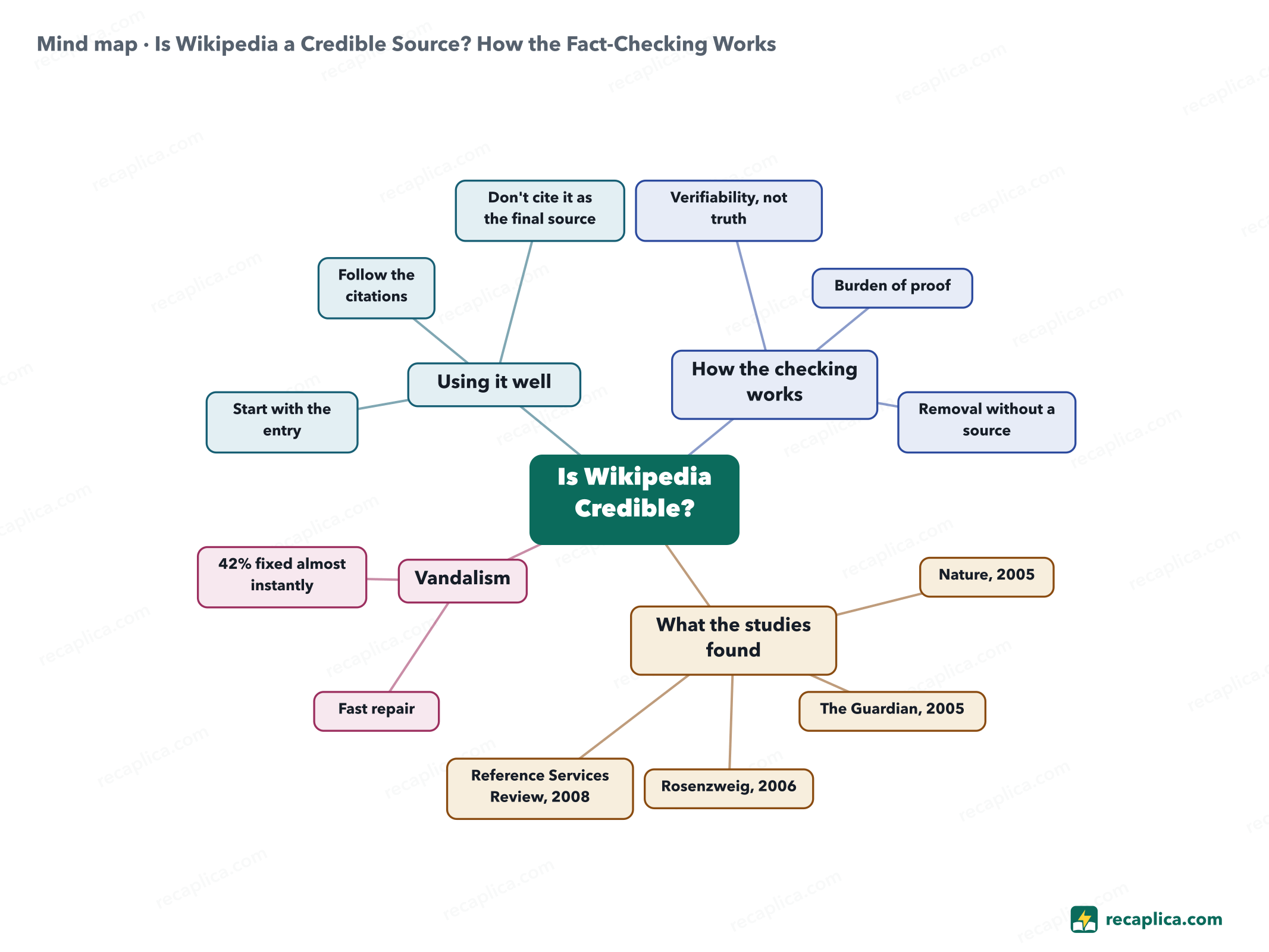
    Mind map: Is Wikipedia a Credible Source? How the Fact-Checking Works
    • Is Wikipedia Credible?
      • How the checking works
        • Verifiability, not truth what counts is the cited source, not the writer's own conviction
        • Burden of proof whoever adds a claim has to cite the source
        • Removal without a source an unverifiable claim can be deleted by anyone
      • What the studies found
        • Nature, 2005 162 Wikipedia errors vs. 123 for Britannica across 42 science entries
        • The Guardian, 2005 seven entries scored 5-8 out of 10 by experts
        • Rosenzweig, 2006 25 biographies rated surprisingly accurate
        • Reference Services Review, 2008 80% accuracy against 95-96% for other encyclopedias
      • Vandalism
        • Fast repair 2003 IBM study on repair speed
        • 42% fixed almost instantly 2007 figure
      • Using it well
        • Start with the entry to get a general sense of the topic
        • Follow the citations they're the material actually worth citing
        • Don't cite it as the final source many instructors mark it down

    Quiz: test yourself

    Answer the questions to check what you have learned: you get instant feedback and a short explanation.

    Grade 0/10 0/5
    1 What standard does Wikipedia use to decide whether a claim gets included?

    Wikipedia's verifiability guideline states outright that the bar for inclusion is verifiability, not truth: what matters is that a reliable source confirms the claim.

    2 Who is responsible for supplying a source when a claim is added to Wikipedia?

    The verifiability guideline puts the burden of proof on the person writing: whoever adds or restores content has to link it to a reliable source.

    3 True or false: the study published in Nature in 2005 compared Wikipedia with the Encyclopaedia Britannica across a sample of science entries.

    The December 2005 study examined 42 science entries, finding 162 errors in Wikipedia against 123 in Britannica, with the same number of serious errors in both.

    4 According to the 2003 IBM research mentioned in the Recap, what typically happens to acts of vandalism on Wikipedia?

    The research found that vandalism is usually repaired extremely fast, often before most readers get a chance to see it.

    5 What do library guides recommend as the best way to use a Wikipedia entry for research?

    Library guides, like the one from James Cook University, recommend starting with the entry and then following the links to the primary sources it cites, which are the material worth citing in academic work.

    Answers: 1-B · 2-C · 3-A · 4-B · 5-C

    Flashcards

    Tap the card to flip it and check whether you remember the answer, then move to the next one.

    1 / 7

    Explain it in your own words

    The ultimate test: if you can explain it in simple words, you've truly understood it. Write your explanation, then compare it with the Recap.

    Your explanation is saved only on this device.

    Wikipedia isn't reliable or unreliable as a whole platform — it depends on the individual entry. Two mechanisms hold each page up: verifiability (whoever adds a claim has to cite a source for it) and ongoing review by the editor community, which catches errors and vandalism over time. What separates a solid entry from a weak one is the citations at the bottom of the page, not the logo at the top. This Recap explains how that checking works and how to use Wikipedia without ever citing it as your final source.

    Frequently asked questions

    Is Wikipedia a credible source or not?

    It depends on the individual entry, not on the platform as a whole: a page with plenty of verifiable citations is solid, one with no sources or a single generic footnote is not. The internal standard is verifiability, not the writer's own claim of accuracy.

    Can you cite Wikipedia in a paper or an assignment?

    Many instructors discourage it and some mark down work that does. Library guides suggest using the entry to get a general sense of a topic and then citing the primary sources it links to at the bottom of the page.

    Why doesn't open editing make Wikipedia unreliable?

    Because the same openness that lets anyone write also lets anyone fix mistakes: a 2003 IBM study found that vandalism is usually repaired extremely fast.

    What happens if a claim on Wikipedia has no source?

    It can be removed by anyone at any time: the verifiability guideline puts the responsibility for supplying a reliable source on the person who wrote it, not on the reader who questions it.

    Is Wikipedia more or less accurate than a traditional encyclopedia?

    The available studies give different answers depending on the sample and the year: in 2005 a Nature study found it close to the Encyclopaedia Britannica on science entries, while a 2008 study of historical entries found a wider gap. Neither covers the encyclopedia as a whole.

    Sources

    • Wikipedia:Reliable sources
    • Wikipedia:Verifiability
    • Reliability of Wikipedia
    • Using Wikipedia — Evaluating Sources (James Cook University)

    Every Recap goes through an independent review before publication.

    Every evening, the day's new Recaps on our Telegram channel. Join the channel →

    Keep learning

    • Civics Carabinieri Ranks: The Four-Role Hierarchy of the Corps Every member of the Carabinieri sits inside one of four legally defined roles, in force since a 2000 law: Officers, Inspectors, Supervisors, and Corporals and Privates. Promotion happens inside a role first, and the four roles themselves run from the most operational to the most senior. The lowest rank is Carabiniere; the highest is Generale di Corpo d'Armata, in the Officer role. Two abbreviations, Q.S. and C.S., show up next to a handful of ranks — they aren't extra rungs on the ladder, just a qualification attached to the top rank already sitting there. Read the Recap →
    • Civics Codice Fiscale: What It Is, Structure and Everyday Uses The codice fiscale is the code that uniquely identifies a person in every dealing with Italian public bodies and administrations, from healthcare to official paperwork. It is made up of 16 alphanumeric characters derived from the holder's personal data. Only the Agenzia delle Entrate, Italy's tax agency, can issue a valid one: any code generated by an outside tool has no official standing. The system dates back to 1973, created by the same decree that set up Italy's taxpayer register. It is a different thing from the partita IVA, which identifies an economic activity. Read the Recap →
    • Civics Italian Government Structure: Which Bodies Do What The Italian state rests on five bodies that the Constitution sets up and regulates directly: Parliament makes the laws, the Government carries them out, the President of the Republic represents national unity, the judiciary applies the law to individual cases, and the Constitutional Court checks that laws respect the Constitution. Alongside them sit four bodies of constitutional relevance — the High Council of the Judiciary, the Court of Auditors, the CNEL and the Council of State — auxiliary bodies the Constitution sets up but keeps in a separate category from the five essential ones. Knowing who does what, and which bodies the system cannot run without, is the fastest way into how Italy is actually governed. Read the Recap →

    recaplica

    Clear in 30 seconds, yours in 10 minutes.

    Recaps Mind maps Request a Recap Telegram channel Mind map maker Our method About Privacy & cookies Legal notes & terms of use

    © 2026 Recaplica · A project by Curi S.r.l. — VAT IT05472000750

    Statistics, only if you say so

    To learn which Recaps help most we would use Google Analytics, with aggregate, anonymous data. It starts only with your OK, and you can change your mind anytime. Privacy policy