|
recaplica
The Mussolini Myth: How Fascist Propaganda Built the Duce | ||||||||||||||||||
| © 2026 Recaplica · recaplica.com — All rights reserved | ||||||||||||||||||
The Mussolini Myth: How Fascist Propaganda Built the DuceWhat to print Page numbers appear when printing with default margins. SlidesChoose a cut Flash10 slidesThe essential thread, to present in classFull18 slidesEvery chapter and the deeper detailBoth come with speaker notes. In 30 seconds quick readThe "myth of Mussolini" was the public persona built to order by Fascist propaganda: an infallible, tireless, ever-young Duce single-handedly lifting Italy back on its feet. The regime built it through systematic press censorship, control of radio and cinema, and a purpose-built ministry, the Minculpop, that told newspapers what to print and what to leave out. Some legends born in those years, like the claim that trains always ran on time, were later dismantled by historians. The myth peaked with the proclamation of the Empire in 1936 and collapsed quickly between 1943 and 1945, when military defeat swept away the leader's image along with the regime. Key Points
Key figures
Deep DiveA Persona Built to OrderWhen people picture Italian fascism, the image that comes to mind first is often Mussolini addressing a packed square from the balcony of Palazzo Venezia. That image did not happen by accident: it was the product of an organised machine that spent twenty years building, defending and refreshing a public figure larger than life. Historians call this the “myth of the Duce”, and it is worth keeping it separate from fascism as a political system: it was the propaganda arm of the regime, the part that kept the masses rallied around one man. Treccani puts it plainly: Mussolini’s charismatic personality and the myth built around him were among the main reasons the regime enjoyed the support of most Italians, especially between 1929 and 1936. Not the only reason, though. Propaganda around economic results also mattered, campaigns like the “Battle for Grain” and the draining of the Pontine Marshes, along with the absence of organised opposition after independent parties, unions and newspapers were outlawed between late 1925 and 1926, and a social climate left exhausted by the First World War. Of these causes, the Duce’s myth was the one built most deliberately: it had offices, a budget and a ministry of its own. The Tools: Censorship, Daily Directives and a Ministry of Its OwnControl over information was the first pillar. A royal decree in 1923 introduced oversight of newspapers; in 1925 systematic state censorship began, and on 8 November of that year the papers L’Unità and Avanti! were suspended. On 31 December 1925 a law required every newspaper to have a government-approved editor, and in 1926 a failed assassination attempt against Mussolini was used as a pretext to shut down further opposition papers. From then on, newspapers received daily “veline”: press directives spelling out article content, headline emphasis and even typeface size. The system was centralised on 27 May 1937 with the creation of the Minculpop, the Ministry of Popular Culture, successor to the earlier Ministry for Press and Propaganda. A dedicated books division inside the ministry could seize publications, ban reprints or demand revisions: the publisher Mondadori alone had more than 200 works censored between 1929 and 1945, and in 1938-1939 publishers pulled roughly 900 titles on their own, in self-censorship. After the racial laws, 355 Italian journalists were classified as “presumed Jews” and barred from the professional register, in a list updated as of February 1938. Among the censorship rules applied systematically: never report on Mussolini’s illnesses or birthday, always run his speeches on the front page, never praise other regime officials, and keep circulating photographs showing him on horseback, swimming, or directing military manoeuvres. Cinema and Radio: The Istituto Luce and the EIARThe written word alone was not enough: a large part of Italy’s population was still illiterate or nearly so. That is why the regime leaned heavily on moving images. The Istituto Luce was founded in 1924, after Mussolini watched a short film shot during a visit to Naples and grasped its potential. From 1927 to 1945 it produced the Giornale Luce, the newsreel shown in cinemas and, through mobile projections, in town and city squares: during the war in Ethiopia (1935-1936) new instalments came out almost daily. Recurring themes were agricultural modernisation, land reclamation, public health progress, sporting achievements and military successes. Deaths, destruction and social problems were routinely left out. The 1938 racial laws, despite their scale, received almost no coverage in Luce newsreels: a direct example of how censorship by omission worked, especially on the gravest facts. Mussolini appears today in more than 11,000 photographs and 1,100 audiovisual items in the Luce archive, a scale of self-representation that gives some sense of the effort involved. Alongside cinema, the ministry also oversaw the EIAR, the state radio broadcaster, through a dedicated Broadcasting Inspectorate set up in 1934. A Body That Was Not Allowed to AgeOne of the odder sides of the myth concerned age. The regime insisted that Mussolini remain, in the public image, forever young: the Fascist anthem is titled Giovinezza (“Youth”), and official rhetoric kept insisting that fascism was a movement of the young.
According to the foreign press of the time, Mussolini himself brushed off questions about ageing by saying he was too busy to grow old. Italian editors knew perfectly well what never to mention, in a climate of self-censorship that ran alongside the censorship imposed from above. A Myth with Feet of Clay: The Trains That “Always” Ran on TimeNo legend about fascism is more widespread than the one about trains running punctually thanks to Mussolini. It is a good example of how the propaganda worked: take an everyday service that lends itself to anecdote, and use it to make the wider myth feel closer to ordinary experience. In 1976, reviewing Denis Mack Smith’s Mussolini biography for the New York Review of Books, British historian A.J.P. Taylor dismissed the claim as an empty catchphrase, with no documented substance behind it. The attribution matters here: the sharp verdict is Taylor’s, not a direct quote from Mack Smith, even though Mack Smith remains the historian most closely tied, in English-language scholarship, to the systematic dismantling of the Duce’s personal myth. In that same review, Taylor also argued that fascism was best understood as a piece of propaganda machinery rather than as a coherent political project. A note of historiographical caution, also raised by Jonathan Steinberg in a review for the London Review of Books: stopping at anecdotes about Mussolini’s personal boasting risks obscuring the structural causes, unrelated to any single leader, that account for the regime’s existence in the first place. Consent, Plebiscites and RepressionThe consent the regime enjoyed was never a simple thing to measure, and the instruments used to certify it were anything but neutral. On 24 March 1929 Italians voted in a plebiscite that no longer offered competing lists, only a single slate of candidates put forward by the Grand Council of Fascism, to be approved or rejected as a block. The official result was 8,517,838 “yes” votes (98.34%) against 135,773 “no” votes, with turnout at 89.86%, far above the 63.1% recorded in the 1924 elections. The ballots, though, had a flaw that was anything but accidental: the “yes” ballot carried tricolour bands visible even when folded, while the “no” ballot was plain white. Public employees and workers were warned that abstaining or voting no could cost them their jobs. Behind the facade of plebiscite-style consent, the regime had spent the 1920s and the early 1930s building a full repressive apparatus: the MVSN volunteer militia for national security, the political police OVRA and, from 1926, the Special Tribunal for the Defence of the State, set up after four assassination attempts against Mussolini. Among the victims of political repression in those years were Giovanni Amendola and Piero Gobetti. Even inside the party the regime was no monolith: between October 1930 and December 1931, under secretary Giovanni Giuriati, about 120,000 members were expelled from the PNF in an internal purge. His successor, Achille Starace, the longest-serving secretary in the party’s history (1931-1939), took the opposite approach: fewer ideological purges, more mass ritual, choreographed ceremony and cult of the Duce. The 1936 Peak, and the Statue That Trapped the ManThe myth’s high point came on 9 May 1936, when Mussolini announced from the balcony of Palazzo Venezia, before an ecstatic crowd, the proclamation of the Empire following the conquest of Ethiopia. It was the moment of greatest popular enthusiasm for the cult of the leader, and it coincided with the admiration a number of conservative European governments felt for him, largely for anti-communist reasons. From that point on, according to Treccani’s account, Mussolini himself grew increasingly a prisoner of the public figure he had helped build. Fascist official Giuseppe Bottai recalled that in some meetings from those years he found himself facing not a man but something closer to a statue: cold, made of stone, with words coming out of it like hammer blows. It is a useful image for understanding how, once the myth reached its peak, it had stopped being just a tool and had become a cage even for the man who embodied it.
The Collapse, 1943-1945On 10 July 1943 the Allies landed in Sicily, hitting a regime already deep in crisis over military defeats and collapsing support among the vast majority of Italians. On 25 July 1943 a majority of the officials gathered in the Grand Council of Fascism voted no confidence in Mussolini, who was dismissed by the king, arrested and removed from power: the end of the regime, after twenty-one years. For what followed, and the birth of the Italian Social Republic, see our piece on the Second World War. The previous September, in 1939, Italians had greeted with relief the choice not to enter the war right away, going so far as to hail Mussolini as the guarantor of peace, an enthusiasm that irritated him deeply, since he believed Italians should be preparing psychologically for war, not celebrating having avoided it. Over the roughly 600 days of the Italian Social Republic, the myth crumbled for good. In private letters to Claretta Petacci, on 29 March 1944, Mussolini went as far as writing that it was not fascism that had spoiled the Italians, but the reverse; in other letters from the same period he described himself as a “shipwrecked dreamer”. On 27 April 1945 he was captured by partisans; the next day he was shot along with Claretta Petacci; on 29 April his body was put on public display in Milan’s Piazzale Loreto, in front of a crowd. It was the public end of an image the regime had spent twenty years building through censorship and propaganda. Slide deckSlides ready to download and make your own in PowerPoint or Google Slides, with speaker notes. Pick the Flash cut or the Full one.     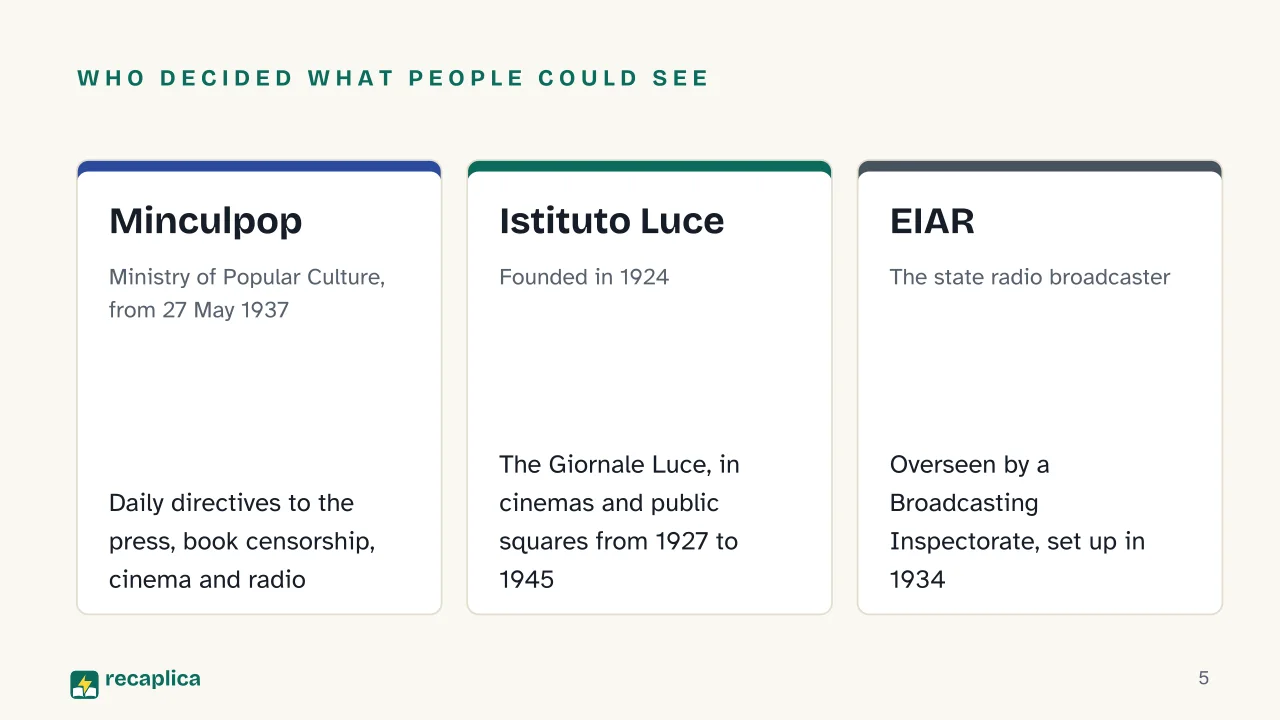 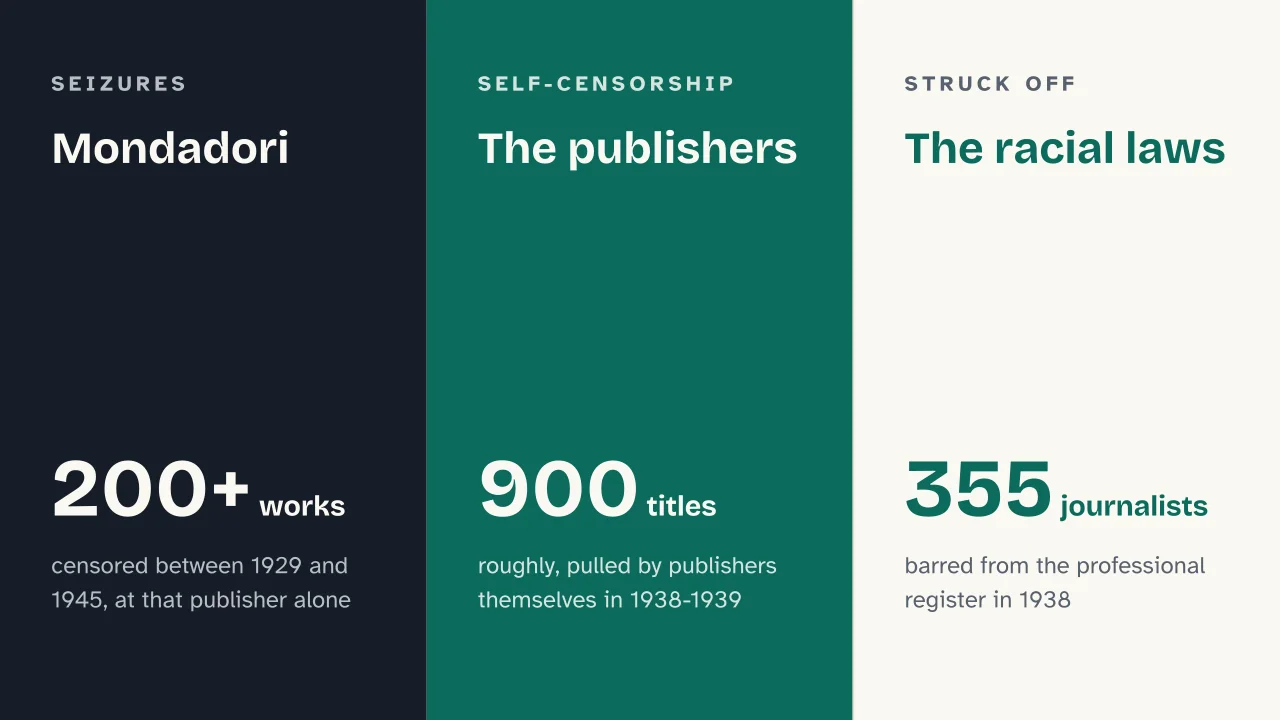 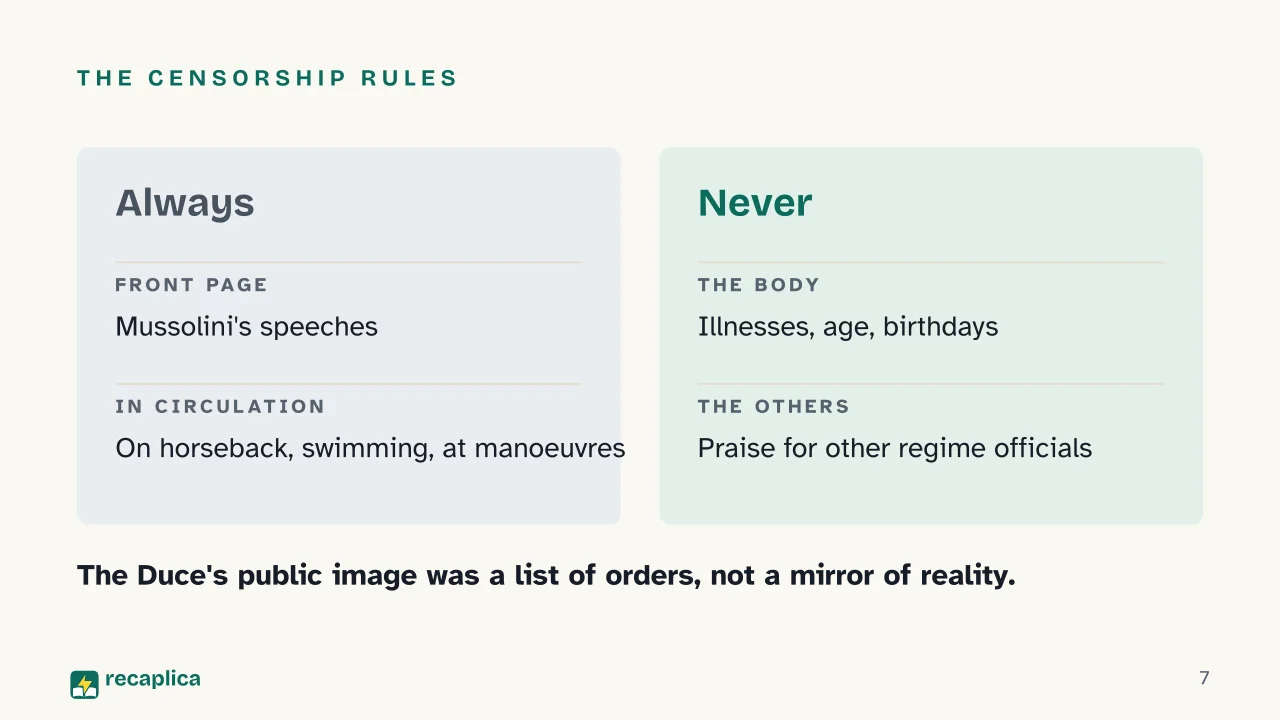  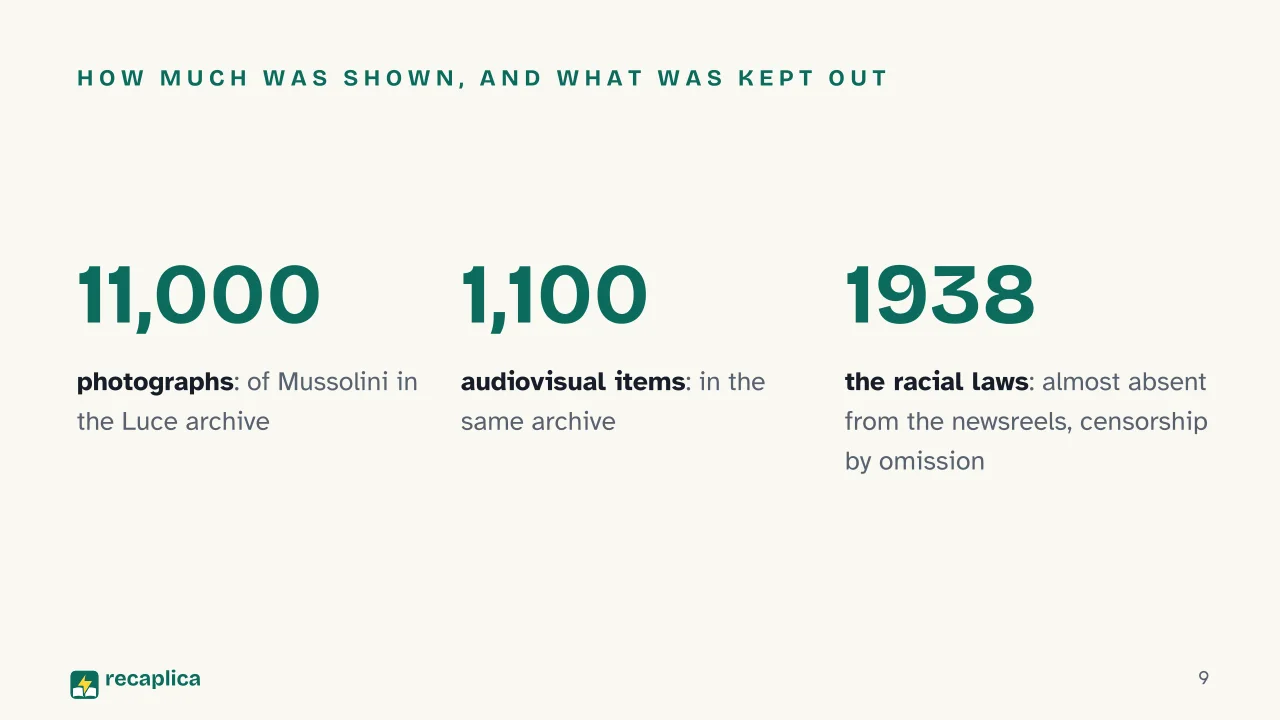 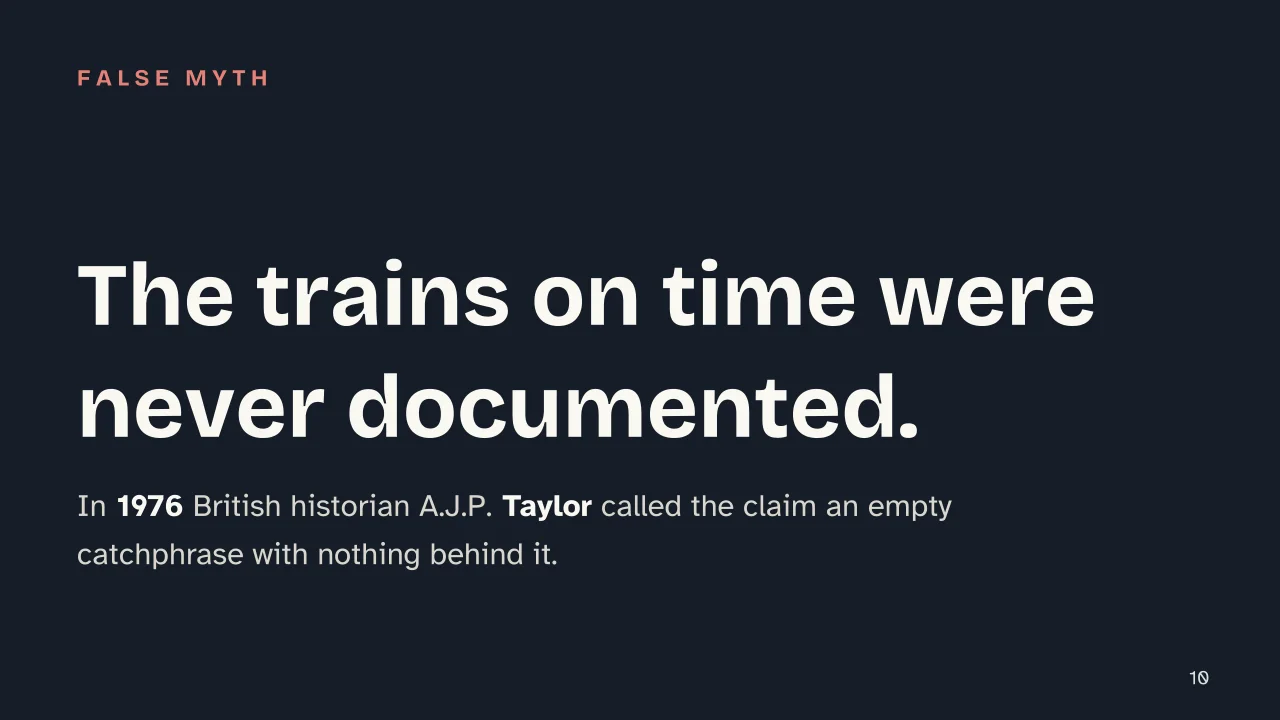  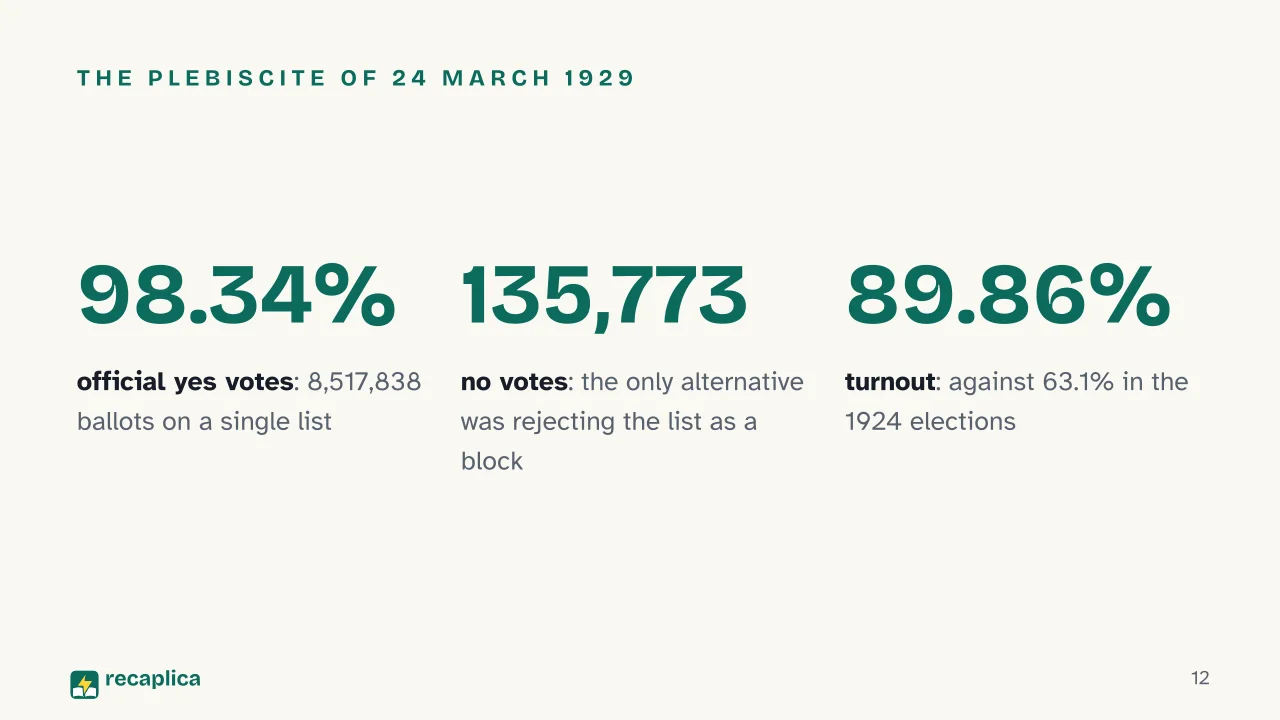 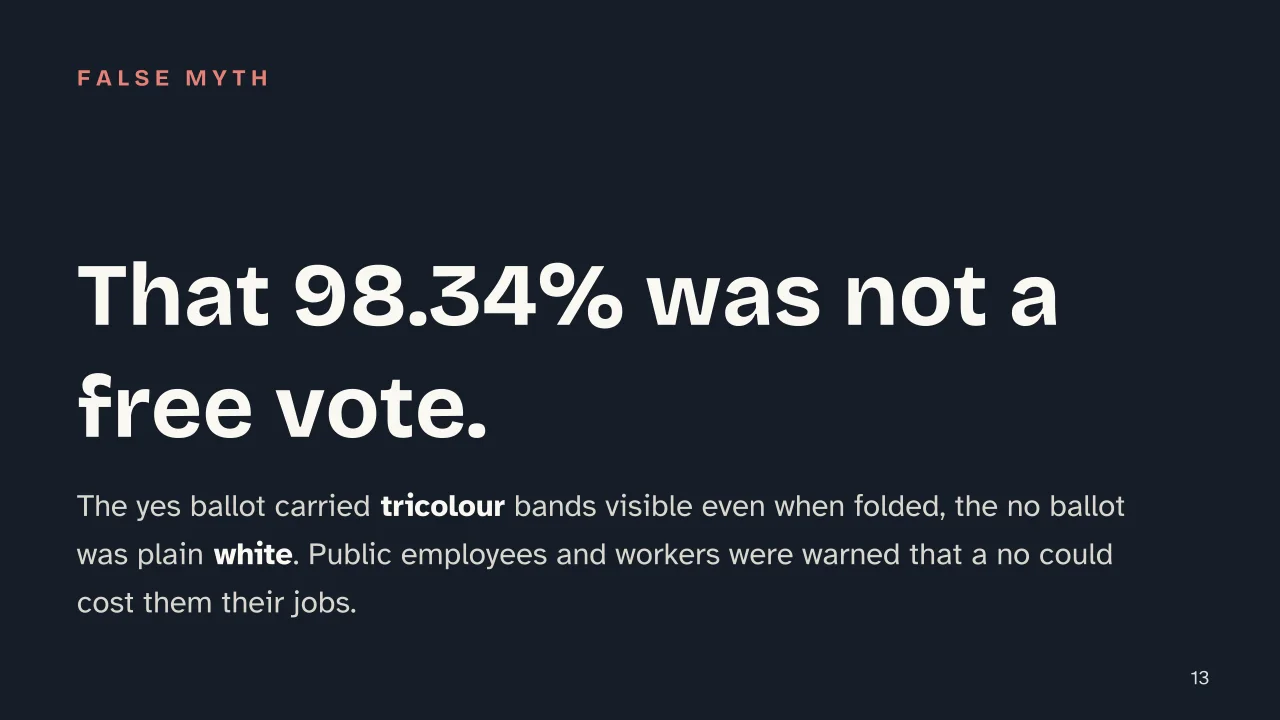 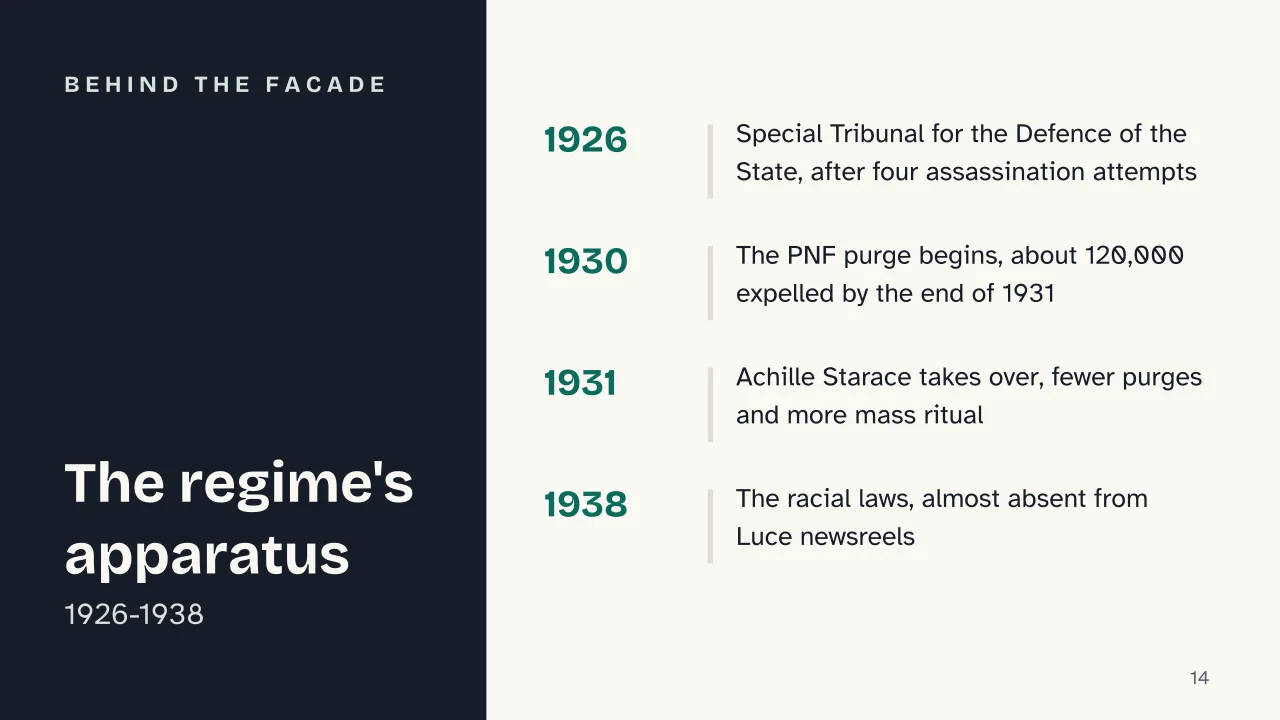  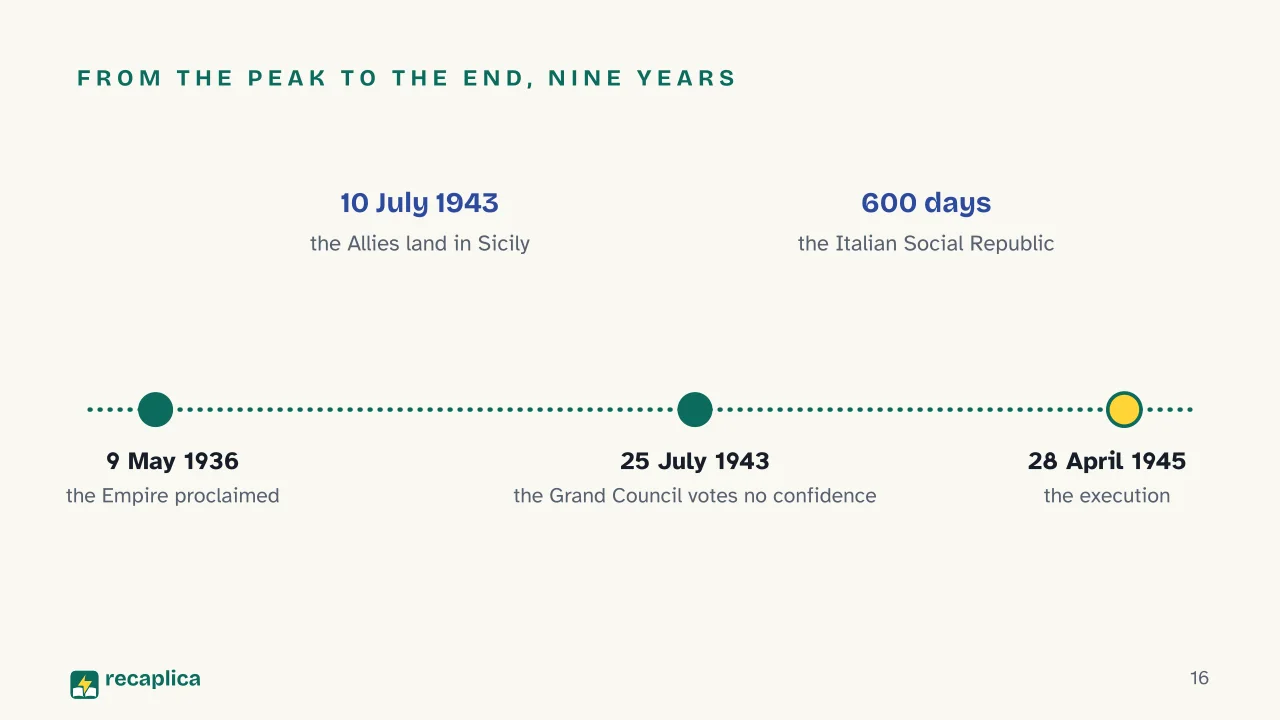 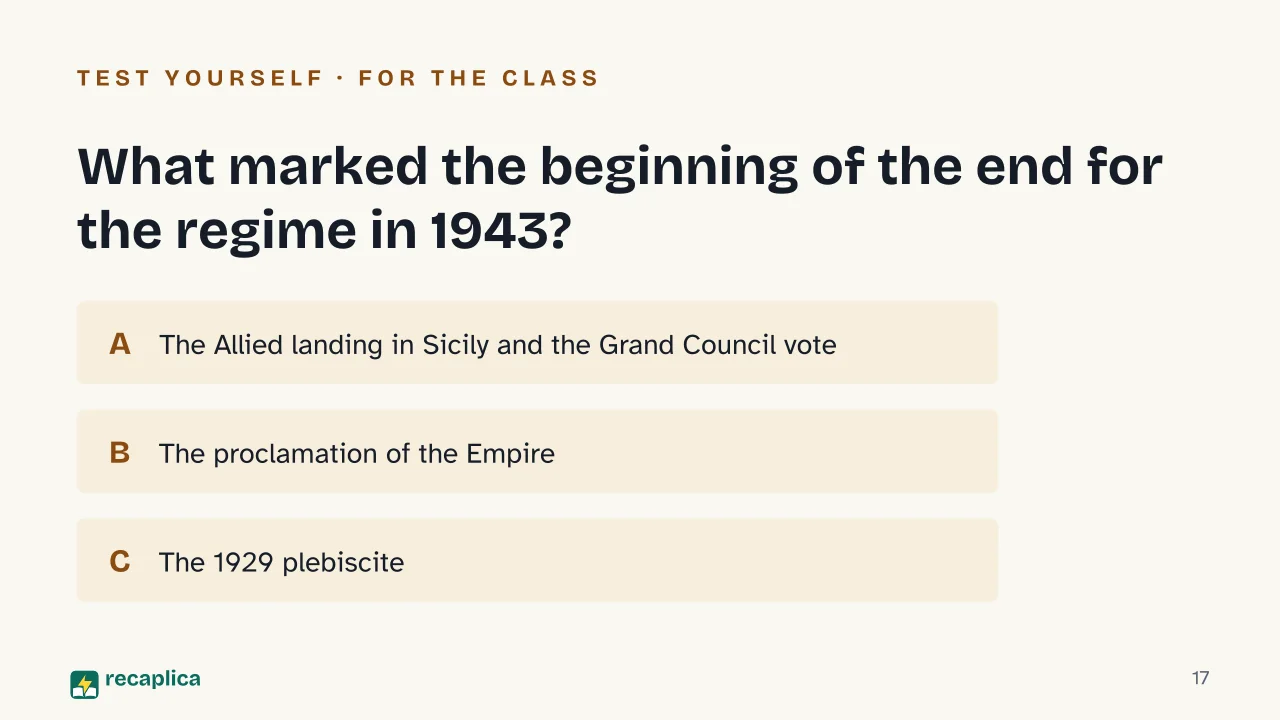  Common myths
Mind mapDrag the background to move around and the nodes to reposition them; use − and + to collapse and expand branches. 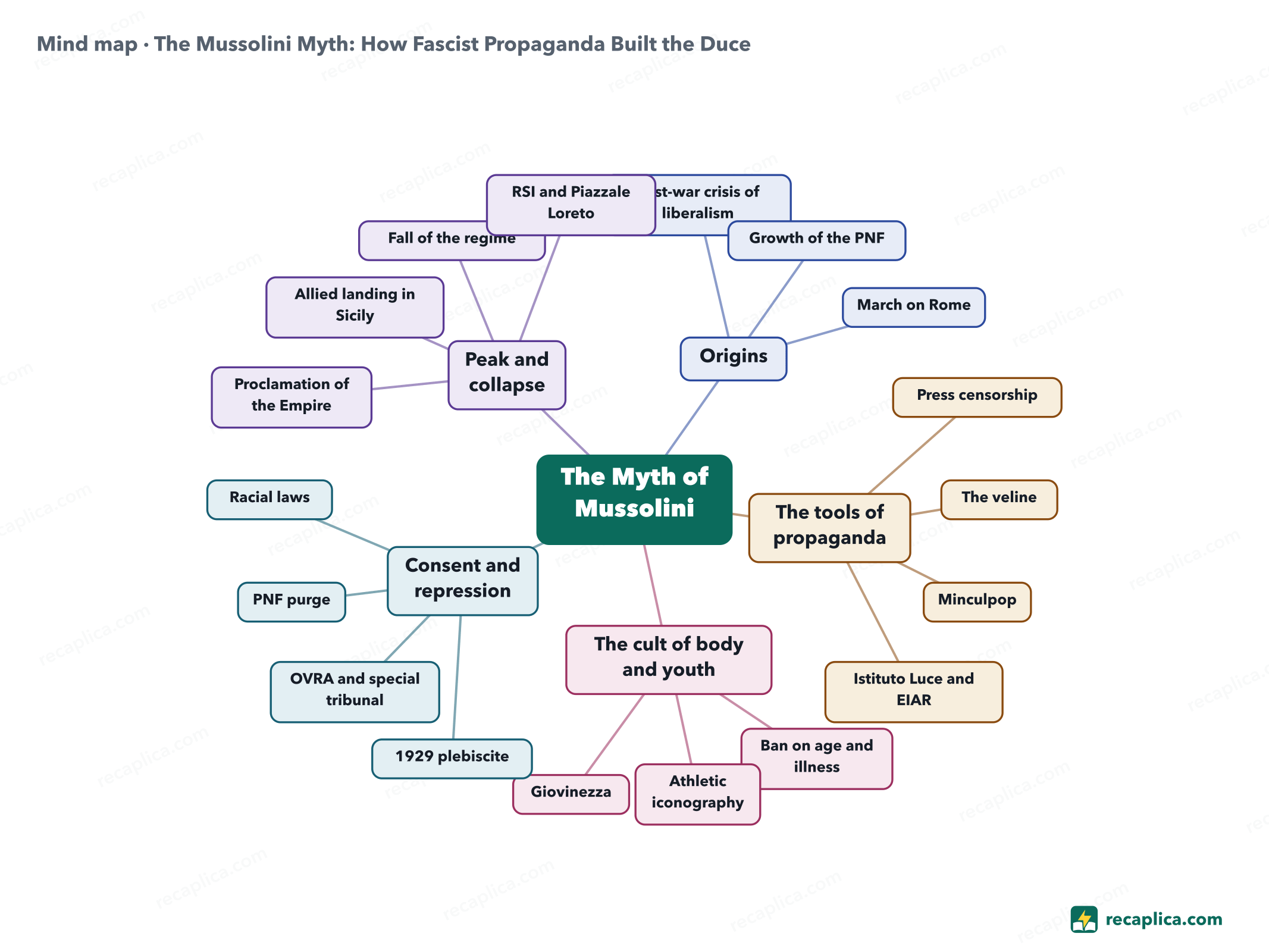
Quiz: test yourselfAnswer the questions to check what you have learned: you get instant feedback and a short explanation. Grade 0/10 0/5
FlashcardsTap the card to flip it and check whether you remember the answer, then move to the next one. 1 / 8 Explain it in your own wordsThe ultimate test: if you can explain it in simple words, you've truly understood it. Write your explanation, then compare it with the Recap. Your explanation is saved only on this device.
Frequently asked questionsWho first cast doubt on the 'trains running on time' myth?The sharpest verdict comes from A.J.P. Taylor, who in 1976, reviewing Denis Mack Smith's Mussolini biography for the New York Review of Books, dismissed the claim as an empty catchphrase with no substance behind it. Mack Smith is the historian most closely associated, in English-language scholarship, with the systematic dismantling of the Duce's personal myth. What was the Minculpop?The Ministry of Popular Culture, created on 27 May 1937 when the existing Ministry for Press and Propaganda changed its name. It centralised control over newspapers, cinema and state radio, sending editors daily directives, known as veline, spelling out what to publish, how to headline it and what to leave out. Why was Mussolini said never to age?Because the regime enforced it through censorship: reporting on his illnesses or birthday was forbidden. In 1936, for his 53rd birthday, and in 1933, for his 50th, the Italian press published nothing at all, and it was even forbidden to call him a grandfather or publish photos of his grandson. Did fascism enjoy the support of all Italians?No: mass support, concentrated mainly between 1929 and 1936, was largely a product of the personality cult built around Mussolini, not full, widespread ideological conviction. It coexisted with a repressive apparatus (the OVRA political police, a special tribunal, and the banning of parties and unions from 1926) and with plebiscites in which ballot secrecy was effectively compromised. When and how did the Fascist regime collapse?Between 1943 and 1945. The Allied landing in Sicily (10 July 1943) hit a regime already weakened by military defeats; on 25 July 1943 the Grand Council of Fascism voted no confidence in Mussolini, who was arrested. The Italian Social Republic followed, lasting roughly 600 days, until Mussolini's capture on 27 April 1945 and his execution the next day. Every Recap goes through an independent review before publication. |