Skip to content
recaplica

    One moment: security check

    Cloudflare wants to make sure you're not a robot. Tick the box below and your search will continue on its own.

    IT
    recaplica Italian Ministry of Foreign Affairs: how MAECI is organized
    © 2026 Recaplica · recaplica.com — All rights reserved
    Home › Civics

    Italian Ministry of Foreign Affairs: how MAECI is organized

    By Recaplica Newsroom · Updated on September 14, 2026

    What to print

    Page numbers appear when printing with default margins.

    Slides

    Choose a cut

    Flash10 slidesThe essential thread, to present in classFull16 slidesEvery chapter and the deeper detail

    Both come with speaker notes.

    Telegram channel
    recaplica Clear in 30 seconds, yours in 10 minutes.
    In 30 seconds Key points Figures Deep dive Slides Myths Mind map Quiz Flashcards FAQ

    In 30 seconds quick read

    The Ministry of Foreign Affairs and International Cooperation, MAECI, runs Italy's foreign policy and its network of embassies, consulates and cultural institutes abroad. The current name dates from Law no. 125 of 11 August 2014, which also created the Italian Agency for Development Cooperation, AICS, operating since January 2016. Since 1 January 2026 the central administration has been organized into 9 Directorates General, under a ministerial decree of 4 December 2025 that implemented the latest reform of Presidential Decree 95 of 2010. In 2025 the network abroad counted 313 posts in total, including embassies, consulates, permanent missions and cultural institutes, with 4,853 career staff as of 1 January 2026.

    Key Points

    • MAECI took its current name under Law no. 125 of 11 August 2014, which also established AICS.
    • Since 1 January 2026 the central administration has been organized into 9 Directorates General, under a ministerial decree of 4 December 2025.
    • AICS, operating since January 2016, has its own legal personality and budget, while remaining under MAECI's oversight.
    • In 2025 the diplomatic-consular network counted 313 posts abroad, including 130 embassies and 85 career consular offices.
    • Alongside the career consulates, 332 honorary consular offices were active as of 31 December 2025, run by unpaid officials.
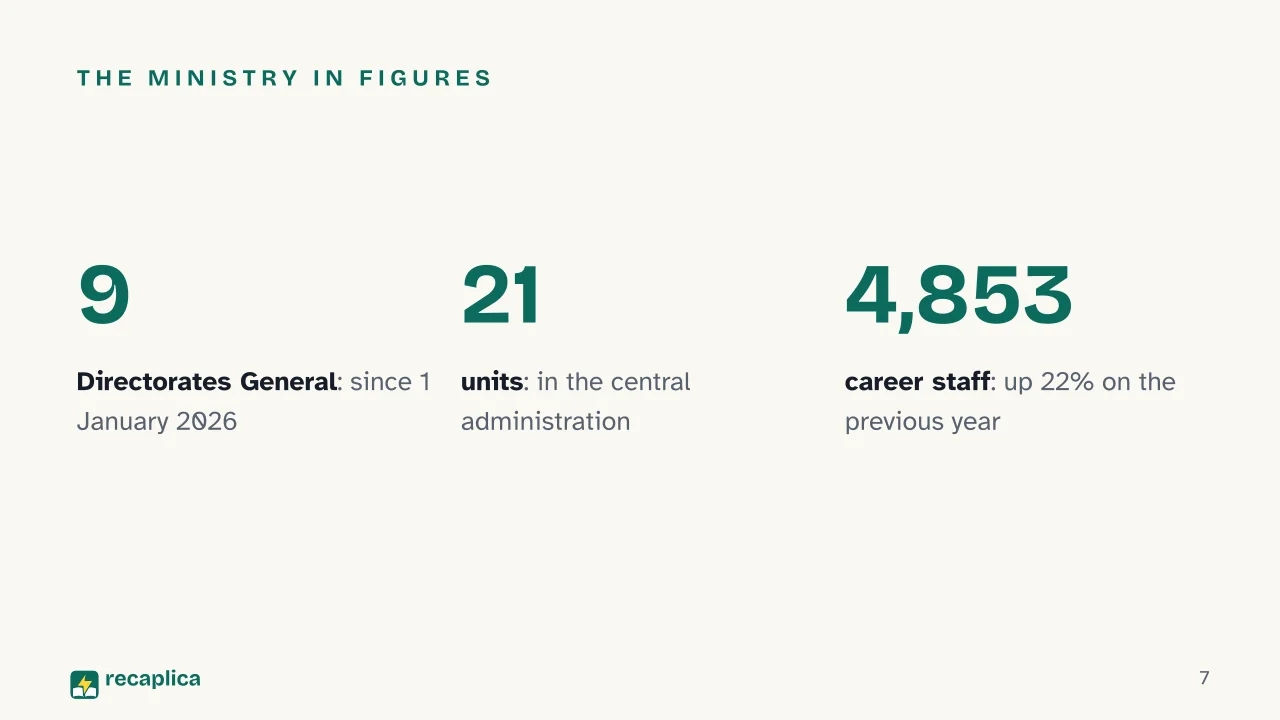
    • As of 1 January 2026, MAECI's career staff numbered 4,853, up 22% on the previous year.

    Key figures

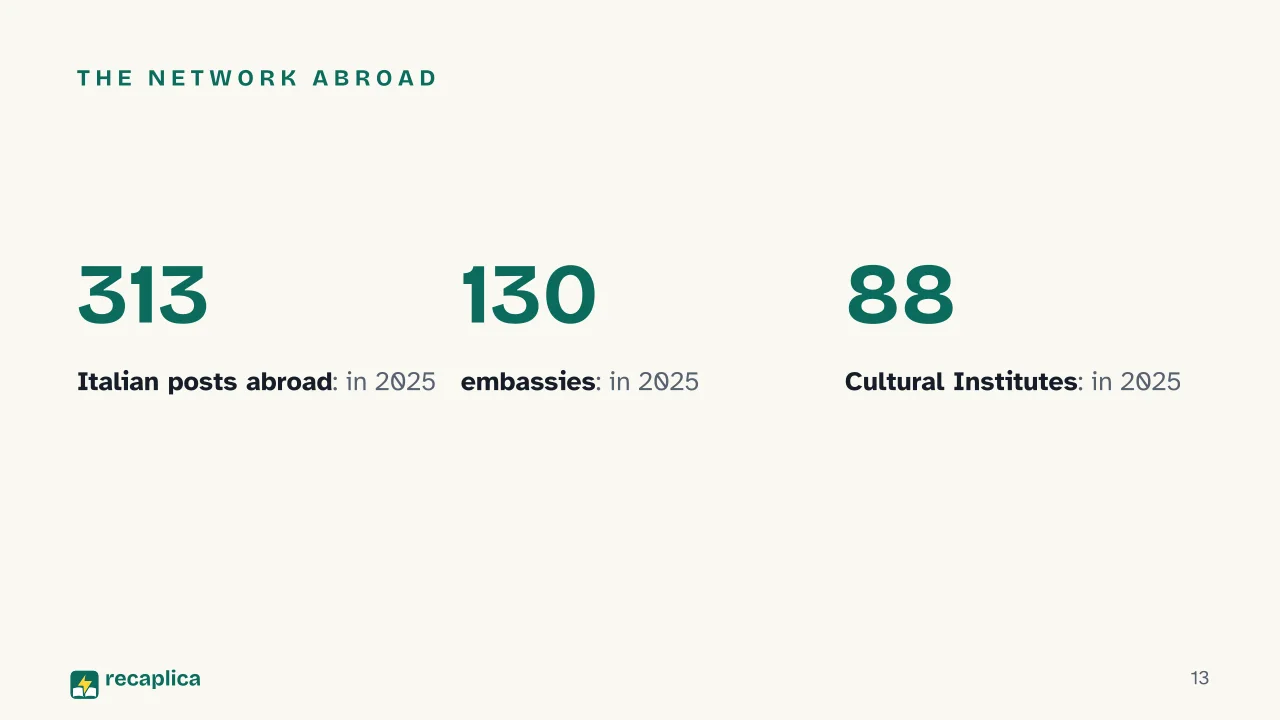
    • 313 Italian posts abroad in 2025 (130 embassies, 85 career consular offices, 9 permanent missions, 1 special diplomatic delegation, 88 Cultural Institutes) Source: MAECI Statistical Yearbook 2026, data for 2025
    • 4,853 MAECI career staff as of 1 January 2026, up 22% on the previous year Source: MAECI Statistical Yearbook 2026
    • 9 Directorates General in MAECI's central administration since 1 January 2026 Source: MAECI ministerial decree of 4 December 2025

    Deep Dive

    A name born in the 1800s, reorganized many times since

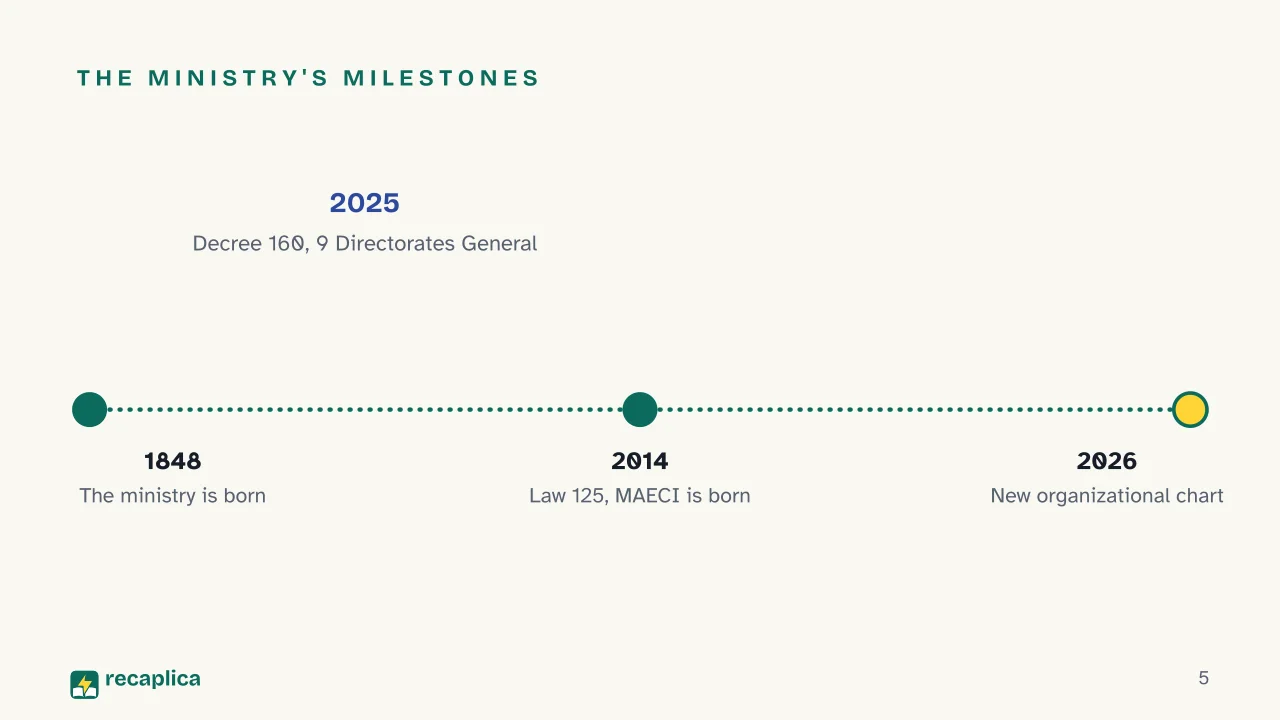
    The ministry in charge of Italy’s foreign policy carries a name coined in 1848, when the Statuto Albertino gave the Kingdom of Sardinia a Ministry of Foreign Affairs. The current name, with “and International Cooperation” added, instead dates from Article 3 of Law no. 125 of 11 August 2014 — the same law that established the Italian Agency for Development Cooperation, AICS.

    The internal structure, however, changes more often than the name. In 2010, Presidential Decree 19 May 2010, no. 95 — published in the Official Gazette on 24 June and in force from 9 July that year — reorganized the central administration into 8 Directorates General. That setup stayed in place for fifteen years, until Presidential Decree 3 September 2025, no. 160, published in the Official Gazette on 31 October 2025, amended it by adding a ninth Directorate General.

    The organizational chart in force since 1 January 2026

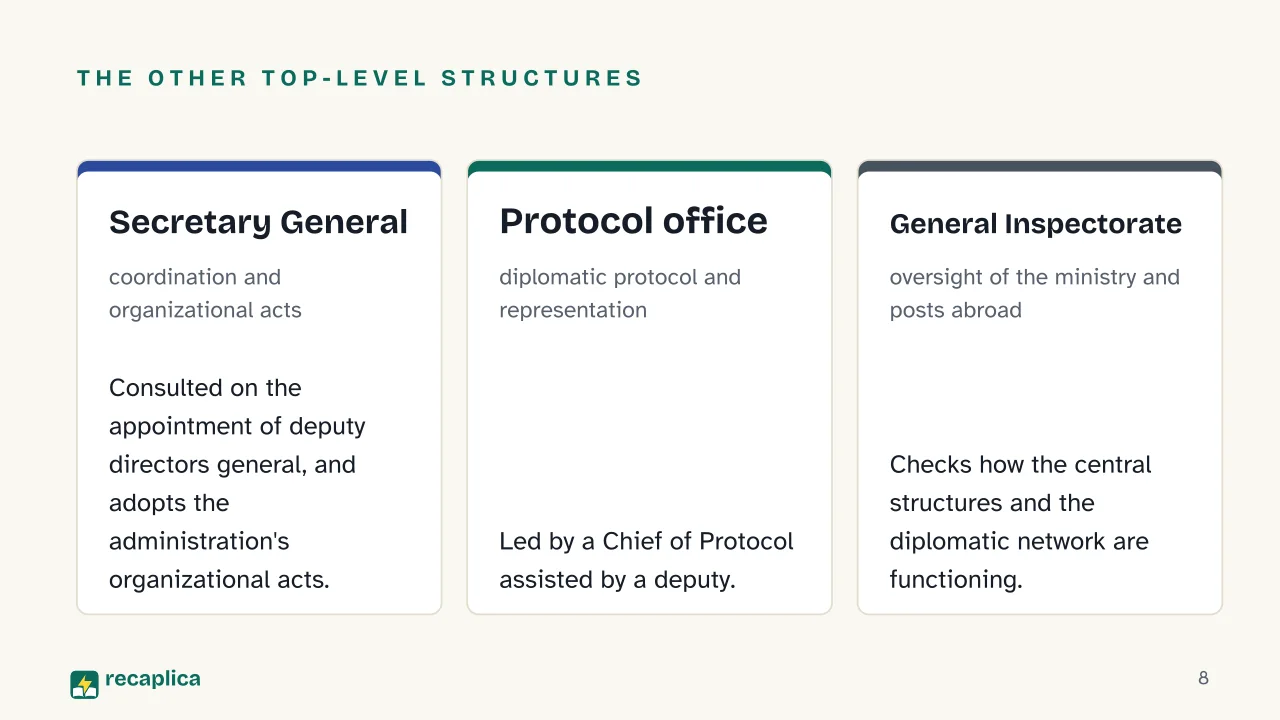
    A MAECI ministerial decree dated 4 December 2025 translated the 2025 reform into a detailed operating structure, applicable from 1 January 2026. The Secretary General’s office remains the top administrative body, flanked by three other top-level structures that are not Directorates General: the Diplomatic Protocol of the Republic, which handles protocol and representation; the General Inspectorate of the ministry and its posts abroad; and the Legal Affairs, Diplomatic Disputes and Treaties Service.

    The 9 Directorates General cover different areas: political affairs and international security; relations with sub-Saharan Africa, Latin America, Asia and Oceania, Europe and international trade policy; growth and export promotion; citizen services abroad and migration policy; development cooperation; cyber affairs and technological innovation; resources and training; and property and administration. Among the new features of the 2025 reform is precisely the Directorate General for cyber affairs, information technology and innovation, which also follows European negotiations on digital issues — an area where the European Union has already produced binding texts such as the EU AI Act.

    Each Directorate General is headed by a Director General assisted by two or three deputy directors general, each responsible for several numbered offices: the Directorate General for political affairs and international security, for instance, has four deputies overseeing thirteen offices. Under Article 6 of the ministerial decree of 4 December 2025, every deputy director general has operational autonomy, signs documents intended for use outside the administration, and deals directly with the parties concerned; within each Directorate General, the Minister also assigns deputising duties to one of the deputy directors general, on the director general’s proposal and after consulting the Secretary General.

    Practical example: an Italian company looking to enter a new export market usually goes through the relevant embassy, whose trade promotion work falls under the Directorate General for growth and export promotion — one of the strands feeding into foreign trade, a component of Italy’s GDP calculation.

    Development cooperation, split between a ministry and an agency

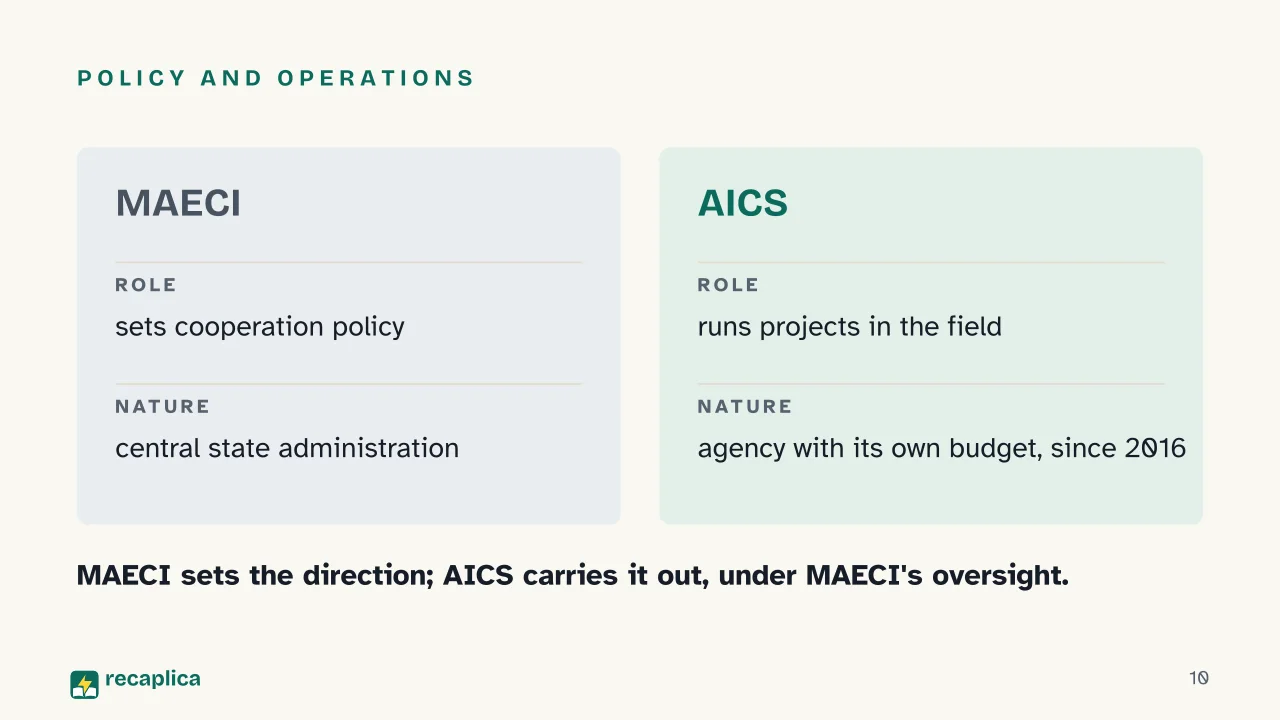
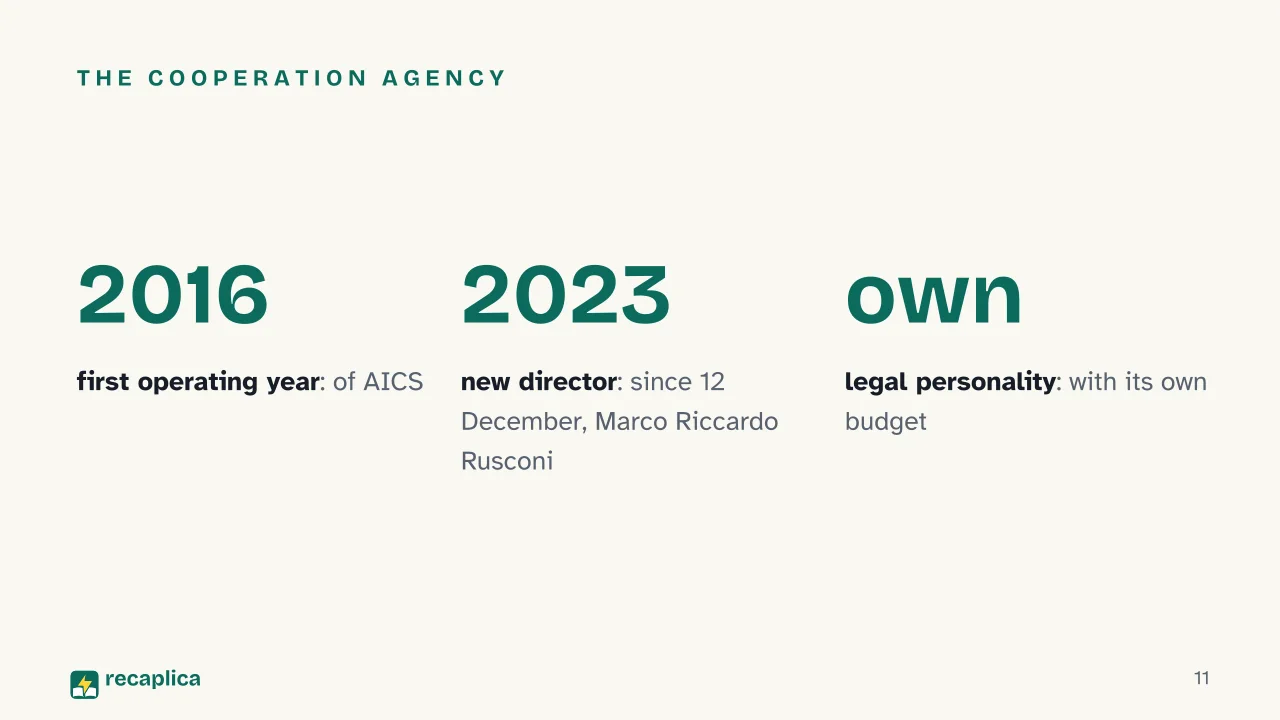
    Law 125 of 2014 did more than rename the ministry: it also established AICS, the Italian Agency for Development Cooperation, operating since January 2016 with its own legal personality, budget and organization. Political coordination of cooperation policy stays with the Deputy Minister in charge, assisted by MAECI’s Directorate General for Development Cooperation; AICS manages the projects in the field, under the ministry’s oversight.

    AICS has its headquarters in Rome, on Via Cantalupo in Sabina, a secondary office in Florence, and a network of field offices abroad, alongside project offices in countries of secondary accreditation that report to those field offices. Since 12 December 2023 the agency has been led by Marco Riccardo Rusconi.

    Embassies, consulates and cultural institutes

    According to the MAECI Statistical Yearbook 2026, with data referring to 2025, the network of Italian posts abroad counted 313 sites in total: a figure that rose from 309 in 2023 to 313 in 2024, and stayed stable in 2025.

    Type of postNumber (2025)
    Embassies130
    Career consular offices85
    Permanent missions9
    Special diplomatic delegation1
    Italian Cultural Institutes88
    Total313

    Embassies are not evenly spread across regions: 26 in the European Union, 25 in sub-Saharan Africa, 24 in Asia and Oceania, 20 in the Americas, 18 between the Mediterranean and the Middle East, and 17 in the rest of Europe. Italy’s diplomatic missions also include the one to the Holy See, the institution that elects the Pope through the conclave.

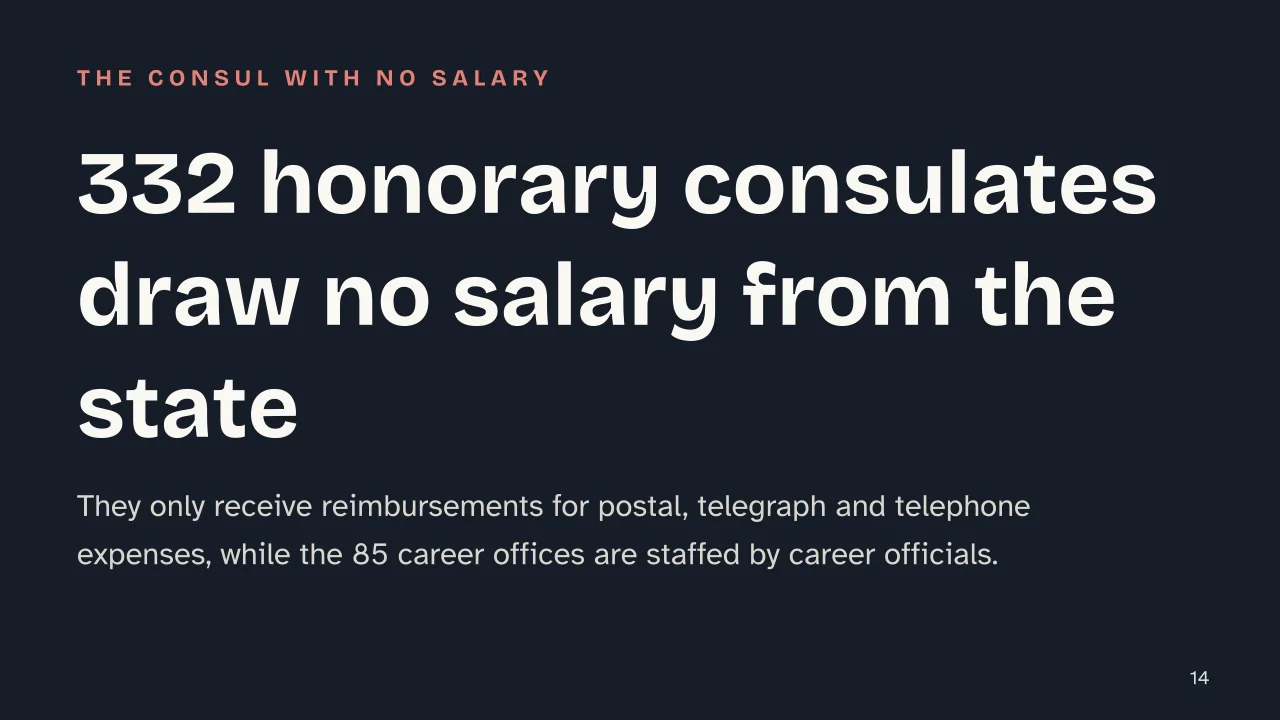
    Alongside the 85 career consular offices recorded in the same statistical table, MAECI also lists a separate network: as of 31 December 2025 there were 332 active honorary consular offices, whose heads have no employment relationship with the state and can only receive reimbursements for postal, telegraph and telephone expenses.

    The staff

    As of 1 January 2026, MAECI counted 4,853 career staff, up 22% on the previous year: 1,122 diplomats, 45 senior managers, and 3,686 assistants and officials. On the same date, the central administration was organized into 21 units and 97 offices, spread across the 9 Directorates General and the other top-level structures.

    Slide deck

    Slides ready to download and make your own in PowerPoint or Google Slides, with speaker notes. Pick the Flash cut or the Full one.
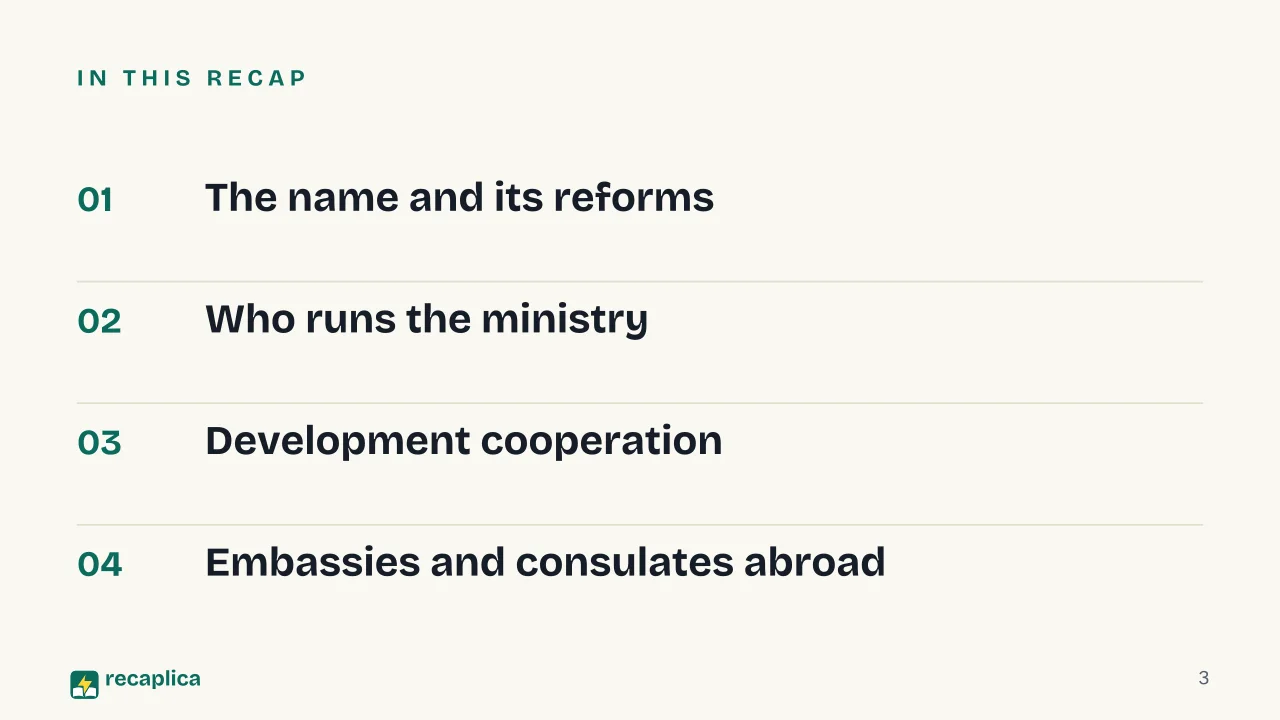
    Slide 1 of the presentation on Italian Ministry of Foreign Affairs: MAECI, Italy's foreign policy ministrySlide 2 of the presentation on Italian Ministry of Foreign Affairs: Who decides which countries Italy talks to?Slide 3 of the presentation on Italian Ministry of Foreign Affairs: In this RecapSlide 4 of the presentation on Italian Ministry of Foreign Affairs: Chapter 01: The name and its reformsSlide 5 of the presentation on Italian Ministry of Foreign Affairs: The ministry's milestonesSlide 6 of the presentation on Italian Ministry of Foreign Affairs: Chapter 02: Who runs the ministrySlide 7 of the presentation on Italian Ministry of Foreign Affairs: The ministry in figuresSlide 8 of the presentation on Italian Ministry of Foreign Affairs: The other top-level structures: Secretary General, Protocol office, General InspectorateSlide 9 of the presentation on Italian Ministry of Foreign Affairs: Chapter 03: Development cooperationSlide 10 of the presentation on Italian Ministry of Foreign Affairs: Policy and operationsSlide 11 of the presentation on Italian Ministry of Foreign Affairs: The cooperation agencySlide 12 of the presentation on Italian Ministry of Foreign Affairs: Chapter 04: Embassies and consulates abroadSlide 13 of the presentation on Italian Ministry of Foreign Affairs: The network abroadSlide 14 of the presentation on Italian Ministry of Foreign Affairs: 332 honorary consulates draw no salary from the stateSlide 15 of the presentation on Italian Ministry of Foreign Affairs: How many Directorates General does MAECI have as of 2026?Slide 16 of the presentation on Italian Ministry of Foreign Affairs: The full Recap
    Flash10 slidesThe essential thread, to present in classFull16 slidesEvery chapter and the deeper detail

    Common myths

    • ✗ Myth The Ministry of Foreign Affairs has always had the same name and the same internal structure.

      ✓ Reality The current name comes from Article 3 of Law no. 125 of 11 August 2014; before that it was simply the Ministry of Foreign Affairs, a name going back to the Statuto Albertino of 1848. The internal structure also changes periodically: the setup fixed in 2010 by Presidential Decree 95, with 8 Directorates General, became 9 after Presidential Decree 160 of 2025 took effect on 1 January 2026.

    • ✗ Myth The ministry manages development cooperation directly, as one of its internal offices.

      ✓ Reality Since January 2016, AICS, the Italian Agency for Development Cooperation, has run cooperation projects in the field, with its own legal personality and budget, under MAECI's oversight; the ministry coordinates cooperation policy through the Deputy Minister in charge and the Directorate General for Development Cooperation.

    • ✗ Myth Every Italian consular office has a career official paid by the state.

      ✓ Reality As of 31 December 2025 there were 332 active honorary consular offices, a category distinct from the 85 career consular offices recorded that same year in the MAECI Statistical Yearbook; honorary consuls have no employment relationship with the state and can only be reimbursed for postal, telegraph and telephone expenses.

    Mind map

    Drag the background to move around and the nodes to reposition them; use − and + to collapse and expand branches.
    Customize
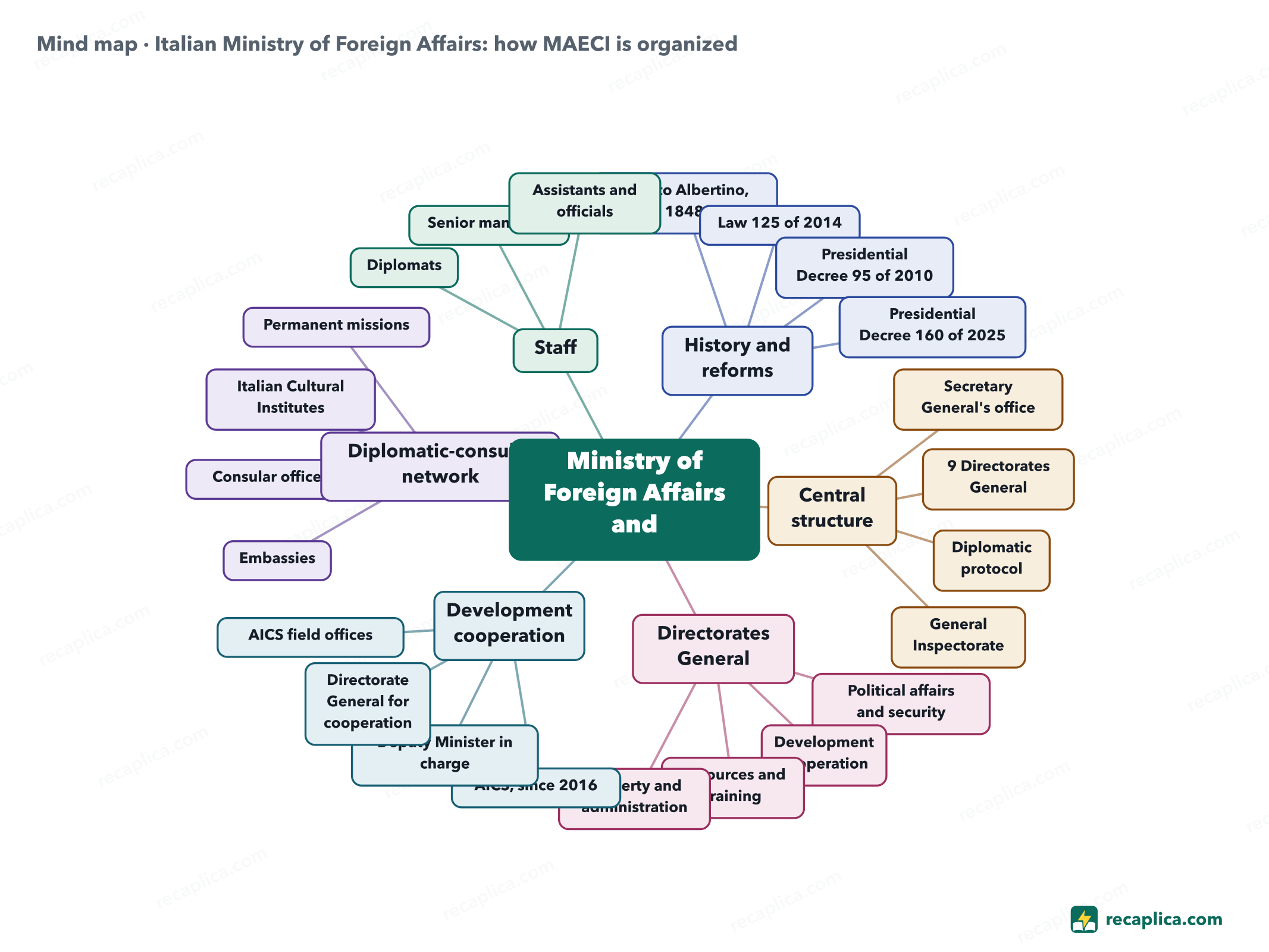
    Mind map: Italian Ministry of Foreign Affairs: how MAECI is organized
    • Ministry of Foreign Affairs and International Cooperation
      • History and reforms
        • Statuto Albertino, 1848 Historical origin of the Ministry of Foreign Affairs
        • Law 125 of 2014 MAECI and AICS are created
        • Presidential Decree 95 of 2010 Reorganization with 8 Directorates General
        • Presidential Decree 160 of 2025 Directorates General rise to 9
      • Central structure
        • Secretary General's office
        • 9 Directorates General
        • Diplomatic protocol
        • General Inspectorate
      • Directorates General
        • Political affairs and security
        • Development cooperation
        • Resources and training
        • Property and administration
      • Development cooperation
        • AICS, since 2016 Agency with its own budget and legal personality
        • Deputy Minister in charge
        • Directorate General for cooperation
        • AICS field offices
      • Diplomatic-consular network
        • Embassies 130 in 2025
        • Consular offices 85 career, 332 honorary in 2025
        • Italian Cultural Institutes 88 in 2025
        • Permanent missions 9 at international organizations
      • Staff
        • Diplomats 1,122 as of 1 January 2026
        • Senior managers 45 as of 1 January 2026
        • Assistants and officials 3,686 as of 1 January 2026

    Quiz: test yourself

    Answer the questions to check what you have learned: you get instant feedback and a short explanation.

    Grade 0/10 0/5
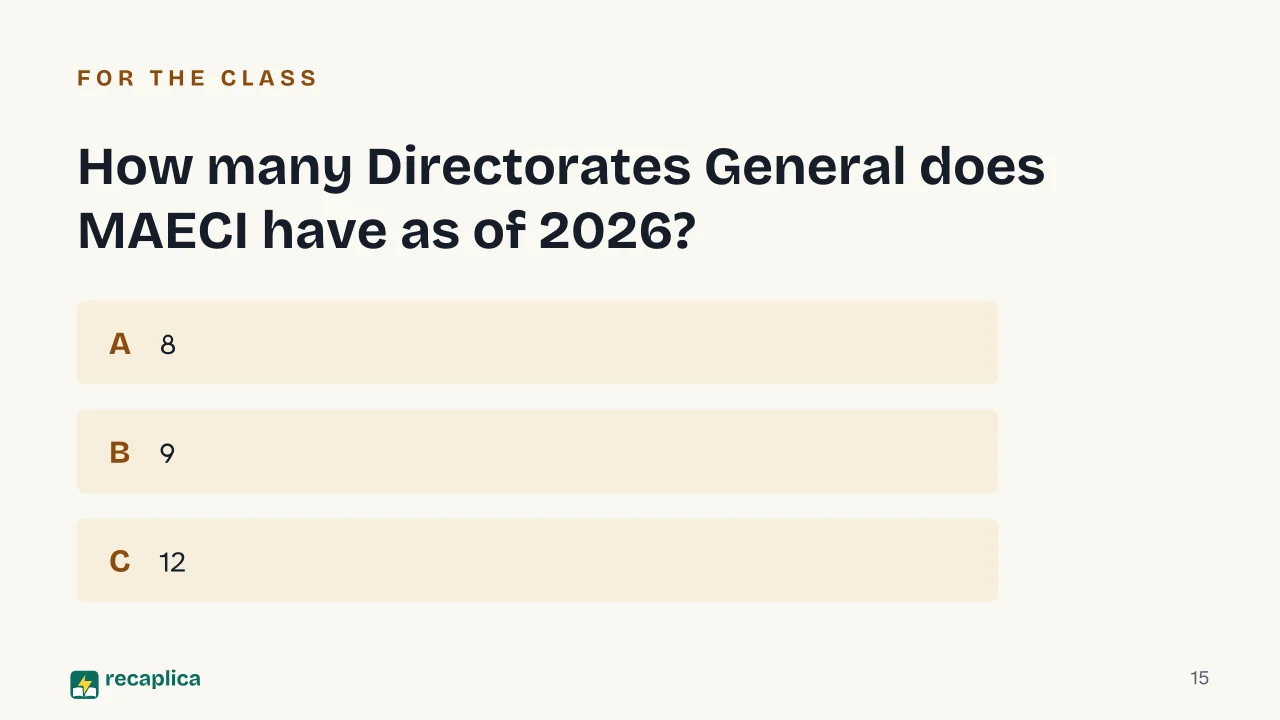
    1 How many Directorates General make up MAECI as of 1 January 2026?

    The ministerial decree of 4 December 2025, in force since 1 January 2026, sets the figure at 9, three more than the 8 of the original 2010 version of Presidential Decree 95.

    2 What is AICS?

    The Italian Agency for Development Cooperation, operating since January 2016, has its own legal personality and budget, while remaining under MAECI's oversight.

    3 How many Italian embassies were active in 2025, according to the MAECI Statistical Yearbook?

    The 2026 Statistical Yearbook, with data for 2025, counts 130 embassies, a figure stable compared with 2023 and 2024.

    4 True or false: every Italian consular office has a career official paid by the state.

    As of 31 December 2025, MAECI counted 332 active honorary consular offices, a category distinct from the 85 career offices; honorary consuls are not career staff and can only be reimbursed for expenses.

    5 Which law created the name MAECI and the agency AICS?

    Article 3 of Law no. 125 of 11 August 2014 changed the ministry's name and established AICS, operating since January 2016.

    Answers: 1-B · 2-B · 3-C · 4-B · 5-B

    Flashcards

    Tap the card to flip it and check whether you remember the answer, then move to the next one.

    1 / 8

    Explain it in your own words

    The ultimate test: if you can explain it in simple words, you've truly understood it. Write your explanation, then compare it with the Recap.

    Your explanation is saved only on this device.

    The Ministry of Foreign Affairs and International Cooperation, MAECI, runs Italy's foreign policy and its network of embassies, consulates and cultural institutes abroad. The current name dates from Law no. 125 of 11 August 2014, which also created the Italian Agency for Development Cooperation, AICS, operating since January 2016. Since 1 January 2026 the central administration has been organized into 9 Directorates General, under a ministerial decree of 4 December 2025 that implemented the latest reform of Presidential Decree 95 of 2010. In 2025 the network abroad counted 313 posts in total, including embassies, consulates, permanent missions and cultural institutes, with 4,853 career staff as of 1 January 2026.

    Frequently asked questions

    How many embassies does Italy have worldwide?

    In 2025 Italy had 130 embassies, stable compared with the two previous years, distributed mainly across the European Union (26), sub-Saharan Africa (25), and Asia and Oceania (24), according to the MAECI Statistical Yearbook 2026.

    What is the difference between MAECI and AICS?

    MAECI is the ministry that sets Italy's foreign and cooperation policy; AICS is the implementing agency, operating since January 2016, which runs development cooperation projects in the field under MAECI's oversight.

    How many people work at MAECI?

    As of 1 January 2026, MAECI's career staff numbered 4,853: 1,122 diplomats, 45 senior managers and 3,686 assistants and officials, up 22% on the previous year, according to the MAECI Statistical Yearbook.

    Since when has the Ministry of Foreign Affairs and International Cooperation existed under that name?

    The current name dates from Article 3 of Law no. 125 of 11 August 2014, which also established AICS; the ministry itself goes back to the Statuto Albertino of 1848 as the Ministry of Foreign Affairs.

    How many Italian Cultural Institutes are there abroad?

    In 2025 there were 88, up from 86 in 2023, distributed mainly across the European Union (31) and the Americas (19), according to the MAECI Statistical Yearbook 2026.

    Sources

    • Presidential Decree 19 May 2010, no. 95, reorganization of the Ministry of Foreign Affairs, Official Gazette
    • Presidential Decree 19 May 2010, no. 95, consolidated text, Normattiva
    • MAECI, ministerial decree of 4 December 2025, organizational structure in force since 1 January 2026
    • MAECI, Statistical Yearbook 2026
    • AICS, Profile and objectives
    • AICS, Structure

    Every Recap goes through an independent review before publication.

    Every evening, the day's new Recaps on our Telegram channel. Join the channel →

    Keep learning

    • Civics Carabinieri Ranks: The Four-Role Hierarchy of the Corps Every member of the Carabinieri sits inside one of four legally defined roles, in force since a 2000 law: Officers, Inspectors, Supervisors, and Corporals and Privates. Promotion happens inside a role first, and the four roles themselves run from the most operational to the most senior. The lowest rank is Carabiniere; the highest is Generale di Corpo d'Armata, in the Officer role. Two abbreviations, Q.S. and C.S., show up next to a handful of ranks — they aren't extra rungs on the ladder, just a qualification attached to the top rank already sitting there. Read the Recap →
    • Civics Codice Fiscale: What It Is, Structure and Everyday Uses The codice fiscale is the code that uniquely identifies a person in every dealing with Italian public bodies and administrations, from healthcare to official paperwork. It is made up of 16 alphanumeric characters derived from the holder's personal data. Only the Agenzia delle Entrate, Italy's tax agency, can issue a valid one: any code generated by an outside tool has no official standing. The system dates back to 1973, created by the same decree that set up Italy's taxpayer register. It is a different thing from the partita IVA, which identifies an economic activity. Read the Recap →
    • Civics Italian Government Structure: Which Bodies Do What The Italian state rests on five bodies that the Constitution sets up and regulates directly: Parliament makes the laws, the Government carries them out, the President of the Republic represents national unity, the judiciary applies the law to individual cases, and the Constitutional Court checks that laws respect the Constitution. Alongside them sit four bodies of constitutional relevance — the High Council of the Judiciary, the Court of Auditors, the CNEL and the Council of State — auxiliary bodies the Constitution sets up but keeps in a separate category from the five essential ones. Knowing who does what, and which bodies the system cannot run without, is the fastest way into how Italy is actually governed. Read the Recap →

    recaplica

    Clear in 30 seconds, yours in 10 minutes.

    Recaps Mind maps Request a Recap Telegram channel Mind map maker Our method About Privacy & cookies Legal notes & terms of use

    © 2026 Recaplica · A project by Curi S.r.l. — VAT IT05472000750

    Statistics, only if you say so

    To learn which Recaps help most we would use Google Analytics, with aggregate, anonymous data. It starts only with your OK, and you can change your mind anytime. Privacy policy