|
recaplica
Italy's Health Professions Admission Test: How It Works | |||||||||||||||||||||||||||||
| © 2026 Recaplica · recaplica.com — All rights reserved | |||||||||||||||||||||||||||||
Italy's Health Professions Admission Test: How It WorksWhat to print Page numbers appear when printing with default margins. SlidesChoose a cut Flash10 slidesThe essential thread, to present in classFull15 slidesEvery chapter and the deeper detailBoth come with speaker notes. In 30 seconds quick readItaly admits students to nursing, physiotherapy, midwifery and other health-degree programs through a single national entrance test, set by law 264/1999. For the 2026/2027 academic year the test has 60 multiple-choice questions to answer in 100 minutes, worth up to 90 points. The format is not fixed: a new ministerial decree resets it every year, and the 2024/2025 edition had 80 questions and a 120-minute limit. Places are awarded through a ranked list based on each candidate's score, not through a dedicated CISIA test. Key Points
Key figures
Deep DiveEvery year, thousands of students hoping to become nurses, physiotherapists, midwives or other health technicians sit the same test, on the same date, across Italy. It’s the health professions admission test: the entrance exam for capped-enrollment degree programs in the health field, introduced by law 264/1999. It isn’t an exam each university designs on its own — it’s a single national test, with content set every year by a decree from Italy’s Ministry of University and Research (MUR). A single ministerial test, not a CISIA TOLCAnyone researching the test often runs into the term TOLC, the family of online tests run by CISIA (the Interuniversity Consortium for Integrated Access Systems) and used by many universities for other degree programs. CISIA’s own official site, however, lists TOLC tests for agriculture and veterinary science, biology, economics, pharmacy, engineering, professionalizing degrees, psychology, science, political and social science, and humanities — nothing dedicated to health professions. The MUR statements reviewed for this Recap describe something different: a written test held on a single national date, with questions set by ministerial decree and administered directly by universities. That test, not a CISIA TOLC, is the actual gateway into nursing, physiotherapy, midwifery and the other programs in this group. Some universities may ask for a generic TOLC in unrelated situations — off-cycle enrollment, or related programs — but that’s a separate case from ordinary admission to the health professions. The 2026/2027 formatAccording to the MUR statement of August 12, 2026, the 2026/2027 test consists of 60 multiple-choice questions, each with five options and one correct answer, to be completed in 100 minutes. The dates set for that academic year were September 16, 2026 for Italian-language programs and September 17, 2026 for English-language programs. The questions break down as follows:
Scoring follows a straightforward rule: 1.5 points for each correct answer, -0.4 points for each wrong one, 0 points for a question left blank. The theoretical maximum is 90 points. A format that changes every yearComparing two editions of the test shows why every figure in this Recap is tagged with its academic year. The MUR statement of August 1, 2024 described a different test, for the 2024/2025 academic year:
The ministerial decree governing the test is renewed each year: the number of questions, the time allowed and the split between subjects can all shift from one edition to the next. Candidates need to check the rules for the year they’ll actually sit the test, not an older edition they happened to find online.
How many places are availableFor the 2026/2027 academic year, MUR set 39,624 places for bachelor’s-level health-profession degree programs nationwide: 38,184 reserved for EU and non-EU candidates residing in Italy, and 1,440 for non-EU candidates residing abroad. Single-cycle master’s programs received another 4,572 places, 4,443 of them in Italy and 129 abroad. The national total then splits by university. As one concrete example: for the 2024/2025 test, the University of Florence offered 947 places for EU and non-EU candidates plus 29 reserved for non-EU candidates residing abroad, spread across thirteen programs (605 in nursing, 63 in physiotherapy). That year, 1,743 of 1,840 registered candidates in Florence actually sat the test, with physiotherapy (588 first-choice picks) and nursing (512) the most requested programs. How the ranked list worksA passing score alone doesn’t secure admission. Each university builds a ranked list — national or local, depending on the program — based on test scores: candidates who land within the number of available places for their chosen program get in, and those who fall outside it don’t, even with a positive score. That’s why it pays to study every subject on the test seriously rather than simply aiming to answer as many questions as possible — a higher score means a better rank. For a broader look at capped enrollment across other degree programs, see the Recap on university entrance exams. How to prepareBiology and chemistry carry the most questions in the 2026/2027 test, a reasonable starting point for organizing study time. Anyone who needs to review the basics of biology can start with the structure of the cell; for chemistry, the periodic table remains the go-to tool for navigating elements and their properties. The logical reasoning and problem-solving section also draws on the basics of probability and statistics, useful for reading data and percentages quickly under time pressure. Timed mock exams are the most direct way to get used to the test’s pace: working through 60 questions in 100 minutes trains time management, which often matters as much as subject knowledge alone. Publishers such as Alpha Test produce question sets modeled on the ministerial exam, useful for practice before the real thing. Slide deckSlides ready to download and make your own in PowerPoint or Google Slides, with speaker notes. Pick the Flash cut or the Full one.     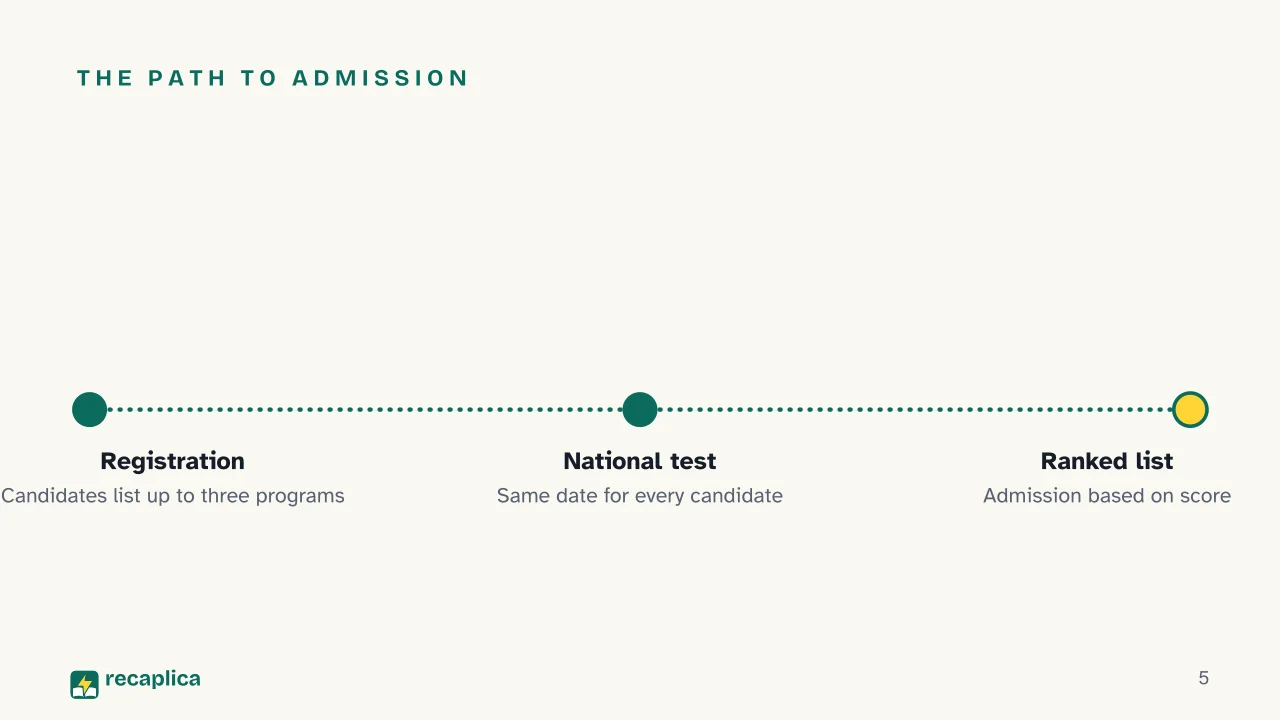  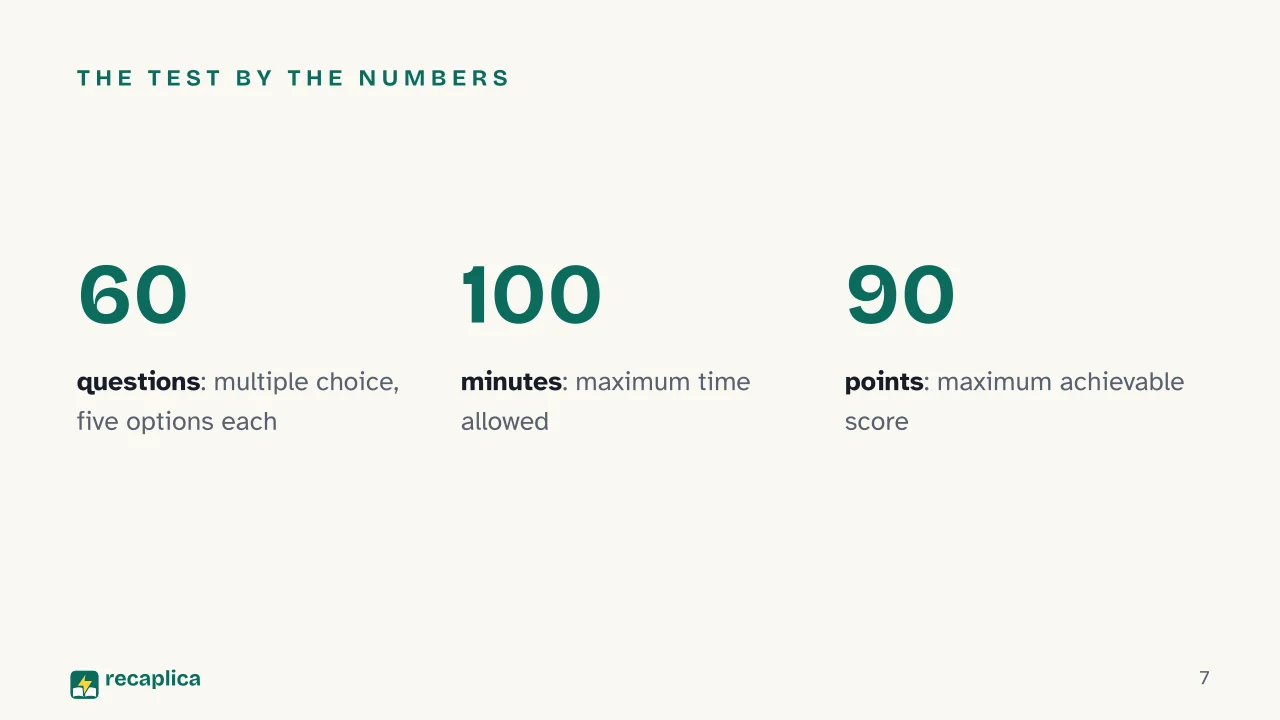 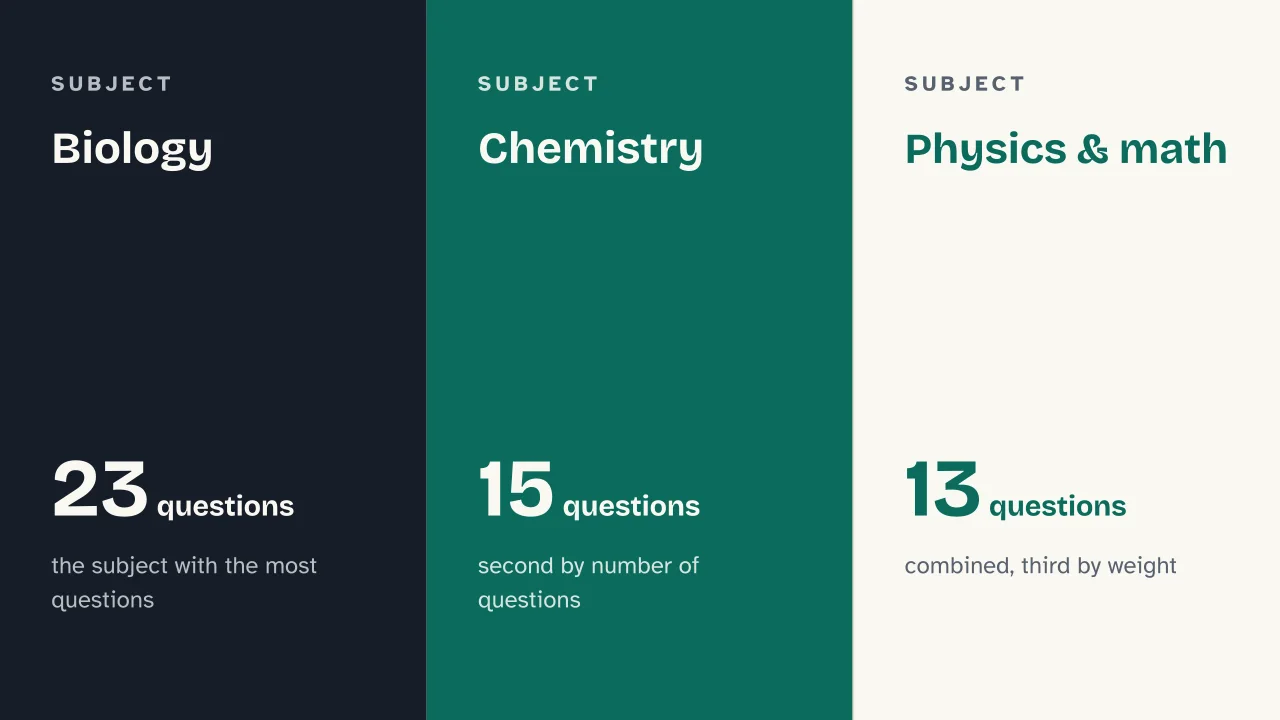  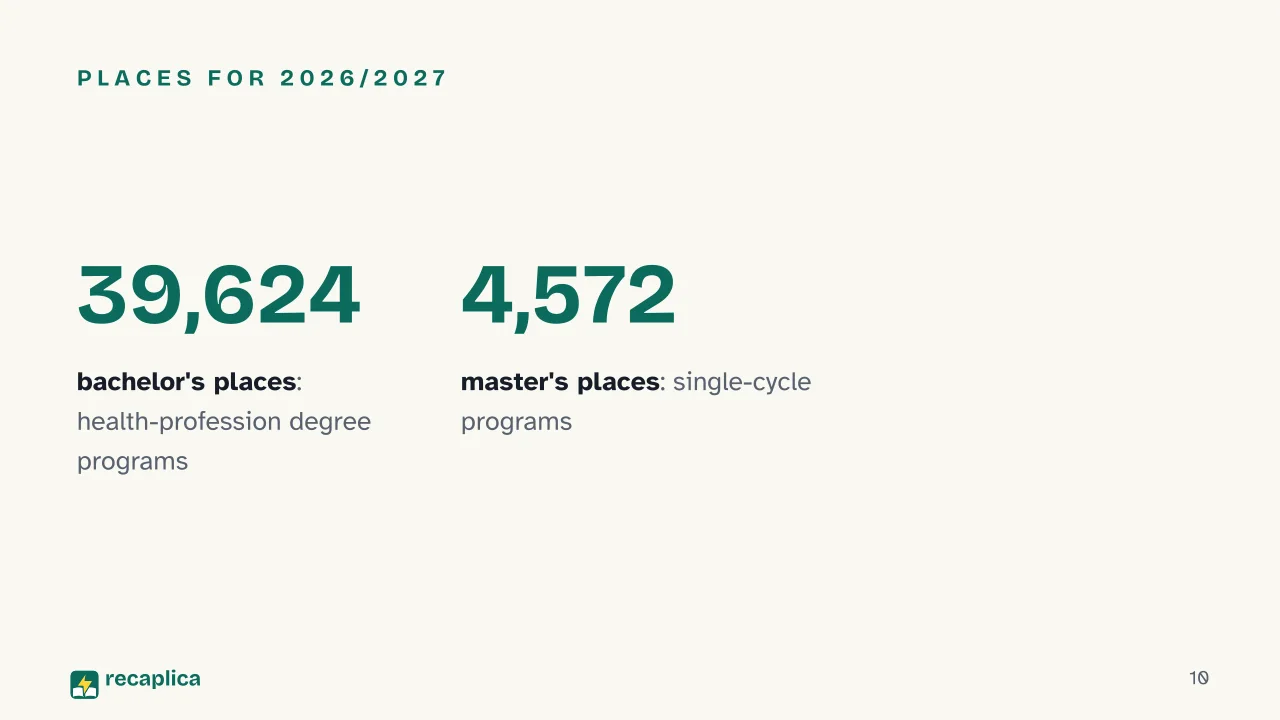 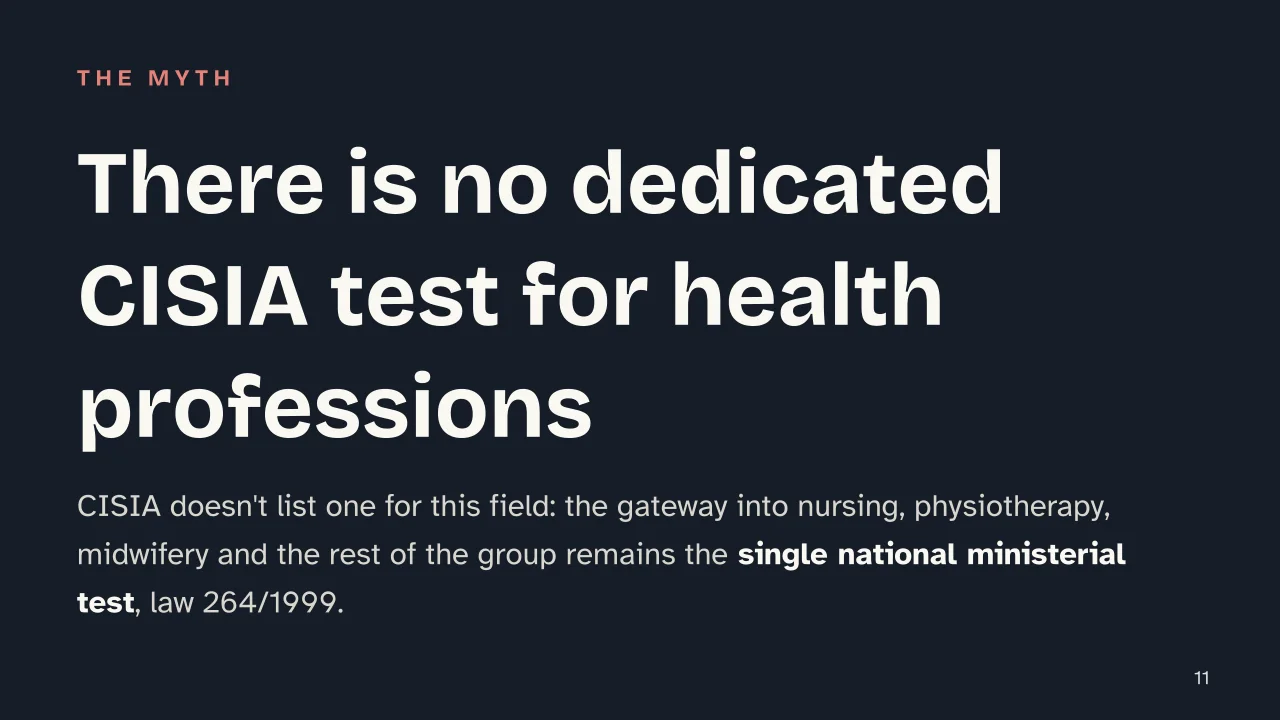  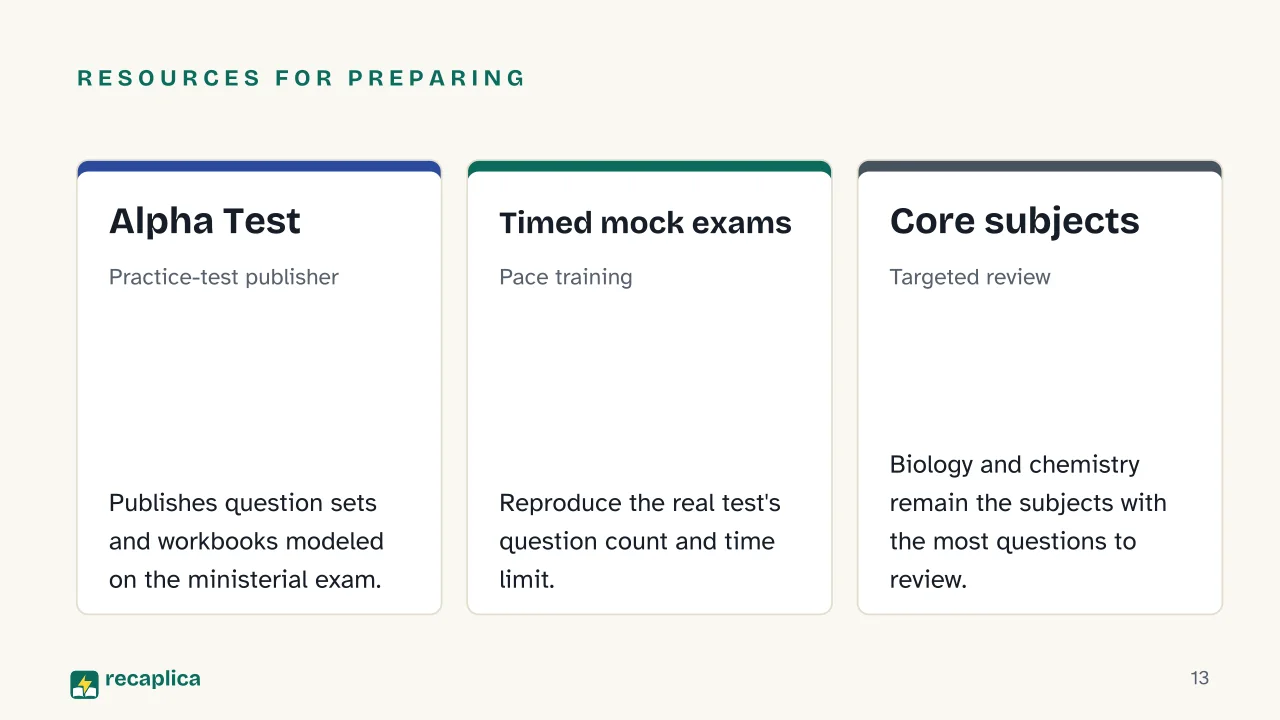 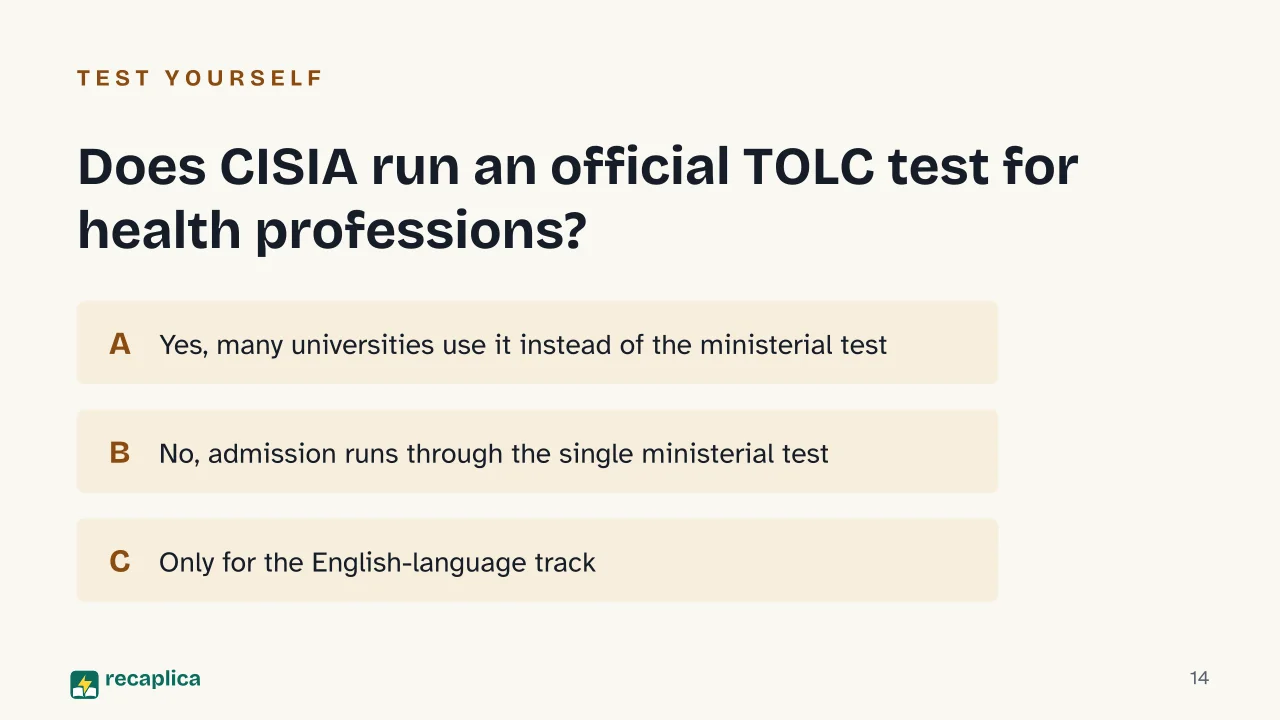  Common myths
Mind mapDrag the background to move around and the nodes to reposition them; use − and + to collapse and expand branches. 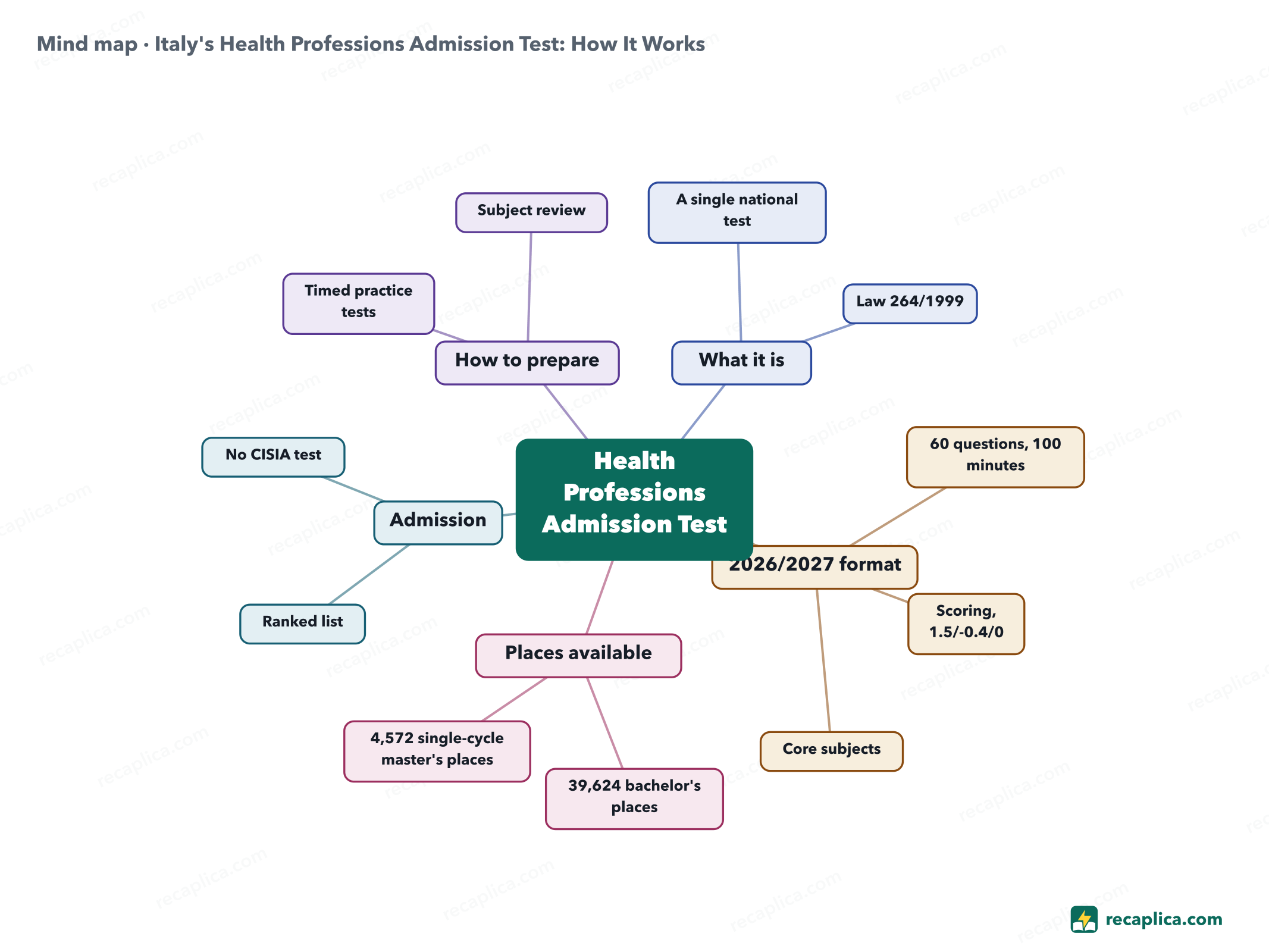
Quiz: test yourselfAnswer the questions to check what you have learned: you get instant feedback and a short explanation. Grade 0/10 0/5
FlashcardsTap the card to flip it and check whether you remember the answer, then move to the next one. 1 / 7 Explain it in your own wordsThe ultimate test: if you can explain it in simple words, you've truly understood it. Write your explanation, then compare it with the Recap. Your explanation is saved only on this device.
Frequently asked questionsIs there a CISIA TOLC test for health professions in Italy?No. CISIA's official published list of TOLC tests has no entry for health professions. Admission to nursing, physiotherapy, midwifery and the other programs in this group runs through the single national ministerial test set under law 264/1999, not a CISIA TOLC. How many questions are on the health professions admission test?It depends on the academic year: the 2026/2027 test has 60 questions to answer in 100 minutes, while the 2024/2025 edition had 80 questions in 120 minutes. A new ministerial decree resets the format every year. What subjects does the health professions admission test cover?The 2026/2027 test includes 23 biology questions, 15 chemistry, 13 physics and math, 5 logical reasoning and problem-solving, and 4 reading comprehension, for 60 questions total. How many places are available for health-profession degrees in Italy?For 2026/2027, Italy's Ministry of University and Research (MUR) set 39,624 places for bachelor's-level programs and 4,572 for single-cycle master's programs nationwide. Each university then publishes its own admission notice with places broken down by individual program. How do candidates prepare for the health professions admission test?By reviewing the test's core subjects — biology and chemistry carry the most weight — and practicing with timed mock exams, such as those published by specialized publishers like Alpha Test, to get used to working within the 100-minute limit. Every Recap goes through an independent review before publication. |