Skip to content
recaplica

    One moment: security check

    Cloudflare wants to make sure you're not a robot. Tick the box below and your search will continue on its own.

    IT
    recaplica Gym and Sports Facility Collective Agreement in Italy: Who It Covers
    © 2026 Recaplica · recaplica.com — All rights reserved
    Home › Civics

    Gym and Sports Facility Collective Agreement in Italy: Who It Covers

    By Recaplica Newsroom · Updated on October 5, 2026

    What to print

    Page numbers appear when printing with default margins.

    Slides

    Choose a cut

    Flash10 slidesThe essential thread, to present in classFull17 slidesEvery chapter and the deeper detail

    Both come with speaker notes.

    Telegram channel
    recaplica Clear in 30 seconds, yours in 10 minutes.
    In 30 seconds Key points Figures Deep dive Slides Myths Mind map Quiz Flashcards FAQ

    In 30 seconds quick read

    Italy's national collective agreement for gyms and sports facilities, known as the CCNL Impianti Sportivi e Palestre, sets the employment rules for people hired as staff at gyms, fitness clubs and sports centers. It does not cover people working under Italy's separate sports worker status, created by Legislative Decree 36/2021. The version in force was signed on January 12, 2024, and runs through December 31, 2026. That same renewal also set pay rules for amateur sports collaborators, while the agreement itself remains one for employees.

    Key Points

    • The CCNL Impianti Sportivi e Palestre covers employees of entities, associations and companies that run or promote sports, fitness and wellness activities in Italy.
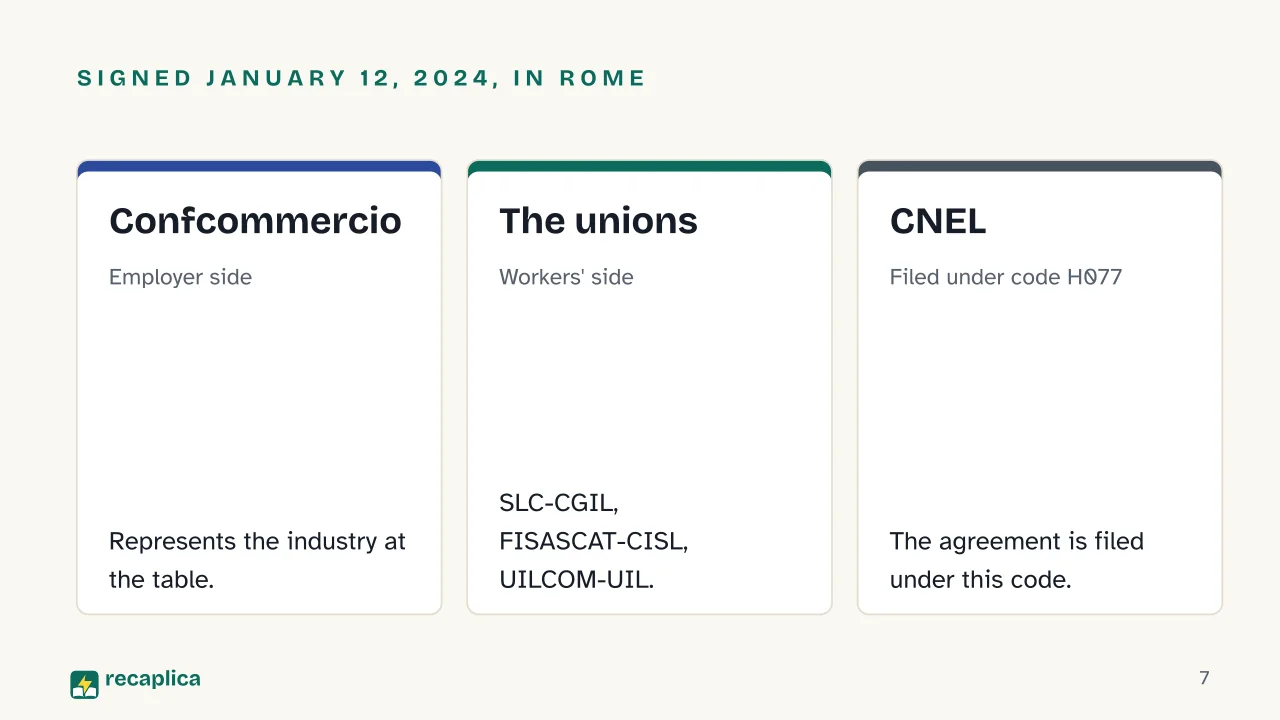
    • The current agreement was signed on January 12, 2024, in Rome, between the Confederazione italiana dello sport-Confcommercio employer group and the SLC-CGIL, FISASCAT-CISL and UILCOM-UIL unions.
    • It runs for three years, from January 1, 2024, to December 31, 2026, filed with CNEL under code H077.
    • It is separate from the sports worker status under Legislative Decree 36/2021, which covers athletes, coaches and instructors tied to Italy's recognized sports system.
    • General staff at a gym, such as front-desk or administrative employees, stay under this agreement regardless of the sports reform.
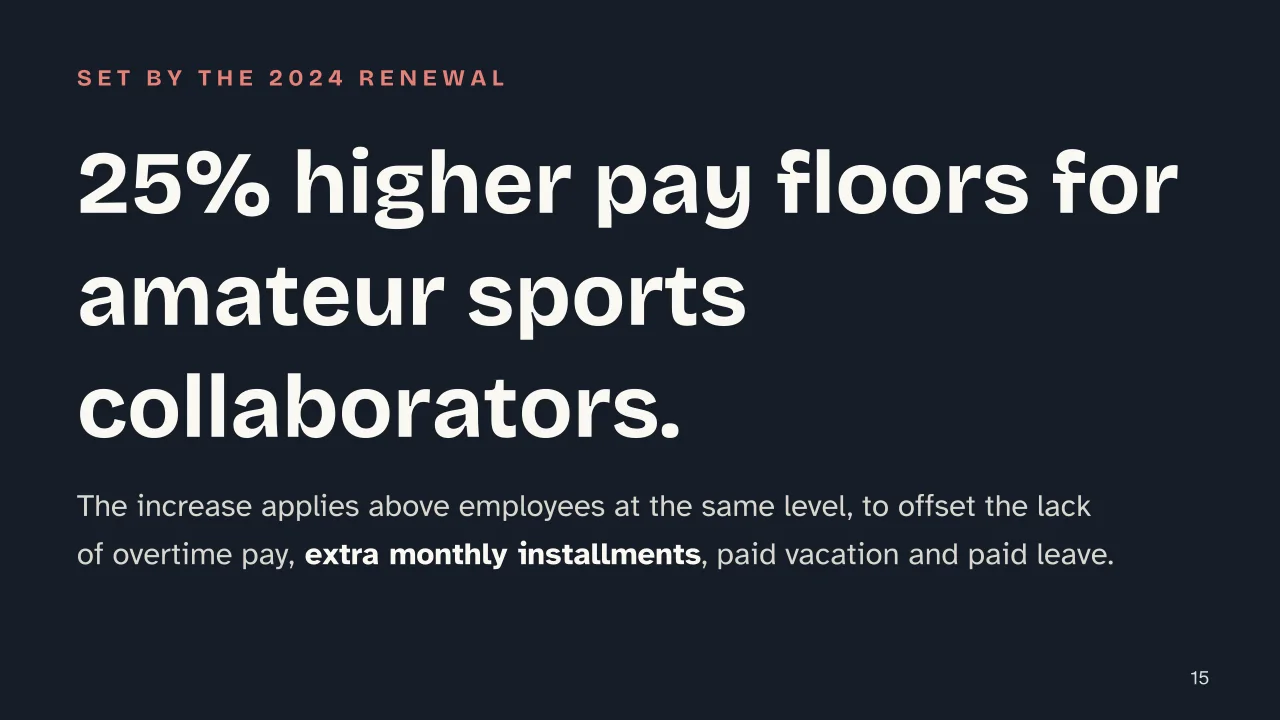
    • The 2024 renewal folded in the sports reform by setting pay floors for amateur sports collaborators 25% above employees at the same level.

    Key figures

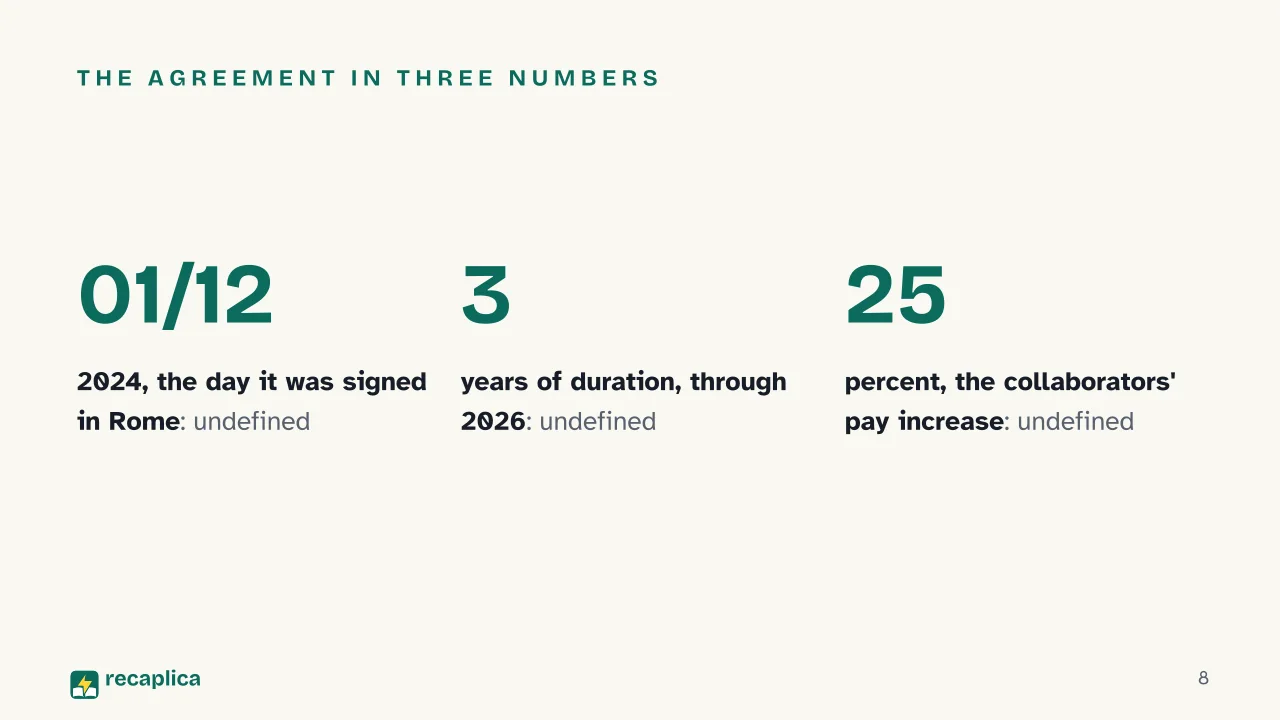
    • January 12, 2024 Date the current CCNL Impianti Sportivi e Palestre was signed, in Rome. Source: CCNL Impianti Sportivi e Palestre
    • 2024-2026 Three-year term of the agreement, from January 1, 2024, to December 31, 2026. Source: CCNL Impianti Sportivi e Palestre
    • +25% Pay floor increase set for amateur sports collaborators over employees at the same level, under the 2024 renewal. Source: Wbox.it, February 20, 2024

    Deep Dive

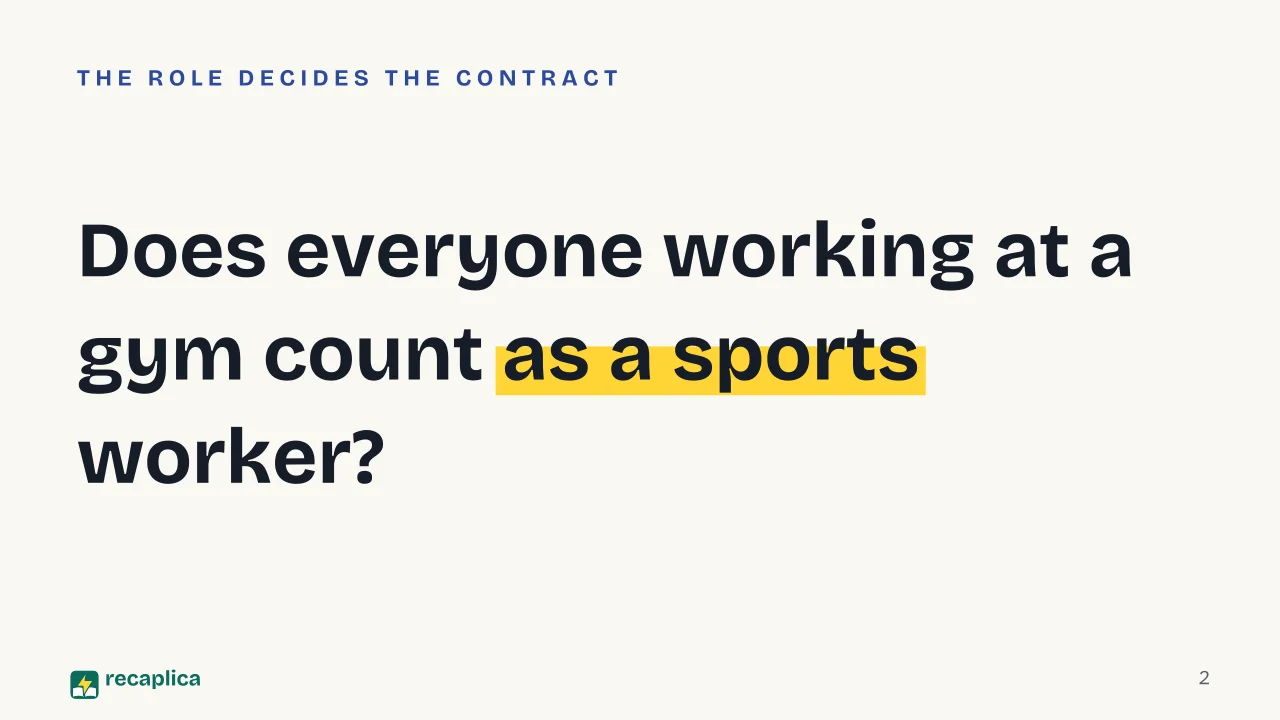
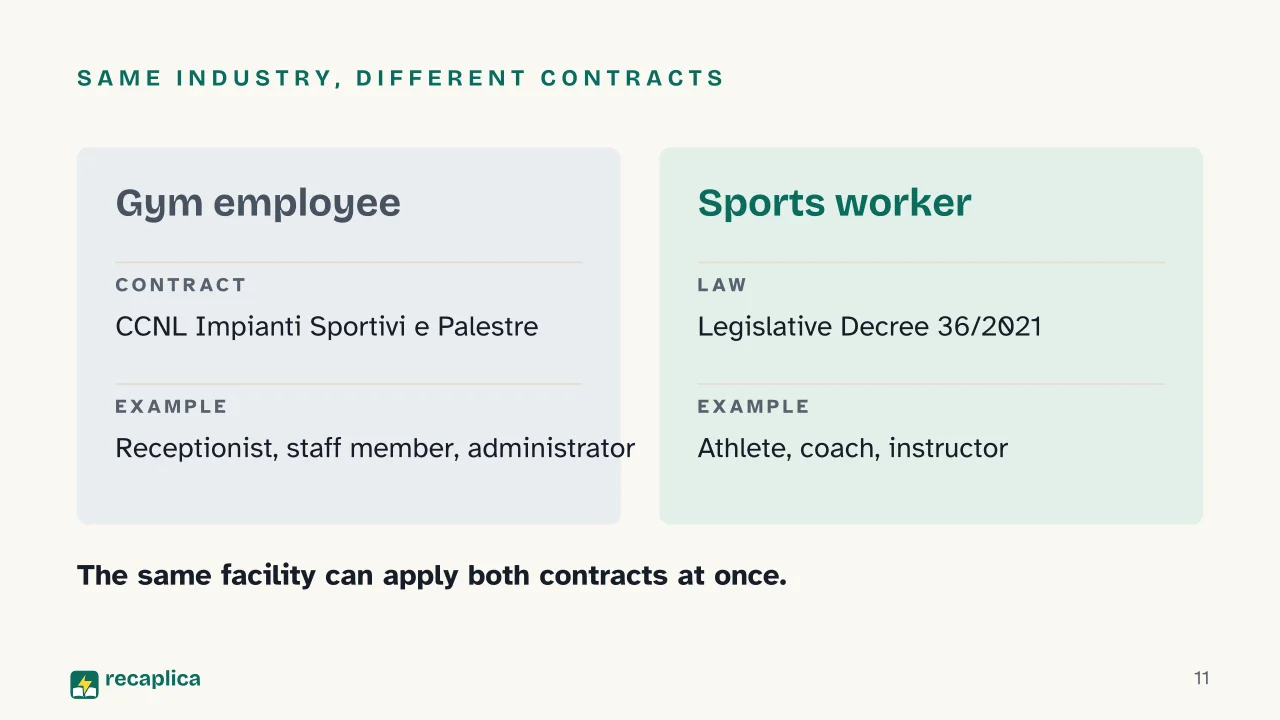
    Working at a gym or sports facility in Italy does not mean just one kind of contract. It depends on the role: someone at the front desk or in administration, without sports worker status, is an employee covered by the CCNL Impianti Sportivi e Palestre. A coach, a fitness trainer or a competition director tied to a federation, on the other hand, can fall under an entirely different regime, the sports collaboration contract set out in Legislative Decree 36/2021. Two separate legal worlds that sometimes share the same building.

    The agreement and who it covers

    The CCNL Impianti Sportivi e Palestre in force since 2024 was signed on January 12 of that year, in Rome, between the Confederazione italiana dello sport-Confcommercio on the employer side and the SLC-CGIL, FISASCAT-CISL and UILCOM-UIL unions on the workers’ side. The text itself is titled the “Testo Unico del Contratto Collettivo di Lavoro per i Lavoratori Sportivi” (consolidated collective agreement for sports workers): the older name, gyms and sports facilities, is still how the agreement is known and searched for. It is filed with CNEL under code H077 and runs for three years, from January 1, 2024, to December 31, 2026.

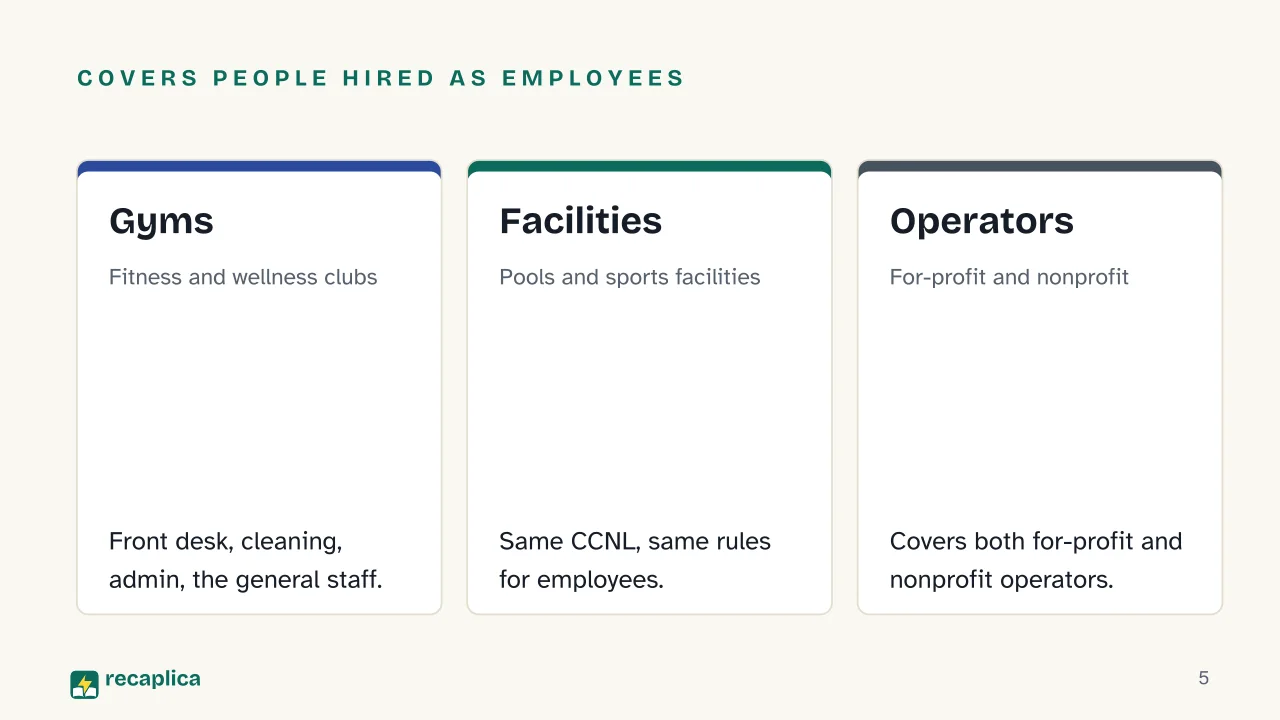
    It covers employees of gyms, fitness clubs, swimming pools and sports facilities.

    It applies to both for-profit and nonprofit operators, whenever they manage athletes or run sports, fitness and wellness activities. It does not cover self-employed collaborators, nor anyone holding sports worker status.

    Many of these organizations are nonprofit associations, a form close to Italy’s third sector. They still fall under the CCNL Impianti Sportivi e Palestre, not under a nonprofit-specific agreement.

    The distinction from sports worker status

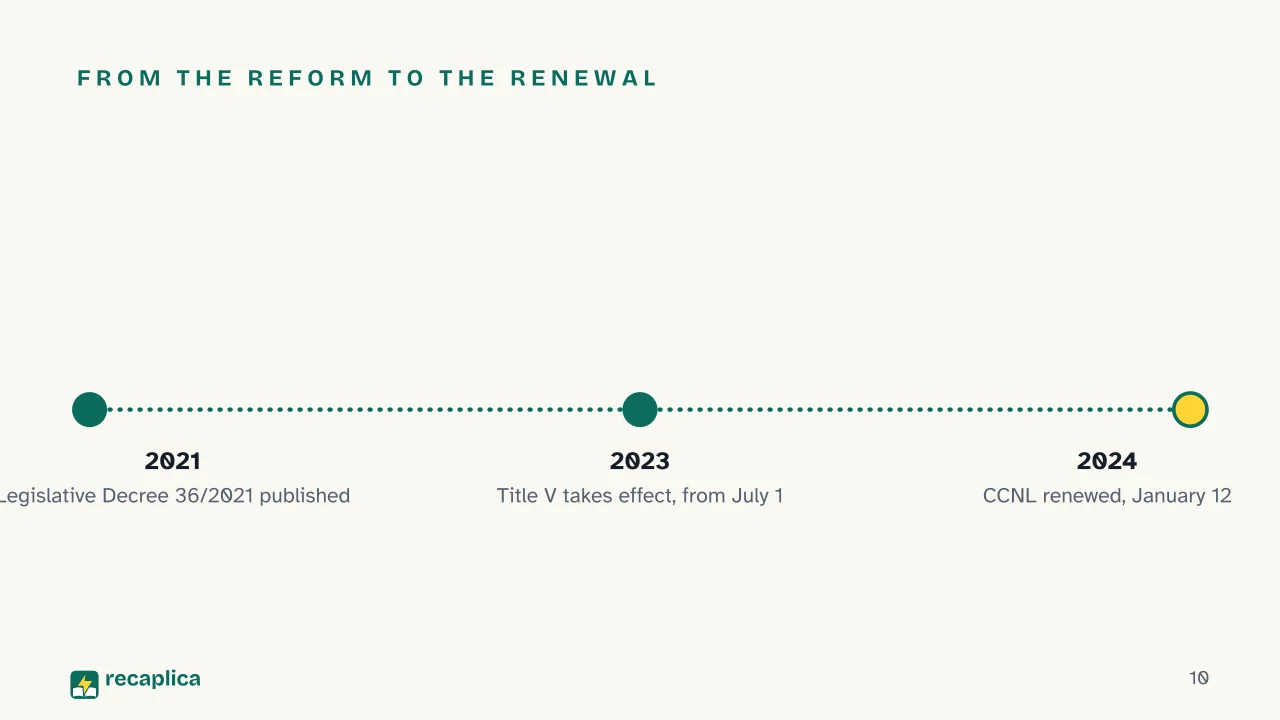
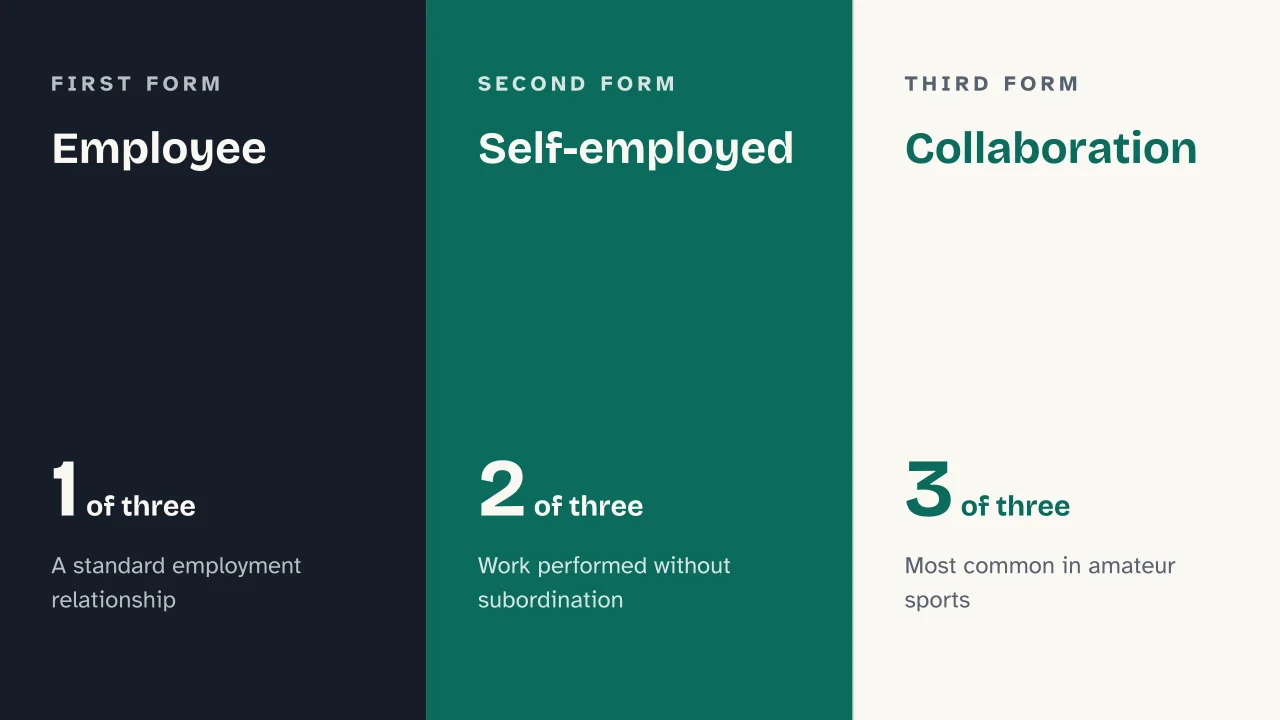
    Legislative Decree No. 36 of February 28, 2021, reformed sports employment in Italy, with Title V taking effect on July 1, 2023. The reform created the “sports worker” status: athlete, coach, instructor, technical or sports director, fitness trainer, competition director. Anyone holding this status, when tied to an organization in the recognized sports system - a federation, a sports promotion body, CONI, CIP, Sport e salute - can work as an employee, as self-employed, or under a coordinated and continuous collaboration. There is no single “sports collaborator” regime, then: the collaboration form is only one of three possible arrangements, and under Legislative Decree 36/2021 it is the most common one in amateur sports.

    Practical example: at the same gym, a receptionist is hired under the CCNL Impianti Sportivi e Palestre while a swimming instructor is classified as a sports worker under a coordinated collaboration, as set out in Legislative Decree 36/2021: same workplace, two contracts with different rules, because the law looks at the role performed, not the sector where it happens.

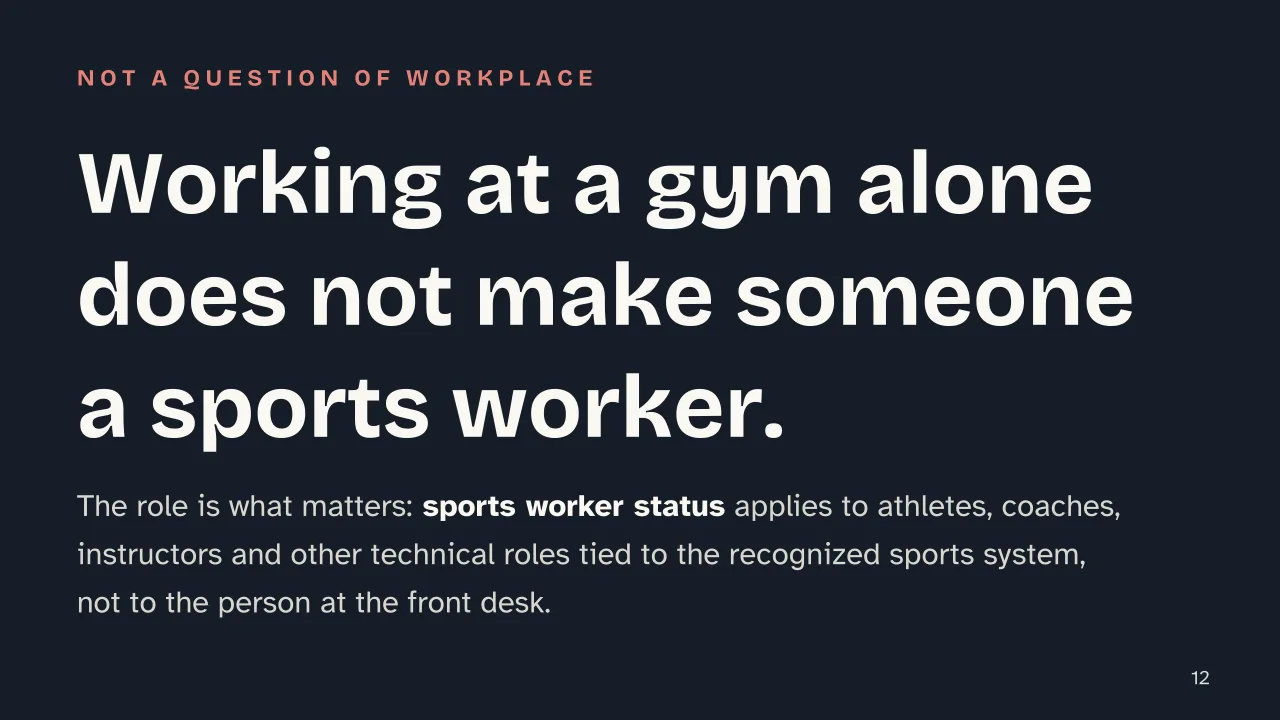
    This is where most of the confusion starts. The 2021 reform did not pull every worker in the sports sector under one umbrella: it defined a specific status, tied to technical sports functions recognized by an organization affiliated with the sports system. General staff at a gym - the front desk, cleaning, administration - do not fall under that status. They stay under ordinary labor law, meaning under the CCNL Impianti Sportivi e Palestre, regardless of the sports reform.

    The difference goes beyond the contract’s name. Whoever classifies staff at a sports facility first has to decide whether a given role falls under sports worker status or not: that choice determines whether the CCNL Impianti Sportivi e Palestre applies, with its rules on an employment contract, or one of the three arrangements under Legislative Decree 36/2021. A sports instructor can also choose, or be classified, as self-employed: in that case they are more likely to use a VAT number than a project-based contract.

    The 2024 renewal and amateur sports collaborators

    According to Wbox.it, the January 12, 2024, renewal also folded the sports employment reform into the contract, setting out within the same CCNL how coordinated and continuous collaborators working in amateur sports are paid. The same source reports that these collaborators get pay floors 25% above employees classified at the same level.

    The increase is not a bonus: it offsets the fact that a collaborator gets no overtime pay, no extra monthly installments, no paid vacation and no paid leave, benefits an employee is entitled to. The agreement tries to balance that gap through pay, while leaving the underlying protections of each regime as they are.

    Gyms and sports facilities in Italy therefore run under two labor rules: the CCNL for anyone hired as an employee, and Legislative Decree 36/2021 for anyone holding sports worker status. The same pattern shows up elsewhere in the labor market, where employees and collaborators share a workplace under separate contracts.

    Slide deck

    Slides ready to download and make your own in PowerPoint or Google Slides, with speaker notes. Pick the Flash cut or the Full one.
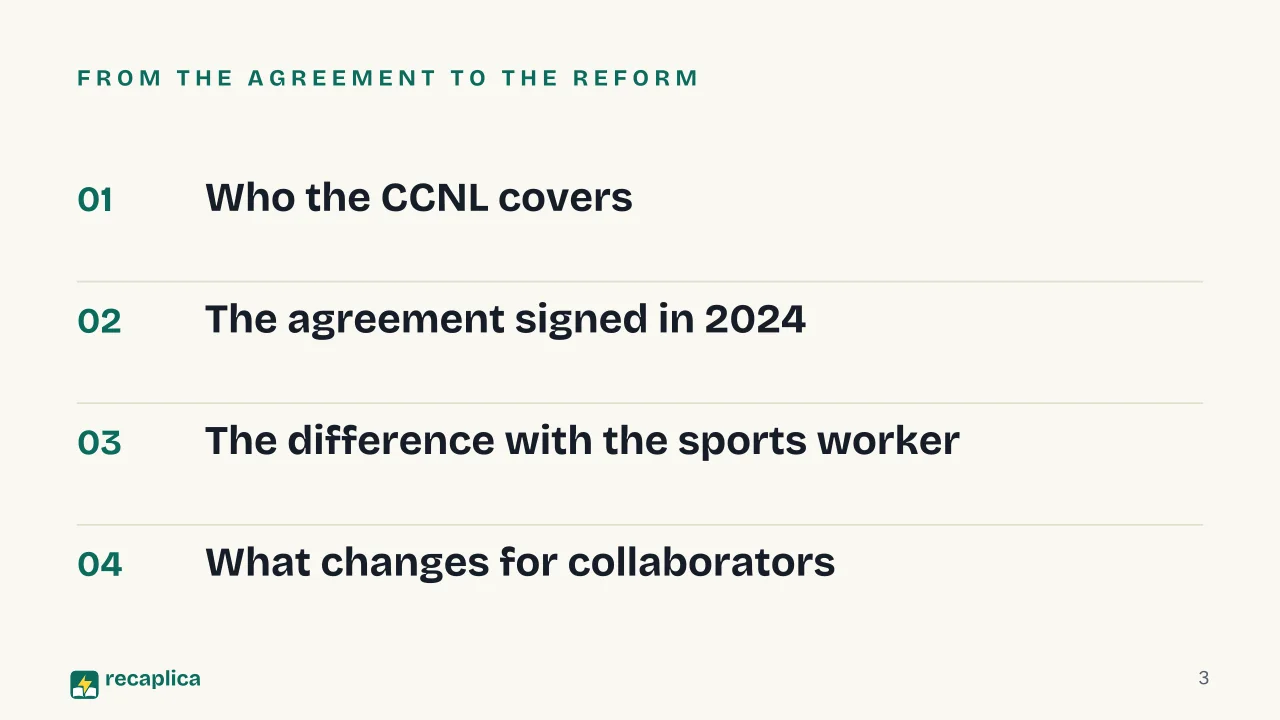
    Slide 1 of the presentation on Gym and Sports Facility Collective Agreement in Italy: Gym and Sports Facility Collective AgreementSlide 2 of the presentation on Gym and Sports Facility Collective Agreement in Italy: Does everyone working at a gym count as a sports worker?Slide 3 of the presentation on Gym and Sports Facility Collective Agreement in Italy: From the agreement to the reformSlide 4 of the presentation on Gym and Sports Facility Collective Agreement in Italy: Chapter 01: Who the CCNL coversSlide 5 of the presentation on Gym and Sports Facility Collective Agreement in Italy: Covers people hired as employees: Gyms, Facilities, OperatorsSlide 6 of the presentation on Gym and Sports Facility Collective Agreement in Italy: Chapter 02: The agreement signed in 2024Slide 7 of the presentation on Gym and Sports Facility Collective Agreement in Italy: Signed January 12, 2024, in Rome: Confcommercio, The unions, CNELSlide 8 of the presentation on Gym and Sports Facility Collective Agreement in Italy: The agreement in three numbersSlide 9 of the presentation on Gym and Sports Facility Collective Agreement in Italy: Chapter 03: The difference with sports workersSlide 10 of the presentation on Gym and Sports Facility Collective Agreement in Italy: From the reform to the renewalSlide 11 of the presentation on Gym and Sports Facility Collective Agreement in Italy: Same industry, different contractsSlide 12 of the presentation on Gym and Sports Facility Collective Agreement in Italy: Working at a gym alone does not make someone a sports worker.Slide 13 of the presentation on Gym and Sports Facility Collective Agreement in Italy: Chapter 04: What changes for collaboratorsSlide 14 of the presentation on Gym and Sports Facility Collective Agreement in Italy: Employee · Self-employed · CollaborationSlide 15 of the presentation on Gym and Sports Facility Collective Agreement in Italy: 25% higher pay floors for amateur sports collaborators.Slide 16 of the presentation on Gym and Sports Facility Collective Agreement in Italy: How many possible arrangements does Legislative Decree 36/2021 set for a sports worker?Slide 17 of the presentation on Gym and Sports Facility Collective Agreement in Italy: Read more
    Flash10 slidesThe essential thread, to present in classFull17 slidesEvery chapter and the deeper detail

    Common myths

    • ✗ Myth Anyone working at a gym falls under Italy's sports reform, Legislative Decree 36/2021.

      ✓ Reality The reform applies to the sports worker status - athletes, coaches, instructors, technical or competition directors - tied to organizations in Italy's recognized sports system. General staff, such as front-desk or administrative employees, stay under the CCNL Impianti Sportivi e Palestre instead.

    • ✗ Myth A sports collaborator is a single type of contract.

      ✓ Reality Legislative Decree 36/2021 actually allows three possible arrangements for a sports worker: employee, self-employed, or a coordinated and continuous collaboration. The collaboration form is only one of the three, though it is the one most amateur clubs rely on.

    • ✗ Myth Amateur sports collaborators earn less than employees at the same level.

      ✓ Reality According to Wbox.it, the 2024 renewal of the CCNL set their pay floors 25% above employees at the same level, since their collaboration status leaves out overtime, extra monthly pay, vacation time and paid leave.

    Mind map

    Drag the background to move around and the nodes to reposition them; use − and + to collapse and expand branches.
    Customize
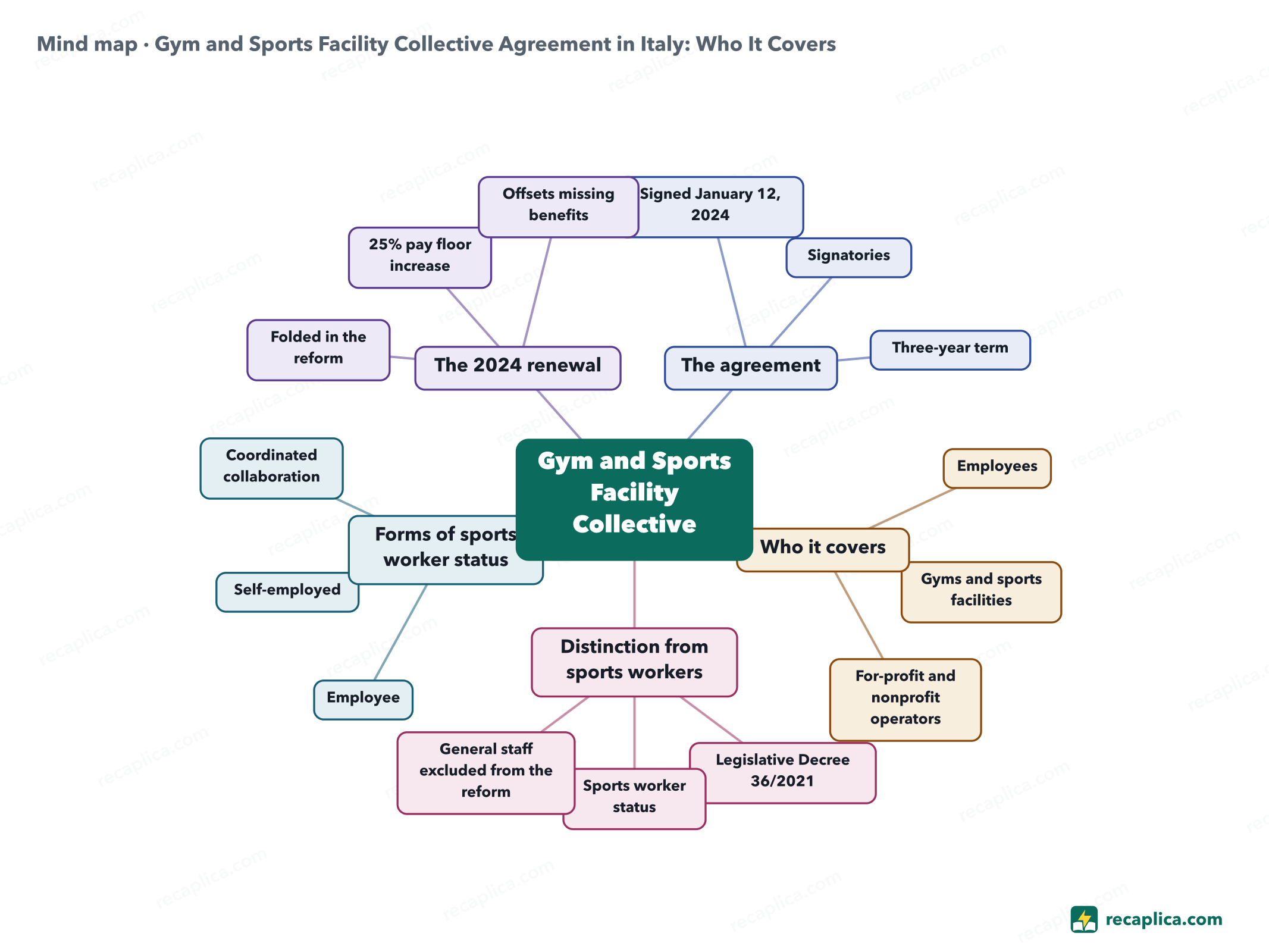
    Mind map: Gym and Sports Facility Collective Agreement in Italy: Who It Covers
    • Gym and Sports Facility Collective Agreement
      • The agreement
        • Signed January 12, 2024 In Rome
        • Signatories Confederazione italiana dello sport-Confcommercio, SLC-CGIL, FISASCAT-CISL, UILCOM-UIL
        • Three-year term From January 1, 2024 to December 31, 2026
      • Who it covers
        • Employees
        • Gyms and sports facilities
        • For-profit and nonprofit operators
      • Distinction from sports workers
        • Legislative Decree 36/2021 Italy's sports work reform
        • Sports worker status Athletes, coaches, instructors, technical and competition directors
        • General staff excluded from the reform Stay under the regular CCNL
      • Forms of sports worker status
        • Employee
        • Self-employed
        • Coordinated collaboration Most common in amateur sports
      • The 2024 renewal
        • Folded in the reform
        • 25% pay floor increase For amateur sports collaborators
        • Offsets missing benefits Overtime, extra installments, vacation, paid leave

    Quiz: test yourself

    Answer the questions to check what you have learned: you get instant feedback and a short explanation.

    Grade 0/10 0/5
    1 Who does the CCNL Impianti Sportivi e Palestre cover?

    The agreement covers people hired as employees at gyms, fitness clubs or sports facilities, not self-employed collaborators or sports workers.

    2 When was the CCNL Impianti Sportivi e Palestre in force since 2024 signed?

    The agreement was signed in Rome on January 12, 2024, and runs for three years, through December 31, 2026.

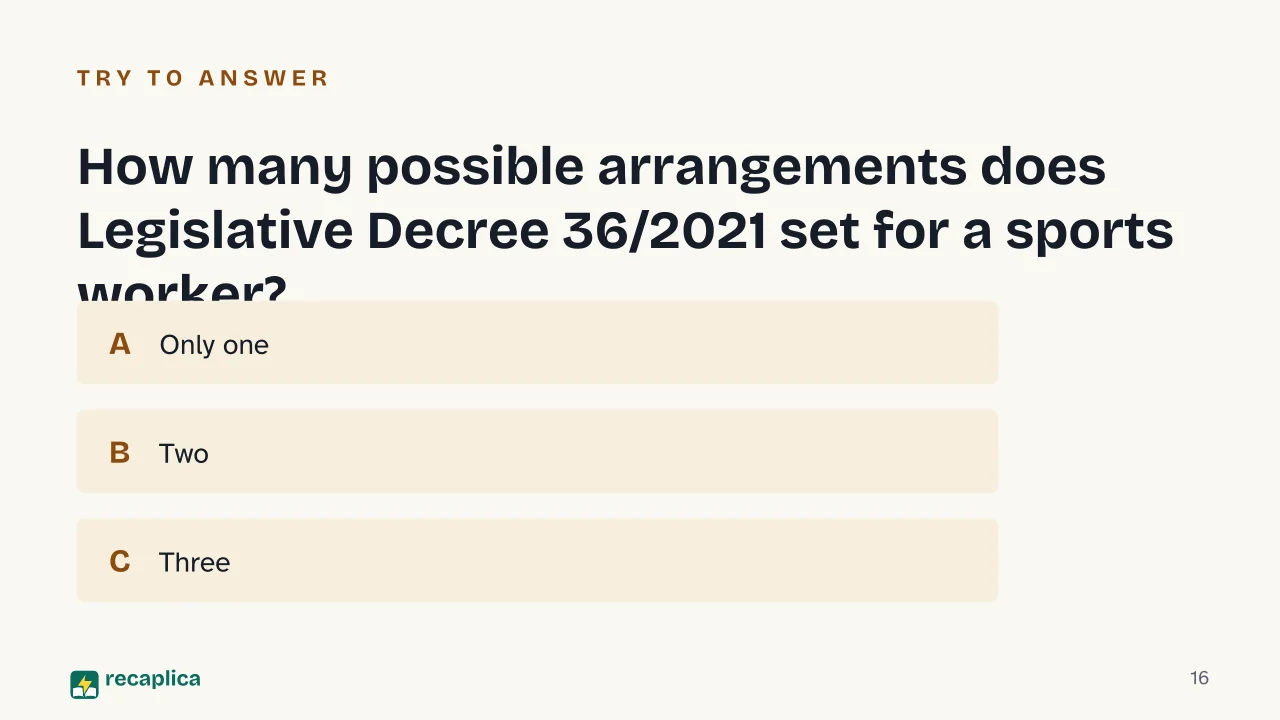
    3 Under Legislative Decree 36/2021, how many possible arrangements can a sports worker have?

    The reform allows three possible arrangements for a sports worker, not a single regime; the coordinated collaboration form is the most common one in amateur sports.

    4 True or false: a receptionist working at a gym automatically counts as a sports worker under Legislative Decree 36/2021.

    The sports worker status applies to athletes, coaches, instructors and other technical sports roles tied to the recognized sports system; general staff stay under the regular CCNL.

    5 What does the 2024 CCNL renewal set for amateur sports collaborators, according to Wbox.it?

    The increase offsets the fact that collaborators get no overtime pay, extra monthly installments, paid vacation or paid leave, unlike employees.

    Answers: 1-A · 2-A · 3-C · 4-B · 5-A

    Flashcards

    Tap the card to flip it and check whether you remember the answer, then move to the next one.

    1 / 6

    Explain it in your own words

    The ultimate test: if you can explain it in simple words, you've truly understood it. Write your explanation, then compare it with the Recap.

    Your explanation is saved only on this device.

    Italy's national collective agreement for gyms and sports facilities, known as the CCNL Impianti Sportivi e Palestre, sets the employment rules for people hired as staff at gyms, fitness clubs and sports centers. It does not cover people working under Italy's separate sports worker status, created by Legislative Decree 36/2021. The version in force was signed on January 12, 2024, and runs through December 31, 2026. That same renewal also set pay rules for amateur sports collaborators, while the agreement itself remains one for employees.

    Frequently asked questions

    What is the CCNL Impianti Sportivi e Palestre?

    It is Italy's national collective agreement governing employment at gyms, fitness clubs and sports facilities. The version in force was signed on January 12, 2024, in Rome.

    Who is covered by the CCNL Impianti Sportivi e Palestre?

    People hired as employees by gyms, fitness clubs, swimming pools and sports facilities, whether run by for-profit or nonprofit operators.

    What is the difference between a gym employee and a sports collaborator in Italy?

    A gym employee is covered by the CCNL Impianti Sportivi e Palestre. A sports collaborator instead holds sports worker status under Legislative Decree 36/2021 and can be classified as an employee, self-employed, or under a coordinated collaboration - a separate and distinct regime.

    How long does the CCNL signed in 2024 last?

    The agreement runs for three years and stays in force through December 31, 2026.

    Sources

    • CCNL Impianti Sportivi e Palestre (full text, signed 01/12/2024)
    • Legislative Decree No. 36 of February 28, 2021 - Normattiva
    • Wbox.it - Harmonizing the new gym and sports facility CCNL with the sports reform (02/20/2024)
    • EC News - Sports and administrative co.co.co. contracts: the applicable CCNL and minimum pay

    Every Recap goes through an independent review before publication.

    Every evening, the day's new Recaps on our Telegram channel. Join the channel →

    Keep learning

    • Civics Sports Collaboration Contract in Italy: Rules, Pay and Tax Italy's sports collaboration contract is the self-employment arrangement that Legislative Decree 36/2021 set up for anyone who coaches, instructs or works for an ASD or SSD, the two legal forms an Italian amateur sports club can take. When the work is ongoing but stays under 24 hours a week, competitions aside, and follows the technical rules of a sports federation, the law treats it as a co.co.co, a coordinated and continuous collaboration; a club or worker can still show the real relationship is different. The worker signs up for INPS's Gestione separata scheme on their own, and pay above certain thresholds changes both the tax and the social security treatment. The role is separate from the administrative co.co.co that also exists inside an ASD, which does not carry the same presumption. Read the Recap →
    • History The History of Football Rules: From 1863 to VAR Football as we know it began in London in 1863, when twelve clubs founded the Football Association and wrote down the first shared set of rules. From there the game changed piece by piece: goalkeepers were formalized, the crossbar arrived, offside was relaxed step by step, and the penalty kick grew out of two disputed incidents in Scotland and England. Cards and VAR are even more recent inventions, created to solve problems that had shown up on the pitch. IFAB, the body that has decided the rules since 1886, brings together the British football associations and FIFA. Read the Recap →
    • History Table Tennis Rules: How Ping Pong Works, from the Table to Scoring Table tennis, known worldwide as ping pong, started out as a parlour game in Victorian England in the 1880s, when the upper class played it after dinner with whatever was lying around. The name "Ping-Pong" arrived in 1901, when the games company Jaques of London trademarked it, inspired by the sound the ball made against paddle and table. The official rules, set out by the International Table Tennis Federation in its 2025 statutes, define the table's size, the net's height, the ball's specifications and the scoring system, where a game is won at 11 points. The sport only made it to the Olympics in 1988, in Seoul, decades after becoming a Paralympic event in 1960. Along the way, the ball itself changed twice, first in size and then in material, for reasons of both play and safety. Read the Recap →

    recaplica

    Clear in 30 seconds, yours in 10 minutes.

    Recaps Mind maps Request a Recap Telegram channel Mind map maker Our method About Privacy & cookies Legal notes & terms of use

    © 2026 Recaplica · A project by Curi S.r.l. — VAT IT05472000750

    Statistics, only if you say so

    To learn which Recaps help most we would use Google Analytics, with aggregate, anonymous data. It starts only with your OK, and you can change your mind anytime. Privacy policy