|
recaplica
The History of Football Rules: From 1863 to VAR | ||||||||||
| © 2026 Recaplica · recaplica.com — All rights reserved | ||||||||||
The History of Football Rules: From 1863 to VARWhat to print Page numbers appear when printing with default margins. SlidesChoose a cut Flash10 slidesThe essential thread, to present in classFull19 slidesEvery chapter and the deeper detailBoth come with speaker notes. In 30 seconds quick readFootball as we know it began in London in 1863, when twelve clubs founded the Football Association and wrote down the first shared set of rules. From there the game changed piece by piece: goalkeepers were formalized, the crossbar arrived, offside was relaxed step by step, and the penalty kick grew out of two disputed incidents in Scotland and England. Cards and VAR are even more recent inventions, created to solve problems that had shown up on the pitch. IFAB, the body that has decided the rules since 1886, brings together the British football associations and FIFA. Key Points
Key figures
Deep DiveWatching a football match, it looks like a simple game: two goals, a ball, eleven players a side. But the rulebook that makes all of it possible — offside, penalties, cards, VAR — did not appear fully formed. It is the product of more than a century and a half of adjustments, many of them made after a disputed incident on the pitch had exposed a gap in the existing rules. Before the Football Association: school rulesBefore 1863 there was no single version of football: every English school played by its own rules, some close to rugby (the ball could be carried by hand), others closer to the modern game. A first attempt to bring order came with the Cambridge Rules of 1848, written by fourteen representatives from schools such as Eton, Rugby, Winchester, Shrewsbury, and Harrow, meeting in Henry Charles Malden’s rooms at Trinity College, Cambridge. The original rules have not survived in written form: what is known comes from Malden’s own recollections, which describe how they were followed and how, years later, someone picked them up and turned them “with very slight alterations” into the rules of the Football Association. Among the main bans were “carrying” (catching the ball with the hands) and “hacking” (kicking an opponent’s shins) — two practices that would return to the center of the debate fifteen years later, in London. 1863: the Football Association is bornOn the evening of Monday 26 October 1863, twelve London clubs met at the Freemasons’ Tavern on Great Queen Street to found the Football Association. Among them were Barnes, Crystal Palace, Blackheath, and the Civil Service FC, the only founding club still in existence. At the center of the project was Ebenezer Cobb Morley, a London lawyer who had founded Barnes FC the previous year and argued for the need for “a definite code of rules,” taking cricket as his model. It took six meetings over 44 days to reach a shared text, and the sharpest dispute was over hacking: Blackheath wanted to keep it as part of the game, but the opposing view won out. That choice had a consequence reaching beyond football: supporters of the rougher game, dissatisfied, went their own way and, among other factors of the period, helped give rise to rugby as a separate sport. The final laws were approved on 8 December 1863, and the first official match, Barnes against Richmond, was played eleven days later, on 19 December, ending 0-0.
A rulebook built piece by pieceThe Football Association’s rules did not stay still. In 1866 offside was relaxed, raising the threshold to three defenders between the attacker and the goal, instead of the extremely strict starting line. The goalkeeper role arrived in 1871, the goal kick in 1869, the corner kick in 1872, and the referee’s whistle, used for the first time in 1878, changed the way matches were run — before that, referees had to make themselves heard by voice or with a handkerchief. Meanwhile football was spreading beyond England’s borders, and with that spread came early problems of consistency: every association applied the rules its own way in international matches. To fix that, on 2 June 1886, the International Football Association Board, IFAB, was formed in Manchester, aiming to give England, Scotland, Wales, and Northern Ireland one shared set of rules. FIFA, founded a few years later, adopted IFAB’s framework in 1904 and gained its own voting weight in 1913. The voting system, set in 1958, still reflects that historical balance: the four British associations get one vote each, FIFA gets four, and changing a rule requires at least six of the eight votes — FIFA’s support alone is not enough; at least two British associations have to back it too. IFAB is headquartered in Zurich and meets twice a year. The code born in London in 1863 took shape over the following decades of Victorian England. Offside: a rule rewritten again and againFew football rules have changed shape as much as offside. Here is how it evolved, according to the Laws of the Game:
Each step shifted the balance between attack and defense: the stricter versions rewarded defensive cover, the more recent ones favor attacking play. The penalty kick: born from two disputed incidentsThe penalty kick was not dreamed up on paper; it grew out of a real problem. It was proposed in 1890 by William McCrum, a goalkeeper and businessman from Milford, in County Armagh, Northern Ireland. The Irish Football Association brought the proposal to IFAB that same year, but the decision was postponed. Two incidents during the 1890-91 season made the gap in the rules impossible to ignore: on 20 December 1890, in a Scottish Cup match, Jimmy Adams punched away a ball heading under the crossbar; on 14 February 1891, in an FA Cup round, a Notts County player committed an obvious handball on the goal line. In neither case was there any specific punishment for such a serious foul inside the penalty area. On 2 June 1891 IFAB approved the rule, and the first penalty in history was awarded just five days later, on 6 June, to Airdrieonians against Royal Albert. In 1891 the penalty had a different shape from the one fixed in 1902: it could be taken “from any point 12 yards from the goal line,” with no fixed spot. The penalty spot itself arrived only in 1902, together with the modern penalty area. Other details were added in the years that followed: in 1892 the kicker was banned from touching the ball twice in a row, in 1896 the ball had to be kicked forward, in 1905 the goalkeeper was required to stay on the goal line, in 1923 other players had to stand at least 10 yards from the spot, in 1997 the goalkeeper was allowed to move along the line before the kick, and in 2016 new rules arrived covering feints and infringements during the kick. Yellow and red cards: an idea born at a traffic lightThe card system, too, grew out of a real incident rather than a plan drawn up in advance. At the 1966 World Cup in England, during England against Argentina on 23 July, German referee Rudolf Kreitlein sent off Argentine captain Antonio Rattín in the 35th minute. Rattín did not understand the decision right away — there was no clear visual signal — and stayed on the pitch for seven to ten minutes before leaving. In the same tournament, England’s Charlton brothers did not even know whether they had been booked, because there was no way to communicate with the German referee. Ken Aston, the referees’ chief for that World Cup, was driving home from Wembley when he stopped at a traffic light on Kensington High Street in London. That stop is where the idea of a color-based system came from: red for serious misconduct, yellow for a lesser offense, understandable anywhere without a word being said. The system made its official debut at the 1970 World Cup in Mexico; the first red card in World Cup history came in 1974, shown to Chile’s Carlos Caszely in a match against West Germany. From VAR to the most recent rulesThe changes did not stop in the twentieth century. In 2016 IFAB approved the first trials of the Video Assistant Referee, tested for the first time in an official top-level match on 21 September 2016, in a round of the KNVB Cup, the Dutch domestic cup. Formal approval within the Laws of the Game came on 3 March 2018, and the 2018 FIFA World Cup in Russia was the first edition of the tournament to use it. The protocol limits VAR to reviewing “clear and obvious errors” or “serious missed incidents,” and only within four categories: goals, penalty decisions, direct red cards, and cases of mistaken identity for a sanctioned player. IFAB also oversees other technologies, such as Goal Line Technology, which determines whether the ball has crossed the goal line, and roles such as additional assistant referees. The rules keep being revisited: after full overhauls in 1938 (led by Stanley Rous) and 1997, in 2025 the maximum time a goalkeeper can hold the ball in their hands was changed, extended from 6 to 8 seconds.
A few more milestonesNot everything about football’s origins is about written rules: the game’s growth ran alongside the birth of its first competitions. In 1871 Charles Alcock, then secretary of the FA, proposed the FA Cup, which drew 15 entries in its first edition; the 1872 final, Wanderers against Royal Engineers, 1-0 at the Kennington Oval in front of 2,000 spectators, remains the first cup final in the history of codified football. Around the same time, on 30 November 1872, the first official international match was played, England against Scotland, which also ended 0-0. Professionalism was legalized in English football in 1885, and in 1888 the Football League was founded, the first regularly organized championship. Slide deckSlides ready to download and make your own in PowerPoint or Google Slides, with speaker notes. Pick the Flash cut or the Full one.    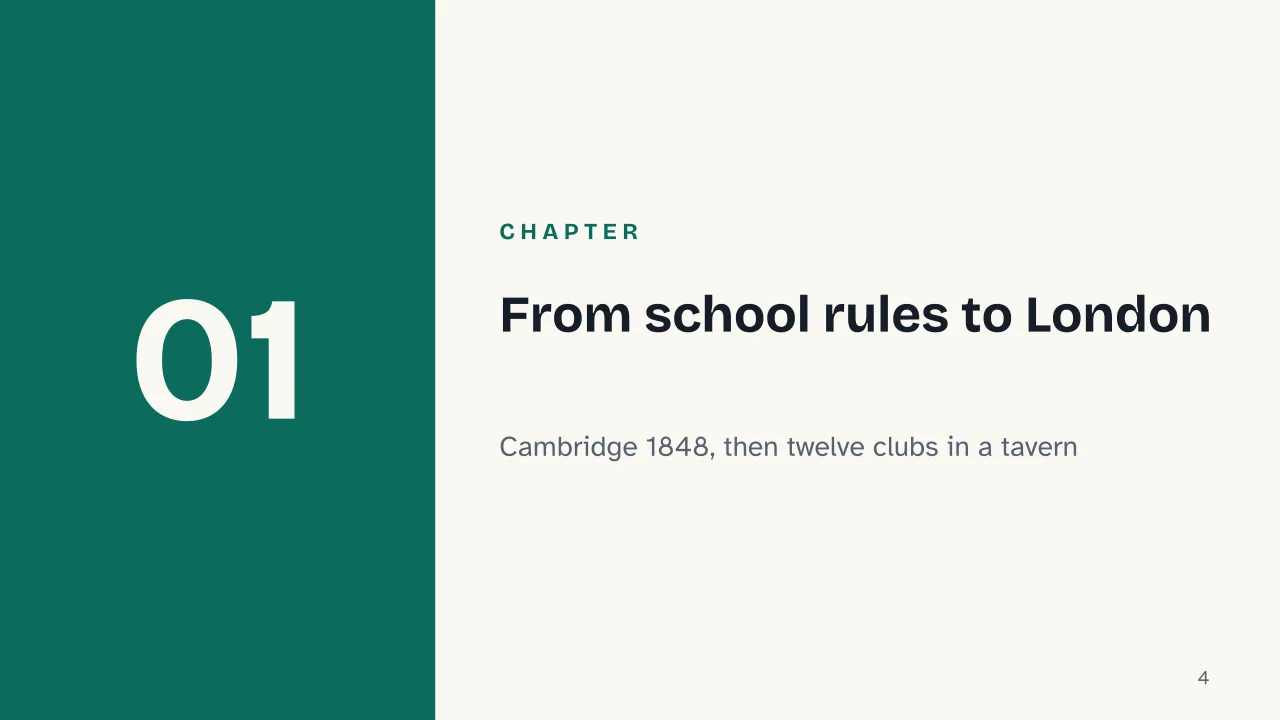 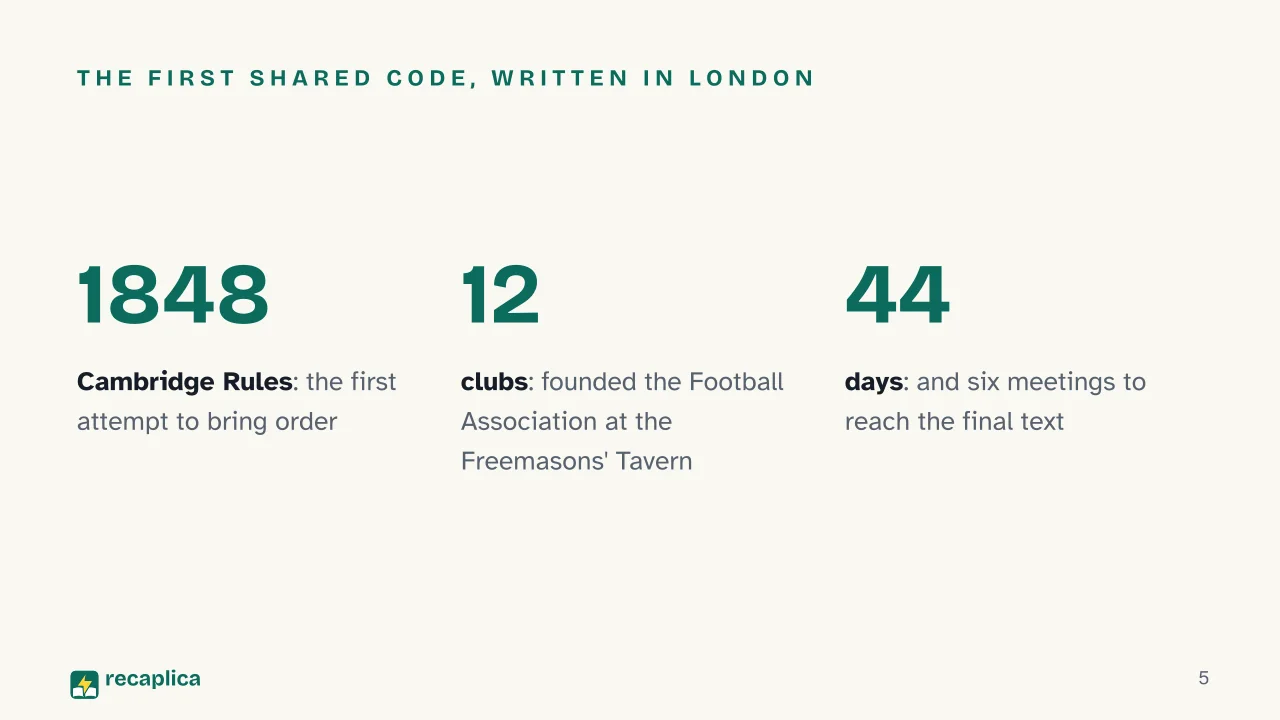 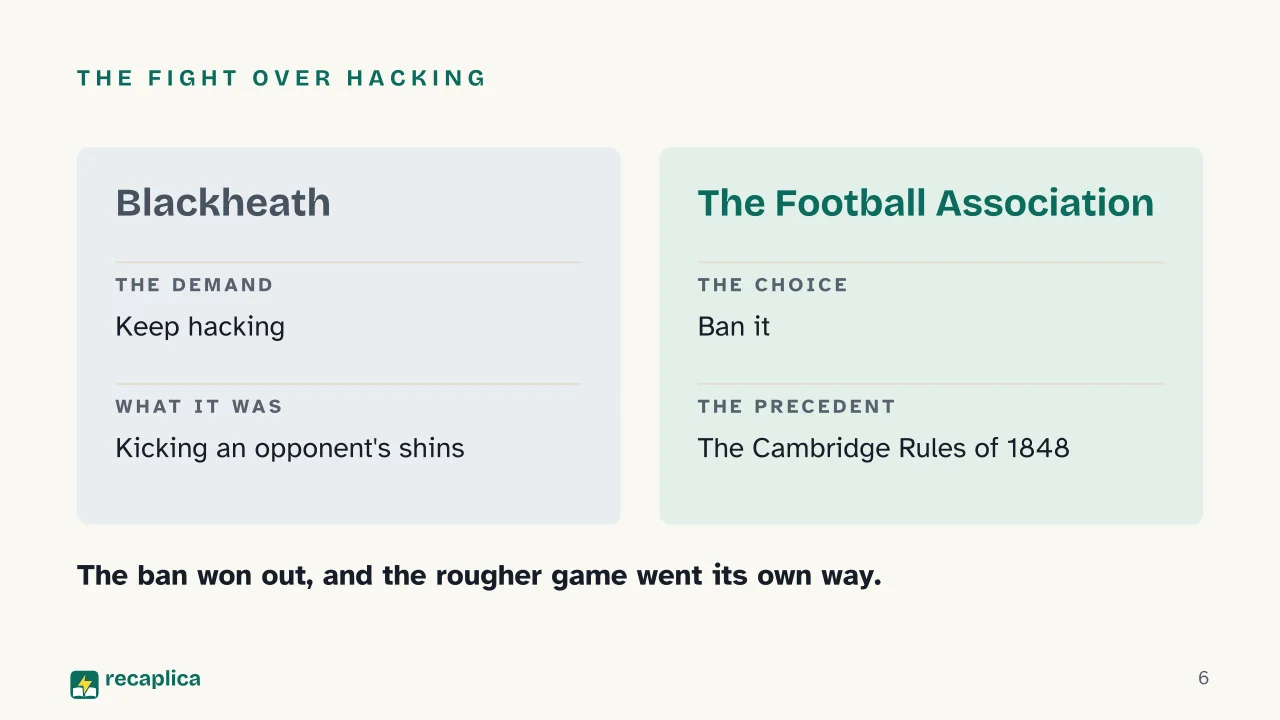  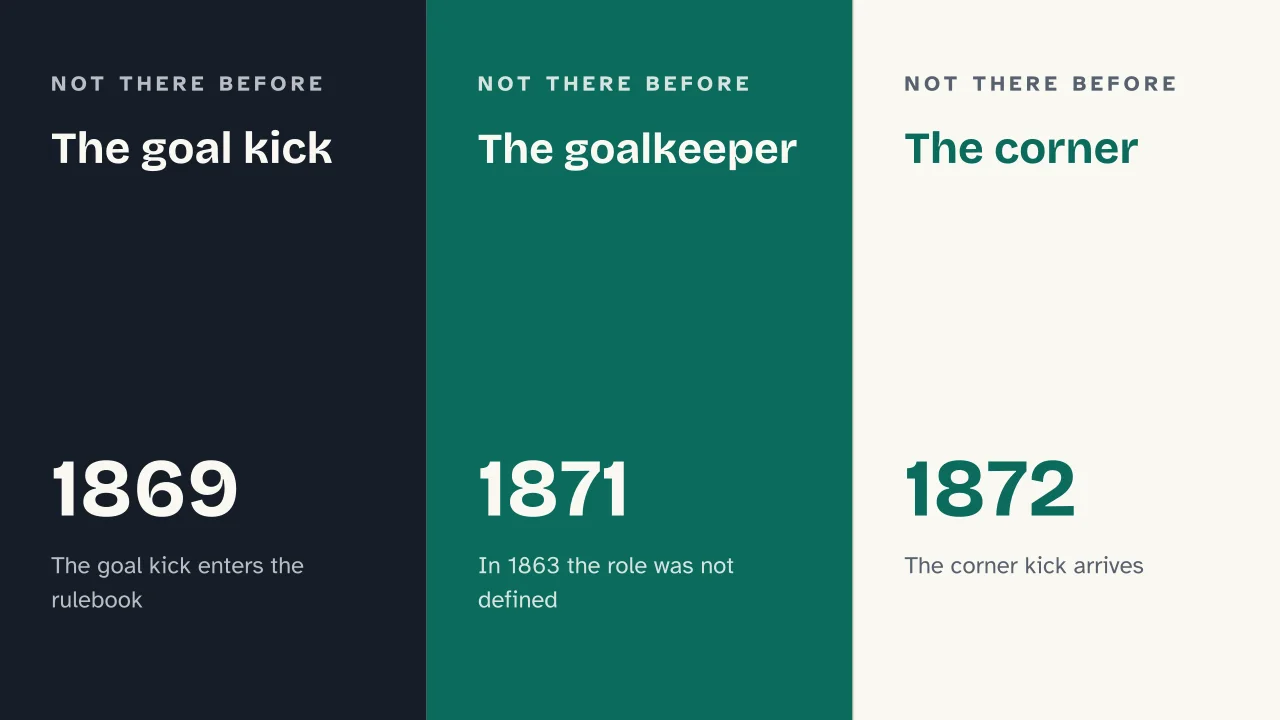 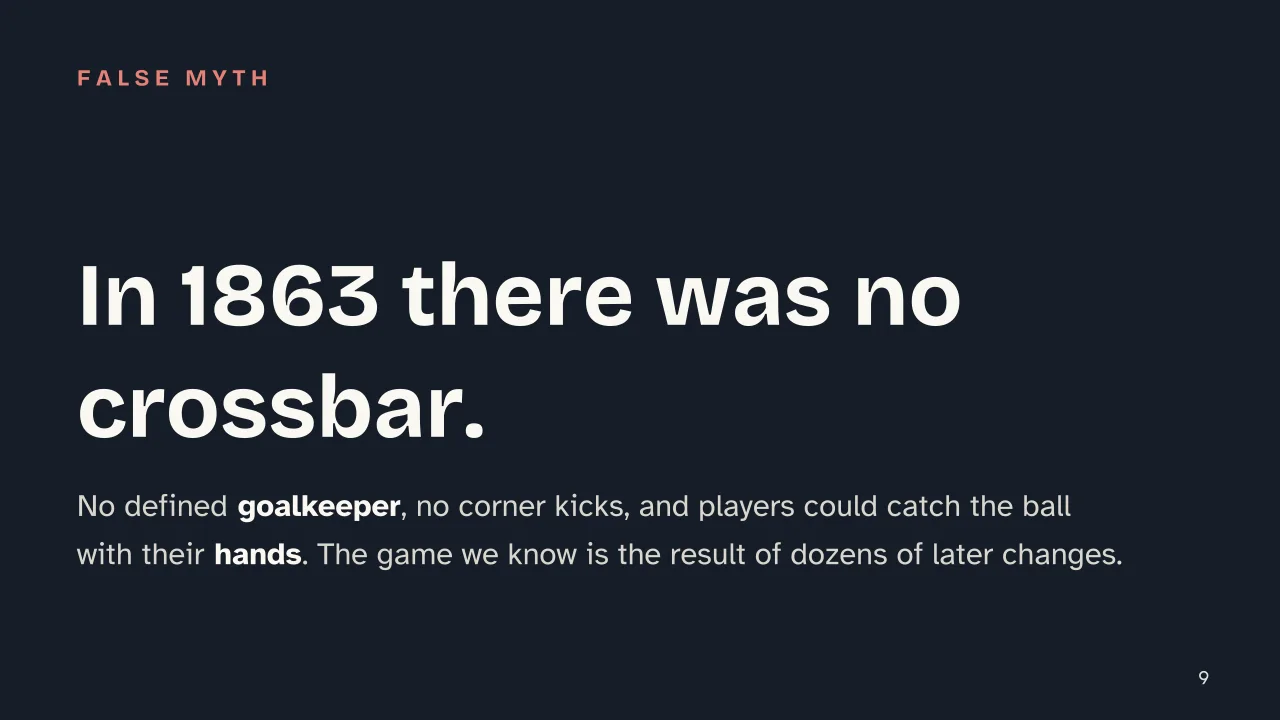  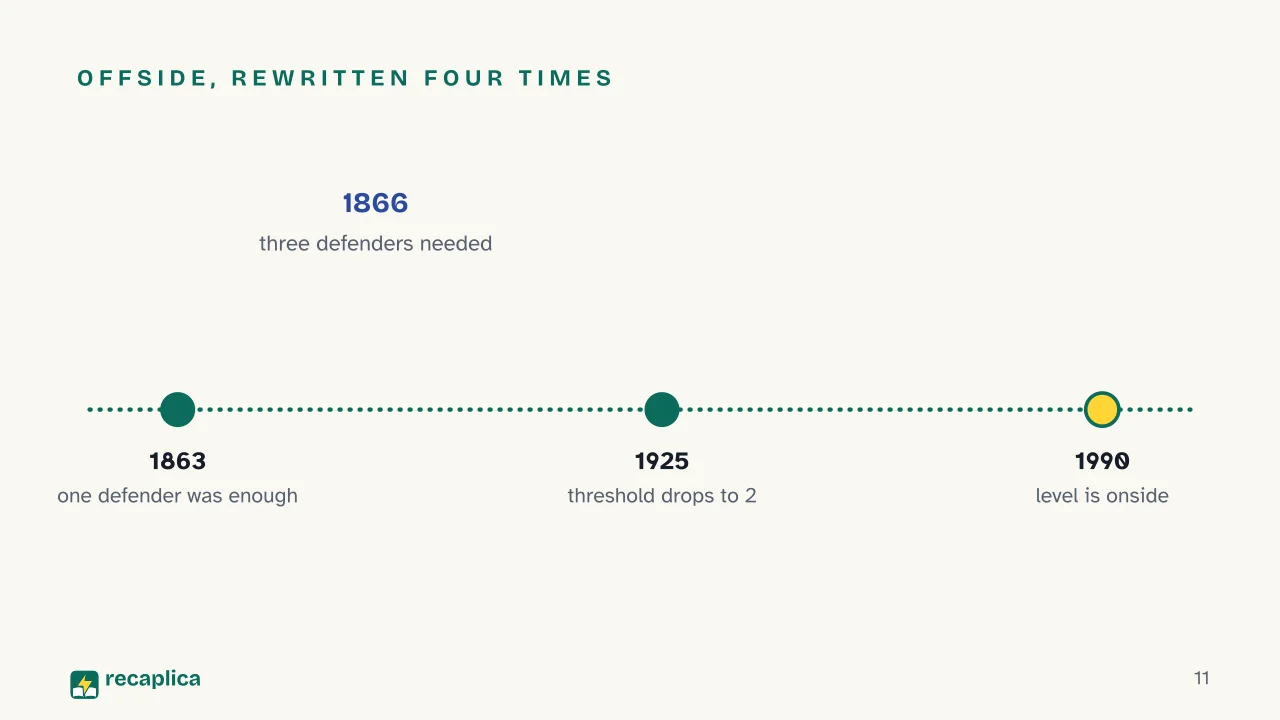 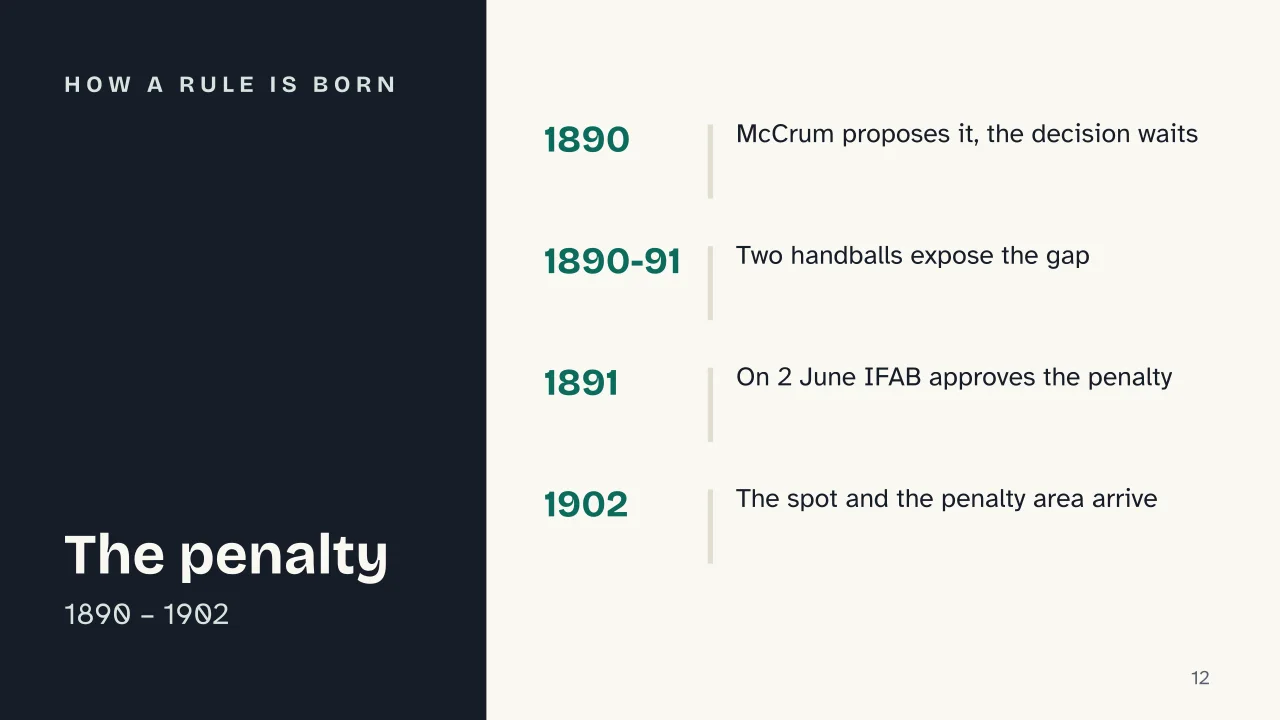   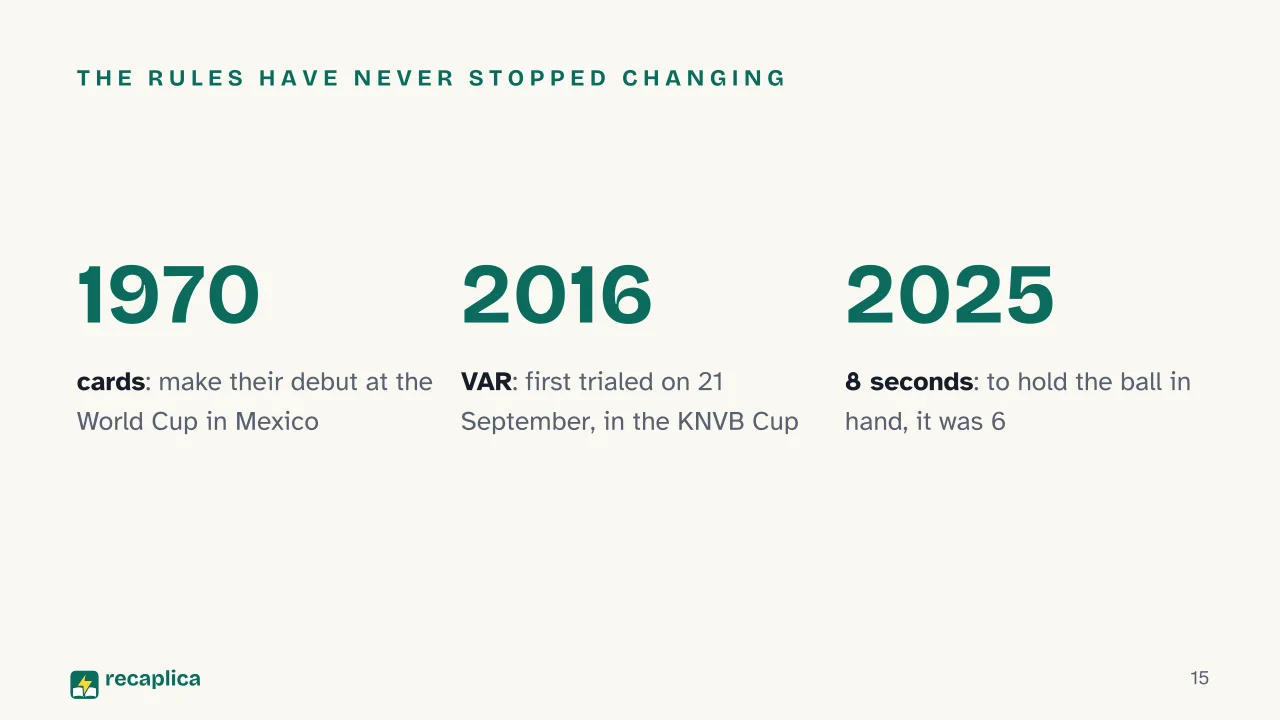 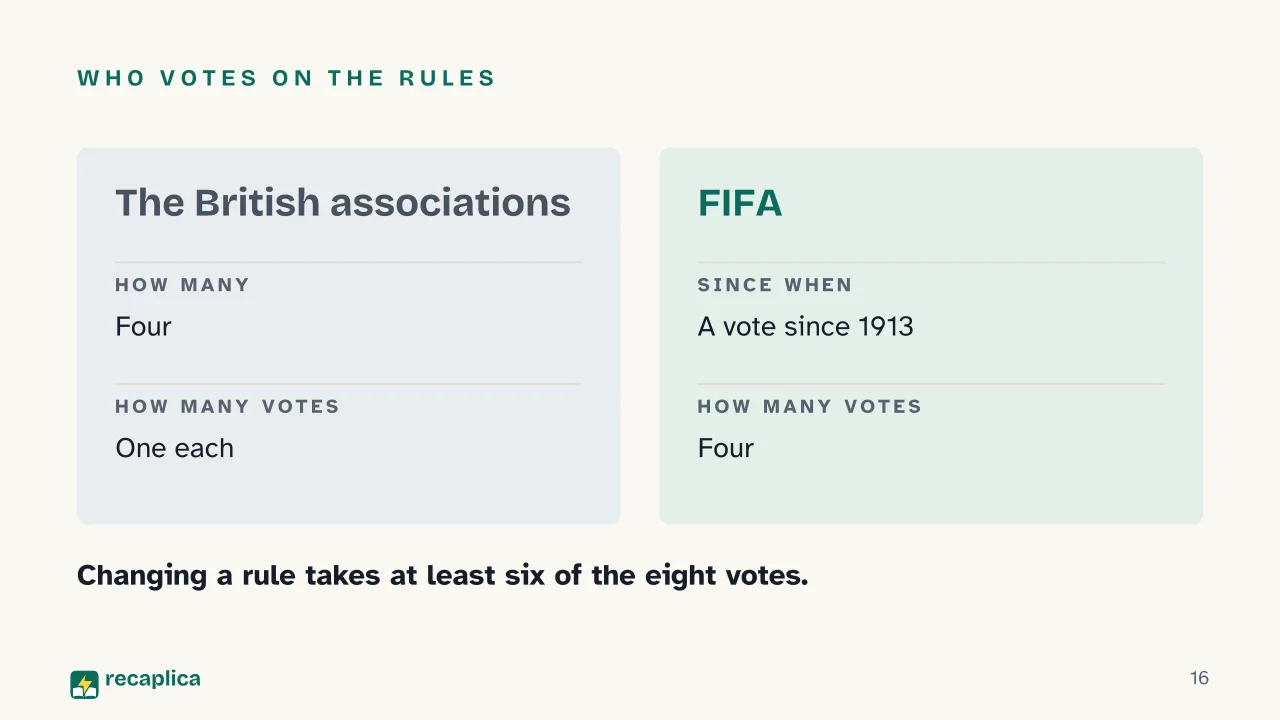 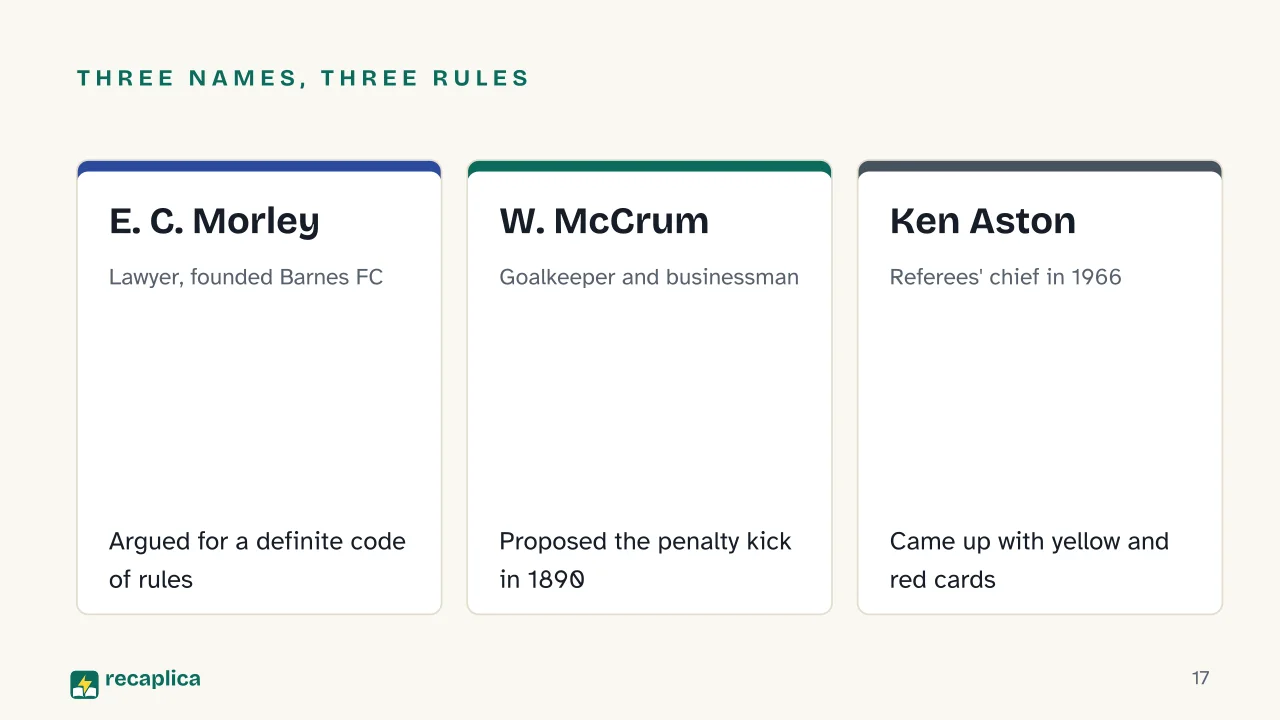 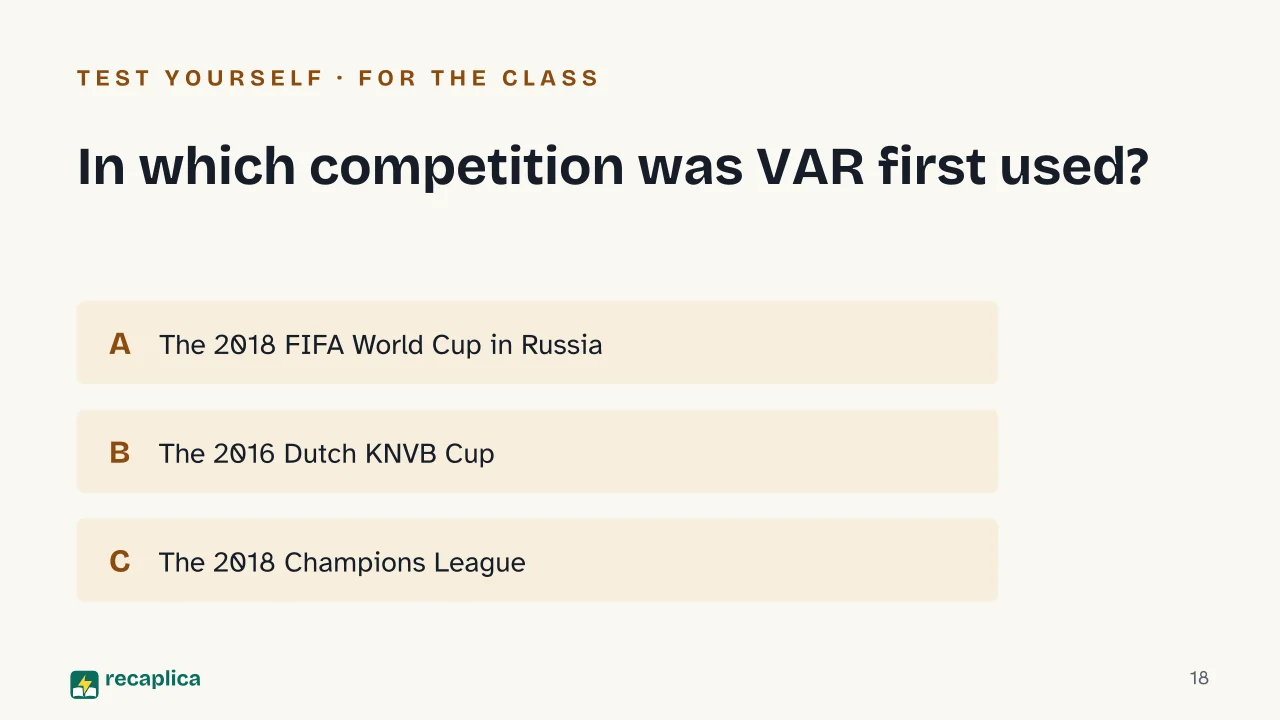  Common myths
Mind mapDrag the background to move around and the nodes to reposition them; use − and + to collapse and expand branches. 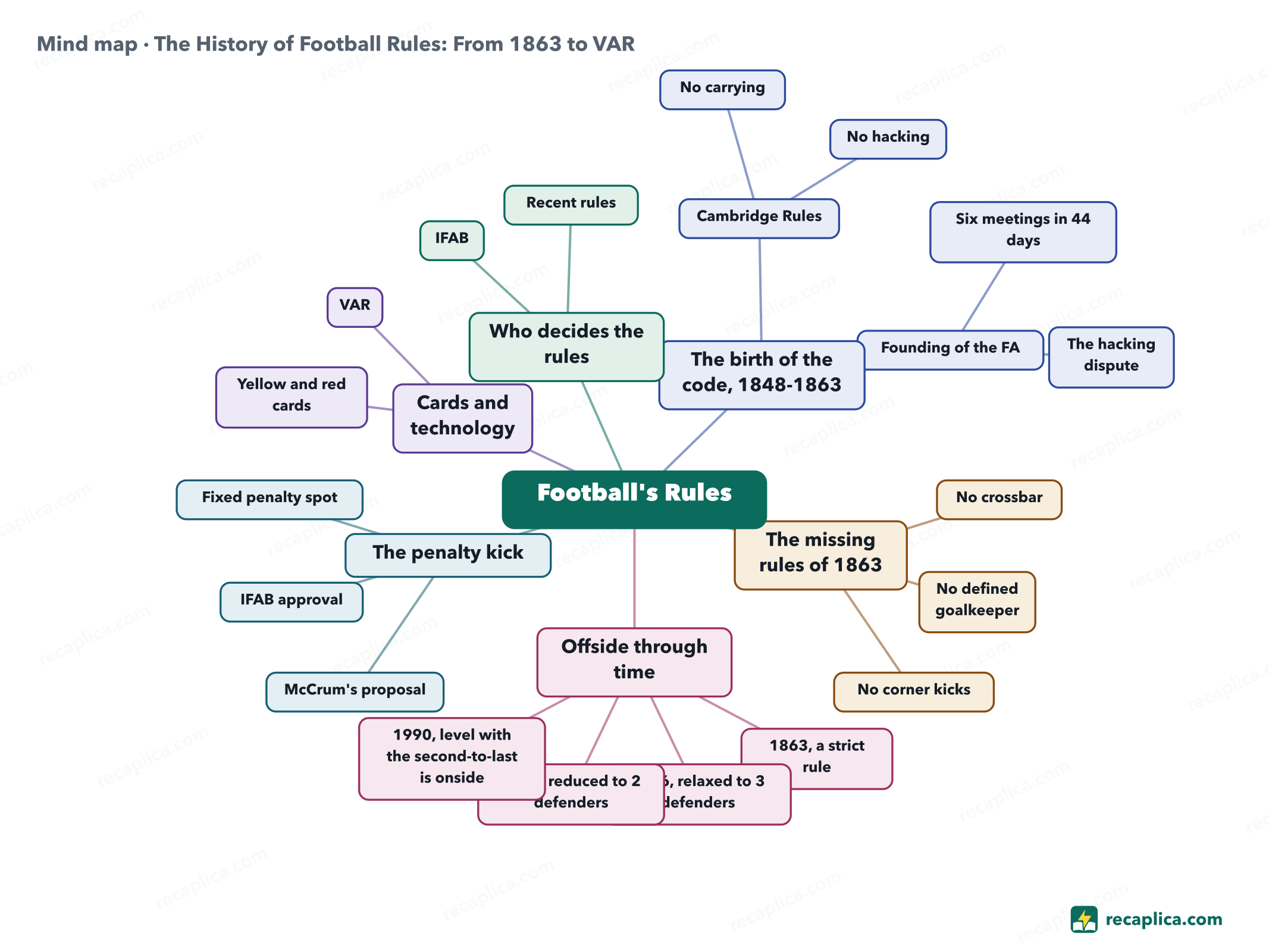
Quiz: test yourselfAnswer the questions to check what you have learned: you get instant feedback and a short explanation. Grade 0/10 0/5
FlashcardsTap the card to flip it and check whether you remember the answer, then move to the next one. 1 / 8 Explain it in your own wordsThe ultimate test: if you can explain it in simple words, you've truly understood it. Write your explanation, then compare it with the Recap. Your explanation is saved only on this device.
Frequently asked questionsWho invented the rules of football?Not a single person: the first rules to be written down and circulated were the Cambridge Rules of 1848, drafted by representatives from English schools such as Eton, Rugby, and Harrow. The code that gave rise to the modern game, though, dates to 1863, when twelve London clubs founded the Football Association, with Ebenezer Cobb Morley as the driving force behind the project. When was offside introduced in football?Offside has existed since the first rules of 1863, though in a much stricter form than the modern game. It was relaxed in 1866 (three defenders between the attacker and the goal were enough, instead of more), again in 1925 (two defenders), and in 1990, when a player level with the second-to-last defender was ruled onside. When was the penalty kick introduced?The penalty kick was approved by IFAB on 2 June 1891, on a proposal by Irishman William McCrum. The first penalty in history was awarded just days later, on 6 June 1891, in a match between Airdrieonians and Royal Albert. Why does football use yellow and red cards?The idea came from Ken Aston, the referees' chief at the 1966 World Cup in England, after a player who had been sent off failed to understand the referee's decision because there was no clear visual signal. Driving home, Aston thought of a traffic-light system after stopping at a set of lights in London; cards were officially introduced at the 1970 World Cup in Mexico. Who decides football's rules?IFAB, the International Football Association Board, founded in 1886 in Manchester to standardize the rules among the British football associations. Its members are the football associations of England, Scotland, Wales, and Northern Ireland, one vote each, and FIFA, which holds four votes; changing a rule requires at least six of the eight votes. Every Recap goes through an independent review before publication. |