|
recaplica
Table Tennis Rules: How Ping Pong Works, from the Table to Scoring | ||||||||||||||||
| © 2026 Recaplica · recaplica.com — All rights reserved | ||||||||||||||||
Table Tennis Rules: How Ping Pong Works, from the Table to ScoringWhat to print Page numbers appear when printing with default margins. SlidesChoose a cut Flash10 slidesThe essential thread, to present in classFull18 slidesEvery chapter and the deeper detailBoth come with speaker notes. In 30 seconds quick readTable tennis, known worldwide as ping pong, started out as a parlour game in Victorian England in the 1880s, when the upper class played it after dinner with whatever was lying around. The name "Ping-Pong" arrived in 1901, when the games company Jaques of London trademarked it, inspired by the sound the ball made against paddle and table. The official rules, set out by the International Table Tennis Federation in its 2025 statutes, define the table's size, the net's height, the ball's specifications and the scoring system, where a game is won at 11 points. The sport only made it to the Olympics in 1988, in Seoul, decades after becoming a Paralympic event in 1960. Along the way, the ball itself changed twice, first in size and then in material, for reasons of both play and safety. Key Points
Key figures
Deep DiveA game invented to kill an eveningIn Victorian England in the 1880s, among an upper class with both the leisure time and the houses large enough to clear a table after dinner, a pastime was born that would eventually turn into a sport played worldwide: table tennis. Early versions were homemade, built from whatever was on hand — stacked books served as a net, cigar box lids doubled as paddles, and champagne corks were carved into makeshift balls. It was more an age of scattered patents than a single invention. In 1883 the company Slazenger filed a patent for a net built specifically for the tabletop game; in 1890 David Foster put together his own version of the game. It was Jaques of London, though, a games company founded in 1795, that sold the first genuinely standardised set in the 1890s, marketed under the name “Gossima.” 1901, the year of ping and pongThe real leap came in 1901, when several changes landed within months of each other. James W. Gibb, returning from a trip to the United States, came across celluloid balls and realised they suited the tabletop game perfectly — light and bouncy. That same year E.C. Goode invented the modern paddle, gluing a sheet of pimpled rubber onto a wooden blade. It was also in 1901 that Jaques of London renamed the game “Ping-Pong,” an onomatopoeic name inspired by the sound of the ball striking paddle and table. The name became a registered trademark — first in the United Kingdom, then licensed to Parker Brothers in the United States — and for years “Ping-Pong” and “table tennis” coexisted as, respectively, the brand name and the generic name for the same game. The body that writes and updates the rules, the International Table Tennis Federation, came later, founded in 1926 alongside the first World Championships. The measurements that matterThe official rules are laid out in the ITTF’s statutes, whose 2025 revision devotes a whole chapter to the “Laws of Table Tennis.” The table measures 2.74 metres long by 1.525 metres wide, standing 76 centimetres off the ground; its surface has to produce an even bounce of about 23 centimetres when the ball is dropped from a height of 30 centimetres. The net, stretched across the full width of the table, stands 15.25 centimetres tall, held up by posts that extend the same distance beyond the side lines. The ball, spherical, measures 40 millimetres across and weighs 2.7 grams, specifications set in 2000 and confirmed in the ITTF’s 2025 statutes; it must be made of matt white or orange plastic. The rules on paddles are looser than most people assume: shape, size and weight are unrestricted, as long as the blade is flat and rigid, and at least 85% of its thickness is natural wood. A thin adhesive layer reinforced with carbon fibre, glass fibre or compressed paper is allowed, but only if it stays under 7.5% of total thickness or 0.35 millimetres, whichever figure is smaller. One rubber face has to be matt black, the other a bright colour clearly distinguishable from both black and the colour of the ball. How a point gets wonA point (called a “rally” for as long as the ball stays in play) is awarded under a fairly long list of scenarios set out in the rulebook: a faulty serve by the opponent, a return that misses the correct side of the table, a deliberate double hit, an obstruction, a free hand touching the playing surface, among others. The serve follows a precise routine. The ball has to rest, motionless, on the open palm of the server’s free hand; from there it must be tossed nearly straight up, without spin, rising at least 16 centimetres before being struck on the way down. It has to touch the server’s own side first, then the receiver’s side directly; in doubles it must go from the server’s right half of the table to the receiver’s right half, in that order. Servers cannot hide the ball from their opponent’s view, nor keep their arm or free hand between the ball and the net after the toss. If, during an otherwise legal serve, the ball clips the top of the net and still lands on the correct side, the rally doesn’t count and gets replayed — the “let,” probably the rule casual viewers know best. A game is won by reaching 11 points first, unless the score ties at 10-10, in which case whoever gets a 2-point lead first takes the game. A match is played over an odd number of games, usually five or seven at major competitions; serve changes every 2 points, except at 10-10 or once the expedite system kicks in, when each player serves just one point at a time.
A ball changed twiceFor a full century, from 1900 to 2000, the standard ball was celluloid: 38 millimetres across and 2.5 grams. Its smaller size made it curve sharply through the air, which favoured heavy cuts and spin. In 2000 the ITTF bumped the diameter up to 40 millimetres and the weight to 2.7 grams, while sticking with celluloid. According to the specialist site RacketInsight, one reason behind the change was that paddle and rubber technology had become so advanced that the larger ball flew noticeably slower, while still allowing plenty of spin. The second change came in 2014, when the ITTF officially adopted a plastic ball across all its competitions, replacing celluloid. Industry sources cite celluloid’s poor environmental profile, its flammability, and the fact that by then only two factories in the world, both in China, could still produce it. Plastic is a harder material than celluloid: less spin, more speed, a shift that observers say ended up favouring attacking players who stay close to the table over defenders and more all-around styles.
An Olympic debut a century lateDespite its nineteenth-century origins, table tennis only became an Olympic sport in 1988, at the Seoul Games, in a South Korea that has remained divided from North Korea since the middle of the twentieth century. The competition ran from 23 September to 1 October, in the gymnasium of Seoul National University, with 129 athletes (81 men and 48 women) from 41 countries, across four events: men’s and women’s singles and doubles. The gold medallists already hinted at the balance that would define the decades to follow: South Korea’s Yoo Nam-kyu won the men’s singles, China’s Chen Jing the women’s singles, China’s Chen Longcan and Wei Qingguang the men’s doubles, and South Korea’s Hyun Jung-hwa and Yang Young-ja the women’s doubles. That Olympic debut arrived later than other milestones: table tennis had already featured at the Summer Paralympics since their very first edition, in 1960, twenty-eight years before Seoul. Who has dominated the sportSince the ITTF started keeping count of titles, one country has pulled well ahead of the rest: Chinese players have won 60% of the men’s World Championships since 1959, and Chinese women have claimed nearly every edition of the Corbillon Cup, the women’s world team title, since 1971, with only three exceptions. One name, plenty of legendsTable tennis also carries a few stories that are more charming than documented: some sources place early improvised versions among British officers in India, between the 1860s and 1870s, using books as a net and golf balls in place of a proper ball. It’s a piece of background far less solid than the later, better-documented dates. It isn’t an isolated case: the story of carbonara shows a dish whose real, document-based origin turns out to be more recent and murkier than the legend most people repeat. Slide deckSlides ready to download and make your own in PowerPoint or Google Slides, with speaker notes. Pick the Flash cut or the Full one.     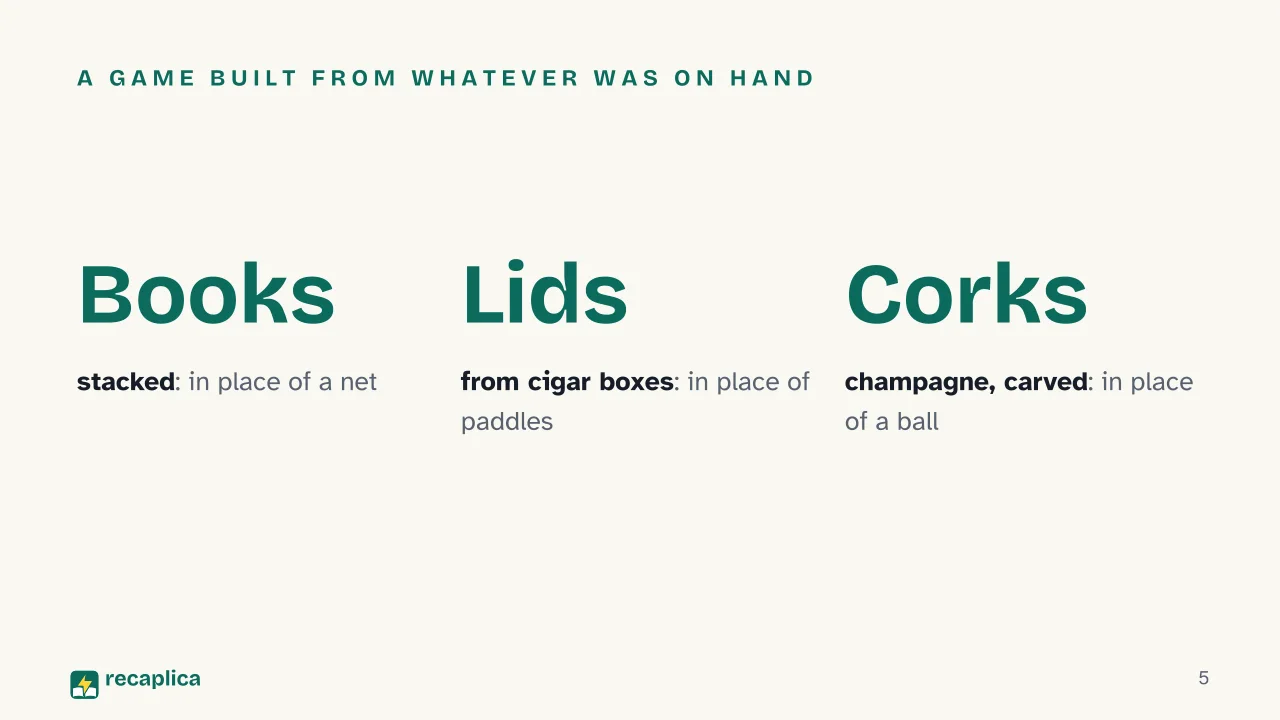 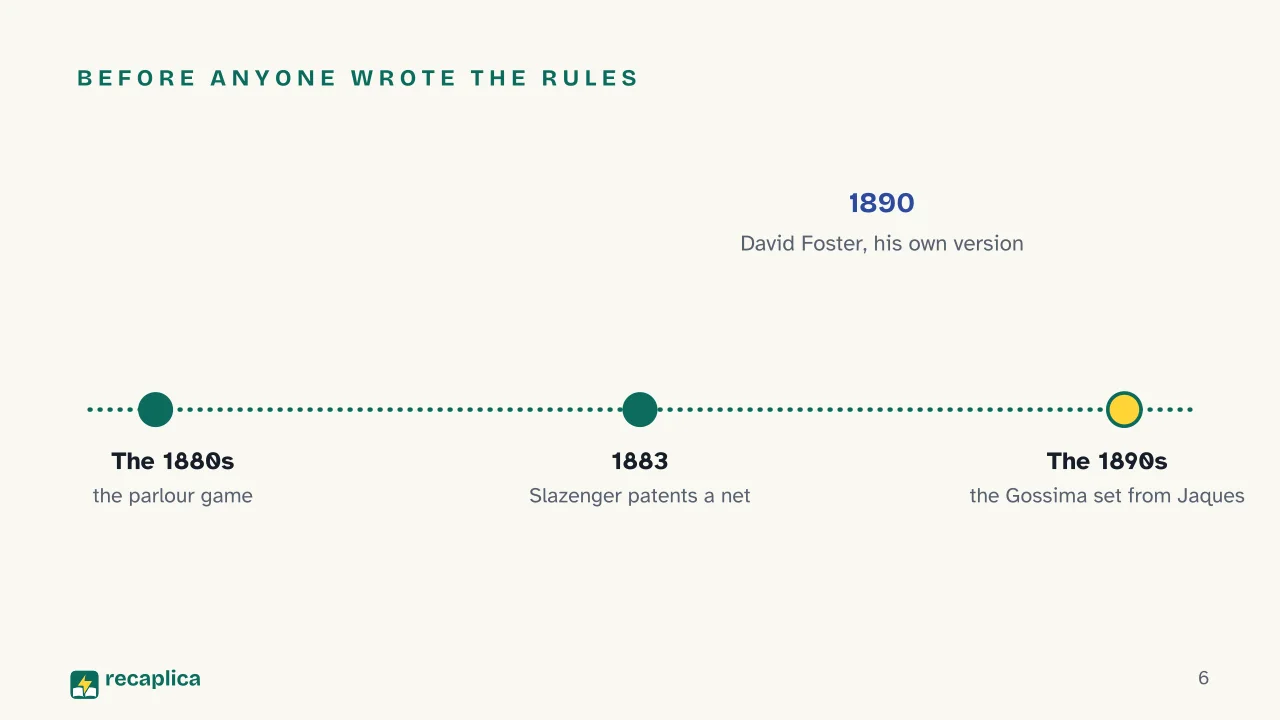  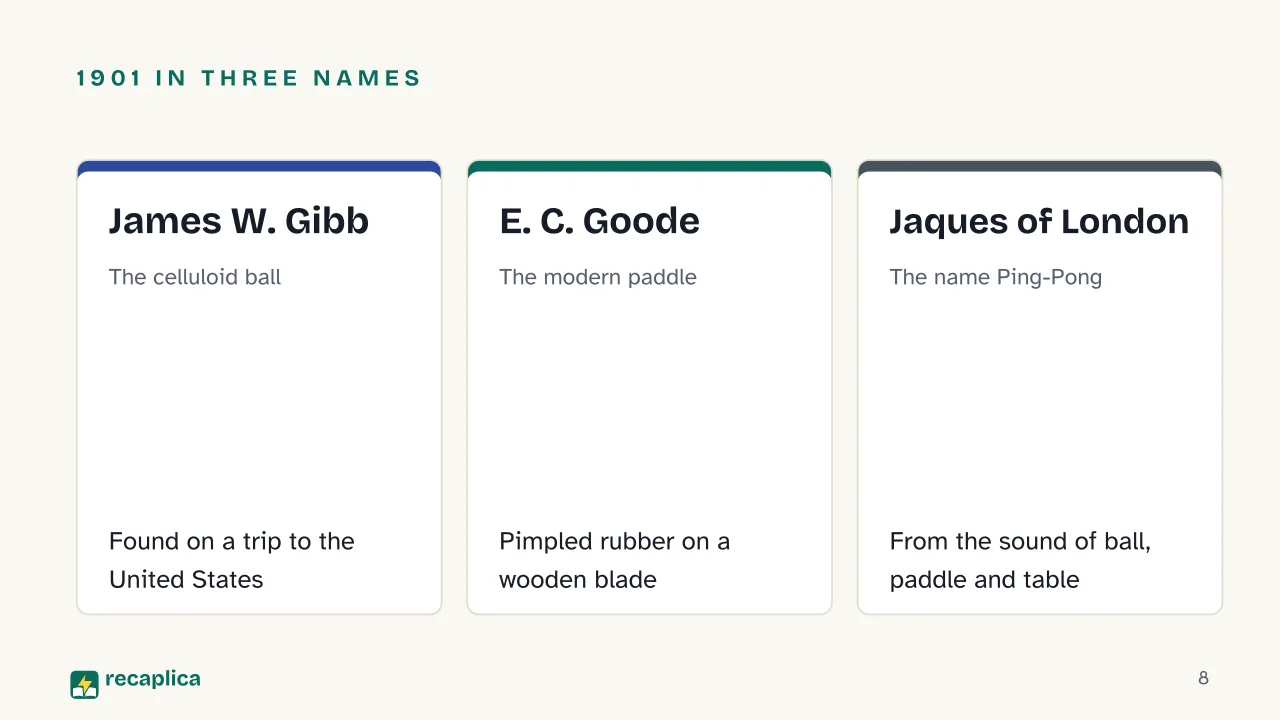 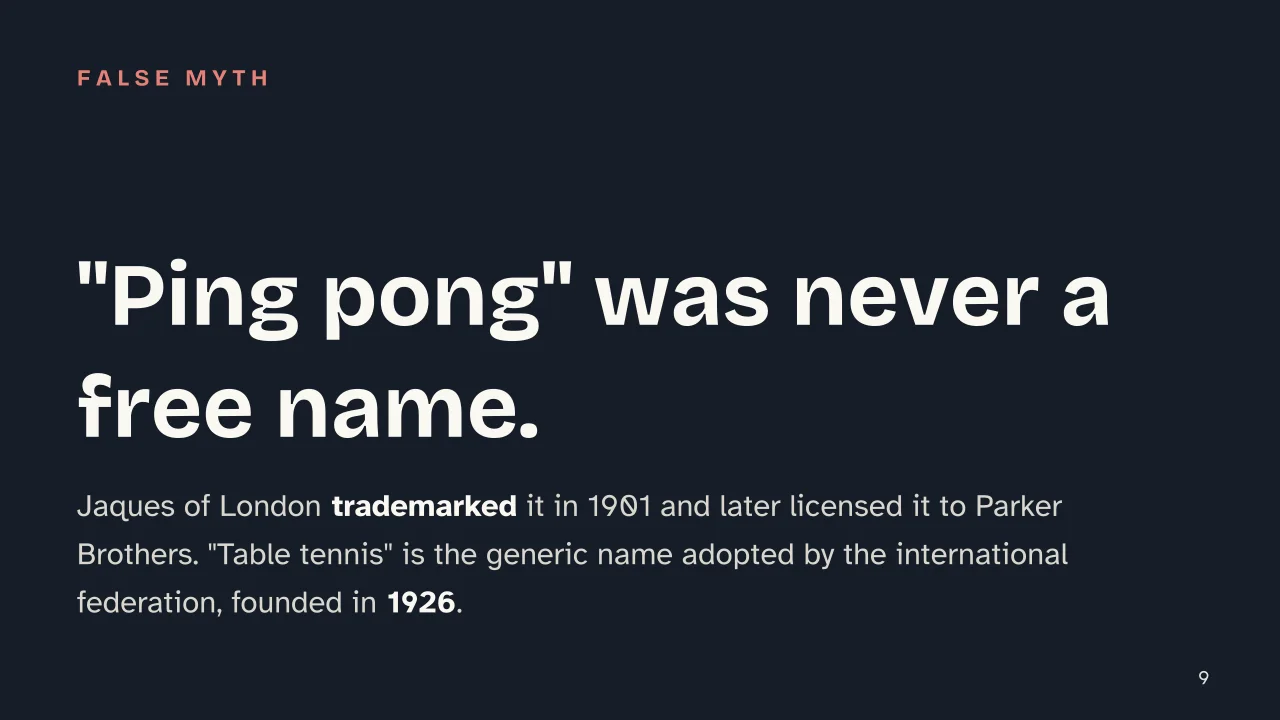  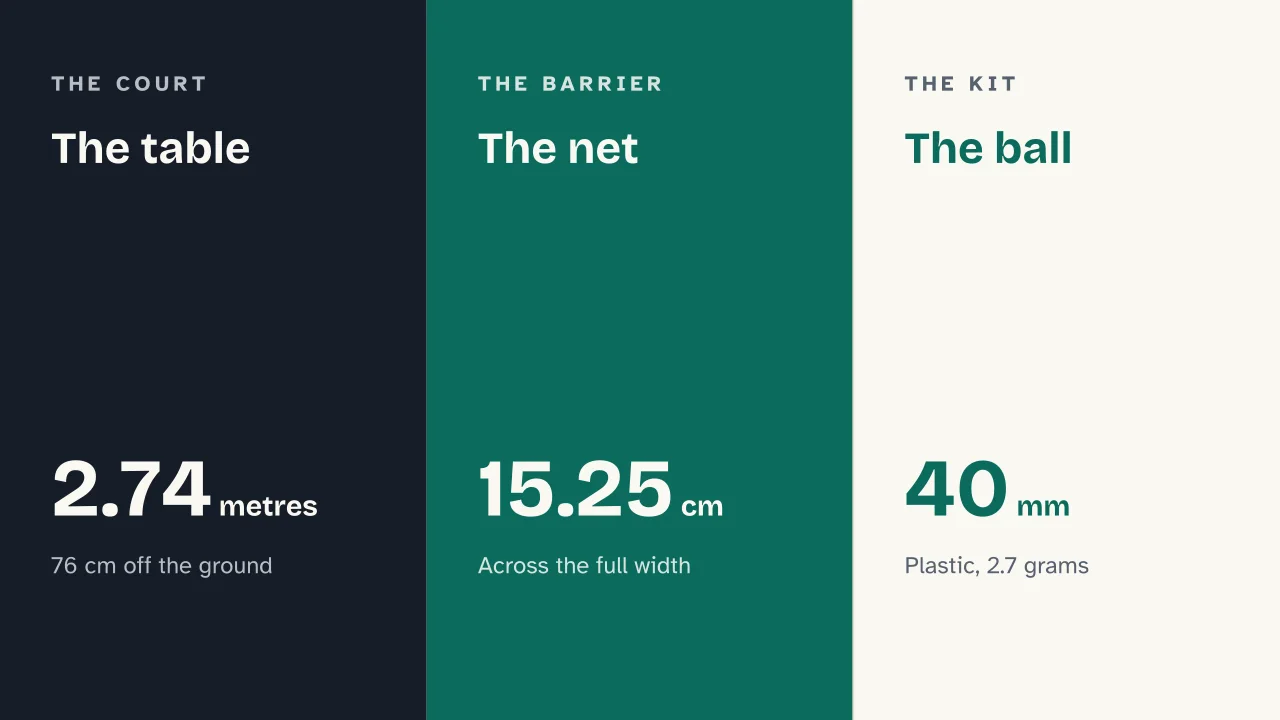 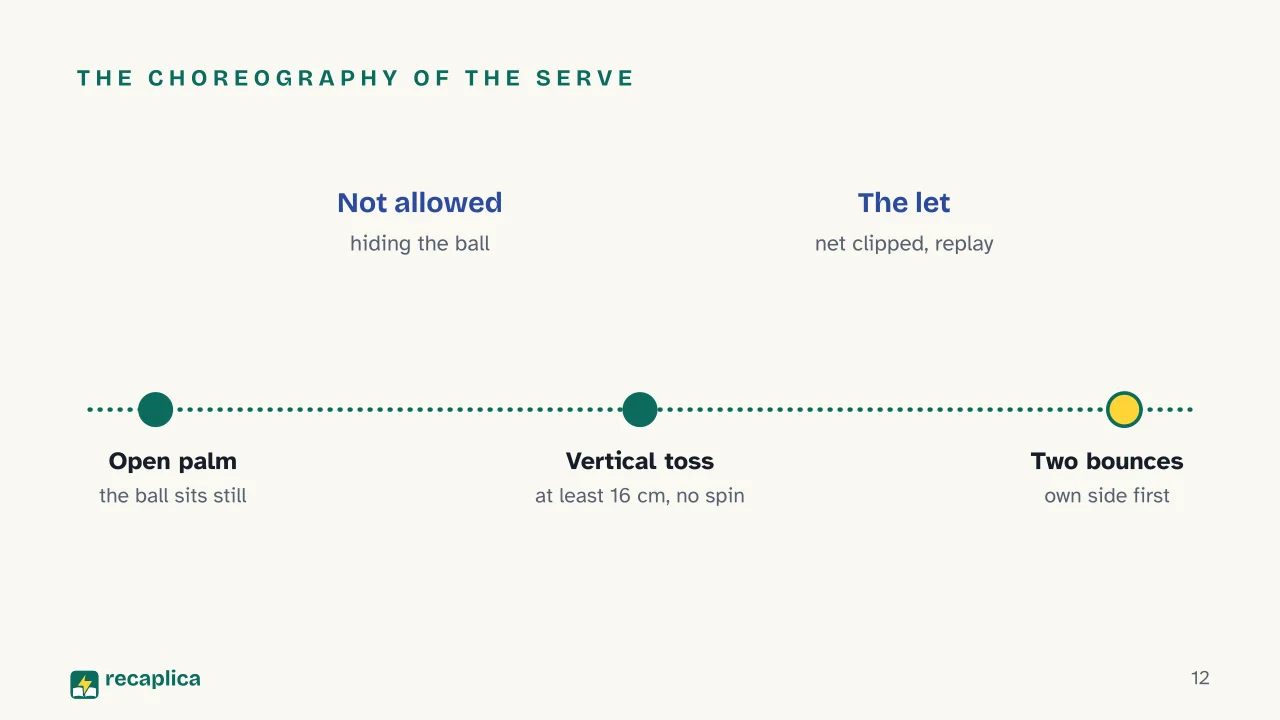 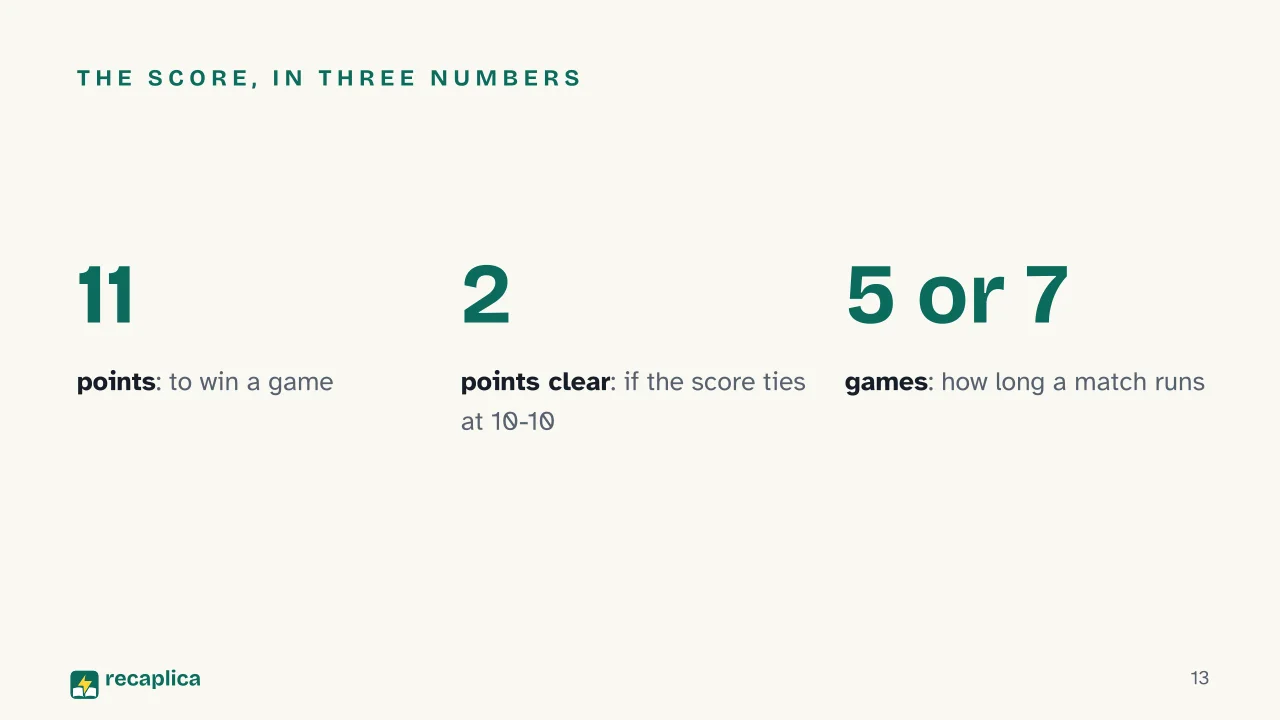 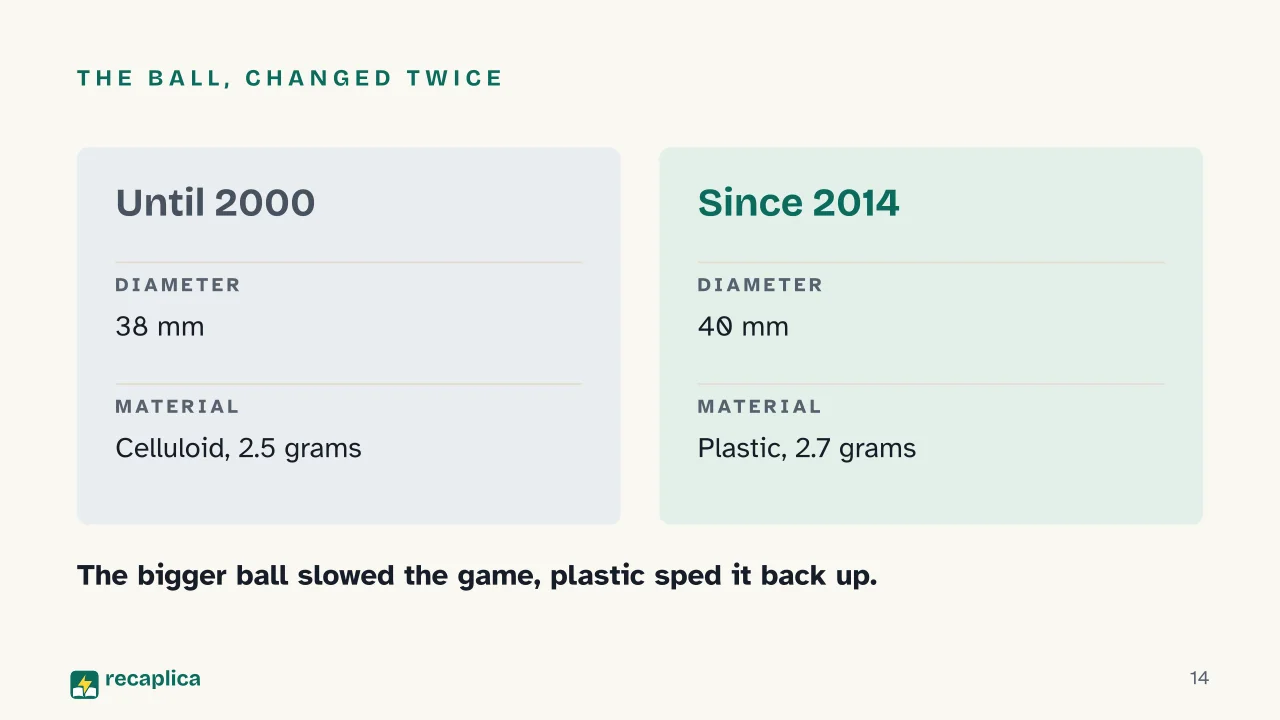  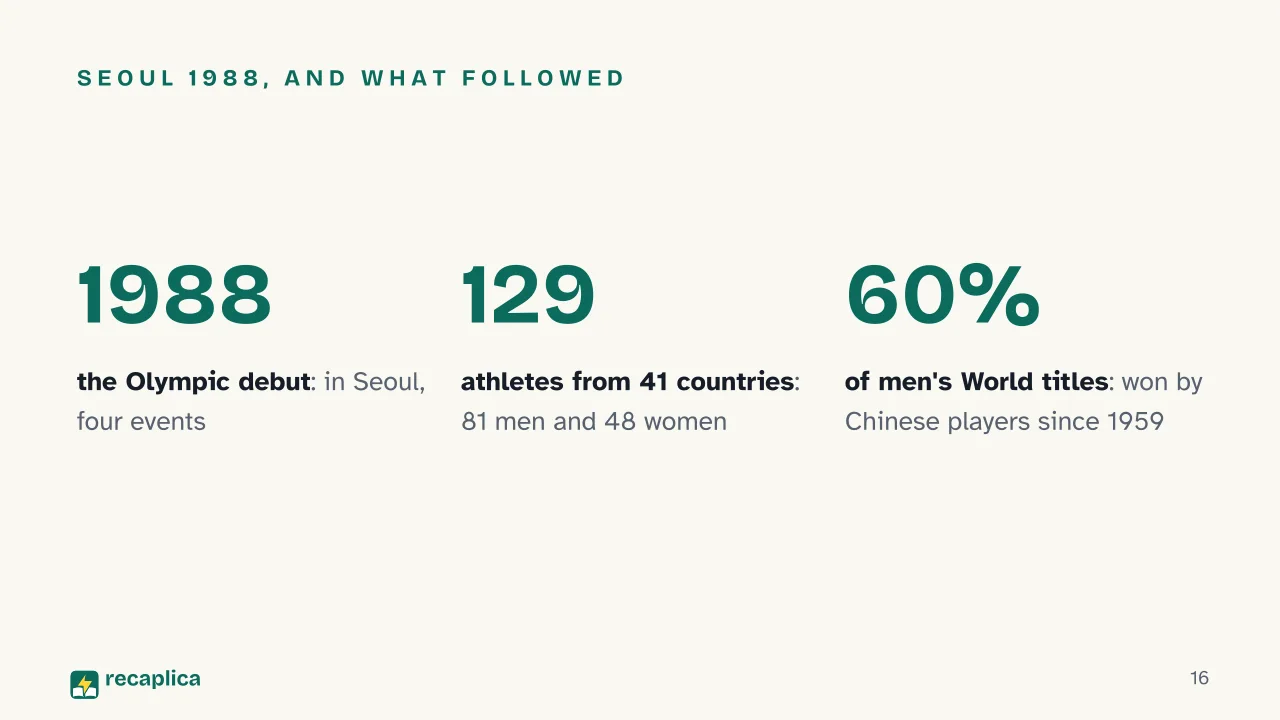   Common myths
Mind mapDrag the background to move around and the nodes to reposition them; use − and + to collapse and expand branches. 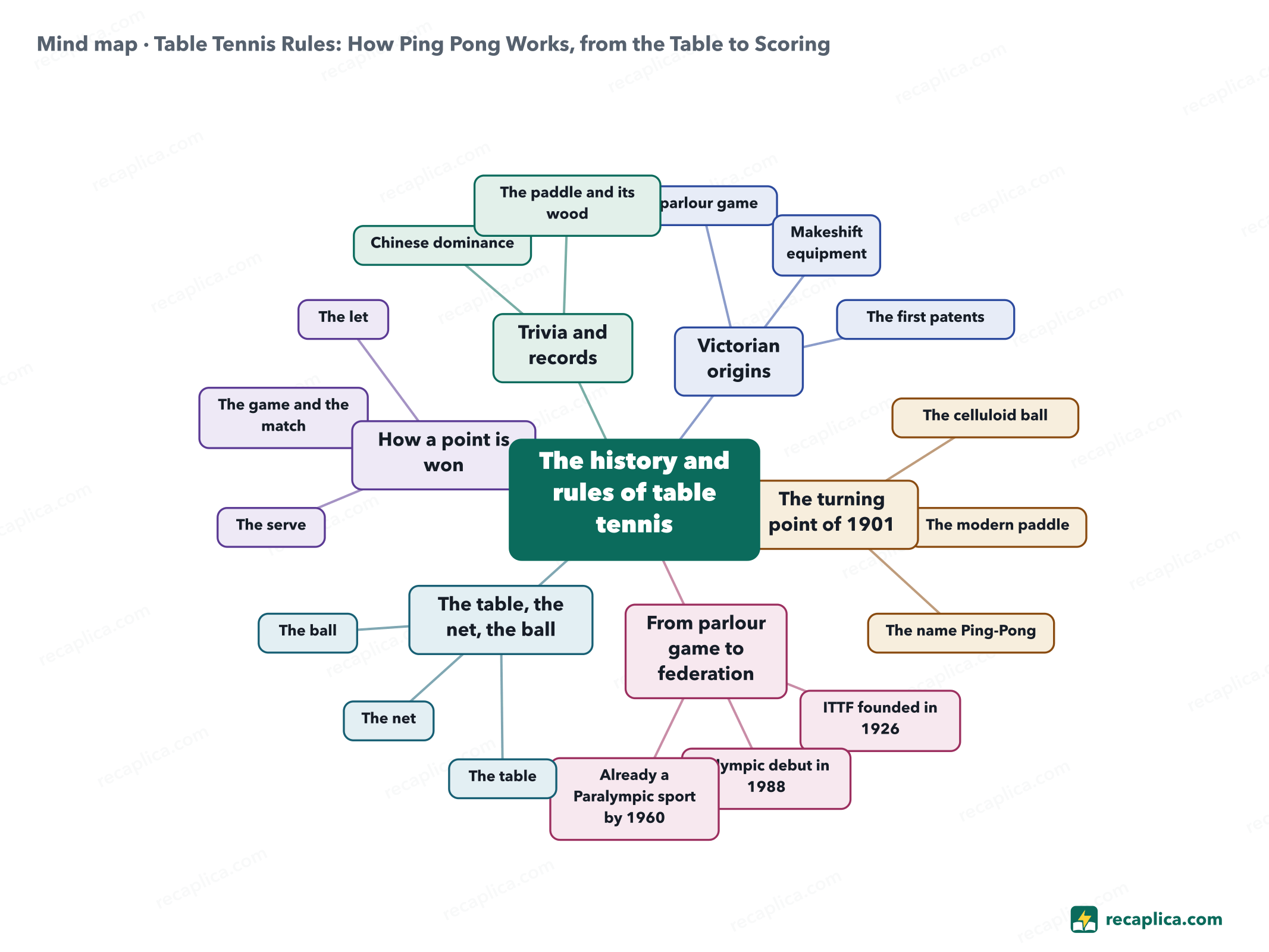
Quiz: test yourselfAnswer the questions to check what you have learned: you get instant feedback and a short explanation. Grade 0/10 0/5
FlashcardsTap the card to flip it and check whether you remember the answer, then move to the next one. 1 / 8 Explain it in your own wordsThe ultimate test: if you can explain it in simple words, you've truly understood it. Write your explanation, then compare it with the Recap. Your explanation is saved only on this device.
Frequently asked questionsHow many people can play table tennis at once?It can be played as singles, one against one, or as doubles, with two pairs alternating returns in a fixed order — the server, then the receiver, then the server's partner, then the receiver's partner, and so on. How much does the official table tennis ball weigh, and how big is it?Under the International Table Tennis Federation's statutes the ball is spherical, with a 40-millimetre diameter and a weight of 2.7 grams, made of matt white or orange plastic; those specifications have applied since 2000 for the size and since 2014 for the material. How many points do you need to win a table tennis match?Each game is won by whoever reaches 11 points first, with a lead of at least 2 if the score ties at 10-10; a match is played over an odd number of games, typically five or seven at top-level competitions. Since when has table tennis been an Olympic sport?It debuted at the Seoul Olympics in 1988, with four events (men's and women's singles and doubles) and 129 athletes from 41 countries; it had already featured at the Summer Paralympics since their first edition, in 1960. Why is it called both "ping pong" and "table tennis"?They are two names for the same game. "Ping-Pong" started out as a trademark registered by Jaques of London in 1901, while "table tennis" is the generic name adopted by the international federation, founded in 1926, to describe the sport independently of a privately-owned brand. Every Recap goes through an independent review before publication. |