Skip to content
recaplica

    One moment: security check

    Cloudflare wants to make sure you're not a robot. Tick the box below and your search will continue on its own.

    IT
    recaplica Third Sector: What It Is and What Role It Plays
    © 2026 Recaplica · recaplica.com — All rights reserved
    Home › Economics

    Third Sector: What It Is and What Role It Plays

    By Recaplica Newsroom · Updated on September 30, 2026

    What to print

    Page numbers appear when printing with default margins.

    Slides

    Choose a cut

    Flash10 slidesThe essential thread, to present in classFull14 slidesEvery chapter and the deeper detail

    Both come with speaker notes.

    Telegram channel
    recaplica Clear in 30 seconds, yours in 10 minutes.
    In 30 seconds Key points Figures Deep dive Slides Myths Mind map Quiz Flashcards FAQ

    In 30 seconds quick read

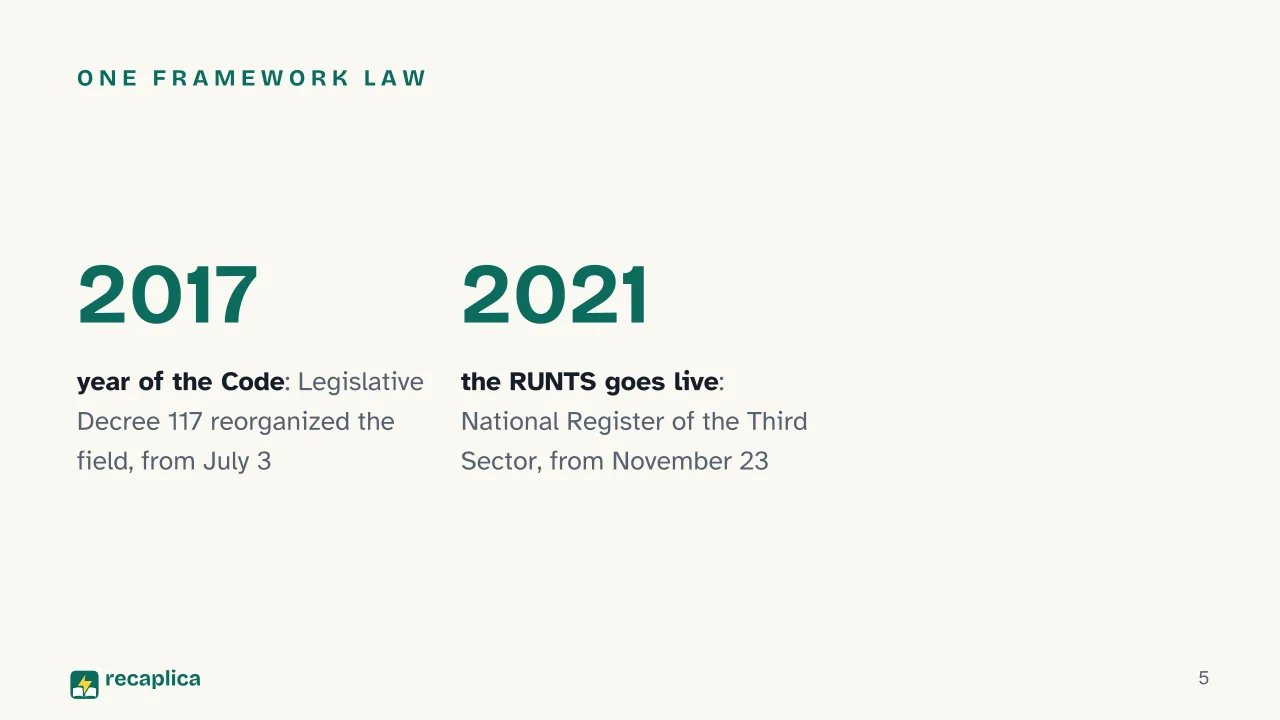
    The third sector is the group of private organizations that carry out activities of general interest without seeking profit, standing apart from both government and the market. In Italy, the Third Sector Code, in force since 2017, gives this area a single legal framework and lists which organizations qualify: associations, foundations, social cooperatives and several other types. To be formally recognized as a third-sector entity, an organization must register with the RUNTS, the National Register of the Third Sector, operating since November 23, 2021. The Code explicitly leaves out public administrations, along with political parties, trade unions and trade associations. According to ISTAT, Italy counted 368,367 active nonprofit institutions as of December 31, 2023, employing 949,200 people.

    Key Points

    • The third sector is made up of private, non-profit organizations that pursue activities of general interest, positioned between government and the market.
    • Italy's Third Sector Code, Legislative Decree 117, reorganized the field starting in 2017 and lists the qualifying organization types in Article 4.
    • Third-sector organizations include volunteer organizations, social promotion associations, social enterprises (including social cooperatives) and foundations.
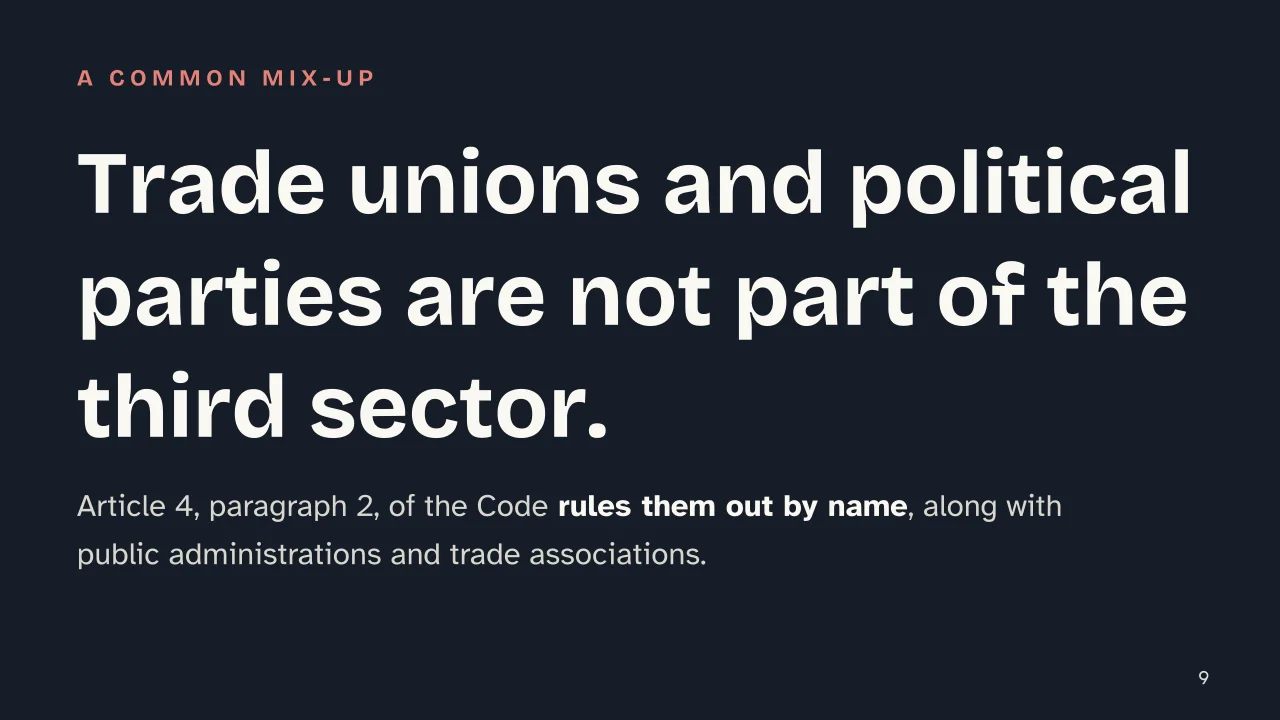
    • Article 4, paragraph 2, excludes public administrations, political parties, trade unions and trade associations from the third sector.
    • Registering with the RUNTS, operating since November 23, 2021, is the requirement for being formally recognized as a third-sector organization.
    • According to ISTAT, in 2023 Italy had 368,367 active nonprofit institutions employing 949,200 people.

    Key figures

    • 368,367 active nonprofit institutions in Italy as of December 31, 2023 Source: ISTAT
    • about 1 in 3 nonprofit institutions that in 2023 operated in the sports sector Source: ISTAT

    Deep Dive

    What the Third Sector Is

    “Third sector” is the name Italian law gives to a field of economic and social activity that stands apart from both government and the market: private organizations that, without seeking profit, pursue goals of collective benefit. Since 2017, Italy’s Third Sector Code, Legislative Decree no. 117, has gathered into one law a set of rules that used to be scattered across separate statutes for each type of organization. Article 1 of the Code ties this reorganization directly to the Constitution, including Article 118, fourth paragraph, on horizontal subsidiarity: the principle that citizens, including through associations, can carry out activities of general interest on their own, and public institutions support that autonomous initiative (the same idea comes up in the Recap on the structure of the Italian Constitution).

    Types of Third-Sector Organizations

    Article 4, paragraph 1, of the Code lists by name who can be called a third-sector organization: volunteer organizations, social promotion associations, philanthropic entities, social enterprises (including social cooperatives), associative networks, mutual aid societies, recognized or unrecognized associations, foundations, and other private entities that aren’t companies. What they share is the absence of a profit motive, activities of general interest carried out as their sole or main purpose, and registration with the national third-sector register.

    TypeWhat it does, in short
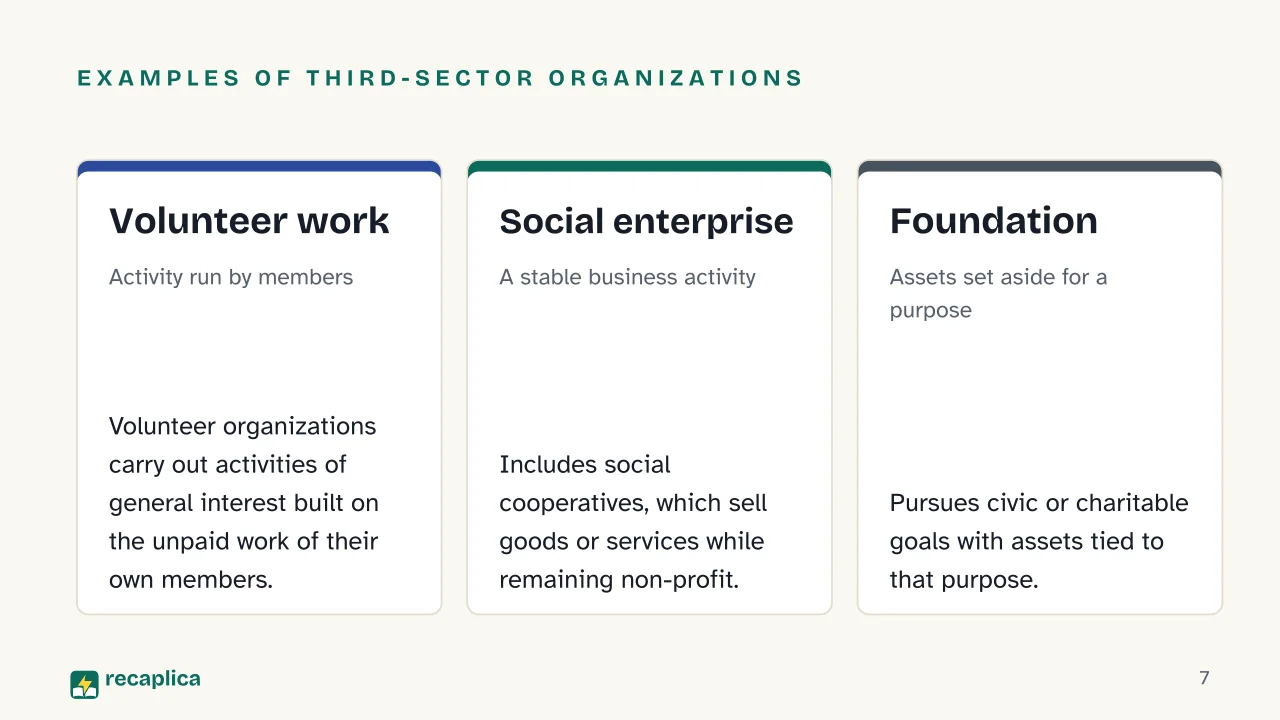
    Volunteer organizations (ODV)Carries out activities of general interest built mainly on the unpaid work of its own members
    Social promotion associations (APS)Operates for the benefit of members, their families or third parties, relying mainly on members’ contributions
    Philanthropic entitiesProvides money, goods or services to support disadvantaged people or activities of general interest
    Social enterprises, including social cooperativesRuns a business activity of general interest on a stable basis
    Associative networksBrings together a minimum number of other third-sector organizations at a regional or national level
    Mutual aid societiesProvides benefits to its own members in case of illness or other needs, funded by member contributions
    Associations and foundationsThe most common legal forms, set up for civic and charitable purposes

    In practice: a social cooperative running a group home for minors and a neighborhood association offering free after-school tutoring are both third-sector organizations, even though their legal form and business model differ: one sells a service, the other runs on its members’ contributions.

    Volunteering is one of the ways the Code allows an organization to carry out its activities, alongside providing money, goods or services for free and mutual or market exchange: Article 4 lists it as one possible route, not the only one. A volunteer organization is built around this model; a social enterprise, by contrast, can operate with paid staff.

    What Isn’t the Third Sector

    Article 4, paragraph 2, explicitly excludes from the third sector (with an exception for civil protection bodies):

    • public administrations;
    • political parties and political movements;
    • trade unions;
    • professional and trade associations;
    • employer associations.

    The line is a sharp one, tied to what the organization does: the Code’s scope covers activities of general interest for the wider community, while representing group interests or exercising public authority falls outside that definition.

    The RUNTS, One Register Instead of Many

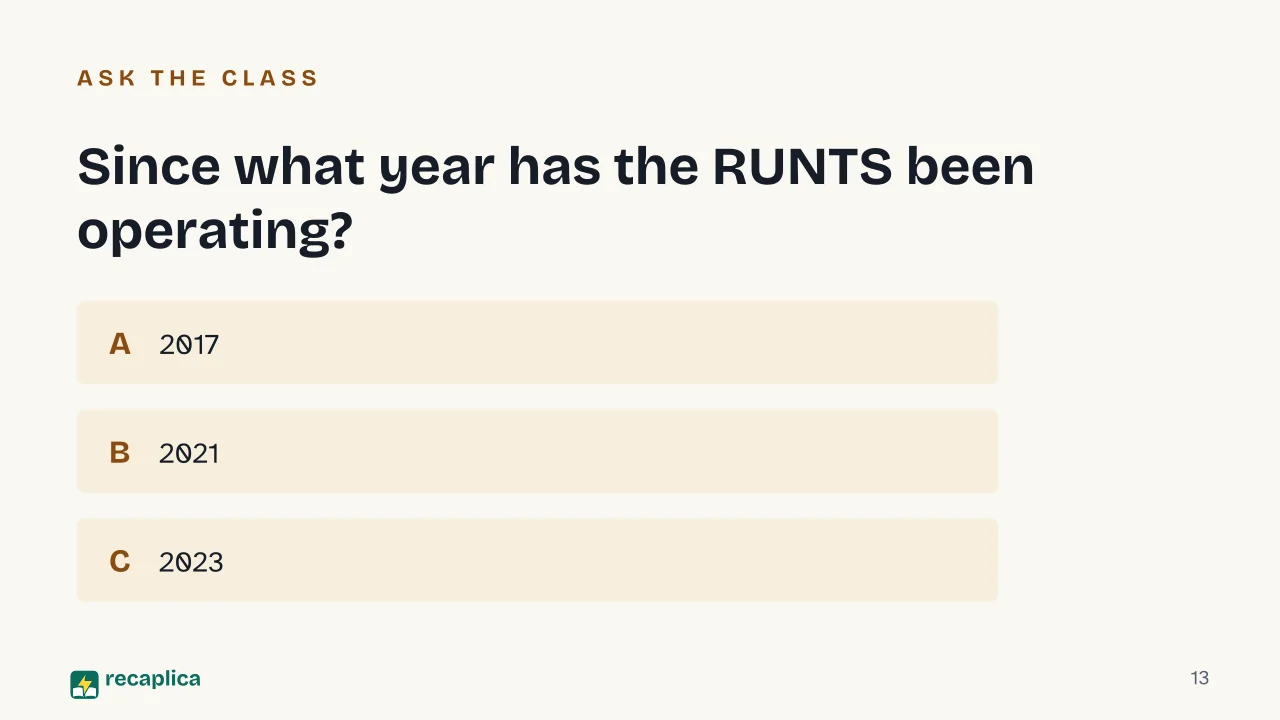
    Before the reform, checking whether a volunteer organization or a social promotion association was properly established meant consulting different registers, often kept at the regional level, plus a separate roll for Onlus entities. Article 45 of the Third Sector Code established the National Register of the Third Sector (RUNTS), which has been operating since November 23, 2021. According to Italy’s Ministry of Labor and Social Policies, the RUNTS replaces the older registers for ODVs and APSs and the Onlus roll required under previous rules: organizations already listed in those registers flow into it; social enterprises and social cooperatives are added to it; anyone not yet registered anywhere can apply exclusively through the dedicated online portal. Being registered with the RUNTS is the legal condition for being recognized as a third-sector organization, with all the benefits and obligations that come with it. The RUNTS exists because of a legislative decree, a legal norm with the same force as an ordinary law, which is why it can require registration from anyone who wants to be called a third-sector organization; an association’s own internal rulebook has no such reach.

    The Economic and Social Role

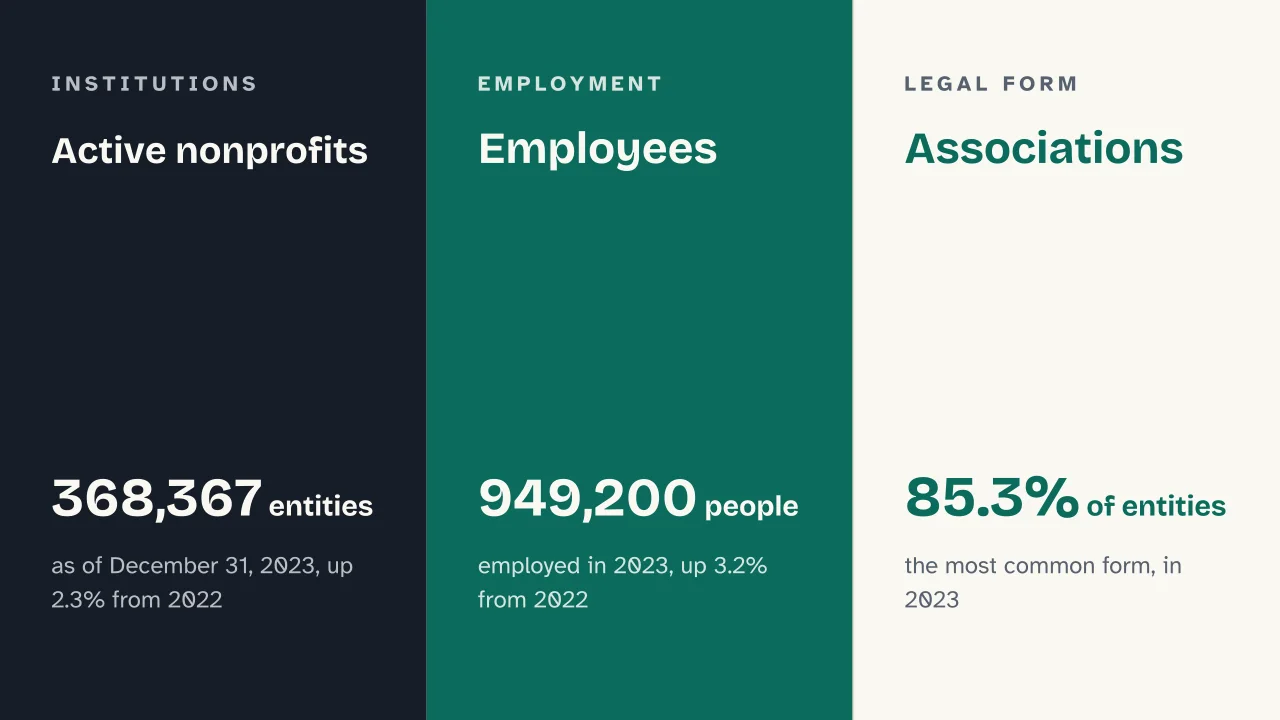
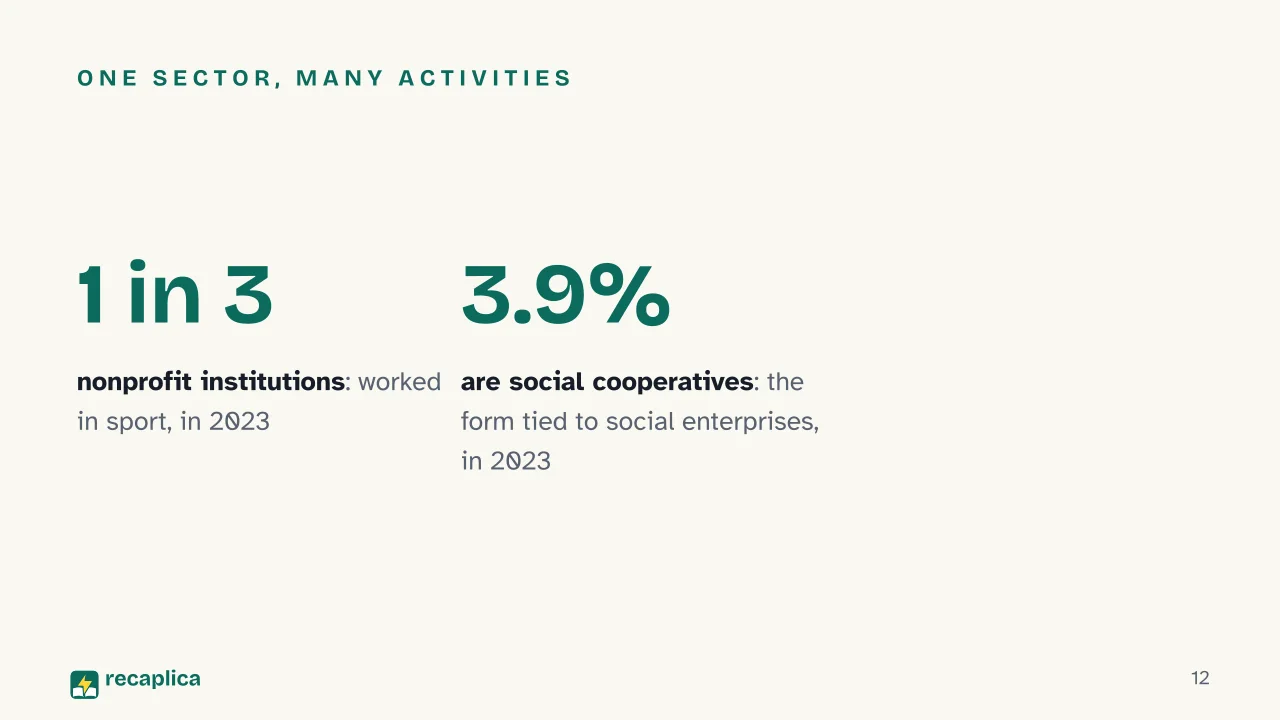
    According to ISTAT, as of December 31, 2023, Italy had 368,367 active nonprofit institutions, up 2.3% from 2022 (up 0.6% once statistical refinements are stripped out). That same year, these institutions employed 949,200 people, up 3.2% from 2022: a workforce that in scale and momentum sits alongside the broader trends of the labor market. By legal form, the association remains by far the most common choice, at 85.3% of organizations in 2023, followed by other legal forms (8.4%), social cooperatives (3.9%) and foundations (2.4%). Geographically, the North is home to 49.7% of nonprofit institutions, the Center 22.0%, the South 18.8% and the Islands 9.5%. By field of activity, about one nonprofit institution in three worked in sport in 2023: the single most represented field, ahead of culture, social assistance and the other areas covered by third-sector organizations.

    Slide deck

    Slides ready to download and make your own in PowerPoint or Google Slides, with speaker notes. Pick the Flash cut or the Full one.
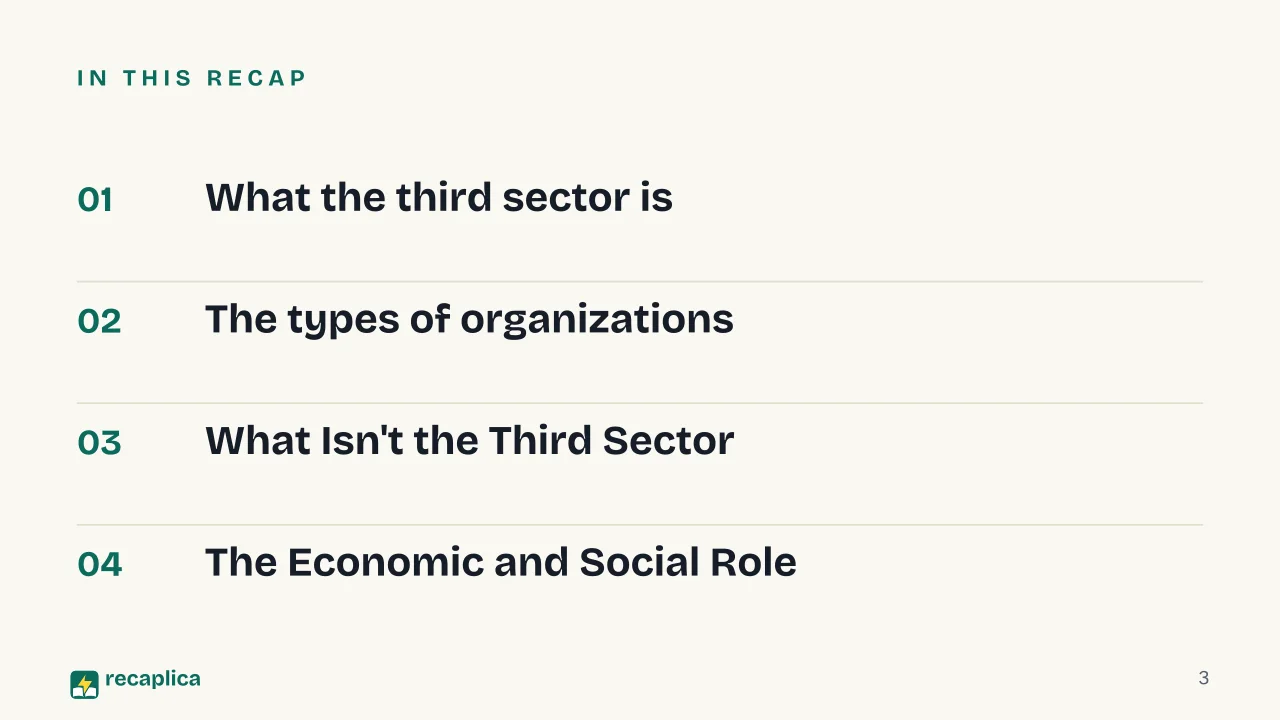
    Slide 1 of the presentation on Third Sector: Third SectorSlide 2 of the presentation on Third Sector: Who runs a group home, if not the government?Slide 3 of the presentation on Third Sector: In this RecapSlide 4 of the presentation on Third Sector: Chapter 01: What the Third Sector IsSlide 5 of the presentation on Third Sector: One framework lawSlide 6 of the presentation on Third Sector: Chapter 02: The Types of OrganizationsSlide 7 of the presentation on Third Sector: Examples of third-sector organizations: Volunteer work, Social enterprise, FoundationSlide 8 of the presentation on Third Sector: Chapter 03: What Isn't the Third SectorSlide 9 of the presentation on Third Sector: Trade unions and political parties are not part of the third sector.Slide 10 of the presentation on Third Sector: Chapter 04: The Economic and Social RoleSlide 11 of the presentation on Third Sector: Active nonprofits · Employees · AssociationsSlide 12 of the presentation on Third Sector: One sector, many activitiesSlide 13 of the presentation on Third Sector: Since what year has the RUNTS been operating?Slide 14 of the presentation on Third Sector: Keep reading
    Flash10 slidesThe essential thread, to present in classFull14 slidesEvery chapter and the deeper detail

    Common myths

    • ✗ Myth Trade unions and political parties count as third-sector organizations, since they operate within civil society too.

      ✓ Reality Article 4, paragraph 2, of the Code rules them out by name, along with public administrations and trade associations: their defining role is representing the interests of their own members, while the Code is about activities of general interest for the wider community.

    • ✗ Myth Non-profit means no paid staff — an activity that runs only on people's unpaid time.

      ✓ Reality According to ISTAT, in 2023 Italian nonprofit institutions employed 949,200 people. Not seeking profit is about what happens to any surplus an organization generates, not about whether it has paid employees.

    • ✗ Myth The third sector is just another name for volunteering.

      ✓ Reality Article 4 of the Code lists voluntary work as one of several ways an organization can carry out its activities, alongside providing goods or services free of charge and mutual or market exchange: a social enterprise, for instance, can run entirely on paid staff.

    Mind map

    Drag the background to move around and the nodes to reposition them; use − and + to collapse and expand branches.
    Customize
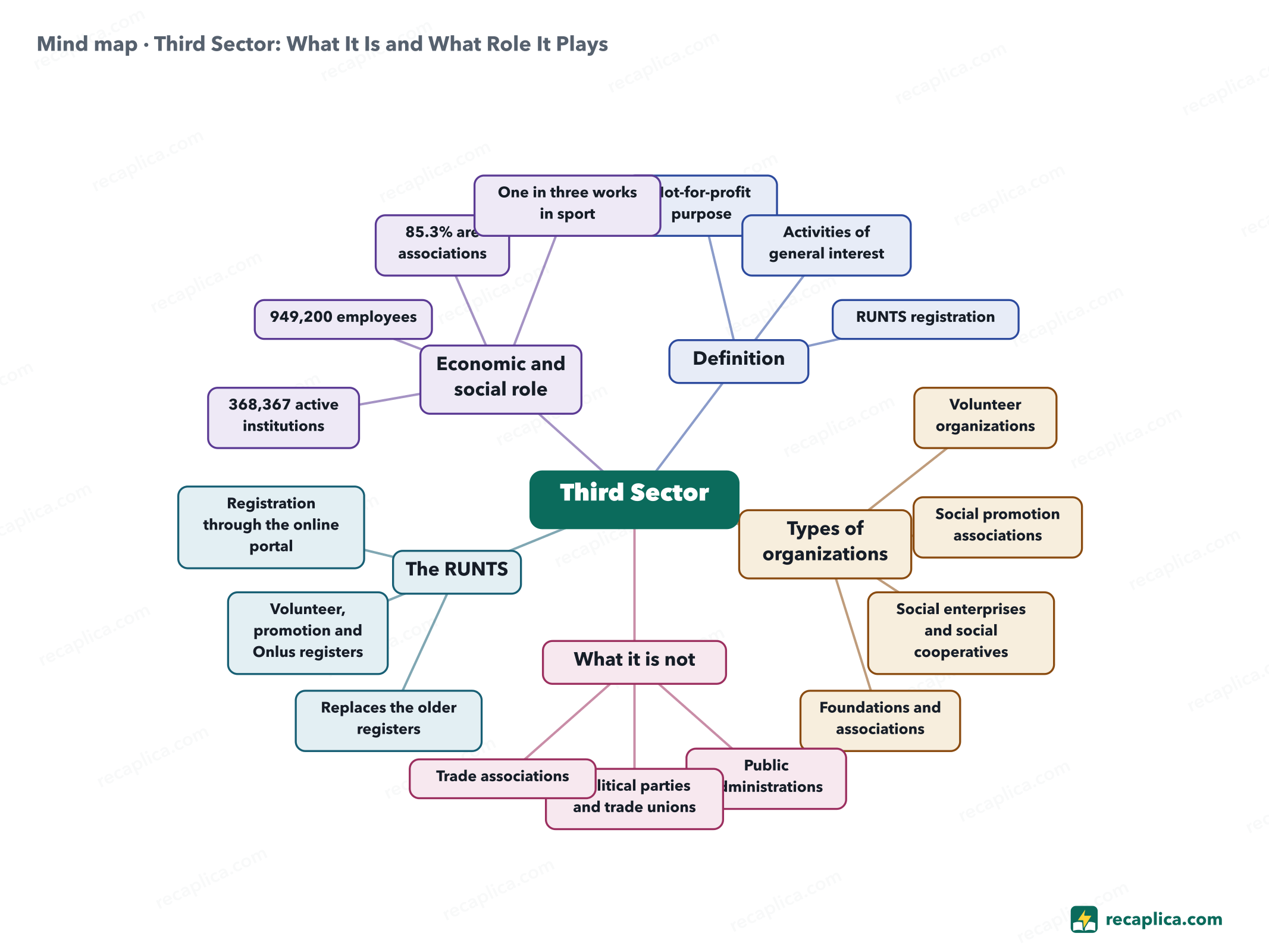
    Mind map: Third Sector: What It Is and What Role It Plays
    • Third Sector
      • Definition Third Sector Code, since 2017
        • Not-for-profit purpose
        • Activities of general interest
        • RUNTS registration
      • Types of organizations Article 4's fixed list
        • Volunteer organizations
        • Social promotion associations
        • Social enterprises and social cooperatives
        • Foundations and associations
      • What it is not The exclusions in Article 4, paragraph 2
        • Public administrations
        • Political parties and trade unions
        • Trade associations
      • The RUNTS Operating since November 23, 2021
        • Replaces the older registers
        • Volunteer, promotion and Onlus registers flow in
        • Registration through the online portal
      • Economic and social role ISTAT data, 2023
        • 368,367 active institutions
        • 949,200 employees
        • 85.3% are associations
        • One in three works in sport

    Quiz: test yourself

    Answer the questions to check what you have learned: you get instant feedback and a short explanation.

    Grade 0/10 0/5
    1 What year did Italy's Third Sector Code come into force?

    The Third Sector Code is Legislative Decree no. 117 of July 3, 2017.

    2 Which of these is excluded from the third sector under Article 4, paragraph 2, of the Code?

    Trade unions represent the interests of their members, and Article 4, paragraph 2, leaves them out by name, as it does political parties, public administrations and trade associations.

    3 Since when has the RUNTS, Italy's National Register of the Third Sector, been operating?

    The RUNTS, established under Article 45 of the Code, has been operating since November 23, 2021, according to Italy's Ministry of Labor and Social Policies.

    4 True or false: according to ISTAT, the most common legal form among Italian nonprofit institutions in 2023 was the association.

    True: in 2023, 85.3% of Italian nonprofit organizations were associations, according to ISTAT.

    5 According to ISTAT, how many active nonprofit institutions did Italy have as of December 31, 2023?

    As of December 31, 2023, ISTAT counted 368,367 active nonprofit institutions in Italy.

    Answers: 1-B · 2-B · 3-B · 4-A · 5-C

    Flashcards

    Tap the card to flip it and check whether you remember the answer, then move to the next one.

    1 / 8

    Explain it in your own words

    The ultimate test: if you can explain it in simple words, you've truly understood it. Write your explanation, then compare it with the Recap.

    Your explanation is saved only on this device.

    The third sector is the group of private organizations that carry out activities of general interest without seeking profit, standing apart from both government and the market. In Italy, the Third Sector Code, in force since 2017, gives this area a single legal framework and lists which organizations qualify: associations, foundations, social cooperatives and several other types. To be formally recognized as a third-sector entity, an organization must register with the RUNTS, the National Register of the Third Sector, operating since November 23, 2021. The Code explicitly leaves out public administrations, along with political parties, trade unions and trade associations. According to ISTAT, Italy counted 368,367 active nonprofit institutions as of December 31, 2023, employing 949,200 people.

    Frequently asked questions

    What is the third sector, in simple terms?

    It's the name Italian law gives to private organizations that work for the general interest without chasing a profit: associations, foundations, social cooperatives and the other types that the Third Sector Code has listed since 2017. They sit alongside government and the market, as a third area.

    What is the RUNTS?

    The National Register of the Third Sector, established under Article 45 of the Code and operating since November 23, 2021. According to Italy's Ministry of Labor, it replaces the older registers for volunteer organizations and social promotion associations, along with the separate Onlus roll: registering with it is what makes an organization a third-sector entity.

    What sets a third-sector organization apart from any other association?

    Registration with the RUNTS, which requires meeting the conditions in Article 4 of the Code: no profit motive, and activities of general interest carried out as the organization's sole or main purpose. An association that hasn't registered can still exist legally, but it isn't a third-sector organization in the technical sense.

    Are trade unions part of the third sector?

    No. Article 4, paragraph 2, of the Code explicitly excludes trade unions, along with political parties, public administrations, professional and trade associations, and employer associations.

    How many nonprofit institutions are there in Italy?

    According to ISTAT, as of December 31, 2023, Italy had 368,367 active nonprofit institutions, up 2.3% from 2022, employing 949,200 people.

    Sources

    • Third Sector Code — Legislative Decree no. 117 of July 3, 2017 (consolidated text)
    • Ministry of Labor and Social Policies — National Register of the Third Sector (RUNTS)
    • ISTAT — Structure and profile of the nonprofit sector, 2023

    Every Recap goes through an independent review before publication.

    Every evening, the day's new Recaps on our Telegram channel. Join the channel →

    Keep learning

    • Economics Lewin's Change Model: What It Is and How It Works Lewin's change model describes, in three stages, the passage of an organization from a settled way of working to a new one, and how it avoids sliding back into old habits. In the unfreeze stage, the organization recognizes the need for change and prepares the ground; in the change stage, new processes and behaviors are introduced; in the refreeze stage, the new setup is locked in so it does not slip back to where it started. The model grows out of Kurt Lewin's work on group dynamics in the 1940s, but the three-stage version used in change management is largely a later reconstruction. It remains the most cited reference point in organizational change management, criticism included. Read the Recap →
    • Economics Biggest Economies in the World: The Ranking by GDP, Explained In 2024, according to World Bank data, the United States remains the country with the highest nominal GDP in the world, ahead of China. Measured instead at purchasing power parity (PPP), which accounts for differences in price levels between countries, the ranking flips and China moves into first place. Nominal GDP reflects the weight of an economy on international markets in current dollars; PPP GDP reflects the domestic purchasing power of a country's residents. The two measures tell different stories, which is why the same economy can rank differently depending on which one you check. Read the Recap →
    • Economics How Much Does Italy's Regime Forfettario Really Cost? Keeping a VAT number under Italy's regime forfettario doesn't cost the same for everyone. Taxable income carries a substitute tax of 15%, cut to 5% for the first five years for those who meet certain conditions. The taxable base comes from applying a profitability coefficient to revenue that varies by activity, from 40% for trade up to 86% for construction: at the same revenue, a higher coefficient means a bigger tax bill. On top of that come social security contributions, with separate rates for tradespeople and shopkeepers and a reduction for those who stay in the scheme, plus a few recurring fixed costs that exist but carry no single amount set by any official source. Read the Recap →

    recaplica

    Clear in 30 seconds, yours in 10 minutes.

    Recaps Mind maps Request a Recap Telegram channel Mind map maker Our method About Privacy & cookies Legal notes & terms of use

    © 2026 Recaplica · A project by Curi S.r.l. — VAT IT05472000750

    Statistics, only if you say so

    To learn which Recaps help most we would use Google Analytics, with aggregate, anonymous data. It starts only with your OK, and you can change your mind anytime. Privacy policy