Skip to content
recaplica

    One moment: security check

    Cloudflare wants to make sure you're not a robot. Tick the box below and your search will continue on its own.

    IT
    recaplica Passport Requirements for International Travel: When an ID Card Is Enough
    © 2026 Recaplica · recaplica.com — All rights reserved
    Home › Civics

    Passport Requirements for International Travel: When an ID Card Is Enough

    By Recaplica Newsroom · Updated on September 21, 2026

    What to print

    Page numbers appear when printing with default margins.

    Slides

    Choose a cut

    Flash10 slidesThe essential thread, to present in classFull15 slidesEvery chapter and the deeper detail

    Both come with speaker notes.

    Telegram channel
    recaplica Clear in 30 seconds, yours in 10 minutes.
    In 30 seconds Key points Figures Deep dive Slides Myths Mind map Quiz Flashcards FAQ

    In 30 seconds quick read

    Which document you need to enter another country depends on where you're going. Inside the Schengen area, plus Iceland, Liechtenstein, Norway and Switzerland, a valid national ID card or a passport is enough. Outside that area, most countries require a passport, often with a minimum validity beyond the travel dates, and sometimes an additional visa. Children always need their own travel document, never an entry on a parent's.

    Key Points

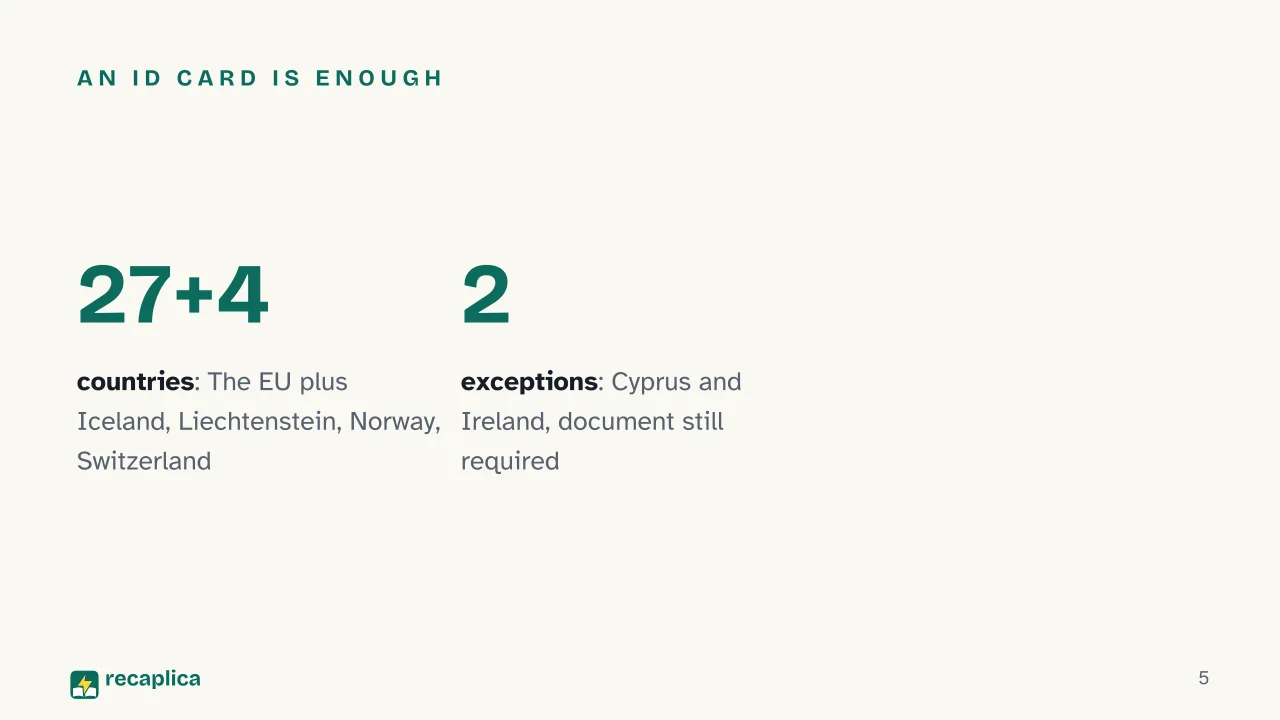
    • Inside the Schengen area (the EU plus Iceland, Liechtenstein, Norway and Switzerland), a valid national ID card or a passport is enough.
    • Cyprus and Ireland are EU members but don't apply the Schengen rules: travelers still have to show a valid document there.
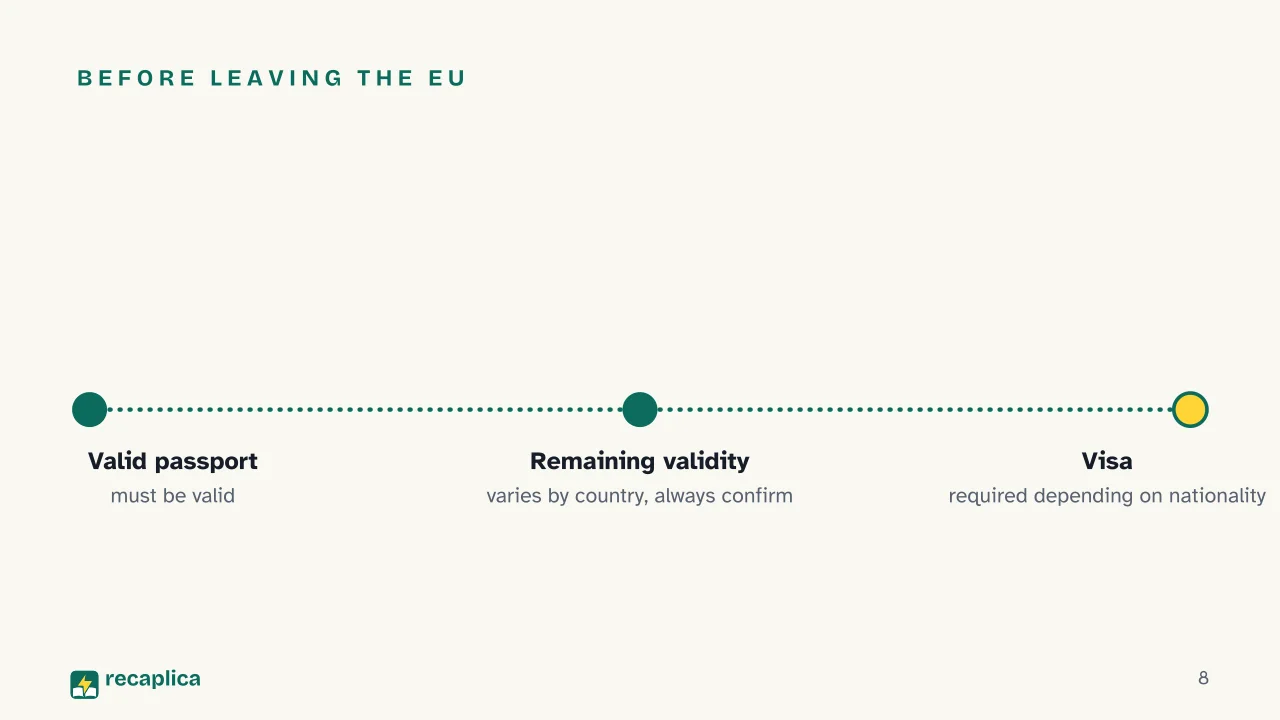
    • Outside the EU, a passport is required, usually with a minimum remaining validity that varies by country, and sometimes a visa.
    • For short stays, the EU applies the 90/180 rule to non-EU nationals entering the Schengen area: up to 90 days within any 180-day period.
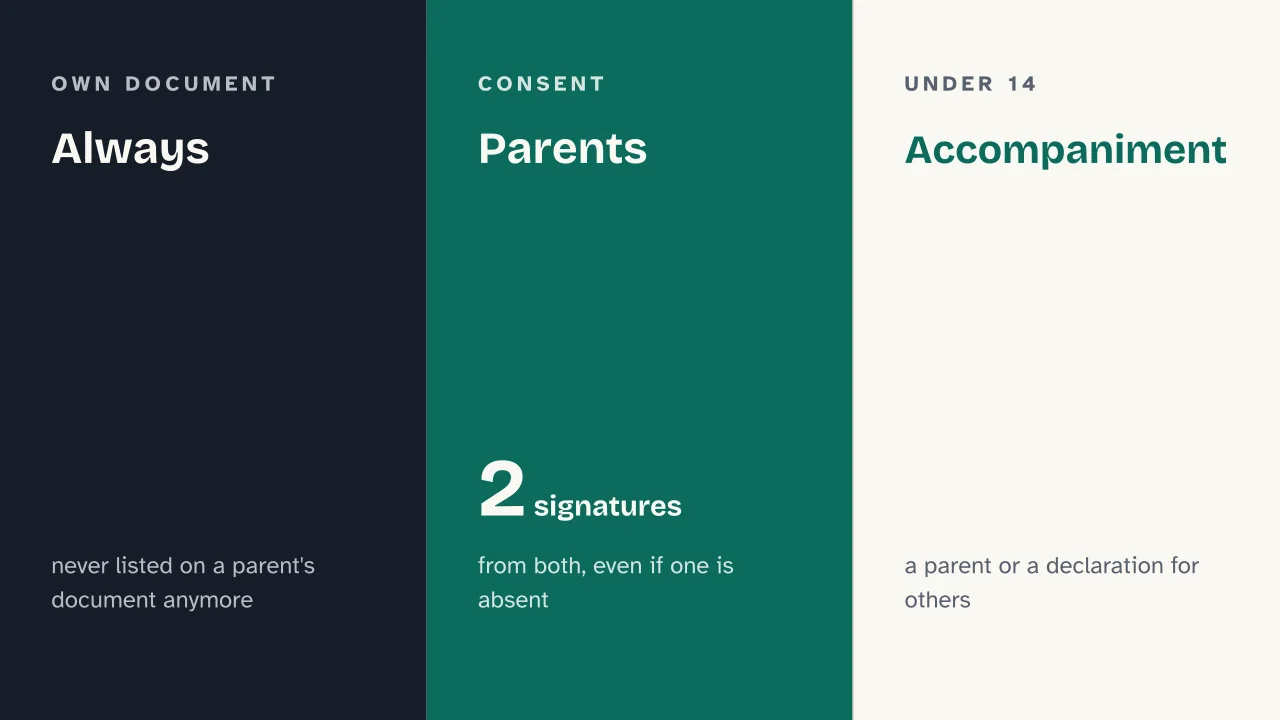
    • Children need their own travel document, and a passport application for a minor requires both parents' consent.
    • Under 14, a minor traveling abroad needs a parent, a legal guardian, or an accompaniment declaration.

    Key figures

    • 90 days in 180 Is the general rule the European Union applies to non-EU nationals for short stays inside the Schengen area. Source: European Commission, Your Europe
    • 10 years Is how long an Italian adult's ID card stays valid; it drops to 5 years for minors aged 3 to 18, and to 3 years for minors under 3. Source: Italian Ministry of Foreign Affairs and International Cooperation
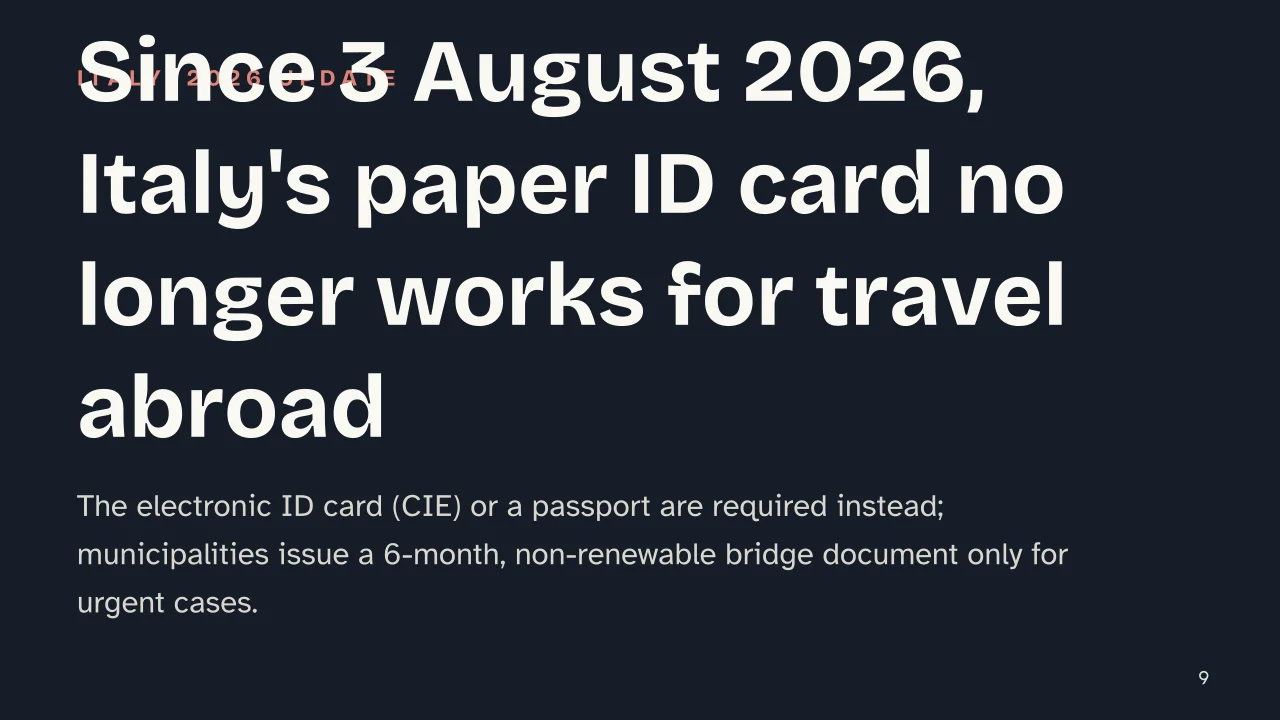
    • 3 August 2026 Is the date from which Italy's paper ID card stopped being valid for travel abroad, an Italy-specific example: municipalities now issue a 6-month, non-renewable bridge document instead. Source: Italian Consulate General in Boston, Decree-Law 108/2026

    Deep Dive

    Anyone planning a trip abroad usually starts with the same question: does an ID card work, or do I need a passport? The rules change from destination to destination, so there’s no shortcut that covers every case.

    Inside the EU and the Schengen area

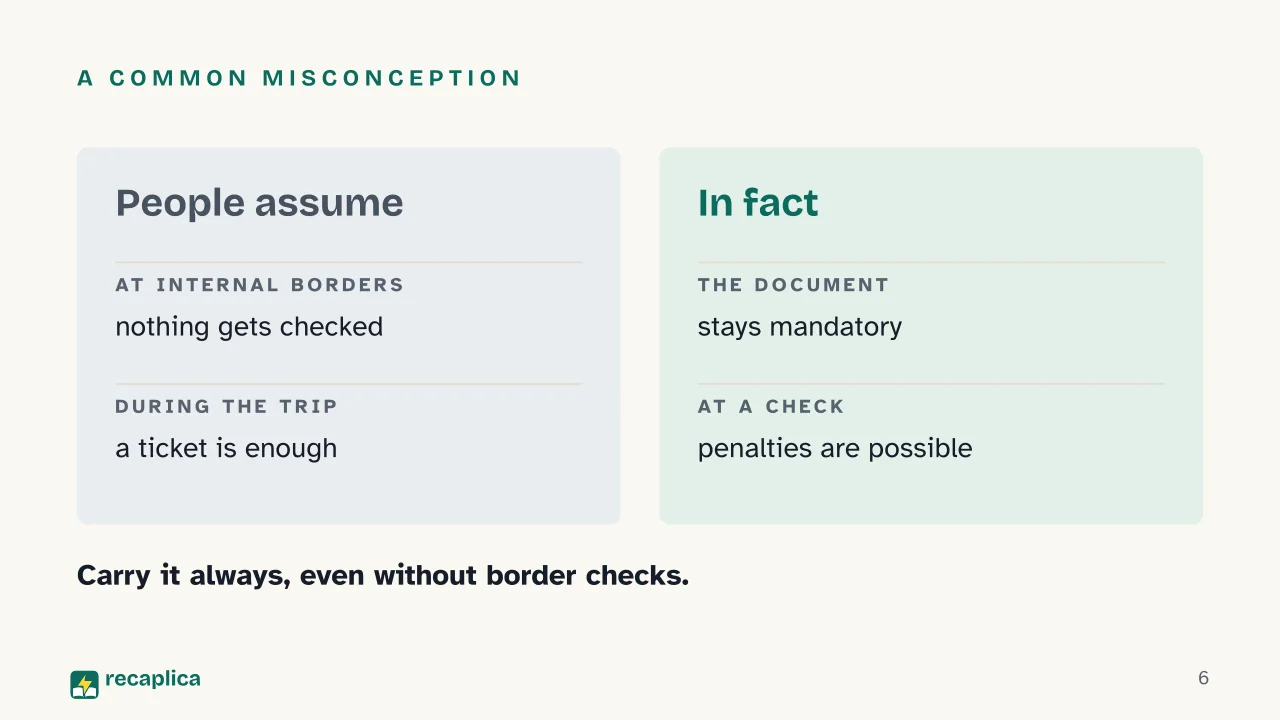
    According to the European Commission, an EU citizen can travel across the 27 member states, plus Iceland, Liechtenstein, Norway and Switzerland, with a valid national ID card or a passport. The document has to be valid on the day of travel. It usually isn’t requested at internal Schengen borders, but it becomes necessary again if a country applies temporary controls, and it’s always required crossing between a Schengen country and Cyprus or Ireland: both are EU members but don’t apply the Schengen agreement.

    Children need their own document, an ID card or a passport: listing a child on a parent’s document is no longer an option. Anyone without a valid document during a police check risks penalties, even inside the Schengen area.

    Real-world example: a family driving from Italy to Greece through several Schengen borders won’t stop at any customs checkpoint, but they still keep every ID card, parents’ and children’s, within reach, because a police check can happen at any point in the trip.

    Outside the European Union

    Traveling to a country outside the EU almost always requires a passport. The European Commission, describing the reverse case of a non-EU national entering the Union, sets out a general principle: a minimum remaining validity of three months beyond the planned departure date, and a passport issued no more than ten years earlier. Many countries outside the EU apply a similar logic to travelers, asking for a few months of remaining validity; the exact figure changes from country to country and should always be confirmed before departure with the destination’s foreign ministry or its consulate, never assumed.

    Depending on nationality, an entry visa may also be required, an authorization on top of the passport. For non-EU nationals entering the Schengen area for short stays, the EU applies the rule known as 90/180: up to 90 days of stay within any 180-day period. At the border, other documents can also be requested, such as proof of sufficient funds, an invitation letter, proof of accommodation, or a return ticket.

    Italy’s paper ID card, an example of what can change

    Rules like this can shift without warning, and Italy’s paper ID card is a recent case worth knowing even for readers outside the country. A 2026 decree (Decree-Law 108/2026) set 3 August 2026 as the date after which Italy’s paper ID card stopped being valid for expatriation. The electronic ID card (CIE) and the passport remain valid. Anyone still holding only the paper version who needs to travel urgently can request a provisional document from their municipality, not from a consulate, valid for a maximum of 6 months and not renewable; it’s issued alongside the appointment booking for the CIE. Some foreign countries may still decline to accept this bridge document, so arriving with the CIE or a passport remains the safer option.

    For uses inside Italy, the paper card keeps its validity until its normal expiration in dealings with public administration, public service providers, and private contracts already in place on 3 August 2026.

    Outside the EU, Italy also has bilateral agreements that extend the ID card’s validity to some non-EU countries: the updated list, which changes over time, should be checked on the Ministry of Foreign Affairs’ Viaggiare sicuri website before every trip, rather than relied on from lists found elsewhere.

    WhereDocumentNote
    Schengen area (EU + Iceland, Liechtenstein, Norway, Switzerland)Valid ID card or passportmust be valid
    Cyprus and IrelandValid ID card or passportEU but outside Schengen, still required
    Countries outside the EUPassportoften with remaining validity to confirm, sometimes a visa
    Children (any destination)Own documentnever listed on a parent’s document

    Documents for children

    Every child traveling abroad, from newborns onward, needs their own document: an ID card or a passport. Applying for a passport for a minor requires the consent of both parents; if one of them can’t appear at the appointment, they have to provide a signed consent statement along with a copy of both sides of an ID document.

    Expatriation for children under 14 also requires a parent (or a legal guardian) to accompany them, or, if they’re traveling with other adults, an accompaniment declaration. There’s also a specific pass for children under 15, created by a 1957 European agreement, a lesser-known alternative to the ID card or passport for simpler trips.

    Health and other checks before you travel

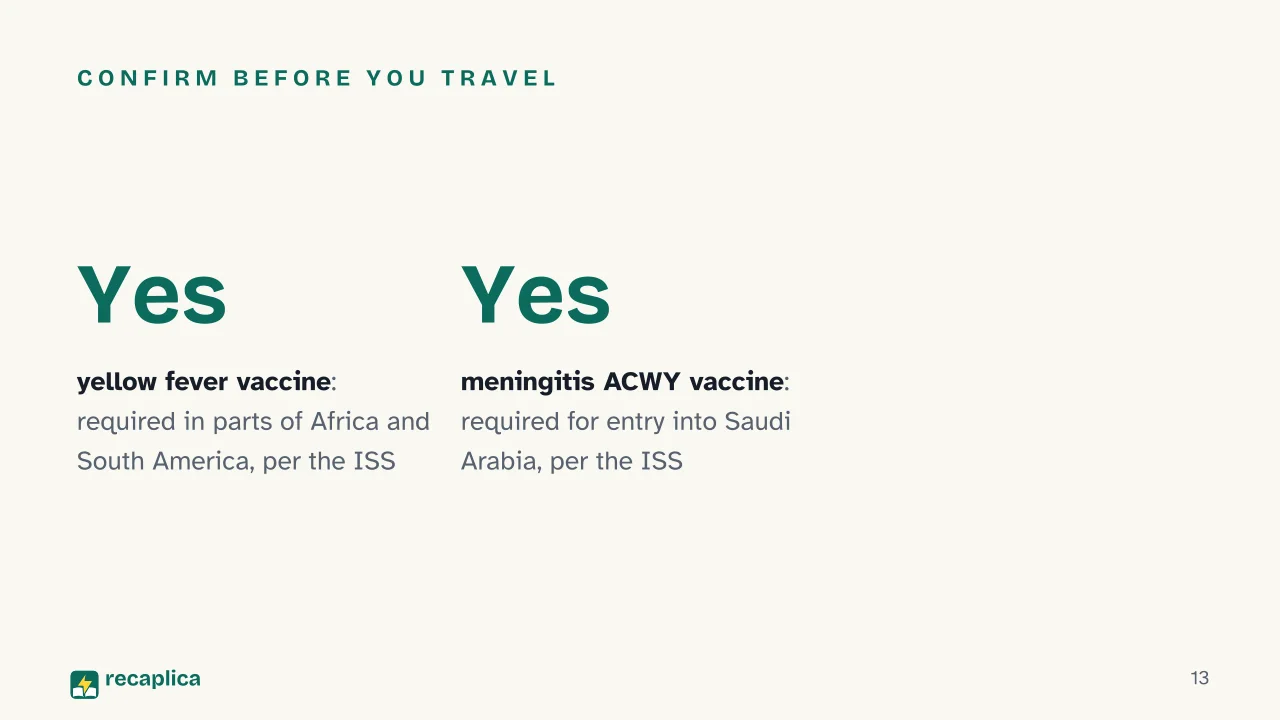
    The ISS notes that some countries require a vaccination certificate for entry, for example against yellow fever in parts of equatorial Africa and South America, or against meningitis ACWY for entry into Saudi Arabia. This isn’t a list to follow without checking further: the specific case for a given itinerary should be confirmed with official sources, a local health authority, or a travel medicine clinic, not with a generic search.

    For updated document, visa and health requirements by country, a reference used by airlines is the IATA Travel Centre. Before departure it’s also worth checking the practical side of the trip: how the Italian Ministry of Foreign Affairs supports citizens abroad, how SPID works for booking appointments online, when an eSIM beats a local SIM card, and how payment and cancellation work for a hotel reservation abroad.

    Slide deck

    Slides ready to download and make your own in PowerPoint or Google Slides, with speaker notes. Pick the Flash cut or the Full one.
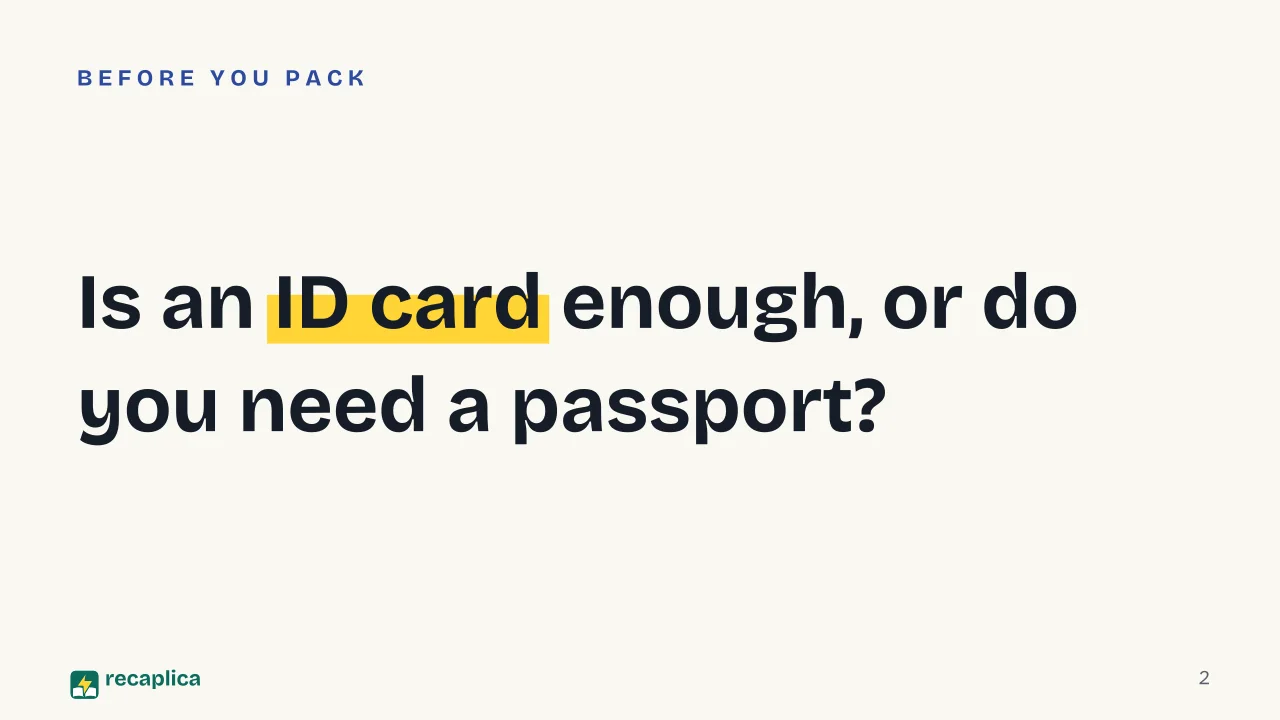
    Slide 1 of the presentation on Passport Requirements for International Travel: Passport Requirements for International TravelSlide 2 of the presentation on Passport Requirements for International Travel: Is an ID card enough, or do you need a passport?Slide 3 of the presentation on Passport Requirements for International Travel: In this RecapSlide 4 of the presentation on Passport Requirements for International Travel: Chapter 01: Inside the EUSlide 5 of the presentation on Passport Requirements for International Travel: An ID card is enoughSlide 6 of the presentation on Passport Requirements for International Travel: A common misconceptionSlide 7 of the presentation on Passport Requirements for International Travel: Chapter 02: Outside the EUSlide 8 of the presentation on Passport Requirements for International Travel: Before leaving the EUSlide 9 of the presentation on Passport Requirements for International Travel: Since 3 August 2026, Italy's paper ID card no longer works for travel abroadSlide 10 of the presentation on Passport Requirements for International Travel: Chapter 03: Documents for ChildrenSlide 11 of the presentation on Passport Requirements for International Travel: Always · Parents · AccompanimentSlide 12 of the presentation on Passport Requirements for International Travel: Chapter 04: Health and Final ChecksSlide 13 of the presentation on Passport Requirements for International Travel: Confirm before you travelSlide 14 of the presentation on Passport Requirements for International Travel: What's enough to enter a Schengen-area country?Slide 15 of the presentation on Passport Requirements for International Travel: The right document, always with you
    Flash10 slidesThe essential thread, to present in classFull15 slidesEvery chapter and the deeper detail

    Common myths

    • ✗ Myth Inside the EU, no document is needed at all

      ✓ Reality A valid ID card or passport is still required even inside the Schengen area. It usually isn't shown at internal borders, but it must be carried, and showing up to a police check without one can lead to penalties.

    • ✗ Myth Any passport works as long as it hasn't technically expired

      ✓ Reality Many countries outside the EU require a minimum remaining validity beyond the travel dates, and the exact figure changes from country to country. It has to be checked before departure with the destination's foreign ministry or consulate, never assumed.

    • ✗ Myth An Italian paper ID card still works for travel abroad

      ✓ Reality Since 3 August 2026 Italy's paper ID card is no longer valid for expatriation. Only the electronic ID card (CIE) or a passport work; the bridge document some municipalities issue for urgent cases lasts 6 months, can't be renewed, and isn't guaranteed to be accepted by every foreign country.

    Mind map

    Drag the background to move around and the nodes to reposition them; use − and + to collapse and expand branches.
    Customize
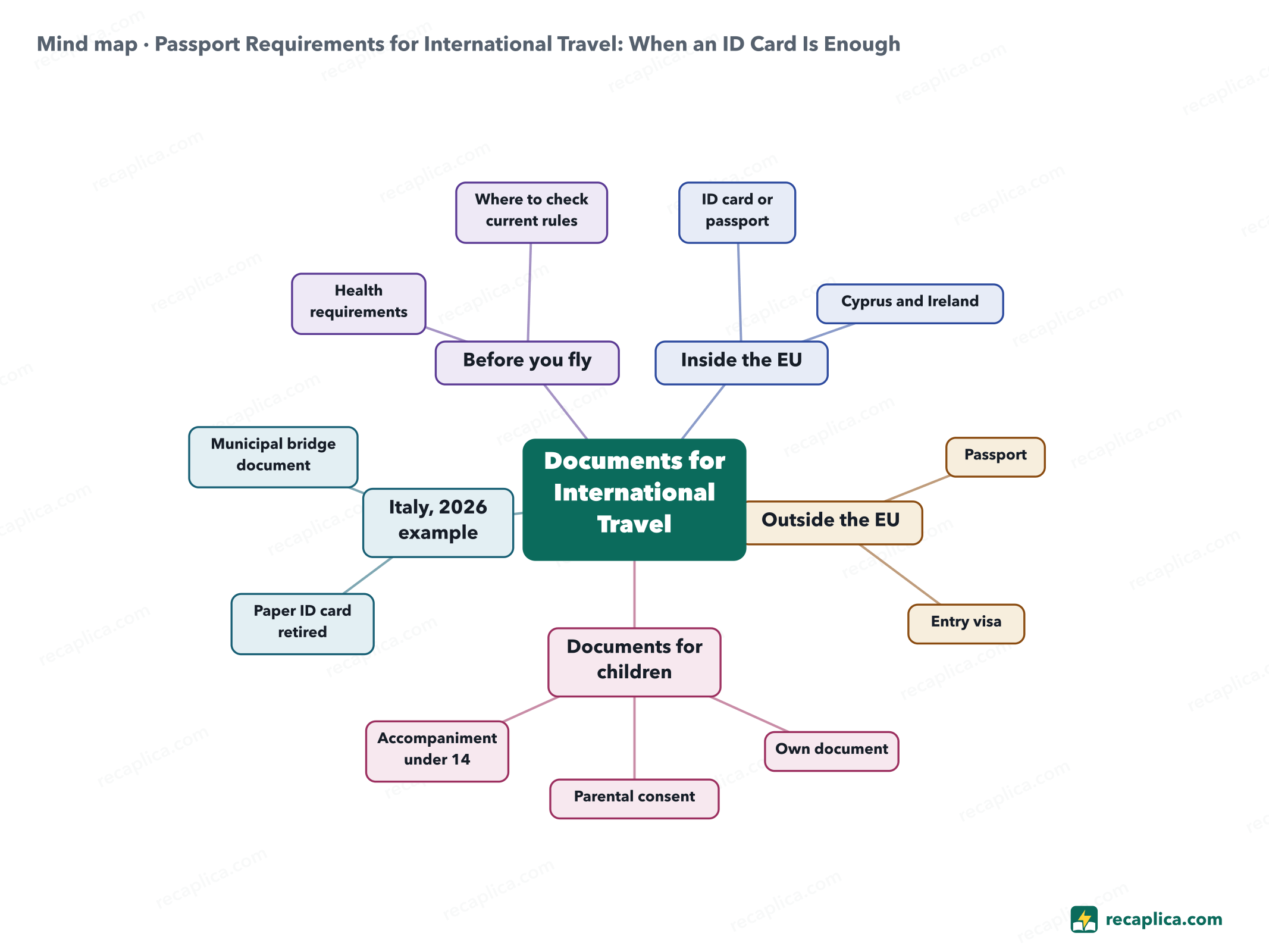
    Mind map: Passport Requirements for International Travel: When an ID Card Is Enough
    • Documents for International Travel
      • Inside the EU Schengen area plus Iceland, Liechtenstein, Norway, Switzerland
        • ID card or passport must be valid
        • Cyprus and Ireland EU but outside Schengen, document still required
      • Outside the EU
        • Passport check remaining validity for the destination
        • Entry visa required depending on nationality
      • Documents for children
        • Own document ID card or passport
        • Parental consent from both parents, even if one is absent
        • Accompaniment under 14 a parent or a declaration for other adults
      • Italy, 2026 example
        • Paper ID card retired no longer valid for travel abroad since 3 August 2026
        • Municipal bridge document 6 months, not renewable, urgent cases only
      • Before you fly
        • Health requirements confirm with official sources
        • Where to check current rules destination's foreign ministry, consulate, IATA Travel Centre

    Quiz: test yourself

    Answer the questions to check what you have learned: you get instant feedback and a short explanation.

    Grade 0/10 0/5
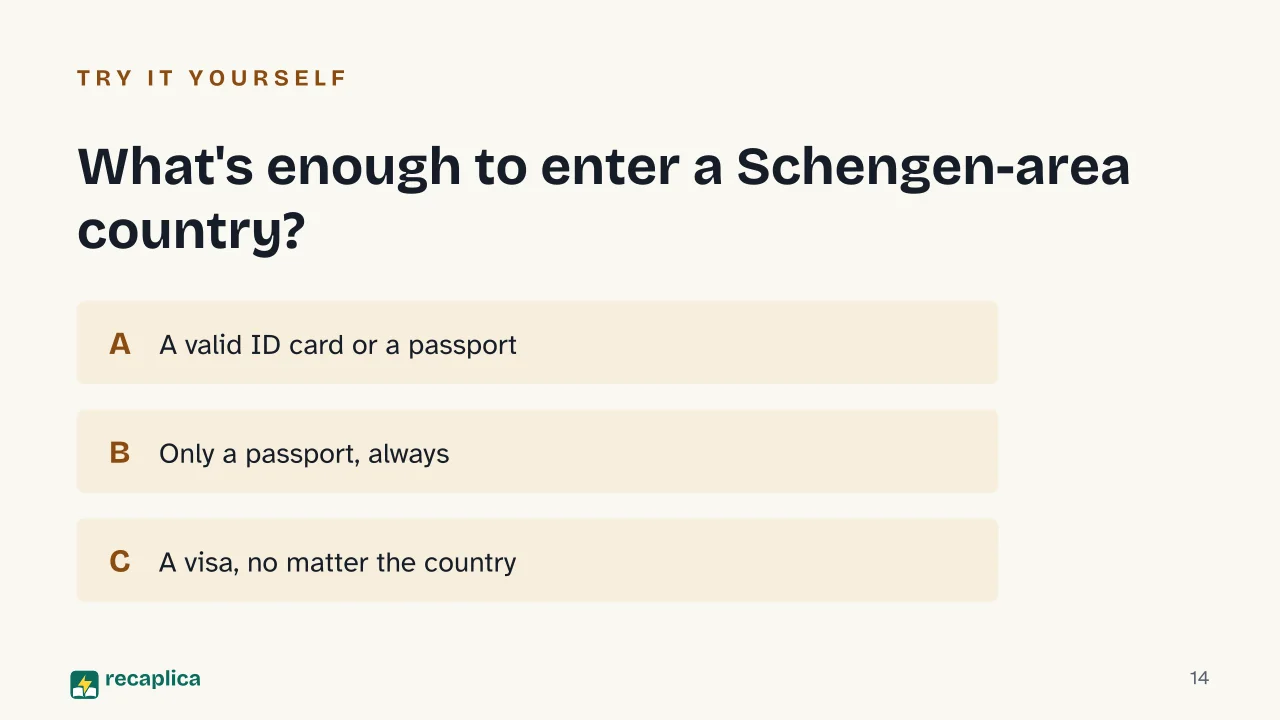
    1 What's enough for a traveler to enter a Schengen-area country?

    Inside the Schengen area (the EU plus Iceland, Liechtenstein, Norway and Switzerland), either document is enough, as long as it's valid.

    2 True or false: inside the Schengen area, no document is ever needed because internal borders aren't checked.

    False. A valid document is still mandatory and must be carried; temporary border controls or police checks can require it at any time.

    3 What general rule does the EU apply to non-EU nationals for short stays inside the Schengen area?

    It's known as the 90/180 rule: up to 90 days of stay within any 180-day period, unless different agreements apply based on nationality.

    4 As of 3 August 2026, which document stopped being valid for travel abroad from Italy?

    Decree-Law 108/2026 ended the paper ID card's validity for expatriation from that date; the electronic ID card and the passport remain valid.

    5 Who can accompany a minor under 14 traveling abroad, based on the rules covered in this Recap?

    Under 14, a minor needs a parent or legal guardian, or, when traveling with other adults, an accompaniment declaration.

    Answers: 1-A · 2-B · 3-A · 4-A · 5-A

    Flashcards

    Tap the card to flip it and check whether you remember the answer, then move to the next one.

    1 / 7

    Explain it in your own words

    The ultimate test: if you can explain it in simple words, you've truly understood it. Write your explanation, then compare it with the Recap.

    Your explanation is saved only on this device.

    Which document you need to enter another country depends on where you're going. Inside the Schengen area, plus Iceland, Liechtenstein, Norway and Switzerland, a valid national ID card or a passport is enough. Outside that area, most countries require a passport, often with a minimum validity beyond the travel dates, and sometimes an additional visa. Children always need their own travel document, never an entry on a parent's.

    Frequently asked questions

    What is an entry visa, and when do I need one?

    It's an additional authorization that some countries outside the EU require depending on the traveler's nationality, on top of a valid passport. For non-EU nationals entering the Schengen area, the general rule for short stays is 90 days within any 180-day period.

    Is an ID card enough to travel in Europe?

    Inside the EU, plus Iceland, Liechtenstein, Norway and Switzerland, a valid ID card works instead of a passport. Cyprus and Ireland are the exception: both are EU members but don't apply the Schengen rules, so a document still has to be shown there.

    How much passport validity do I need to enter a country outside the EU?

    Many countries outside the EU ask for a minimum remaining validity of several months beyond the planned departure date, but the exact figure changes from country to country. It has to be confirmed before departure with the destination's foreign ministry or consulate, never assumed from a general rule.

    What documents does a child need to travel abroad?

    Their own document, an ID card or a passport, plus the consent of both parents for the application. Under 14, the child also needs a parent, a legal guardian, or an accompaniment declaration if traveling with other adults.

    Do some countries require vaccinations for entry, and where can I check current requirements?

    The Italian public health institute (ISS) notes that some countries require a vaccination certificate, for example against yellow fever in parts of Africa and South America, or against meningitis ACWY for Saudi Arabia. The specific case for a given itinerary should be checked with official sources (the destination's health authority, a travel clinic), not with a generic search. For document and visa requirements, the IATA Travel Centre is a reference used by airlines.

    Sources

    • Italian State Police — Documents for travel
    • Italian State Police — Passport for minors and expatriation
    • Italian Ministry of Foreign Affairs and International Cooperation — ID card
    • European Commission, Your Europe — Travel documents for EU nationals
    • European Commission, Your Europe — Travel documents for non-EU nationals
    • IATA Travel Centre — Passport, Visa & Health requirements
    • Istituto Superiore di Sanità, EpiCentro — Vaccinations for international travelers
    • Italian Consulate General in Boston — Decree-Law 26 June 2026, no. 108
    • ANSA — Italy's paper ID card is no longer valid for expatriation

    Every Recap goes through an independent review before publication.

    Every evening, the day's new Recaps on our Telegram channel. Join the channel →

    Keep learning

    • Civics How the European Union Works: Who Really Runs It The European Union does not have one government; it runs on seven institutions with different jobs. The European Parliament, elected directly by citizens, and the Council of the European Union, where national ministers sit, jointly pass almost every EU law, but only after the European Commission has proposed it. The European Council, made up of heads of state and government, sets the broad political direction but never votes on legislation. The toughest calls at the Council of the EU go through qualified majority voting: at least 15 of the 27 member states have to say yes, and together they must represent 65% of the EU population. Read the Recap →
    • Technology eSIM: what is it and how does it work for travel An eSIM is a digital SIM built into a phone: it turns on with a QR code or an app, with nothing to insert or remove. It's convenient for travel because a data plan can be activated remotely, but the phone needs a Wi-Fi connection to finish the setup. Inside the European Union, though, a traveler's home operator already includes roaming at domestic rates since 2017: the eSIM vs local SIM choice mostly matters outside that area, where roaming can get expensive. Read the Recap →
    • Civics Carabinieri Ranks: The Four-Role Hierarchy of the Corps Every member of the Carabinieri sits inside one of four legally defined roles, in force since a 2000 law: Officers, Inspectors, Supervisors, and Corporals and Privates. Promotion happens inside a role first, and the four roles themselves run from the most operational to the most senior. The lowest rank is Carabiniere; the highest is Generale di Corpo d'Armata, in the Officer role. Two abbreviations, Q.S. and C.S., show up next to a handful of ranks — they aren't extra rungs on the ladder, just a qualification attached to the top rank already sitting there. Read the Recap →

    recaplica

    Clear in 30 seconds, yours in 10 minutes.

    Recaps Mind maps Request a Recap Telegram channel Mind map maker Our method About Privacy & cookies Legal notes & terms of use

    © 2026 Recaplica · A project by Curi S.r.l. — VAT IT05472000750

    Statistics, only if you say so

    To learn which Recaps help most we would use Google Analytics, with aggregate, anonymous data. It starts only with your OK, and you can change your mind anytime. Privacy policy