|
recaplica
DBMS: What It Is, the Main Types, and Real Examples | ||||||||||||||||||
| © 2026 Recaplica · recaplica.com — All rights reserved | ||||||||||||||||||
DBMS: What It Is, the Main Types, and Real ExamplesWhat to print Page numbers appear when printing with default margins. SlidesChoose a cut Flash10 slidesThe essential thread, to present in classFull14 slidesEvery chapter and the deeper detailBoth come with speaker notes. In 30 seconds quick readA DBMS, short for database management system, is the software that lets people create, query and update the data in a database without having to know how that data is physically stored. Compared with spreadsheets or scattered files, it keeps data in one place and more consistent, cutting down on duplication and security gaps. The most common type is the relational model, which organizes data into linked tables and is queried with SQL. Nonrelational, or NoSQL, systems handle more flexible data, and two older models, hierarchical and network, sit alongside an object-oriented model. Key Points
Deep DiveWhat a DBMS actually isIBM treats a database as a digital repository that stores, manages and secures organized collections of data. A DBMS, short for database management system, is the software layer on top of it: it’s what lets administrators, users and applications interface with that data — formatting the database, managing metadata, querying data sets, and adding, updating or deleting information. Snowflake adds a useful detail: a DBMS gives whoever uses it a more systematic way to create, update and query databases, while keeping data integrity intact along the way. Why a DBMS beats spreadsheets and manual filesSnowflake describes older methods bluntly: spreadsheets, text documents or printed files weren’t just slow, they came with duplicated or isolated data, poor data quality and weak security. A DBMS stores data centrally and securely, cutting down on redundancy; because the system is centralized, it’s easier to guarantee security, integrity and consistency across different users and applications.
IBM adds that databases managed by a DBMS bring real advantages over spreadsheets and other manual record-keeping, which are notoriously prone to errors, redundancy and inaccuracy. A DBMS also lets multiple users access the same data at the same time while keeping it consistent and intact, according to Snowflake. The relational model, still the most commonThe relational model is, per MongoDB, a system designed in the 1970s: it commonly uses SQL for operations such as creating, reading, updating and deleting data, and it stores information in separate tables joined together through fields called foreign keys. Before building those tables, database designers typically sketch an entity-relationship diagram to map out entities, attributes and relationships. Snowflake confirms that it organizes data into tables of rows and columns and remains the most widely used type of database. Sources name MySQL, Microsoft SQL Server, PostgreSQL and Oracle as examples. The NoSQL world: four distinct familiesFor IBM, “nonrelational database” is essentially a catch-all term for any database that doesn’t store data in a rigid format like a table; these systems are commonly known as NoSQL. MongoDB breaks that world down into at least four families. Document databases store data in JSON, BSON or XML documents, which can be nested and indexed to speed up queries; MongoDB itself is named as an example by Snowflake. Key-value databases are the simplest kind: every element is a pair made of an attribute name, the key, and a value, as in Redis and Riak KV. Column databases, unlike a relational DBMS that reads data row by row, are organized as a set of columns. Graph databases focus on the relationship between elements, each stored as a node connected to others through links or relationships; Neo4j is one example.
Hierarchical and network: the two oldest modelsIBM describes hierarchical databases as tree-shaped structures, with parent records and child records: a model developed in the 1960s, per MongoDB, which compares it to a family tree where no child can have more than one parent. Network databases behave much like hierarchical ones, with one precise difference: each child record can link to multiple parent records. Snowflake describes the hierarchical structure as similar to a traditional file system with folders and subfolders, and the network model as a graph that allows for more complex connections between data. A database management course at the UC Berkeley School of Information confirms this four-model taxonomy — hierarchical, network, relational and object-oriented — as the basis of academic teaching on DBMS: it isn’t a classification invented by software vendors, but one taught in computer science courses. The object-oriented modelObject-oriented databases store data as objects, in the sense used in object-oriented programming, according to IBM. MongoDB adds that these systems store and manage objects on a database server’s disk, and that what sets them apart is that associations between objects can persist over time. An application written in JavaScript or PHP, languages that often talk to a relational DBMS through SQL, can instead rely on an object-oriented database when the objects in the program map more naturally onto the objects stored in the database.
Every variant of a DBMS is part of the software layer that made the recent history of computers possible: from the hierarchical model of the 1960s and the relational model of the 1970s to the web applications that exchange data with a database on every page loaded over the internet. Slide deckSlides ready to download and make your own in PowerPoint or Google Slides, with speaker notes. Pick the Flash cut or the Full one.   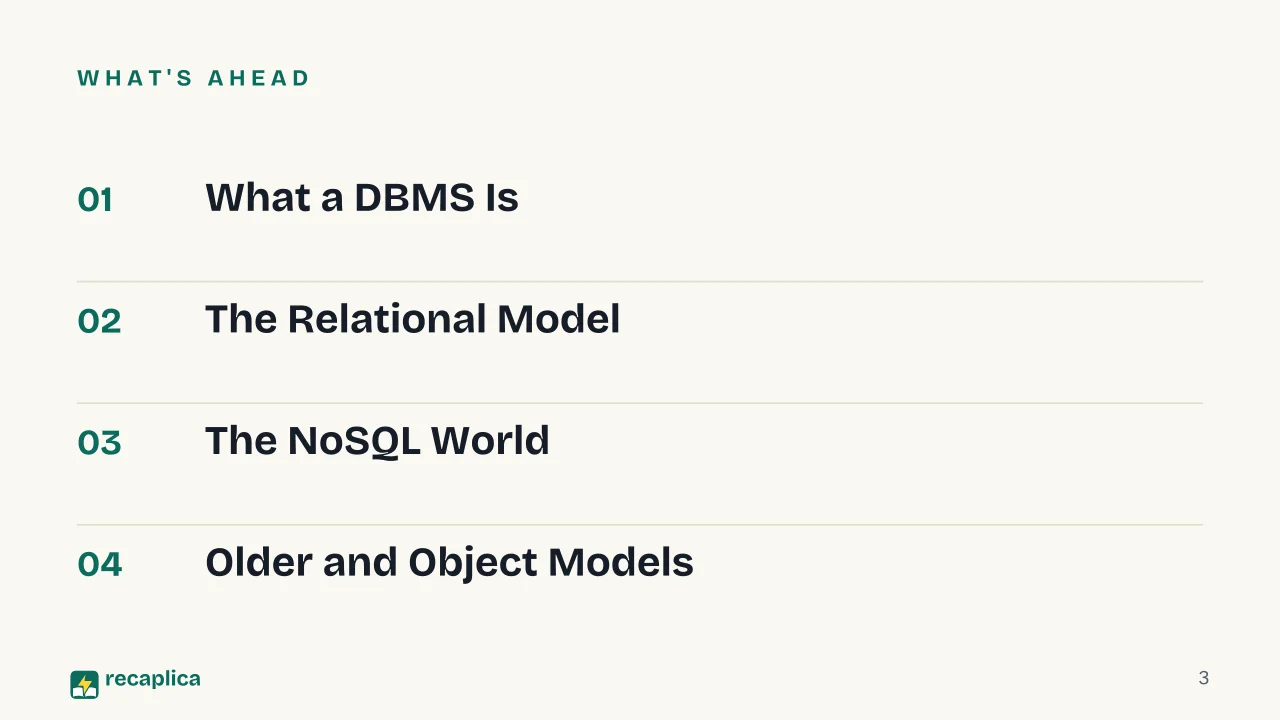  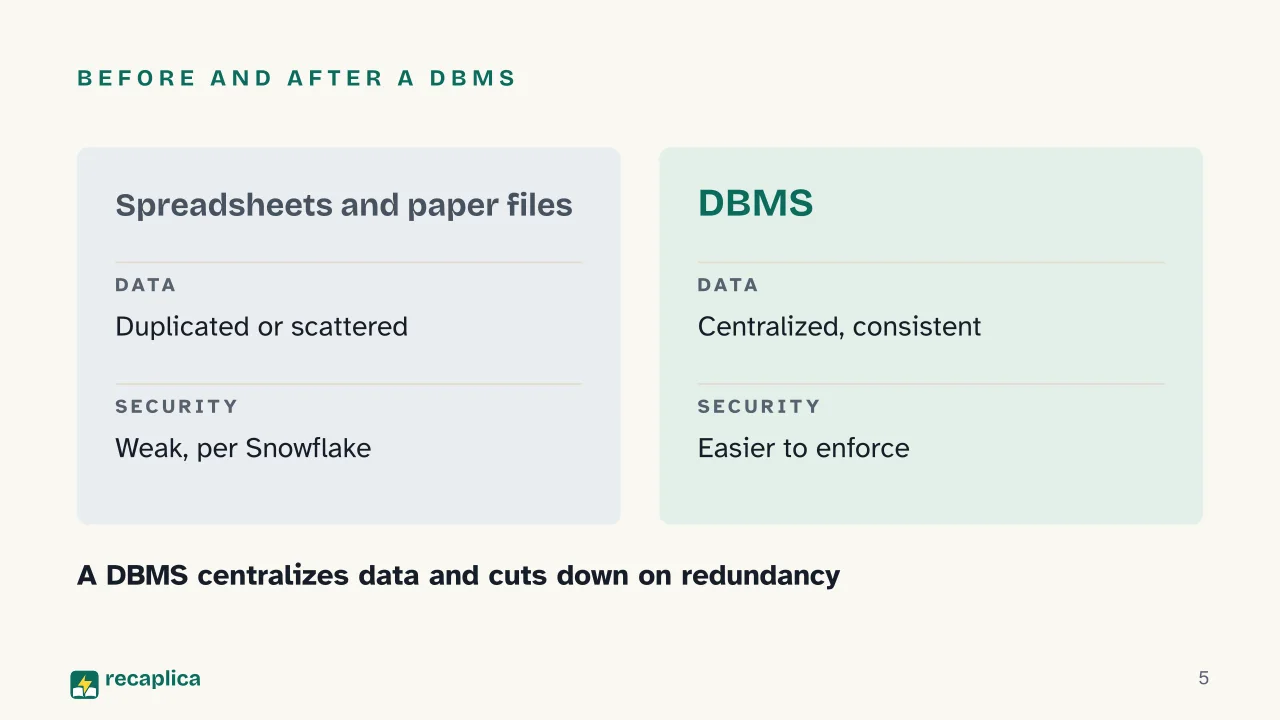  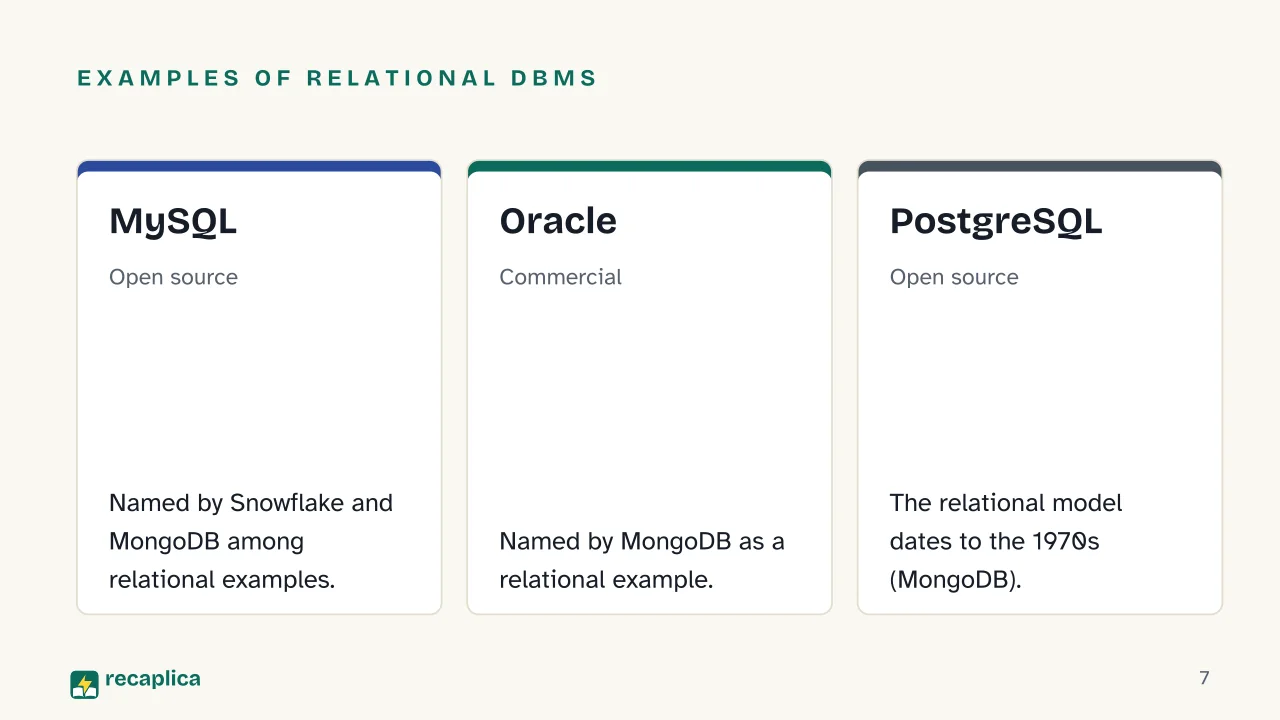  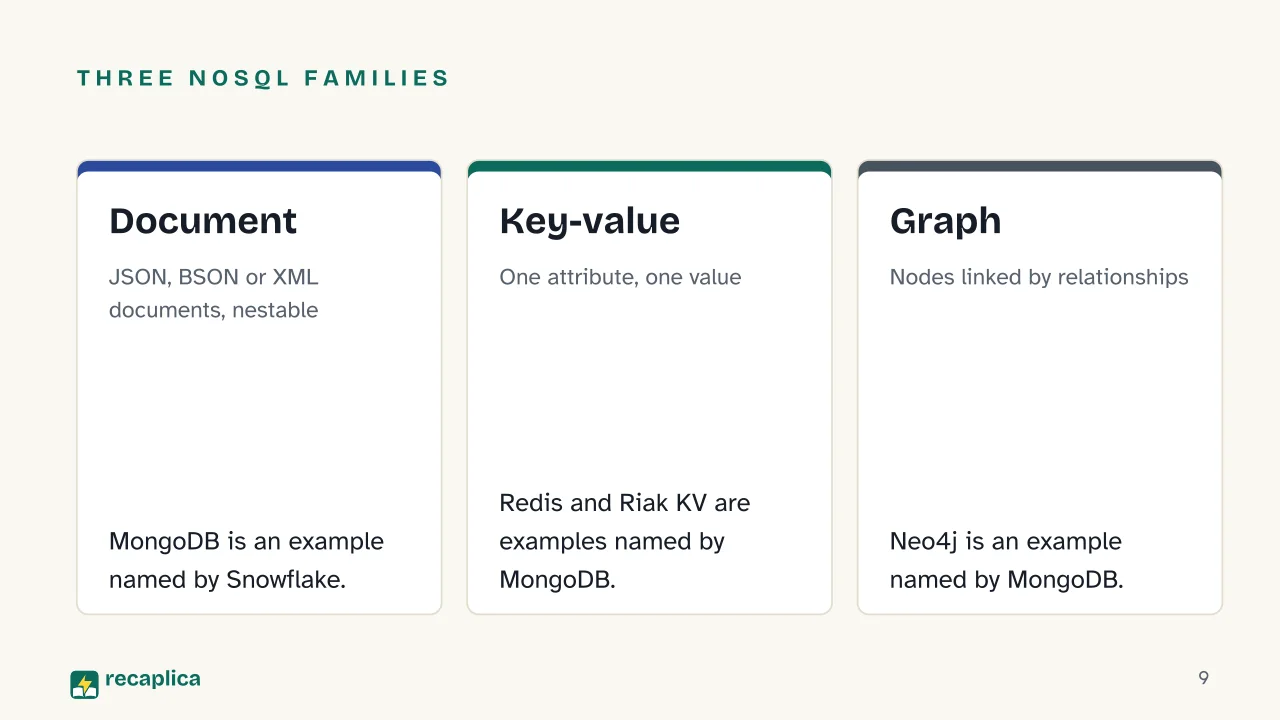  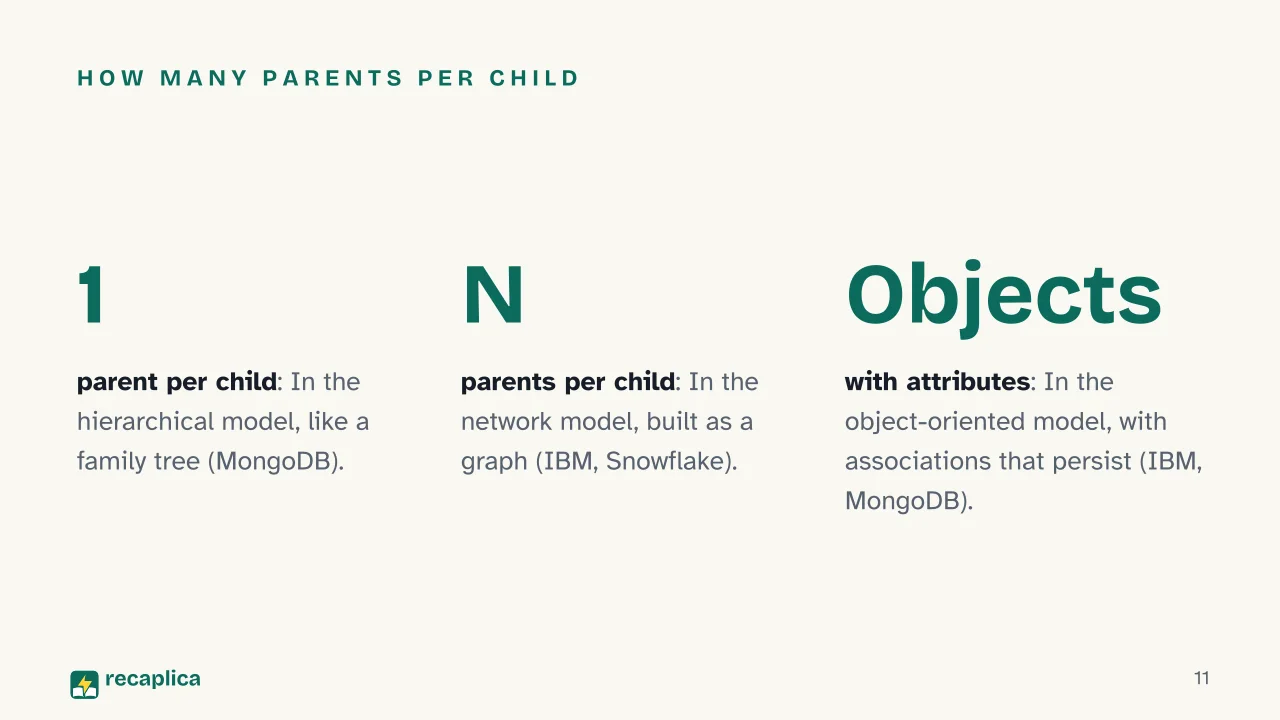 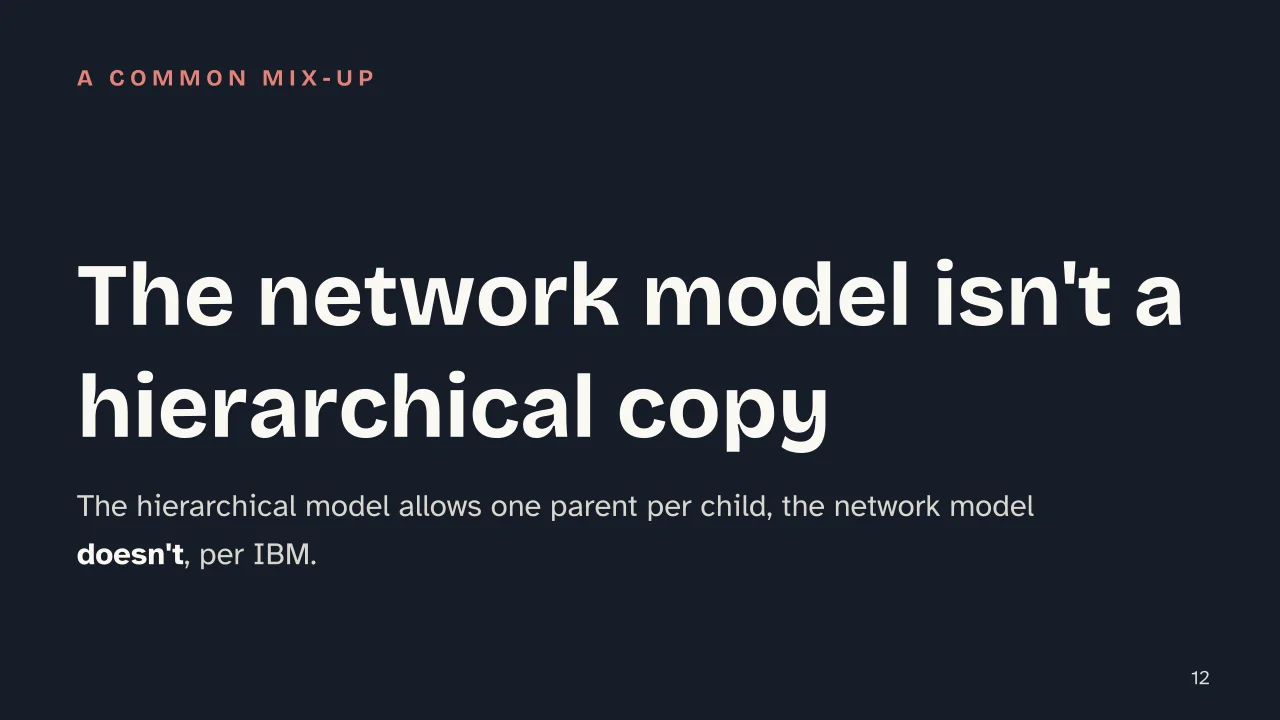 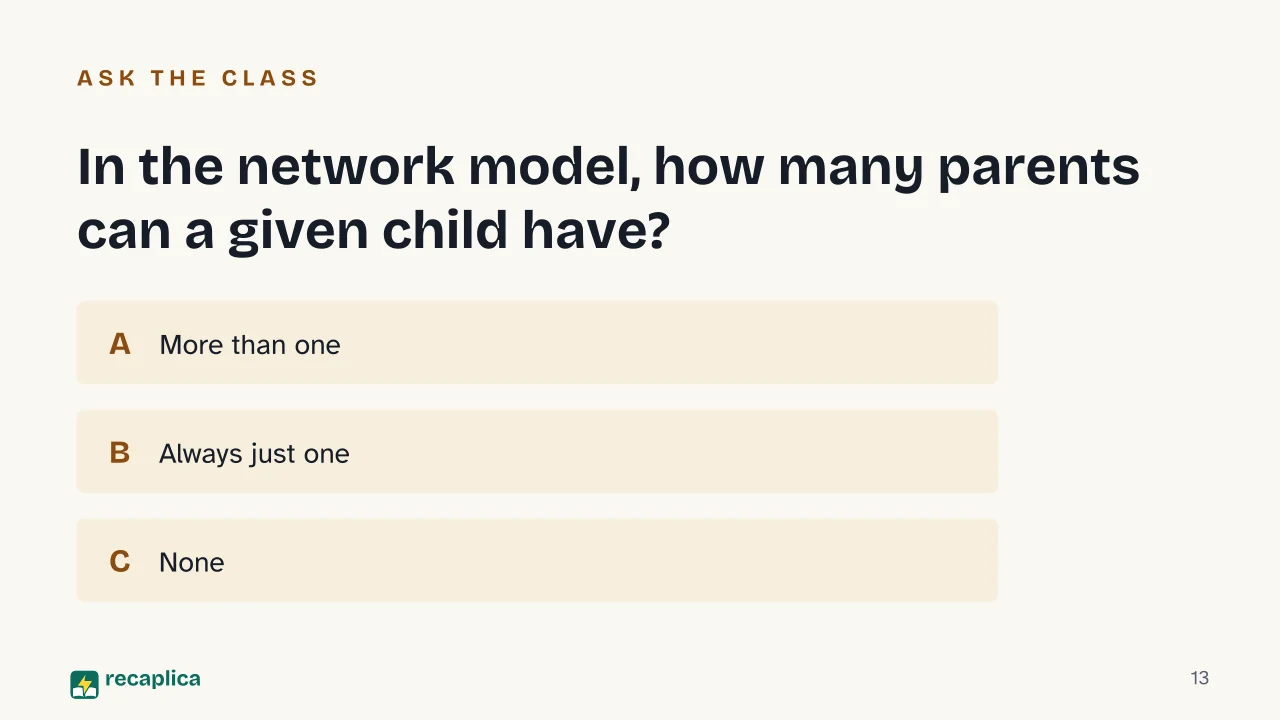  Common myths
Mind mapDrag the background to move around and the nodes to reposition them; use − and + to collapse and expand branches. 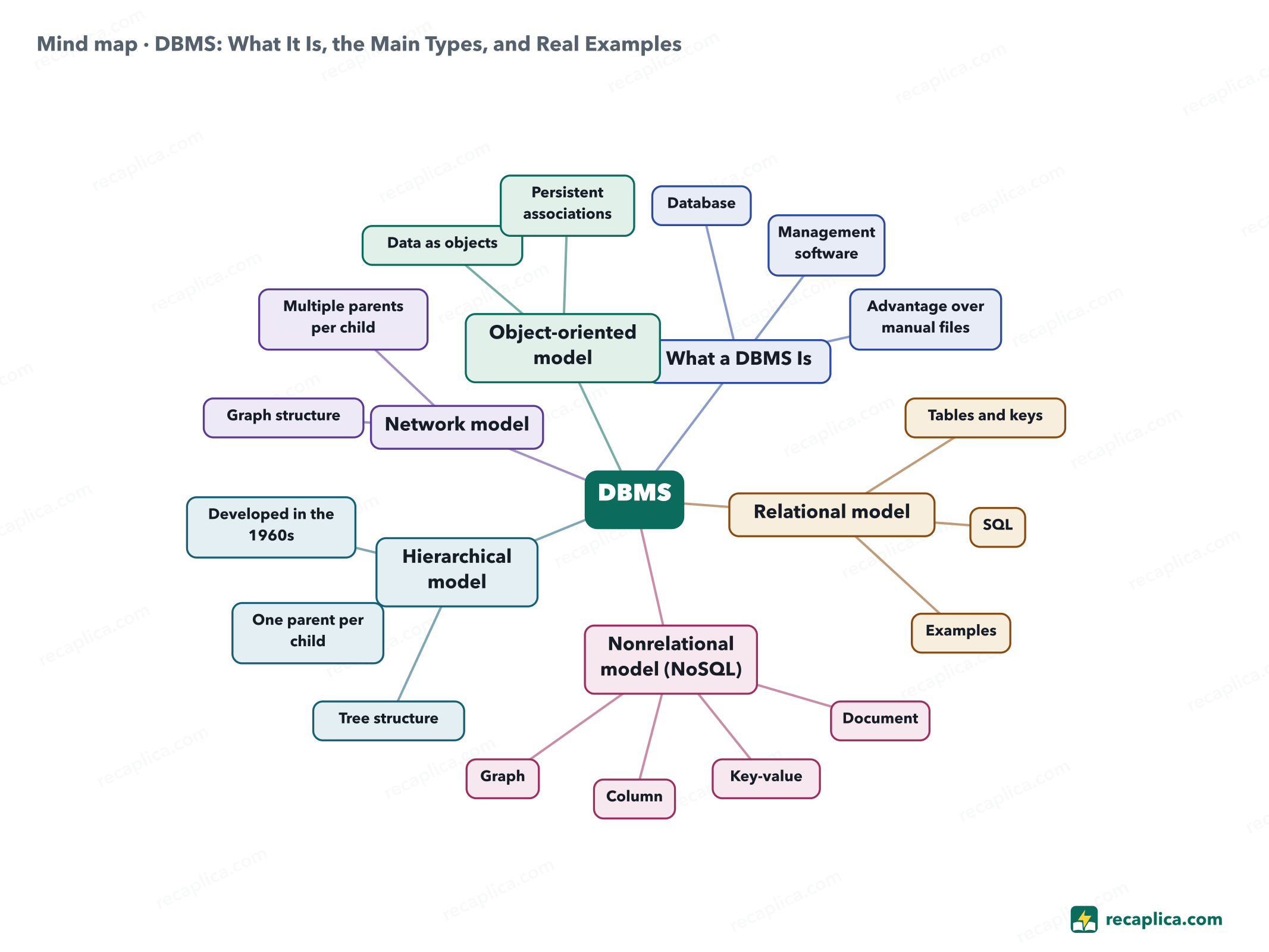
Quiz: test yourselfAnswer the questions to check what you have learned: you get instant feedback and a short explanation. Grade 0/10 0/5
FlashcardsTap the card to flip it and check whether you remember the answer, then move to the next one. 1 / 8 Explain it in your own wordsThe ultimate test: if you can explain it in simple words, you've truly understood it. Write your explanation, then compare it with the Recap. Your explanation is saved only on this device.
Frequently asked questionsWhat is a DBMS?It's the software that lets administrators, everyday users and applications create, query, update and secure the data held in a database (IBM). What are the types of database management system?Five main ones: relational, nonrelational (or NoSQL), hierarchical, network, and object-oriented. Each organizes data with a different logic, from tables linked by keys to tree or graph structures (IBM). What are some real database management system examples?Among relational systems: MySQL, PostgreSQL, Microsoft SQL Server and Oracle. Among nonrelational ones: MongoDB for documents, Redis and Riak KV for key-value pairs, Neo4j for graphs (Snowflake, MongoDB). What's the difference between a relational and a NoSQL DBMS?A relational DBMS organizes data into tables with fixed rows and columns, linked by keys. NoSQL groups more flexible, non-tabular formats instead, such as JSON documents, key-value pairs, columns, or graphs of linked nodes (IBM, MongoDB). Why use a DBMS instead of spreadsheets or scattered files?Snowflake points out that older methods — spreadsheets, text documents or printed files — tend to produce duplicated or isolated data, of poor quality and with weak security; a DBMS centralizes data and cuts down on that redundancy. Every Recap goes through an independent review before publication. |