|
recaplica
Power bank on a plane: the rules for carrying and using it safely | ||||||||||||
| © 2026 Recaplica · recaplica.com — All rights reserved | ||||||||||||
Power bank on a plane: the rules for carrying and using it safelyWhat to print Page numbers appear when printing with default margins. SlidesChoose a cut Flash10 slidesThe essential thread, to present in classFull16 slidesEvery chapter and the deeper detailBoth come with speaker notes. In 30 seconds quick readPower banks and other spare lithium batteries must always travel in carry-on luggage, never in a checked suitcase: it's the rule shared by the FAA, TSA, IATA and EASA. The limit depends on the battery's capacity, measured in watt-hours (Wh): up to 100 Wh you can fly with no permission, between 101 and 160 Wh you need the airline's approval and can carry at most two spare batteries in that range, and above 160 Wh the power bank stays on the ground. The reason is technical, not bureaucratic: if a lithium battery overheats (a phenomenon called thermal runaway), the crew can act immediately only if the device is visible, in the cabin, not if it's sealed away in the hold or an overhead bin. After an Air Busan plane caught fire in January 2025, ignited by a power bank stored above passengers' heads, several Asian airlines added stricter rules on in-flight use. Individual airline rules keep changing, so it's always worth checking them before you travel. Key Points
Key figures
Deep DiveIn the cabin, not in your suitcaseBefore the numbers, the first distinction to make is between carry-on and checked luggage. Power banks and other spare lithium batteries — meaning ones not installed inside a device, like battery cases for smartphones — have to travel in carry-on luggage only: it’s the rule the FAA (the US agency that regulates aviation), the TSA (which enforces it at security checkpoints), IATA (the international association of airlines) and EASA (the European aviation safety agency) all agree on. Devices with a battery already built in (a laptop, a phone, a camera) can in some cases travel in the hold too, but the general recommendation is still to keep them in the cabin. The reason isn’t bureaucratic box-ticking. If a lithium battery goes into thermal runaway — a chain reaction in which it overheats, releases gas, and can catch fire — the only way to act quickly is to have the device where someone can see it. In the cabin, a crew member can spot the early signs of a fire and respond within seconds; in the hold, sealed inside a suitcase among dozens of others, no one would notice until smoke started showing up somewhere else. That’s also why spare batteries have to stay in the cabin even when switched off: turning a device off doesn’t protect against internal faults in the battery powering it.
The terminals of spare batteries also need protection against short-circuits: insulating tape over the contacts, the original packaging, or a separate pouch all work. It’s a small precaution that removes one of the most common ways a battery can start heating up without anyone intending it. Three brackets, measured in watt-hoursBeyond where you pack it, a power bank’s capacity matters too. The reference measure is the watt-hour (Wh), calculated by multiplying the battery’s rated amp-hours (Ah) by its voltage; by law, the value has to be printed on the casing, which helps anyone holding a power bank that only states milliamp-hours (mAh) rather than Wh directly.
Non-rechargeable lithium metal batteries, like some camera batteries, follow a different scale based on grams of lithium: up to 2 grams with no approval, between 2 and 8 grams only with the airline’s approval and a maximum of two spares. For most batteries there’s no explicit cap on how many you can carry, but they have to be for the passenger’s personal use, and the final call on what clears security still rests with the officer on duty. These three brackets remain the shared international baseline, not necessarily the last word: many airlines impose stricter limits than the FAA, TSA and IATA minimums, so it’s always worth checking your carrier’s website before flying, especially if you’re traveling with devices that come close to the 100 Wh threshold — a high-end laptop or a very large power bank can sit right near it. A fire on the ground, and what it changedOn January 28, 2025, an Airbus A321 operated by the South Korean airline Air Busan (Flight 391) caught fire while parked on the ground during taxi, at Gimhae International Airport near Busan. There were 176 people on board, all evacuated; the preliminary investigation recorded seven minor injuries, while the aircraft itself was destroyed by the flames. On March 14, 2025, South Korean authorities attributed the cause to a breakdown in the internal insulation of a power bank stored in the overhead bin, above passengers’ heads, which was said to have triggered a short circuit. The critical factor wasn’t really the power bank itself but where it was. Stored in the overhead bin, no one could notice what was happening inside it in time — the same principle, flipped around, that underlies the “never in the hold” rule: what matters is that a battery in trouble stays visible and within reach of someone who can act. After the incident, South Korea’s Ministry of Land, Infrastructure and Transport introduced, from March 1, 2025, a ban on storing power banks and e-cigarettes in overhead bins, a ban on charging them through seat-back USB ports, and a limit of five power banks per passenger per flight. Some airlines went further than their own country’s rules. Air Busan, Korean Air and the other Hanjin Group carriers (Asiana, Jin Air, Air Seoul) banned using power banks in flight starting January 26, 2026: passengers can still bring one, but can’t use it to charge devices, and it has to stay within reach — in a pocket, the seat-back pocket, or under the seat — never in an overhead bin. Singapore Airlines and its low-cost arm Scoot introduced a similar rule from April 1, 2025: no charging power banks through onboard USB ports, and no using a power bank to charge personal devices for the entire flight. These are rules set by individual airlines, born out of one real incident and a wave of regulatory tightening that started in South Korea, not an IATA or ICAO standard that applies to every flight worldwide: as of this Recap’s writing, IATA flags new power bank rules due to take effect on January 1, 2027, and in the meantime advises passengers to always check their own airline’s current guidance, since it’s subject to revision. It’s the same mindset needed to understand the electric current running through any battery-powered device in the first place: anyone wanting a refresher on where the energy a power bank stores and releases actually comes from can read the Recap on how electric current works. Not just a question of chargeIt’s tempting to assume the risk only applies to batteries that are very full or very old, but the causes of thermal runaway are more varied: EASA, which works alongside IATA and ICAO on these recommendations, cites physical damage (impacts, crushing), overcharging, improper packaging, and counterfeit or low-quality batteries bought from unreliable sellers. Even a power bank that looks perfectly fine, like the one on Air Busan Flight 391, can carry a manufacturing defect in its internal insulation that surfaces without warning. That’s the basis for a few practical recommendations shared by EASA, IATA and ICAO, useful regardless of any individual airline’s own rules: keep the power bank somewhere you can monitor it, not stashed away and forgotten; avoid charging devices from a power bank in flight and avoid recharging the power bank itself on board; buy batteries from original retailers. They’re the same kind of care that applies to any sensitive piece of electronics — not so far removed from the batteries powering large parts of the transport industry by the mid-2020s, including the struggles the European automotive sector has faced in its own shift to electric vehicles, covered in the Recap on the European automotive industry crisis. One last parallel is worth drawing about how aviation handles technical risk more broadly: an aircraft’s black box exists for exactly this reason, to reconstruct precisely what happened after an incident — the same principle that let South Korean investigators trace the Flight 391 fire back to a single power bank. Anyone curious about how that kind of reconstruction actually works can read the Recap on the flight data recorder, which covers what it really records and how it’s recovered. Slide deckSlides ready to download and make your own in PowerPoint or Google Slides, with speaker notes. Pick the Flash cut or the Full one.     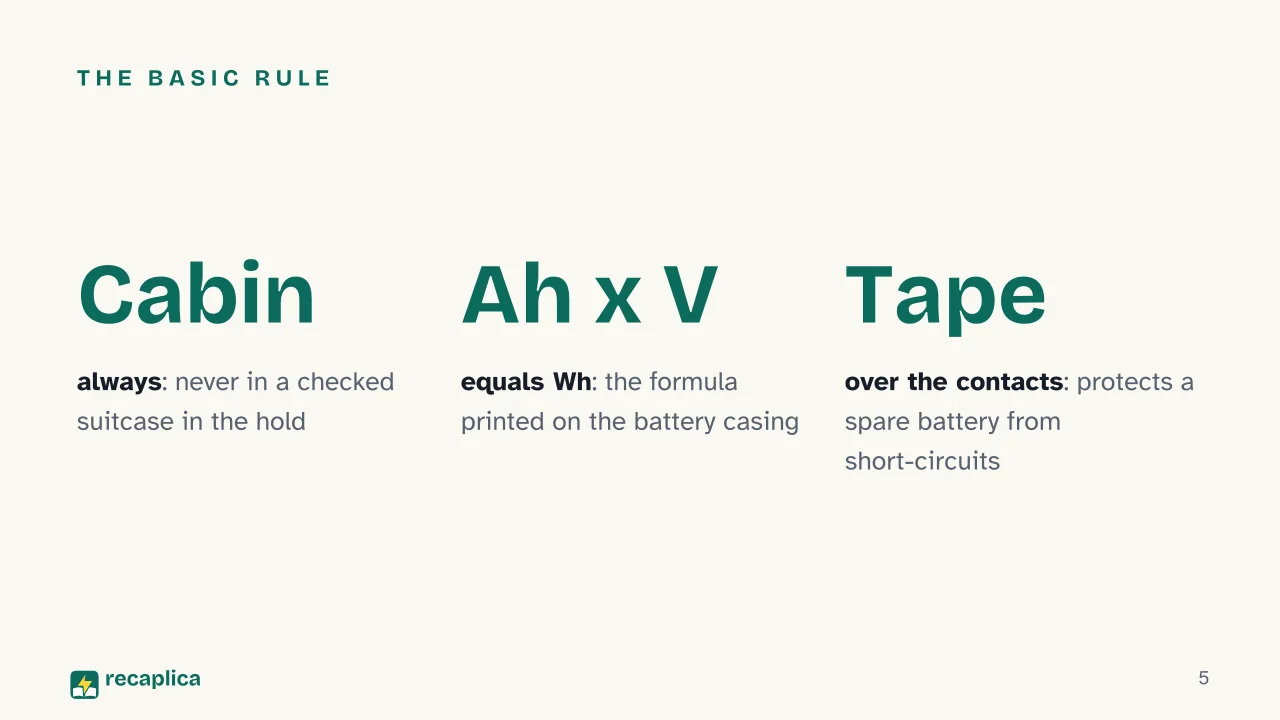 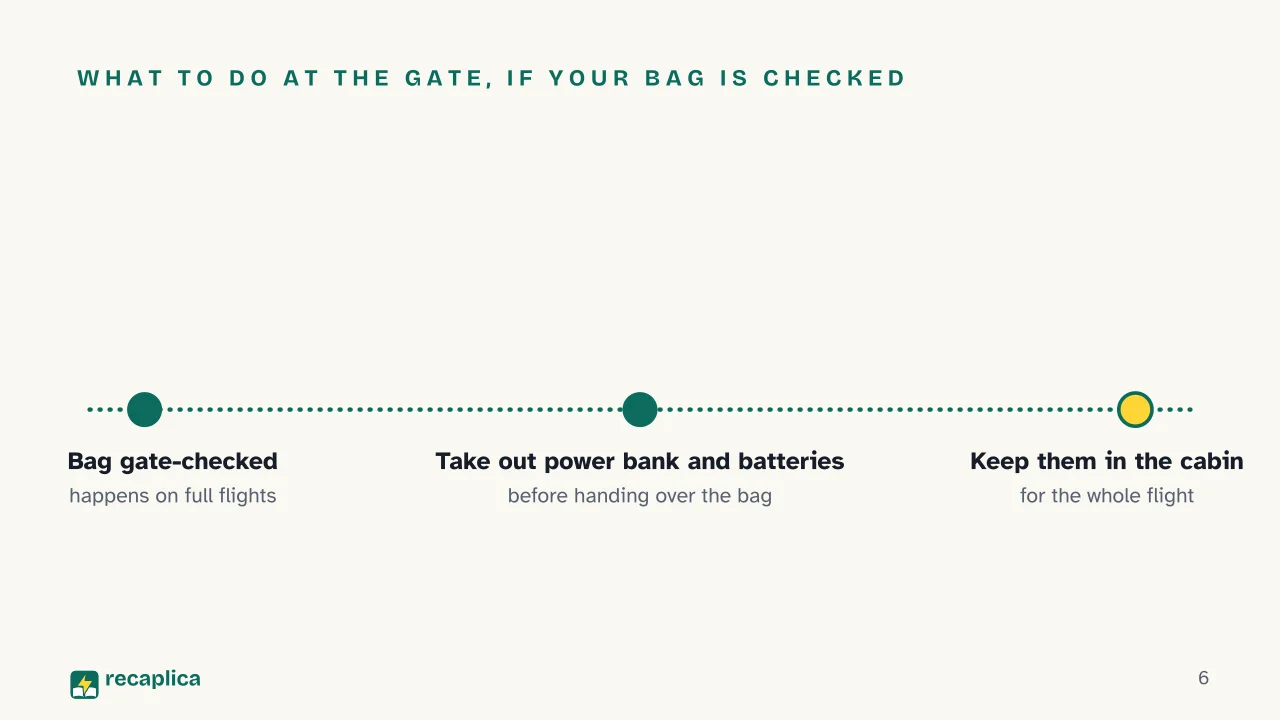  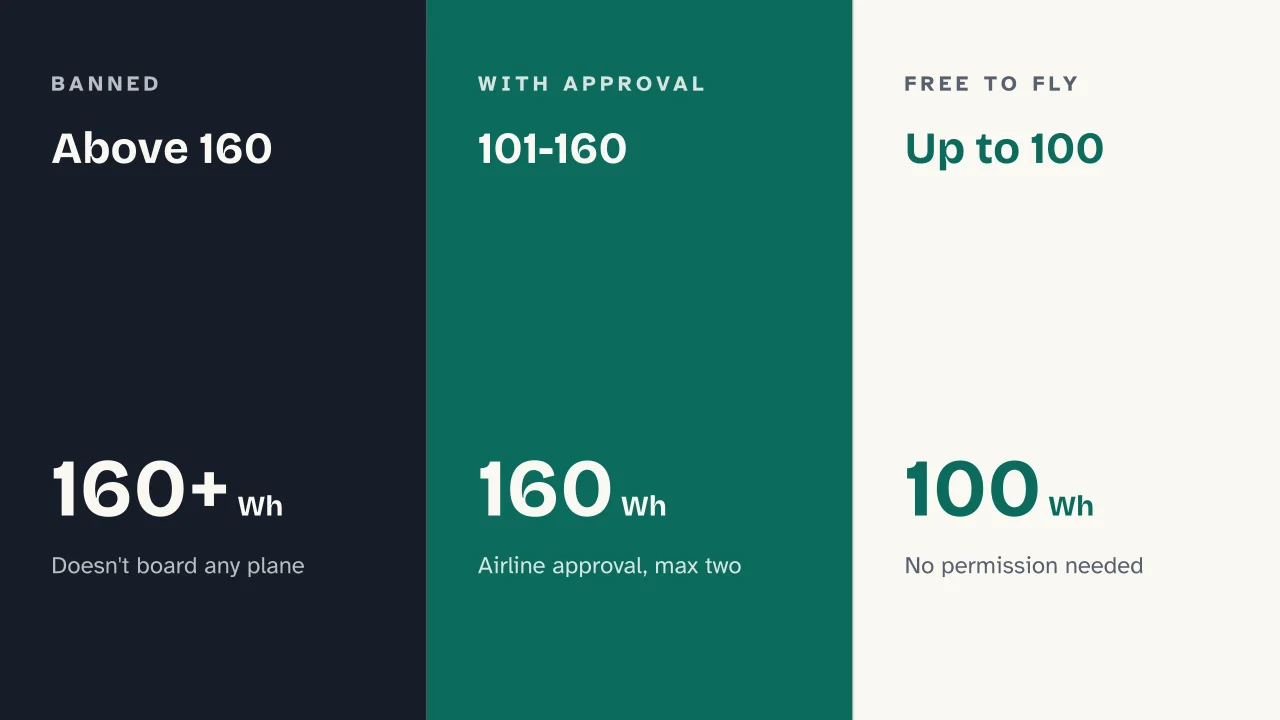 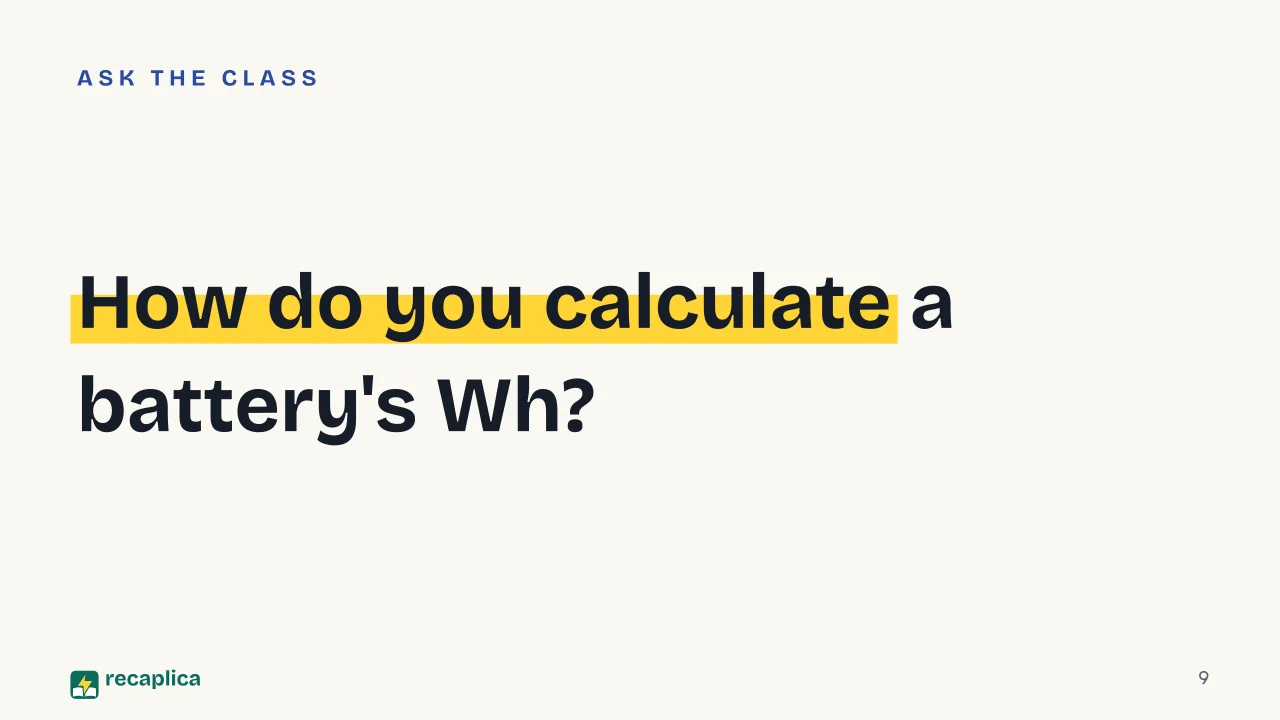  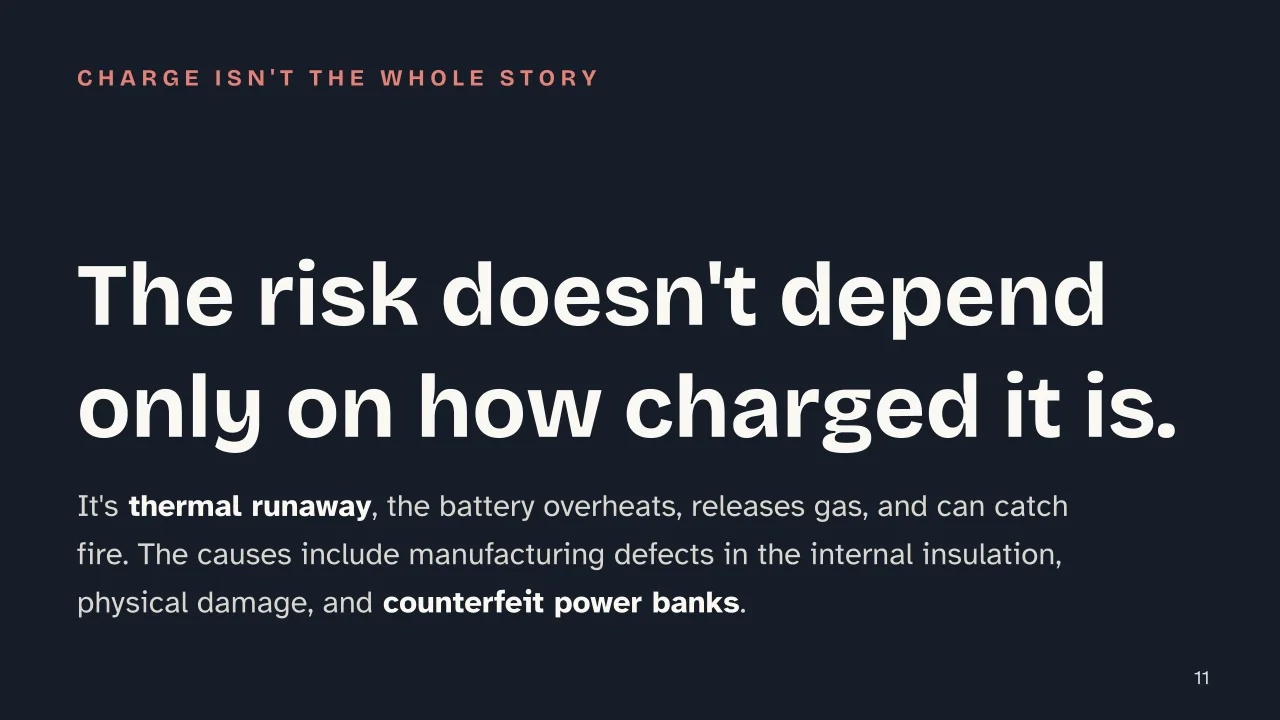  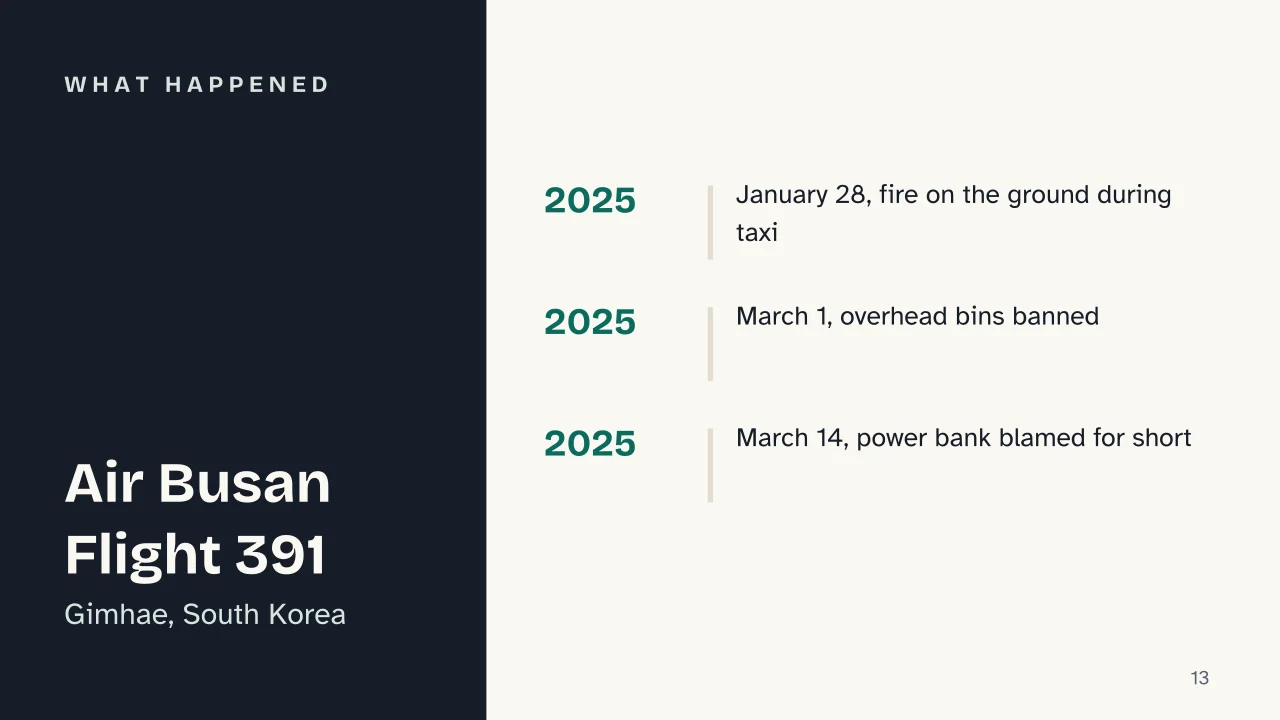 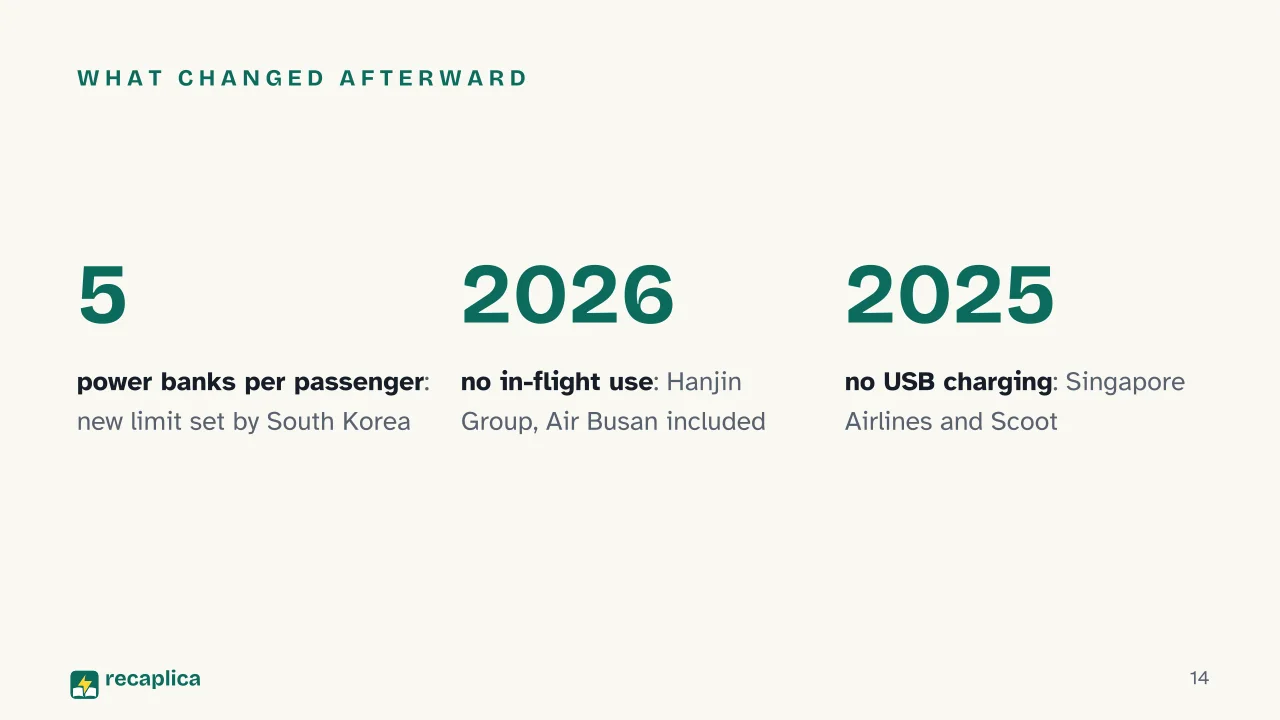 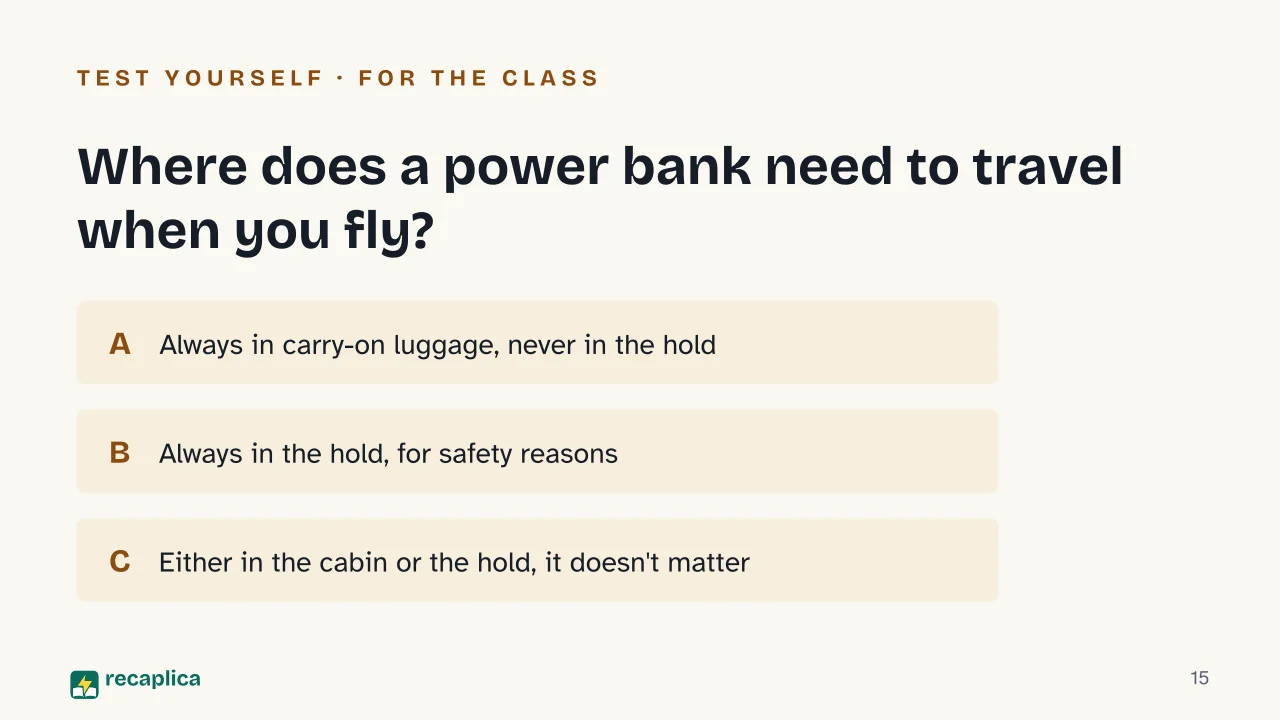  Common myths
Mind mapDrag the background to move around and the nodes to reposition them; use − and + to collapse and expand branches. 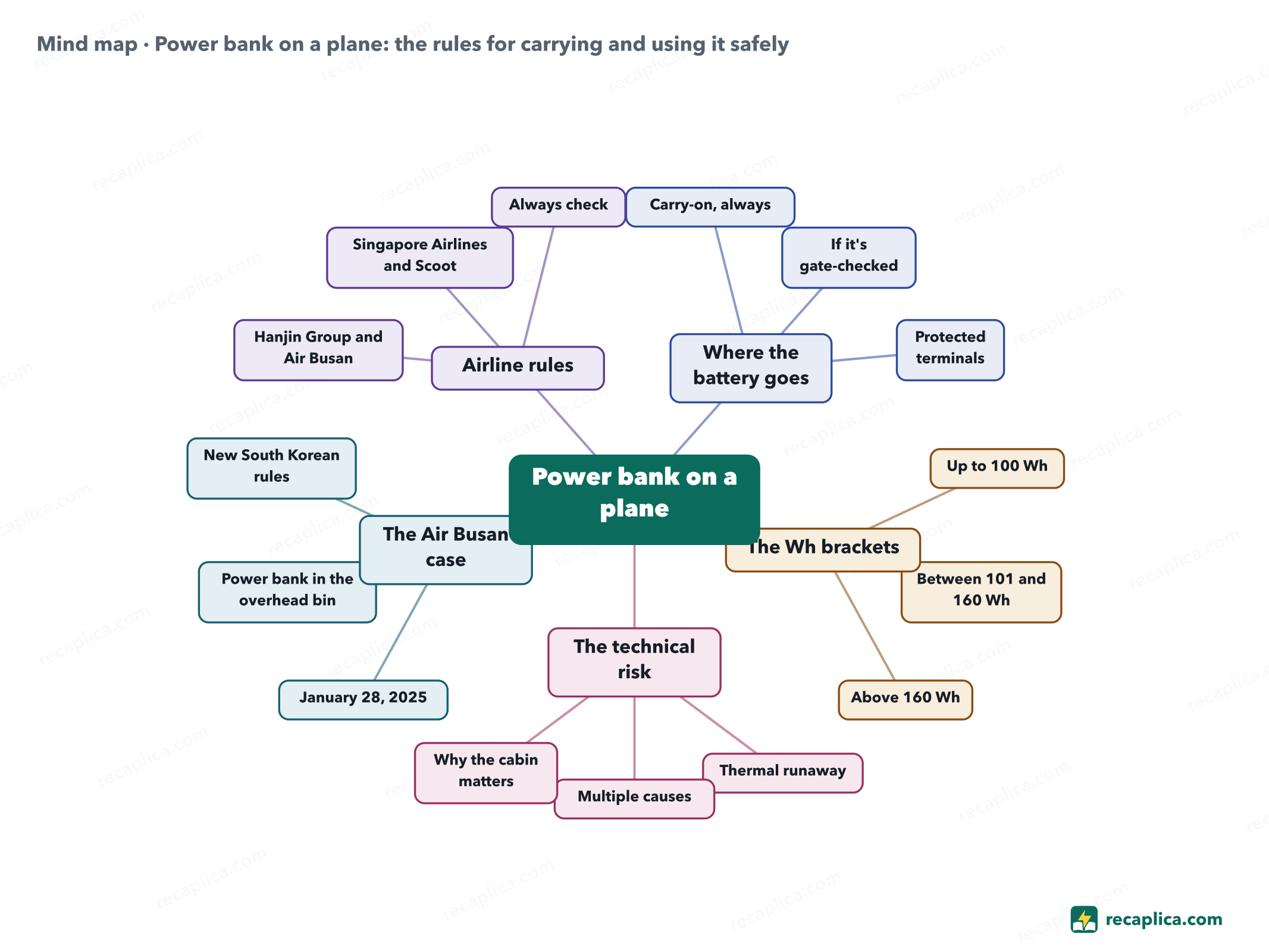
Quiz: test yourselfAnswer the questions to check what you have learned: you get instant feedback and a short explanation. Grade 0/10 0/5
FlashcardsTap the card to flip it and check whether you remember the answer, then move to the next one. 1 / 8 Explain it in your own wordsThe ultimate test: if you can explain it in simple words, you've truly understood it. Write your explanation, then compare it with the Recap. Your explanation is saved only on this device.
Frequently asked questionsCan I pack my power bank in checked luggage?No. Power banks and other spare lithium batteries must always travel in carry-on luggage: it's the rule shared by the FAA/TSA, IATA and EASA, because only in the cabin can the crew notice a fire starting and act right away. How many watt-hours (Wh) can a power bank have on a plane?Up to 100 Wh, you can fly with no permission. Between 101 and 160 Wh you need the airline's approval, with a maximum of two spare batteries in that bracket. Above 160 Wh, the battery can't fly on a passenger aircraft. How do I find out how many Wh my power bank has?The Wh value is normally printed on the battery's casing. If it's missing, you can calculate it by multiplying the rated amp-hours (Ah) by the rated voltage, which are also on the label. What should I do if I'm asked to gate-check my carry-on?Before handing it over, take out the power bank and any other spare batteries and keep them with you in the cabin, as IATA recommends, because these batteries can't travel in the hold. Why did some airlines ban using power banks in flight after the Air Busan incident?Because the South Korean investigation attributed the Flight 391 fire on January 28, 2025 to a power bank stored in an overhead bin, where no one could notice it in time. Following that, several Asian airlines introduced stricter rules on using and storing power banks on board — decisions made by individual airlines, not a single international standard. Every Recap goes through an independent review before publication. |