|
recaplica
How Does an Aircraft Carrier Work? Flight Deck, Catapults and Nuclear Power | ||||||||||||||||||
| © 2026 Recaplica · recaplica.com — All rights reserved | ||||||||||||||||||
How Does an Aircraft Carrier Work? Flight Deck, Catapults and Nuclear PowerWhat to print Page numbers appear when printing with default margins. SlidesChoose a cut Flash10 slidesThe essential thread, to present in classFull16 slidesEvery chapter and the deeper detailBoth come with speaker notes. In 30 seconds quick readAn aircraft carrier is a warship built to launch and land aircraft in the middle of the ocean, turning its deck into a floating airport runway. Since the first one, the British HMS Argus, entered service in 1918, aircraft carriers have become among the most important warships in the world's navies. Some, like the American Nimitz class, use catapults and arresting wires; others, like the Italian Cavour, rely on an angled ramp and aircraft built for short takeoff or vertical landing. Below deck, between the hangar and the crew quarters, a single ship can house thousands of people. Key Points
Key figures
Deep DiveWhat an aircraft carrier isAn aircraft carrier is a warship built around an idea that’s simple to state and hard to pull off: carry a runway out to the middle of the ocean so aircraft can take off and land from it. Since World War II, aircraft carriers have become among the most important warships in the world’s navies, able to project air power to any point on the oceans without relying on a nearby land base. The first ship to manage this with a full-length flight deck, unbroken from bow to stern, was the British HMS Argus. In one of naval history’s odder twists, it started out as an Italian ocean liner: the Royal Navy bought it in 1916, converted it, and completed it as an aircraft carrier in September 1918, with a flight deck about 170 meters long and a hangar that could hold 20 aircraft. It became the prototype for every carrier that followed. From steam power to the nuclear reactorFor decades, aircraft carriers stayed on conventional propulsion, cluttered with fuel bunkers, smokestacks and exhaust ducts that ate up valuable space. On September 24, 1960, the USS Enterprise was launched, the first nuclear-powered aircraft carrier in the world, entering service the following year. With eight reactors driving its four propellers, a displacement of about 75,000 tons and a flight deck over 330 meters long, the Enterprise managed to sail more than 320,000 kilometers over three years without stopping to refuel. Starting in 1975, the ten carriers of the Nimitz class took the Enterprise’s place, proving that carriers didn’t need nearly as much nuclear power to match its performance: they get by on just two reactors, against the Enterprise’s eight, while reaching comparable speeds, and their uranium core lasts about 13 years between refuelings. The newest carriers, like the USS Gerald R. Ford, build on the Nimitz’s basic hull while betting on a new generation of launch and recovery systems, which we’ll get to shortly. What happens on the flight deckThe operational heart of an aircraft carrier is the flight deck, and on a Nimitz-class ship it’s a rectangle about 77 meters wide where, within a few dozen seconds, a fighter jet can go from a standstill to airborne, or from 240 km/h to a dead stop. Two separate systems make that violent acceleration or deceleration possible. The steam catapult takes a 37-ton fighter jet from zero to 180 miles per hour, about 290 km/h, in under three seconds, using less than 300 feet, about 91 meters, of available deck: an acceleration that, in physical terms, isn’t so different from what shows up in any basic lesson on force, mass and acceleration, just applied on an industrial scale. The arresting wires do the opposite job: they stop a landing aircraft arriving at 150 miles per hour, about 240 km/h, within less than 400 feet, catching it with steel cables about 5 cm thick connected to hydraulic rams below deck.
Below the flight deck, elevators connect the surface to the hangar underneath, where aircraft are parked, repaired and refueled before heading back up. A Nimitz-class carrier has four of them, and the ship can hold up to 85 aircraft in total, though the air wing actually embarked during real operations tends to be smaller. The flight deck’s color codeWith dozens of aircraft, vehicles and people moving through a cramped, loud and potentially dangerous space, a coordination mistake can be costly. That’s why the flight deck runs on a system of seven jersey colors that identify roles at a glance, according to the US Department of Defense’s official service DVIDS: yellow directs aircraft and keeps personnel safe; blue operates the elevators and drives the tractors that move aircraft around; purple handles fast, safe fueling; white covers safety, medical staff and landing signal officers; green maintains the arresting gear and catapults; brown belongs to the technicians assigned to individual aircraft; red handles munitions and doubles as the crash and fire crew. As one flight-deck safety specialist told DVIDS, the system helps everyone working there understand in an instant who needs to be where. It’s not an isolated case of coordinating a chaotic space through simple rules: systems like this echo, on a much smaller scale, how a flight data recorder on an airliner has to work reliably and predictably even in the most extreme conditions, with no room for improvisation. CATOBAR versus STOVL: two ways to flyNot every aircraft carrier is built the same way. There are two main design families, and the difference comes down mostly to the kind of aircraft the ship needs to carry.
The Cavour, flagship of Italy’s Carrier Strike Group, is an example of a STOVL carrier: 244 meters long, with a flight deck measuring 220 by 34 meters, it displaces 27,100 tons at full load and carries up to 20-22 aircraft, a mix of EH-101 helicopters and AV-8B or F-35B jets depending on the mission. Its crew numbers 1,210, including the flight component and an embarked marine brigade. It isn’t only a carrier: it also doubles as a logistics platform, command post and hospital ship, much the way smaller STOVL carriers often carry helicopters alongside their jets, a reminder that not every deck launch is a catapult shot — some of it looks closer to how a helicopter’s rotor generates lift than to a fighter blasting off a Nimitz. US nuclear carriers, at the opposite extreme, remain the exception rather than the global rule: the scale of a Nimitz, nearly 97,000 tons and a combined crew of over 5,600 people, isn’t the model most of the world’s navies, including those of other wealthy nations, are trying to match. The new electromagnetic catapultsOn the newest carriers, like the USS Gerald R. Ford, the old steam catapults give way to EMALS, an electromagnetic launch system. According to the US Navy’s NAVAIR command, electromagnetic catapults can accelerate aircraft to takeoff speed more smoothly than the old steam catapults, cutting down on airframe stress, and can be tuned more precisely to an aircraft’s weight: an advantage that also helps with launching drones, which are far lighter than a crewed fighter jet. Working alongside EMALS is AAG, Advanced Arresting Gear, the landing system that replaces the older Mk-7. NAVAIR describes it as a modular system built from energy absorbers, control electronics and digital systems, designed to safely stop a much wider range of aircraft than before, from the lightest unmanned drones to the heaviest crewed fighters. AAG is already installed on the USS Gerald R. Ford, and it’s also planned for the future USS John F. Kennedy and USS Enterprise, the second ship to carry that name after the nuclear pioneer of 1961. A myth worth bustingThe movie image of the aircraft carrier as an unsinkable fortress, impossible to hit and impossible to stop, doesn’t hold up well against the US Navy’s own professional debate. A deployed carrier, that discussion argues, can be more exposed than commonly assumed to a so-called “mission kill”: the loss of the ship’s operational capability, for example its flight deck or launch systems, without the ship actually sinking. Modern carriers put more weight on redundant critical systems and the ability to keep operating under pressure than on the thick armor of an old-style battleship, the kind that dominated naval warfare before World War II: they remain complex targets to defend, one reason they almost always sail with an escort of other ships, not invulnerable fortresses sailing alone. Slide deckSlides ready to download and make your own in PowerPoint or Google Slides, with speaker notes. Pick the Flash cut or the Full one.     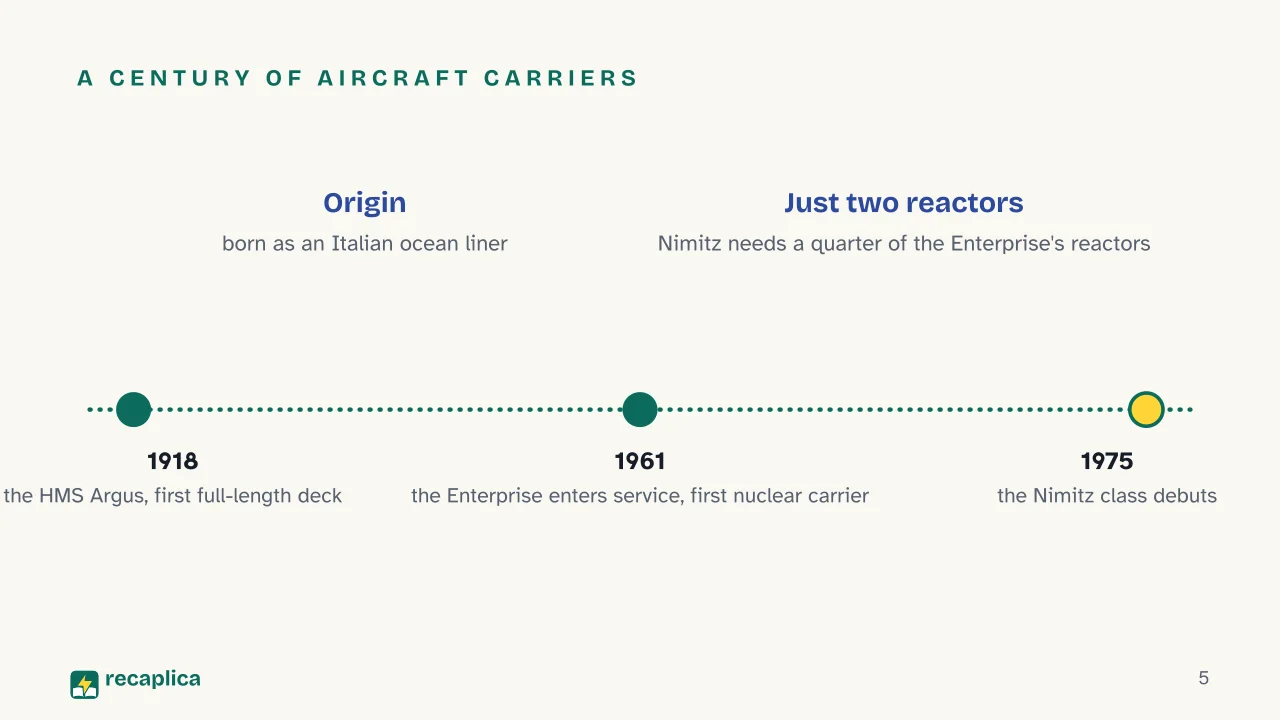 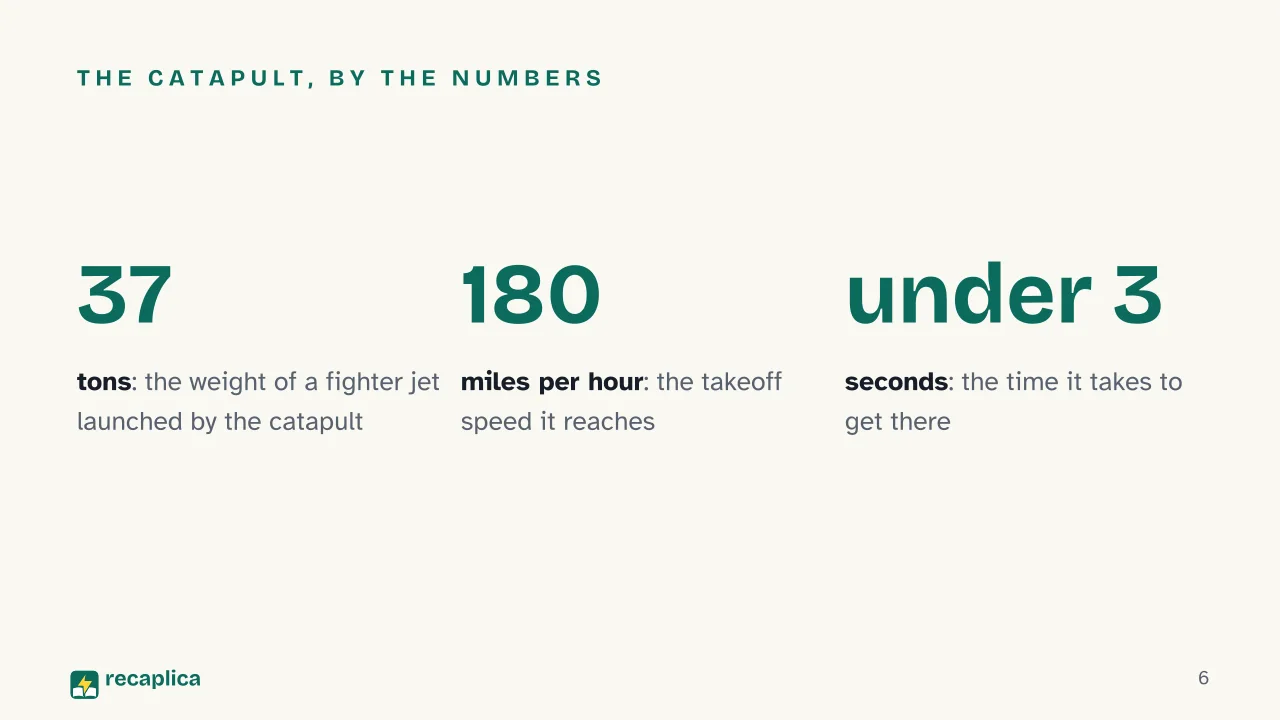  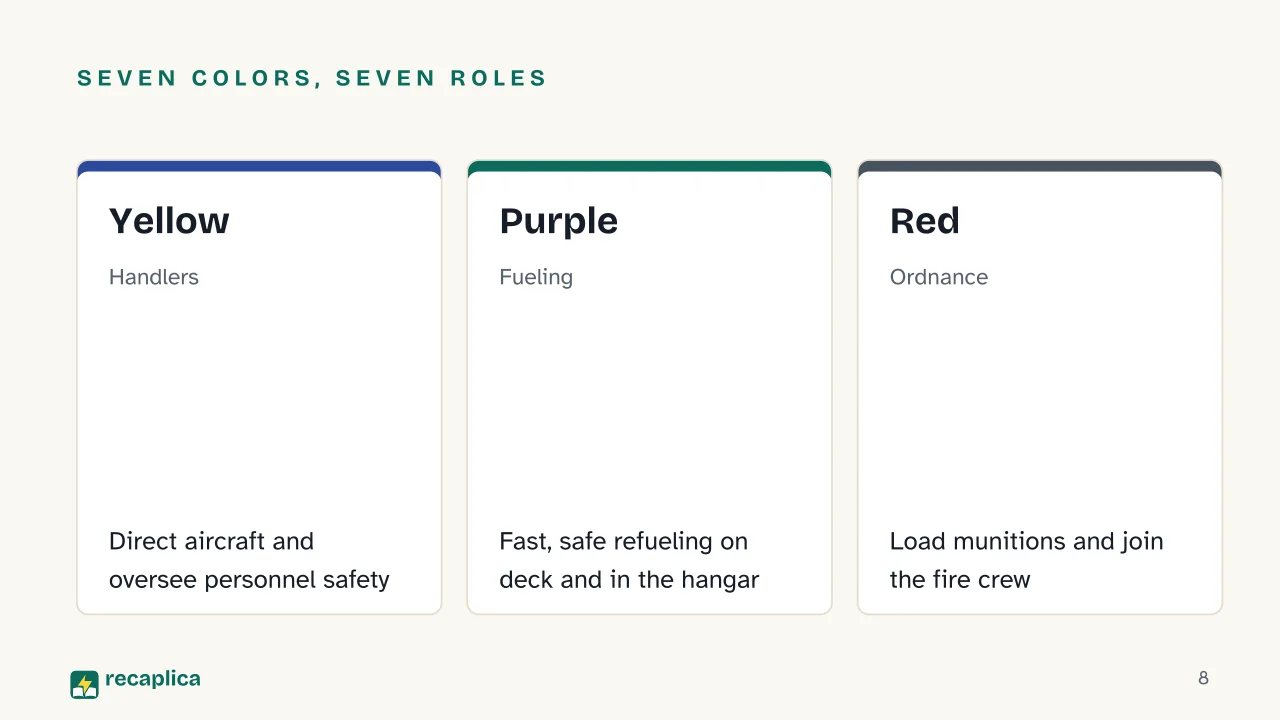  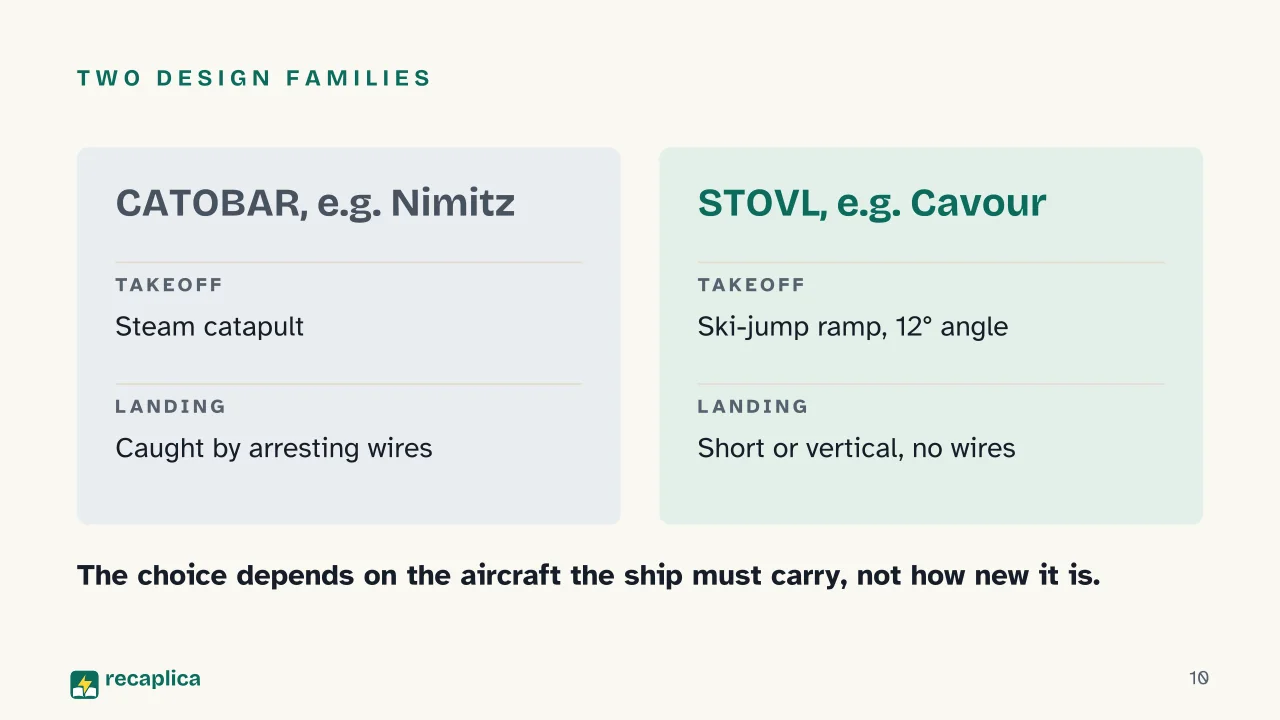 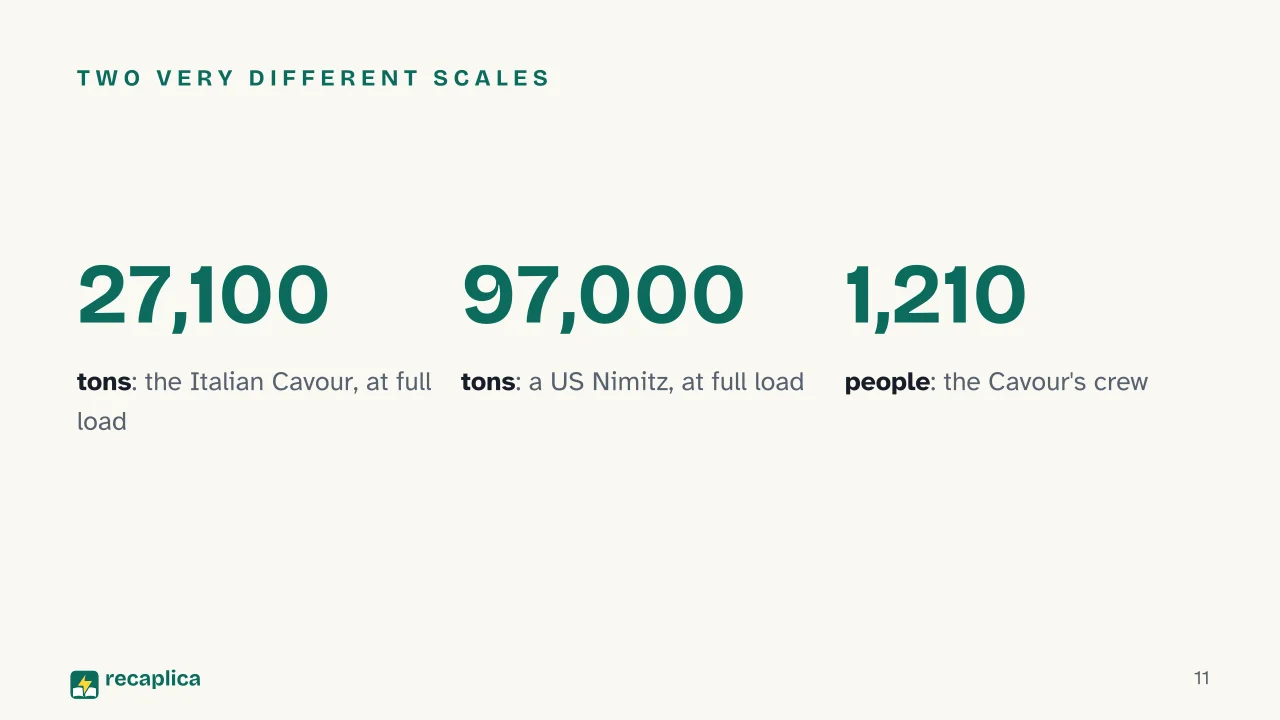  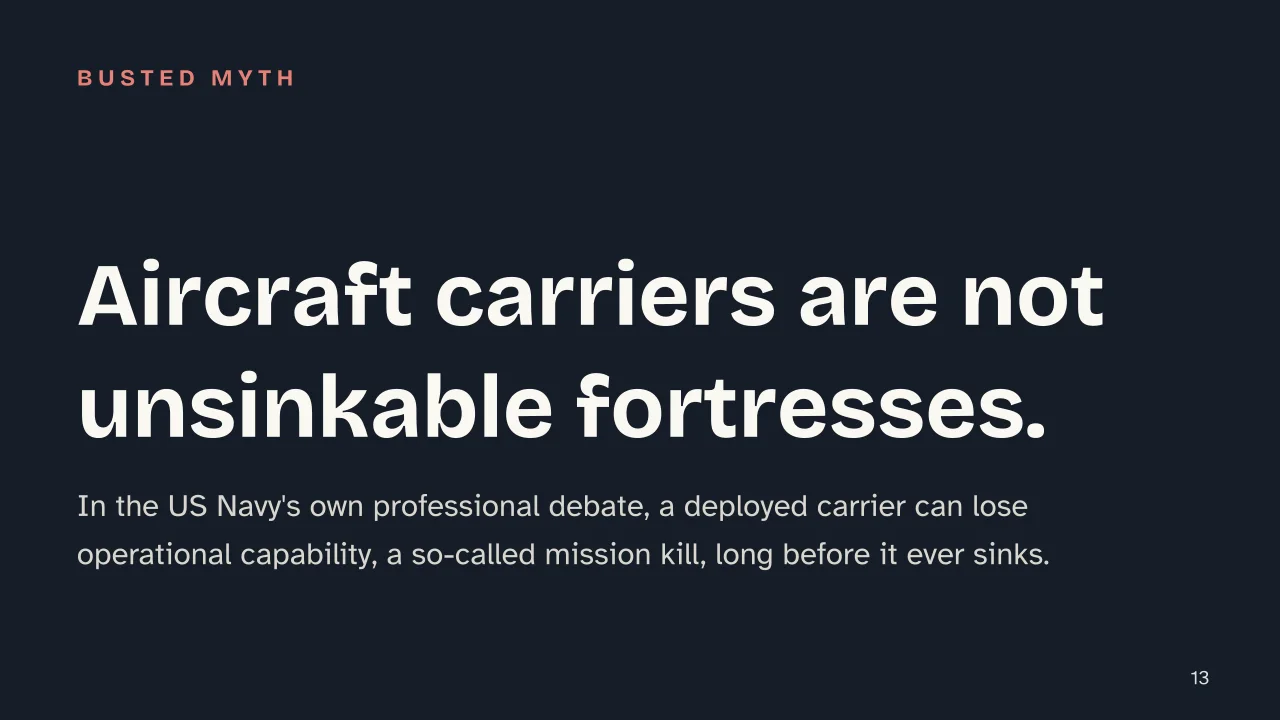 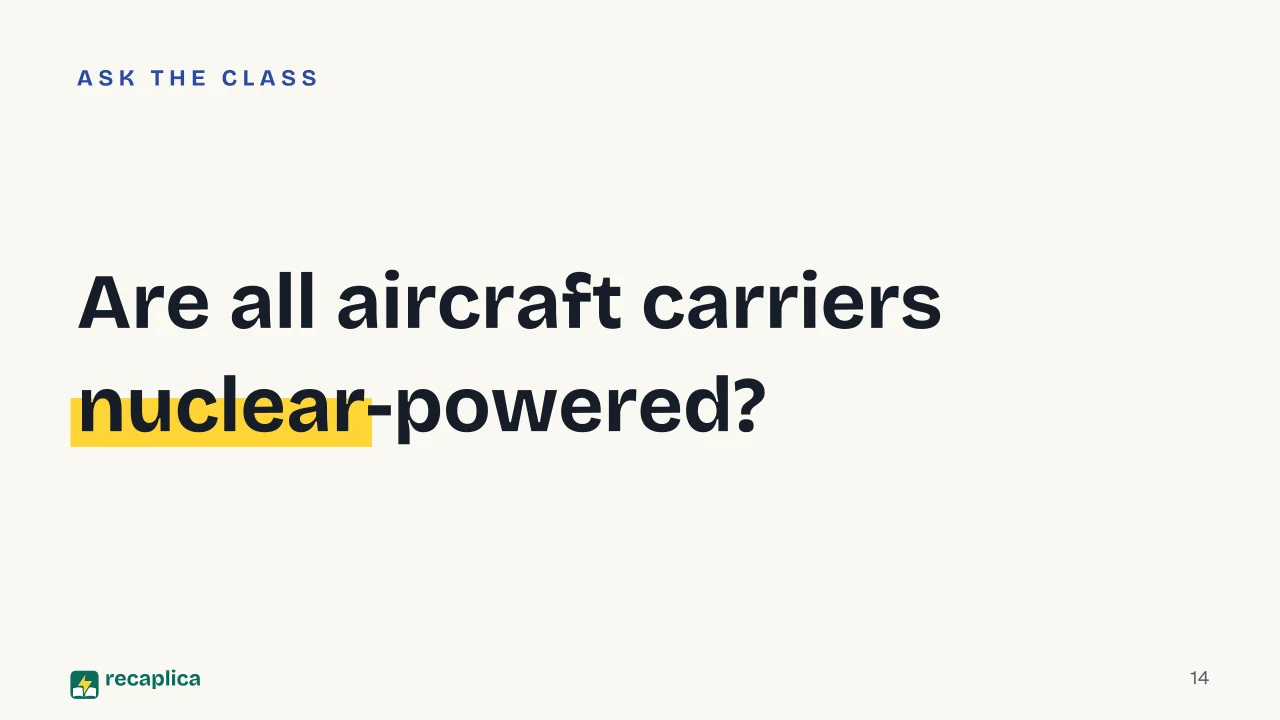 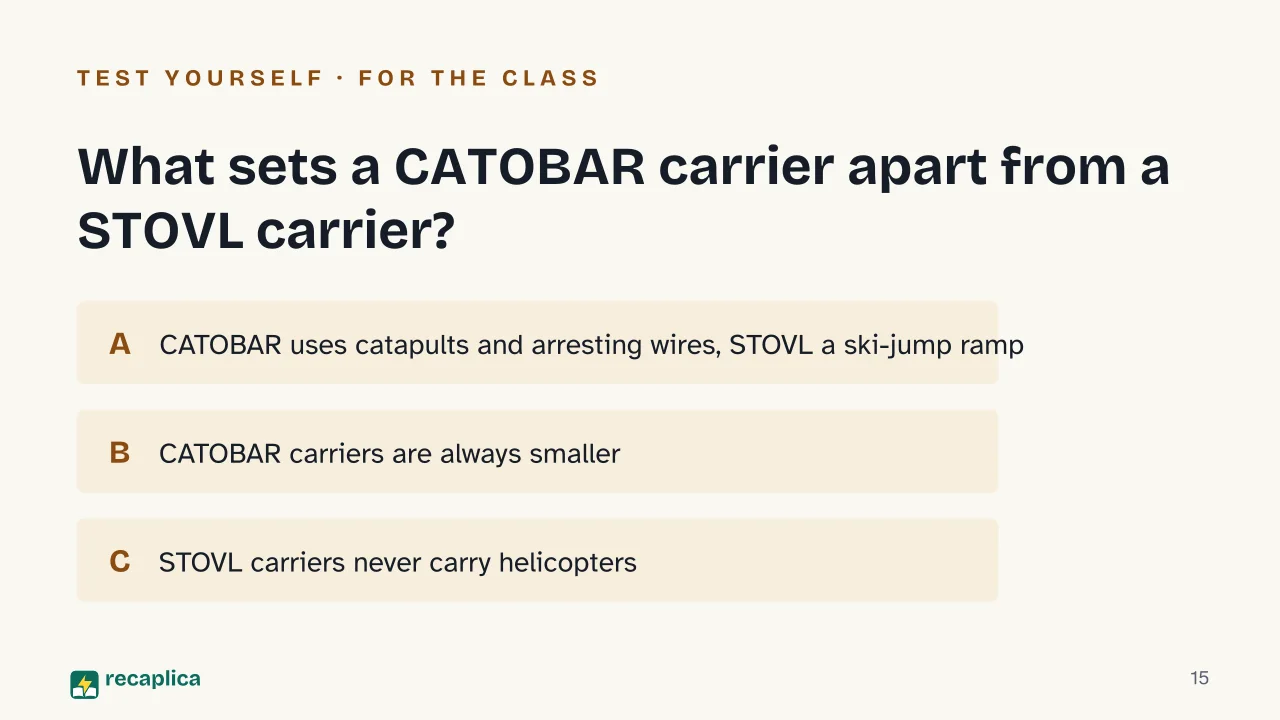  Common myths
Mind mapDrag the background to move around and the nodes to reposition them; use − and + to collapse and expand branches. 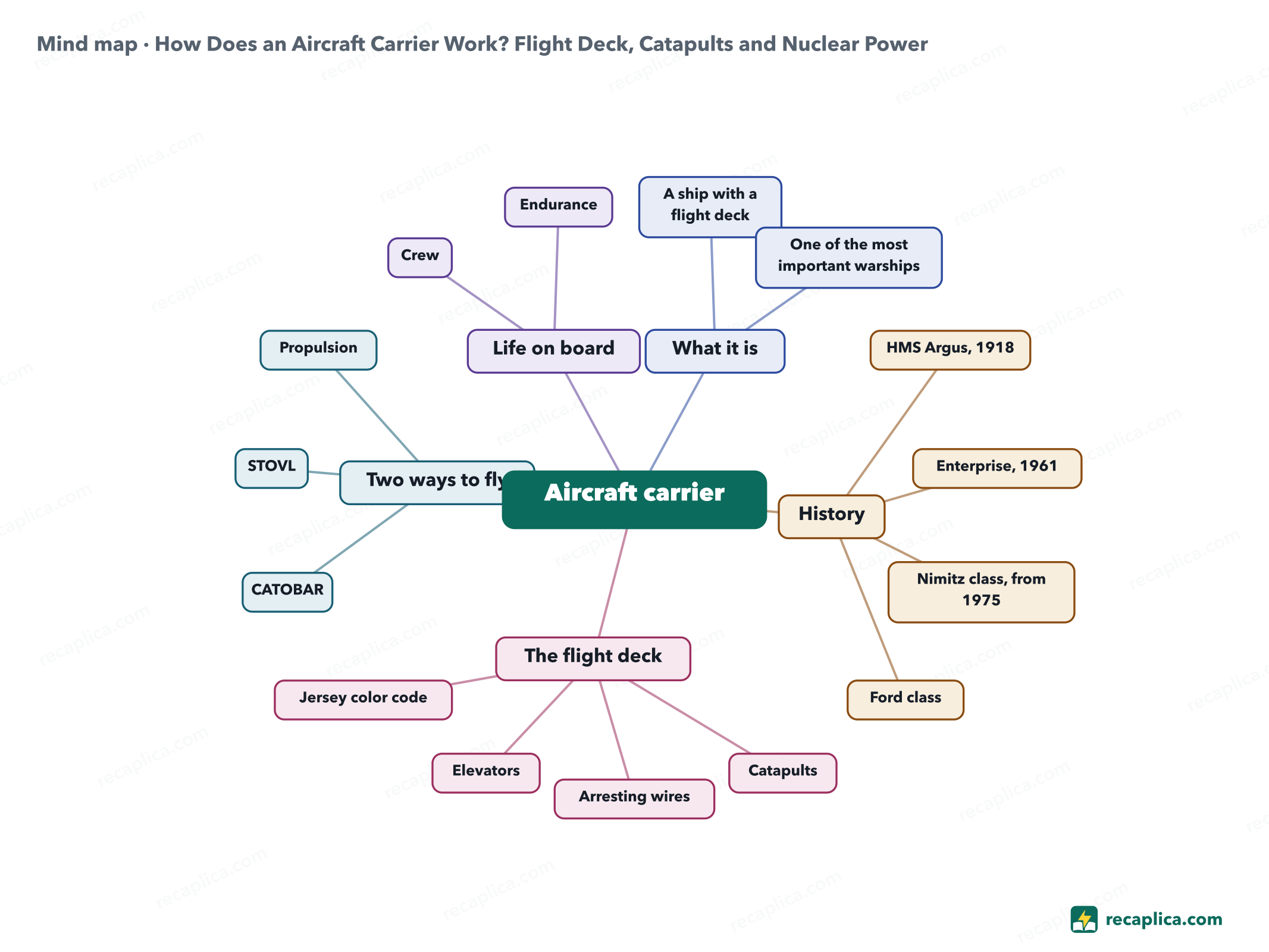
Quiz: test yourselfAnswer the questions to check what you have learned: you get instant feedback and a short explanation. Grade 0/10 0/5
FlashcardsTap the card to flip it and check whether you remember the answer, then move to the next one. 1 / 8 Explain it in your own wordsThe ultimate test: if you can explain it in simple words, you've truly understood it. Write your explanation, then compare it with the Recap. Your explanation is saved only on this device.
Frequently asked questionsHow does a plane take off from an aircraft carrier that has no catapults?On STOVL carriers, like the Italian Cavour, aircraft take off using an angled ramp called a ski-jump, set at 12° on the Cavour. The ramp alone isn't enough: it takes aircraft built for short takeoff or vertical landing, like the F-35B, capable of generating enough thrust of their own without a catapult's help. How large is the crew on a US nuclear aircraft carrier?On a Nimitz-class carrier, the ship's own crew numbers about 3,200 people, joined by roughly 2,480 more from the embarked air wing, for a combined total of nearly 5,700: more people than live in a small town, all aboard the same ship. Are Italian aircraft carriers nuclear-powered?No. The Cavour, flagship of the Italian Navy, runs on conventional propulsion with four gas turbines producing about 88,000 kW, reaching a top speed of 28 knots and a range of about 7,000 nautical miles, roughly 18 days of continuous sailing at 16 knots. What are EMALS and AAG on the newest aircraft carriers?They're the systems replacing the old steam catapults and arresting wires on the newest US carriers, like the USS Gerald R. Ford. EMALS is an electromagnetic catapult that can adjust its thrust to an aircraft's weight, reducing stress on the airframe; AAG is the matching arresting system, designed to stop a wider range of aircraft, from light drones to heavy fighter jets, according to the US Navy's NAVAIR command. Every Recap goes through an independent review before publication. |