Skip to content
recaplica

    One moment: security check

    Cloudflare wants to make sure you're not a robot. Tick the box below and your search will continue on its own.

    IT
    recaplica Offline Maps: Getting Around and Translating Without a Connection
    © 2026 Recaplica · recaplica.com — All rights reserved
    Home › Technology

    Offline Maps: Getting Around and Translating Without a Connection

    By Recaplica Newsroom · Updated on September 20, 2026

    What to print

    Page numbers appear when printing with default margins.

    Slides

    Choose a cut

    Flash10 slidesThe essential thread, to present in classFull14 slidesEvery chapter and the deeper detail

    Both come with speaker notes.

    Telegram channel
    recaplica Clear in 30 seconds, yours in 10 minutes.
    In 30 seconds Key points Figures Deep dive Slides Myths Mind map Quiz Flashcards FAQ

    In 30 seconds quick read

    An offline map is a chunk of the map your phone stores locally before you leave, so navigation keeps working even without mobile data or Wi-Fi. Google Maps, the app most people search for, lets you download an area and drive it, but with sharp limits worth knowing before you rely on it mid-trip. Apple Maps and alternatives such as Organic Maps handle offline coverage differently, while Waze is the outlier: it has no real offline mode. Translation works the same way in advance, through Google Translate's downloadable language packs.

    Key Points

    • A downloaded Google Maps offline area expires after 15 days, so it needs a refresh or a fresh download before your next trip.
    • Google Maps offline driving directions only work if the entire route sits inside the downloaded area, with no live traffic and no alternate routes.
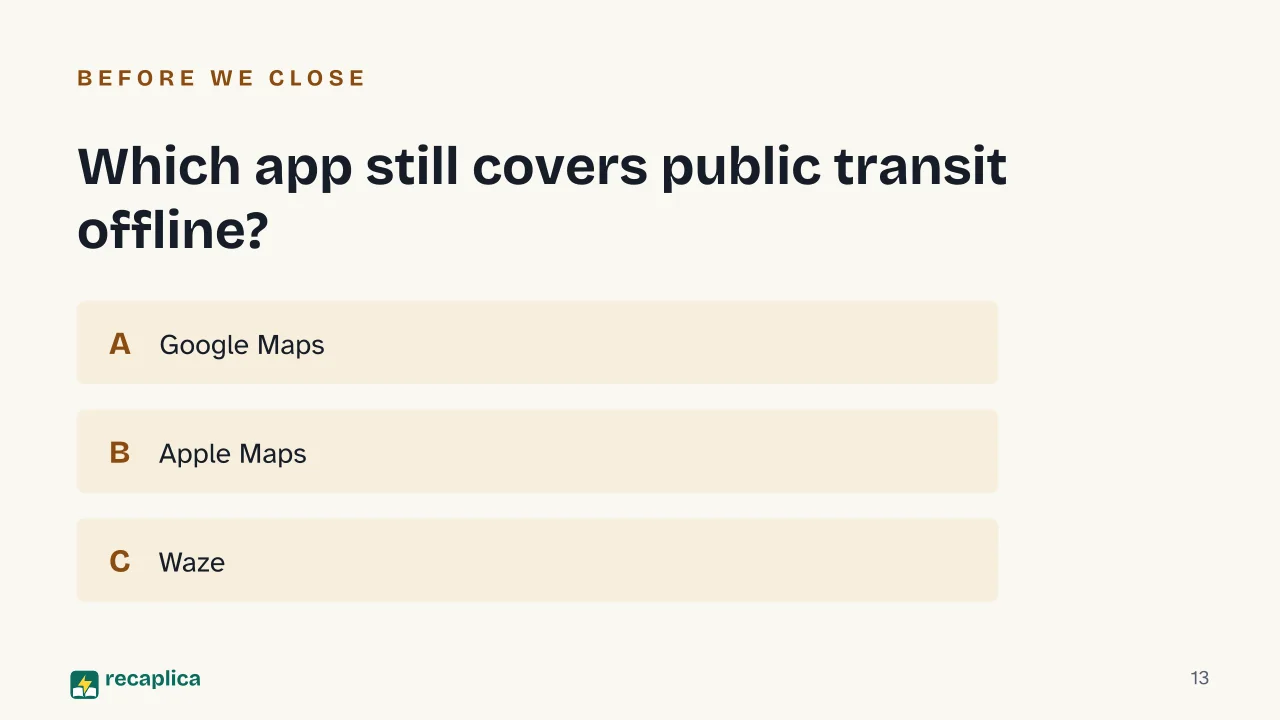
    • Apple Maps offline, which needs iOS 17 or later, also covers public transit schedules, something Google Maps offline leaves out.
    • Organic Maps, the open-source successor to Maps.me, claims 100% of its features work offline, including elevation contours for hikers.
    • Waze has no offline mode comparable to the others: it runs on live traffic data and user reports to function at all.
    • Google Translate lets you download language packs so text and camera translation keep working without a connection.

    Key figures

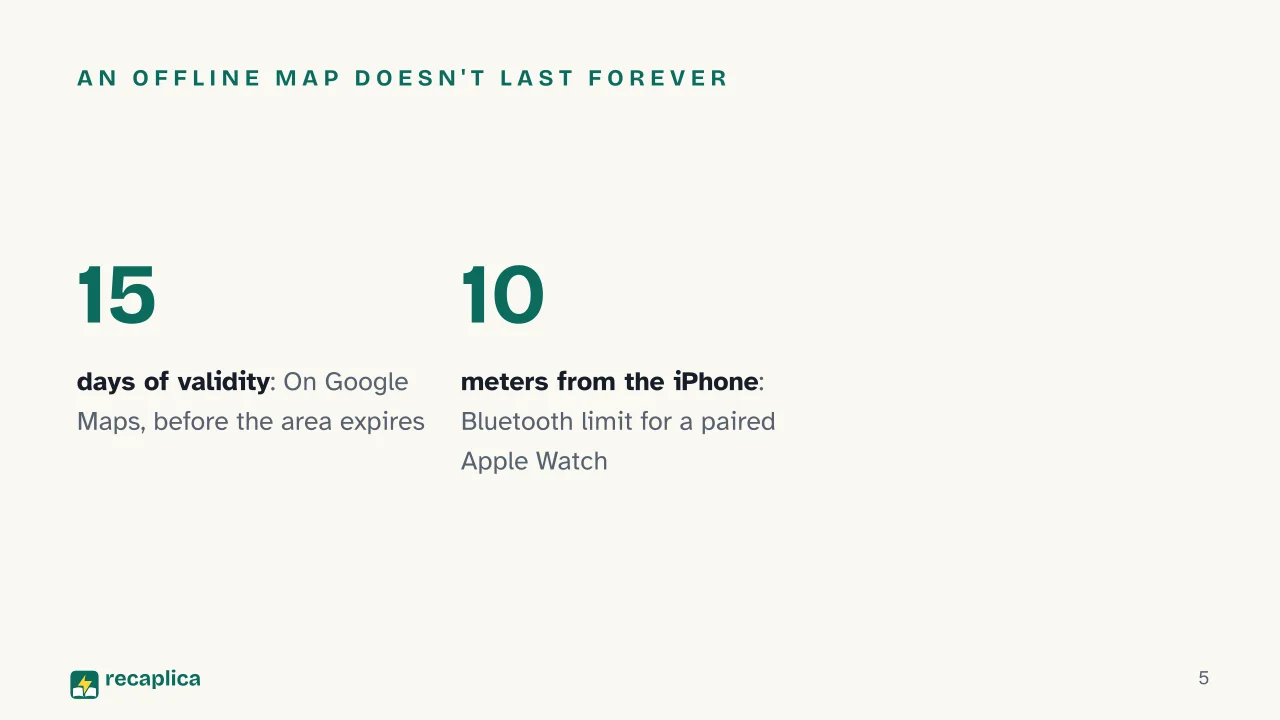
    • 15 days How long a Google Maps offline area lasts before it expires and needs renewing or re-downloading. Source: Google Maps Help, 2026
    • 10 meters Maximum Bluetooth distance from the iPhone within which a paired Apple Watch can still use maps downloaded for offline use on the phone. Source: Apple Support, 2026

    Deep Dive

    An offline map is, in practice, a piece of the map your phone keeps stored instead of pulling it from the internet piece by piece as you move. The upside is obvious to anyone who’s tried finding their way around a foreign country with no data roaming: the navigation app keeps showing streets and directions even in a dead zone, as long as the area was downloaded beforehand.

    How the offline download actually works

    The mechanism is similar across apps, though the details differ. Google Maps Help walks through it: search for a place, open its place card, tap “More,” then “Download offline map.” A connection needs to be active at that moment, and you need to be signed in, because the download itself happens while you’re still online.

    Once downloaded, the map doesn’t stay valid indefinitely. Google Maps lets it expire after 15 days: if the phone connects to Wi-Fi before then, the system tries to update the area on its own; otherwise it has to be re-downloaded by hand before the next trip. It’s an easy detail to forget when packing for a trip, so it’s worth a check before leaving.

    Downloaded maps land in the phone’s internal storage by default. On Android 6.0 and later, they can be moved to an SD card, but only if that card is set up as “portable storage” rather than as an extension of internal memory. Not every part of the world can be downloaded: Google Maps flags limits in some countries or regions over contracts, language support or address formats, without publishing a list of where.

    Google Maps offline: what works and what doesn’t

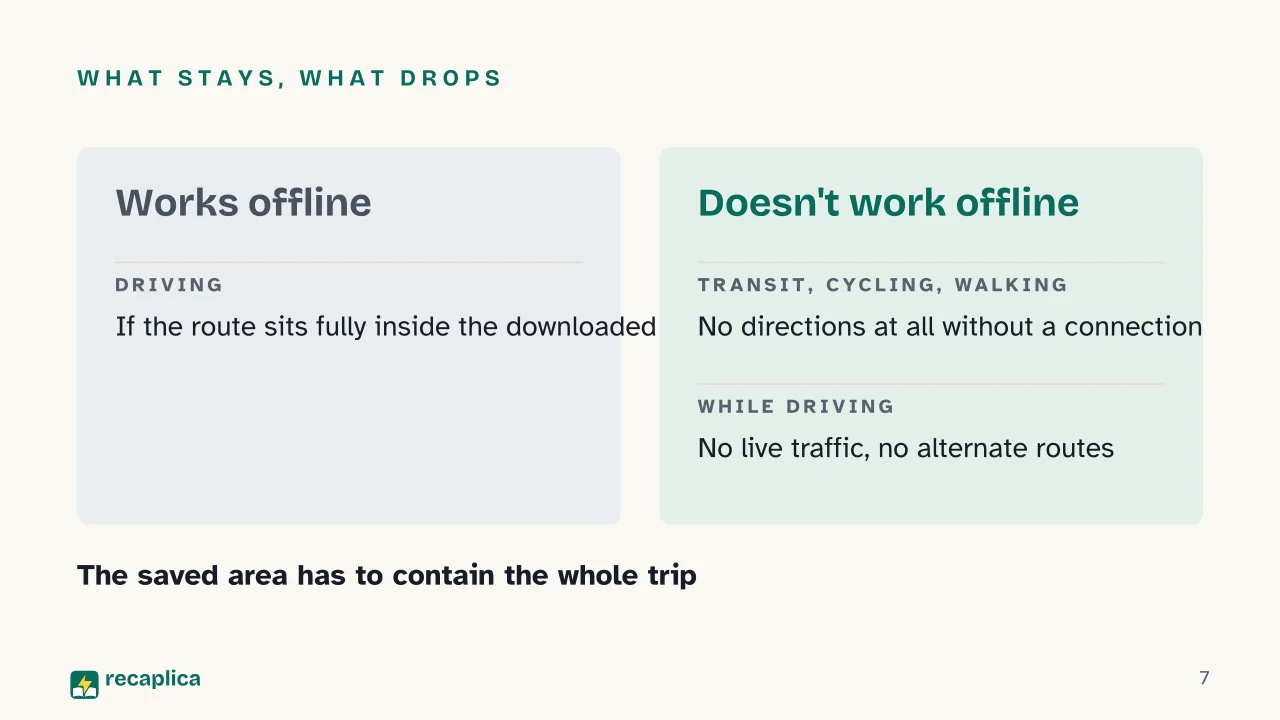
    Google Maps is the app people search for most, and it’s also the one worth being precise about, because its offline limits are tighter than most people expect. Turn-by-turn driving directions do work, but only if the entire route sits inside the downloaded area: stray even slightly outside those borders mid-trip, and the app can no longer guide you the rest of the way.

    What’s missing offline turns out to be broader than it first looks. Without a connection, there are no directions for transit, cycling or walking; driving still works, but without live traffic information or alternate routes if there’s a jam or an accident ahead. Driving with Google Maps offline means working from the basic turn-by-turn directions only.

    Practical example: before heading into a mountain area with no signal, it’s worth downloading a wider area than the planned route, including likely detours — stray even slightly past the saved borders and turn-by-turn voice guidance cuts out exactly where it’s needed most.

    The apps with native offline coverage

    Not every app treats offline the same way, and the differences matter when deciding what to download before a trip.

    AppRequirementOffline coverageNotes
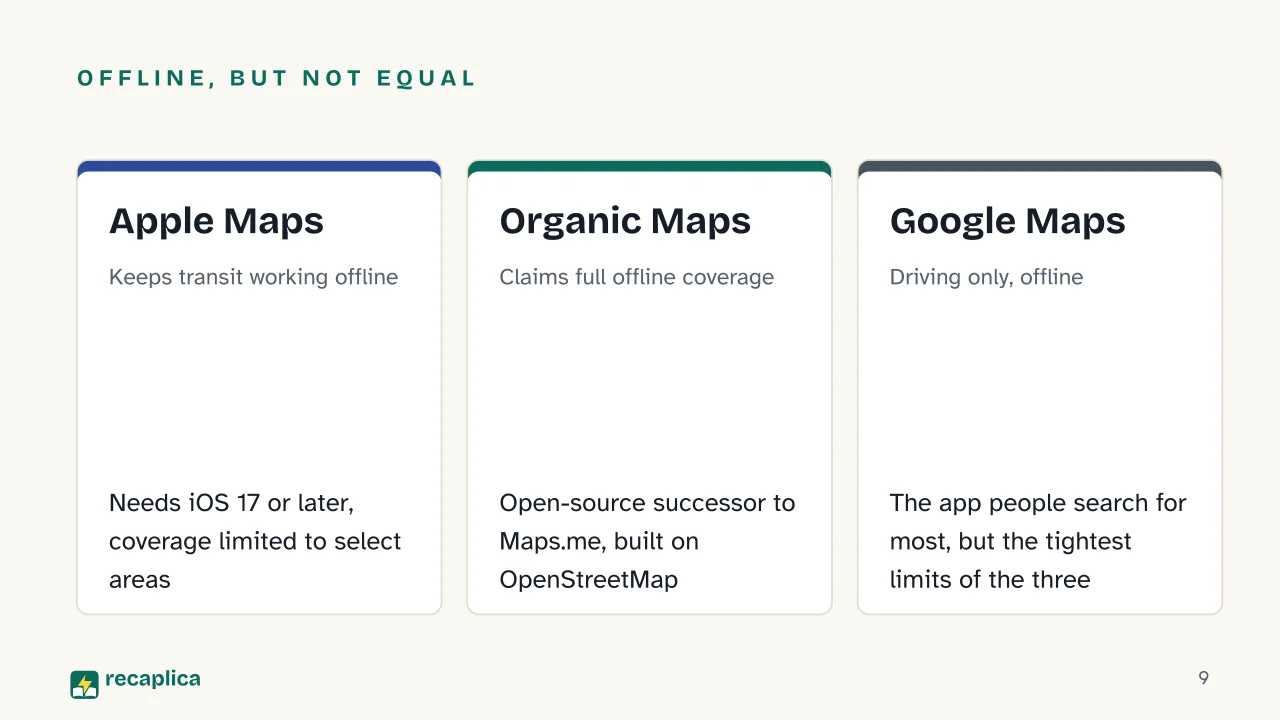
    Google MapsNone in particularDriving only, if the route sits inside the downloaded areaNo traffic, no transit
    Apple MapsiOS 17 or laterDriving, walking, cycling and transitCoverage limited to select areas, no sync across devices
    Organic MapsDedicated app (iOS/Android)Claims 100% of featuresOpenStreetMap data, no ads or tracking claimed

    Apple Support lists public transit schedules and directions among what Apple Maps keeps offline, on top of driving, cycling and walking — a point where it beats Google Maps offline. Before a download, the app shows the file size and lets you resize the chosen area. Maps update automatically, and any left unused for a while get deleted on their own after a period Apple doesn’t specify. One practical limit involves the Apple Watch: maps downloaded for offline use on the iPhone only stay usable from a paired watch within roughly 10 meters over Bluetooth.

    Organic Maps, born as an open-source fork of Maps.me after that app changed ownership in 2022, builds on OpenStreetMap, the collaborative mapping project fed by community contributions. The project’s own site claims 100% of its features work offline, including cycling and hiking tracks, elevation contours and altitude profiles — a detail useful for hikers in mountain areas with no signal. Organic Maps and Maps.me remain linked in the same lineage, which is why searches for both names still coexist.

    Need a technical fix mid-trip, like figuring out why a map won’t update or a language pack won’t start downloading? How the internet works: the journey of data from cable to page helps tell a connection problem apart from an app limit.

    Waze: the offline myth

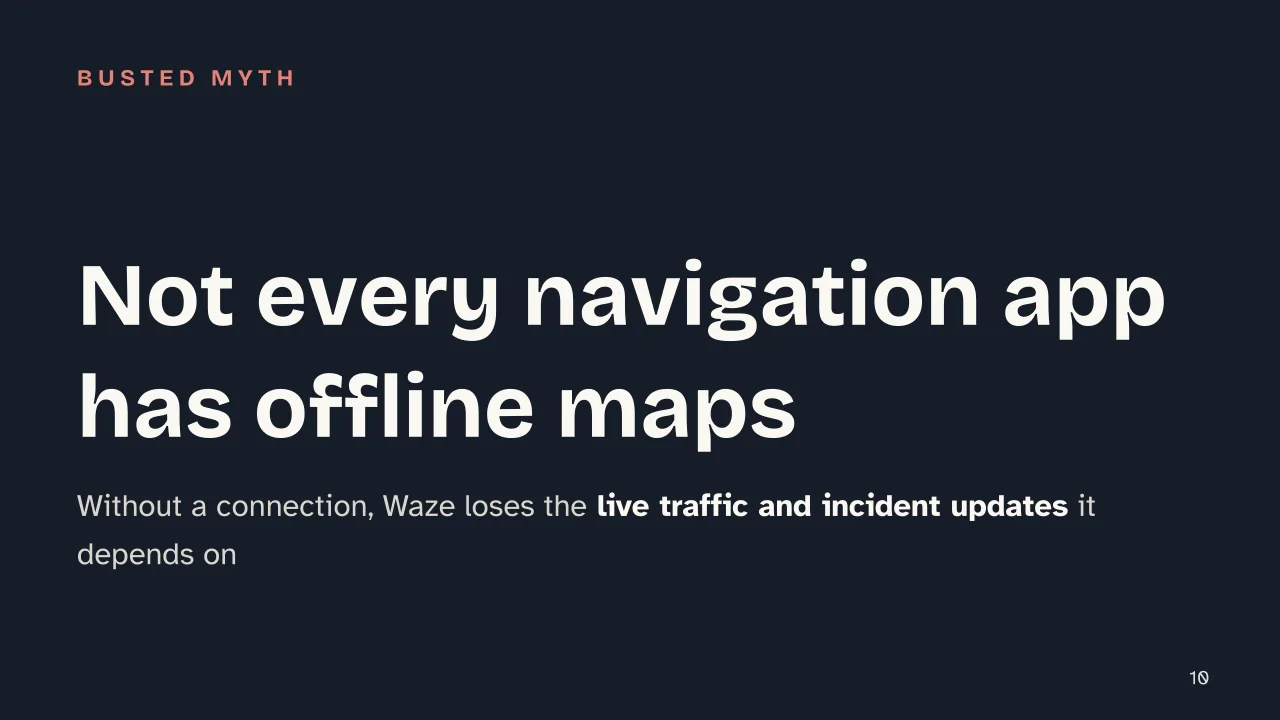
    Waze is among the most downloaded navigation apps, yet it has no offline map feature comparable to Google Maps or Apple Maps. The reason sits in how it operates: Waze leans on live data, such as traffic and incident reports from other drivers, to calculate its routes. Cut the connection, and that data pool disappears, taking much of the app’s usefulness with it.

    There’s a narrow, almost accidental exception: if a route was set while connected, it stays visible in the app’s cache even if the connection drops mid-drive. But the limit is hard — traffic updates and alternate routes stop coming, and once the app closes, the cached route is gone until the connection returns. In a dead zone, Waze alone isn’t enough to find the way.

    Offline translation: language packs

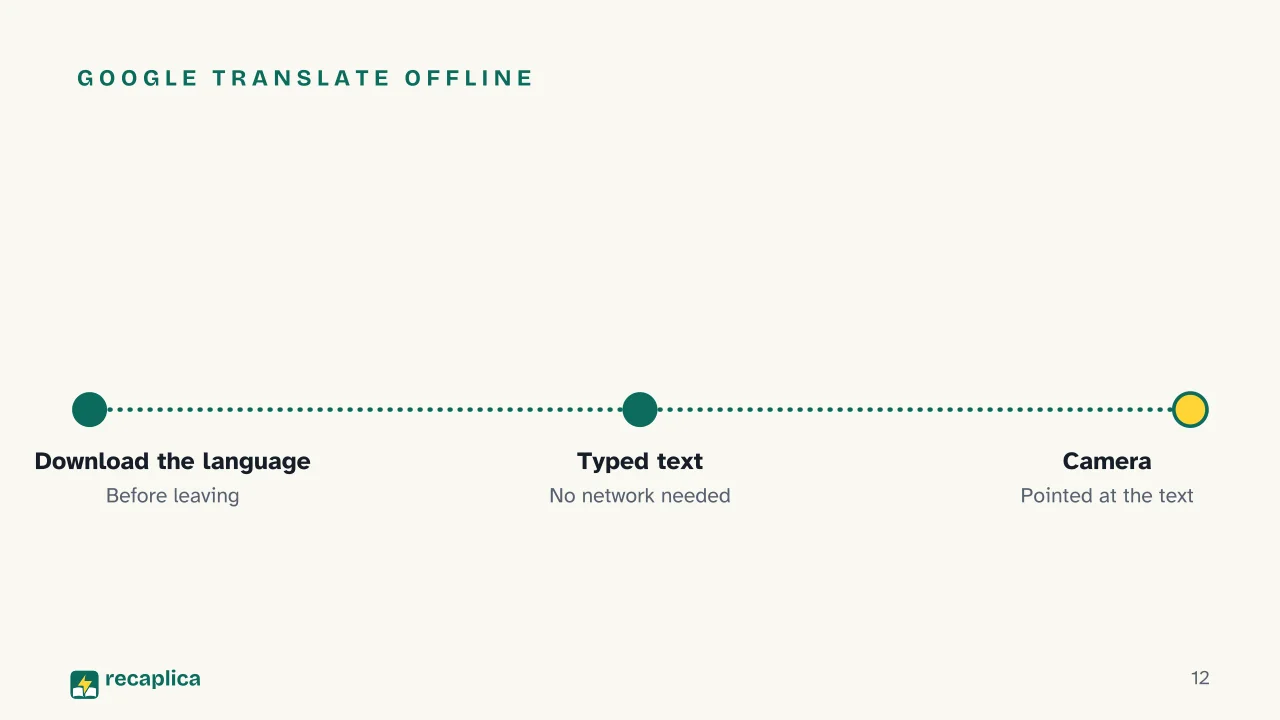
    Finding your way is only half the job if you can’t talk to the people you meet, and translation gets prepared the same way, by downloading language packs ahead of time. In Google Translate, the process is simple: open the app, pick the language from the available list, and tap the download button next to its name; on iPhone the path runs through Settings, then Offline Translation.

    Not every language can be downloaded: if a language in the list has no download button next to it, that language simply isn’t available offline. Once a pack is saved, two functions keep working: translating typed text, and translating through the camera, pointing it at a sign or a menu on the spot. Google Translate Help describes the packs as small files, downloadable even over mobile data, while flagging the possible data cost with your carrier.

    Practical example: heading into a country where signal is expected to be scarce, it’s worth downloading the local language in Google Translate while still on Wi-Fi, so a restaurant menu or a road sign stays readable without hunting for a network.

    One last practical note, on battery: downloading maps and language packs beforehand costs data and time, but using them offline afterward is easier on the phone than continuous connected GPS navigation, since there’s no steady background data traffic. To make it to the end of a travel day with charge to spare, see Smartphone Battery Life: How to Make It Last Longer; and for anyone carrying a power bank as backup, the rules change if a flight is involved — covered in Power bank on a plane: the rules for carrying and using it safely.

    Slide deck

    Slides ready to download and make your own in PowerPoint or Google Slides, with speaker notes. Pick the Flash cut or the Full one.
    Slide 1 of the presentation on Offline Maps: Offline MapsSlide 2 of the presentation on Offline Maps: How long does a downloaded map stay usable before it needs a fresh copy?Slide 3 of the presentation on Offline Maps: What's aheadSlide 4 of the presentation on Offline Maps: Chapter 01: How the download worksSlide 5 of the presentation on Offline Maps: An offline map doesn't last foreverSlide 6 of the presentation on Offline Maps: Chapter 02: Google Maps offlineSlide 7 of the presentation on Offline Maps: What stays, what dropsSlide 8 of the presentation on Offline Maps: Chapter 03: The alternativesSlide 9 of the presentation on Offline Maps: Offline, but not equal: Apple Maps, Organic Maps, Google MapsSlide 10 of the presentation on Offline Maps: Not every navigation app has offline mapsSlide 11 of the presentation on Offline Maps: Chapter 04: Translation tooSlide 12 of the presentation on Offline Maps: Google Translate offlineSlide 13 of the presentation on Offline Maps: Which app still covers public transit offline?Slide 14 of the presentation on Offline Maps: The full Recap
    Flash10 slidesThe essential thread, to present in classFull14 slidesEvery chapter and the deeper detail

    Common myths

    • ✗ Myth Every navigation app has an offline mode somewhere in its settings.

      ✓ Reality Waze, one of the most downloaded navigation apps, offers nothing like the offline map downloads found in Google Maps or Apple Maps: it runs on live data (traffic, user reports), and without a connection the most it keeps is a route already set before the app was closed.

    • ✗ Myth Once a map is downloaded offline, it stays good forever.

      ✓ Reality On Google Maps, an offline area expires after 15 days; if the phone reconnects to Wi-Fi in that window the system tries to refresh it on its own, otherwise it has to be downloaded again by hand. Apple Maps instead keeps its offline maps current automatically and deletes them on its own if they sit unused too long.

    • ✗ Myth Offline maps cover the same ground as the connected version, just without the connection.

      ✓ Reality Google Maps offline drops transit, cycling and walking directions, and driving loses live traffic and alternate routes. Apple Maps offline still covers transit. Organic Maps claims all of its features work with no network at all: coverage varies app by app, not just by connection status.

    Mind map

    Drag the background to move around and the nodes to reposition them; use − and + to collapse and expand branches.
    Customize
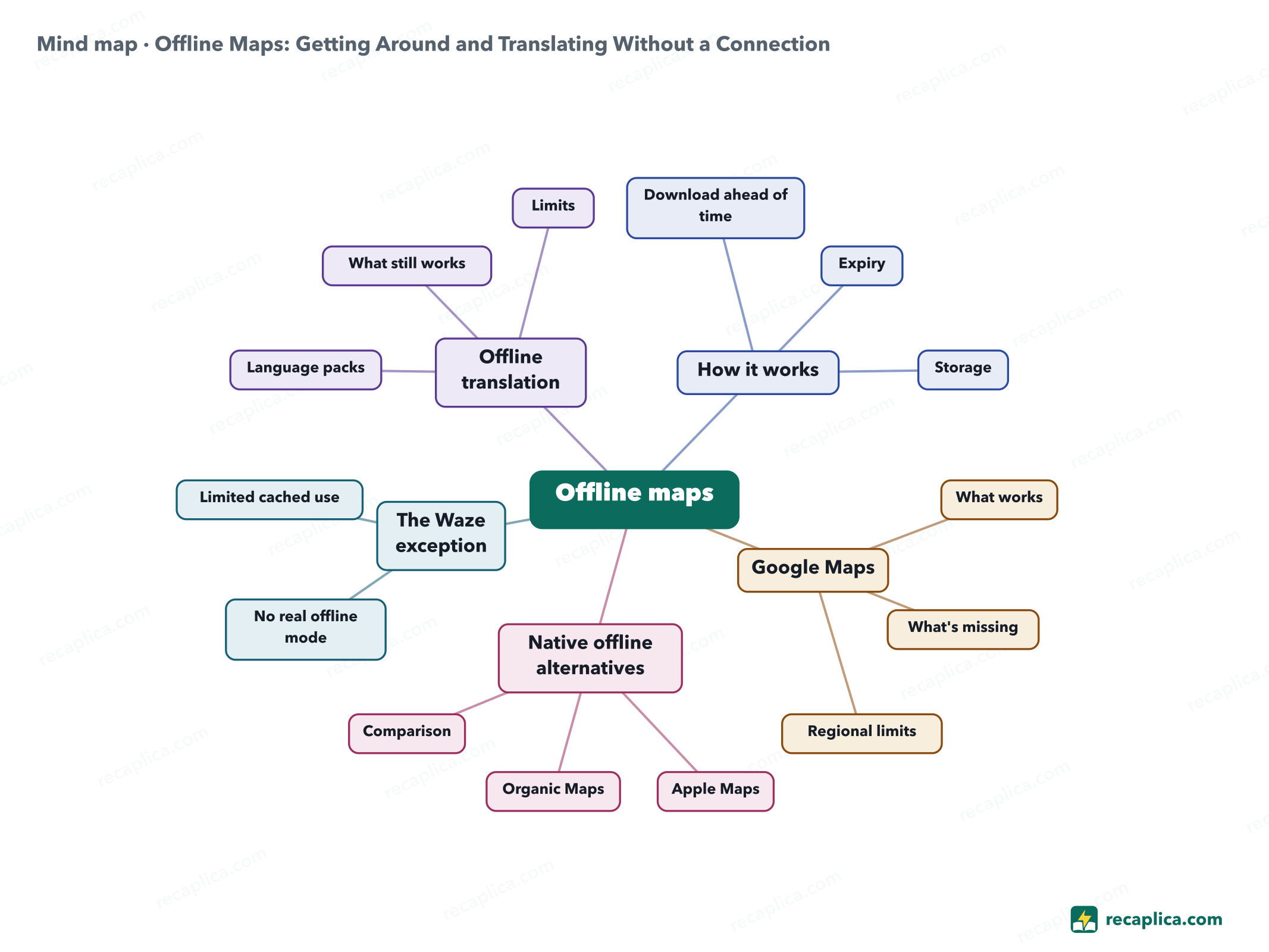
    Mind map: Offline Maps: Getting Around and Translating Without a Connection
    • Offline maps
      • How it works
        • Download ahead of time An area is saved while still connected, before leaving
        • Expiry 15 days on Google Maps, then it needs renewing or re-downloading
        • Storage Internal memory by default, movable to a portable SD card on Android
      • Google Maps
        • What works Driving directions, if the whole route sits in the downloaded area
        • What's missing Transit, cycling, walking, live traffic, alternate routes
        • Regional limits Not downloadable in some countries due to contracts or regulations
      • Native offline alternatives
        • Apple Maps Needs iOS 17 or later, also covers public transit
        • Organic Maps Open-source successor to Maps.me, built on OpenStreetMap
        • Comparison Offline coverage differs by app, not a single fixed figure
      • The Waze exception
        • No real offline mode Depends on live traffic and user reports
        • Limited cached use The route already set stays visible until the app closes
      • Offline translation
        • Language packs Downloaded from Google Translate before leaving
        • What still works Typed text and camera-based translation
        • Limits Not every language can be downloaded

    Quiz: test yourself

    Answer the questions to check what you have learned: you get instant feedback and a short explanation.

    Grade 0/10 0/5
    1 How long can a Google Maps offline area go before it expires, if you never renew it?

    Google Maps Help states that an offline area expires after 15 days; if the phone happens to be on Wi-Fi at that point, the system tries to refresh it automatically.

    2 True or false: Google Maps offline can give you public transit directions.

    False. Google Maps offline only handles driving directions, and only if the entire route falls inside the downloaded area — transit, cycling and walking directions all need a connection.

    3 Which of these apps does NOT offer a real offline maps mode?

    Waze relies on live traffic data and user reports to function; without a connection it keeps at most a route already set in cache, not a proper offline mode like the other apps.

    4 According to Apple, what do you need to use offline maps on an iPhone?

    Apple Support lists iOS 17 or later as the requirement for downloading offline maps on iPhone; availability still depends on being in a supported area.

    5 What can you still do after downloading a language pack in Google Translate for offline use?

    Google Translate Help says that once a language is downloaded, both typed-text translation and camera translation keep working, pointing the camera at the text to translate.

    Answers: 1-B · 2-B · 3-C · 4-B · 5-B

    Flashcards

    Tap the card to flip it and check whether you remember the answer, then move to the next one.

    1 / 7

    Explain it in your own words

    The ultimate test: if you can explain it in simple words, you've truly understood it. Write your explanation, then compare it with the Recap.

    Your explanation is saved only on this device.

    An offline map is a chunk of the map your phone stores locally before you leave, so navigation keeps working even without mobile data or Wi-Fi. Google Maps, the app most people search for, lets you download an area and drive it, but with sharp limits worth knowing before you rely on it mid-trip. Apple Maps and alternatives such as Organic Maps handle offline coverage differently, while Waze is the outlier: it has no real offline mode. Translation works the same way in advance, through Google Translate's downloadable language packs.

    Frequently asked questions

    How do you download an offline map in Google Maps?

    Search for the place or area in the app, open its place card, tap "More" and then "Download offline map." You need an active connection and to be signed in to Google Maps to start the download; once saved, the area stays valid for 15 days.

    Does Google Translate work without internet?

    Yes, once you've downloaded the language pack you need from the app: typed-text translation and camera translation both keep working. Not every language can be downloaded — if a language in the list has no download button next to it, it isn't available offline.

    What are the alternatives to Google Maps with offline coverage?

    Apple Maps, on an iPhone with iOS 17 or later, also covers public transit offline. Organic Maps, the open-source successor to Maps.me built on OpenStreetMap, claims 100% of its features work without a network, including hiking trails and elevation contours. Regional availability varies for both.

    Why doesn't Waze work well without a connection?

    Waze's core function depends on live data — traffic and reports from other drivers — and it has no offline map download comparable to the other apps. Without a connection, at most the route already set stays visible, until the app is closed.

    Do offline maps take up a lot of space on the phone?

    It depends on the area you pick: both Google Maps and Apple Maps show the file size before you finish downloading, so you can shrink the area if needed. On Android, maps can be moved to an SD card, but only if it's set up as portable storage.

    Sources

    • Google Maps Help — Use offline maps
    • Apple Support — How to download maps to use offline on your iPhone
    • Organic Maps — official project site
    • Google Translate Help — Download languages to use offline

    Every Recap goes through an independent review before publication.

    Every evening, the day's new Recaps on our Telegram channel. Join the channel →

    Keep learning

    • Technology Local Transportation While Traveling: How to Pick the Right Option Arriving somewhere unfamiliar always raises the same question: which way of getting around actually fits the trip. Buses and subways cost the least but ask you to figure out lines and tickets on the spot; taxis and ride-sharing apps are more convenient but reward a few checks before you get in; renting a car only pays off in specific situations. The gap between a smooth trip and a stressful one usually comes down to a handful of things verified in advance: cost, safety, time on hand and how far you actually need to go. Read the Recap →
    • Technology How Does an Aircraft Carrier Work? Flight Deck, Catapults and Nuclear Power An aircraft carrier is a warship built to launch and land aircraft in the middle of the ocean, turning its deck into a floating airport runway. Since the first one, the British HMS Argus, entered service in 1918, aircraft carriers have become among the most important warships in the world's navies. Some, like the American Nimitz class, use catapults and arresting wires; others, like the Italian Cavour, rely on an angled ramp and aircraft built for short takeoff or vertical landing. Below deck, between the hangar and the crew quarters, a single ship can house thousands of people. Read the Recap →
    • Technology Power bank on a plane: the rules for carrying and using it safely Power banks and other spare lithium batteries must always travel in carry-on luggage, never in a checked suitcase: it's the rule shared by the FAA, TSA, IATA and EASA. The limit depends on the battery's capacity, measured in watt-hours (Wh): up to 100 Wh you can fly with no permission, between 101 and 160 Wh you need the airline's approval and can carry at most two spare batteries in that range, and above 160 Wh the power bank stays on the ground. The reason is technical, not bureaucratic: if a lithium battery overheats (a phenomenon called thermal runaway), the crew can act immediately only if the device is visible, in the cabin, not if it's sealed away in the hold or an overhead bin. After an Air Busan plane caught fire in January 2025, ignited by a power bank stored above passengers' heads, several Asian airlines added stricter rules on in-flight use. Individual airline rules keep changing, so it's always worth checking them before you travel. Read the Recap →

    recaplica

    Clear in 30 seconds, yours in 10 minutes.

    Recaps Mind maps Request a Recap Telegram channel Mind map maker Our method About Privacy & cookies Legal notes & terms of use

    © 2026 Recaplica · A project by Curi S.r.l. — VAT IT05472000750

    Statistics, only if you say so

    To learn which Recaps help most we would use Google Analytics, with aggregate, anonymous data. It starts only with your OK, and you can change your mind anytime. Privacy policy