|
recaplica
Flight data recorder: how the aircraft 'black box' really works | |||||||||||||||
| © 2026 Recaplica · recaplica.com — All rights reserved | |||||||||||||||
Flight data recorder: how the aircraft 'black box' really worksWhat to print Page numbers appear when printing with default margins. SlidesChoose a cut Flash10 slidesThe essential thread, to present in classFull18 slidesEvery chapter and the deeper detailBoth come with speaker notes. In 30 seconds quick readThe aircraft 'black box' isn't black, and it isn't a single device: it's really two orange recorders, the FDR (flight data) and the CVR (cockpit voice), often combined into one unit on modern aircraft. The idea came from Australian chemist David Warren in 1956, and it only became law after a 1960 crash whose cause was never determined. Both recorders are built to survive violent impacts, fire, and the crushing pressure of the deep ocean, so investigators can piece together what happened even when little else of the aircraft survives. Key Points
Key figures
Deep DiveTwo recorders, one nickname“Black box” is really shorthand for a system made of two separate instruments, which on most modern aircraft are built into a single combined unit. The first is the FDR (Flight Data Recorder): it logs technical parameters such as altitude, airspeed, and heading, and on the newest aircraft it can track more than a thousand of them at once. The second is the CVR (Cockpit Voice Recorder): using an area microphone mounted between the two pilots, it captures radio transmissions, cockpit conversation, and any sound relevant to an investigation, from engine behavior to a stall warning. The Airbus A320 family, for instance, introduced combined recorders that store both flight data and cockpit audio in a single device, alongside text and digital communications exchanged during the flight. The distinction between FDR and CVR still matters, though: together they add up to a complete picture of a flight, the technical parameters on one side, the cockpit environment on the other. Then there’s a little-known detail: the name is wrong. Black boxes aren’t black. They’re orange, a color chosen from the very start because it makes the metal casing far easier to spot among crash debris. The term “black box” itself comes from something else entirely: it dates back to the 1930s and the recorder built by French engineer François Hussenot, which used photographic film housed inside a light, airtight casing. The name stuck; the color didn’t. The idea: David Warren and the Comet mysteryThe invention has a specific author: David Warren, an Australian chemist born in 1925 on Groote Eylandt, in the Northern Territory, who specialized in aviation fuels and worked as a researcher at the Aeronautical Research Laboratories (ARL) in Melbourne. In the mid-1950s he was drawn into the investigation of a series of crashes involving the De Havilland Comet, the world’s first jet airliner, which had gone down repeatedly between 1953 and 1954 for reasons nobody could pin down. Warren’s insight came at a trade fair, where he saw one of the first miniaturized voice recorders ever put up for sale: if a device like that stayed running in the cockpit right up to the moment of impact, he reasoned, recovering it from the wreckage would let investigators find out what had really happened, instead of guessing from the debris alone. His decisive technical contribution was swapping photographic film for magnetic tape — a medium that could be erased and rewritten continuously, and that therefore worked for an ordinary flight, not just for capturing a single unrepeatable event. Warren built the first prototype, named the ARL Flight Memory Unit, in 1956.
Australia’s rejection, and the Mackay crashThe story of how the black box was adopted was anything but a straight line, and it’s the least-known part of the whole affair. Australia’s military authorities dismissed the proposal to fit recorders on Royal Australian Air Force aircraft with what one official letter later described as more expletives than explanation, and the Department of Defence refused even to patent the invention, judging the £2,000 in fees required not worth the expense. It was a British official, Sir Robert Hardingham of the Air Registration Board, who showed genuine interest when Warren presented the idea to him in 1958. What ultimately swayed Australia was a tragedy. On June 10, 1960, a Fokker F27 Friendship operated by Trans Australia Airlines crashed near Mackay, in Queensland, killing all 29 people on board. The inquiry that followed closed on November 10, 1960, without being able to establish the cause of the crash. It was precisely that failure to answer the simplest possible question — what happened — that led the presiding judge to recommend making black boxes mandatory on commercial aircraft. The Australian federal government adopted the recommendation the following year, in 1961: Australia became the first country in the world to require cockpit voice recording on commercial flights, even though the Department of Civil Aviation ended up purchasing an American system instead of the one Warren had built. In the United States, the same requirement didn’t arrive until 1965. In one of the odder twists of the story, the first unit produced commercially at scale was built in the United Kingdom, and the acknowledgment of the invention’s Australian origins, present in the earliest communications, later disappeared from official records. What the FDR and CVR actually recordLet’s set the two devices side by side: the differences run deeper than the shared nickname suggests.
The technological leap in how many parameters the FDR records has been enormous: the Airbus A300B2, which entered service in the late 1970s, logged around 100; a modern Airbus A350 handles roughly 3,500 over 25 continuous hours. Helicopters, which face different flight dynamics from fixed-wing aircraft, typically record between 800 and 1,200 parameters. The leap also shows up in the storage medium itself: from the photographic film of the earliest days, to the magnetic tape Warren introduced, to solid-state memory, which has eliminated moving mechanical parts and, with them, most of the risk of breakage during an impact — the same storage technology now found in most everyday digital devices. Where it sits, and what it survivesPhysically, the FDR and CVR sit almost always in the tail section of the aircraft, the part the NTSB identifies as statistically the most resistant to impact compared with the rest of the fuselage. The sensor that measures vertical acceleration, in particular, must be rigidly mounted to the airframe, within specific limits relative to the aircraft’s center of gravity, under US federal regulations. But the real protection doesn’t come from location alone: it comes from the casing. Technical standards, including the FAA’s TSO-C124 and its European equivalent, EUROCAE ED-112A, require the container to withstand:
These are thresholds designed with a single goal in mind: keep the recorder intact even when almost everything else on the aircraft hasn’t made it. After the crash: recovery, then the labIf an aircraft goes down at sea, finding an object the size of a shoebox somewhere across kilometers of seafloor wouldn’t be possible without technical help. That’s why every recorder carries an underwater locator beacon (ULB): a device that, the moment it makes contact with water through a dedicated switch, begins emitting an ultrasonic pulse at 37.5 kHz once a second, detectable from 1-2 kilometers under normal conditions and up to 4-5 kilometers under ideal ones. On large aircraft flying beyond 180 nautical miles from the coast, EASA has required a second, low-frequency beacon (8.8 kHz) since 2019, detectable from 13 to 22 kilometers — roughly four times farther than the standard model. Once activated, these devices’ batteries must guarantee at least 90 days of continuous transmission under EASA rules in force since 2020, up from the 30-40 days of earlier generations. Once recovered, the recorder isn’t “read” on the spot: it goes to specialists who download, decode, validate, and analyze the data it holds, a process that in the United States takes place at the NTSB’s headquarters in Washington. It isn’t an isolated task, either: specialists synchronize the cockpit audio with the FDR’s parameters, radar data, airport camera footage, and air traffic control recordings, reconstructing the sequence of events minute by minute — a systematic process, not too different in its logic from how an algorithm follows precise, repeatable steps to reach a verifiable result. By law, the NTSB in the United States cannot release any part of a CVR audio recording publicly, given the sensitive nature of private cockpit communications.
The rules that make all this happenNone of what’s described here is left to individual manufacturers’ good will: a fairly detailed international regulatory framework governs it, not unlike other areas of technology where the European Union has chosen to set binding standards, as with the EU AI Act for artificial intelligence. Under ICAO Annex 6, the international reference standard, newly installed CVRs have had to guarantee at least 2 hours of recording plus a 10-minute backup power supply since 2001; a CVR is mandatory on every turbine aircraft with more than 9 passenger seats used for paid transport. In the United States, federal regulation (14 CFR 25.1459) sets specific requirements for installation, for the recorder’s electrical power supply — which must stay active as long as possible without compromising the aircraft’s emergency systems — and for the casing’s resilience. In Europe, EASA has raised the bar further for aircraft heavier than 27,000 kg built after January 1, 2021, requiring a CVR capable of recording 25 continuous hours, up from the 2 hours that used to be enough. Every new aircraft, in any case, must monitor at least 88 flight parameters deemed important by regulators — a minimum that manufacturers, as we’ve seen, have long since exceeded by a wide margin. Slide deckSlides ready to download and make your own in PowerPoint or Google Slides, with speaker notes. Pick the Flash cut or the Full one.     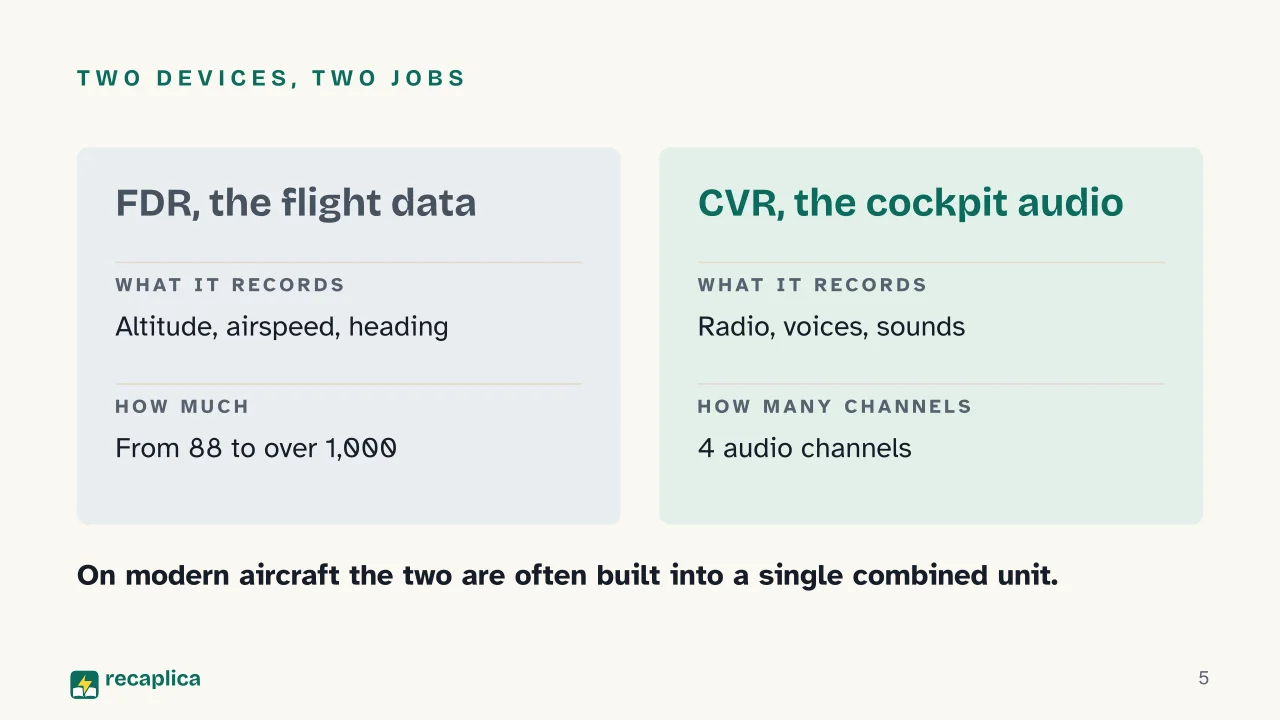 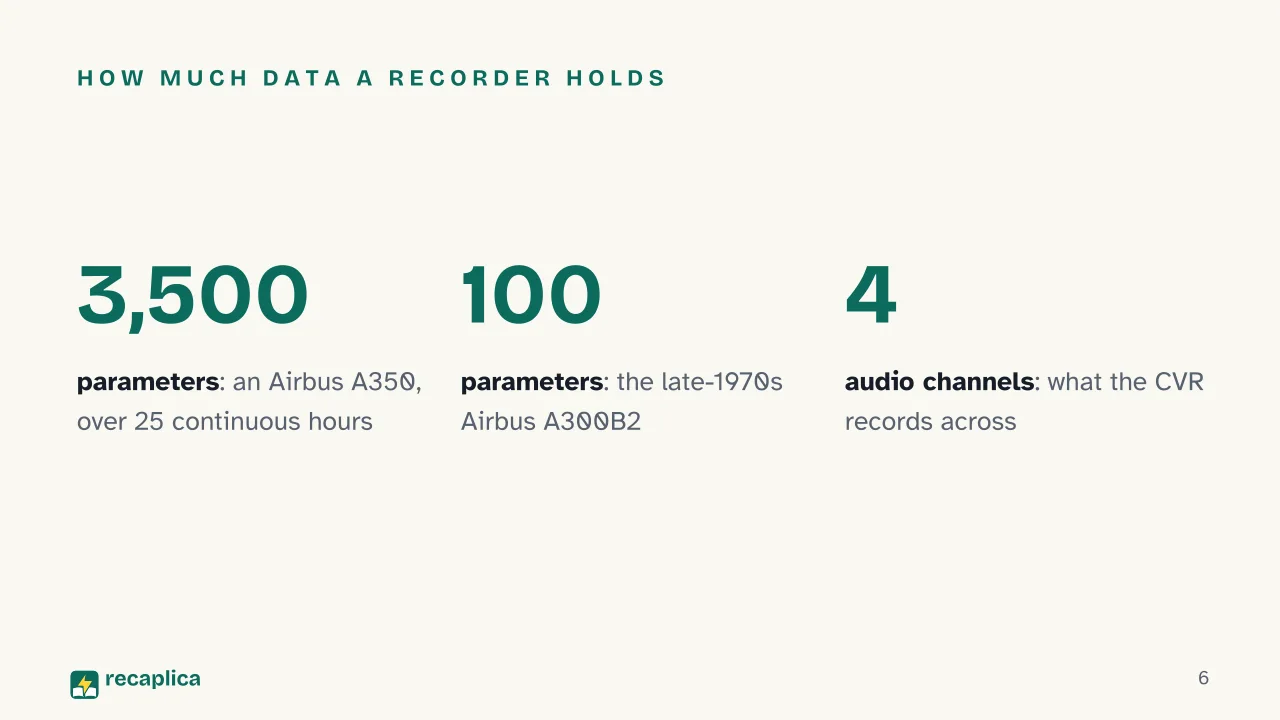   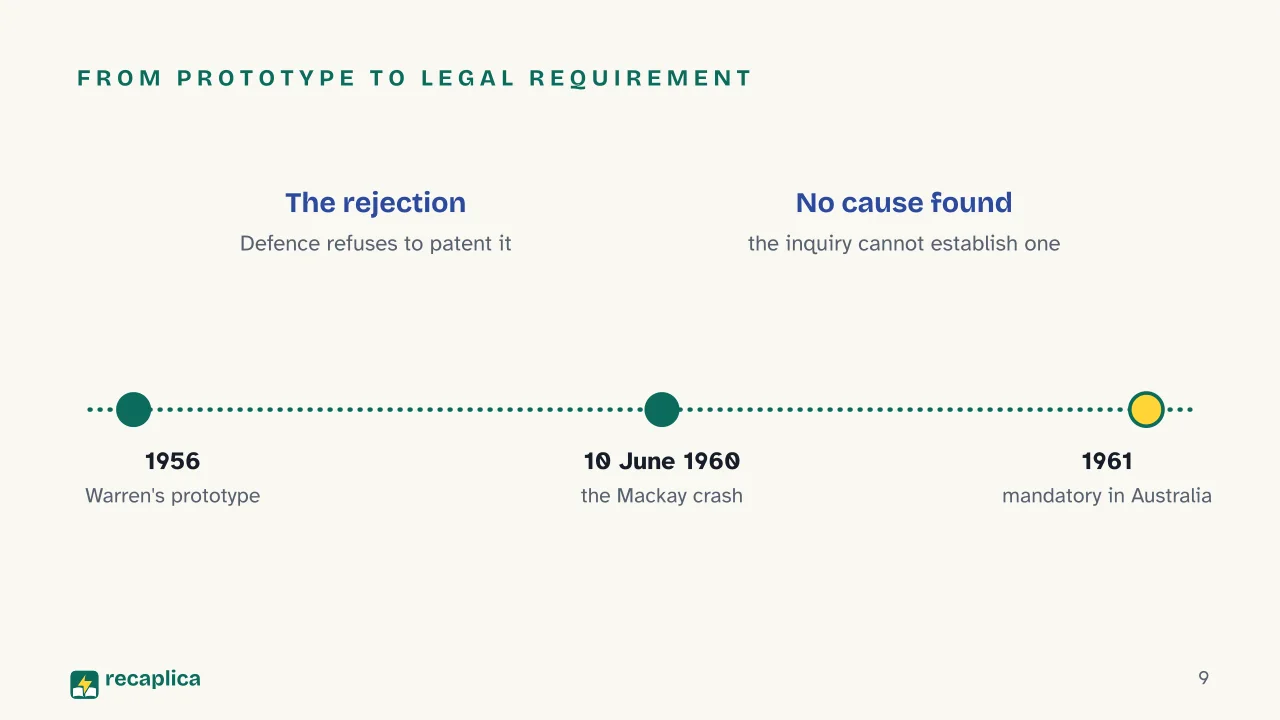  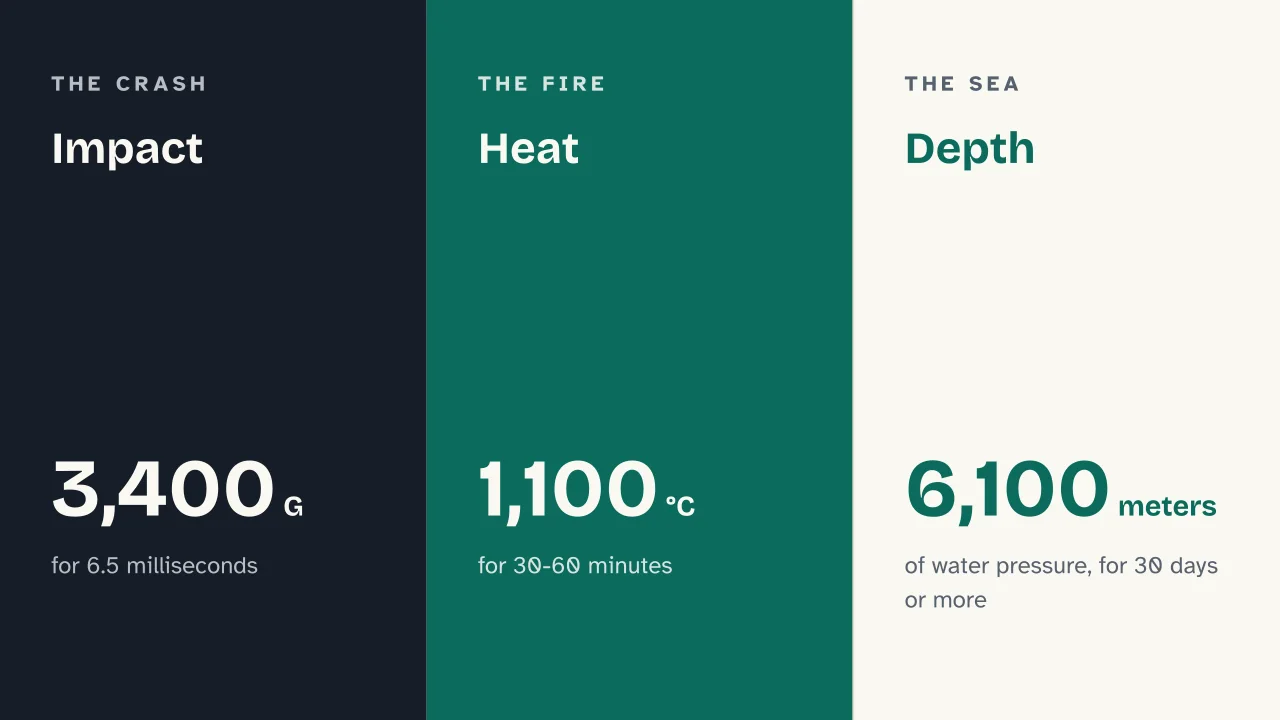   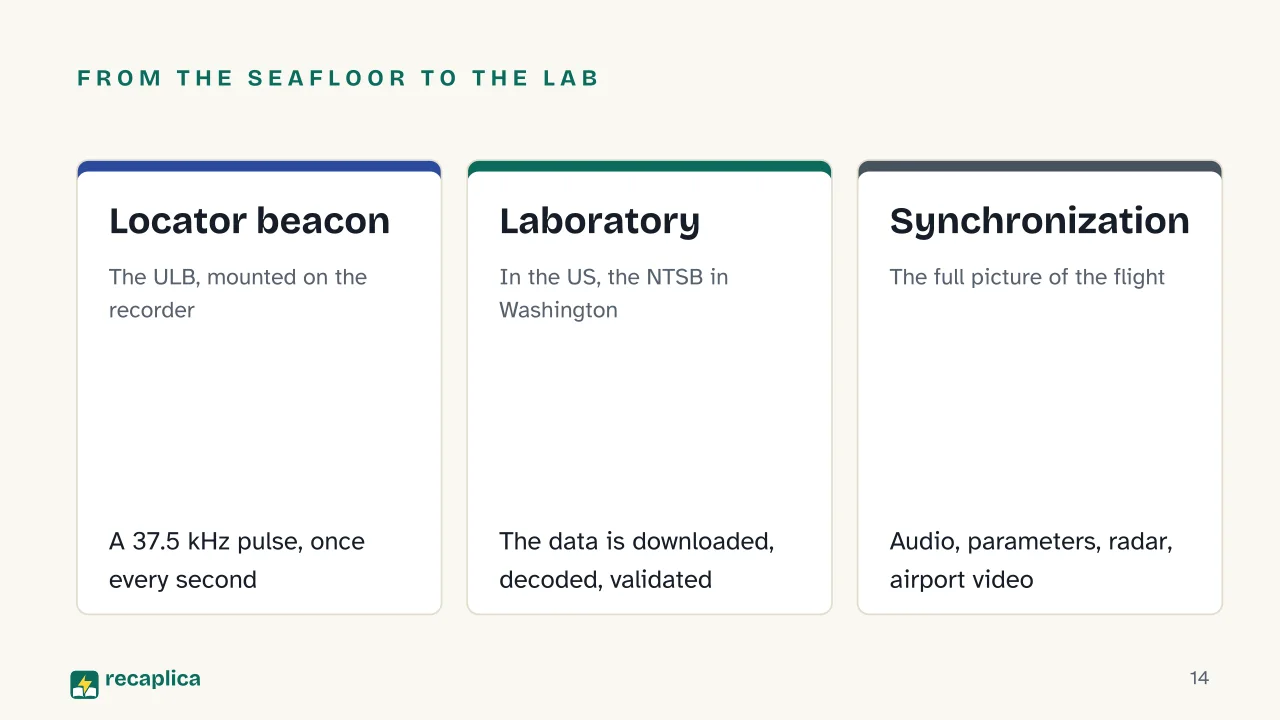 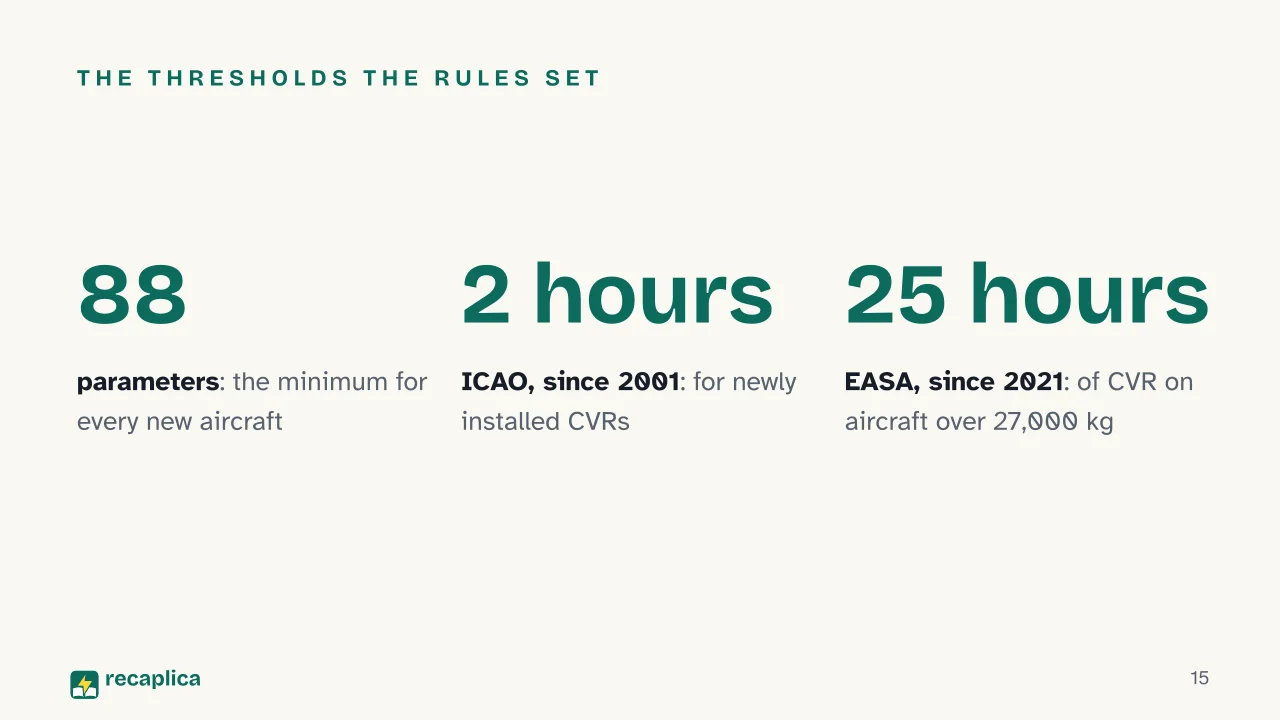  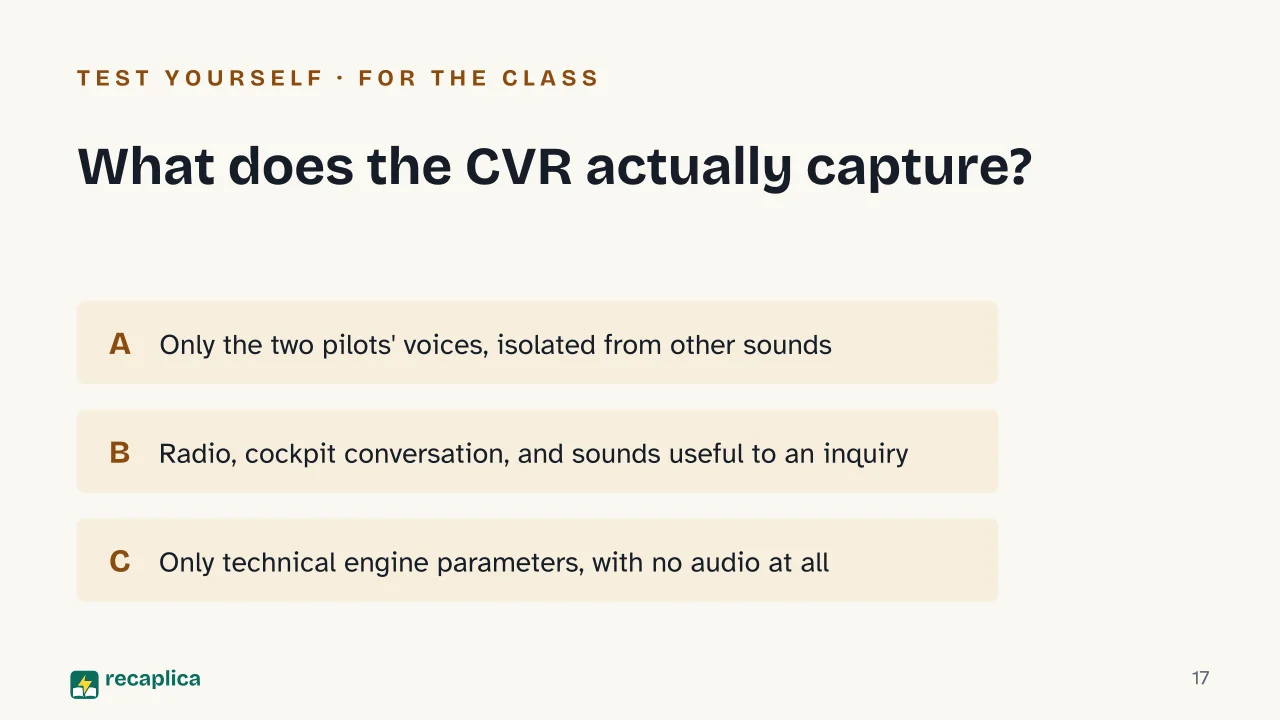  Common myths
Mind mapDrag the background to move around and the nodes to reposition them; use − and + to collapse and expand branches. 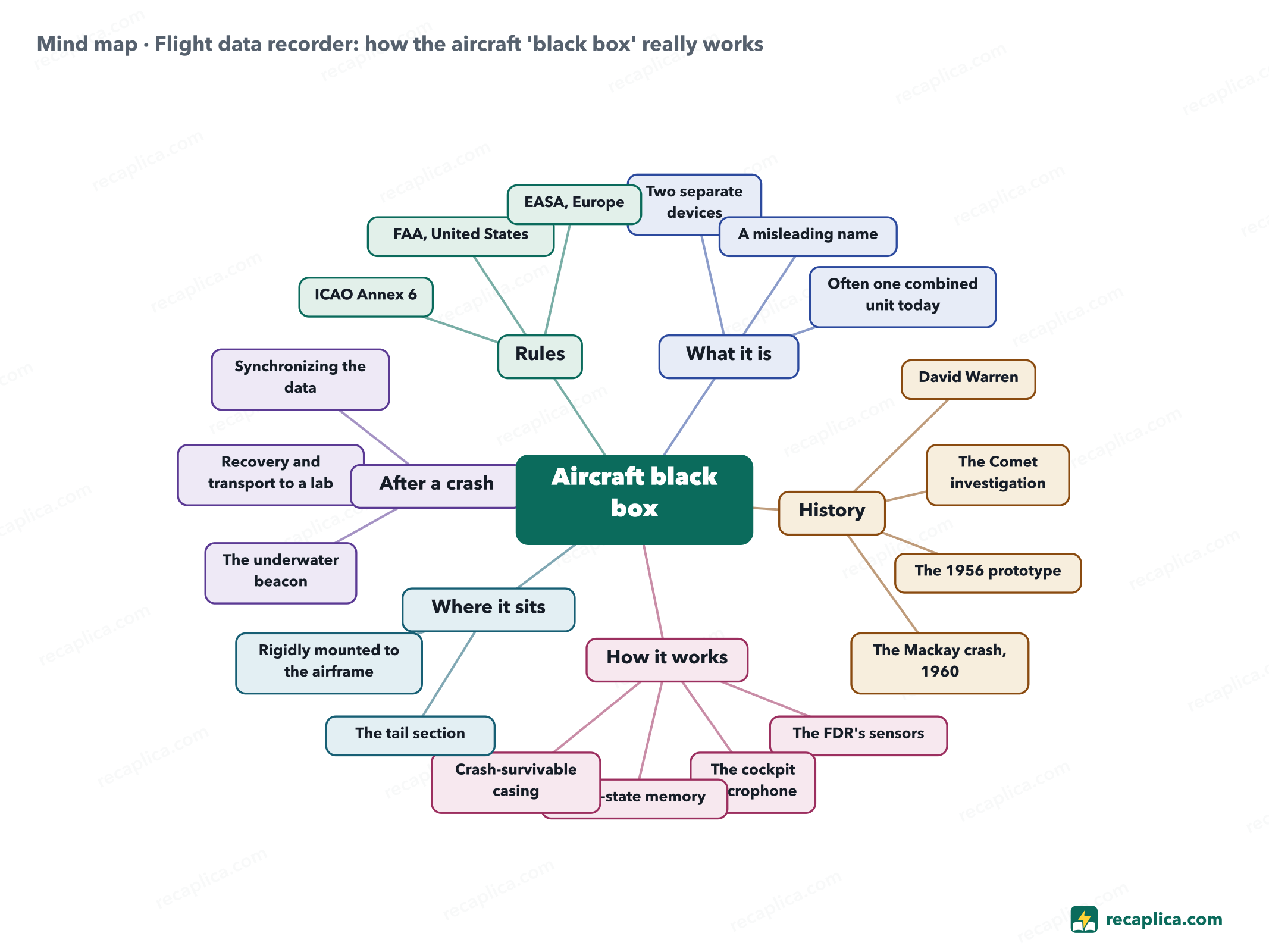
Quiz: test yourselfAnswer the questions to check what you have learned: you get instant feedback and a short explanation. Grade 0/10 0/5
FlashcardsTap the card to flip it and check whether you remember the answer, then move to the next one. 1 / 8 Explain it in your own wordsThe ultimate test: if you can explain it in simple words, you've truly understood it. Write your explanation, then compare it with the Recap. Your explanation is saved only on this device.
Frequently asked questionsIf it's actually orange, why is it called a black box?The term 'black box' dates back to the 1930s, when early recorders used photographic film sealed inside an airtight casing. The device's real color, though, has been bright orange since it was first conceived — a deliberate choice meant to make it easier to spot among wreckage after a crash. Where is the black box physically located on an aircraft?Usually in the tail section, which the NTSB identifies as the part of the aircraft that's statistically most resistant to impact. The recorder is rigidly mounted to the airframe and designed to remain intact even when the rest of the fuselage has been destroyed. How long does a black box keep recording for?It depends on the unit and its generation. The FDR records 25 continuous hours in a loop, overwriting the oldest data. The CVR has varied more over time: 30 minutes on older units, 2 hours on early solid-state units; since 2021, EASA has required 25 continuous hours of CVR recording on the heaviest European aircraft, those over 27,000 kg. Who invented the aircraft black box?Australian chemist David Warren, a researcher at the Aeronautical Research Laboratories in Melbourne, who built the first prototype in 1956 after working on the investigation into the De Havilland Comet crashes of the mid-1950s. Australian authorities refused for years to fund the idea; the first country to make it mandatory by law, in 1961, ended up being Australia itself. What happens to the black box after a plane crash?If the aircraft went down in water, an underwater locator beacon (ULB) mounted on the recorder emits a 37.5 kHz pulse to guide rescuers to the submerged wreckage. Once recovered, technicians take the device to a specialized laboratory (in the United States, the NTSB's headquarters in Washington) to download, decode, and validate the data, synchronizing it with radar records, airport video, and air traffic control recordings. Every Recap goes through an independent review before publication. |