Skip to content
recaplica

    One moment: security check

    Cloudflare wants to make sure you're not a robot. Tick the box below and your search will continue on its own.

    IT
    recaplica History of Microsoft Windows: From MS-DOS to Windows 11
    © 2026 Recaplica · recaplica.com — All rights reserved
    Home › Technology

    History of Microsoft Windows: From MS-DOS to Windows 11

    By Recaplica Newsroom · Updated on September 6, 2026

    What to print

    Page numbers appear when printing with default margins.

    Slides

    Choose a cut

    Flash10 slidesThe essential thread, to present in classFull18 slidesEvery chapter and the deeper detail

    Both come with speaker notes.

    Telegram channel
    recaplica Clear in 30 seconds, yours in 10 minutes.
    In 30 seconds Key points Figures Deep dive Slides Myths Mind map Quiz Flashcards FAQ

    In 30 seconds quick read

    Windows launched in 1985 as a graphical shell that ran on top of MS-DOS, not as a standalone operating system. Starting in 1988, Microsoft was secretly developing something far more ambitious in parallel, led by engineer Dave Cutler: the NT kernel, built for the professional market. The two product lines ran side by side for years, the consumer one (Windows 95, 98, Me) and the NT one (Windows NT, 2000), until they merged into a single product with Windows XP in 2001. From there, every version through Vista, 7, 8, 10 and 11 has been built on the same technical foundation, even though the name NT disappeared from marketing back in 2000.

    Key Points

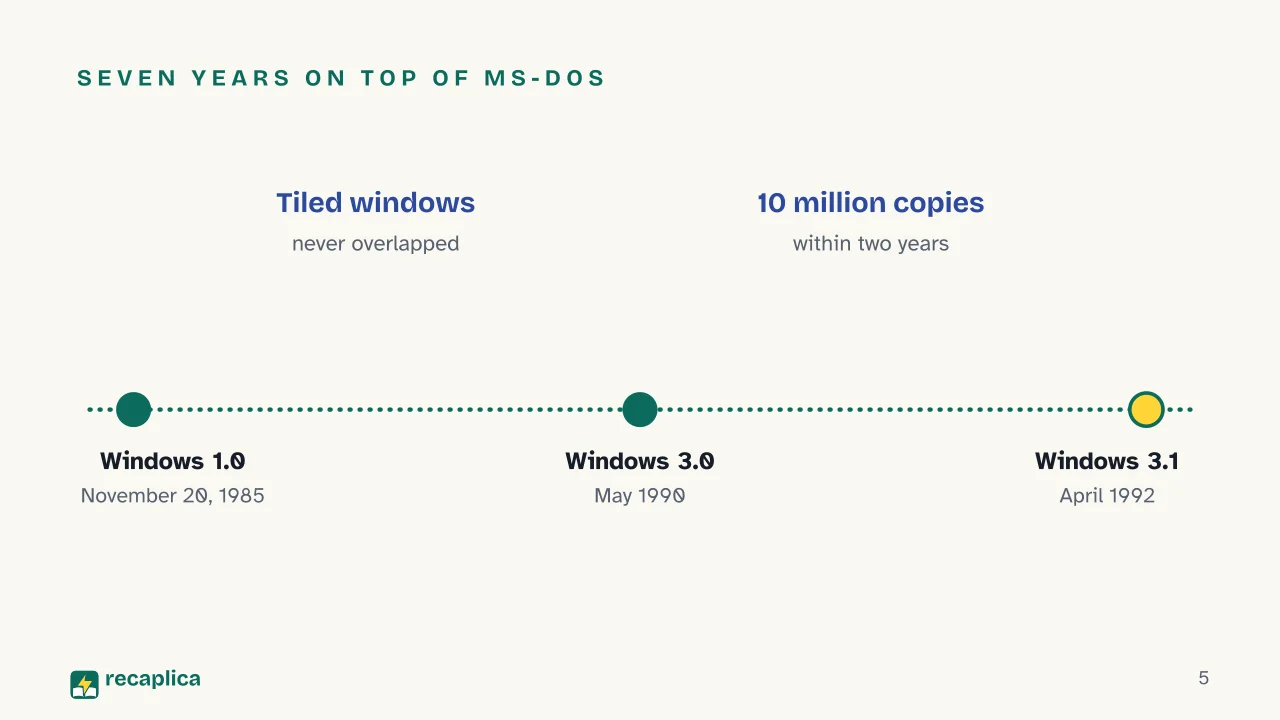
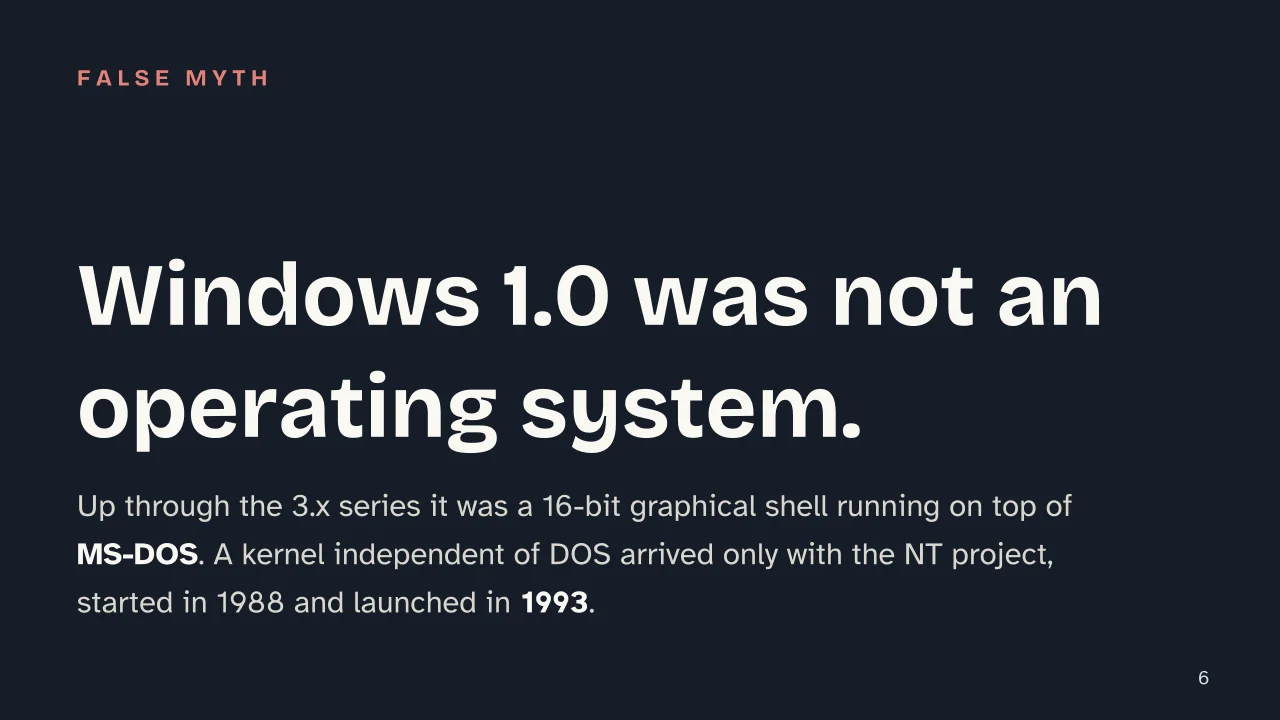
    • Windows 1.0, released on November 20, 1985, was not a complete operating system but a 16-bit "operating environment" that ran on top of MS-DOS, with windows that could only be tiled, never overlapped.
    • Windows 3.0 (May 1990) was the platform's first genuine commercial hit, selling around 10 million copies within two years.
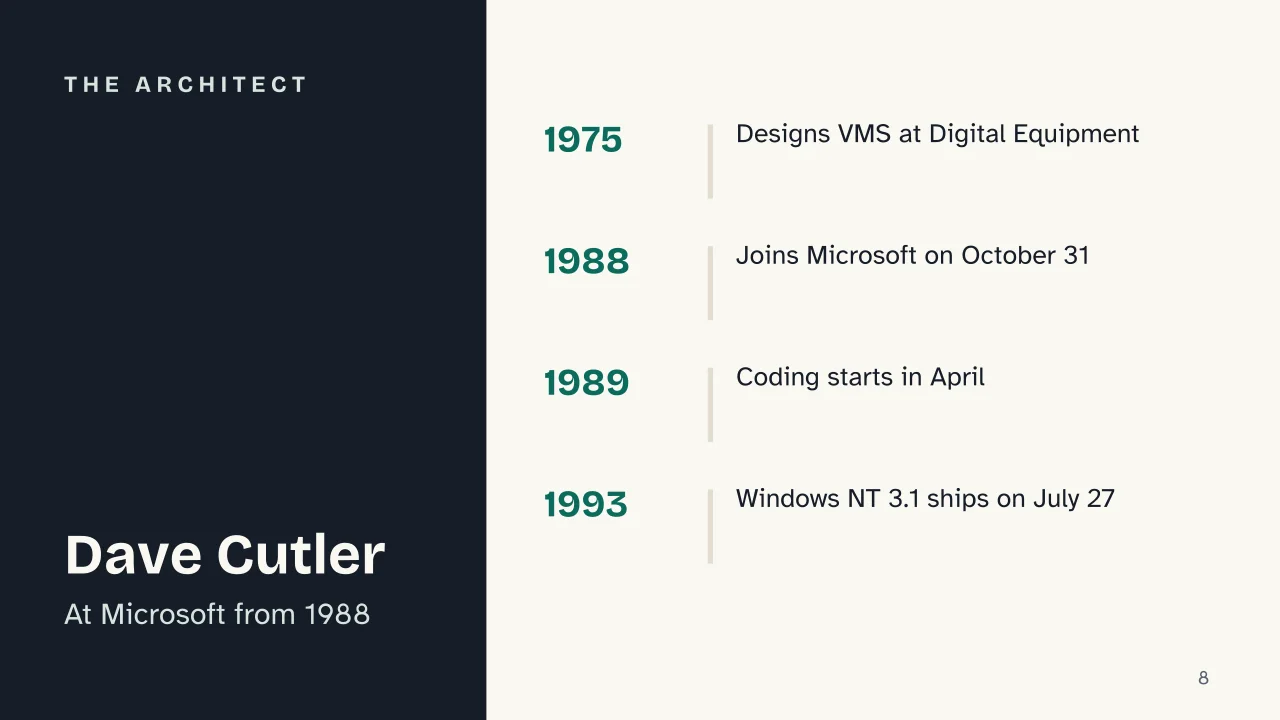
    • Windows NT 3.1 (July 27, 1993) grew out of a separate project started in 1988 under Dave Cutler, an engineer who had joined from Digital Equipment Corporation after working on the VMS operating system.
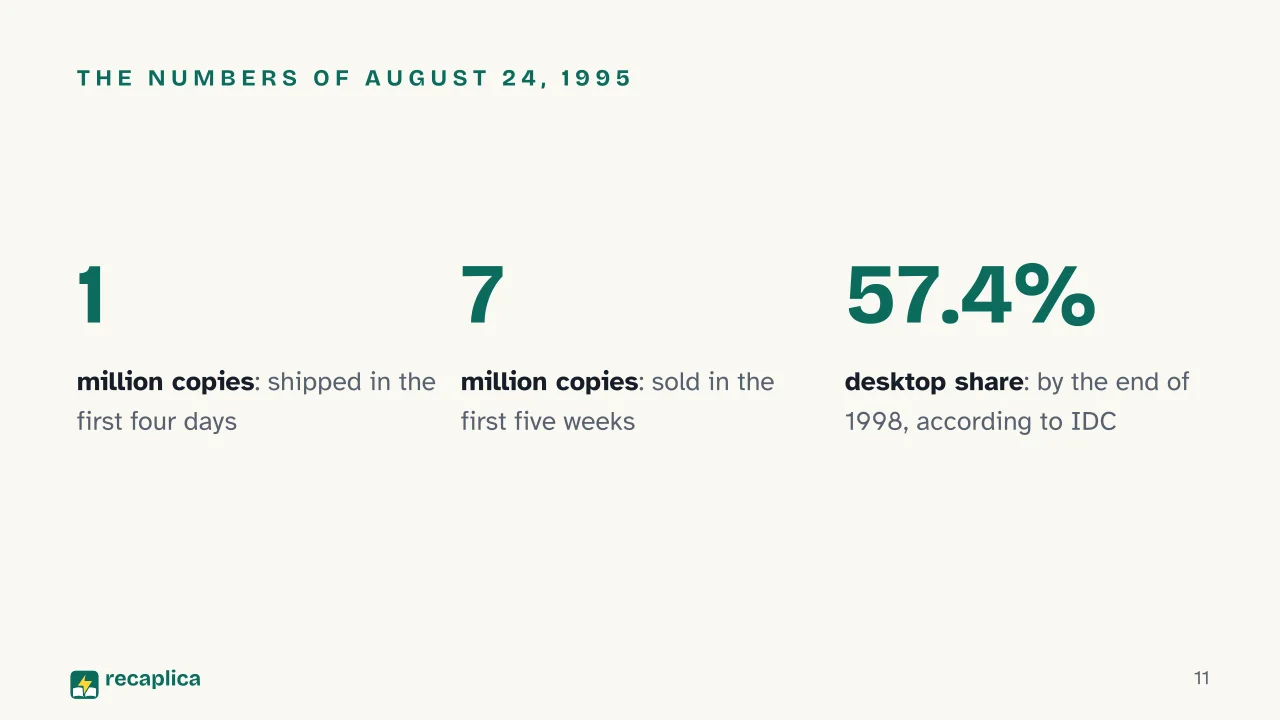
    • Windows 95, launched on August 24, 1995, introduced the Start menu and the taskbar and reached, according to IDC, a 57.4% share of the desktop market by the end of 1998.
    • Windows XP (October 25, 2001) unified the NT line with the MS-DOS-based consumer line for the first time, ending a split that had lasted since 1993.
    • Windows 11 (October 5, 2021) is the first non-server version of Windows to drop support for 32-bit processors entirely.

    Key figures

    • 10 million copies copies of Windows 3.0 sold in the first two years after its May 1990 launch, the result that turned the platform into a mass commercial success for the first time Source: Wikipedia, Microsoft Windows version history
    • 57.4% the desktop market share Windows 95 had reached by the end of 1998, according to International Data Corporation estimates Source: Wikipedia, Windows 95 (IDC data)
    • 7 million copies copies of Windows 95 sold in the five weeks after its August 24, 1995 launch Source: Microsoft News Center, Launch of Windows 95

    Deep Dive

    A graphical environment, not an operating system

    Bill Gates announced the “Windows” name in November 1983, but the product didn’t reach store shelves until two years later, on November 20, 1985. The delay was long enough that, as Microsoft engineer Chris Pratley later recalled, “Windows development started back in 1983, and it was a joke in the industry … Betting the company on it was a big, big bet.” When it finally shipped, Windows 1.0 was not a complete, self-contained operating system: it was an “operating environment,” a 16-bit graphical shell that ran on top of MS-DOS, bundled with programs like Paint, Write, Notepad, Calendar and the game Reversi. Its windows, on top of that, could only be tiled across the screen, not overlapped the way later Windows interfaces would allow. It saw little popularity.

    Later versions slowly improved things. Windows 2.0, released on December 9, 1987, saw somewhat wider adoption than its predecessor, helped along by the availability of the Aldus PageMaker desktop publishing software, and added support for the High Memory Area on Intel 80286 processors. The real turning point came with Windows 3.0 in May 1990: it was the first to run Windows programs in protected mode with virtual memory support, worked across a range of processors from the 8086/8088 up to the 80386, and sold around 10 million copies within two years, the platform’s first genuine mass commercial success. Windows 3.1 (April 1992) added scalable TrueType fonts, developed jointly with Apple, and dropped the old real mode, requiring at least an 80286 processor: by that point, the Windows API had become the de facto standard for consumer software, a role that a language like PHP would later come to play on the server side of the web.

    A second, more ambitious project running in parallel

    While Windows was growing as a graphical shell on top of MS-DOS, Microsoft was about to start an entirely different kind of project. In October 1988, work began on a new operating system led by Dave Cutler, an engineer who had joined the company that same month, on October 31, from Digital Equipment Corporation. There, starting in April 1975, Cutler had already designed the VMS operating system, and two years later, in 1977, he watched the first VAX roll off DEC’s production line. Gordon Bell, who had worked alongside Cutler in those years, called him “the best writer of operating systems in the world,” adding: “Dave is the ultimate competitor. He really wants to win.”

    The new project — the one that would become Windows NT — aimed at something far more ambitious than a graphical shell on top of DOS: a kernel portable across multiple hardware architectures (MIPS, DEC Alpha, PowerPC, as well as the Intel i860), with a layered architecture split between “user mode” and “kernel mode,” compatible with POSIX, OS/2 and 32-bit Windows APIs, built to meet security certification requirements and capable of taking advantage of multiple processors at once. The first six months were spent purely on specification work; actual coding began in April 1989. Windows NT 3.1 shipped on July 27, 1993, aimed initially not at consumers but at the workstation, office and server markets. Years later, discussing Cutler’s contribution, then-CEO Steve Ballmer would say: “There wouldn’t be a Microsoft today without Dave.”

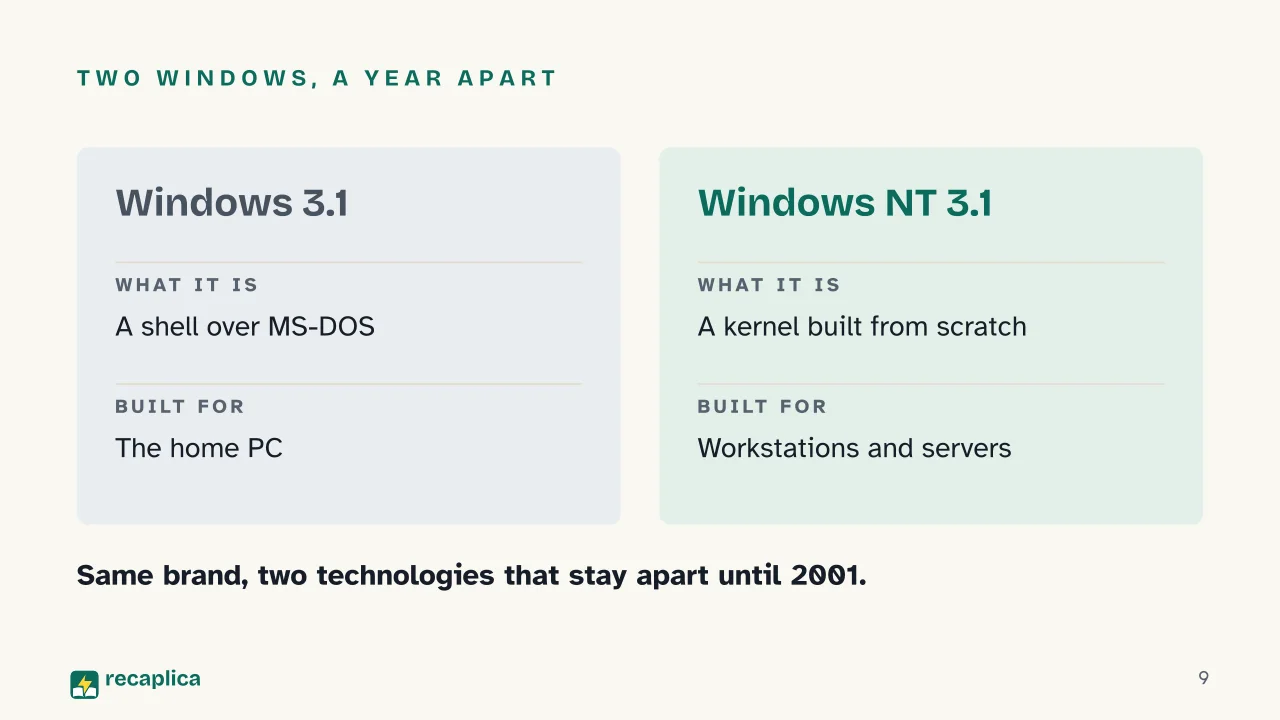
    Real-world example: picture two PCs bought around the same time, say 2000: one running Windows 98, the other Windows 2000. They’re the same age, but internally they’re two different operating systems. The first still carries MS-DOS inside it, with the old memory-addressing limits DOS had dragged along for decades; the second runs on the NT kernel (internally, version NT 5.0), with the NTFS file system extended to consumers and without the old 4 GB per-file limit. Opening the “About Windows” window was enough to tell which of the two worlds you were in.

    Windows 95 and the decade of a PC in every home

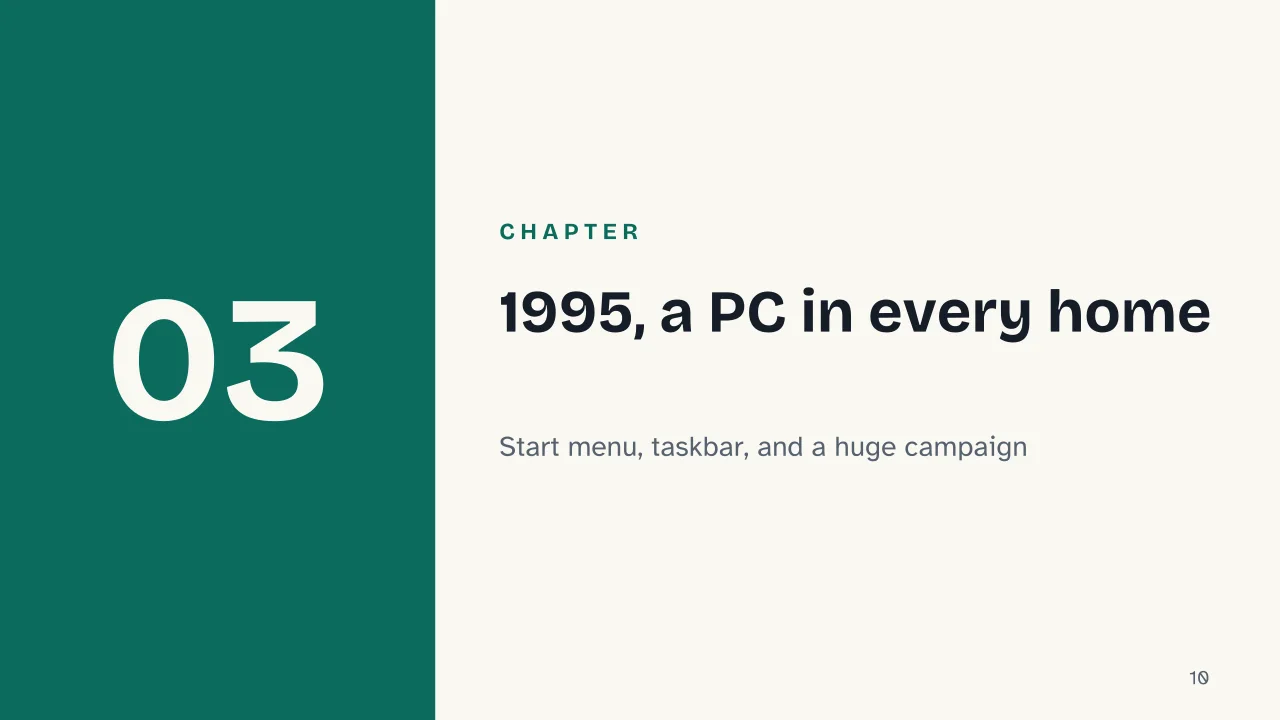
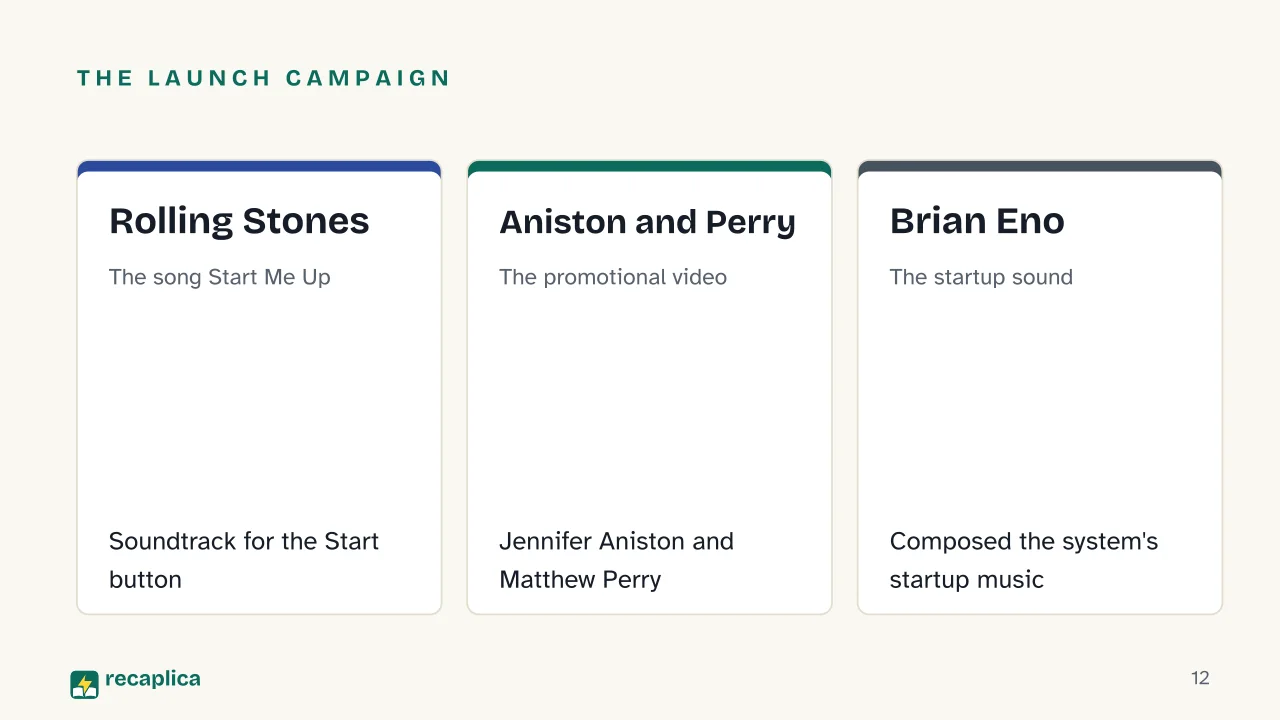
    On August 24, 1995 (after manufacturing had finished on July 14), Windows 95 hit store shelves, backed by one of the biggest marketing campaigns the computer industry had ever seen: Microsoft’s own advertising spend is estimated at around 200 million dollars, while the total campaign, spanning the whole industry, from PC makers to retailers to publishers, is estimated at close to a billion dollars; a promotional video starring Jennifer Aniston and Matthew Perry; the Empire State Building lit up in the blue of the Windows logo; and, most famously, the rights to the Rolling Stones’ “Start Me Up” as the soundtrack for the Start button — Microsoft said it paid 3 million dollars, though contemporary reports put the figure anywhere between 8 and 14 million. Even the system’s startup sound had a well-known name behind it: it was composed by Brian Eno.

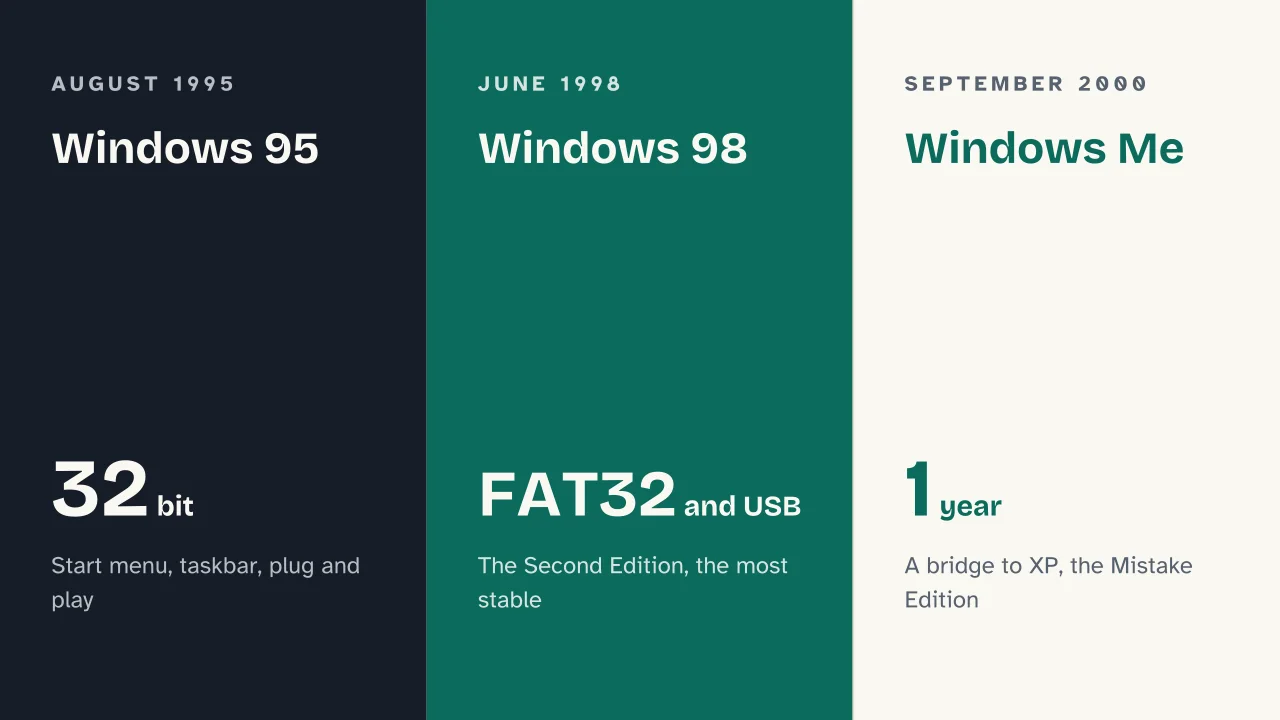
    Behind the spectacle were real technical advances: 32-bit preemptive multitasking (though the kernel still retained some 16-bit code for compatibility with existing software), the Start menu and taskbar with its notification area, plug-and-play support for automatically installing hardware, file names up to 255 characters long, and Windows Explorer as the file manager. The public responded: a million copies shipped in the first four days, 7 million copies sold in the first five weeks according to Microsoft, and eventually a 57.4% share of the desktop market by the end of 1998, according to International Data Corporation. Windows 98 (June 25, 1998) and its 1999 Second Edition, often remembered as the most stable release in the Windows 9x family, brought a larger-capacity FAT32 file system and improved USB support. Windows Me, on September 14, 2000, closed out the line on a controversial note: conceived as a one-year bridge between Windows 98 and the upcoming Windows XP, it was the last version of Windows built on DOS, it introduced the System Restore feature, but its stability problems earned it the ironic nickname “Mistake Edition.”

    VersionRelease yearMain innovation
    Windows 1.01985First graphical environment on top of MS-DOS
    Windows 3.01990First mass commercial success
    Windows NT 3.11993NT kernel for workstations and servers
    Windows 951995Start menu, taskbar, plug and play
    Windows XP2001Merger of the NT and consumer lines
    Windows 102015Continuous updates, Start menu restored
    Windows 112021Redesigned interface, end of 32-bit support

    Two lines become one: from XP to Windows 7

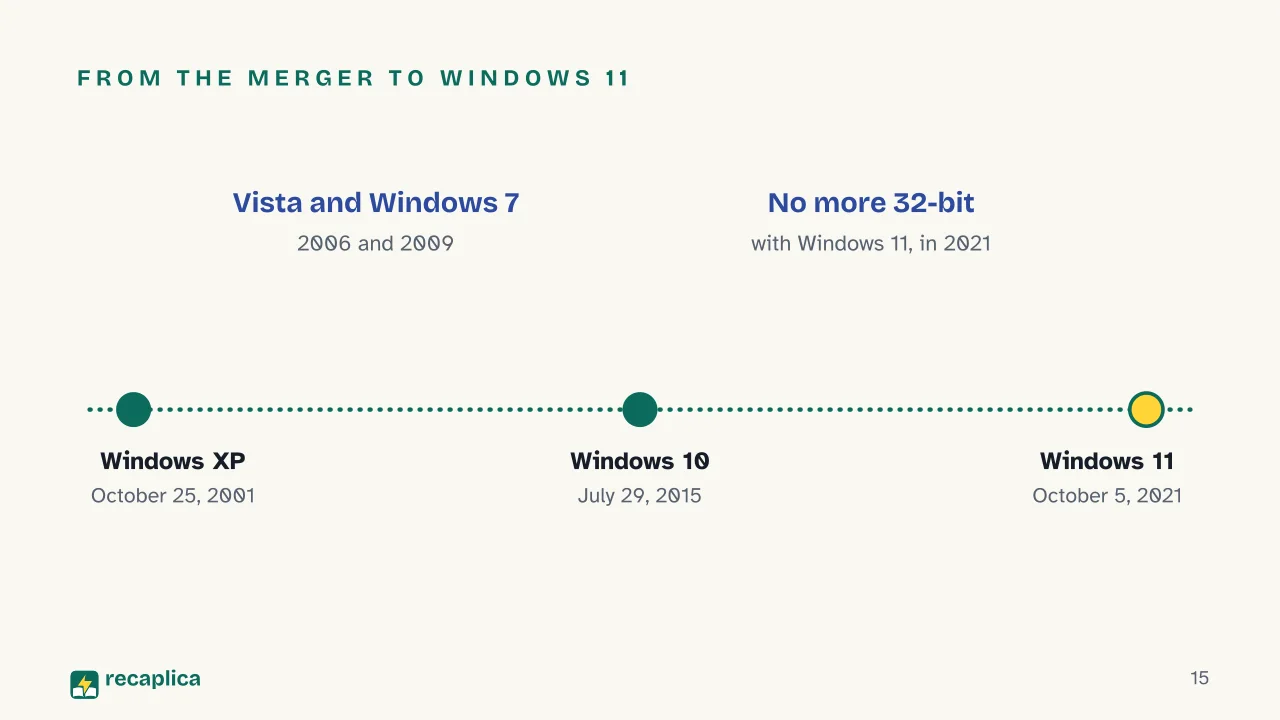
    While the 9x family was winding down, the NT line kept moving forward on its own: Windows 2000 (NT 5.0, February 17, 2000) brought the Active Directory directory service and extended NTFS support to non-business users, and it saw solid adoption in both the server and workstation markets. On October 25, 2001, the two paths finally merged: Windows XP (NT 5.1) unified the NT/2000 codebase with the consumer 95/98/Me codebase into a single product for the first time, inheriting features like System Restore from Windows Me. Backed by three service packs (2002, 2004 and 2008), XP remained Microsoft’s flagship product for more than five years, one of the company’s longest-lived releases.

    Windows Vista (NT 6.0), which reached businesses on November 30, 2006 and consumers on January 30, 2007, introduced User Account Control and the Aero graphical interface, but got a lukewarm reception, criticized mainly for its performance problems. Windows 7 (NT 6.1), available to manufacturers from July 22, 2009 and on sale from October 22, 2009, arrived instead to positive reviews, often described as what Windows 8 “should have been”: it started up faster, handled windows more cleanly, and made User Account Control less intrusive.

    The touch era, continuous updates, and modern Windows

    Windows 8 (NT 6.2), released on October 26, 2012, tried to reimagine Windows as a touch-first product: the traditional Start menu was replaced by a full-screen Start Screen, with a flat “Modern UI” design in place of Aero and a new app platform called Metro (later renamed UWP). The change was radical enough to draw significant criticism from reviewers, and Windows 8.1 (October 17, 2013) partly reversed course by bringing the Start icon back to the bottom-left corner, to the point that many consider it more of a substantial service pack than a genuine new version.

    Windows 10 (NT 10.0), released on July 29, 2015, restored the classic Start menu and introduced a continuous-update model, with 13 major updates rolled out over the years in place of the old, separately numbered versions; it also brought the Cortana virtual assistant and the Microsoft Edge browser, and remained Microsoft’s flagship product for six years, until Windows 11 arrived on October 5, 2021. Windows 11, also built on the NT 10.0 kernel, brought rounded corners and a redesigned Start menu, but it also marks a clean technical break with the platform’s more distant past: it’s the first non-server version of Windows to drop support for 32-bit processors entirely, a compatibility line that stretched literally all the way back to Windows 3.0. Dave Cutler himself, after shipping NT in 1993, kept working at Microsoft on projects spanning much of this history: in 2005 he led the porting of the first 64-bit versions of Windows to the AMD64 architecture, between 2006 and 2008 he worked on the hypervisor underlying Microsoft Azure, and between 2011 and 2013 on the virtual machine inside the Xbox One, in an industry that, as the history of computers also shows, tends to move through successive steps rather than sudden revolutions. Preemptive multitasking, introduced at mass scale by Windows 95 in 1995, is in practice the applied result of an algorithm for managing processes, designed specifically to split computing time between multiple programs without the user ever noticing.

    Slide deck

    Slides ready to download and make your own in PowerPoint or Google Slides, with speaker notes. Pick the Flash cut or the Full one.
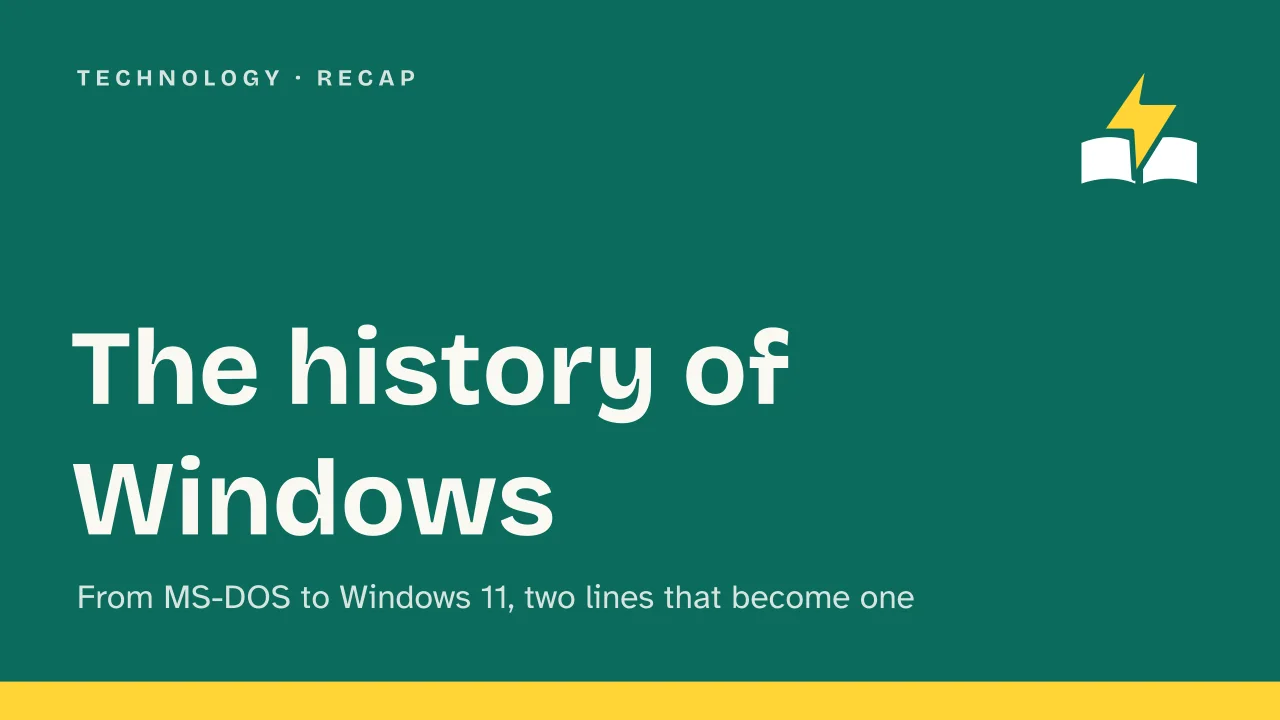
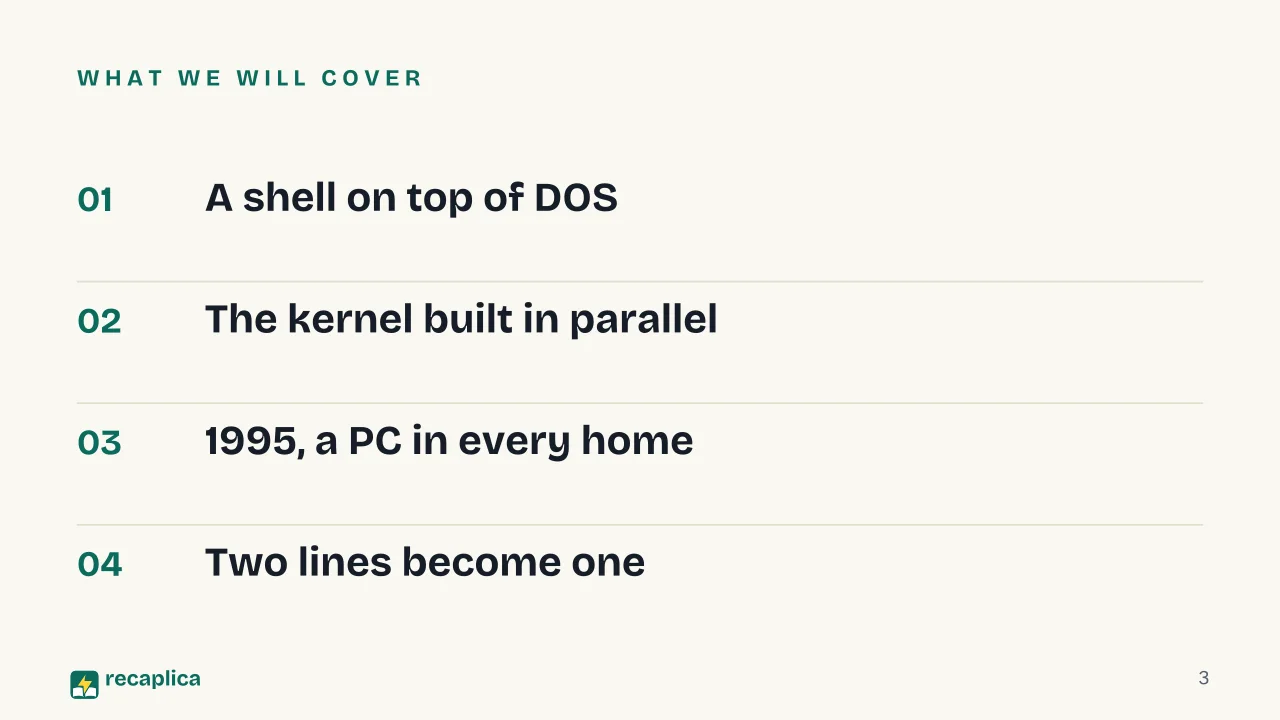
    Slide 1 of the presentation on History of Microsoft Windows: The history of WindowsSlide 2 of the presentation on History of Microsoft Windows: How many different Windows existed in 2000?Slide 3 of the presentation on History of Microsoft Windows: What we will coverSlide 4 of the presentation on History of Microsoft Windows: Chapter 01: A shell on top of DOSSlide 5 of the presentation on History of Microsoft Windows: Seven years on top of MS-DOSSlide 6 of the presentation on History of Microsoft Windows: Windows 1.0 was not an operating system.Slide 7 of the presentation on History of Microsoft Windows: Chapter 02: The kernel built in parallelSlide 8 of the presentation on History of Microsoft Windows: The architectSlide 9 of the presentation on History of Microsoft Windows: Two Windows, a year apartSlide 10 of the presentation on History of Microsoft Windows: Chapter 03: 1995, a PC in every homeSlide 11 of the presentation on History of Microsoft Windows: The numbers of August 24, 1995Slide 12 of the presentation on History of Microsoft Windows: The launch campaign: Rolling Stones, Aniston and Perry, Brian EnoSlide 13 of the presentation on History of Microsoft Windows: Windows 95 · Windows 98 · Windows MeSlide 14 of the presentation on History of Microsoft Windows: Chapter 04: Two lines become oneSlide 15 of the presentation on History of Microsoft Windows: From the merger to Windows 11Slide 16 of the presentation on History of Microsoft Windows: Why did Windows 8 land so badly?Slide 17 of the presentation on History of Microsoft Windows: Who was the chief architect of the Windows NT project, started in 1988?Slide 18 of the presentation on History of Microsoft Windows: And now, the review
    Flash10 slidesThe essential thread, to present in classFull18 slidesEvery chapter and the deeper detail

    Common myths

    • ✗ Myth Windows has always been a true, standalone operating system, ever since Windows 1.0.

      ✓ Reality Windows 1.0 (1985) and the versions up through the 3.x series were an "operating environment," a 16-bit graphical interface running on top of MS-DOS, not a standalone operating system. An independent kernel arrived only with the NT project, started in 1988 and launched in 1993, and it became the foundation for consumer products only with Windows XP in 2001.

    • ✗ Myth Windows Me was nothing but a failure, with no lasting legacy.

      ✓ Reality Despite being criticized for stability problems and nicknamed the "Mistake Edition," Windows Me was the first version of Windows to introduce the System Restore feature, which stayed in every version of the operating system that followed.

    • ✗ Myth The "NT" name disappeared because Microsoft abandoned that technology after Windows 2000.

      ✓ Reality The "NT" name was dropped from marketing starting with the Windows 2000 launch, but the underlying technology never changed families, and the NT kernel designed by Dave Cutler has remained the foundation of Windows XP, Vista, 7, 8, 10 and 11.

    Mind map

    Drag the background to move around and the nodes to reposition them; use − and + to collapse and expand branches.
    Customize
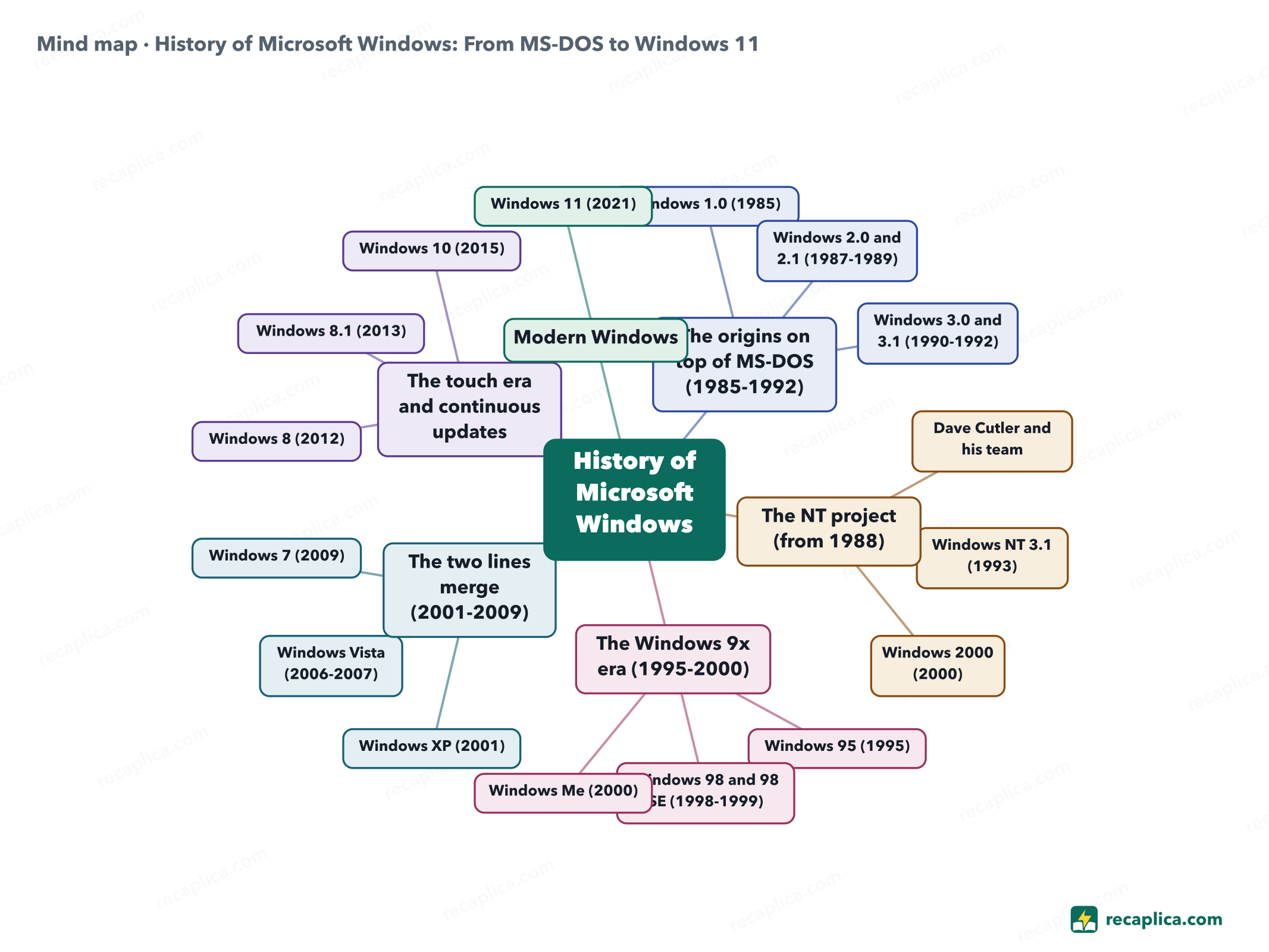
    Mind map: History of Microsoft Windows: From MS-DOS to Windows 11
    • History of Microsoft Windows
      • The origins on top of MS-DOS (1985-1992)
        • Windows 1.0 (1985) 16-bit operating environment, windows could only be tiled.
        • Windows 2.0 and 2.1 (1987-1989) Boosted by Aldus PageMaker, protected mode on the Intel 80286.
        • Windows 3.0 and 3.1 (1990-1992) First mass commercial success, TrueType fonts.
      • The NT project (from 1988)
        • Dave Cutler and his team Formerly of Digital Equipment Corporation, experience with the VMS operating system.
        • Windows NT 3.1 (1993) Hybrid kernel, initially aimed at workstations and servers.
        • Windows 2000 (2000) Active Directory, NTFS extended to consumers too.
      • The Windows 9x era (1995-2000)
        • Windows 95 (1995) Start menu, taskbar, plug and play.
        • Windows 98 and 98 SE (1998-1999) Extended FAT32, improved USB support.
        • Windows Me (2000) Last version on MS-DOS, criticized for stability.
      • The two lines merge (2001-2009)
        • Windows XP (2001) Unifies the NT line and the consumer line.
        • Windows Vista (2006-2007) User Account Control, Aero interface.
        • Windows 7 (2009) Positive reception after the criticism of Vista.
      • The touch era and continuous updates (2012-2015)
        • Windows 8 (2012) Start Screen built for touch, heavily criticized.
        • Windows 8.1 (2013) Start icon returns to the bottom-left corner.
        • Windows 10 (2015) Start menu restored, Cortana, continuous updates.
      • Modern Windows
        • Windows 11 (2021) Redesigned interface, end of 32-bit processor support.

    Quiz: test yourself

    Answer the questions to check what you have learned: you get instant feedback and a short explanation.

    Grade 0/10 0/5
    1 What was Windows 1.0, released on November 20, 1985, really?

    Windows 1.0 didn't replace MS-DOS, it extended it with a graphical interface, running as a 16-bit shell on top of the existing operating system. Its windows, too, could only be tiled side by side, not overlapped the way later Windows interfaces would allow.

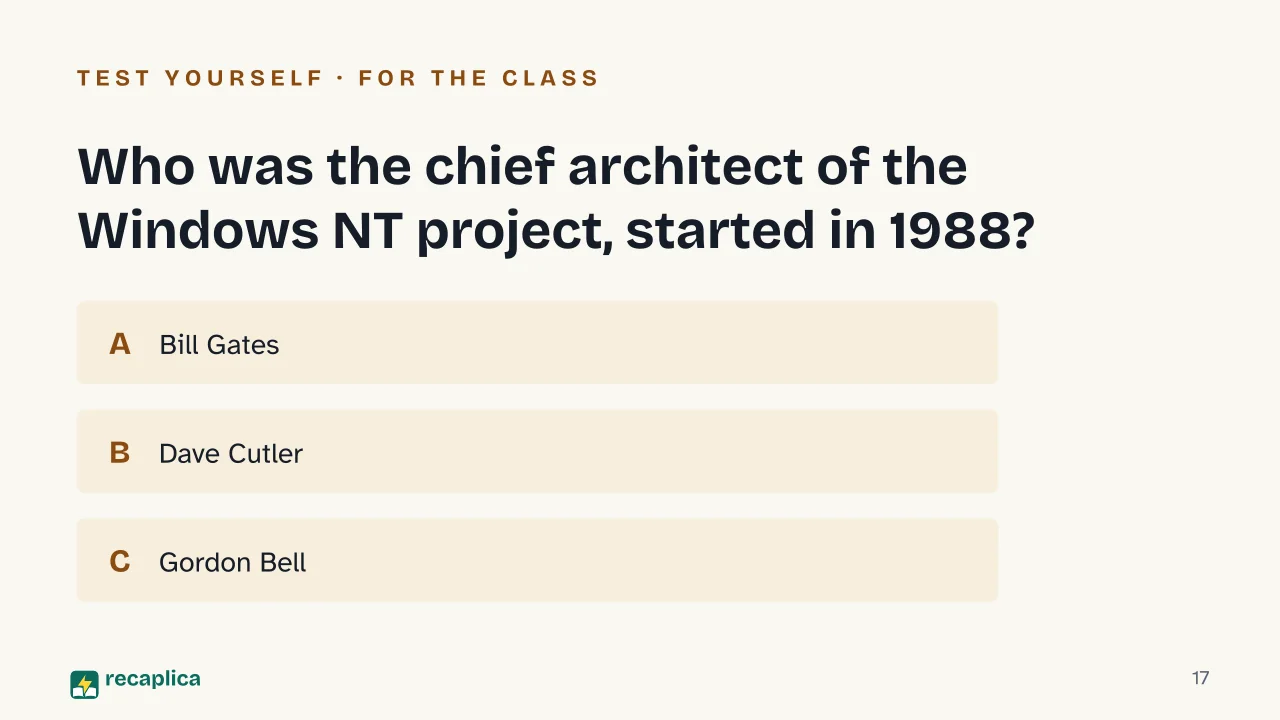
    2 Who was the chief architect of the Windows NT project, started in 1988?

    Dave Cutler joined Microsoft on October 31, 1988, after leaving Digital Equipment Corporation, where since 1975 he had led development of the VMS operating system. He brought that experience to Microsoft to build the NT kernel from the ground up.

    3 True or false: Windows XP, released in 2001, was the first version to unify the NT/2000 line and the consumer Windows 95/98/Me line into a single product.

    True. Until Windows Me (2000), Microsoft ran two separate product families, one based on MS-DOS for consumers and one built on NT for the professional market. Windows XP merged them into a single codebase, ending that split development path.

    4 According to International Data Corporation estimates, what desktop market share had Windows 95 reached by the end of 1998?

    57.4% is the figure IDC reported for Windows 95's desktop market share at the end of 1998, a result that reflects both the system's technical improvements and the marketing campaign that accompanied its launch in August 1995.

    5 Which Microsoft operating system was nicknamed the "Mistake Edition" by critics at the time?

    Windows Me (Millennium Edition), released on September 14, 2000, was meant as a one-year bridge between Windows 98 and Windows XP and was criticized for stability problems, earning it the ironic nickname "Mistake Edition." It was also the last version of Windows built on MS-DOS.

    Answers: 1-B · 2-C · 3-A · 4-C · 5-C

    Flashcards

    Tap the card to flip it and check whether you remember the answer, then move to the next one.

    1 / 8

    Explain it in your own words

    The ultimate test: if you can explain it in simple words, you've truly understood it. Write your explanation, then compare it with the Recap.

    Your explanation is saved only on this device.

    Windows launched in 1985 as a graphical shell that ran on top of MS-DOS, not as a standalone operating system. Starting in 1988, Microsoft was secretly developing something far more ambitious in parallel, led by engineer Dave Cutler: the NT kernel, built for the professional market. The two product lines ran side by side for years, the consumer one (Windows 95, 98, Me) and the NT one (Windows NT, 2000), until they merged into a single product with Windows XP in 2001. From there, every version through Vista, 7, 8, 10 and 11 has been built on the same technical foundation, even though the name NT disappeared from marketing back in 2000.

    Frequently asked questions

    What's the difference between Windows and Windows NT?

    NT refers to the kernel and architecture developed starting in 1988 by a team led by Dave Cutler, launched in 1993 as Windows NT 3.1 for the professional and server market. Until 2001 there was also a separate consumer "Windows" line built on MS-DOS (Windows 95, 98, Me). Windows XP merged the two lines, and since then the NT kernel has underpinned every version of Windows, even though the name "NT" was dropped from marketing as early as the Windows 2000 launch.

    Why was Windows Me considered a failure?

    Windows Me (Millennium Edition), released on September 14, 2000, was meant as a one-year bridge between Windows 98 and Windows XP. It was criticized for stability problems and nicknamed the "Mistake Edition," but it remains the last version of Windows built on MS-DOS and the first to introduce the System Restore feature.

    What was the first version of Windows?

    Windows 1.0, released on November 20, 1985. It wasn't a complete operating system but a graphical environment that ran on top of MS-DOS, with a tiled-only window interface, and it saw little popularity.

    Why was Windows 95 so successful?

    Factors included genuine technical advances (Start menu, taskbar, 32-bit preemptive multitasking, plug-and-play support) and a huge marketing campaign, with celebrities like Jennifer Aniston and Matthew Perry and the rights to the Rolling Stones song "Start Me Up." The result was a 57.4% desktop market share by the end of 1998, according to IDC.

    What happened to the "NT" name after Windows 2000?

    It was dropped from marketing starting with the Windows 2000 launch, but the underlying technology never changed families, and the NT kernel has remained the foundation of Windows XP, Vista, 7, 8, 10 and 11.

    Sources

    • Microsoft Windows version history (Wikipedia)
    • Windows NT (Wikipedia)
    • The engineer's engineer: Computer industry luminaries salute Dave Cutler's five-decade-long quest for quality (Microsoft News Center)
    • Windows 95 (Wikipedia)
    • Launch of Windows 95 (Microsoft News Center)

    Every Recap goes through an independent review before publication.

    Every evening, the day's new Recaps on our Telegram channel. Join the channel →

    Keep learning

    • Technology ASCII Table: What Is It? The ASCII table assigns a fixed number to every letter, digit, punctuation mark, and keyboard control command, so that a computer, which only handles numbers, can represent text. Published in 1963 by the ANSI X3.4 committee and adopted for U.S. federal computers in 1968, it uses 7 bits and covers 128 characters, almost all of them from the English alphabet, according to the IEEE's Engineering and Technology History Wiki. RFC 20 shows how those 7 bits fit neatly inside an 8-bit byte, with the highest bit left unused; putting that extra bit to work opens up more combinations, the basis for the variants known as Extended ASCII. Because it only covers English, though, standard ASCII falls short for languages with accents, ideograms, or other alphabets — a gap Unicode was built to close. Read the Recap →
    • Technology Binary Code: What It Is and How Computers Write Numbers Binary code is how a computer represents numbers using only two digits, 0 and 1. The reason is physical: a computer's circuits reliably tell apart only two electrical states, current off or current on, and we label them 0 and 1 for convenience. Just like the decimal system, each digit's value depends on its position, but here positions are worth powers of two instead of powers of ten: the number 101 works out to (1×4)+(0×2)+(1×1), which is 5. Eight of these digits together form a byte, the unit a computer typically uses to hold one number. Binary alone covers numbers; writing letters needs an extra convention, such as ASCII or Unicode, covered in their own Recaps. Read the Recap →
    • Technology Unicode: What Is It? How It Replaced ASCII Unicode is the standard that gives a unique number, called a code point, to every character in every written language. It replaced ASCII, the 1963 code whose 128 characters covered only the English alphabet, with no accents and no other scripts. Text online travels almost always as UTF-8, one of the forms Unicode uses to turn those numbers into bytes, and it's backward compatible: a file written purely in ASCII is already valid UTF-8. Version 18.0 of the standard, published in September 2026, covers 172,808 characters. Read the Recap →

    recaplica

    Clear in 30 seconds, yours in 10 minutes.

    Recaps Mind maps Request a Recap Telegram channel Mind map maker Our method About Privacy & cookies Legal notes & terms of use

    © 2026 Recaplica · A project by Curi S.r.l. — VAT IT05472000750

    Statistics, only if you say so

    To learn which Recaps help most we would use Google Analytics, with aggregate, anonymous data. It starts only with your OK, and you can change your mind anytime. Privacy policy