|
recaplica
History of Amazon and Jeff Bezos: From Garage Startup to Antitrust Case | ||||||||||||||||||||||
| © 2026 Recaplica · recaplica.com — All rights reserved | ||||||||||||||||||||||
History of Amazon and Jeff Bezos: From Garage Startup to Antitrust CaseWhat to print Page numbers appear when printing with default margins. SlidesChoose a cut Flash10 slidesThe essential thread, to present in classFull15 slidesEvery chapter and the deeper detailBoth come with speaker notes. In 30 seconds quick readAmazon started in 1994 in a garage in Bellevue, Washington, as an online bookstore called Cadabra before taking the name it has kept ever since. It grew fast, went public in 1997, nearly collapsed during the dot-com crash between 1999 and 2001, then expanded well beyond books until Amazon Web Services turned it into a cloud computing giant too. Founder Jeff Bezos bought The Washington Post in 2013, in a personal deal. Since 2023 the company has also faced an FTC monopoly lawsuit and, since 2024, a US Senate investigation into warehouse conditions. Key Points
Key figures
Deep DiveThe key milestones
From Cadabra to the Bellevue garageIn 1994, Jeff Bezos, a Princeton graduate, left a job on Wall Street and started an online bookstore in a garage in Bellevue, Washington. He named the business Cadabra, a play on the word “abracadabra.” The public site opened a year later, in July 1995, already under the name Amazon: in its first month of operation the company shipped books to all 50 US states and 45 countries. The first book ever sold was Fluid Concepts and Creative Analogies: Computer Models of the Fundamental Mechanisms of Thought, by Douglas Hofstadter. Amazon’s story crosses paths more than once with other major tech names of the same era, including History of Apple and Steve Jobs, from the Garage to His Return as CEO: another company that started in a garage and went from near-collapse to a dominant market position. 1997 and the “Day 1” letterAccording to Amazon’s first shareholder letter, published in 1997, the company served over 1.5 million customers that year, with revenue growing 838% to $147.8 million. In the same letter, Bezos wrote that the company would measure its success by the long-term value it created for shareholders, not by short-term returns, and that when forced to choose between optimizing the look of its financial statements and maximizing future cash flow, it would always pick the latter. It’s the philosophy that became known as “Day 1”: treating every day as the first one, when everything still has to be built. For more on how a publicly traded stock works and why a company decides to go public, see Stocks and the stock market: how they actually work. From books to everything elseIn 1999, Amazon expanded its catalog to music and video. In 2000, it opened the site to third-party sellers, who could list their own products alongside Amazon’s.
The near-collapse of the dot-com crashBetween 1999 and 2001, Amazon’s stock fell from $106 to $6, in the middle of the dot-com crash that wiped out much of the wave of companies born alongside the internet boom of the 1990s. In January 2001, Amazon cut about 15% of its staff, and around the same time it was burning through hundreds of millions of dollars in cash. In April 2001, author and investment commentator Doug Casey wrote publicly that the company was headed for bankruptcy. Amazon still ended 2001 with over $500 million in cash, a cushion that let it ride out the crisis. AWS, born from an internal problemAWS’s own official pages tell a story different from the one people usually assume: the cloud service grew out of an internal problem. Running Amazon.com’s IT infrastructure was expensive and complicated, and it pulled engineering teams away from building new things. That experience led, in spring 2006, to the first public service, Amazon S3, followed by Amazon EC2. The stated goal, according to AWS, was to let even a kid in a college dorm room access the same technology as the world’s largest companies. The network these services run on is explained in How the internet works: the journey of data from cable to page. Bezos beyond Amazon, The Washington PostIn August 2013, the Washington Post Company announced the sale of the newspaper to Jeff Bezos, for $250 million. The purchase was personal: Bezos made it in his own name, not through Amazon.com. The Washington Post’s then-CEO, Donald Graham, explained the choice by pointing to Bezos’s technology and business expertise and his long-term approach. The deal did not involve layoffs among the newspaper’s 2,000 employees. Under closer scrutiny, antitrust and working conditionsIn September 2023, the Federal Trade Commission, together with 17 state attorneys general, sued Amazon in the US District Court for the Western District of Washington. The complaint covers two markets, online retail and marketplace services, and alleges that Amazon illegally maintains monopoly power: among the practices at issue, the company allegedly charges some sellers fees close to 50% of their total revenue. In December 2024, the Senate Health, Education, Labor and Pensions Committee, chaired by Senator Bernie Sanders, published the findings of an 18-month investigation into seven years of injury data at Amazon warehouses and interviews with over 130 workers. According to the report, over the seven years examined, Amazon workers were injured at nearly twice the rate of workers at other warehouses in the industry, and in 2023 Amazon warehouses recorded over 30% more injuries than the industry average. The investigation also found that the company allegedly discouraged injured workers from seeking outside medical care and ignored internal safety recommendations. Slide deckSlides ready to download and make your own in PowerPoint or Google Slides, with speaker notes. Pick the Flash cut or the Full one.   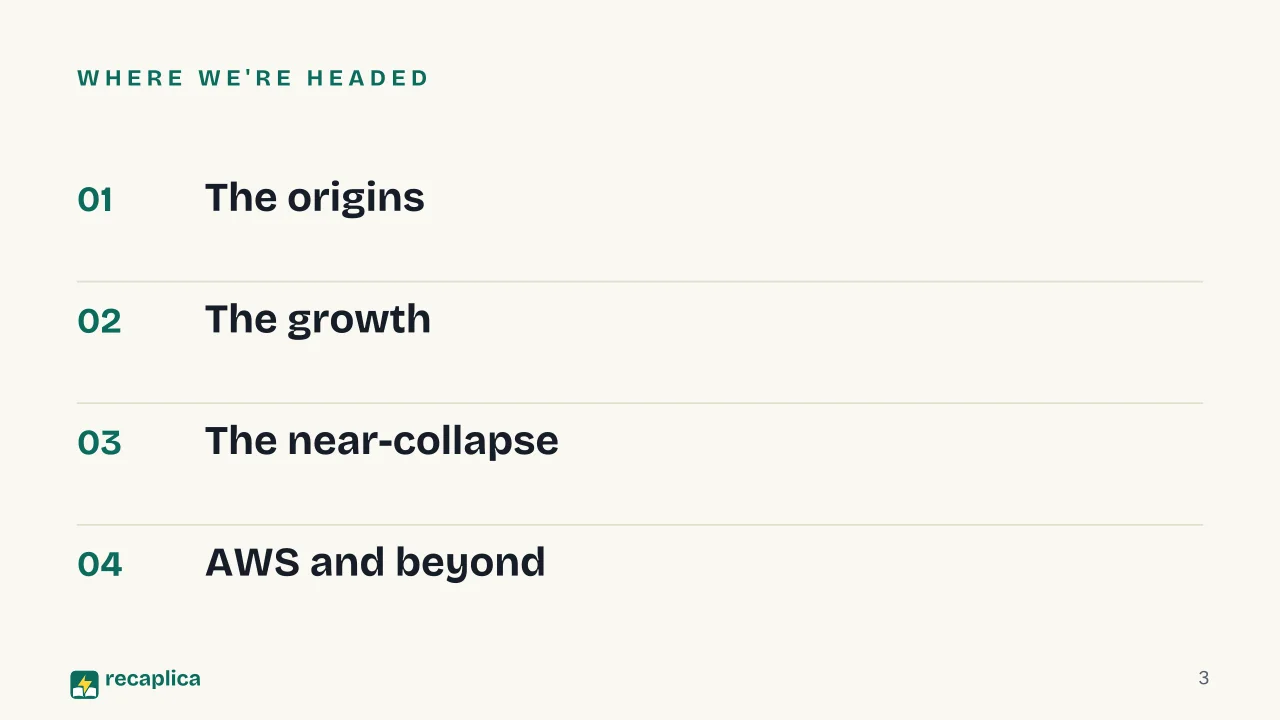  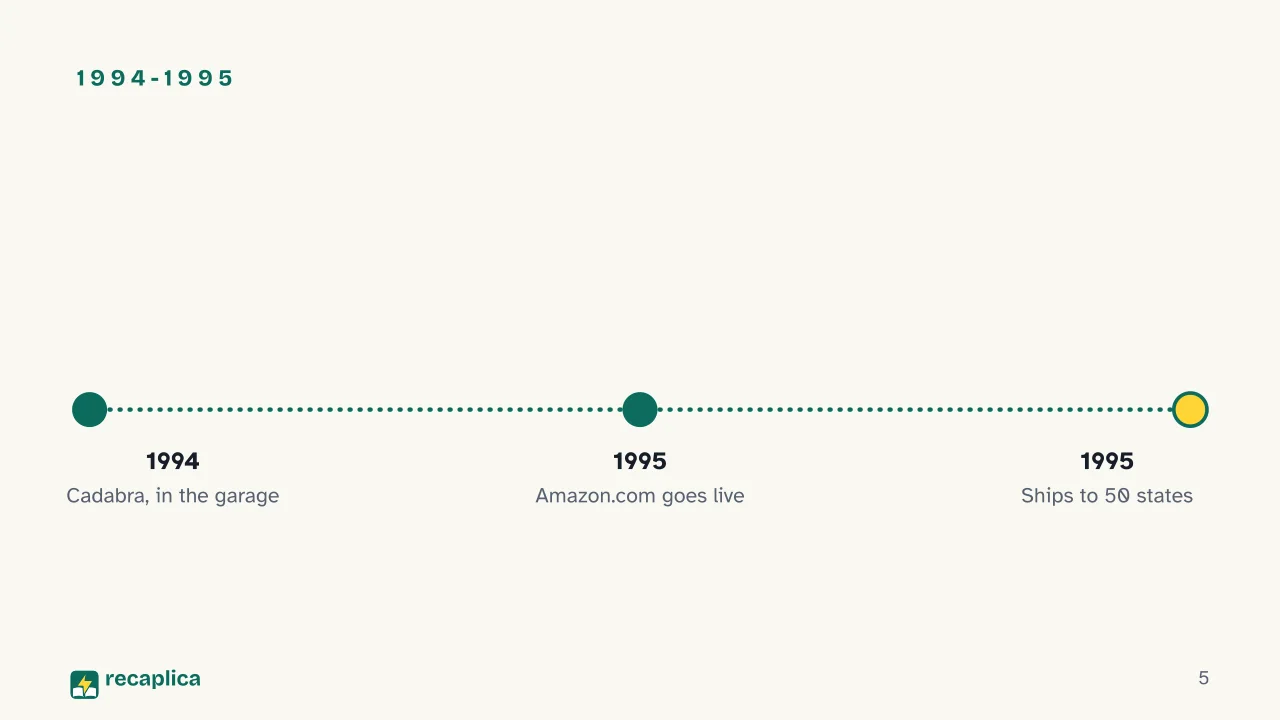 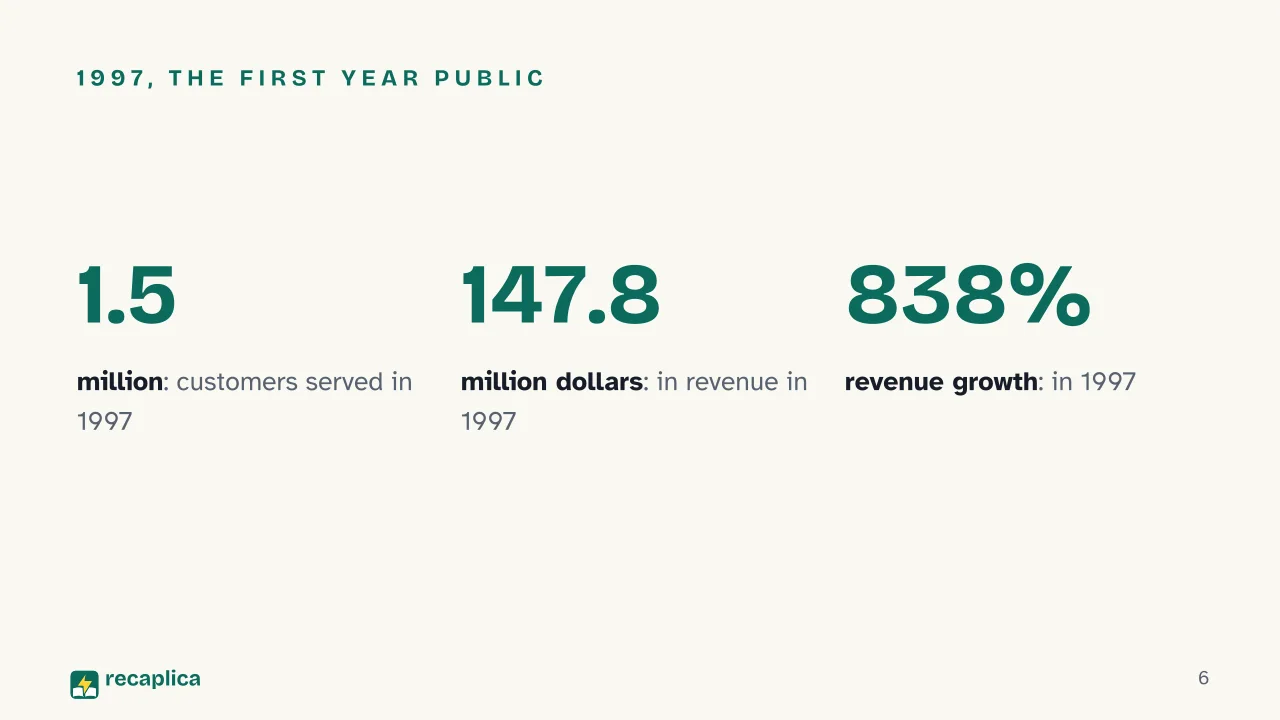  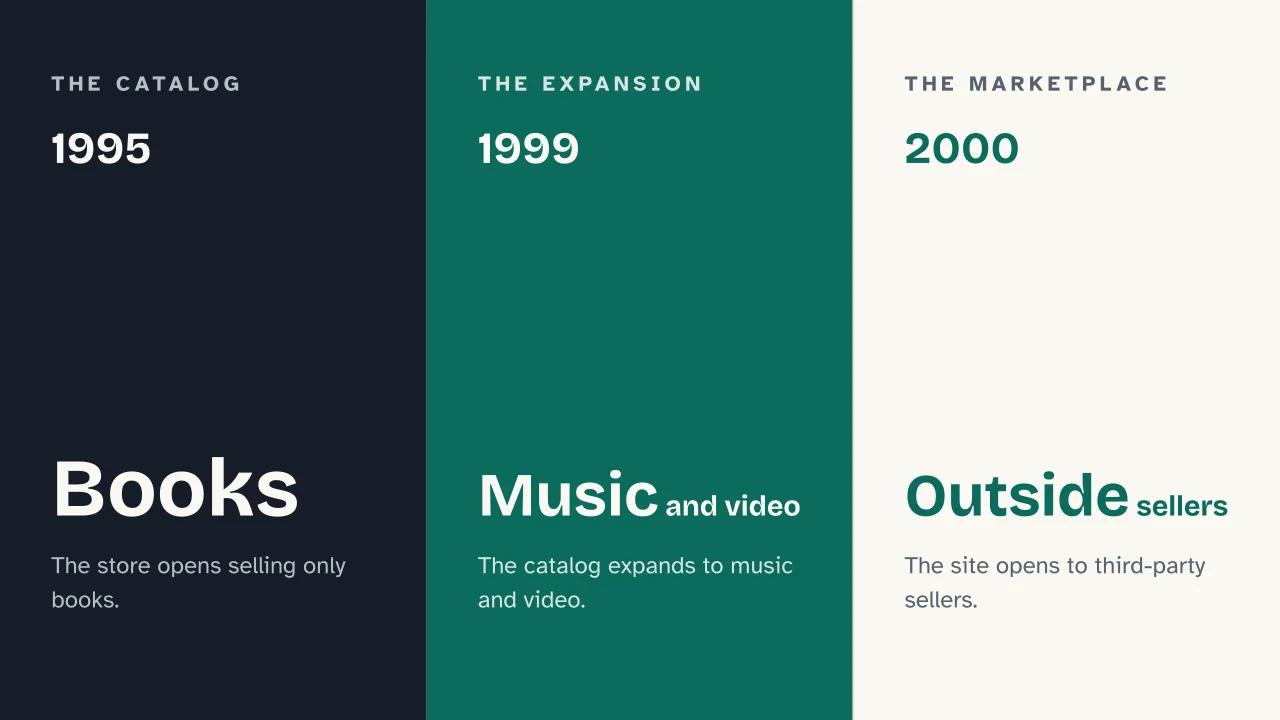  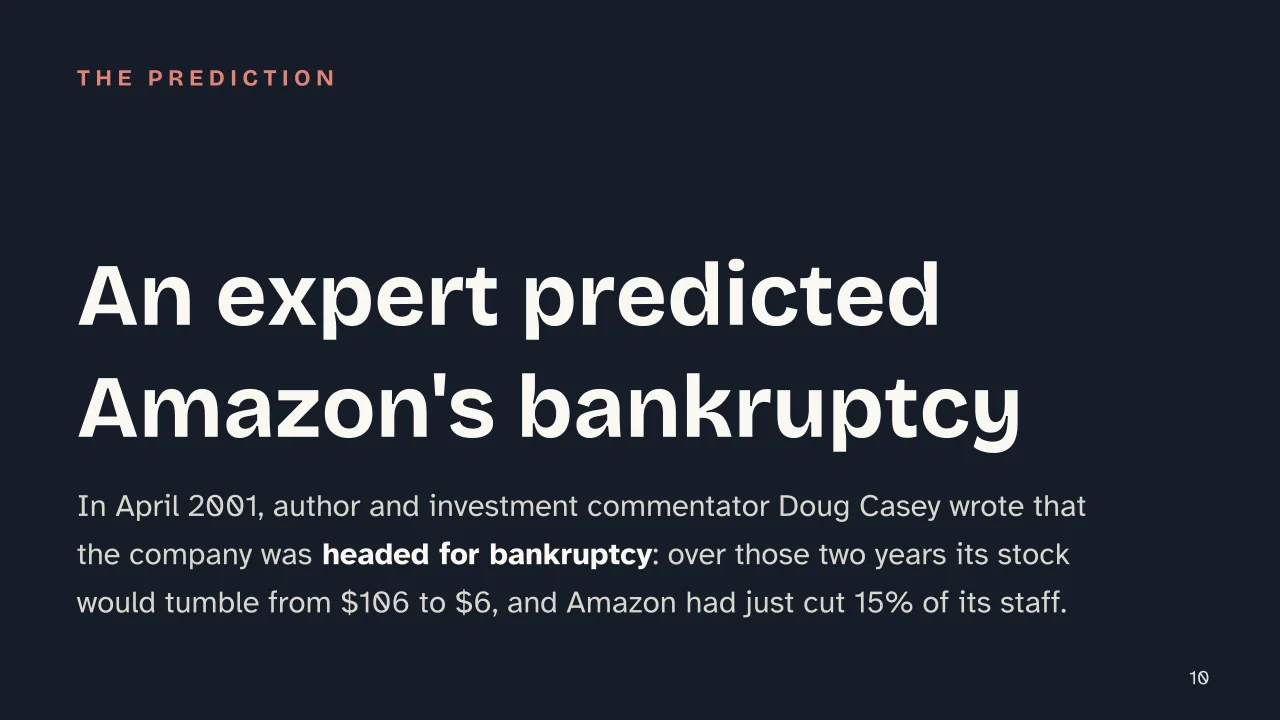  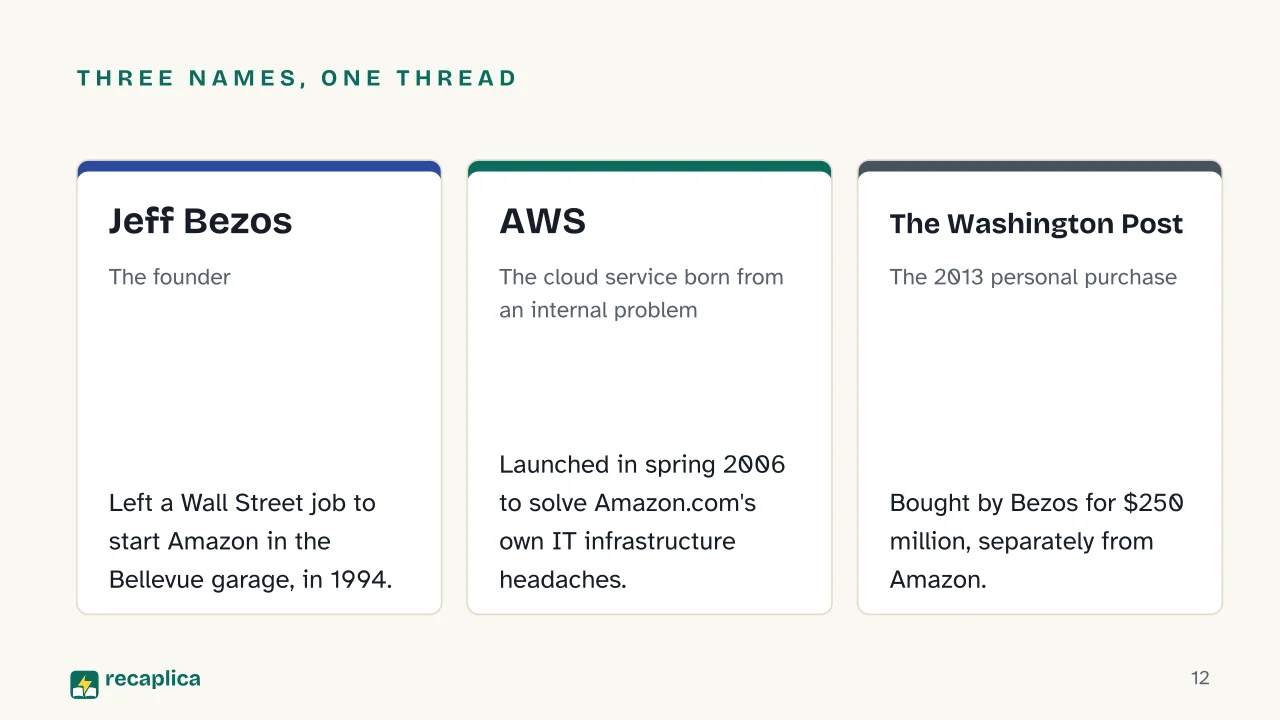 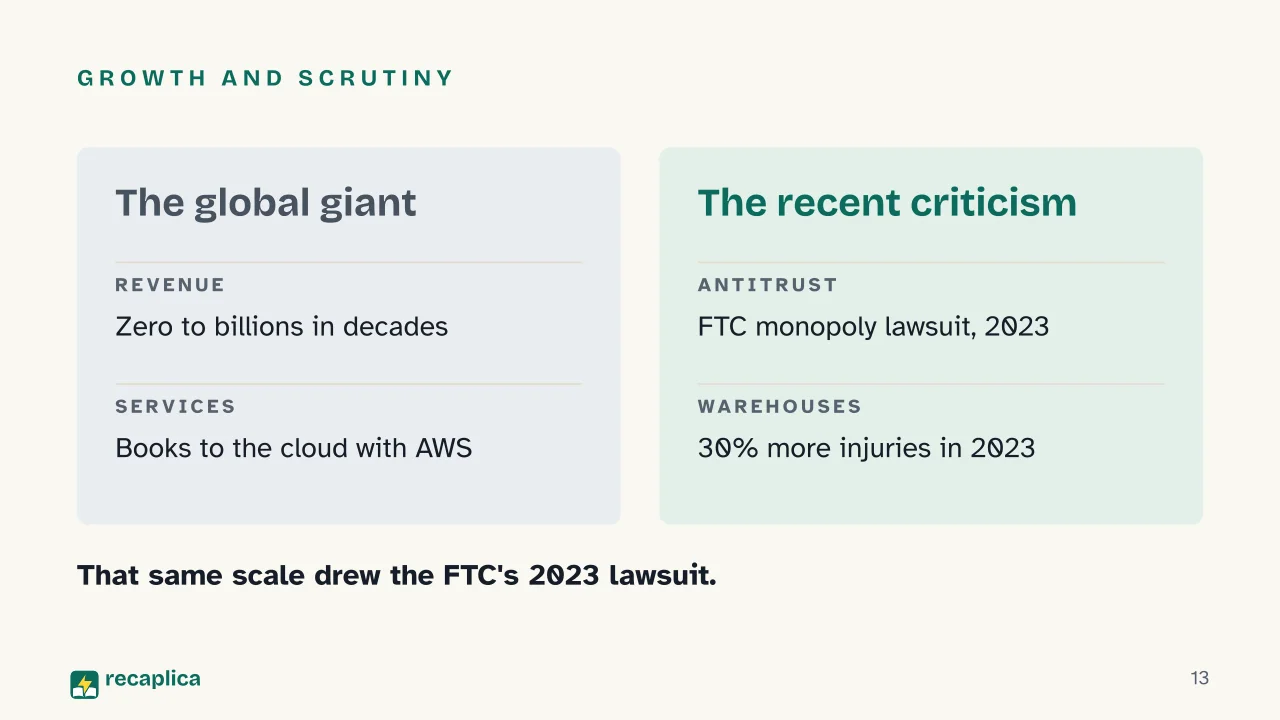   Common myths
Mind mapDrag the background to move around and the nodes to reposition them; use − and + to collapse and expand branches. 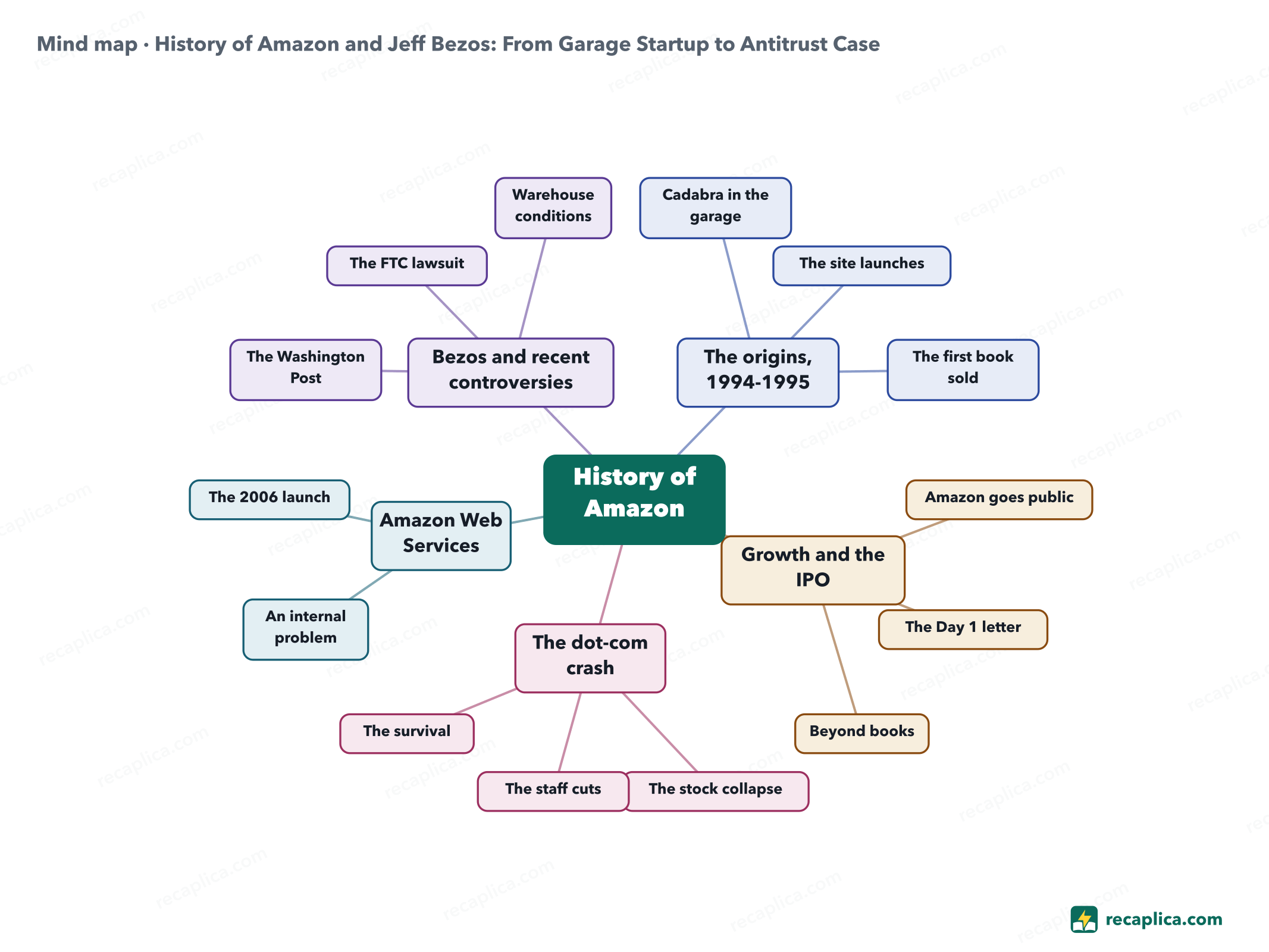
Quiz: test yourselfAnswer the questions to check what you have learned: you get instant feedback and a short explanation. Grade 0/10 0/5
FlashcardsTap the card to flip it and check whether you remember the answer, then move to the next one. 1 / 8 Explain it in your own wordsThe ultimate test: if you can explain it in simple words, you've truly understood it. Write your explanation, then compare it with the Recap. Your explanation is saved only on this device.
Frequently asked questionsWho founded Amazon and when?Amazon was founded by Jeff Bezos in 1994, as an online bookstore called Cadabra, started in a garage in Bellevue, Washington; the public site went live the following year, in July 1995. Why did Amazon nearly go bankrupt during the dot-com crash?Between 1999 and 2001 Amazon's stock fell from $106 to $6 and the company was burning hundreds of millions of dollars in cash; in January 2001 it cut about 15% of its staff, and an investment commentator publicly predicted its bankruptcy, but by the end of 2001 Amazon still had over $500 million in cash. How did Amazon Web Services (AWS) get started?According to AWS's official pages, the cloud service grew out of an internal problem: running Amazon.com's IT infrastructure was expensive and complicated, and it pulled teams away from building new things; the first public services, including Amazon S3, arrived in spring 2006. Did Jeff Bezos buy The Washington Post with Amazon's money?No: in 2013 Bezos bought The Washington Post personally, for $250 million, in a deal kept separate from Amazon.com; the newspaper's then-CEO, Donald Graham, explained the choice by pointing to Bezos's expertise and his long-term approach. What does the FTC accuse Amazon of?In September 2023 the Federal Trade Commission and 17 state attorneys general sued Amazon, alleging that the company illegally maintains monopoly power in the online market, including a practice of demoting in search results sellers who offer lower prices elsewhere. Every Recap goes through an independent review before publication. |