Skip to content
recaplica

    One moment: security check

    Cloudflare wants to make sure you're not a robot. Tick the box below and your search will continue on its own.

    IT
    recaplica eSIM: what is it and how does it work for travel
    © 2026 Recaplica · recaplica.com — All rights reserved
    Home › Technology

    eSIM: what is it and how does it work for travel

    By Recaplica Newsroom · Updated on September 20, 2026

    What to print

    Page numbers appear when printing with default margins.

    Slides

    Choose a cut

    Flash10 slidesThe essential thread, to present in classFull15 slidesEvery chapter and the deeper detail

    Both come with speaker notes.

    Telegram channel
    recaplica Clear in 30 seconds, yours in 10 minutes.
    In 30 seconds Key points Figures Deep dive Slides Myths Mind map Quiz Flashcards FAQ

    In 30 seconds quick read

    An eSIM is a digital SIM built into a phone: it turns on with a QR code or an app, with nothing to insert or remove. It's convenient for travel because a data plan can be activated remotely, but the phone needs a Wi-Fi connection to finish the setup. Inside the European Union, though, a traveler's home operator already includes roaming at domestic rates since 2017: the eSIM vs local SIM choice mostly matters outside that area, where roaming can get expensive.

    Key Points

    • An eSIM is a chip built into the phone that replaces the physical card: it activates with a QR code or an app, and there's nothing to lose or remove.
    • Activating a travel eSIM requires a Wi-Fi connection or a hotspot: without a network on arrival, the activation stays stuck.
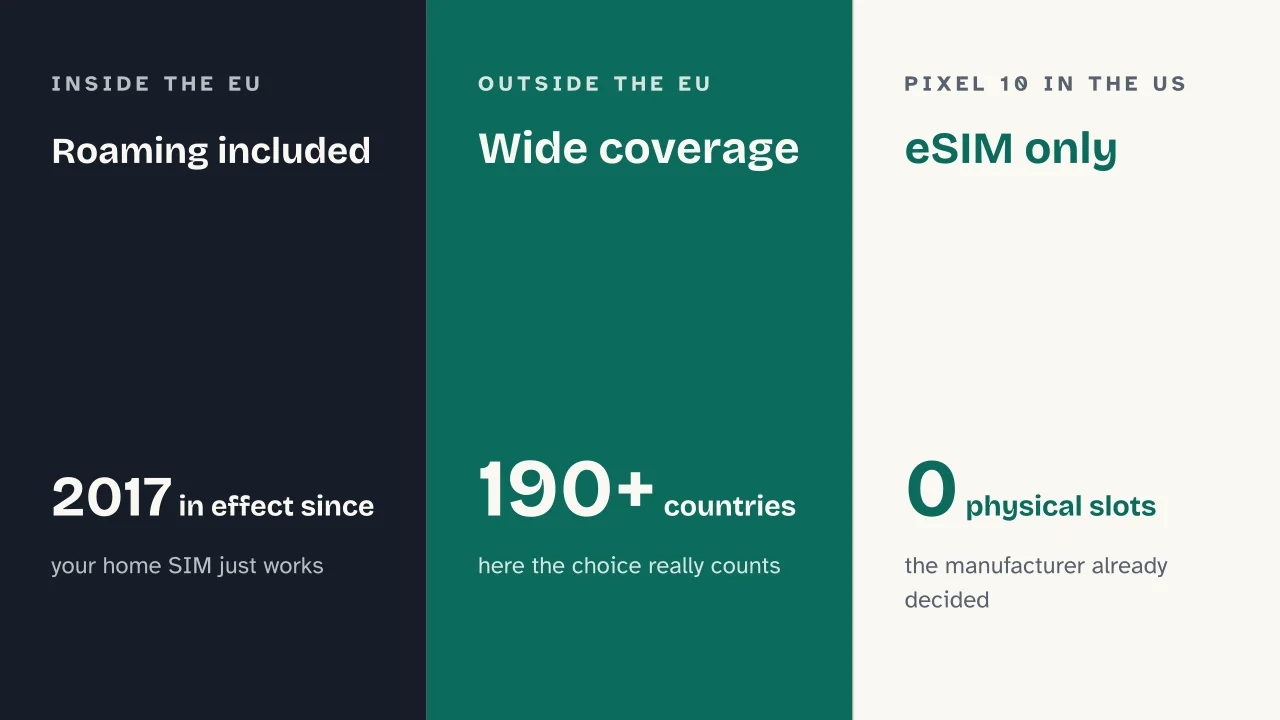
    • Inside the European Union (plus Iceland, Liechtenstein, Norway, and Ukraine and Moldova from 2026) roaming has been included at domestic rates since June 15, 2017: the eSIM vs local SIM choice mainly matters for trips outside that area.
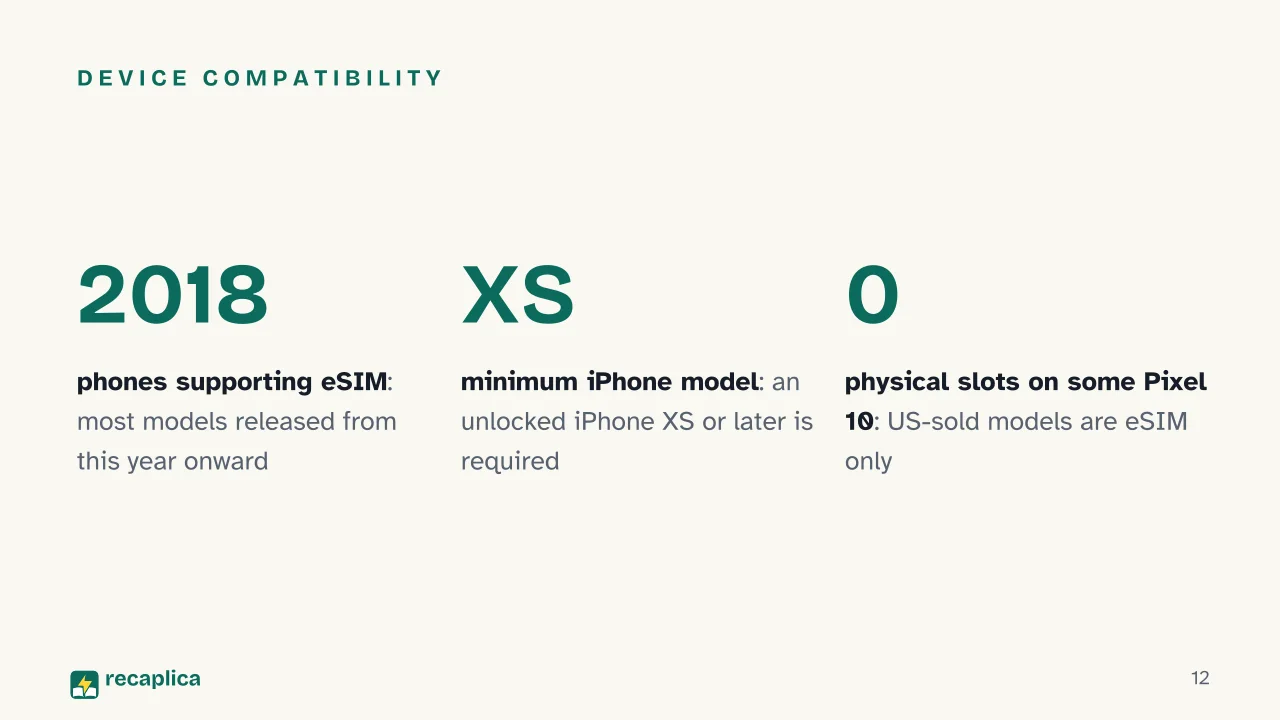
    • Most phones released from 2018 onward support eSIM, but not every model lets two eSIMs run active at the same time in the same way.
    • Some recent models, like the Pixel 10 sold in the United States, no longer have a physical SIM tray at all: the manufacturer has already made that choice.
    • A local physical SIM can be bought and activated at a shop without needing a data connection already in place, a practical edge when there's no Wi-Fi at the airport.

    Key figures

    • June 15, 2017 Date the "roam like at home" rules took effect: since then, travelers inside the EU and European Economic Area use their home data plan without roaming surcharges. Source: European Commission
    • 2018 Year from which most phones and tablets on the market support eSIM technology, including the iPhone XS. Source: Wikipedia
    • 2026 Year Ukraine and Moldova joined the domestic-rate roaming area, alongside the EU, Iceland, Liechtenstein and Norway. Source: European Commission

    Deep Dive

    What an eSIM is

    An eSIM is a digital SIM card, built into the phone as a chip instead of inserted as a removable physical card. Technically, it’s a subscriber identity module installed via software on an eUICC chip soldered into the device. The GSMA maintains three versions of the standard: SGP.22 for consumer phones, SGP.02 for machine-to-machine use, and SGP.32 for the Internet of Things, published in 2023.

    A device can store more than 20 eSIM profiles, though usually only 1 or 2 stay active at the same time.

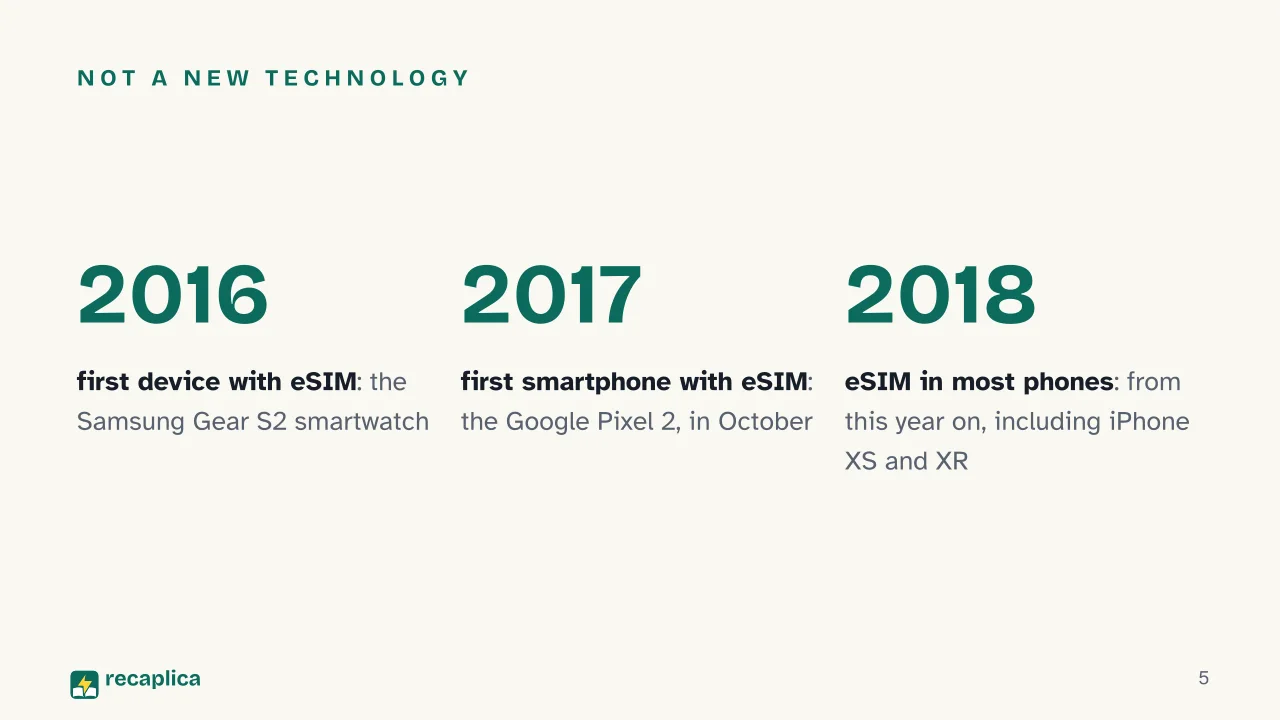
    This isn’t a recent technology. The first consumer device with an eSIM was the Samsung Gear S2 smartwatch, in 2016; the first smartphone followed a year later with the Google Pixel 2, while Apple added support with the iPhone XS and XR in 2018. From 2018 onward, most phones and tablets on the market support it.

    How a travel eSIM gets activated

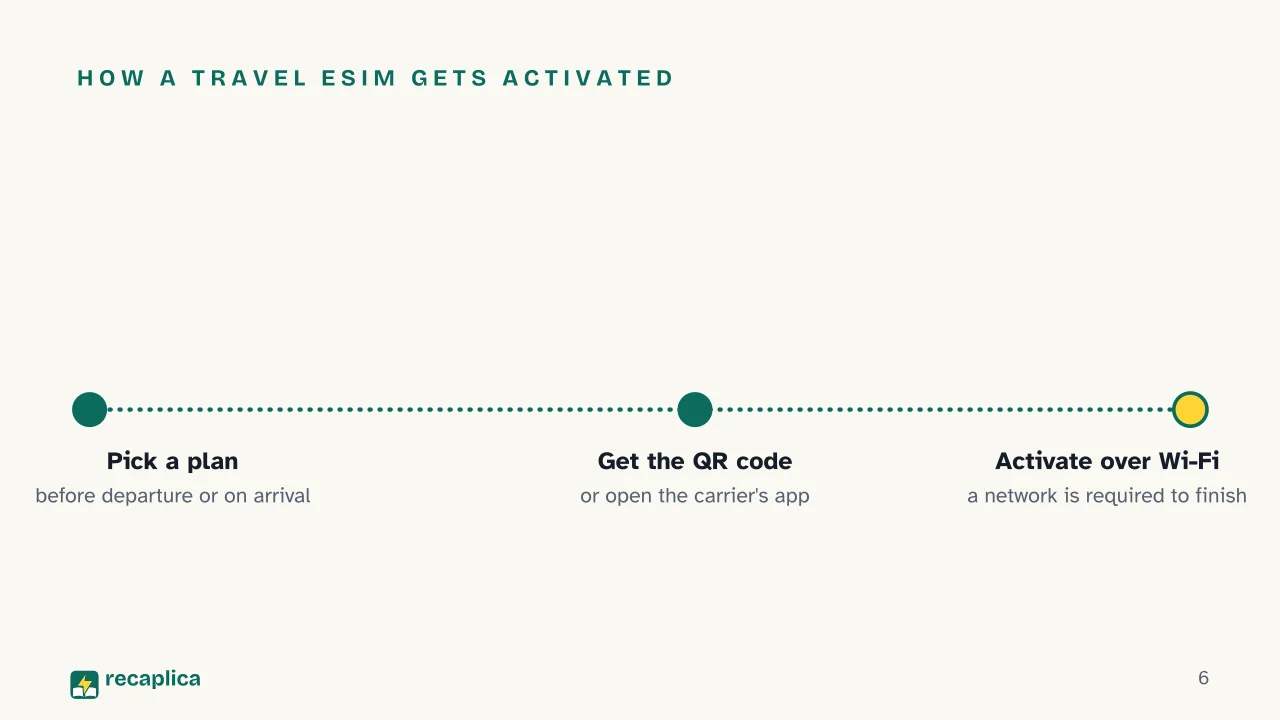
    Activation almost always runs through a QR code or the carrier’s app, generated after buying a prepaid plan: it can be done before departure or already on arrival. The step travelers forget most often is that a Wi-Fi connection or a hotspot is needed to finish the activation: without a network available, the process stays stuck.

    Real-world example: someone landing in a country outside the European Union without having activated the eSIM in advance, and without Wi-Fi at the airport, is stuck until a network turns up. Someone who instead buys a local physical SIM at a shop can activate it even without a data connection already in place, because the shop staff register and insert the card.

    On an unlocked iPhone XS or later, with no SIM restrictions, two eSIMs can stay active together, with one chosen in Cellular settings to handle data while the other stays active for calls and texts. On the Pixel 7 and later, Google allows up to two simultaneous eSIM profiles, if the carrier allows it. From iOS 26 onward, an iPhone automatically turns off the travel eSIM on return and switches back to the main line.

    Inside the European Union, the question often doesn’t come up

    To see how a phone’s data actually travels from one country to another, it helps to revisit how the internet works: a data plan moves from a traveler’s home operator to local ones through roaming agreements, regardless of whether the card is physical or digital.

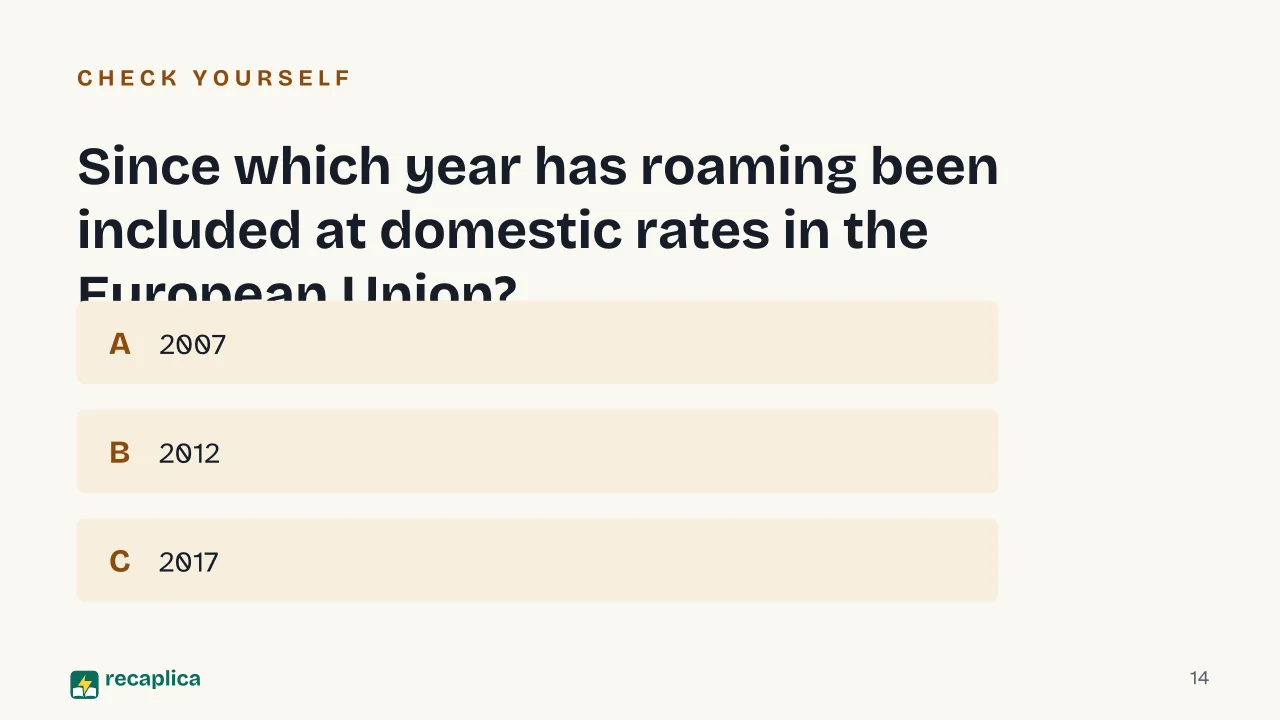
    According to the European Commission, the “roam like at home” rules have been a reality since June 15, 2017: travelers within the European Union use their home Italian operator’s data at the same rate as at home, with no surcharges. The same applies across the European Economic Area (Iceland, Liechtenstein, Norway), and from January 1, 2026, in Ukraine and Moldova too.

    That guarantee isn’t unlimited. A fair use policy, adopted on December 15, 2016, lets operators apply a data cap in roaming if the domestic price is lower than the EU regulatory ceiling, and monitor usage over a four-month period to check whether time spent abroad exceeds time at home. The wholesale rate operators charge each other was €1.30 per gigabyte plus VAT in 2025, dropped to €1.10 in 2026, and will settle at €1.00 per gigabyte plus VAT from 2027.

    Outside the European Union, where the choice really counts

    Outside the EU, the European Economic Area, Ukraine and Moldova, a home Italian operator’s roaming can get expensive: this is where buying a travel eSIM or a local physical SIM starts to make practical sense. Some travel eSIM providers cover plans in over 190 countries or regions, convenient for anyone visiting several stops on the same trip.

    Anyone still putting a trip together, alongside finding cheap flights and a hotel reservation, can add the data connection choice to the same pre-departure checklist: plan coverage, the activation country, and whether the phone being packed — along with a power bank for the flight to avoid running out of battery — actually supports eSIM.

    eSIM vs SIM: the comparison table

    AspecteSIMLocal physical SIM
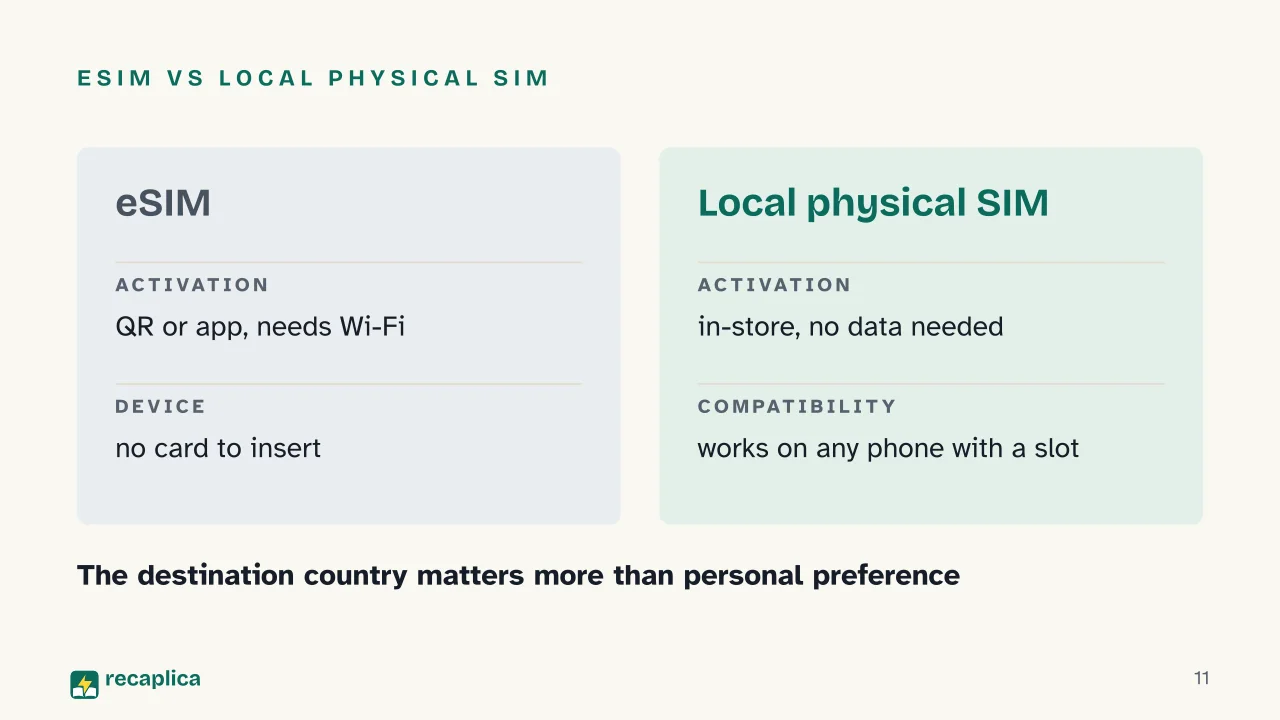
    ActivationQR code or app, needs Wi-Fi or a hotspotAt a shop counter, even without a data connection already active
    CompatibilityOnly on eSIM-capable devices (2018 onward, iPhone XS or later)On any phone with a physical slot
    Managing multiple linesUp to 20 stored profiles, 1-2 active at onceOne number per card, swapped physically
    Practical riskStuck without a connection at the moment of activationRequires finding a store on arrival
    Physical trayNot neededMissing on some models, like the Pixel 10 sold in the United States

    Which one makes more sense mainly depends on the destination country rather than the phone model: an eSIM skips the card that has to be inserted and swapped, while a local physical SIM works without an existing data connection, activated over the counter in a shop.

    Slide deck

    Slides ready to download and make your own in PowerPoint or Google Slides, with speaker notes. Pick the Flash cut or the Full one.
    Slide 1 of the presentation on eSIM: eSIM vs local SIMSlide 2 of the presentation on eSIM: Do you actually need to buy anything for data abroad?Slide 3 of the presentation on eSIM: What's aheadSlide 4 of the presentation on eSIM: Chapter 01: What an eSIM isSlide 5 of the presentation on eSIM: Not a new technologySlide 6 of the presentation on eSIM: How a travel eSIM gets activatedSlide 7 of the presentation on eSIM: Chapter 02: Inside the European UnionSlide 8 of the presentation on eSIM: Inside the EU, there's nothing to buySlide 9 of the presentation on eSIM: Roaming included · Wide coverage · eSIM onlySlide 10 of the presentation on eSIM: Chapter 03: eSIM vs physical SIMSlide 11 of the presentation on eSIM: eSIM vs local physical SIMSlide 12 of the presentation on eSIM: Device compatibilitySlide 13 of the presentation on eSIM: Chapter 04: What to pickSlide 14 of the presentation on eSIM: Since which year has roaming been included at domestic rates in the European Union?Slide 15 of the presentation on eSIM: The Recap continues
    Flash10 slidesThe essential thread, to present in classFull15 slidesEvery chapter and the deeper detail

    Common myths

    • ✗ Myth Traveling abroad always means buying an eSIM or a local SIM.

      ✓ Reality Anyone staying inside the European Union (plus Iceland, Liechtenstein, Norway, and Ukraine and Moldova from 2026) can simply use their home SIM's data: since June 15, 2017, the "roam like at home" rules include it at domestic rates by law, with nothing to buy.

    • ✗ Myth eSIM is a new technology that only showed up in the last few years.

      ✓ Reality The standard has been around for a while: the first consumer device with an eSIM dates to 2016 (the Samsung Gear S2 smartwatch), the first smartphone is from 2017 (the Google Pixel 2), and most phones have supported it since 2018. What became common for tourism was the use case, not the technology.

    • ✗ Myth An eSIM always lets you run two numbers exactly like two physical SIMs would.

      ✓ Reality It depends on the model: an iPhone can keep two eSIMs active at once, but only one line handles data at a time, chosen in Settings; Pixel 7 and later cap it at two simultaneous eSIM profiles, if the carrier allows it. It isn't an automatic match for two separate physical cards.

    Mind map

    Drag the background to move around and the nodes to reposition them; use − and + to collapse and expand branches.
    Customize
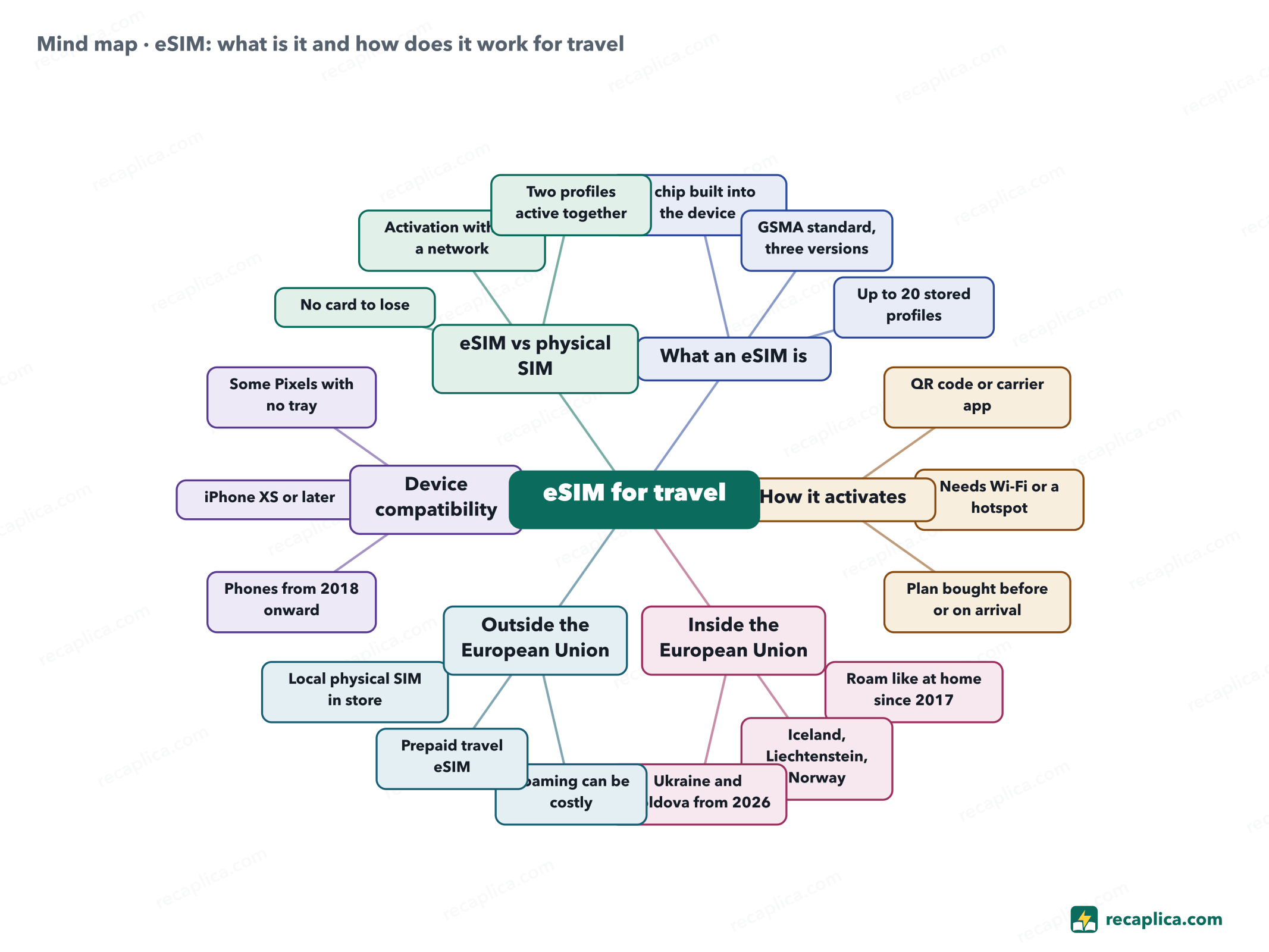
    Mind map: eSIM: what is it and how does it work for travel
    • eSIM for travel
      • What an eSIM is
        • A chip built into the device
        • GSMA standard, three versions
        • Up to 20 stored profiles
      • How it activates
        • QR code or carrier app
        • Needs Wi-Fi or a hotspot
        • Plan bought before or on arrival
      • Inside the European Union
        • Roam like at home since 2017
        • Iceland, Liechtenstein, Norway
        • Ukraine and Moldova from 2026
      • Outside the European Union
        • Roaming can be costly
        • Prepaid travel eSIM
        • Local physical SIM in store
      • Device compatibility
        • Phones from 2018 onward
        • iPhone XS or later
        • Some Pixels with no tray
      • eSIM vs physical SIM
        • No card to lose
        • Activation without a network
        • Two profiles active together

    Quiz: test yourself

    Answer the questions to check what you have learned: you get instant feedback and a short explanation.

    Grade 0/10 0/5
    1 What is an eSIM?

    An eSIM is a subscriber identity module installed via software on an eUICC chip built into the device, replacing the removable physical card.

    2 True or false: using your home Italian operator's data in another EU country always requires buying an eSIM.

    False: since June 15, 2017, the "roam like at home" rules include EU data roaming at domestic rates, with nothing to buy.

    3 Since which year has "roam like at home" been a reality for travel within the European Union?

    The rules took effect on June 15, 2017, according to the European Commission.

    4 What's needed to activate a travel eSIM right after arriving in a country?

    Activation requires a data connection (Wi-Fi or a hotspot): without a network, it stays stuck — a practical advantage of a local physical SIM, which instead gets activated in a shop.

    5 What's unusual about the Pixel 10 models sold in the United States?

    The Pixel 10, Pixel 10 Pro and Pixel 10 Pro XL sold in the United States are eSIM-only, with no physical tray.

    Answers: 1-A · 2-B · 3-C · 4-A · 5-B

    Flashcards

    Tap the card to flip it and check whether you remember the answer, then move to the next one.

    1 / 8

    Explain it in your own words

    The ultimate test: if you can explain it in simple words, you've truly understood it. Write your explanation, then compare it with the Recap.

    Your explanation is saved only on this device.

    An eSIM is a digital SIM built into a phone: it turns on with a QR code or an app, with nothing to insert or remove. It's convenient for travel because a data plan can be activated remotely, but the phone needs a Wi-Fi connection to finish the setup. Inside the European Union, though, a traveler's home operator already includes roaming at domestic rates since 2017: the eSIM vs local SIM choice mostly matters outside that area, where roaming can get expensive.

    Frequently asked questions

    Is an eSIM or a local physical SIM better for travel?

    It depends on where you're going: inside the European Union (plus Iceland, Liechtenstein, Norway, and Ukraine and Moldova from 2026), a traveler's home operator already includes roaming at domestic rates since 2017, so often neither one needs to be bought. Outside that area, roaming can get expensive, and the choice comes down to the convenience of an eSIM activated before departure (it needs Wi-Fi) versus a local physical SIM, which can be activated in a shop even without a data connection already in place.

    What's the difference between traveling inside and outside the European Union for data roaming?

    Inside the EU, the European Economic Area (Iceland, Liechtenstein, Norway) and, from 2026, Ukraine and Moldova, domestic-rate roaming has been guaranteed by law since 2017. Outside that area there's no such coverage, and a home Italian operator's roaming can get expensive: that's where a travel eSIM or a local physical SIM start to make practical sense.

    How does a travel eSIM get activated?

    Usually just a QR code or the carrier's app, generated after buying a plan. A Wi-Fi connection or a hotspot is needed to finish the activation, so it's worth doing before departure or as soon as a network is found.

    Does my phone support eSIM?

    Most phones and tablets released from 2018 onward support it; on iPhone, an unlocked XS or later is required. Some recent models, like the Pixel 10 sold in the United States, are eSIM-only and no longer have a physical card tray.

    Can an eSIM be used alongside a home operator's physical SIM?

    Yes, on many models: two profiles can stay active (an eSIM and a physical SIM, or two eSIMs), with one chosen to handle data while the other stays active for calls and texts, depending on what the model and carrier allow.

    Sources

    • Wikipedia (EN) — eSIM
    • European Commission — Roaming: Using a mobile phone in the EU
    • European Commission — The history of roaming
    • Apple — Use eSIM while traveling internationally with your iPhone
    • Google — Learn more about eSIMs (Pixel Phone Help)
    • Capacity Media — EU slashes wholesale rates on roaming data, voice and SMS

    Every Recap goes through an independent review before publication.

    Every evening, the day's new Recaps on our Telegram channel. Join the channel →

    Keep learning

    • Civics Passport Requirements for International Travel: When an ID Card Is Enough Which document you need to enter another country depends on where you're going. Inside the Schengen area, plus Iceland, Liechtenstein, Norway and Switzerland, a valid national ID card or a passport is enough. Outside that area, most countries require a passport, often with a minimum validity beyond the travel dates, and sometimes an additional visa. Children always need their own travel document, never an entry on a parent's. Read the Recap →
    • Civics How the European Union Works: Who Really Runs It The European Union does not have one government; it runs on seven institutions with different jobs. The European Parliament, elected directly by citizens, and the Council of the European Union, where national ministers sit, jointly pass almost every EU law, but only after the European Commission has proposed it. The European Council, made up of heads of state and government, sets the broad political direction but never votes on legislation. The toughest calls at the Council of the EU go through qualified majority voting: at least 15 of the 27 member states have to say yes, and together they must represent 65% of the EU population. Read the Recap →
    • Technology ASCII Table: What Is It? The ASCII table assigns a fixed number to every letter, digit, punctuation mark, and keyboard control command, so that a computer, which only handles numbers, can represent text. Published in 1963 by the ANSI X3.4 committee and adopted for U.S. federal computers in 1968, it uses 7 bits and covers 128 characters, almost all of them from the English alphabet, according to the IEEE's Engineering and Technology History Wiki. RFC 20 shows how those 7 bits fit neatly inside an 8-bit byte, with the highest bit left unused; putting that extra bit to work opens up more combinations, the basis for the variants known as Extended ASCII. Because it only covers English, though, standard ASCII falls short for languages with accents, ideograms, or other alphabets — a gap Unicode was built to close. Read the Recap →

    recaplica

    Clear in 30 seconds, yours in 10 minutes.

    Recaps Mind maps Request a Recap Telegram channel Mind map maker Our method About Privacy & cookies Legal notes & terms of use

    © 2026 Recaplica · A project by Curi S.r.l. — VAT IT05472000750

    Statistics, only if you say so

    To learn which Recaps help most we would use Google Analytics, with aggregate, anonymous data. It starts only with your OK, and you can change your mind anytime. Privacy policy