Skip to content
recaplica

    One moment: security check

    Cloudflare wants to make sure you're not a robot. Tick the box below and your search will continue on its own.

    IT
    recaplica Cheap flights: how to compare real deals, not just the lowest price
    © 2026 Recaplica · recaplica.com — All rights reserved
    Home › Economics

    Cheap flights: how to compare real deals, not just the lowest price

    By Recaplica Newsroom · Updated on September 20, 2026

    What to print

    Page numbers appear when printing with default margins.

    Slides

    Choose a cut

    Flash10 slidesThe essential thread, to present in classFull15 slidesEvery chapter and the deeper detail

    Both come with speaker notes.

    Telegram channel
    recaplica Clear in 30 seconds, yours in 10 minutes.
    In 30 seconds Key points Figures Deep dive Slides Myths Mind map Quiz Flashcards FAQ

    In 30 seconds quick read

    Cheap flights are usually the starting point for planning a budget trip, but the number a comparison site shows first is rarely the final amount you pay. EU air travel rules require the fare to be displayed together with taxes and mandatory charges from the very first price shown, leaving out only optional extras like insurance or seat selection. Hotel deals work differently: the lowest rate is often the one you can't cancel, while paying a bit more buys you a window to change your mind. Comparing flights and hotels properly means looking past the big number on the homepage — baggage, taxes, cancellation terms and, if something goes wrong, the rights the law already gives you.

    Key Points

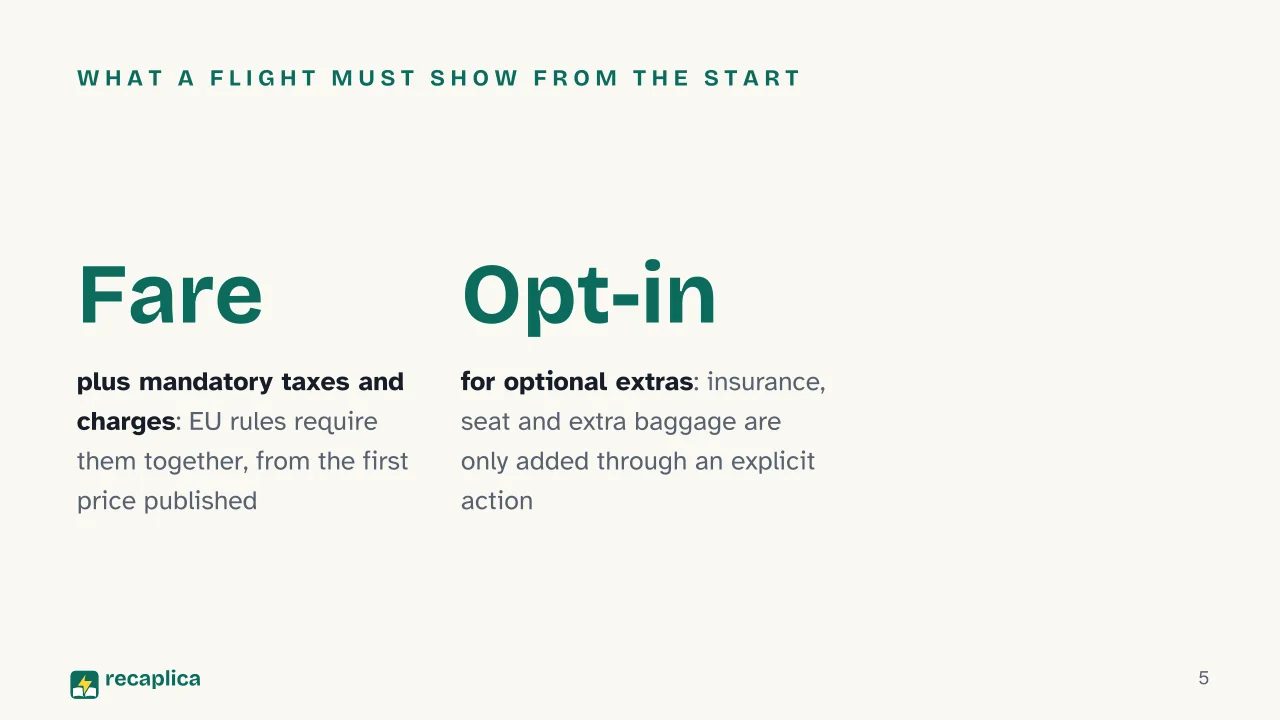
    • EU Regulation 1008/2008 requires airlines to show the fare together with taxes and mandatory charges from the first price they publish.
    • Optional extras (insurance, seat selection, extra baggage) must be accepted through an explicit customer action: they can't be pre-ticked.
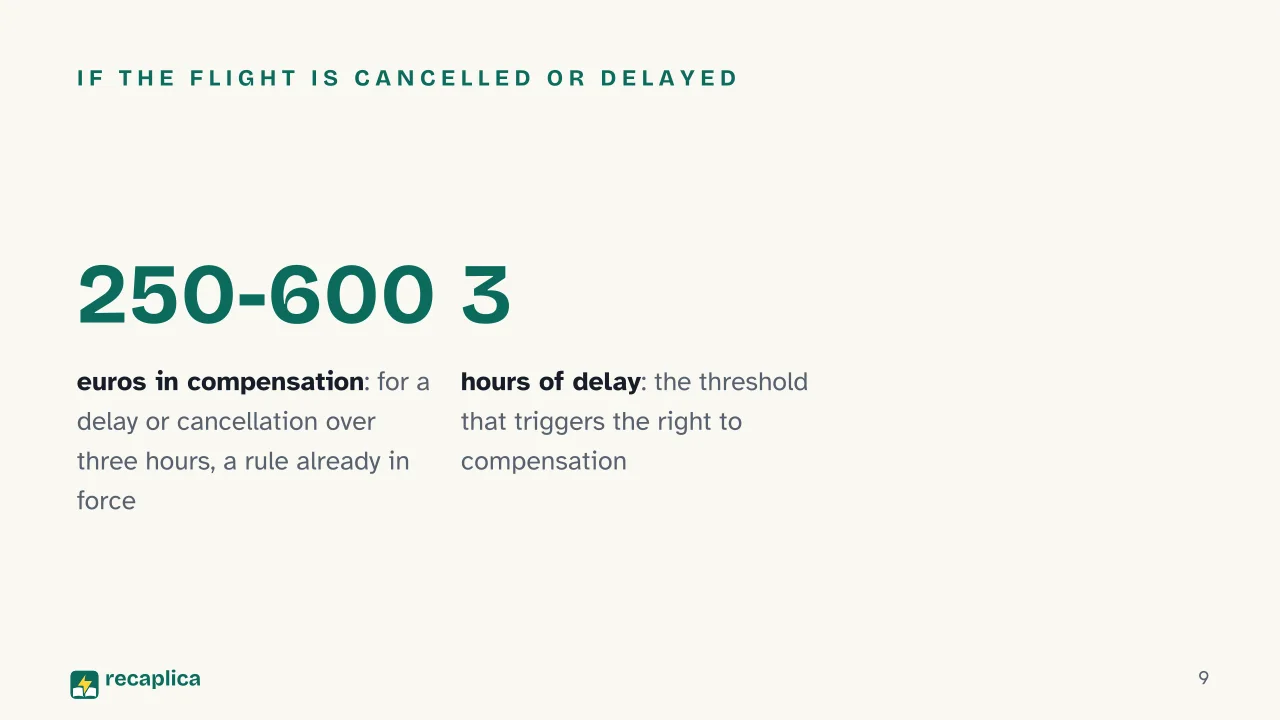
    • A flight cancelled or delayed more than three hours entitles passengers to €250-€600 in compensation, a rule already in force and untouched by the 2026 reform.
    • In 2026 the Council of the EU cleared a rule making carry-on baggage up to 100 cm and 7 kg free, but it only takes effect months after official publication.
    • The cheapest hotel rates are often non-refundable: they cost less but commit you to payment even if you cancel.
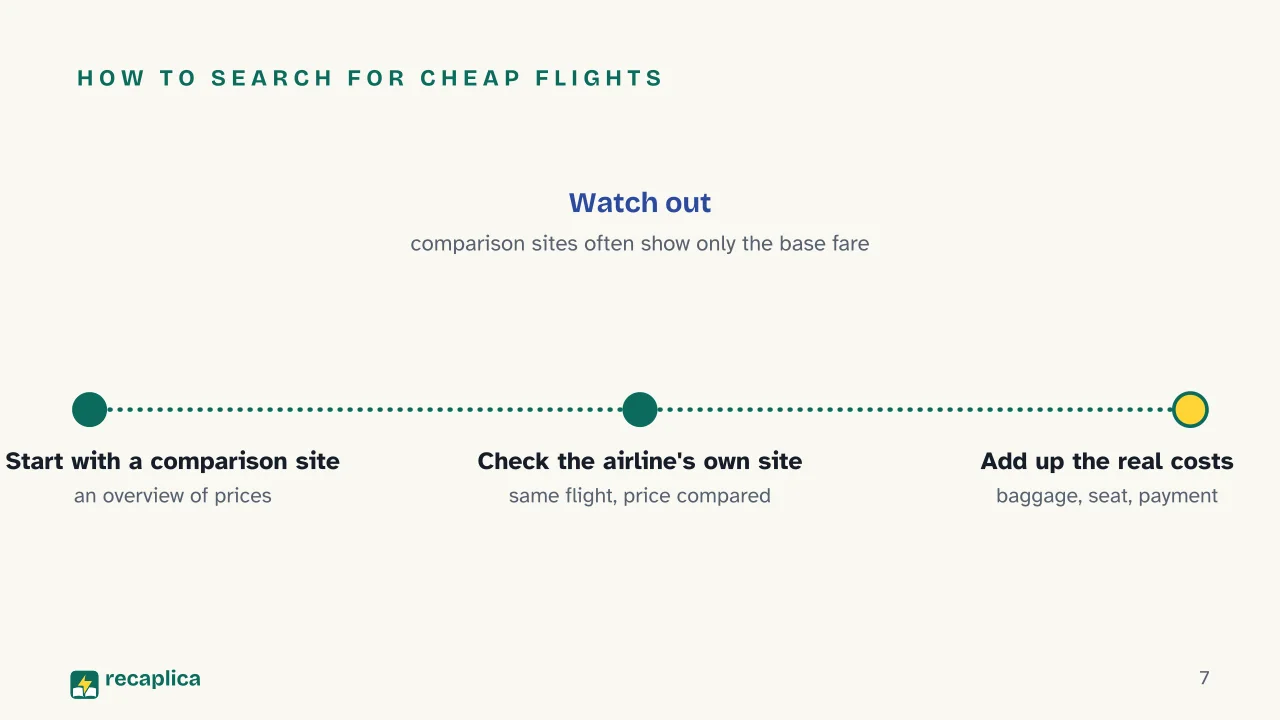
    • Searching for cheap flights methodically means starting with a comparison site for a broad view, then checking the price on the airline's own site and adding up the real cost of the trip.

    Key figures

    • 250-600 euros in compensation owed when a flight is cancelled or delayed more than three hours, a rule already in force and confirmed even after the 2026 reform. Source: Council of the European Union, press release, 13 July 2026
    • 100 cm and 7 kg the maximum size and weight of the carry-on bag that, under the agreement reached by the Council of the European Union in 2026, will have to be included free in the base fare. The rule is not yet in force. Source: Council of the European Union, 2026

    Deep Dive

    Regulation (EC) No 1008/2008 requires the final price of a flight to always include the fare plus all taxes, airport charges and mandatory, foreseeable surcharges at the time the price is published. That’s the rule behind why a comparison site can’t just show the single lowest number without the items that come with it: in the 2017 Air Berlin case, the Court of Justice of the European Union confirmed that the fare and charges must be presented separately from the very first price screen, not added as a surprise later in the purchase process.

    Optional extras follow a different rule. Travel insurance, seat selection, baggage beyond the included allowance: EU rules require these to be communicated clearly from the start of booking and accepted on an opt-in basis, meaning through an explicit customer action. A box already ticked for insurance doesn’t meet that standard, which is why it’s worth scrolling through every screen of the purchase process before confirming.

    Cheap flights: from the comparison site to the airline’s own page

    A comparison site remains the fastest starting point for a first look at prices across a range of dates: it ranks fares with an algorithm that compares them against each other, not against the final price you’ll actually pay. Its limit is that it almost always shows the lowest possible fare, often without checked baggage or an assigned seat: a second check on the airline’s own site, for the same flight and dates, shows whether the price still holds once the extras you actually need are added.

    Practical example: a comparison site shows a flight at €39. On the airline’s own site, for the same time slot, the base fare is the same, but adding a 20 kg checked bag and a window seat brings the total to €78. Another airline, with a starting fare of €49, already includes a larger bag in the price: the comparison is worth making after adding up the items you’ll actually use, not on the first number shown.

    Shifting the dates by a few days, or looking at a nearby airport instead of the most convenient one, often changes the price more than the airline’s name does. Anyone packing for a longer trip also runs into other practical rules on board, like the ones on carrying a power bank on a plane: logistics that add to the price comparison without replacing it.

    Finding cheap flights that stay cheap: baggage and taxes included

    In July 2026, the Council of the European Union gave its final clearance to a reform of air passenger rights that includes free carry-on baggage up to 100 cm total size and 7 kg, to be included in the base fare at no extra cost. The political agreement between the Council and the European Parliament, the two institutions whose workings are covered in more depth in how the European Union works, had been reached on 15 June 2026; the Council’s final clearance followed on 13 July 2026. The new rule, however, only takes effect twelve months and twenty days after official publication in the Official Journal of the European Union, a date not yet known at the time this Recap was written: until then, each airline’s own baggage policy still applies, and it varies a lot from one carrier to another.

    ItemIncluded in the base fare shown by a comparison siteCheck separately
    Fare and airport taxesYes, by law—
    Small personal item (under the seat)Almost alwaysMaximum size differs between airlines
    Cabin bag (over 100 cm/7 kg)RarelyExtra cost, if not included
    Checked baggageRarelyWeight and price vary widely
    Seat selectionRarelyOptional extra, opt-in
    Travel insuranceNever by defaultOptional extra, opt-in

    When a flight falls through: cancellations and delays

    For a flight that’s cancelled, or delayed more than three hours from the scheduled time, EU passenger rights rules provide for compensation between €250 and €600, depending on the route’s distance. It’s a protection that has been in force for some time, and the Council of the European Union’s press release of 13 July 2026 confirms it without changing it: the 2026 reform adds new rights, such as free carry-on baggage, but doesn’t touch the compensation thresholds already in place.

    Hotel deals: cancellation and rates, not just the price

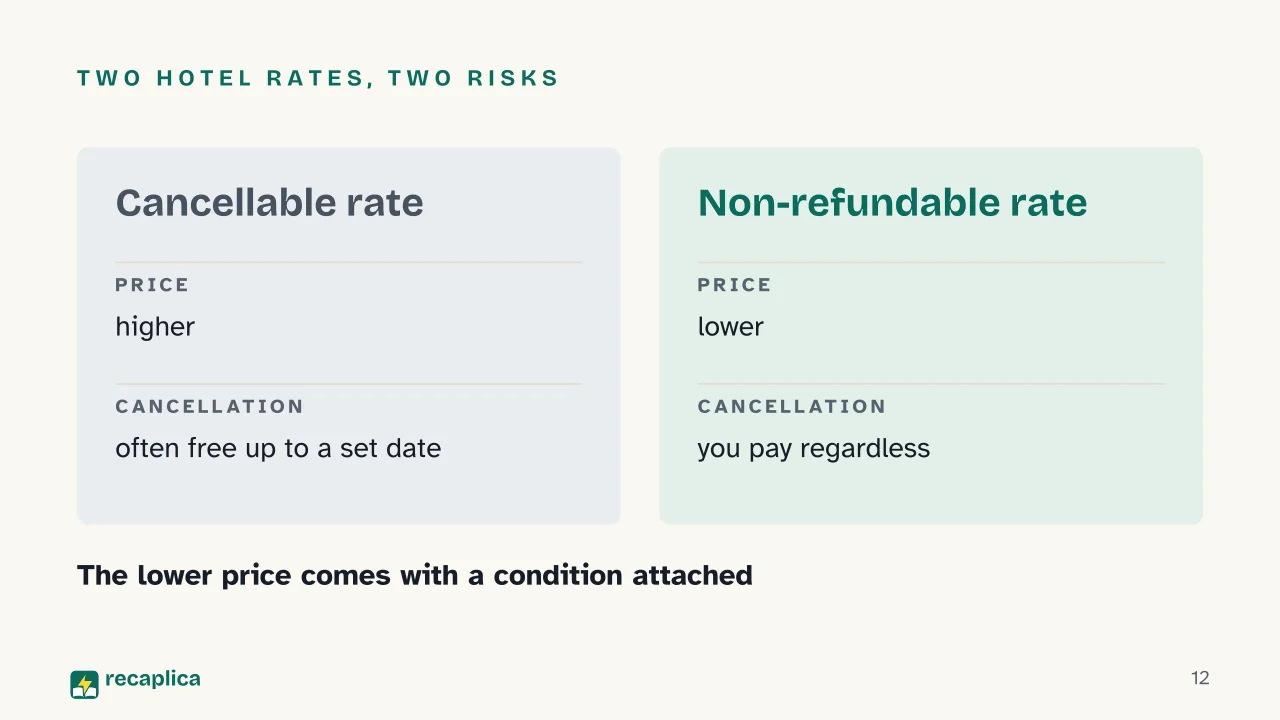
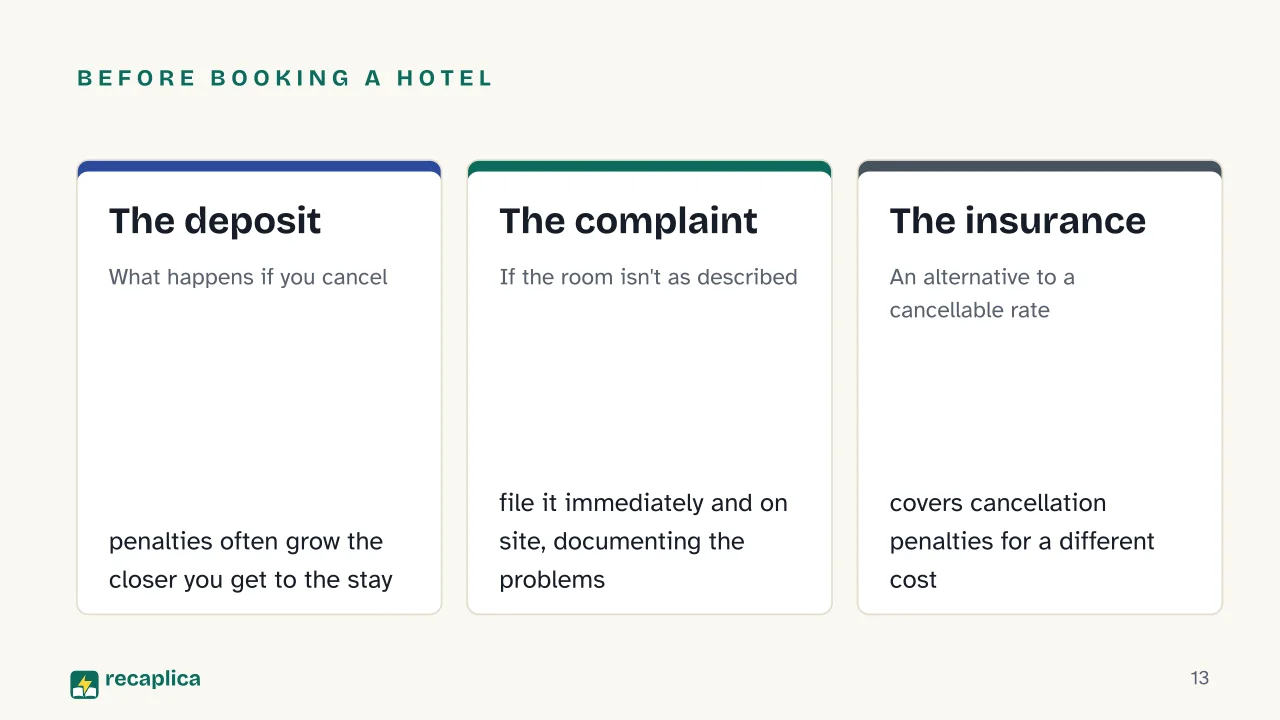
    According to the European Consumer Centre Italy, a hotel booking remains valid even without any advance payment, but the freedom to cancel it depends entirely on the rate chosen at booking. Non-refundable rates, cheaper, commit the customer to paying for the full stay even if they cancel; cancellable rates, pricier, leave a window to change their mind without a penalty. Many hotels apply penalty percentages that grow the closer the stay gets, up to 100% of the amount for a last-minute cancellation, but those penalties must exclude the cost of ancillary services not used, such as breakfast.

    Anyone who wants to keep both options open, the lower price and the ability to cancel, can look at travel insurance that covers cancellation penalties: an added cost that’s worth weighing against the price difference between the two rates.

    Practical example: two people book the same room for the same weekend. The first chooses the cancellable rate and pays €140, with the right to cancel for free up to two days before. The second chooses the non-refundable rate and pays €110. If plans change at the last minute, the first gets the full amount back, the second doesn’t: they agreed to that condition at the time of booking.

    If the room assigned doesn’t match the listing, the source advises complaining immediately and on site, documenting the problems with photos or written reports to staff: a timely complaint makes it easier to claim compensation afterwards, compared with a complaint made only after checkout.

    Slide deck

    Slides ready to download and make your own in PowerPoint or Google Slides, with speaker notes. Pick the Flash cut or the Full one.

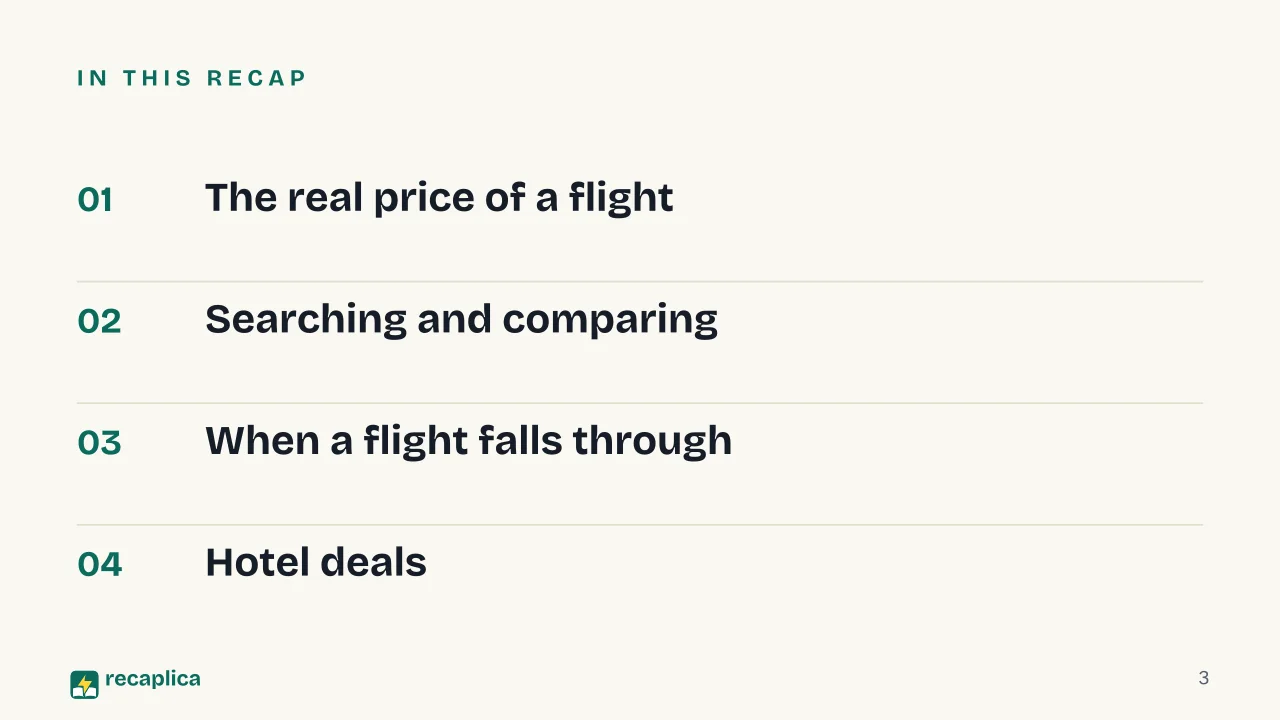
    Slide 1 of the presentation on Cheap flights: Cheap flightsSlide 2 of the presentation on Cheap flights: Is the lowest price always the best deal?Slide 3 of the presentation on Cheap flights: In this RecapSlide 4 of the presentation on Cheap flights: Chapter 01: The real price of a flightSlide 5 of the presentation on Cheap flights: What a flight must show from the startSlide 6 of the presentation on Cheap flights: Chapter 02: Searching and comparingSlide 7 of the presentation on Cheap flights: How to search for cheap flightsSlide 8 of the presentation on Cheap flights: Chapter 03: When a flight falls throughSlide 9 of the presentation on Cheap flights: If the flight is cancelled or delayedSlide 10 of the presentation on Cheap flights: Free carry-on baggage isn't mandatory everywhere yetSlide 11 of the presentation on Cheap flights: Chapter 04: Hotel dealsSlide 12 of the presentation on Cheap flights: Two hotel rates, two risksSlide 13 of the presentation on Cheap flights: Before booking a hotel: The deposit, The complaint, The insuranceSlide 14 of the presentation on Cheap flights: Why does a non-refundable hotel rate cost less than a cancellable one?Slide 15 of the presentation on Cheap flights: Recaplica
    Flash10 slidesThe essential thread, to present in classFull15 slidesEvery chapter and the deeper detail

    Common myths

    • ✗ Myth The price a flight comparison site shows is what I'll actually pay

      ✓ Reality EU Regulation 1008/2008 requires the fare, taxes and mandatory charges to be shown together from the first price published, but optional extras (insurance, seat selection, extra baggage) get added during booking: they must be accepted through an explicit action, never pre-selected from the start.

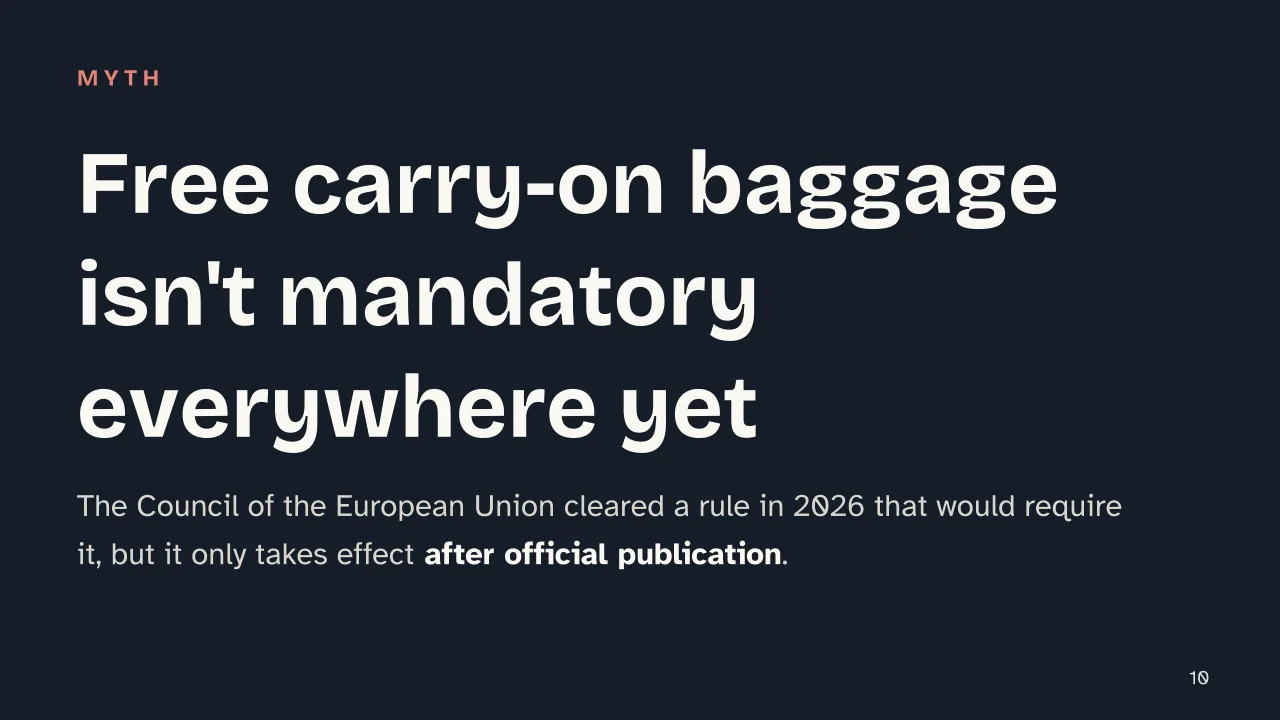
    • ✗ Myth In 2026, free carry-on baggage is already guaranteed on every European flight

      ✓ Reality The Council of the European Union reached the agreement in 2026, but the rule only takes effect twelve months and twenty days after official publication: until then, each airline's own baggage policy still applies.

    • ✗ Myth I can always cancel a hotel booking without paying anything

      ✓ Reality It depends on the rate chosen at booking. With a non-refundable rate, which costs less, the customer agrees upfront to pay regardless; only a cancellable rate, usually pricier, leaves a window to cancel without a penalty.

    Mind map

    Drag the background to move around and the nodes to reposition them; use − and + to collapse and expand branches.
    Customize
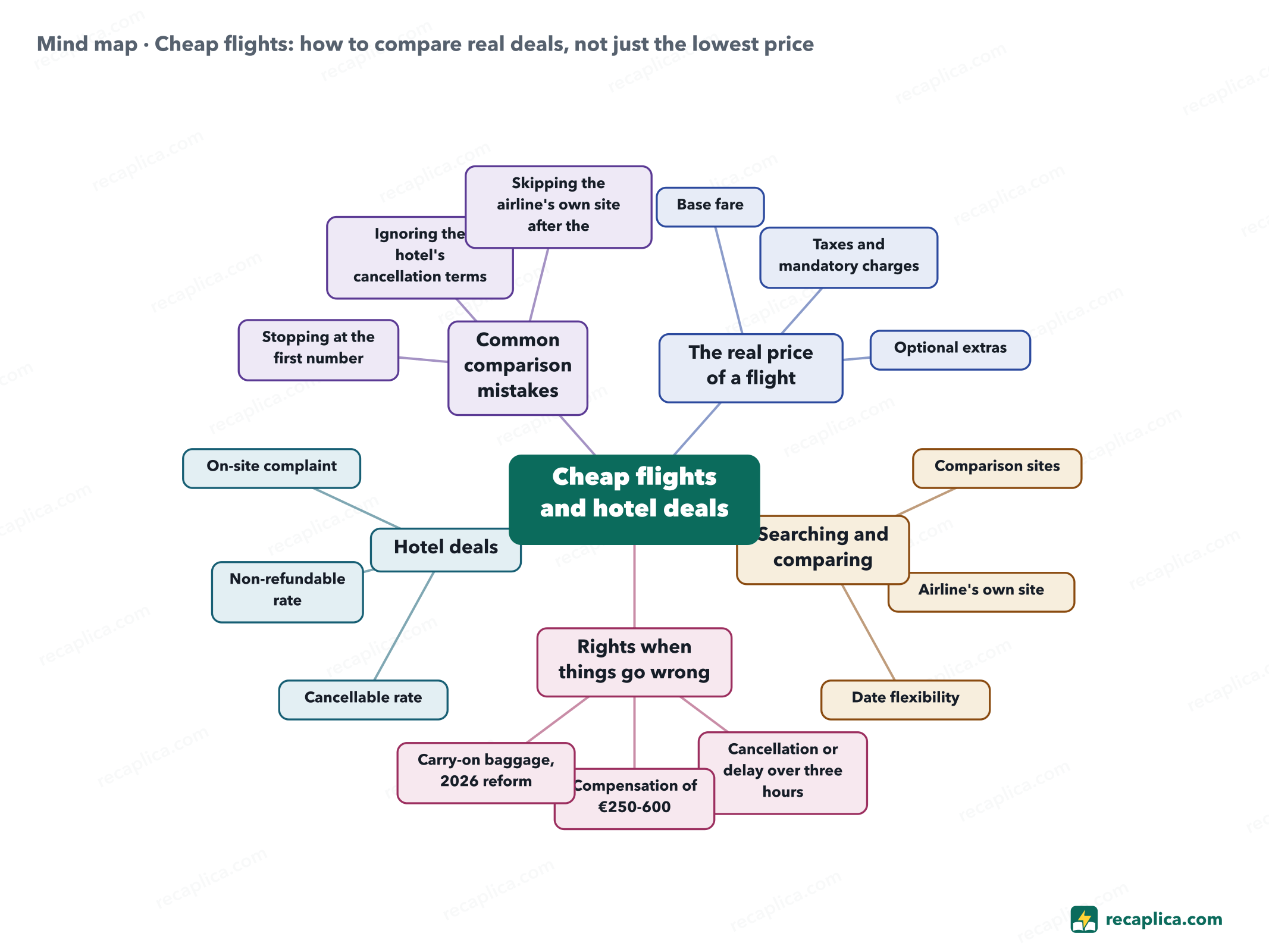
    Mind map: Cheap flights: how to compare real deals, not just the lowest price
    • Cheap flights and hotel deals
      • The real price of a flight
        • Base fare The number a comparison site shows first
        • Taxes and mandatory charges Must appear together with the fare from the first price shown
        • Optional extras Insurance, seat, extra baggage: opt-in acceptance
      • Searching and comparing
        • Comparison sites Useful for a first overview of prices
        • Airline's own site Direct check of the same flight and the same costs
        • Date flexibility Shifting the trip by a few days often changes the price
      • Rights when things go wrong
        • Cancellation or delay over three hours Triggers the right to compensation
        • Compensation of €250-600 Already in force, untouched by the 2026 reform
        • Carry-on baggage, 2026 reform Agreed but not yet in force
      • Hotel deals
        • Cancellable rate Higher price, free cancellation up to a set date
        • Non-refundable rate Lower price, payment owed regardless
        • On-site complaint If the room doesn't match the listing
      • Common comparison mistakes
        • Stopping at the first number The starting price often excludes baggage and seat
        • Ignoring the hotel's cancellation terms
        • Skipping the airline's own site after the comparison

    Quiz: test yourself

    Answer the questions to check what you have learned: you get instant feedback and a short explanation.

    Grade 0/10 0/5
    1 Under EU Regulation 1008/2008, what must appear in the first price a flight is advertised at?

    Article 23 of the regulation requires the fare to be shown together with taxes, airport charges and other mandatory, foreseeable costs from the outset; optional extras stay separate.

    2 What does it mean that optional flight extras must be opt-in?

    EU rules require optional extras to be communicated clearly from the start of booking and accepted by the customer on an opt-in basis — never through a box already checked.

    3 How much compensation is owed for a flight cancelled or delayed more than three hours?

    The €250-€600 compensation for cancellations or delays over three hours was already in force before the 2026 reform and hasn't been changed.

    4 True or false: in 2026, free carry-on baggage is already guaranteed on every European flight.

    The Council of the European Union gave its final clearance in July 2026, but the rule only takes effect twelve months and twenty days after official publication — a date not yet known at the time of writing.

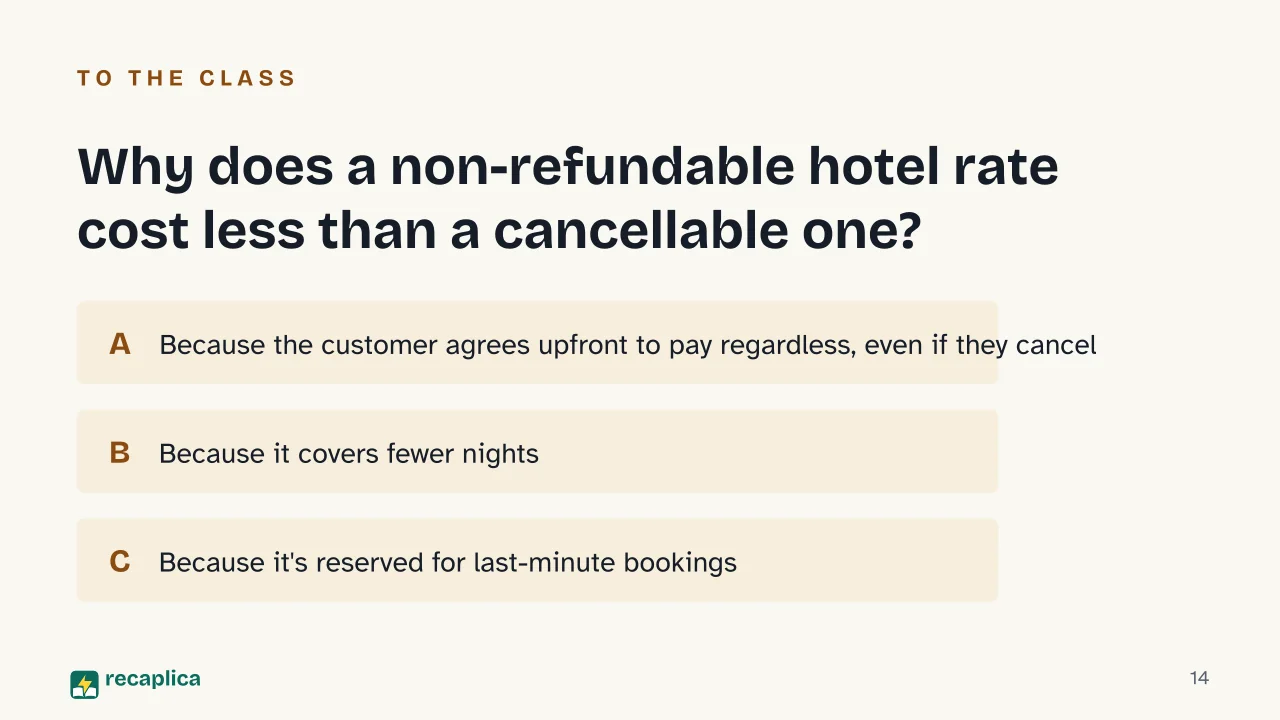
    5 Why does a non-refundable hotel rate cost less than a cancellable one?

    Whoever picks the non-refundable rate agrees explicitly, at booking, to pay for the full stay even if they cancel: that's the trade-off behind the lower price.

    Answers: 1-A · 2-A · 3-A · 4-A · 5-A

    Flashcards

    Tap the card to flip it and check whether you remember the answer, then move to the next one.

    1 / 7

    Explain it in your own words

    The ultimate test: if you can explain it in simple words, you've truly understood it. Write your explanation, then compare it with the Recap.

    Your explanation is saved only on this device.

    Cheap flights are usually the starting point for planning a budget trip, but the number a comparison site shows first is rarely the final amount you pay. EU air travel rules require the fare to be displayed together with taxes and mandatory charges from the very first price shown, leaving out only optional extras like insurance or seat selection. Hotel deals work differently: the lowest rate is often the one you can't cancel, while paying a bit more buys you a window to change your mind. Comparing flights and hotels properly means looking past the big number on the homepage — baggage, taxes, cancellation terms and, if something goes wrong, the rights the law already gives you.

    Frequently asked questions

    How can you search for cheap flights without spending hours comparing different sites?

    A comparison site gives a first overview of the prices available across a range of dates, but it's worth then checking the same flight on the airline's own site: the price sometimes differs, and either way the real cost of the trip needs adding up, starting with baggage.

    How do you find cheap flights that stay cheap once baggage and a seat are added?

    The price a comparison site shows includes the fare, taxes and mandatory charges by law, but not optional extras. It helps to check the size of the baggage already included in the base fare and the cost of an assigned seat first, so the real total is known before paying.

    What happens if a flight is cancelled or delayed by many hours?

    A delay or cancellation of more than three hours entitles passengers to compensation between €250 and €600, under EU passenger rights rules. It's a protection already in force and confirmed by the reform the Council of the European Union approved in 2026.

    Is carry-on baggage always free on cheap flights?

    Not yet, and not consistently. In 2026 the Council of the European Union cleared a rule that would make a carry-on bag up to 100 cm and 7 kg free, but it only takes effect after official publication, plus twelve months and twenty days: until then, each airline's own baggage policy applies.

    Can I cancel a hotel booking for free if my plans change?

    It depends on the rate chosen. A cancellable rate, which costs more, usually leaves a window to cancel without a penalty; a non-refundable rate, cheaper, commits you to paying for the full stay even if you cancel.

    Sources

    • Regulation (EC) No 1008/2008 — Article 23, Information and non-discrimination
    • Council of the European Union — Council gives final clearance for stronger air passenger rights
    • European Consumer Centre Italy (Euroconsumatori) — How hotel booking cancellation is regulated
    • European Consumer Centre Italy (Euroconsumatori) — Hotel booking and stay

    Every Recap goes through an independent review before publication.

    Every evening, the day's new Recaps on our Telegram channel. Join the channel →

    Keep learning

    • Economics Labor Market: How Supply, Demand and Unemployment Work The labor market is where businesses that need workers to produce goods and services meet the people willing to work for them. In the textbook model, that meeting sets wages and employment levels the way any other market would, but imperfect information, bargaining power and legal rules push the real market away from pure competition. Those gaps are where unemployment comes from, and economists split it into frictional, structural, cyclical and technological types depending on the cause. Official statistics, such as Italy's ISTAT, measure it against the labor force — people employed plus people actively looking for work — not the whole population. As of July 2026, Italy's unemployment rate stood at 5.8%, provisional, against 6.4% for the euro area. Read the Recap →
    • Economics Mercantilism: History, Examples, and Definition Mercantilism was the dominant economic doctrine in Western Europe from the 16th to the 18th century: a state grew powerful by selling more abroad than it bought, building up reserves of gold and silver. Britannica Money describes it as "an economic practice by which governments used their economies to augment state power at the expense of other countries." Colonies had one job under this system: supply raw materials to the mother country and buy finished goods back from it, while at home tariffs and monopolies shielded domestic industry. The name itself came later, from the doctrine's most famous critic: Adam Smith made it current in The Wealth of Nations, published in 1776. Read the Recap →
    • Economics Keynesianism explained: the theory born from the Great Depression Keynesianism is the body of economic thinking named after John Maynard Keynes, the British economist who in the 1930s offered a different way of reading a slump. The IMF notes that when the Great Depression hit, the economic theory of the day could neither explain the collapse nor say how to restart production and employment. Keynes put aggregate demand at the centre — the total spending of households, businesses and government — and argued that full employment is a special case rather than something markets deliver on their own. That is where the idea comes from that public spending can step in when private demand stalls. Keynesianism guided economic policy from the end of the Second World War until the 1970s, then lost ground. Read the Recap →

    recaplica

    Clear in 30 seconds, yours in 10 minutes.

    Recaps Mind maps Request a Recap Telegram channel Mind map maker Our method About Privacy & cookies Legal notes & terms of use

    © 2026 Recaplica · A project by Curi S.r.l. — VAT IT05472000750

    Statistics, only if you say so

    To learn which Recaps help most we would use Google Analytics, with aggregate, anonymous data. It starts only with your OK, and you can change your mind anytime. Privacy policy