Skip to content
recaplica

    One moment: security check

    Cloudflare wants to make sure you're not a robot. Tick the box below and your search will continue on its own.

    IT
    recaplica What is JavaScript? The language that outgrew the browser
    © 2026 Recaplica · recaplica.com — All rights reserved
    Home › Technology

    What is JavaScript? The language that outgrew the browser

    By Recaplica Newsroom · Updated on September 8, 2026

    What to print

    Page numbers appear when printing with default margins.

    Slides

    Choose a cut

    Flash10 slidesThe essential thread, to present in classFull18 slidesEvery chapter and the deeper detail

    Both come with speaker notes.

    Telegram channel
    recaplica Clear in 30 seconds, yours in 10 minutes.
    In 30 seconds Key points Figures Deep dive Slides Myths Mind map Quiz Flashcards FAQ

    In 30 seconds quick read

    JavaScript is a lightweight, dynamically typed programming language with first-class functions, defined by MDN as interpreted or compiled just in time. Brendan Eich wrote it for Netscape in 1995, first appearing as 'LiveScript' in the September beta before being renamed JavaScript for the official release in December. It's best known as the scripting language of the web browser, but it runs outside the browser too, ever since Node.js made it possible to power a server as well. The specification behind it is called ECMAScript, maintained by the TC39 committee, and according to the 2025 Stack Overflow Developer Survey it remains the single most used programming language.

    Key Points

    • JavaScript is a lightweight, dynamically typed language with first-class functions, built on prototypes rather than classical classes (MDN's definition).
    • It was born in 1995: Brendan Eich wrote it for Netscape; it debuted as 'LiveScript' in the September 1995 beta and became 'JavaScript' for the official release in December.
    • The official standard is called ECMAScript (ECMA-262), maintained by the TC39 committee at Ecma International; ES6, in 2015, was a major update, followed by yearly editions since.
    • It runs mostly in the browser, but since 2009 also on the server, thanks to Node.js and its V8 engine, the same one that powers Chrome.
    • Despite the name, Java and JavaScript are separate languages: the resemblance comes from a Netscape marketing choice, not a technical relationship.
    • According to the 2025 Stack Overflow Developer Survey, JavaScript is the most used programming language, with 66% of developers reporting they use it.

    Key figures

    • 66% the share of developers who report using JavaScript, the most used language in the survey Source: Stack Overflow Developer Survey 2025
    • 1995 the year Brendan Eich wrote JavaScript for Netscape, then called 'LiveScript' Source: Wikipedia — JavaScript / History of JavaScript
    • 2009 the year Ryan Dahl released Node.js, bringing JavaScript to the server too Source: Wikipedia — Node.js

    Deep Dive

    A language built to bring web pages to life

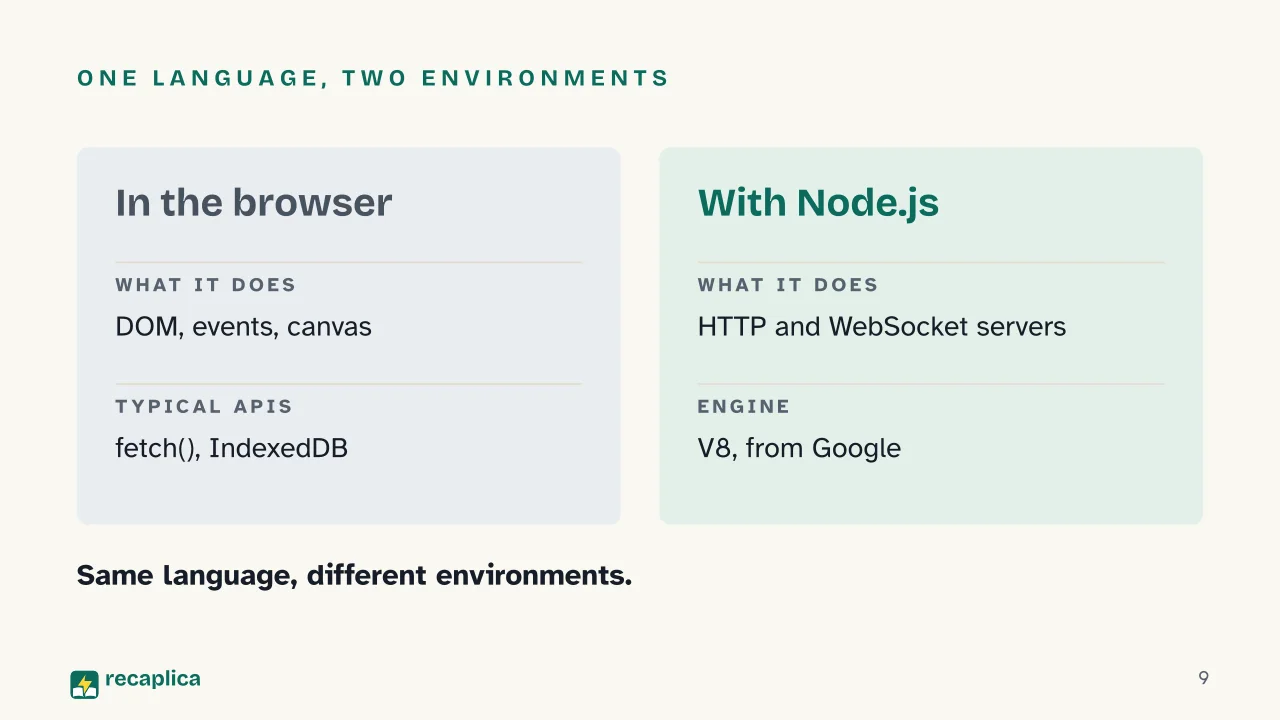
    When you click a button on a web page and something changes without the page reloading, that’s usually JavaScript at work. On its main MDN page, it’s defined as “a lightweight interpreted (or just-in-time compiled) programming language with first-class functions”: dynamically typed, built on prototypes rather than classical classes, with automatic garbage collection, and able to work across several paradigms — imperative, functional, object-oriented. It’s best known as the scripting language of web pages, the one that manipulates page content (the DOM) inside the browser, responds to clicks and other events, fetches data from a server with the fetch() API, draws with canvas, and talks to the device through a range of other APIs, as MDN’s glossary explains. To see how the web got here, it helps to trace how the internet changed from a network of static pages into something interactive.

    A taste of the syntax

    You don’t need to know how to code to recognize JavaScript when you see it: a variable and a function, small algorithms you can call by name, are enough.

    Practical example: a minimal snippet that defines and uses a variable might look like this:

    let name = "Recaplica";
    function greet(who) {
      console.log(`Hello, ${who}!`);
    }
    greet(name);

    In the browser, these lines can run in the developer tools console and print “Hello, Recaplica!” into the open page. With Node.js, the same file also runs from the command line, with no browser open at all: it’s the same distinction described for PHP, between a language that only lives in the browser and one that can live outside it too.

    From Netscape’s beta to the ECMAScript standard

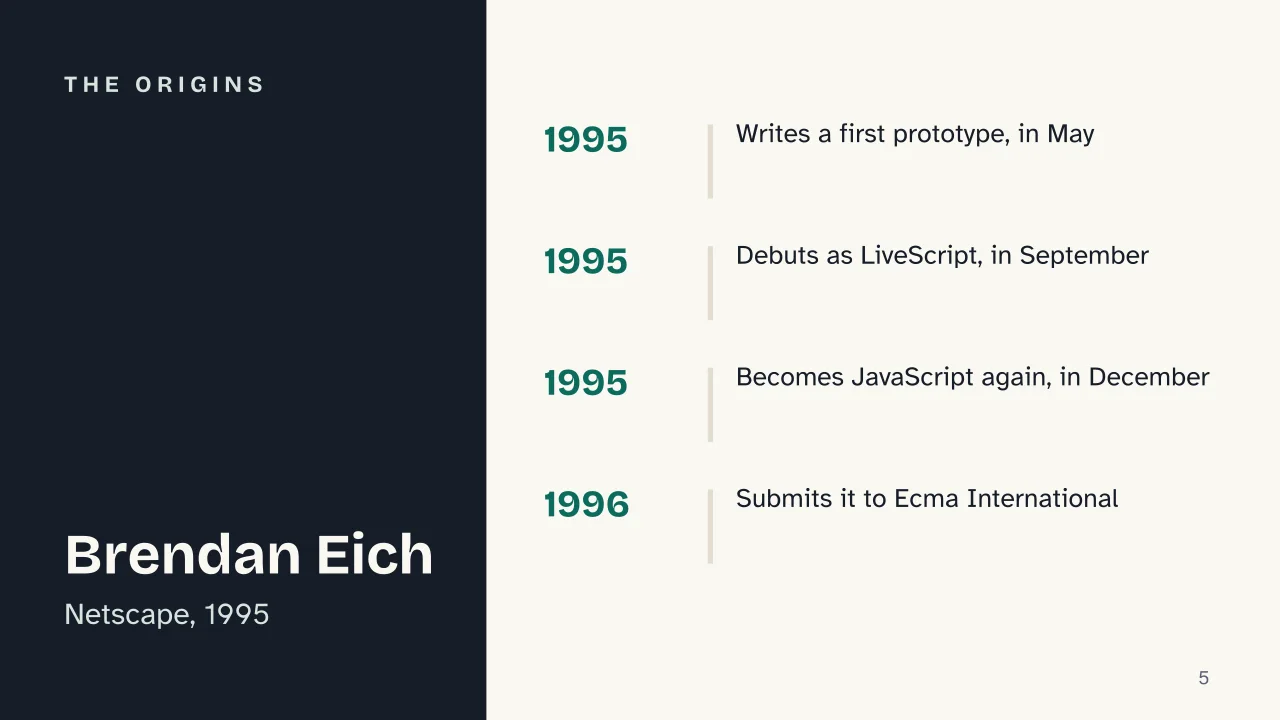
    JavaScript was born in 1995: Brendan Eich wrote it for Netscape, and its first public appearance dates to December 4, 1995. In the Netscape Navigator beta of September 1995 it was still called “LiveScript”; the name was changed to “JavaScript” only for the official release in December, right in the middle of the Java boom during the dot-com bubble. Eich himself, according to multiple web-history sources, called that choice “a marketing ploy by Netscape.”

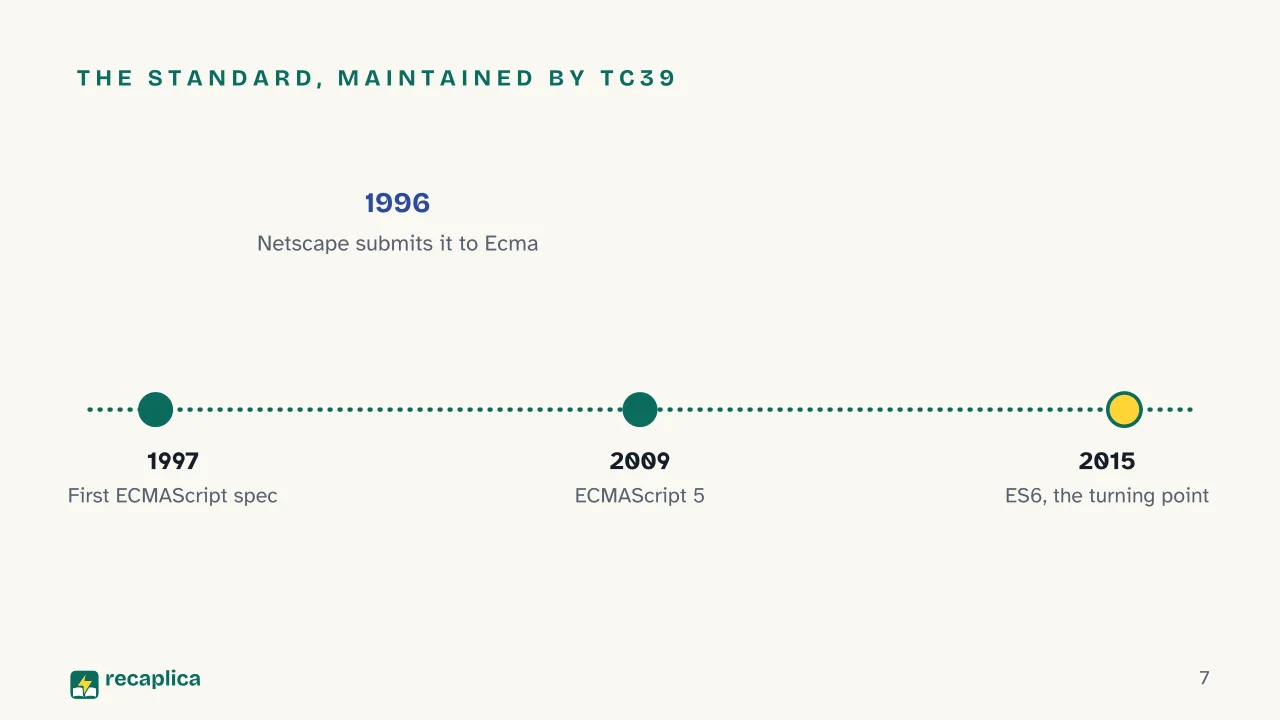
    YearMilestone
    1995Debuts as “LiveScript” in the Netscape Navigator beta, in September
    1995Renamed “JavaScript” for the official release, in December
    1996Netscape submits the language to Ecma International, in November
    1997First ECMAScript spec (ECMA-262), in June
    1999ECMAScript 3, in December
    2009ECMAScript 5, in December
    2015ECMAScript 6 (ES2015), with extensive additions to the language

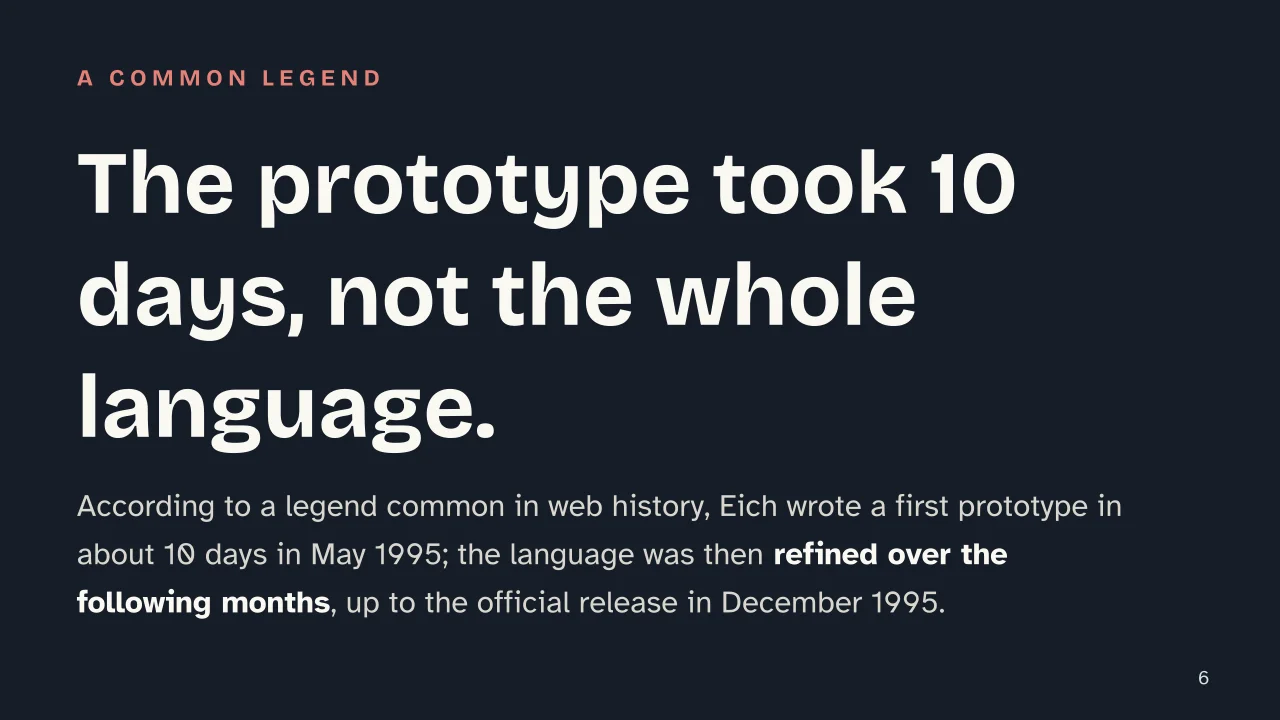
    From ES6 onward, the standard gets a new edition every year: in the words of MDN’s glossary, it’s “a living standard,” maintained by the TC39 technical committee at Ecma International, while the related Web APIs stay under W3C and WHATWG. A legend common in web history says the language’s first prototype, called “Mocha” according to some secondary sources, came together in about 10 days in May 1995, under pressure from a demo tied to the Netscape-Sun agreement on Java. Other web-history sources point out that this is a simplification: the initial prototype was written quickly, but the language was then refined over the following months, up to the December release. The one solid fact, confirmed by multiple independent sources, is the language’s birth in 1995 at Netscape, by Brendan Eich’s hand.

    Outside the browser: Node.js and the rest of the ecosystem

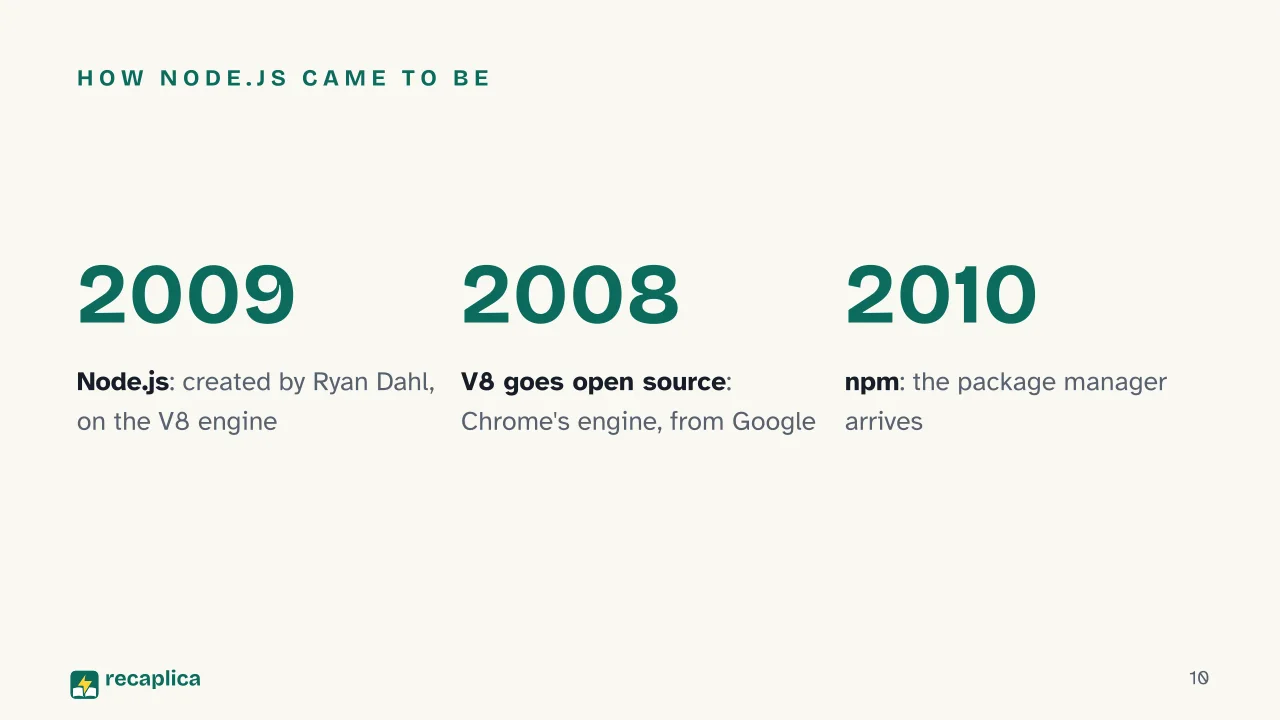
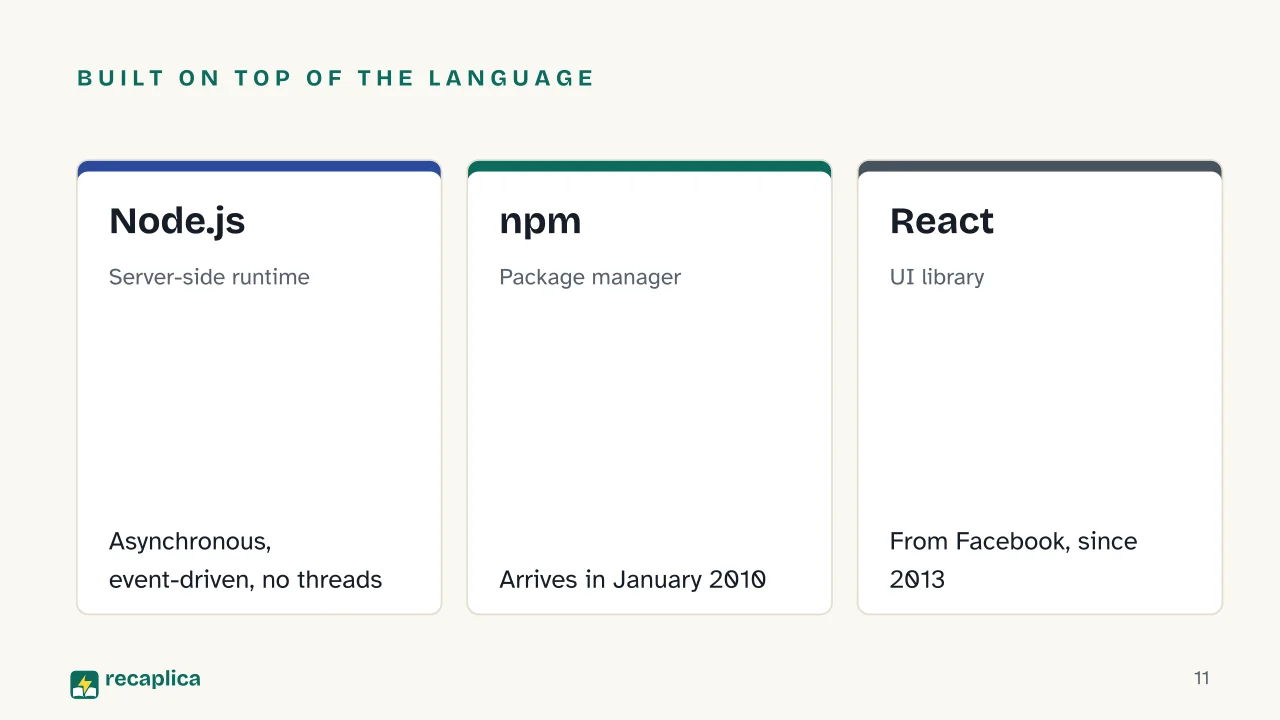
    For almost fifteen years, JavaScript stayed a nearly browser-only language. Things changed in 2009, when Ryan Dahl released Node.js on May 27, criticizing how badly traditional servers handled thousands of simultaneous connections under a sequential programming model. Node.js combines Google’s V8 engine — the same one that powers Chrome, made open source in September 2008 — with an event loop and a low-level, non-blocking input/output API: Node.js’s official site describes it as “an asynchronous event-driven JavaScript runtime, designed to build scalable network applications,” built without a thread-based model, even though it can take advantage of multi-core processors through child processes and the cluster module. Dahl presented the project on November 8, 2009, at the first European edition of JSConf; in January 2010, npm arrived, the package manager that made installing and distributing code written for Node.js much easier.

    Libraries have grown up on top of this ecosystem: React, for instance, started as a prototype in 2011, built by Jordan Walke, an engineer at Facebook, and went open source on May 29, 2013, during the JSConf conference. As of 2026, Meta maintains it together with a community of independent developers, under the MIT open-source license.

    The most common misunderstanding: JavaScript is not Java

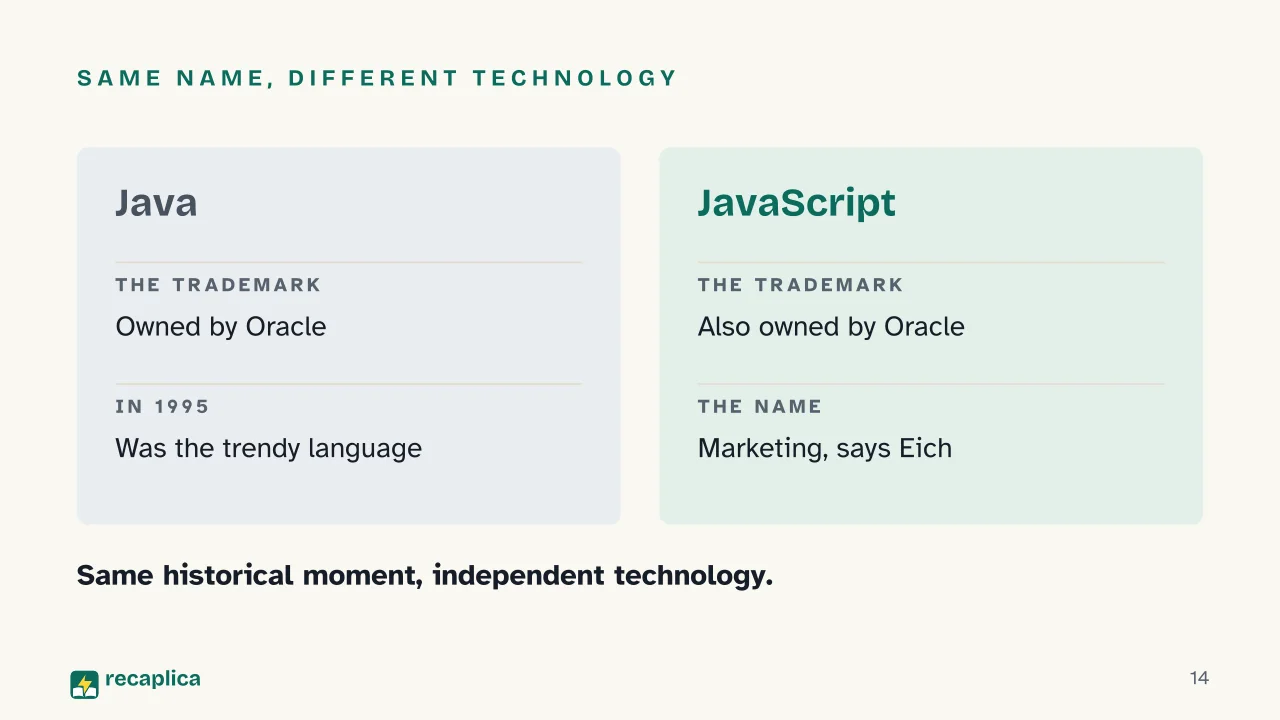
    The name has caused confusion for years: MDN dedicates an explicit note to clarifying that JavaScript shouldn’t be confused with the Java language, and that it’s not “interpreted Java.” The two languages, as Wikipedia also puts it, “are distinct and differ greatly in design,” despite sounding alike and sharing part of their syntax. Both trademarks, “Java” and “JavaScript,” belong to Oracle in the United States and other countries — but they remain two separate technologies, built for different purposes.

    The most used language, by the numbers

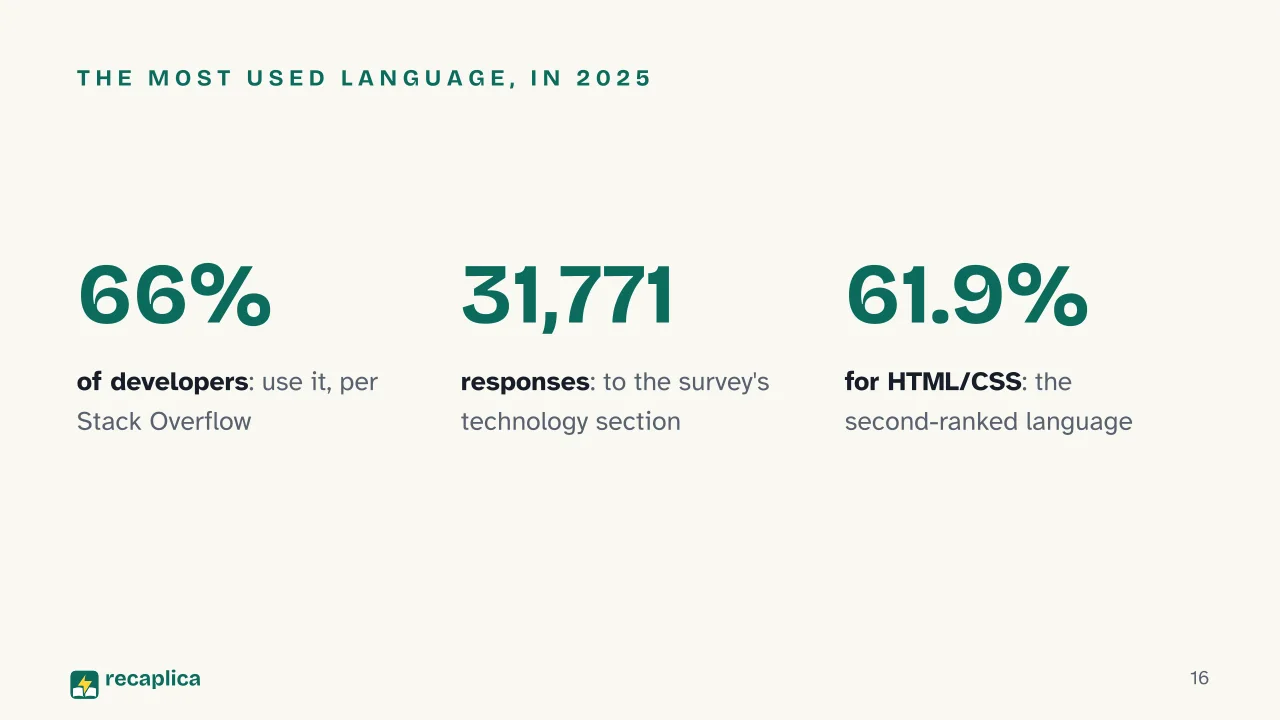
    According to the 2025 Stack Overflow Developer Survey, JavaScript is the single most used programming language: 66% of respondents to the technology section report using it, out of a base of 31,771 people. HTML/CSS follows at 61.9%, then SQL at 58.6% and Python at 57.9%. Python grew by 7 percentage points from 2024 to 2025, driven by artificial intelligence and data science, but in the 2025 edition of the survey JavaScript still comes out as the most widely used language among people who write software.

    Slide deck

    Slides ready to download and make your own in PowerPoint or Google Slides, with speaker notes. Pick the Flash cut or the Full one.
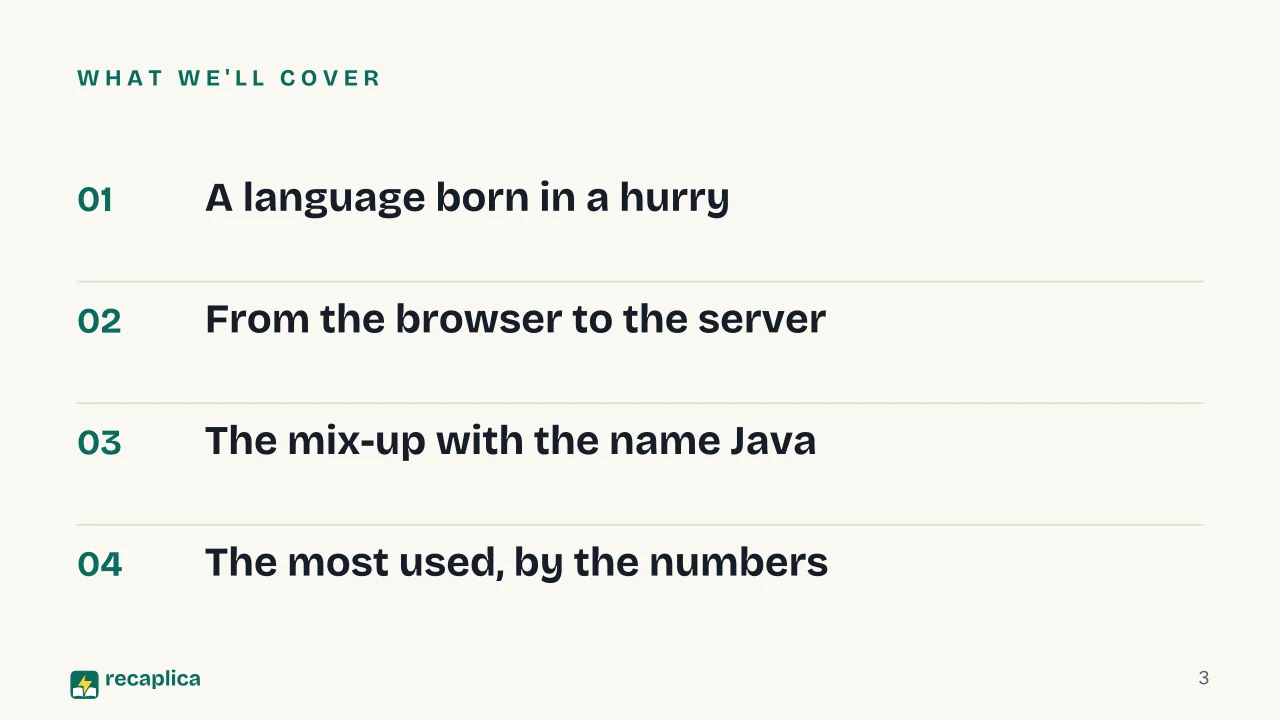
    Slide 1 of the presentation on What is JavaScript? The language that outgrew the browser: JavaScriptSlide 2 of the presentation on What is JavaScript? The language that outgrew the browser: What actually happens when you click a button on a web page?Slide 3 of the presentation on What is JavaScript? The language that outgrew the browser: What we'll coverSlide 4 of the presentation on What is JavaScript? The language that outgrew the browser: Chapter 01: A language born in a hurrySlide 5 of the presentation on What is JavaScript? The language that outgrew the browser: The originsSlide 6 of the presentation on What is JavaScript? The language that outgrew the browser: The prototype took 10 days, not the whole language.Slide 7 of the presentation on What is JavaScript? The language that outgrew the browser: The standard, maintained by TC39Slide 8 of the presentation on What is JavaScript? The language that outgrew the browser: Chapter 02: From the browser to the serverSlide 9 of the presentation on What is JavaScript? The language that outgrew the browser: One language, two environmentsSlide 10 of the presentation on What is JavaScript? The language that outgrew the browser: How Node.js came to beSlide 11 of the presentation on What is JavaScript? The language that outgrew the browser: Built on top of the language: Node.js, npm, ReactSlide 12 of the presentation on What is JavaScript? The language that outgrew the browser: Chapter 03: The mix-up with the name JavaSlide 13 of the presentation on What is JavaScript? The language that outgrew the browser: Are Java and JavaScript the same language?Slide 14 of the presentation on What is JavaScript? The language that outgrew the browser: Same name, different technologySlide 15 of the presentation on What is JavaScript? The language that outgrew the browser: Chapter 04: The most used, by the numbersSlide 16 of the presentation on What is JavaScript? The language that outgrew the browser: The most used language, in 2025Slide 17 of the presentation on What is JavaScript? The language that outgrew the browser: What's the official standard that defines JavaScript called, and who maintains it?Slide 18 of the presentation on What is JavaScript? The language that outgrew the browser: And now, time to review
    Flash10 slidesThe essential thread, to present in classFull18 slidesEvery chapter and the deeper detail

    Common myths

    • ✗ Myth Java and JavaScript are related, or JavaScript is a simplified version of Java.

      ✓ Reality MDN explicitly warns against confusing JavaScript with Java, despite the name, syntax, semantics and use are very different. According to Wikipedia, the name was chosen during the Java boom, in the dot-com bubble years, for marketing reasons at Netscape, not because of any technical kinship; 'Java' and 'JavaScript' are both Oracle trademarks as of 2026, but they refer to two distinct languages.

    • ✗ Myth JavaScript is only useful inside the browser, for dressing up web pages.

      ✓ Reality Born for client-side scripting, but since 2009 it also runs on the server thanks to Node.js, created by Ryan Dahl on Google's V8 engine; newer runtimes like Deno and Bun extend the same use. Node.js's official site describes it as a runtime built for scalable network applications, with HTTP treated as a first-class feature.

    • ✗ Myth JavaScript was written in just 10 days, in one sitting, and nobody has fundamentally changed it since.

      ✓ Reality According to a legend common in web history, Brendan Eich did write a first prototype in about 10 days, in May 1995, under pressure from a demo tied to the Netscape-Sun agreement on Java. Some web-history sources note, though, that this is a simplification: that prototype was then refined over the following months, up to the official release in December 1995, and the ECMAScript standard that defines the language since has kept being updated by the TC39 committee.

    Mind map

    Drag the background to move around and the nodes to reposition them; use − and + to collapse and expand branches.
    Customize
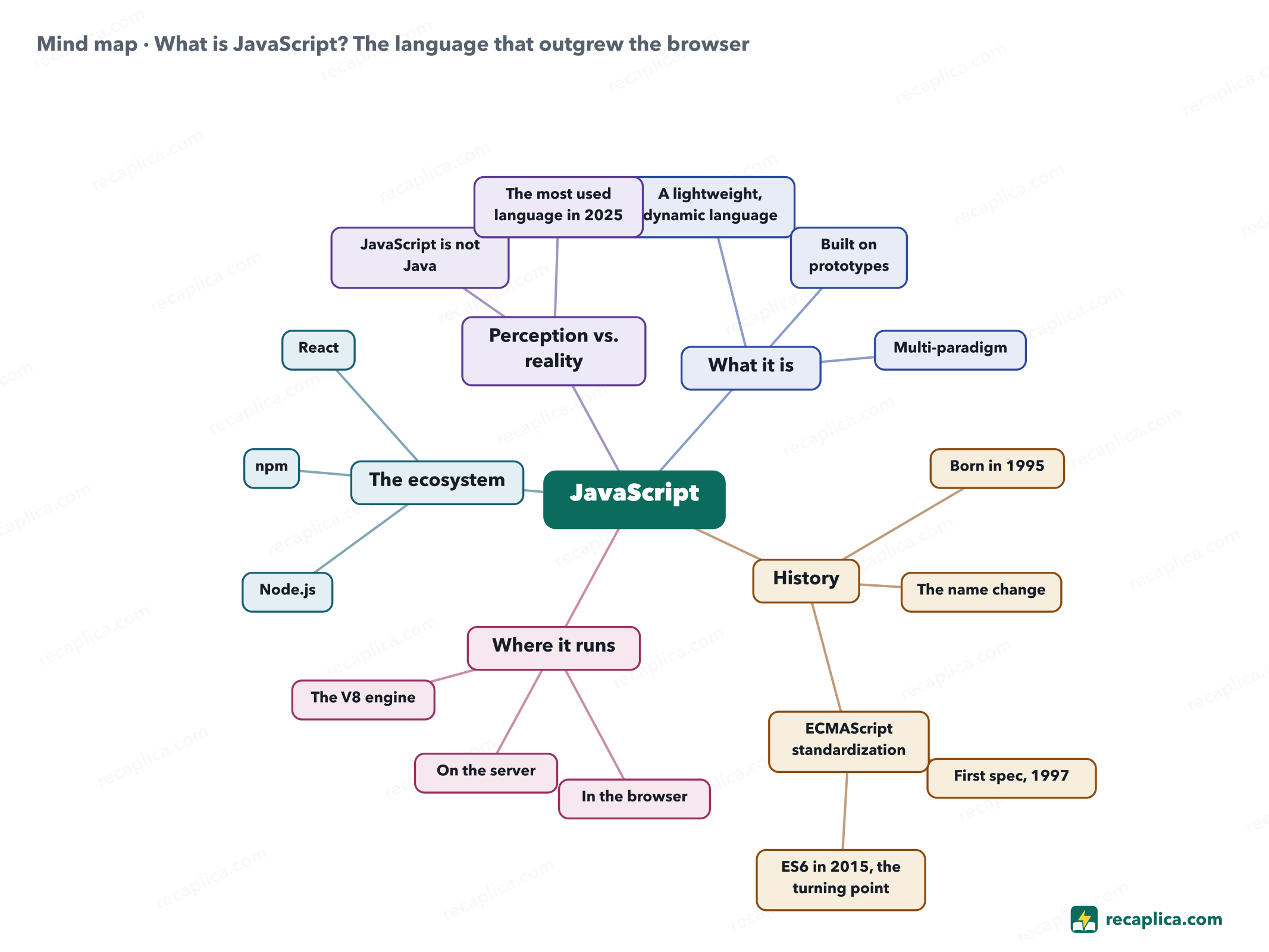
    Mind map: What is JavaScript? The language that outgrew the browser
    • JavaScript
      • What it is
        • A lightweight, dynamic language Interpreted or compiled just in time, first-class functions, per MDN
        • Built on prototypes Not on classical classes, with automatic garbage collection
        • Multi-paradigm Imperative, functional, object-oriented
      • History
        • Born in 1995 Brendan Eich writes it for Netscape
        • The name change From LiveScript, in September, to JavaScript for the December release
        • ECMAScript standardization
          • First spec, 1997
          • ES6 in 2015, the turning point
      • Where it runs
        • In the browser Manipulates the DOM, handles events, draws with canvas
        • On the server With Node.js, Deno, Bun
        • The V8 engine Used by both Chrome and Node.js
      • The ecosystem
        • Node.js Runtime created by Ryan Dahl in 2009
        • npm Package manager, arrived in January 2010
        • React UI library, created by Facebook in 2013
      • Perception vs. reality
        • JavaScript is not Java Similar name, very different design
        • The most used language in 2025 66% of developers, Stack Overflow survey

    Quiz: test yourself

    Answer the questions to check what you have learned: you get instant feedback and a short explanation.

    Grade 0/10 0/5
    1 According to MDN Web Docs, what is JavaScript?

    That's the definition on MDN's main JavaScript page, a lightweight language, interpreted (or compiled just in time), with first-class functions and dynamic typing.

    2 True or false: JavaScript is a simplified version of the Java language.

    False: MDN explicitly warns against confusing the two languages, which have very different syntax, semantics and uses; the similar name came from a Netscape marketing choice in 1995, when Java was the trendy language.

    3 Who created JavaScript, and for which company, in 1995?

    Brendan Eich wrote the language in 1995 for Netscape; its first public appearance dates to December 4, 1995.

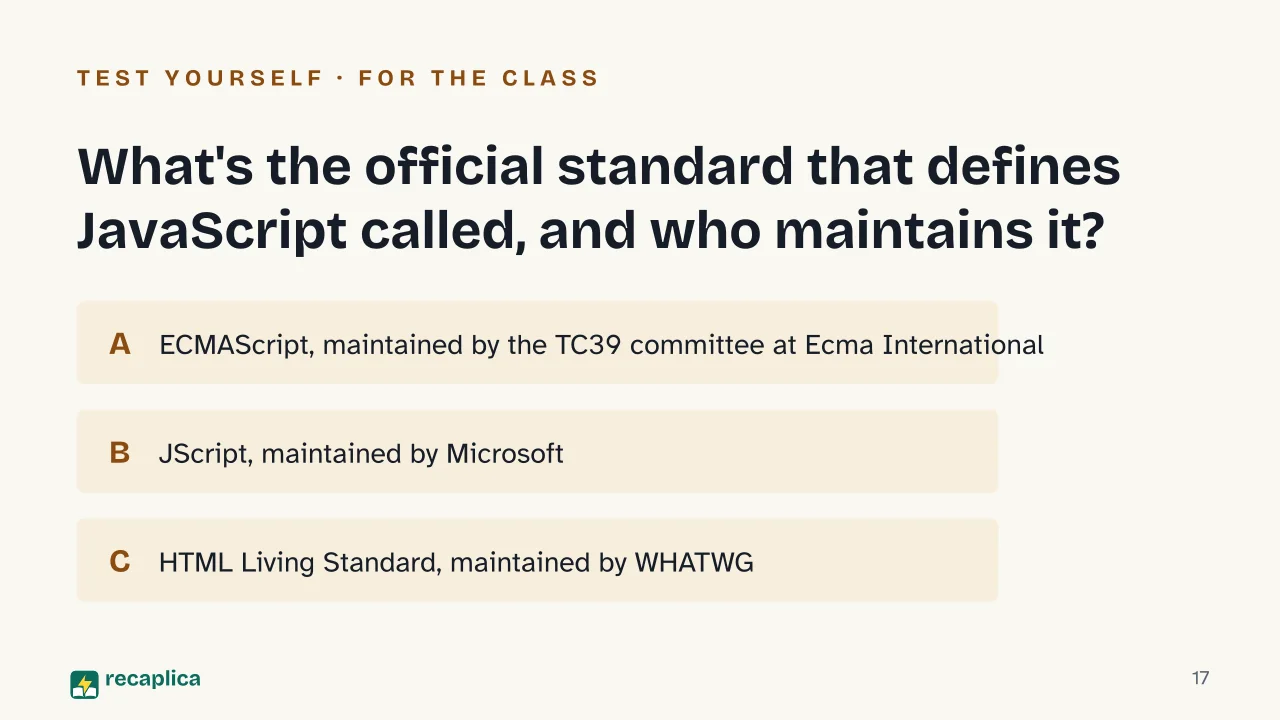
    4 What's the official standard that defines JavaScript called, and who maintains it?

    Netscape submitted JavaScript to Ecma International in November 1996; since then the standard, called ECMAScript (ECMA-262), has been maintained by the TC39 technical committee.

    5 Where can JavaScript run, besides the browser?

    MDN's glossary notes that JavaScript is used most often for dynamic client-side scripts, but it's also commonly used server-side, with a runtime like Node.js, Deno or Bun; Node.js, for instance, is built on Chrome's V8 engine.

    Answers: 1-A · 2-B · 3-A · 4-A · 5-A

    Flashcards

    Tap the card to flip it and check whether you remember the answer, then move to the next one.

    1 / 8

    Explain it in your own words

    The ultimate test: if you can explain it in simple words, you've truly understood it. Write your explanation, then compare it with the Recap.

    Your explanation is saved only on this device.

    JavaScript is a lightweight, dynamically typed programming language with first-class functions, defined by MDN as interpreted or compiled just in time. Brendan Eich wrote it for Netscape in 1995, first appearing as 'LiveScript' in the September beta before being renamed JavaScript for the official release in December. It's best known as the scripting language of the web browser, but it runs outside the browser too, ever since Node.js made it possible to power a server as well. The specification behind it is called ECMAScript, maintained by the TC39 committee, and according to the 2025 Stack Overflow Developer Survey it remains the single most used programming language.

    Frequently asked questions

    Are JavaScript and Java the same thing?

    No. Despite the similar name, they're two distinct languages, with very different syntax, semantics and uses, as MDN states explicitly. The name came from a Netscape marketing choice, in 1995, when Java was the trendy language.

    What is JavaScript used for?

    In its most familiar form, it makes web pages interactive inside the browser: it manipulates the page content (the DOM), responds to clicks and other events, fetches data from a server with the fetch() API, and draws with canvas. Since 2009, with Node.js, it's also used to build servers and automate tasks outside the browser.

    Who invented JavaScript, and why does it have that name?

    Brendan Eich wrote it in 1995 for Netscape. The language's original name, in the September 1995 beta, was 'LiveScript'; it was changed to 'JavaScript' for the official release in December, when Java was the language of the moment, a choice Eich himself has called a Netscape marketing move.

    What is ECMAScript, and how does it differ from JavaScript?

    ECMAScript is the official standard (ECMA-262) that defines the rules of the language, maintained by the TC39 committee at Ecma International. 'JavaScript' remains the name the language goes by in common use, including browser implementations.

    Can you use JavaScript without a browser?

    Yes. With a runtime like Node.js, created by Ryan Dahl in 2009 and built on Google's V8 engine, JavaScript can run HTTP servers, handle files and automate tasks directly from the command line.

    Sources

    • JavaScript | MDN Web Docs
    • JavaScript | Glossary | MDN Web Docs
    • JavaScript | Wikipedia
    • History of JavaScript | Wikipedia
    • Node.js | Wikipedia
    • Node.js — About | official site nodejs.org
    • 2025 Stack Overflow Developer Survey — Technology
    • React | Wikipedia

    Every Recap goes through an independent review before publication.

    Every evening, the day's new Recaps on our Telegram channel. Join the channel →

    Keep learning

    • Technology ASCII Table: What Is It? The ASCII table assigns a fixed number to every letter, digit, punctuation mark, and keyboard control command, so that a computer, which only handles numbers, can represent text. Published in 1963 by the ANSI X3.4 committee and adopted for U.S. federal computers in 1968, it uses 7 bits and covers 128 characters, almost all of them from the English alphabet, according to the IEEE's Engineering and Technology History Wiki. RFC 20 shows how those 7 bits fit neatly inside an 8-bit byte, with the highest bit left unused; putting that extra bit to work opens up more combinations, the basis for the variants known as Extended ASCII. Because it only covers English, though, standard ASCII falls short for languages with accents, ideograms, or other alphabets — a gap Unicode was built to close. Read the Recap →
    • Technology Binary Code: What It Is and How Computers Write Numbers Binary code is how a computer represents numbers using only two digits, 0 and 1. The reason is physical: a computer's circuits reliably tell apart only two electrical states, current off or current on, and we label them 0 and 1 for convenience. Just like the decimal system, each digit's value depends on its position, but here positions are worth powers of two instead of powers of ten: the number 101 works out to (1×4)+(0×2)+(1×1), which is 5. Eight of these digits together form a byte, the unit a computer typically uses to hold one number. Binary alone covers numbers; writing letters needs an extra convention, such as ASCII or Unicode, covered in their own Recaps. Read the Recap →
    • Technology Unicode: What Is It? How It Replaced ASCII Unicode is the standard that gives a unique number, called a code point, to every character in every written language. It replaced ASCII, the 1963 code whose 128 characters covered only the English alphabet, with no accents and no other scripts. Text online travels almost always as UTF-8, one of the forms Unicode uses to turn those numbers into bytes, and it's backward compatible: a file written purely in ASCII is already valid UTF-8. Version 18.0 of the standard, published in September 2026, covers 172,808 characters. Read the Recap →

    recaplica

    Clear in 30 seconds, yours in 10 minutes.

    Recaps Mind maps Request a Recap Telegram channel Mind map maker Our method About Privacy & cookies Legal notes & terms of use

    © 2026 Recaplica · A project by Curi S.r.l. — VAT IT05472000750

    Statistics, only if you say so

    To learn which Recaps help most we would use Google Analytics, with aggregate, anonymous data. It starts only with your OK, and you can change your mind anytime. Privacy policy