Skip to content
recaplica

    One moment: security check

    Cloudflare wants to make sure you're not a robot. Tick the box below and your search will continue on its own.

    IT
    recaplica Verbal and Nonverbal Communication: Differences and Examples
    © 2026 Recaplica · recaplica.com — All rights reserved
    Home › Science

    Verbal and Nonverbal Communication: Differences and Examples

    By Recaplica Newsroom · Updated on October 3, 2026

    What to print

    Page numbers appear when printing with default margins.

    Slides

    Choose a cut

    Flash10 slidesThe essential thread, to present in classFull16 slidesEvery chapter and the deeper detail

    Both come with speaker notes.

    Telegram channel
    recaplica Clear in 30 seconds, yours in 10 minutes.
    In 30 seconds Key points Deep dive Slides Myths Mind map Quiz Flashcards FAQ

    In 30 seconds quick read

    When two people talk face to face, the message also travels through the tone of voice, the gestures and the space they leave between them, not just the words themselves. Researchers split this into three channels that travel together: verbal communication is the linguistic content, paraverbal communication is how it gets said (tone, rhythm, pauses), and nonverbal communication covers eye contact, gestures, posture and physical distance, studied respectively by kinesics and proxemics. These channels can confirm one another or contradict each other, and it is in the contradictions that many everyday misunderstandings start. A widely repeated rule claims that 93% of any conversation rides on the body and the voice, but the research behind it covered a situation far narrower than its fame suggests.

    Key Points

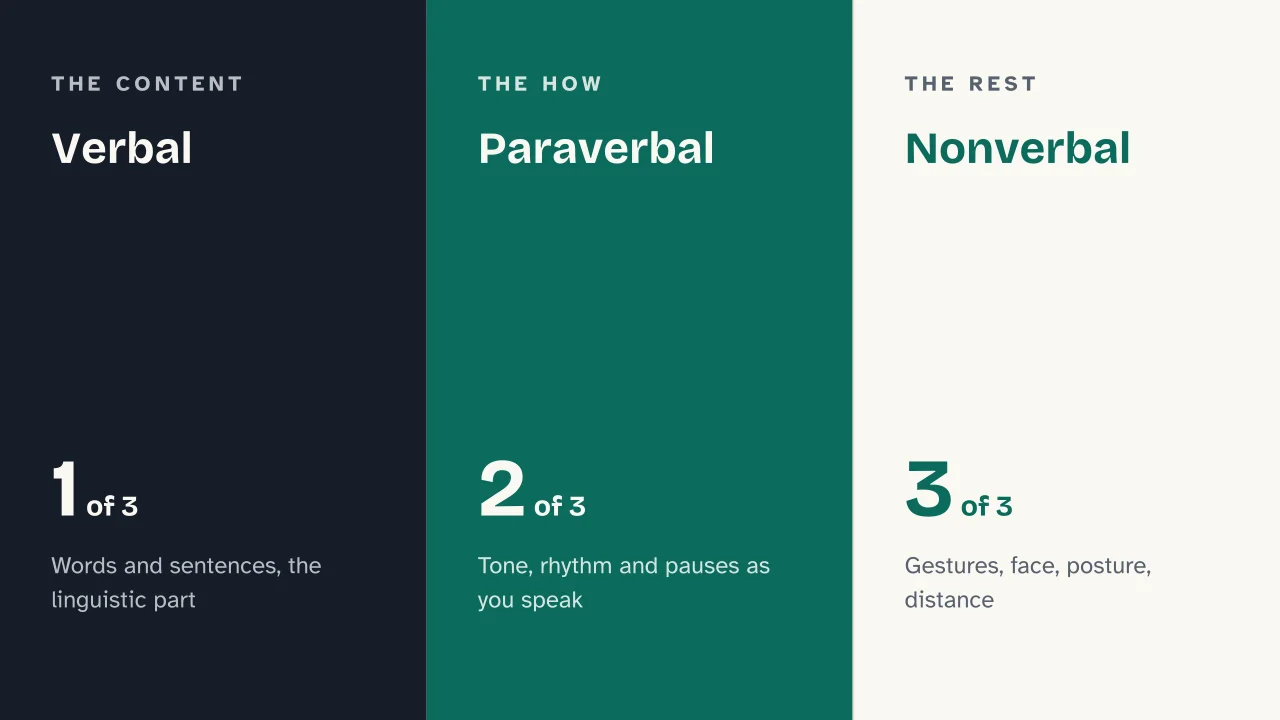
    • Verbal communication covers the words spoken; paraverbal communication covers how they are said, meaning tone, rhythm and pauses; nonverbal communication covers the body that accompanies them, from gestures to posture to physical distance.
    • Paralinguistic features accompany speech: depending on the case, they confirm it, support it or contradict it.
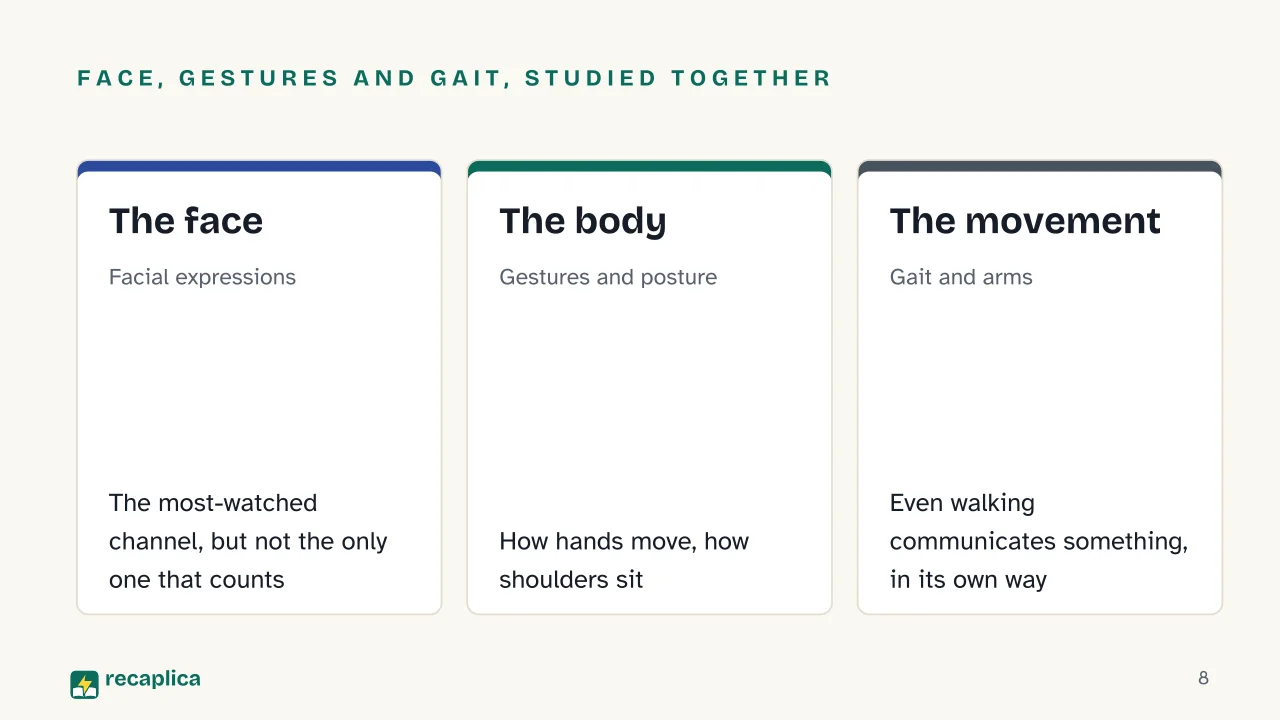
    • Ray Birdwhistell founded kinesics, the field that studies facial expressions, gestures, posture and gait as parts of nonverbal communication.
    • Edward T. Hall introduced proxemics in 1963 to study how cultures manage space during interaction; the distances he described belonged to the Western culture he had observed.
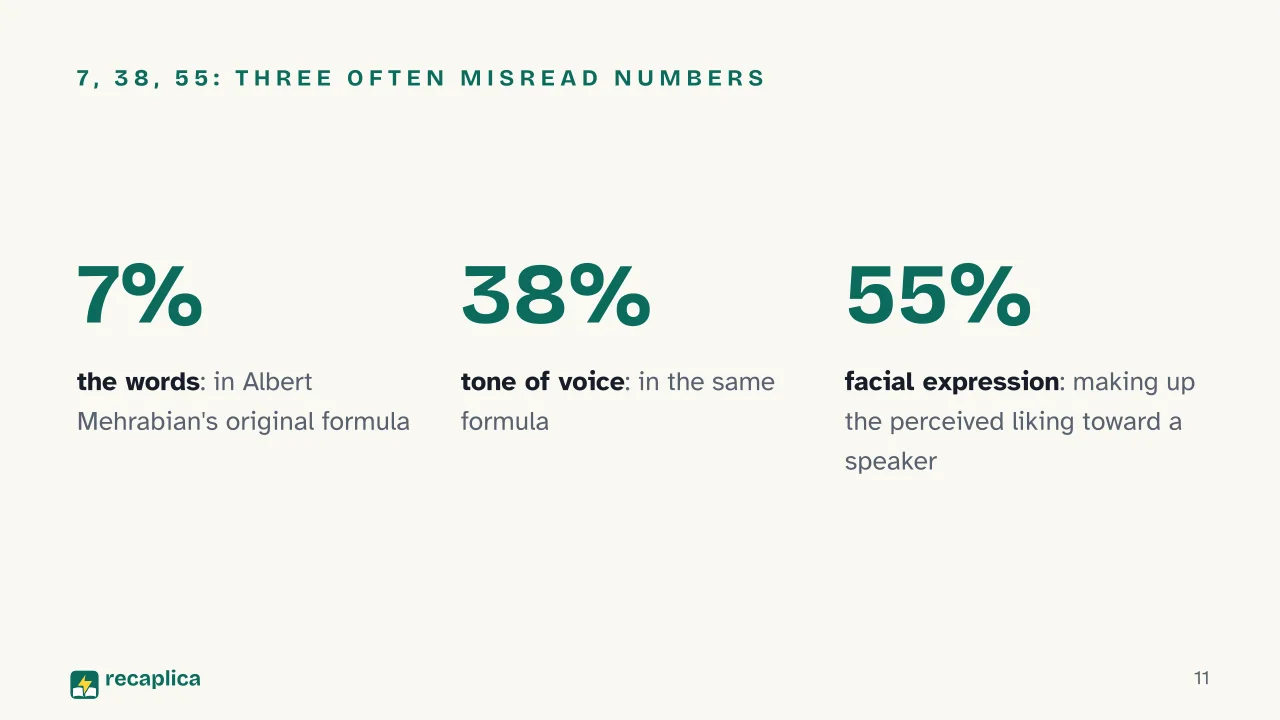
    • Albert Mehrabian's well-known 7%-38%-55% figures describe the perceived liking toward a speaker, in cases where words, tone and face communicate conflicting feelings.
    • Birdwhistell believed that most of a conversation's communicative weight travels outside its words: only a minority share, around 30-35%, would pass through vocabulary itself; this number, too, stays tied to the context in which it was observed.

    Deep Dive

    Three channels, one moment

    Picture a video call where the microphone keeps working but the camera freezes for a few seconds: you still hear the words, yet something is clearly missing. That’s because a face-to-face conversation carries several distinct channels at once. Verbal communication is the linguistic content itself, the words and sentences that make up the message. Paraverbal communication covers how those words get said: tone, speaking rate, intensity, pauses. Nonverbal communication, finally, covers the elements that weave into the verbal part without being made of words at all: facial expressions, movement, posture, physical distance. The topic sits close to psychological science, which studies these exchanges with observational methods and controlled experiments, trying to work out how much weight each channel actually carries in a given situation.

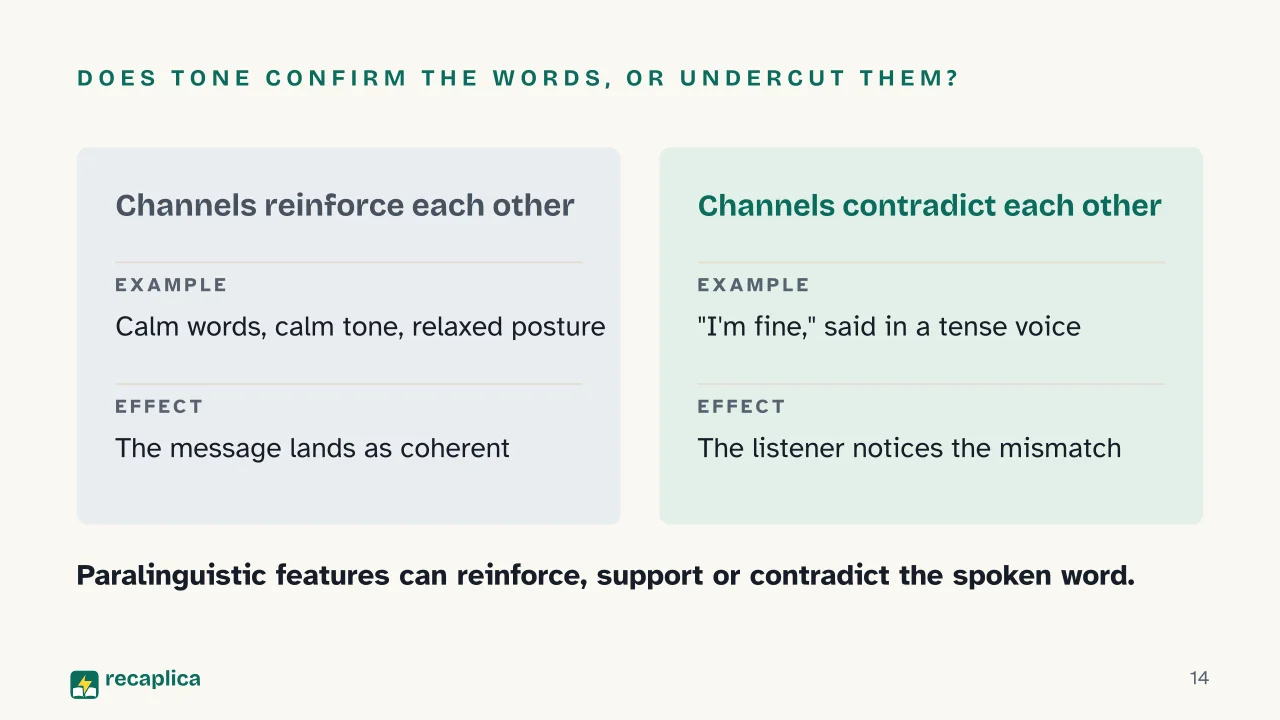
    These channels can confirm each other or clash: a smile during “I’m happy to see you” confirms the message; the same smile during “I’m angry at you” undercuts it.

    Verbal communication: the content

    Verbal communication is the mode expressed through words, the purely linguistic layer of the message. It’s the easiest layer to write down: a sentence on a page carries only this channel, stripped of tone and gesture. In speech, words almost always arrive dressed in how they are said and in what the speaker’s body is doing at the same time.

    Practical example: the phrase “thank you so much” typed in a text message communicates only its literal content. The same phrase said out loud, with a warm tone and a smile, also communicates genuine gratitude; said with a flat tone and a gaze looking elsewhere, it can communicate the exact opposite.

    Paraverbal communication: tone, rhythm, pauses

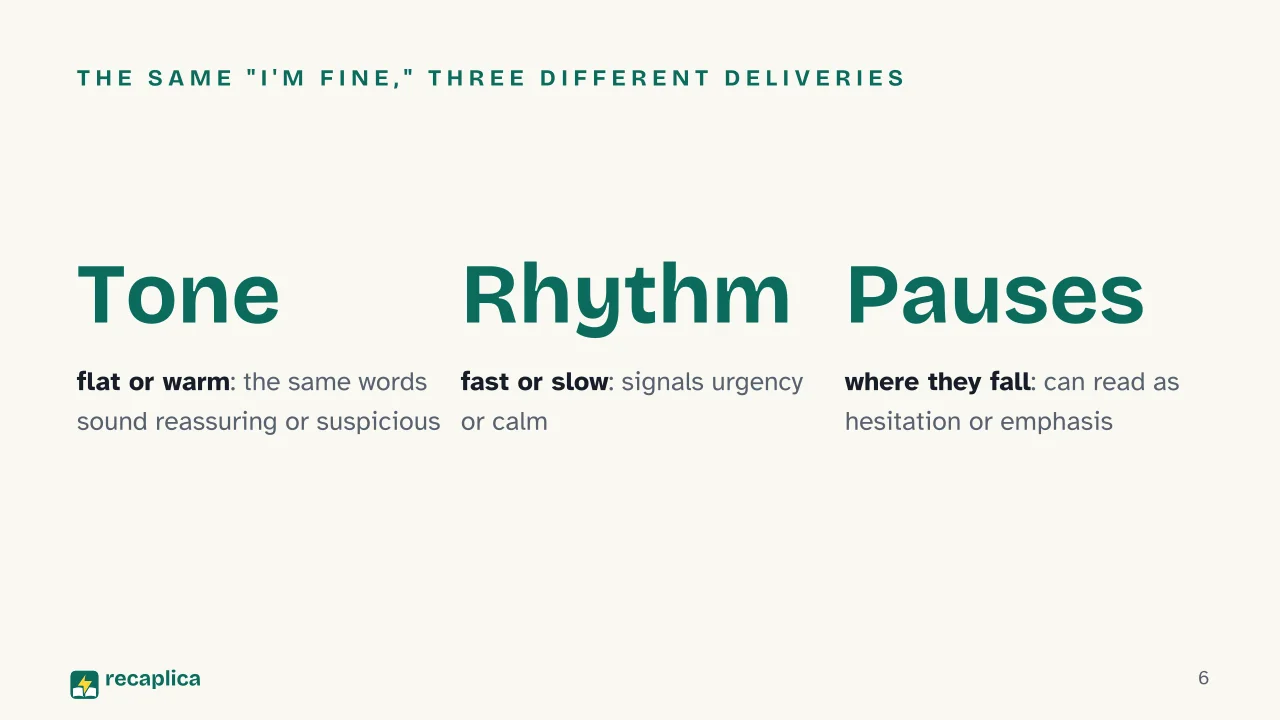
    What school curricula call paraverbal communication corresponds, in the Treccani Encyclopedia of Italian, to a set of features that shape how a message gets spoken: rhythm, speaking rate, tone, intensity and pauses. The voice gives form to words already chosen, adding a layer that a written text never carries.

    A pause before answering an awkward question signals hesitation, even when the words that follow sound confident. A tone that rises toward the end of a statement turns it, to the listener’s ear, into something close to a question. The literal meaning of the words stays identical; what changes, almost every time, is what the listener actually takes away.

    Nonverbal communication: kinesics

    American anthropologist Ray Birdwhistell founded kinesics as a field of study dedicated to facial expressions, gestures, posture, gait and the visible movements of arms and body. His core claim was that words weren’t the only vehicle for meaning in a conversation: a substantial share of what gets communicated would travel through channels outside vocabulary.

    Birdwhistell went as far as estimating that the social meaning of a conversation passed through words in a minority share, around 30-35%, leaving the rest to other channels. It’s an estimate of the same kind, and with the same limits on how far it generalizes, as the better-known figure attributed to Mehrabian discussed further down: a number that only describes the setting where it was gathered, not a universal measure. Birdwhistell himself, for that matter, warned against reading a single body movement in isolation: a gesture makes sense alongside the rest of someone’s behavior, never on its own. Picking up on these cues in someone else’s face is also one of the ingredients of emotional intelligence, the ability to notice and manage emotions in oneself and others.

    Proxemics: the space that communicates

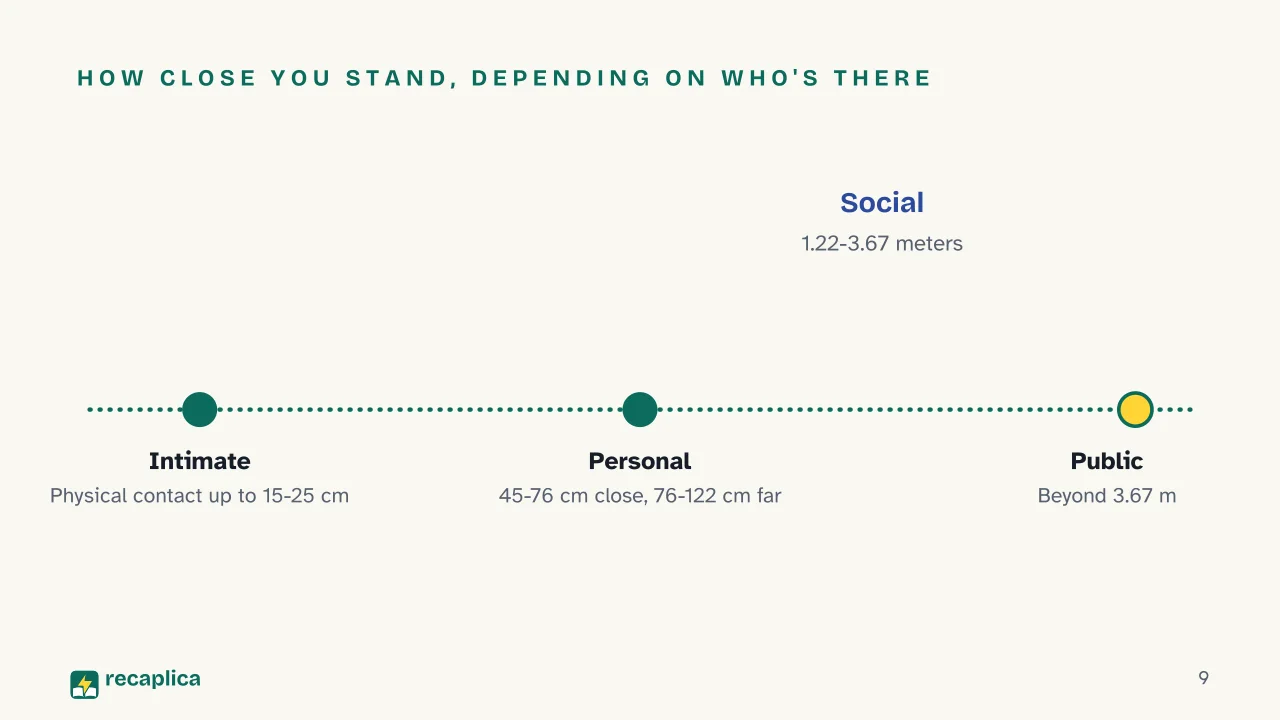
    Nonverbal communication also covers how people manage physical space. Proxemics, a field introduced by anthropologist Edward T. Hall in 1963, studies how different cultures use space and physical distance in interaction. Observing Western culture, Hall distinguished four zones of interpersonal distance:

    ZoneDistanceExample
    Intimateup to 15-25 cm (physical contact)a hug, whispering in someone’s ear
    Personal45-76 cm close, 76-122 cm fartalking with a friend
    Social1.22-2.15 m close, 2.15-3.67 m fara work meeting
    Public3.67-7.64 m close, beyond 7.64 m fara lecture, a public speech

    These figures belong to the cultural context Hall observed. That very observation is where proxemics gets its core idea: what counts as an appropriate distance shifts from one culture to another. Standing 50 centimeters from a stranger during a conversation feels natural in some cultures and intrusive in others, and neither reaction is wrong on its own terms.

    The 93% myth: what Mehrabian really said

    Few figures in the social sciences have been as widely misread as the 7%-38%-55% formula attributed to Albert Mehrabian. In its original formulation, this formula describes how a speaker’s overall perceived liking is composed: it concerns the communication of feelings and attitudes, in the specific cases where words, tone and face are in conflict with each other, not a general measure of how well any communication “works”.

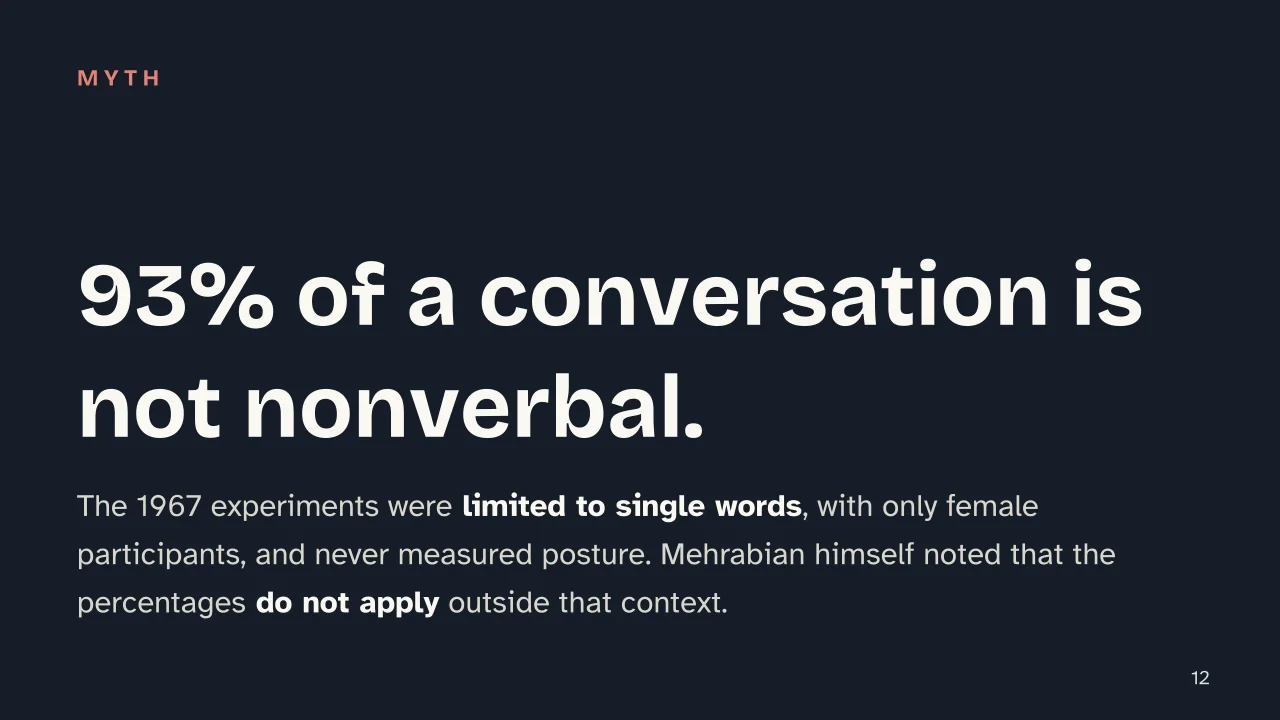
    The original experiments, run in 1967, were tightly scoped: single words spoken with a positive or negative tone, only female participants, no measurement of posture at all. That’s a narrow sample next to the reach the rule later gained in popular culture, where it often circulates as “93% of every message is nonverbal.” Mehrabian himself noted that his percentages apply only to the specific context in which words and nonverbal signals express feelings, and that the rule has been widely misapplied in training and popular writing.

    Practical example: reading furniture assembly instructions aloud doesn’t fit the case Mehrabian studied. There, the verbal content (the instructions) matters enormously, because there’s no conflicting feeling for tone or expression to resolve.

    When channels meet or clash

    The three channels travel together in every live conversation, almost never in isolation. When they tell the same story, the message lands coherently: calm words, calm tone, relaxed posture add up without friction. When one channel contradicts another, kind words spoken in a sharp tone, or an “I’m fine” said with hunched shoulders, the listener notices the mismatch, even without always being able to put it into words.

    Making sense of this distinction doesn’t mean memorizing body language gesture by gesture, the way some popular lists promise. It means remembering that a gesture only makes sense alongside everything else, inside the context where it happens. Birdwhistell and Mehrabian reached that same warning from opposite corners of the field. Much of this behavior, besides, isn’t learned from a manual: people pick it up by watching others from childhood on, not unlike other habits studied by Bandura’s social learning theory.

    Slide deck

    Slides ready to download and make your own in PowerPoint or Google Slides, with speaker notes. Pick the Flash cut or the Full one.
    Slide 1 of the presentation on Verbal and Nonverbal Communication: Verbal and Nonverbal CommunicationSlide 2 of the presentation on Verbal and Nonverbal Communication: You say everything is fine. Why doesn't anyone believe you?Slide 3 of the presentation on Verbal and Nonverbal Communication: What this Recap coversSlide 4 of the presentation on Verbal and Nonverbal Communication: Chapter 01: Verbal and paraverbalSlide 5 of the presentation on Verbal and Nonverbal Communication: Verbal · Paraverbal · NonverbalSlide 6 of the presentation on Verbal and Nonverbal Communication: The same "I'm fine," three different deliveriesSlide 7 of the presentation on Verbal and Nonverbal Communication: Chapter 02: Nonverbal communicationSlide 8 of the presentation on Verbal and Nonverbal Communication: Face, gestures and gait, studied together: The face, The body, The movementSlide 9 of the presentation on Verbal and Nonverbal Communication: How close you stand, depending on who's thereSlide 10 of the presentation on Verbal and Nonverbal Communication: Chapter 03: The 93% mythSlide 11 of the presentation on Verbal and Nonverbal Communication: 7, 38, 55: three often misread numbersSlide 12 of the presentation on Verbal and Nonverbal Communication: 93% of a conversation is not nonverbal.Slide 13 of the presentation on Verbal and Nonverbal Communication: Chapter 04: When channels clashSlide 14 of the presentation on Verbal and Nonverbal Communication: Does tone confirm the words, or undercut them?Slide 15 of the presentation on Verbal and Nonverbal Communication: What does Mehrabian's formula actually describe?Slide 16 of the presentation on Verbal and Nonverbal Communication: Time for a quick review
    Flash10 slidesThe essential thread, to present in classFull16 slidesEvery chapter and the deeper detail

    Common myths

    • ✗ Myth 93% of any communication rides on body language and tone, words barely matter.

      ✓ Reality Mehrabian's formula concerns the perceived liking toward a speaker when words, tone and face tell conflicting emotional stories. It came from 1967 experiments using isolated words, an all-female group of participants, and no measurement of posture, conditions far narrower than the fame the rule later gained. Mehrabian himself warned that the percentages should not be applied outside that context.

    • ✗ Myth The interpersonal distances that feel "right" are the same everywhere in the world.

      ✓ Reality The four zones Hall described in 1963 come from observing Western culture. That very discovery, that comfortable distances shift from one culture to another, is what gave rise to proxemics as a field.

    • ✗ Myth A single gesture, like crossed arms, reveals on its own what someone is thinking.

      ✓ Reality Birdwhistell, the founder of kinesics, warned against exactly this reading: a movement makes sense alongside words, tone and context, never in isolation. Crossed arms can mean cold, comfort or disagreement, depending on what else is happening.

    Mind map

    Drag the background to move around and the nodes to reposition them; use − and + to collapse and expand branches.
    Customize
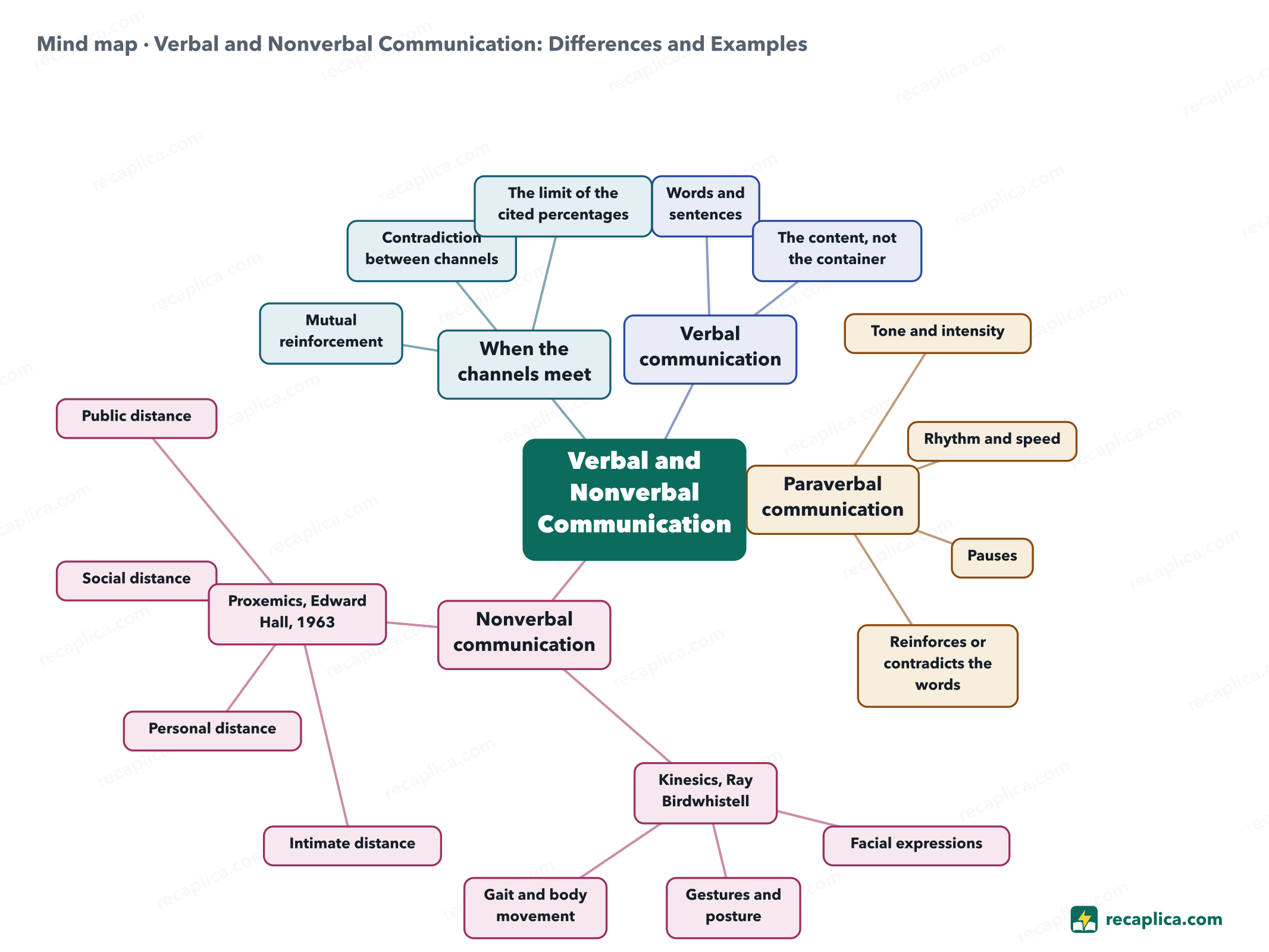
    Mind map: Verbal and Nonverbal Communication: Differences and Examples
    • Verbal and Nonverbal Communication
      • Verbal communication
        • Words and sentences The purely linguistic layer of the message
        • The content, not the container
      • Paraverbal communication
        • Tone and intensity
        • Rhythm and speed
        • Pauses
        • Reinforces or contradicts the words
      • Nonverbal communication
        • Kinesics, Ray Birdwhistell
          • Facial expressions
          • Gestures and posture
          • Gait and body movement
        • Proxemics, Edward Hall, 1963
          • Intimate distance
          • Personal distance
          • Social distance
          • Public distance
      • When the channels meet
        • Mutual reinforcement
        • Contradiction between channels
        • The limit of the cited percentages Mehrabian's and Birdwhistell's estimates only hold in their original context

    Quiz: test yourself

    Answer the questions to check what you have learned: you get instant feedback and a short explanation.

    Grade 0/10 0/5
    1 What distinguishes paraverbal communication from nonverbal communication, in the definition the Treccani Encyclopedia uses?

    The line falls between two kinds of signal: the sound and rhythm of the voice on one side, gestures and physical distance on the other, both tied to the spoken message but different in nature.

    2 Who founded kinesics as a field of study, and what does it cover?

    Birdwhistell coined the term kinesics, starting from the idea that the meaning of a conversation also travels through channels outside spoken words.

    3 What did Edward T. Hall introduce in 1963 with the term "proxemics"?

    Hall observed Western culture and drew four distance zones from it: figures tied to that context, and a central point of the field he founded.

    4 What does Albert Mehrabian's famous 7%-38%-55% rule actually claim, in its original formulation?

    The 1967 experiments used isolated words read with a positive or negative tone, an all-female sample, and no measurement of posture at all, far narrower conditions than the rule's fame suggests.

    5 What was Birdwhistell warning against when he cautioned against reading a single body movement in isolation?

    The warning was precisely this: a gesture taken on its own risks being misread, because its meaning emerges from comparison with the rest of the behavior.

    Answers: 1-A · 2-B · 3-A · 4-C · 5-B

    Flashcards

    Tap the card to flip it and check whether you remember the answer, then move to the next one.

    1 / 8

    Explain it in your own words

    The ultimate test: if you can explain it in simple words, you've truly understood it. Write your explanation, then compare it with the Recap.

    Your explanation is saved only on this device.

    When two people talk face to face, the message also travels through the tone of voice, the gestures and the space they leave between them, not just the words themselves. Researchers split this into three channels that travel together: verbal communication is the linguistic content, paraverbal communication is how it gets said (tone, rhythm, pauses), and nonverbal communication covers eye contact, gestures, posture and physical distance, studied respectively by kinesics and proxemics. These channels can confirm one another or contradict each other, and it is in the contradictions that many everyday misunderstandings start. A widely repeated rule claims that 93% of any conversation rides on the body and the voice, but the research behind it covered a situation far narrower than its fame suggests.

    Frequently asked questions

    What's the difference between verbal, nonverbal and paraverbal communication?

    The content of the words is verbal communication. How the voice delivers them, meaning tone, rhythm, pauses, is paraverbal communication. Gestures, posture, facial expressions and physical distance make up nonverbal communication, and all three layers travel together in any face-to-face conversation.

    Is it true that 93% of communication is nonverbal?

    The percentage describes perceived liking toward a speaker, only in cases where voice, face and words tell conflicting emotional stories; stretched into a rule for every conversation, it goes well past what it was meant to cover. The original 1967 study used single spoken words, recruited only women, and left posture out of the measurements entirely. Mehrabian himself noted that his percentages stay tied to that specific context.

    What is proxemics?

    It is the field founded by Edward T. Hall in 1963 to understand how cultures organize physical space in interaction. Hall described four distance zones by observing the Western world, and that observation is exactly where proxemics gets its core idea: the right distance changes with the place.

    What is kinesics?

    It is the field founded by anthropologist Ray Birdwhistell for the study of the face, gestures, posture and gait. His starting idea was that much of a conversation's meaning travels outside its words, in a share he put at around 30-35%, tied to the context he had observed.

    Why is paraverbal communication called that, if it concerns how people speak?

    The prefix para- signals something that accompanies speech without being part of its wording: tone, rhythm, intensity and pauses dress the words being said. The Treccani Encyclopedia of Italian calls these paralinguistic features for exactly that reason, since they stand alongside spoken language.

    Sources

    • Fenomeni paralinguistici — Enciclopedia dell'Italiano (Treccani)
    • Prossemica — Enciclopedia Italiana (Treccani)
    • Ray Birdwhistell — Wikipedia (EN)
    • Albert Mehrabian — Wikipedia (EN)

    Every Recap goes through an independent review before publication.

    Every evening, the day's new Recaps on our Telegram channel. Join the channel →

    Keep learning

    • Science Correlation: What It Means and How to Read the Coefficient Correlation measures how closely two variables move together, and the most common way to put a number on it is the correlation coefficient, which runs from -1 to +1. A value near +1 means the two variables rise together, near -1 means one rises while the other falls, and near 0 means no linear relationship stands out. The coefficient only captures the strength of a straight-line relationship, and a single unusual data point can push it up or down by a lot. Even when it's strong, a correlation between two variables never shows that one causes the other. Read the Recap →
    • Science Light Refraction: What It Is, the Laws Behind It, and Examples A surface that separates two transparent materials sends some light back, reflecting it, and lets the rest through while bending it toward a new direction. The law of reflection keeps the incoming and outgoing angles equal, both measured from the normal to the surface. Snell's law governs refraction instead, linking the index of each material to how much the ray tilts before and after it crosses over. These two laws alone explain mirrors, lenses, prisms and everyday sights such as a pencil that appears to snap inside a glass of water. Read the Recap →
    • Science Total Internal Reflection and the Critical Angle: Definition and Formula Total internal reflection is what happens when a light ray stops being able to leave a transparent medium and gets sent back inside it completely. It takes place past a specific angle of incidence, called the critical angle, calculated with Snell's law by comparing the refractive indices of the two materials involved. It only happens under one precise condition: the ray must be traveling from an optically denser medium into a less dense one, such as from water into air or from glass into air. Optical fibers and, in part, the sparkle of diamonds rely on this same principle. Read the Recap →

    recaplica

    Clear in 30 seconds, yours in 10 minutes.

    Recaps Mind maps Request a Recap Telegram channel Mind map maker Our method About Privacy & cookies Legal notes & terms of use

    © 2026 Recaplica · A project by Curi S.r.l. — VAT IT05472000750

    Statistics, only if you say so

    To learn which Recaps help most we would use Google Analytics, with aggregate, anonymous data. It starts only with your OK, and you can change your mind anytime. Privacy policy