Skip to content
recaplica

    One moment: security check

    Cloudflare wants to make sure you're not a robot. Tick the box below and your search will continue on its own.

    IT
    recaplica Emotional Intelligence: What It Is
    © 2026 Recaplica · recaplica.com — All rights reserved
    Home › Science

    Emotional Intelligence: What It Is

    By Recaplica Newsroom · Updated on October 3, 2026

    What to print

    Page numbers appear when printing with default margins.

    Slides

    Choose a cut

    Flash10 slidesThe essential thread, to present in classFull14 slidesEvery chapter and the deeper detail

    Both come with speaker notes.

    Telegram channel
    recaplica Clear in 30 seconds, yours in 10 minutes.
    In 30 seconds Key points Figures Deep dive Slides Myths Mind map Quiz Flashcards FAQ

    In 30 seconds quick read

    Emotional intelligence is the ability to recognize, express and regulate emotions — one's own and other people's — and to use them to guide thinking and behavior. Psychologists Peter Salovey and John Mayer coin the term in 1990, five years before Daniel Goleman's book makes it a household phrase worldwide. Several models describe it, each with its own way of measuring it: the ability model of Mayer and Salovey, the trait model of Petrides and Furnham, and the mixed models of Goleman and Bar-On. A review by Cherniss finds that IQ on its own accounts for only a modest share of job performance, and emotional intelligence, taken alone, turns out to be just as modest a predictor of the same performance.

    Key Points

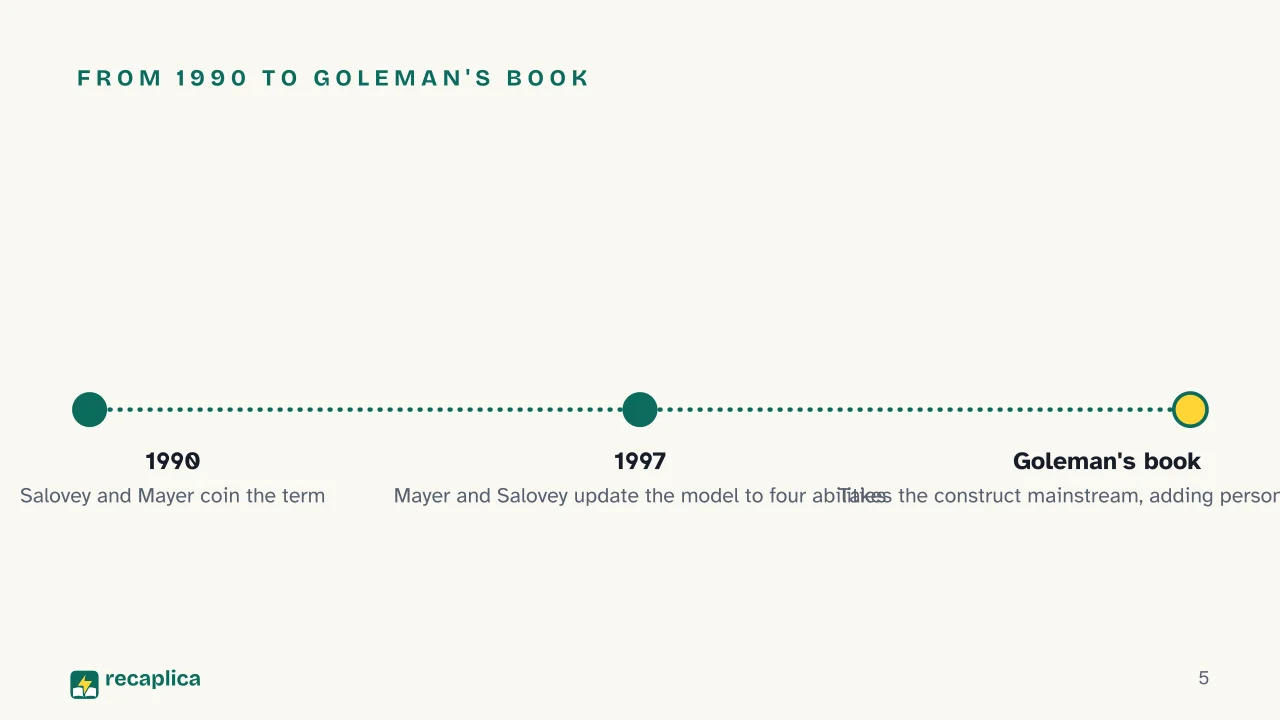
    • Peter Salovey and John Mayer coin the term in 1990, in a paper that describes it as a set of abilities tied to recognizing and regulating emotions.
    • Daniel Goleman brings the construct to a mass audience through a hugely successful book, and the APA Dictionary of Psychology notes he widens the original definition to cover personality traits too.
    • Mayer and Salovey revise the definition in 1997: perceiving, using, understanding and regulating emotions become the model's four abilities.
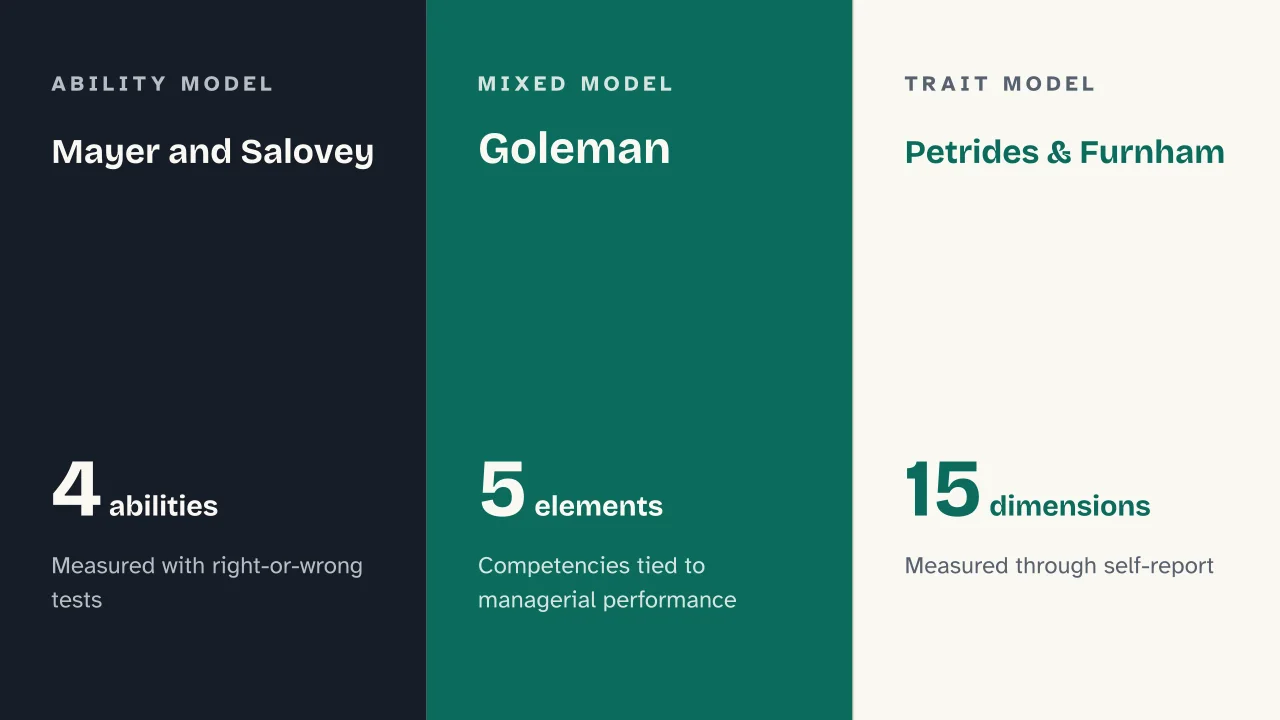
    • Alongside the ability model sit a trait model (Petrides and Furnham, fifteen dimensions) and two mixed models (Goleman, five elements; Bar-On, five components).
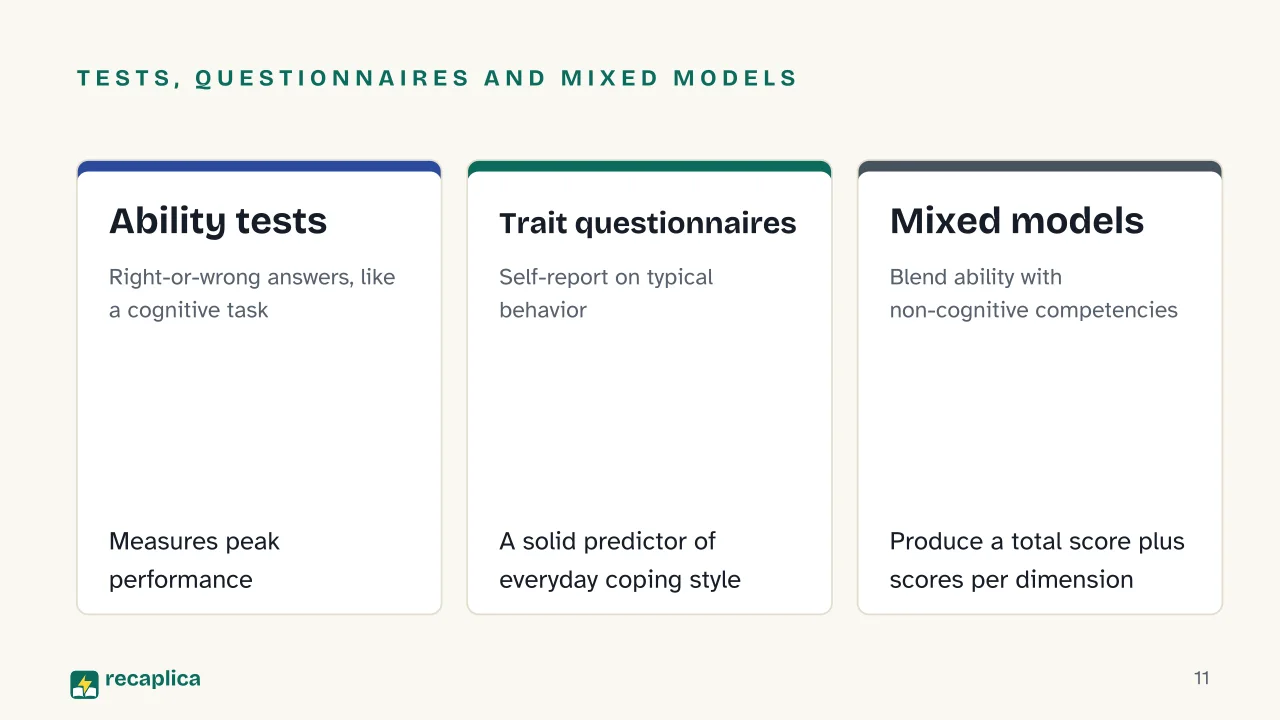
    • The measurement tools change with the model: right-or-wrong test questions for the ability model, self-report questionnaires for the trait and mixed models.
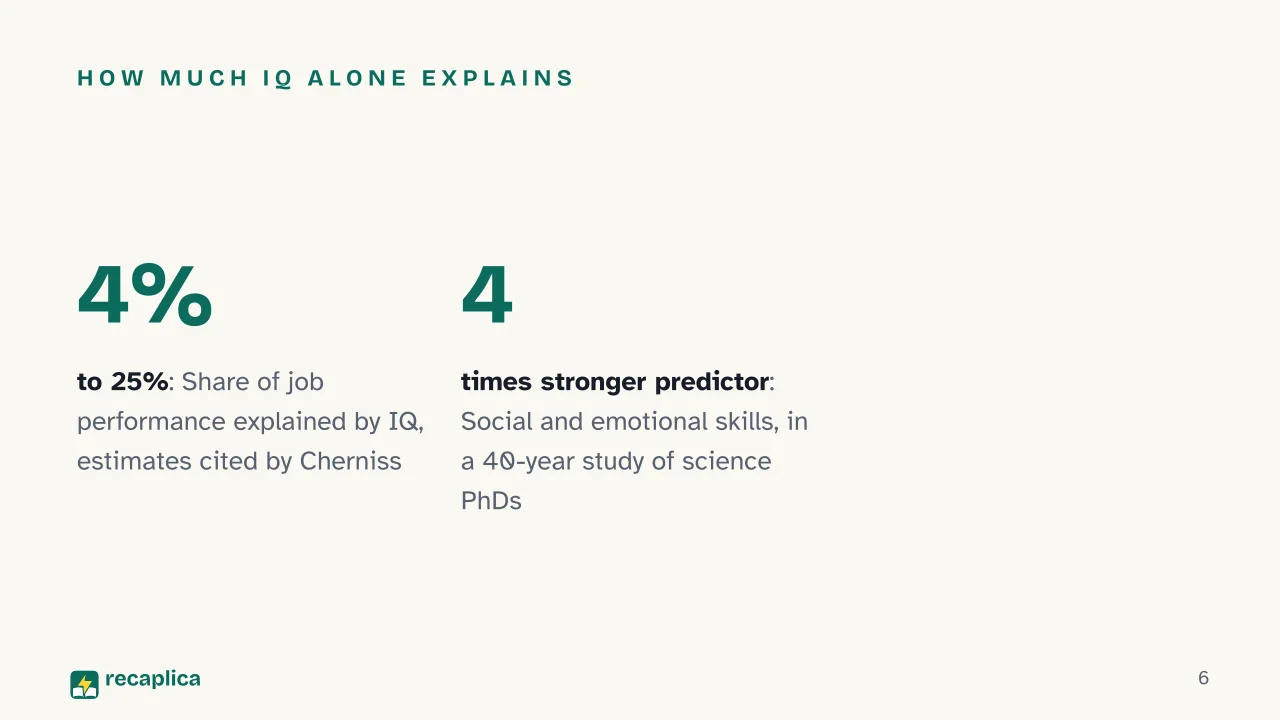
    • A review by Cherniss credits IQ alone with somewhere between 4% and 25% of job performance; the construct itself, taken alone, also turns out to be a modest predictor.

    Key figures

    • 1990 The year Salovey and Mayer publish the paper that introduces the term «emotional intelligence» into academic literature. Source: Salovey & Mayer, 1990
    • 1997 The year Mayer and Salovey revise their own definition, later adopted by the American Psychological Association's official dictionary. Source: APA Dictionary of Psychology

    Deep Dive

    The term emotional intelligence names a specific capacity, one that several theoretical models describe and that gets measured differently depending on which model is used.

    What emotional intelligence is

    Peter Salovey and John Mayer, who coin the term in 1990, define emotional intelligence as a set of abilities for recognizing and expressing one’s own emotions and other people’s, regulating them, and using them to guide thought and action. The authors place it within the framework of personal intelligences described by Howard Gardner, but narrow it: it concerns the recognition and use of emotional states, not general knowledge of oneself and others.

    The American Psychological Association’s dictionary picks up this origin: emotional intelligence is a type of intelligence concerned with the capacity to process emotional information and apply it to reasoning. That definition sits close to how cognitivist psychology describes the mind more broadly — a system that processes information — applied here to emotions. Knowing what counts as an emotion in the first place is the step before that, and the Recap on human emotions covers it.

    Practical example: a student who notices they feel anxious before an oral exam, realizes the anxiety comes from a fear of getting something wrong, and uses that awareness to review calmly instead of spiraling, is exercising exactly the abilities Salovey and Mayer describe: noticing the emotion, making sense of it, regulating it.

    The four-ability model, revised in 1997

    In 1997 Mayer and Salovey revise their original definition into four abilities, according to the APA Dictionary of Psychology: accurately perceiving and appraising emotions; accessing emotions and using them when they help thinking; understanding emotional language; and regulating one’s own emotions and other people’s to support growth and well-being.

    These four abilities remain the reference point for test-based measurement tools: questions with a right answer and a wrong one, much like any other cognitive task. The self-report questionnaires used for the other models work differently, as the next sections show.

    Goleman’s model

    Salovey and Mayer’s ideas are carried to a wide audience by Daniel Goleman, a science journalist and psychologist, through a hugely successful book that revises the original definition to include a range of personality variables, according to the APA Dictionary of Psychology. In Goleman’s mixed model, as described by the review from Bru-Luna and colleagues (2021), emotional intelligence comprises five elements: recognizing one’s own emotions, managing them, self-motivation, recognizing other people’s emotions, and managing relationships. These are the competencies Goleman links to managerial performance and leadership.

    A related but independent model comes from Reuven Bar-On: five components — intrapersonal, interpersonal, adaptability, stress management and general mood — covering a broader set of non-cognitive abilities and competencies.

    The trait model, and how it’s all measured

    Petrides and Furnham propose a different model: a stable personality trait, spread across fifteen dimensions grouped into four factors (well-being, self-control, emotionality, sociability), according to the systematic review by Bru-Luna and colleagues (2021). It is measured through self-report questionnaires on typical behavior.

    ModelAuthorsNatureHow it’s measured
    AbilityMayer and SaloveyCognitive capacityRight-or-wrong tests
    TraitPetrides and FurnhamPersonality traitSelf-report questionnaire
    MixedGolemanAbilities and competenciesSelf-report questionnaire
    MixedBar-OnAbilities and competenciesSelf-report questionnaire

    Despite the differences between models, most measurement tools share a few traits: they produce a total score together with scores for each dimension. The dimensions also overlap quite often, since most instruments end up touching on how emotions get noticed, handled and put to use, according to the same review. Trait-based instruments stand out as good predictors of coping style when adults or children face everyday stress.

    Emotional intelligence, IQ and success at work

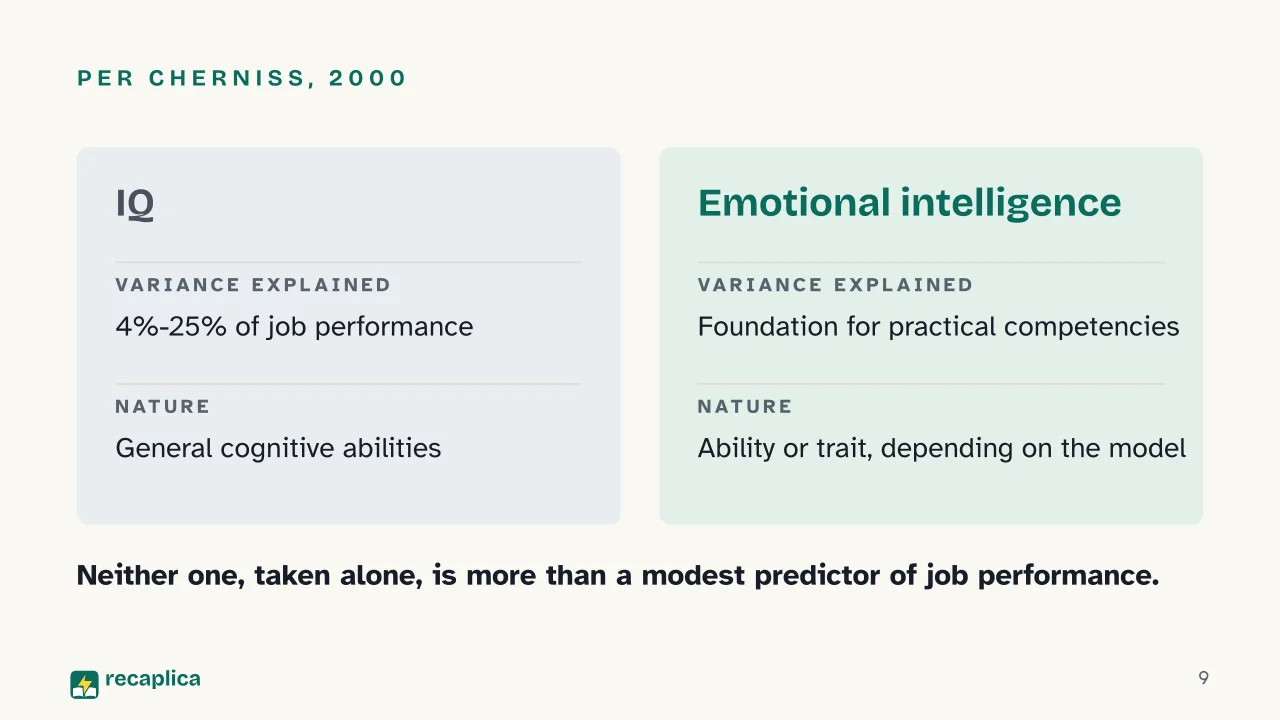
    According to the review by Cary Cherniss (2000), IQ on its own explains a limited share of the variance in job performance — estimated at between 4% and 25%, depending on the study cited. In one study Cherniss reports, following a group of science PhDs over forty years, social and emotional skills turned out to be four times more predictive than youthful IQ scores of the career success and prestige those same people reached later on. For a wider view of the classic theories of intelligence and the tests built to measure it, the distinction between the two research traditions helps make sense of these numbers.

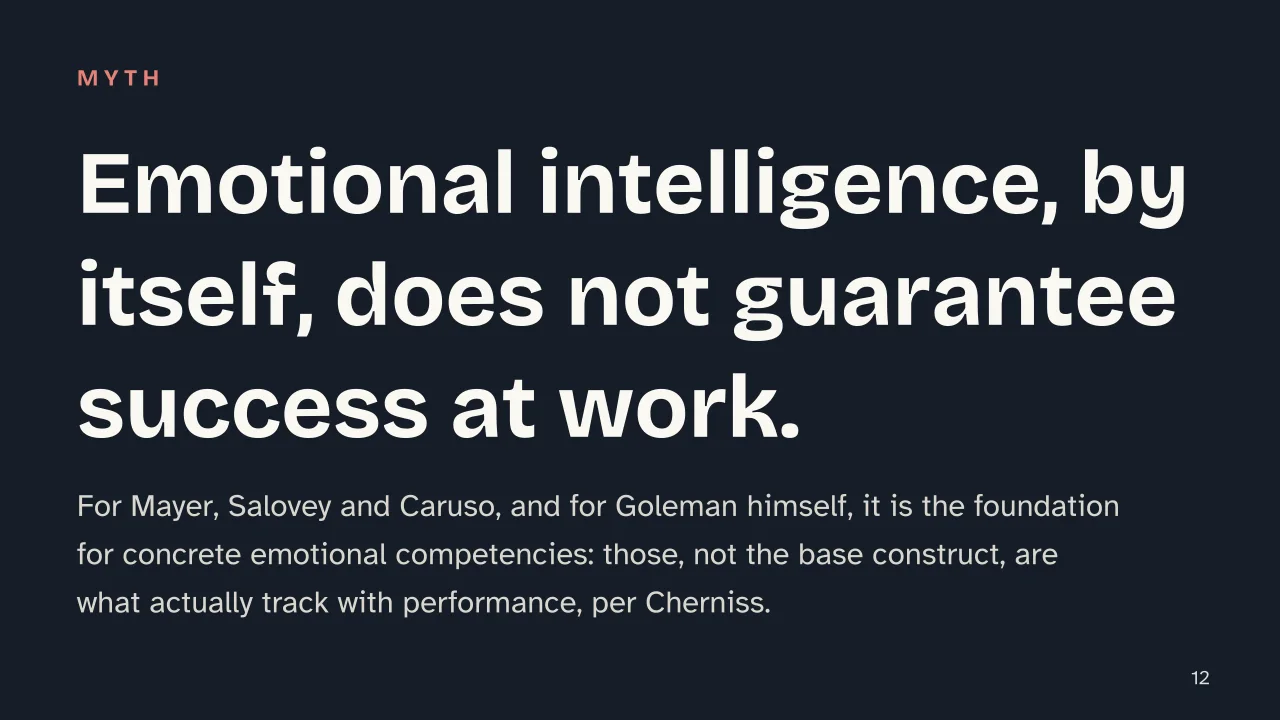
    Cherniss reports that both Goleman and the trio of Mayer, Salovey and Caruso treat the construct, taken on its own, as a modest predictor of job performance. They describe it instead as the foundation for concrete emotional competencies — what Goleman calls emotional competence, distinct from the underlying ability — and it is the competence that correlates with stronger performance. Cherniss also flags an academic critique from Davies, Stankov and Roberts (1998), who argue the construct adds nothing empirically new beyond what other scales already capture, and he concedes that, as of 2000, research on the predictive validity of the measurement tools was still thin.

    Practical example: two managers with identical IQ test scores can perform very differently at work if one notices a team’s frustration building before it turns into open conflict, and the other doesn’t. By Cherniss’s own distinction, it’s that concrete emotional competence that makes the difference, not the IQ score on its own.

    Slide deck

    Slides ready to download and make your own in PowerPoint or Google Slides, with speaker notes. Pick the Flash cut or the Full one.
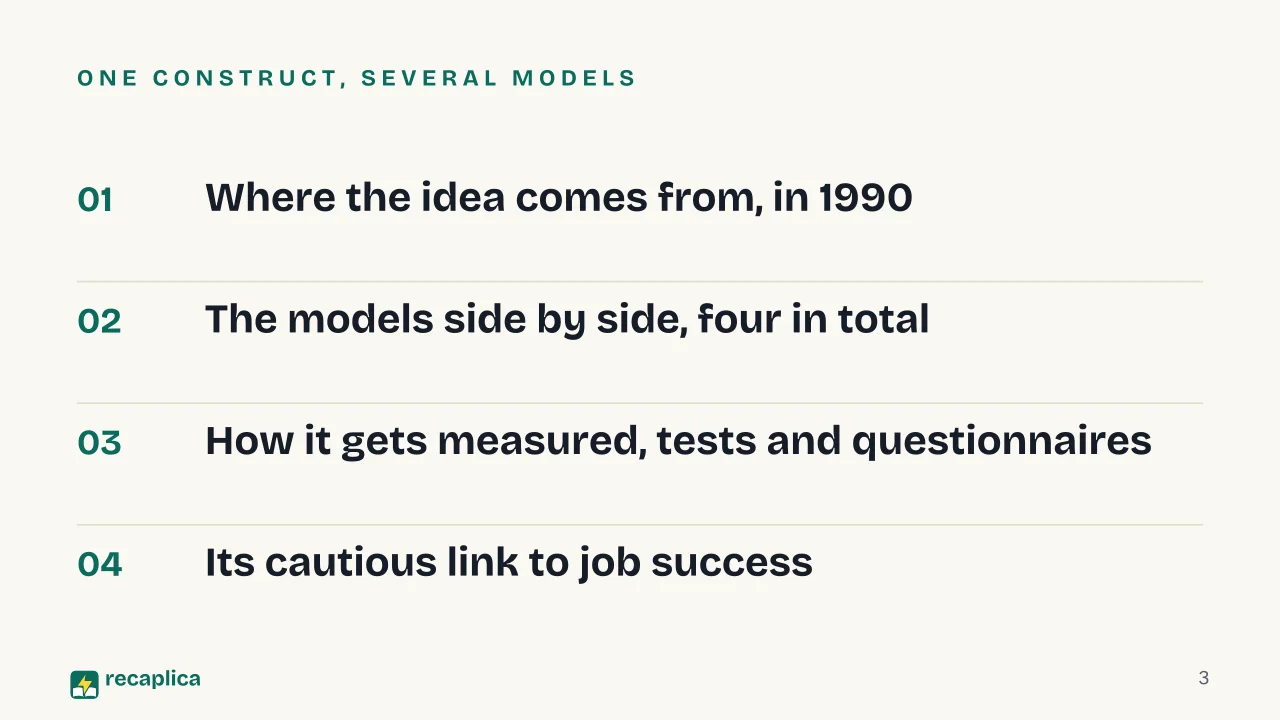
    Slide 1 of the presentation on Emotional Intelligence: Emotional IntelligenceSlide 2 of the presentation on Emotional Intelligence: Is emotional intelligence something you're born with, or a set of abilities?Slide 3 of the presentation on Emotional Intelligence: One construct, several modelsSlide 4 of the presentation on Emotional Intelligence: Chapter 01: Where it startedSlide 5 of the presentation on Emotional Intelligence: From 1990 to Goleman's bookSlide 6 of the presentation on Emotional Intelligence: How much IQ alone explainsSlide 7 of the presentation on Emotional Intelligence: Chapter 02: The models side by sideSlide 8 of the presentation on Emotional Intelligence: Mayer and Salovey · Goleman · Petrides & FurnhamSlide 9 of the presentation on Emotional Intelligence: Per Cherniss, 2000Slide 10 of the presentation on Emotional Intelligence: Chapter 03: How it's measuredSlide 11 of the presentation on Emotional Intelligence: Tests, questionnaires and mixed models: Ability tests, Trait questionnaires, Mixed modelsSlide 12 of the presentation on Emotional Intelligence: Emotional intelligence, by itself, does not guarantee success at work.Slide 13 of the presentation on Emotional Intelligence: Who coined the term «emotional intelligence», and when?Slide 14 of the presentation on Emotional Intelligence: Time for a quick review
    Flash10 slidesThe essential thread, to present in classFull14 slidesEvery chapter and the deeper detail

    Common myths

    • ✗ Myth High emotional intelligence guarantees success at work.

      ✓ Reality Cherniss finds that IQ alone accounts for somewhere between 4% and 25% of job performance, depending on the study cited; Goleman, Mayer, Salovey and Caruso likewise warn that the construct, on its own, remains a modest predictor — useful mainly as a foundation for the emotional competencies that actually track with performance.

    • ✗ Myth Emotional intelligence is an idea that started with Daniel Goleman.

      ✓ Reality The academic credit belongs to Peter Salovey and John Mayer, who publish the original 1990 paper. Goleman arrives five years later with a book that carries the construct to a general readership; the APA Dictionary of Psychology notes it also stretches the original definition to cover personality traits.

    • ✗ Myth There is one scientifically accepted way to measure emotional intelligence.

      ✓ Reality Psychologists use different tools depending on the model: the systematic review by Bru-Luna and colleagues (2021) lists right-or-wrong ability tests, self-report trait questionnaires and mixed instruments, and their results don't line up with one another.

    Mind map

    Drag the background to move around and the nodes to reposition them; use − and + to collapse and expand branches.
    Customize
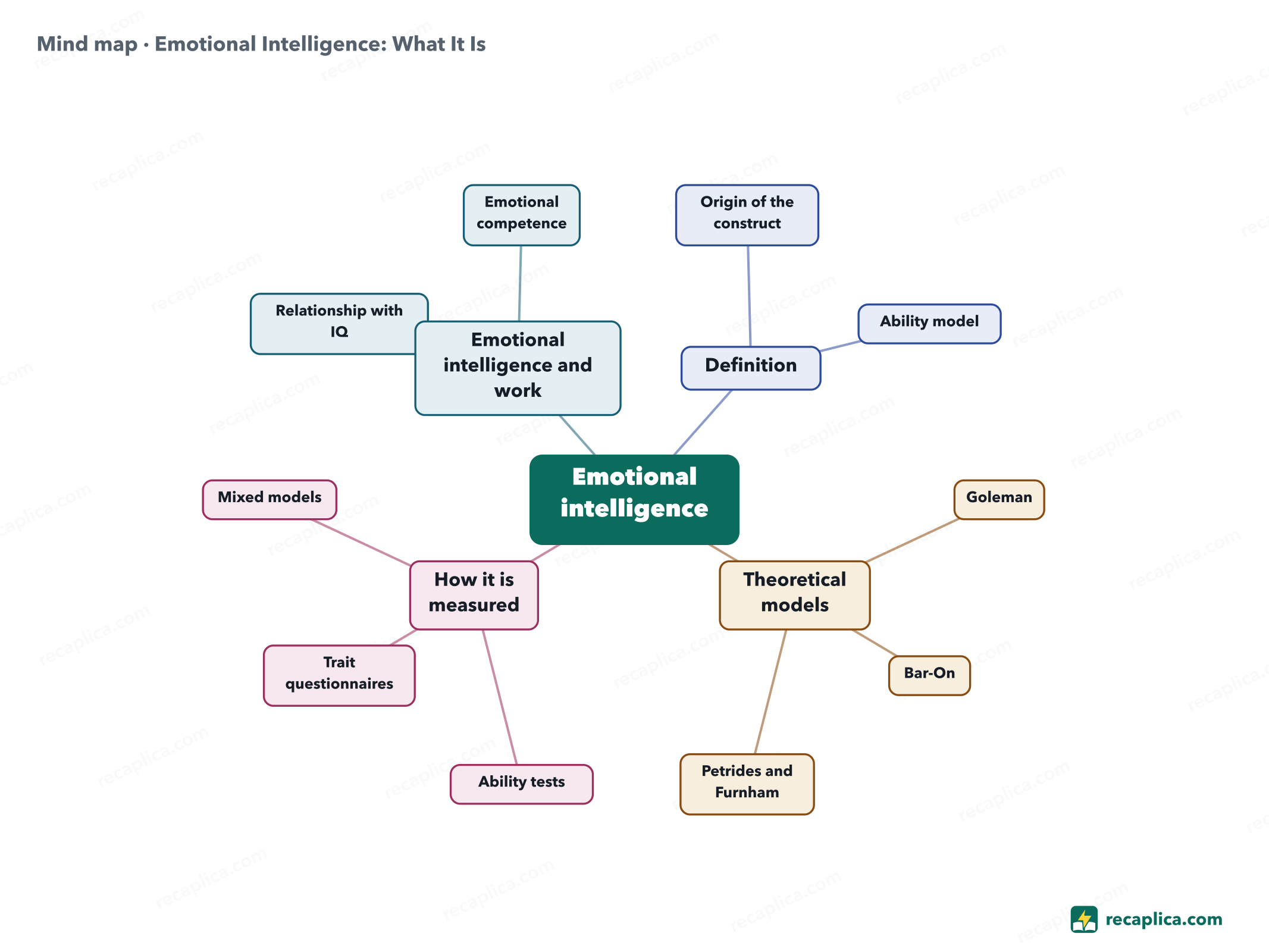
    Mind map: Emotional Intelligence: What It Is
    • Emotional intelligence
      • Definition
        • Origin of the construct Salovey and Mayer, 1990
        • Ability model Revised in 1997, four abilities
      • Theoretical models
        • Goleman Mixed model, five elements
        • Bar-On Mixed model, five components
        • Petrides and Furnham Trait model, fifteen dimensions
      • How it is measured
        • Ability tests Right answers, like a cognitive task
        • Trait questionnaires Self-report on typical behavior
        • Mixed models Blend ability and personality traits
      • Emotional intelligence and work
        • Relationship with IQ Per Cherniss, 2000
        • Emotional competence Goleman's distinction

    Quiz: test yourself

    Answer the questions to check what you have learned: you get instant feedback and a short explanation.

    Grade 0/10 0/5
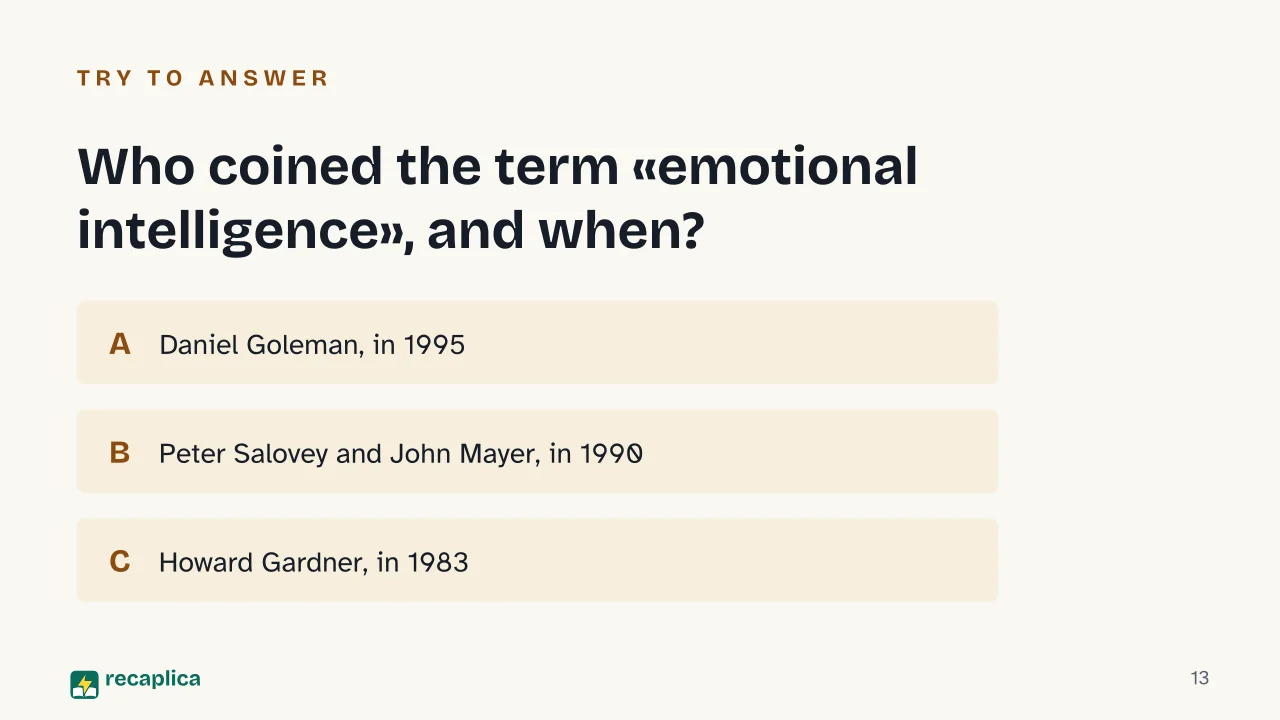
    1 Who coined the term «emotional intelligence», and when?

    The paper that introduces the construct dates to 1990 and is signed by Salovey and Mayer; the book that carries it to a general audience with Goleman's name comes five years later, according to the APA Dictionary of Psychology.

    2 In the model Mayer and Salovey revise in 1997, how many abilities make up emotional intelligence?

    The American Psychological Association's dictionary lists four: accurately appraising emotions, letting them inform reasoning, understanding their language, and managing them in oneself and in others.

    3 According to Mayer, Salovey and Caruso, emotional intelligence by itself is a strong predictor of job performance.

    Cherniss reports that the model's own authors treat the construct as a foundation for the emotional competencies that are more closely tied to performance than the raw capacity itself.

    4 In the trait model developed by Petrides and Furnham, what is emotional intelligence?

    The review by Bru-Luna and colleagues (2021) frames the trait model as a stable personality description, with fifteen dimensions assessed through self-report questionnaires.

    5 How many elements make up Goleman's mixed model, according to the review by Bru-Luna and colleagues?

    The review by Bru-Luna and colleagues counts five elements in Goleman's model, from recognizing one's own emotions through to managing relationships, passing through self-motivation and reading other people's emotions.

    Answers: 1-B · 2-C · 3-B · 4-B · 5-C

    Flashcards

    Tap the card to flip it and check whether you remember the answer, then move to the next one.

    1 / 8

    Explain it in your own words

    The ultimate test: if you can explain it in simple words, you've truly understood it. Write your explanation, then compare it with the Recap.

    Your explanation is saved only on this device.

    Emotional intelligence is the ability to recognize, express and regulate emotions — one's own and other people's — and to use them to guide thinking and behavior. Psychologists Peter Salovey and John Mayer coin the term in 1990, five years before Daniel Goleman's book makes it a household phrase worldwide. Several models describe it, each with its own way of measuring it: the ability model of Mayer and Salovey, the trait model of Petrides and Furnham, and the mixed models of Goleman and Bar-On. A review by Cherniss finds that IQ on its own accounts for only a modest share of job performance, and emotional intelligence, taken alone, turns out to be just as modest a predictor of the same performance.

    Frequently asked questions

    What is emotional intelligence?

    The APA Dictionary of Psychology describes it as a type of intelligence tied to processing emotions and weighing them in reasoning — an idea put forward by Peter Salovey and John Mayer and carried to a general audience by Daniel Goleman.

    What's the difference between emotional intelligence and IQ?

    They come from different research traditions: IQ measures general cognitive abilities, while emotional intelligence concerns one's own emotions and other people's. In Cherniss's review, IQ accounts for between 4% and 25% of job performance, and the emotional construct, on its own, turns out to be an equally modest predictor.

    Who came up with emotional intelligence — Goleman or Salovey and Mayer?

    The 1990 academic paper carries the names of Salovey and Mayer. Goleman's name comes later, tied to the book that spreads the construct worldwide and broadens its definition to include personality traits.

    How many models of emotional intelligence are there?

    The review by Bru-Luna and colleagues (2021) compares four: the ability model from Mayer and Salovey, the trait model from Petrides and Furnham, and the two mixed models signed by Goleman and Bar-On.

    Can emotional intelligence be measured with a test?

    Only partly. The ability model uses right-or-wrong questions; the other models, according to the review by Bru-Luna and colleagues (2021), rely on questionnaires where people describe their own typical behavior.

    Sources

    • Salovey, P., & Mayer, J. D. (1990). Emotional Intelligence. Imagination, Cognition and Personality, 9(3), 185-211
    • APA Dictionary of Psychology, entry «emotional intelligence»
    • Cherniss, C. (2000). What is Emotional Intelligence? The Consortium for Research on Emotional Intelligence in Organizations
    • Bru-Luna, L. M. et al. (2021). Emotional Intelligence Measures: A Systematic Review. Healthcare (Basel), 9(12), 1696

    Every Recap goes through an independent review before publication.

    Every evening, the day's new Recaps on our Telegram channel. Join the channel →

    Keep learning

    • Science Correlation: What It Means and How to Read the Coefficient Correlation measures how closely two variables move together, and the most common way to put a number on it is the correlation coefficient, which runs from -1 to +1. A value near +1 means the two variables rise together, near -1 means one rises while the other falls, and near 0 means no linear relationship stands out. The coefficient only captures the strength of a straight-line relationship, and a single unusual data point can push it up or down by a lot. Even when it's strong, a correlation between two variables never shows that one causes the other. Read the Recap →
    • Science Light Refraction: What It Is, the Laws Behind It, and Examples A surface that separates two transparent materials sends some light back, reflecting it, and lets the rest through while bending it toward a new direction. The law of reflection keeps the incoming and outgoing angles equal, both measured from the normal to the surface. Snell's law governs refraction instead, linking the index of each material to how much the ray tilts before and after it crosses over. These two laws alone explain mirrors, lenses, prisms and everyday sights such as a pencil that appears to snap inside a glass of water. Read the Recap →
    • Science Total Internal Reflection and the Critical Angle: Definition and Formula Total internal reflection is what happens when a light ray stops being able to leave a transparent medium and gets sent back inside it completely. It takes place past a specific angle of incidence, called the critical angle, calculated with Snell's law by comparing the refractive indices of the two materials involved. It only happens under one precise condition: the ray must be traveling from an optically denser medium into a less dense one, such as from water into air or from glass into air. Optical fibers and, in part, the sparkle of diamonds rely on this same principle. Read the Recap →

    recaplica

    Clear in 30 seconds, yours in 10 minutes.

    Recaps Mind maps Request a Recap Telegram channel Mind map maker Our method About Privacy & cookies Legal notes & terms of use

    © 2026 Recaplica · A project by Curi S.r.l. — VAT IT05472000750

    Statistics, only if you say so

    To learn which Recaps help most we would use Google Analytics, with aggregate, anonymous data. It starts only with your OK, and you can change your mind anytime. Privacy policy