|
recaplica
What Is Sustainable Agriculture? Definition, Measures, and the Organic Difference | |||||||||||||||
| © 2026 Recaplica · recaplica.com — All rights reserved | |||||||||||||||
What Is Sustainable Agriculture? Definition, Measures, and the Organic DifferenceWhat to print Page numbers appear when printing with default margins. SlidesChoose a cut Flash10 slidesThe essential thread, to present in classFull14 slidesEvery chapter and the deeper detailBoth come with speaker notes. In 30 seconds quick readSustainable agriculture is a way of growing food and raising livestock that aims to meet today's needs without using up the natural resources future generations will depend on. It isn't one fixed method or a certification: it's a balance among three goals — protecting the environment, keeping farms economically viable, and treating the people who work the land fairly. In practice, it gets measured on three fronts: how soil is managed, how water is used, and how much biodiversity survives in the fields. That is also what sets it apart from organic farming, which is a specific production method regulated by the European Union, not a general goal. Key Points
Key figures
Deep DiveAsk ten people what sustainable agriculture means and most will point to one thing: no pesticides, or non-GMO seeds, or some other single practice. The FAO’s working definition is broader than any of those examples. Agriculture counts as sustainable, in that definition, when it meets today’s food needs without undermining the ability of future generations to meet their own, while keeping farms profitable and treating the people who work them fairly. That definition did not emerge in a vacuum. The FAO defines sustainable agricultural development as managing and conserving the natural resource base while steering technological and institutional change so that human needs are met for both present and future generations, and it ties that definition to Agenda 21, adopted in 1992 at the United Nations Conference on Environment and Development in Rio de Janeiro — the same summit that produced the broader idea of sustainable development. From that document, the FAO draws a concrete principle: sustainable agriculture has to conserve soil, water, and plant and animal genetic resources. It also has to stay technically and economically workable, and acceptable to the society that practices it, while it avoids degrading the environment it depends on. The three fronts sustainable farming practices are judged onA farming practice earns the label sustainable based on how it treats three natural resources: soil, water, biodiversity. Soil comes first: it’s the resource the FAO’s definition names explicitly as something to conserve, the physical base farming depends on. Water is second, and the same definition speaks of conserving it rather than simply using it however is convenient (how water moves through the environment is covered in the water cycle). Biodiversity is third, covering the plant and animal genetic resources that the same FAO definition lists among what sustainable agriculture has to preserve.
The FAO’s guiding principles for sustainable food and agriculture widen the picture beyond the environment: raising productivity, added value, and employment across food systems; protecting and enhancing natural resources; improving livelihoods and fostering inclusive economic growth; building the resilience of people, communities, and ecosystems; and adapting governance to new challenges. The United States works from a separate legal definition, set by the 1990 Farm Bill. It describes sustainable agriculture as an integrated, site-specific system of practices that can, over the long term, satisfy food needs, protect environmental quality, make efficient use of nonrenewable resources, and support the economic viability of farm operations, while making life better for the people who farm and for society overall. In 2011, the USDA reaffirmed those same four underlying goals in a consensus statement. Sustainable is not a synonym for organicThis is where most of the confusion starts. Sustainable agriculture is a broad goal: it can be reached by different routes, depending on climate, crop, and the resources at hand. Organic farming, by contrast, follows a production standard set by the European Union, with rules on which inputs and techniques are allowed.
According to the European Parliament, organic production is a sustainable farming system that respects the environment and animal welfare, with rules extending to every stage of the food chain, from the field to the point of sale. That framing helps place the two concepts in relation to each other: organic is one of the ways — a tightly regulated one — to be sustainable, not the only way and not a synonym. The gap between the two shows up in the numbers. According to the European Commission’s official factsheet on organic farming in the EU, published March 25, 2021, 8.5% of total EU agricultural land was farmed organically in 2019. The same source reports that this area grew from 8.3 million hectares in 2009 to 13.8 million hectares in 2019, an increase of nearly 66% in a decade. The target set by the Commission’s action plan, adopted the same day, is for 25% of EU agricultural land to be farmed organically by 2030 — more than triple the starting share. Having more organic land doesn’t automatically mean having more sustainable agriculture in the fullest sense, but the two goals reinforce each other on one concrete front: the European Commission measures 30% more biodiversity on organic land, one of the very fronts used to judge agricultural sustainability overall. The policies behind itAt the EU level, agricultural sustainability isn’t left entirely to individual farms. The European Commission describes the Common Agricultural Policy’s sustainability as a balance among three pillars for farms — economic, environmental, and social. Among the CAP’s environmental goals, the Commission lists tackling climate change and protecting natural resources, including strengthening biodiversity across the EU. It also states that the CAP ensures responsible management of soil, water, and air across the EU — close to the same fronts the FAO uses to measure sustainability worldwide, translated here into public policy with its own funding and rules. That link to public policy makes sustainable agriculture a topic closer to the Sustainable Development Goals than to a simple choice between “chemical” and “natural” farming. Agriculture’s share of the global climate ledger, discussed when the topic is the greenhouse effect, is also part of why the issue has a fixed place on the European policy agenda, from the 2021 action plan onward. Agroecology: a related term, not an identical oneAnother term that often comes up alongside sustainable agriculture is agroecology. The FAO describes it as a holistic, integrated approach that combines ecological and social principles to design and manage sustainable agriculture and food systems — in that definition, agroecology isn’t an alternative to sustainability but the approach used to design and run it. The FAO also frames it more broadly, as a systemic framework for steering public policy toward sustainable agrifood systems. Slide deckSlides ready to download and make your own in PowerPoint or Google Slides, with speaker notes. Pick the Flash cut or the Full one.     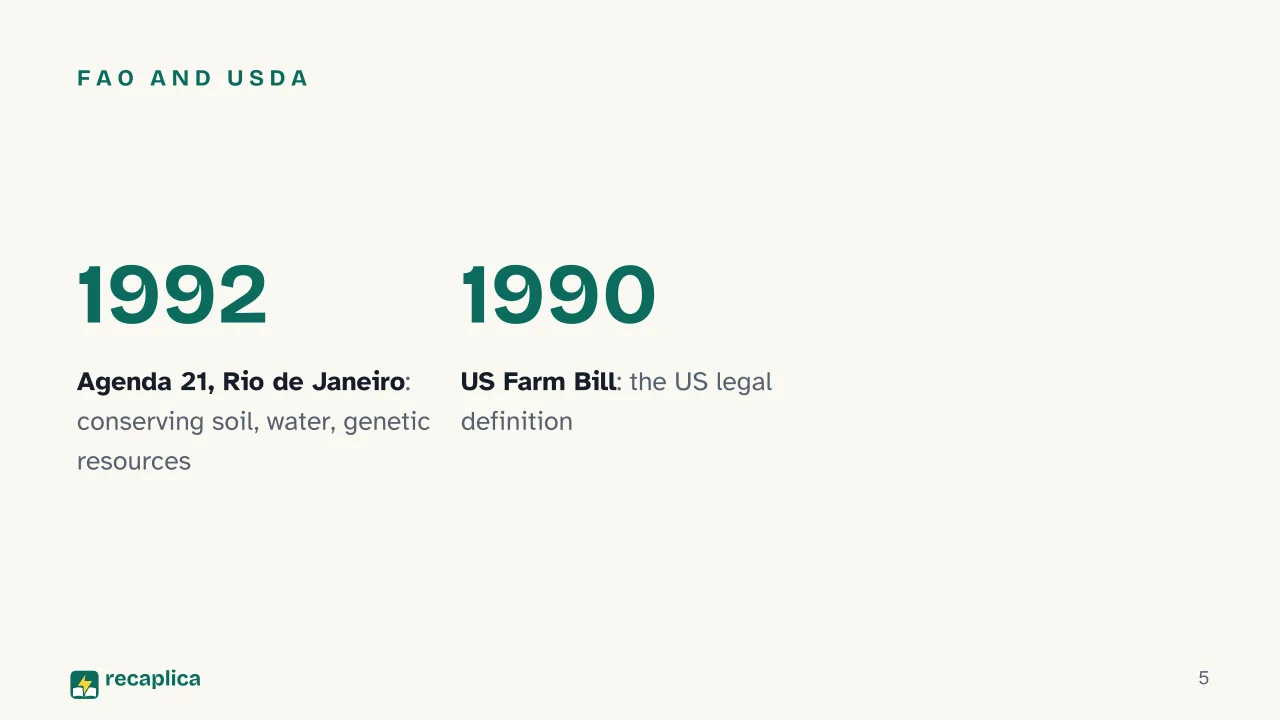  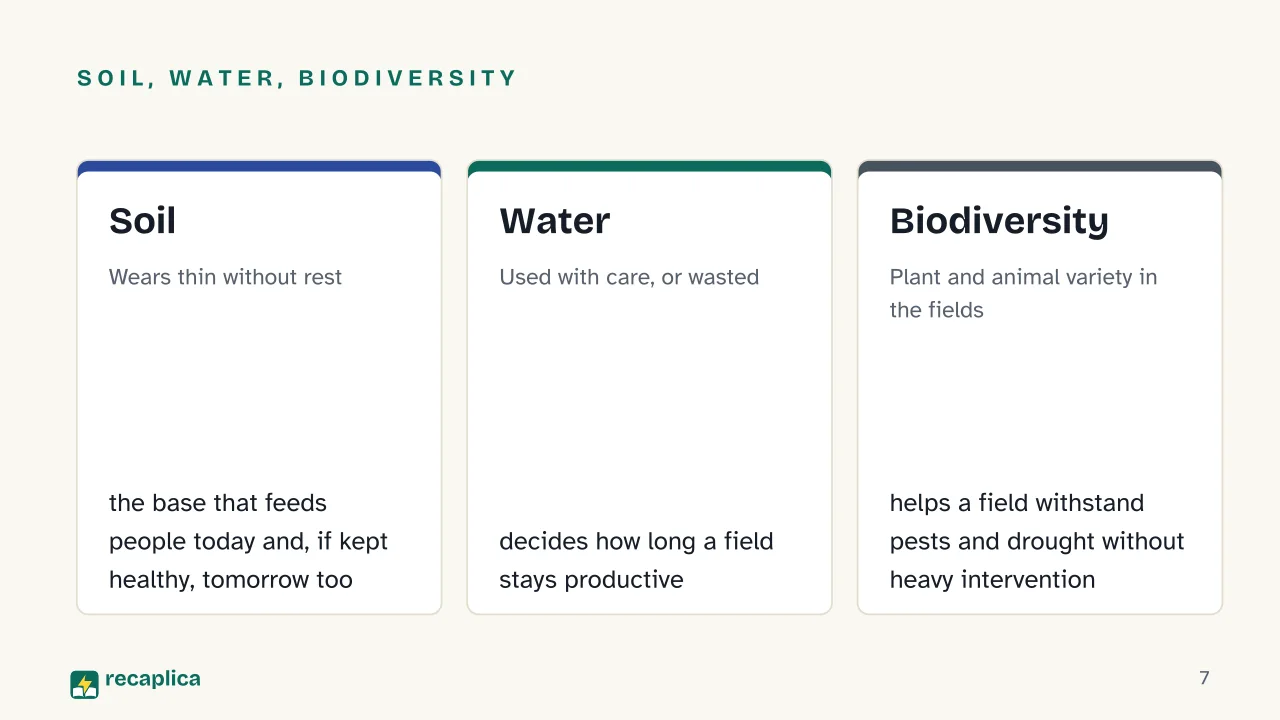  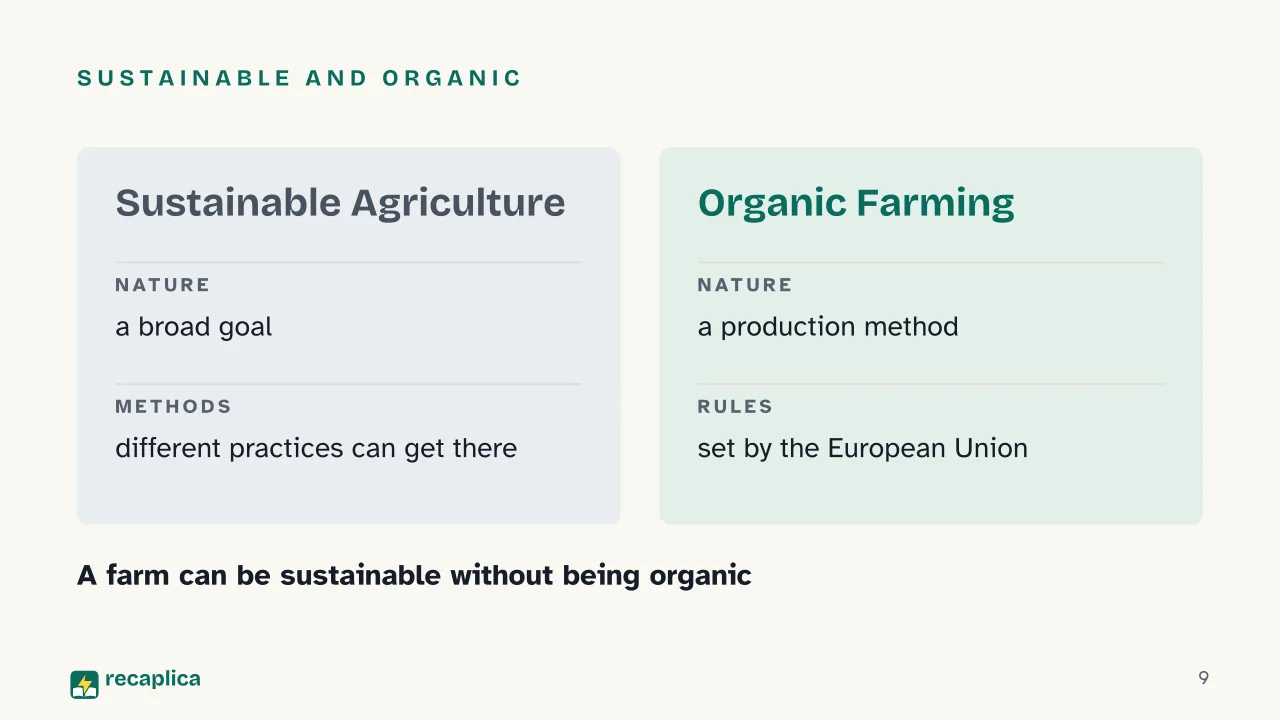 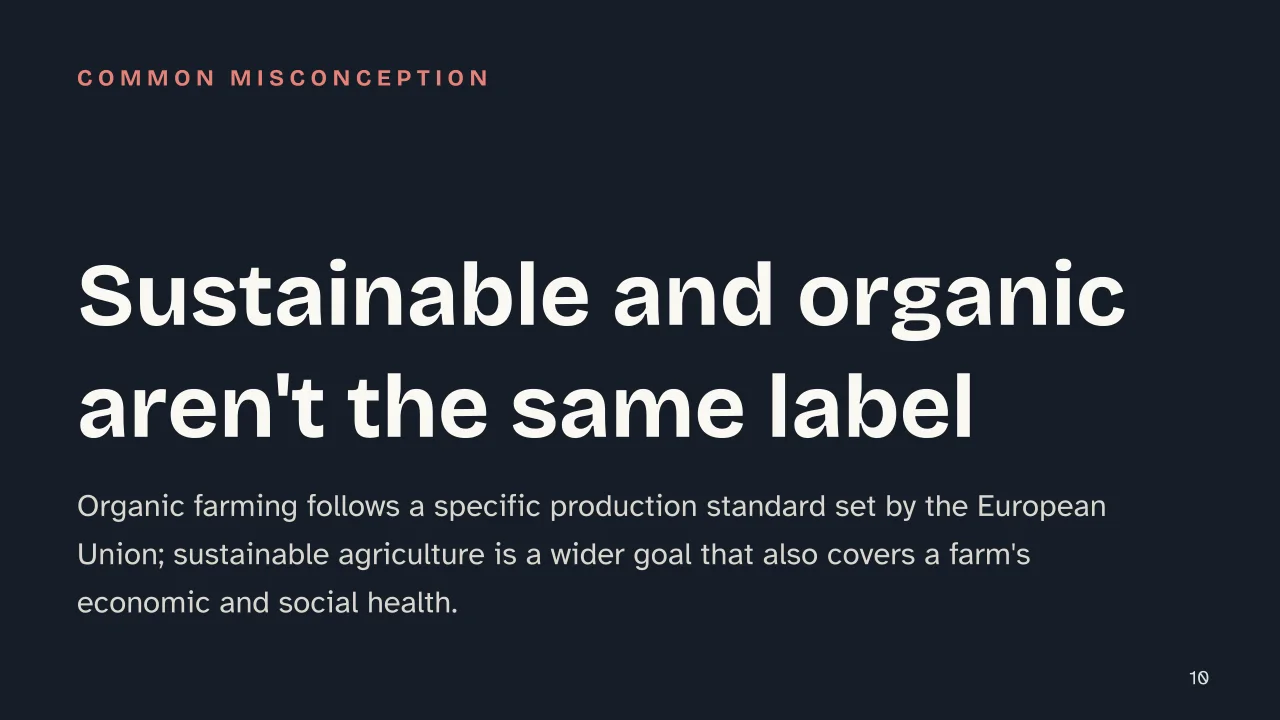  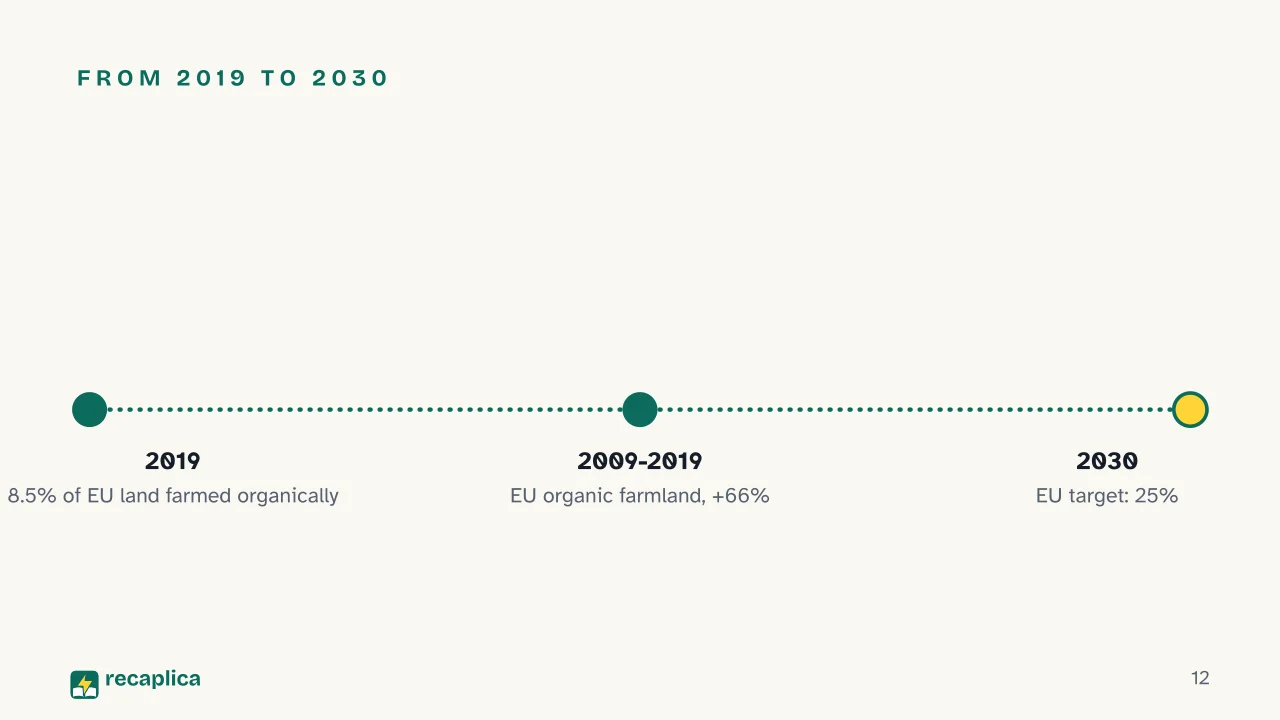 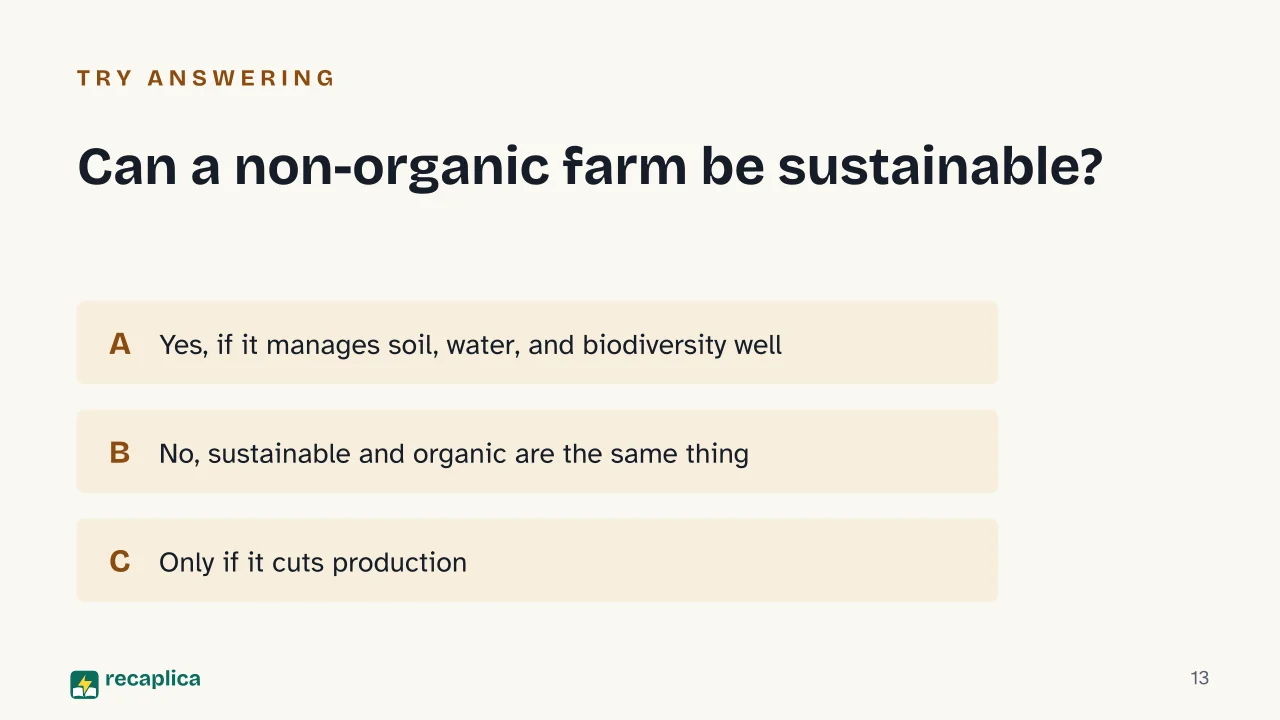  Common myths
Mind mapDrag the background to move around and the nodes to reposition them; use − and + to collapse and expand branches. 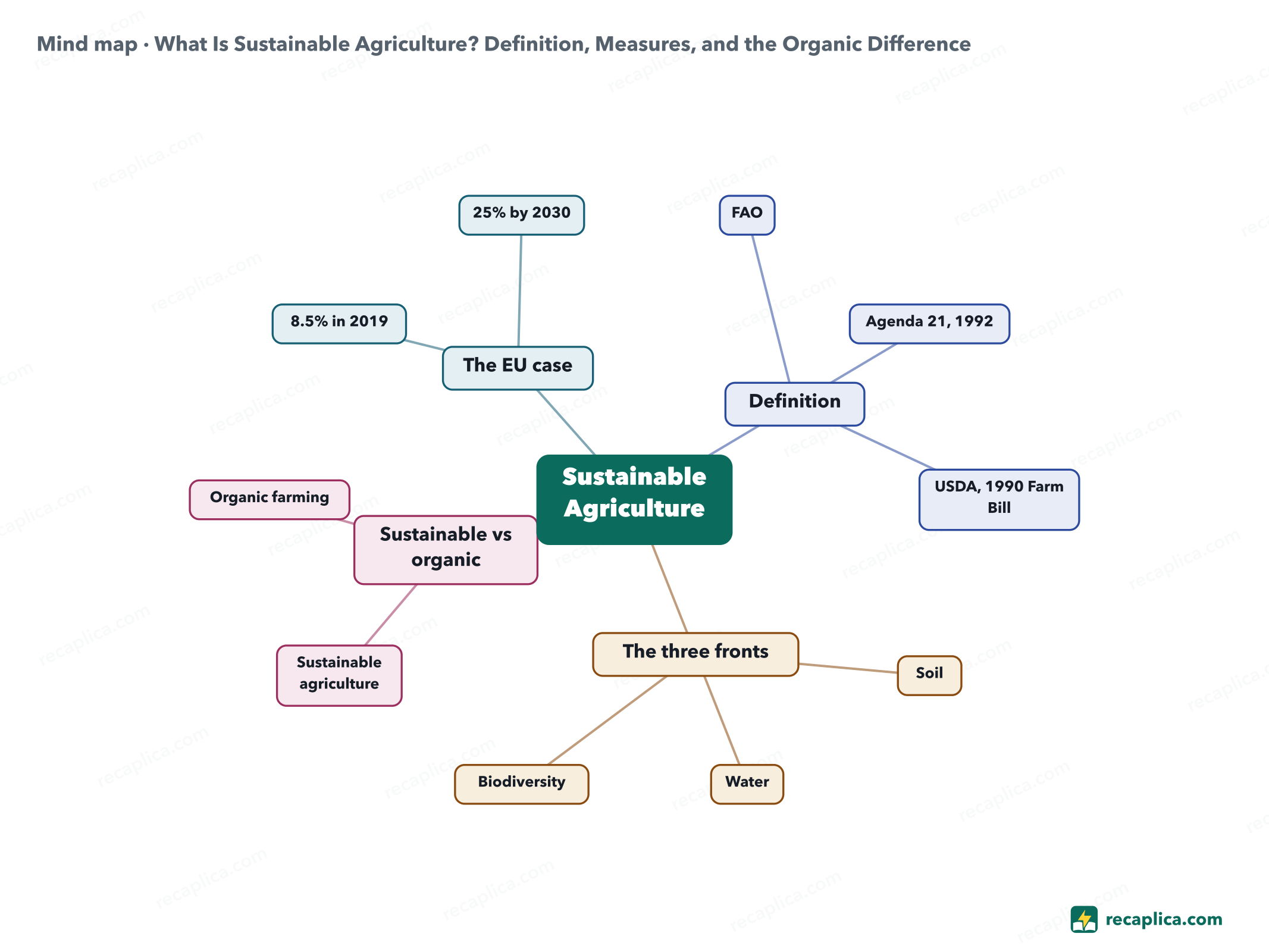
Quiz: test yourselfAnswer the questions to check what you have learned: you get instant feedback and a short explanation. Grade 0/10 0/5
FlashcardsTap the card to flip it and check whether you remember the answer, then move to the next one. 1 / 7 Explain it in your own wordsThe ultimate test: if you can explain it in simple words, you've truly understood it. Write your explanation, then compare it with the Recap. Your explanation is saved only on this device.
Frequently asked questionsWhat is sustainable agriculture?It's a model of farming and livestock-raising that meets today's needs without depleting the natural resources future generations will need, balancing environmental protection, farm profitability, and social fairness. What's the difference between sustainable agriculture and organic farming?Sustainable agriculture is a goal reachable through different practices; organic farming follows a production standard set by the European Union, with defined rules on inputs and techniques. What fronts is a farming practice judged on for sustainability?Mainly three: conserving soil, managing water, and protecting biodiversity, alongside the economic and social health of the farming operation. What is the European Union's target for organic farming?Reaching 25% of agricultural land farmed organically by 2030, up from 8.5% in 2019. What is agroecology, and how does it relate to sustainable agriculture?The FAO treats it as a way of weaving ecological and social thinking into how sustainable agriculture and food systems get designed and run — not a rival concept, but a method for building sustainability on the ground. The FAO also presents it as a broad systemic lens for steering public policy toward sustainable food systems. Every Recap goes through an independent review before publication. |