Skip to content
recaplica

    One moment: security check

    Cloudflare wants to make sure you're not a robot. Tick the box below and your search will continue on its own.

    IT
    recaplica The Water Cycle: What It Is and How It Works, Stage by Stage
    © 2026 Recaplica · recaplica.com — All rights reserved
    Home › Science

    The Water Cycle: What It Is and How It Works, Stage by Stage

    By Recaplica Newsroom · Updated on September 1, 2026

    What to print

    Page numbers appear when printing with default margins.

    Slides

    Choose a cut

    Flash10 slidesThe essential thread, to present in classFull18 slidesEvery chapter and the deeper detail

    Both come with speaker notes.

    Telegram channel
    recaplica Clear in 30 seconds, yours in 10 minutes.
    In 30 seconds Key points Figures Deep dive Slides Myths Mind map Quiz Flashcards FAQ

    In 30 seconds quick read

    The water cycle is water's never-ending journey between the oceans, the atmosphere and the land. The sun's heat makes it evaporate, the vapor condenses into clouds high up, then water falls back as rain or snow and returns to the sea through rivers and groundwater. Along the way it changes state again and again, but it is never created or destroyed. That is why the cycle has no starting point and no end.

    Key Points

    • The engine of the cycle is the sun: its heat evaporates water from oceans, lakes and rivers; gravity brings it back down.
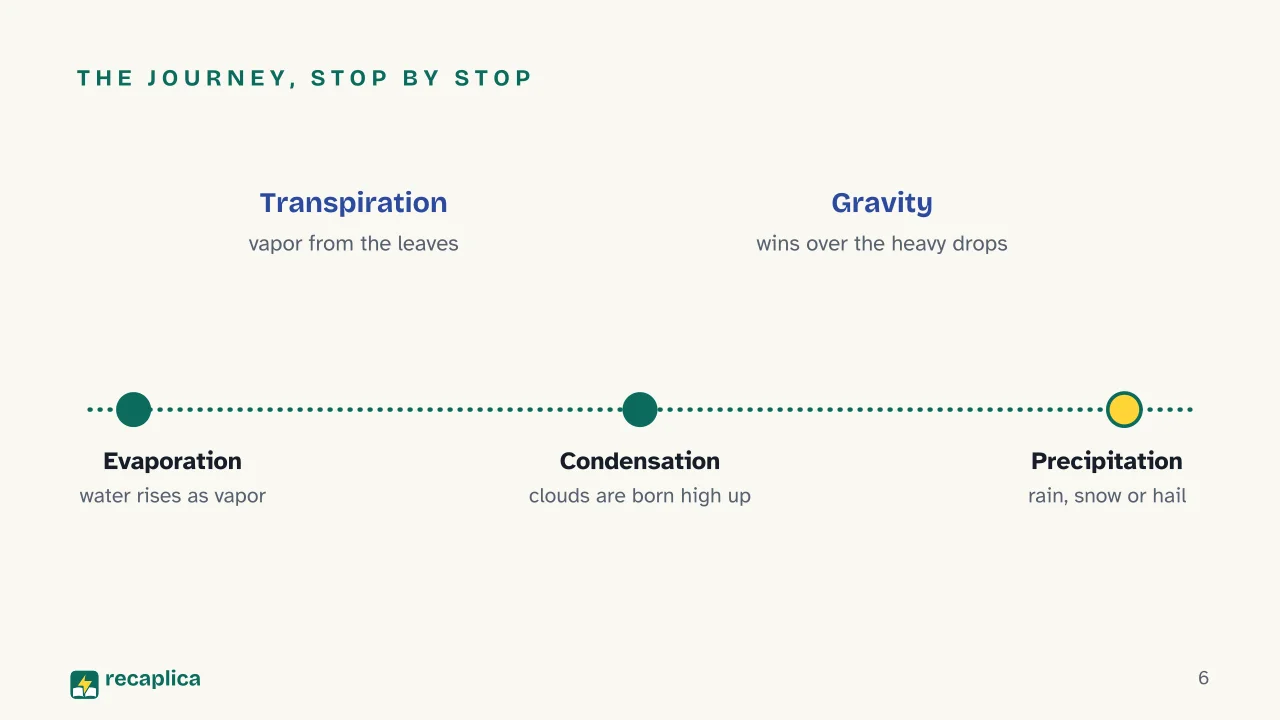
    • Water rises as vapor (evaporation and transpiration), condenses into clouds and falls back as rain or snow.
    • Back on land, water flows toward rivers and the sea (runoff) or soaks into the ground and feeds aquifers (infiltration).
    • 96.5% of Earth's water is in the oceans; only 2.5% is freshwater, and almost all of it is locked in ice and underground.
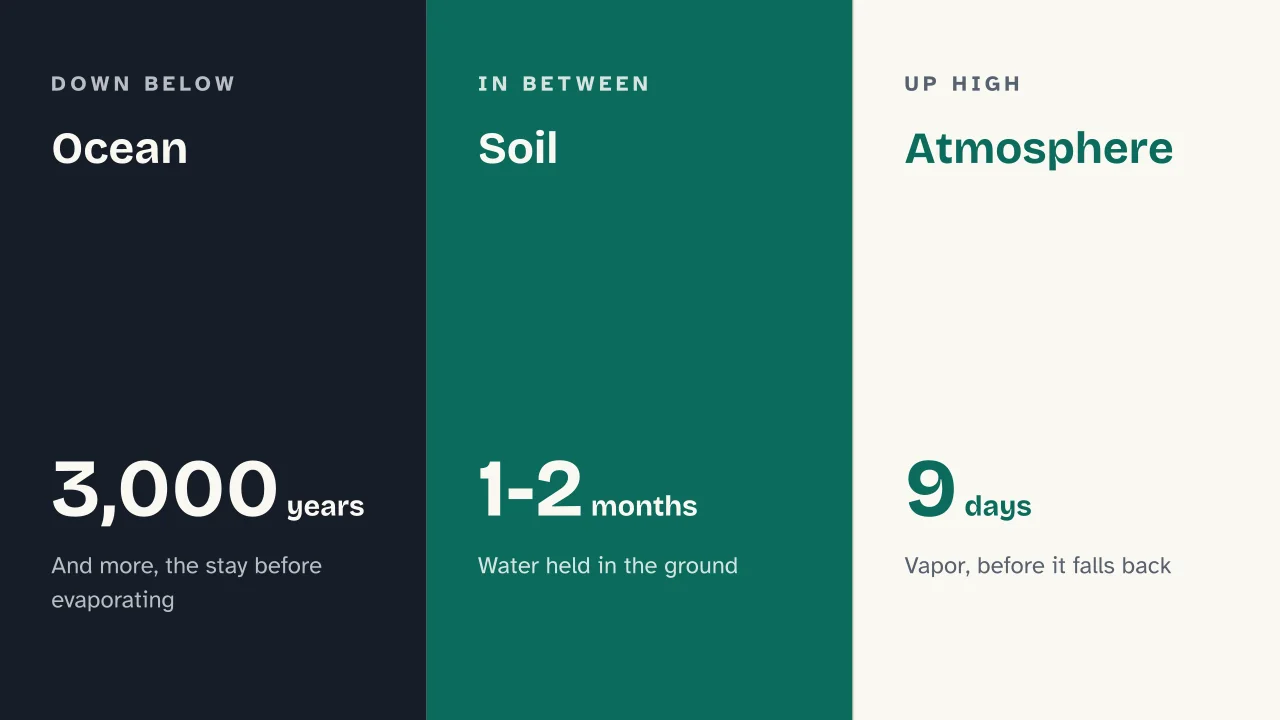
    • Every stop lasts a different amount of time: vapor stays in the atmosphere about 9 days, while a molecule can sit in the ocean for over 3,000 years.
    • Water is never used up: it only changes state and place, circulating endlessly from one reservoir to another.

    Key figures

    • 96.5% the share of Earth's water held in the oceans Source: USGS
    • ≈9 days the average time a water molecule spends in the atmosphere before falling back Source: UCAR
    • 3,000+ years the average time a water molecule spends in the ocean before evaporating Source: UCAR

    Deep Dive

    A journey with no starting point

    The water in your glass may have passed through an ocean, a cloud over the Alps and the root of a pine tree. The water cycle (textbooks also call it the hydrologic cycle) is this never-ending journey between the planet’s three great reservoirs: the oceans, the atmosphere and the land. Along the way, water changes state — liquid, vapor, ice — but it is never created or destroyed: it only changes place.

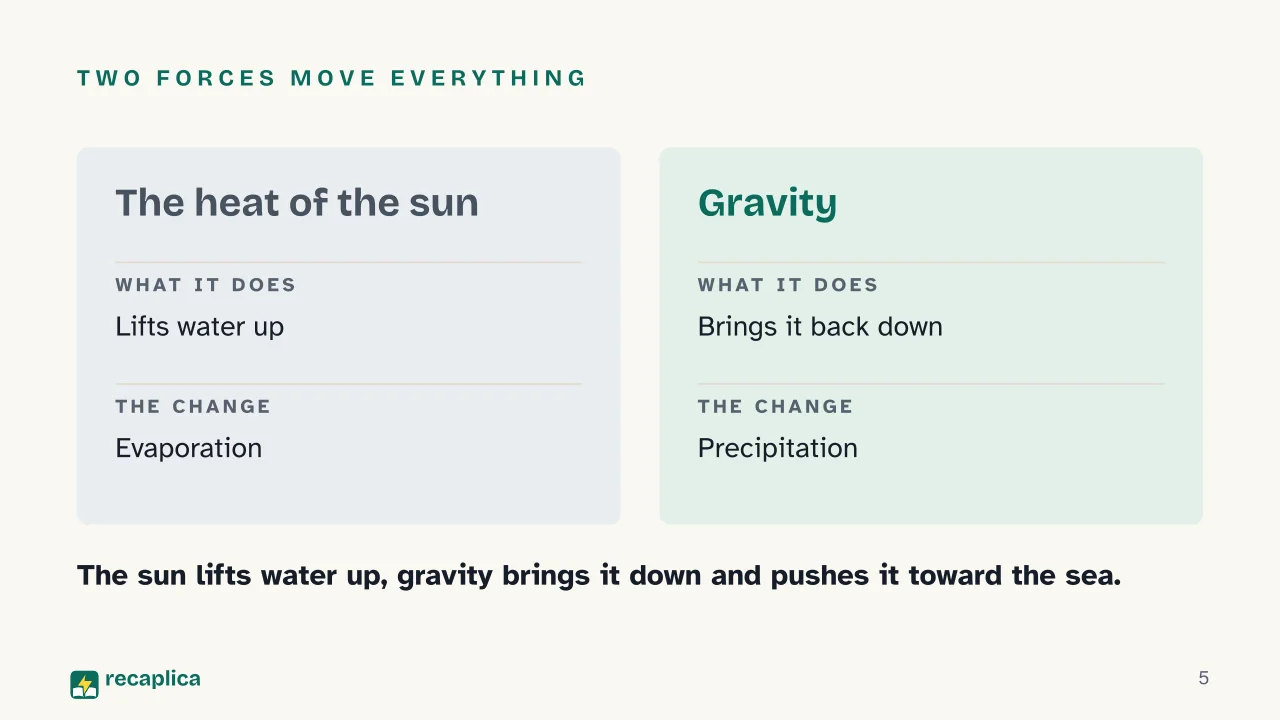
    Two forces keep everything moving. The heat of the sun lifts water by making it evaporate; gravity brings it back down and pushes it, drop by drop, toward the sea.

    The way up: from water to sky

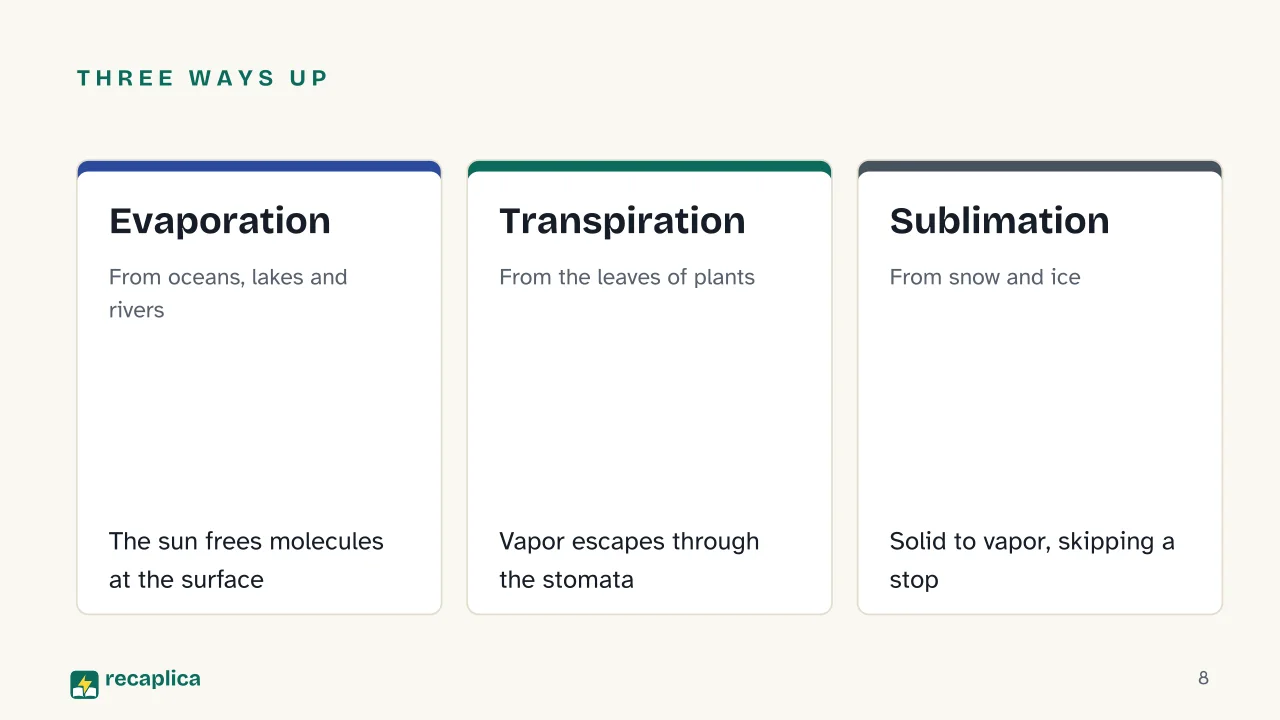
    The sun warms oceans, lakes and rivers, and some of the molecules at the surface break free and become water vapor, an invisible gas that rises into the air: this is evaporation. According to UCAR, about 86% of the water that evaporates worldwide each year comes from the oceans.

    Plants take part too. Through transpiration they release vapor from their leaves, out of the same stomata that let in carbon dioxide for photosynthesis. Snow and ice, finally, can skip a stop: through sublimation they pass directly from solid to vapor.

    Practical example: laundry on the line dries even on a cold, windy day. The water does not “vanish”: it evaporates molecule by molecule, and the wind carries the vapor away before the air around the clothes gets saturated.

    Up in the sky: condensation and clouds

    As it rises, the air cools and the vapor condenses: it turns back into microscopic liquid droplets, or freezes into tiny crystals, that stay suspended in the air. These are clouds. When droplets and crystals merge and grow too heavy, gravity wins: they fall as precipitation — rain, snow or hail, depending on the temperatures they meet on the way down.

    Practical example: the fogged-up bathroom mirror after a shower is condensation in miniature. Warm vapor meets a cold surface and turns back into liquid. Clouds are born the same way, just a few kilometers higher up.

    The return: rivers, soil and aquifers

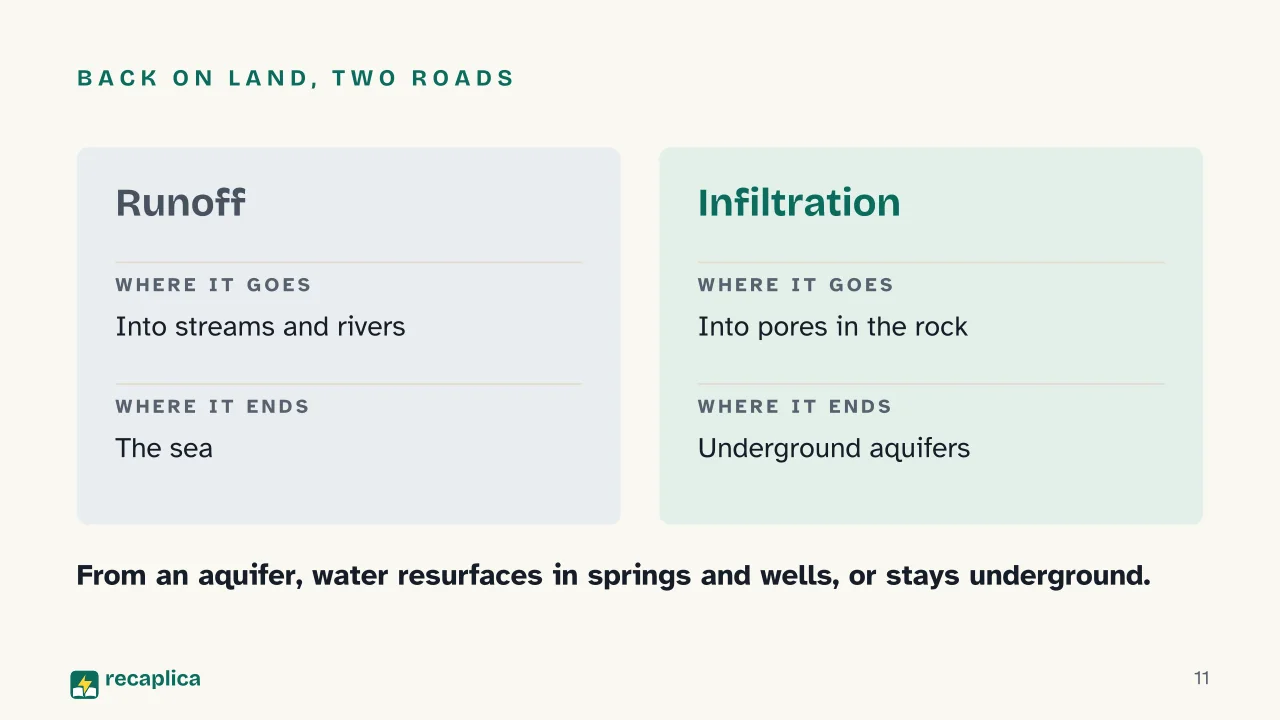
    Back on land, water takes one of two roads. Part of it flows over the surface (runoff), collecting in streams and rivers until it reaches the sea again. Another part soaks into the ground (infiltration) and fills the pores and cracks of rocks: these are the aquifers, which according to the USGS store 30.1% of all the planet’s freshwater. From there, water resurfaces in springs and wells, or stays underground for a long time.

    A small share travels through us: we drink it, and every cell in our body works bathed in water. Then we hand it back to the cycle, partly through breath and sweat, the rest down the drain.

    How long each stop lasts

    The journey has no single rhythm: some stops last days, others millennia. The average times estimated by UCAR:

    Stop on the journeyAverage stay
    Atmosphere (vapor)about 9 days
    Soil1-2 months
    Oceanover 3,000 years
    Ice caps and glaciersthousands to hundreds of thousands of years

    Where Earth’s water is

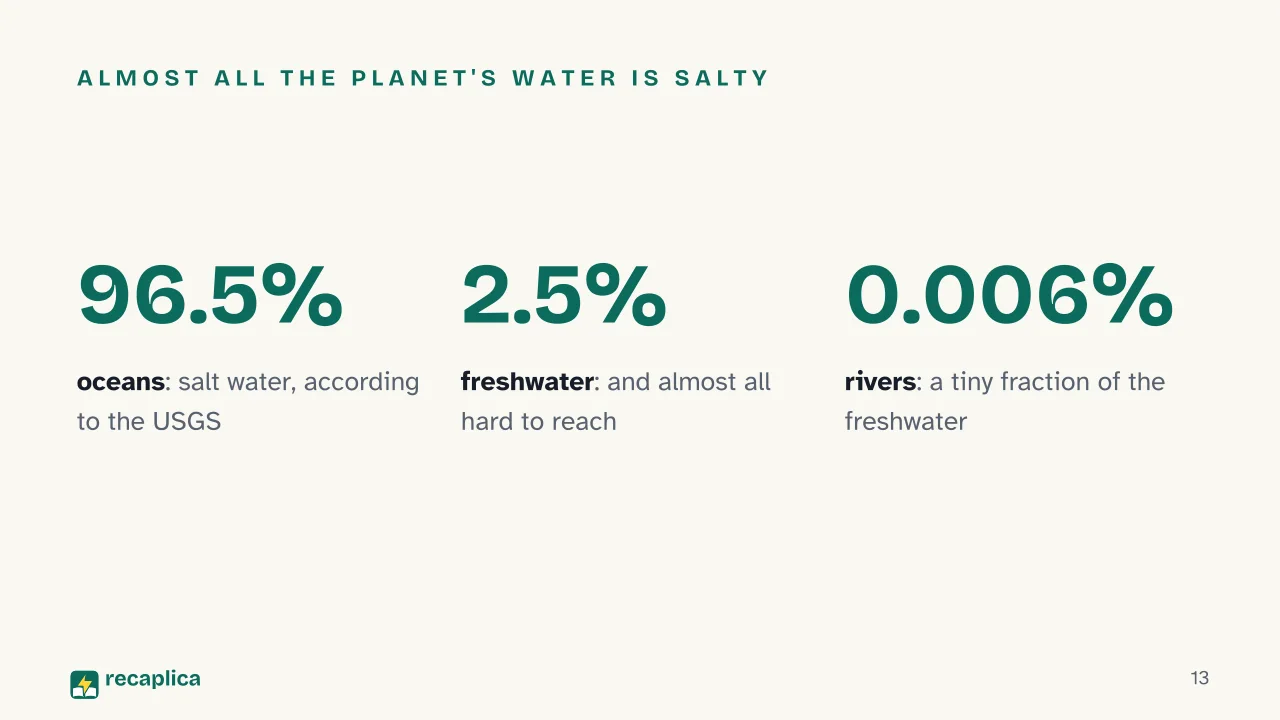
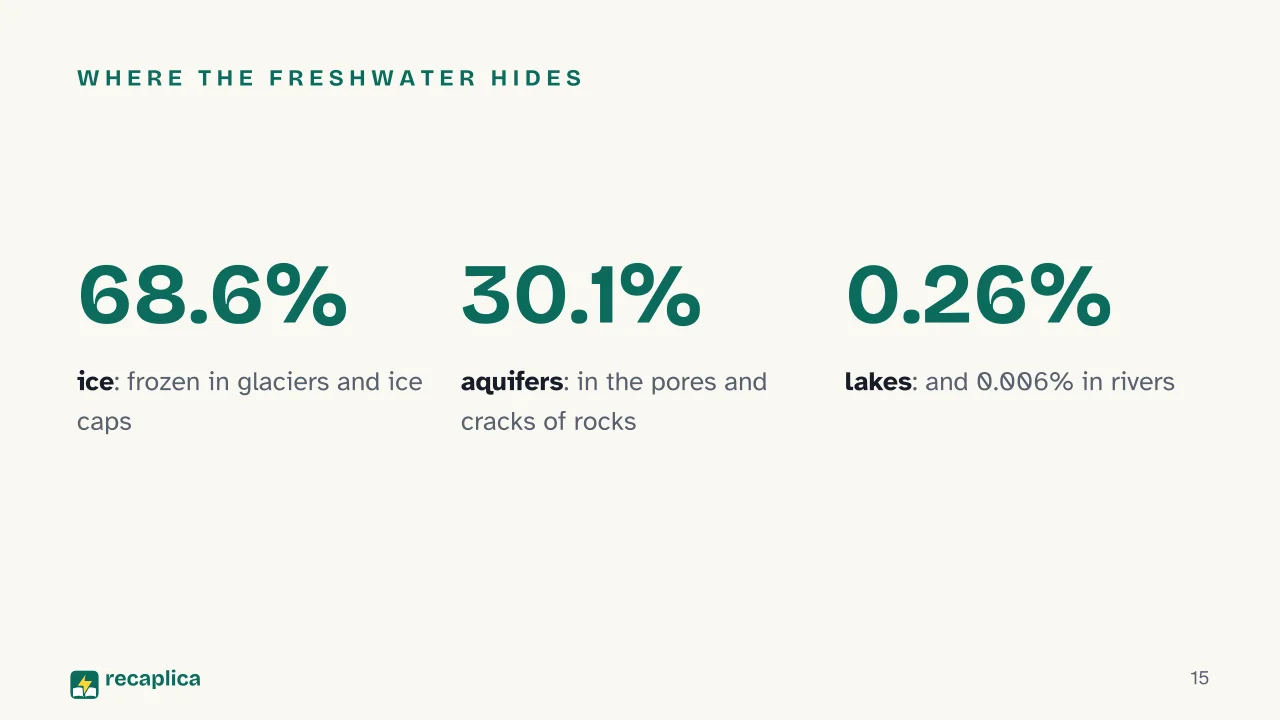
    Almost all the planet’s water — 96.5%, according to the USGS — is salty and sits in the oceans. Freshwater is just 2.5% of the total, and almost all of it is hard to reach: 68.6% is frozen in glaciers and polar ice caps, and 30.1% lies in underground aquifers. Rivers carry just 0.006% of all freshwater, lakes 0.26%.

    Why the cycle matters to us

    The cycle decides where and when freshwater is available. As the climate warms, it is changing pace: more heat means more evaporation and, according to UCAR, heavier precipitation in some regions and stronger droughts in others. That is why NASA follows the journey from above with its satellite missions: the data they gather helps predict floods and droughts further in advance.

    Slide deck

    Slides ready to download and make your own in PowerPoint or Google Slides, with speaker notes. Pick the Flash cut or the Full one.
    Slide 1 of the presentation on The Water Cycle: The Water CycleSlide 2 of the presentation on The Water Cycle: Where has the water in your glass been?Slide 3 of the presentation on The Water Cycle: What we will coverSlide 4 of the presentation on The Water Cycle: Chapter 01: The engineSlide 5 of the presentation on The Water Cycle: Two forces move everythingSlide 6 of the presentation on The Water Cycle: The journey, stop by stopSlide 7 of the presentation on The Water Cycle: Chapter 02: From water to skySlide 8 of the presentation on The Water Cycle: Three ways up: Evaporation, Transpiration, SublimationSlide 9 of the presentation on The Water Cycle: Clouds are not made of vapor.Slide 10 of the presentation on The Water Cycle: Chapter 03: The way backSlide 11 of the presentation on The Water Cycle: Back on land, two roadsSlide 12 of the presentation on The Water Cycle: Chapter 04: Where the water isSlide 13 of the presentation on The Water Cycle: Almost all the planet's water is saltySlide 14 of the presentation on The Water Cycle: Ocean · Soil · AtmosphereSlide 15 of the presentation on The Water Cycle: Where the freshwater hidesSlide 16 of the presentation on The Water Cycle: Water is never used up, it moves.Slide 17 of the presentation on The Water Cycle: Where is most of Earth's freshwater found?Slide 18 of the presentation on The Water Cycle: Now, the review
    Flash10 slidesThe essential thread, to present in classFull18 slidesEvery chapter and the deeper detail

    Common myths

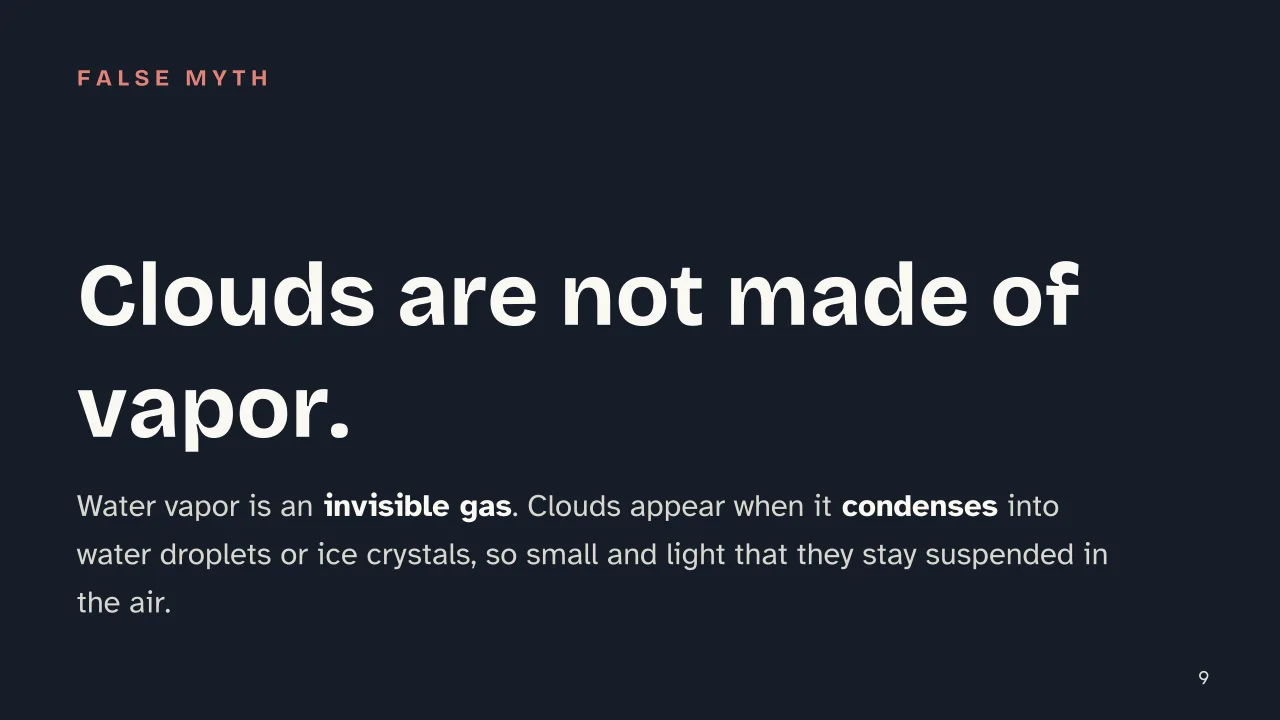
    • ✗ Myth Clouds are made of water vapor.

      ✓ Reality Water vapor is an invisible gas: as long as it stays vapor, you cannot see it. Clouds appear when the vapor cools and condenses into liquid water droplets or ice crystals, so small and light that they stay suspended in the air.

    • ✗ Myth Most freshwater flows in rivers and lakes.

      ✓ Reality Rivers and lakes hold only a tiny fraction: according to the USGS, 68.6% of freshwater is frozen in glaciers and ice caps and 30.1% sits in underground aquifers. Rivers carry just 0.006%, lakes 0.26%.

    • ✗ Myth When we use water, we use it up and it disappears.

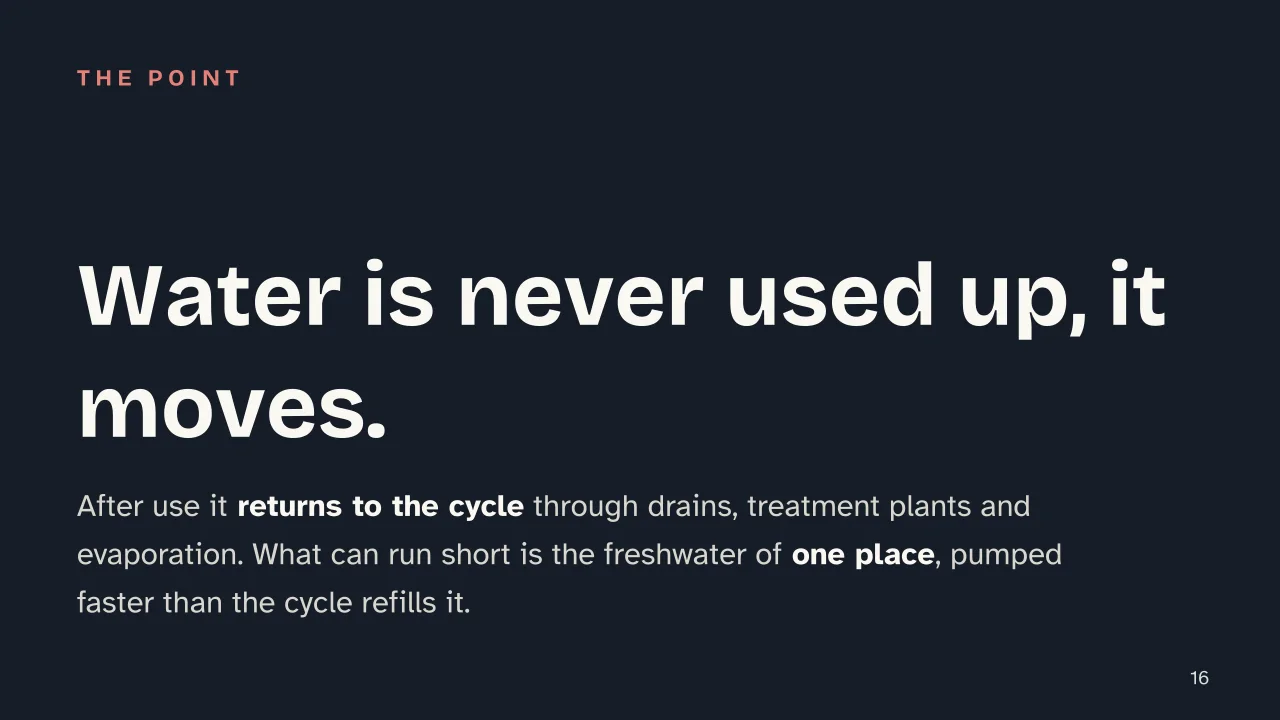
      ✓ Reality Water is not destroyed: after use it returns to the cycle through drains, treatment plants and evaporation. The real problem is the local supply of clean freshwater, which can run out wherever it is pumped faster than the cycle refills it.

    Mind map

    Drag the background to move around and the nodes to reposition them; use − and + to collapse and expand branches.
    Customize
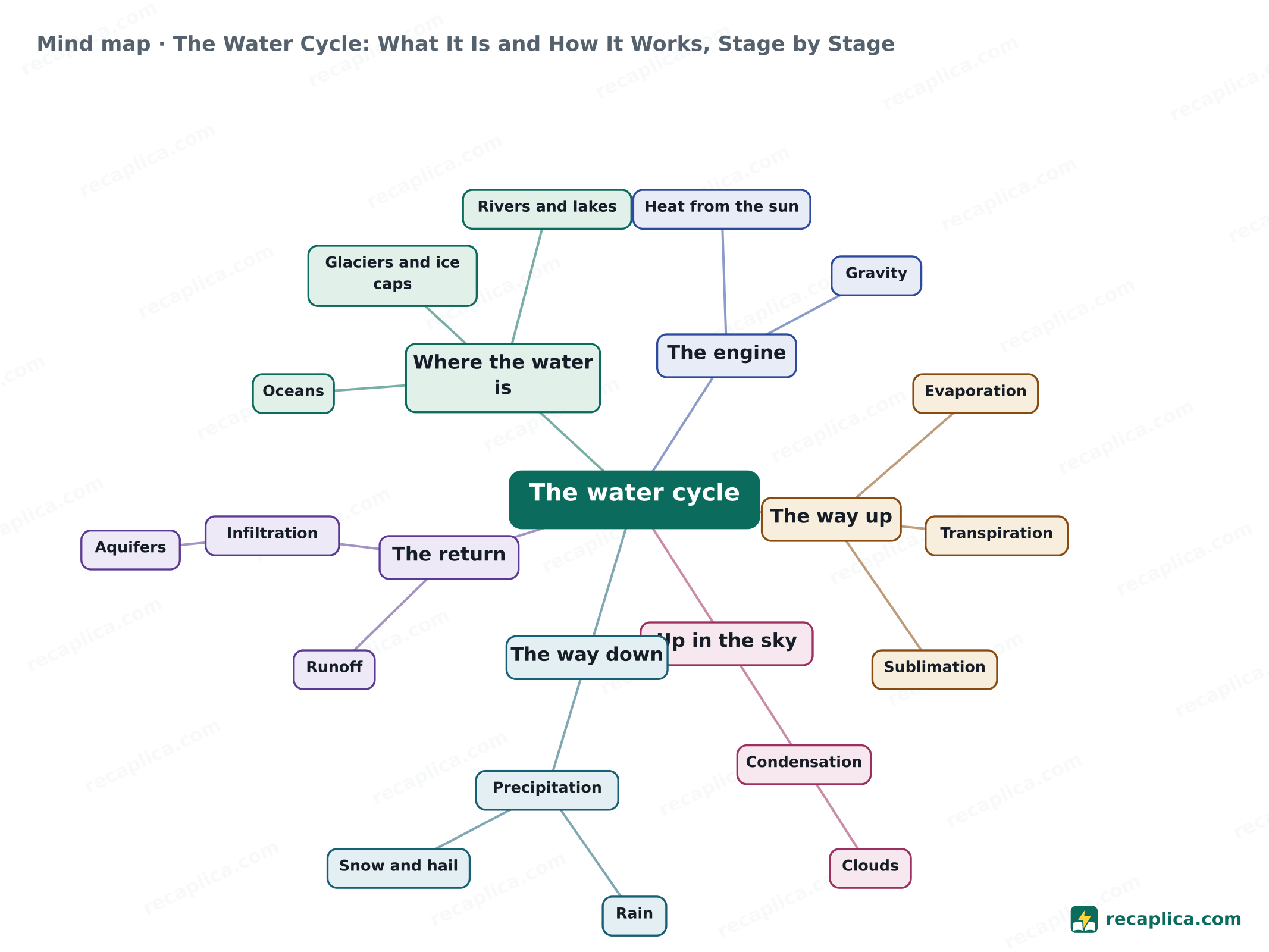
    Mind map: The Water Cycle: What It Is and How It Works, Stage by Stage
    • The water cycle
      • The engine
        • Heat from the sun Evaporates water and lifts it up.
        • Gravity Pulls water back down and toward the sea.
      • The way up
        • Evaporation From oceans, lakes and rivers.
        • Transpiration Vapor released by plant leaves.
        • Sublimation From snow and ice, skipping the liquid state.
      • Up in the sky
        • Condensation
          • Clouds Liquid droplets and ice crystals.
      • The way down
        • Precipitation
          • Rain
          • Snow and hail
      • The return
        • Runoff Water flows toward rivers and the sea.
        • Infiltration
          • Aquifers Hold 30.1% of all freshwater.
      • Where the water is
        • Oceans 96.5% of the total, salt water.
        • Glaciers and ice caps 68.6% of all freshwater.
        • Rivers and lakes A tiny fraction of freshwater.

    Quiz: test yourself

    Answer the questions to check what you have learned: you get instant feedback and a short explanation.

    Grade 0/10 0/5
    1 What is the engine that drives the water cycle?

    The sun's energy evaporates water and lifts it into the atmosphere as vapor; gravity closes the loop by pulling precipitation down and pushing water toward the sea.

    2 What is the name of the change from liquid water to vapor?

    Evaporation turns liquid water into water vapor. Condensation is the opposite change: from vapor to the tiny liquid droplets that form clouds.

    3 On average, how long does a water molecule stay in the atmosphere?

    According to UCAR, water vapor stays in the atmosphere for about 9 days on average before condensing and falling back. At the other extreme, a molecule can sit in the ocean for over 3,000 years.

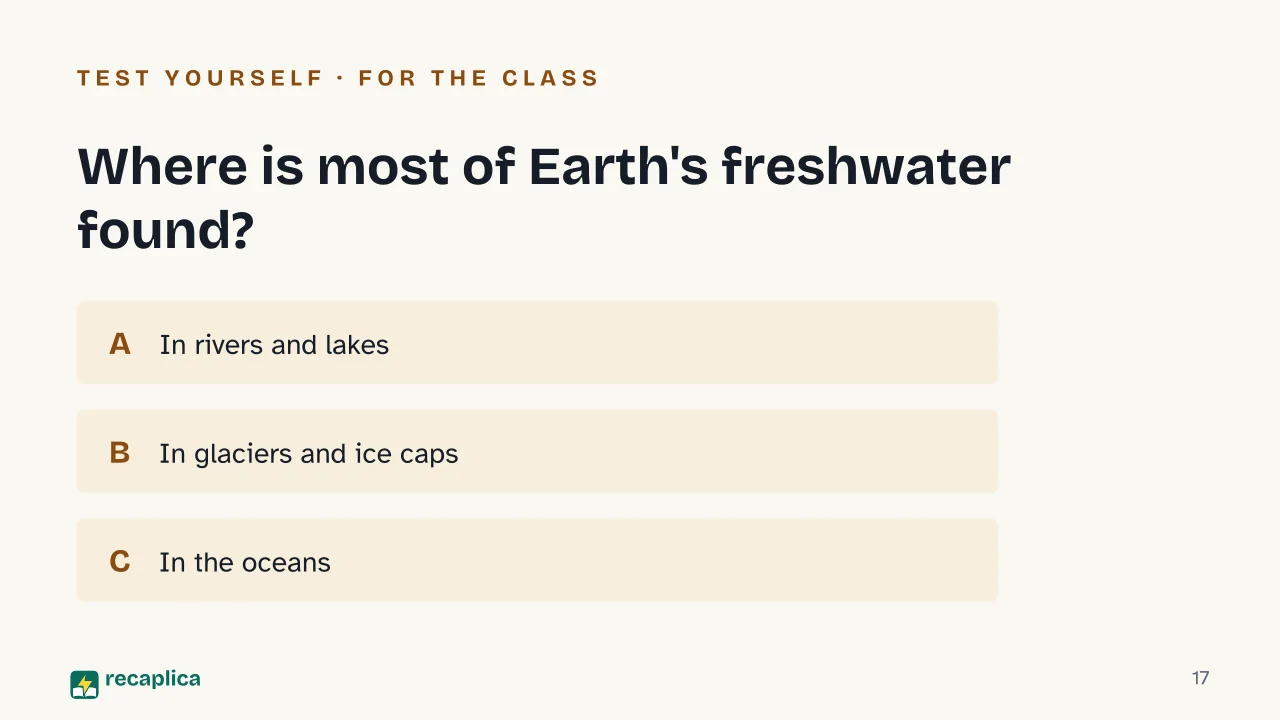
    4 Where is most of Earth's freshwater found?

    According to the USGS, 68.6% of freshwater is frozen in glaciers and ice caps; rivers carry just 0.006%. The oceans hold almost all the planet's water, but it is salty.

    5 What happens to rainwater that soaks into the ground?

    That is infiltration: water fills the pores and cracks of rocks and forms aquifers, which hold 30.1% of Earth's freshwater and resurface in springs and wells.

    Answers: 1-A · 2-B · 3-A · 4-B · 5-B

    Flashcards

    Tap the card to flip it and check whether you remember the answer, then move to the next one.

    1 / 8

    Explain it in your own words

    The ultimate test: if you can explain it in simple words, you've truly understood it. Write your explanation, then compare it with the Recap.

    Your explanation is saved only on this device.

    The water cycle is water's never-ending journey between the oceans, the atmosphere and the land. The sun's heat makes it evaporate, the vapor condenses into clouds high up, then water falls back as rain or snow and returns to the sea through rivers and groundwater. Along the way it changes state again and again, but it is never created or destroyed. That is why the cycle has no starting point and no end.

    Frequently asked questions

    Why is it called a 'cycle'?

    Because it has no beginning and no end: the same water moves endlessly from oceans to atmosphere to land and back to the oceans, changing state but never running out.

    Can Earth run out of water?

    The planet's total amount of water stays practically constant, because the cycle keeps recycling it. What can run short is the freshwater available in a specific place at a specific time: aquifers, for example, refill far more slowly than they can be emptied.

    What is the difference between evaporation and transpiration?

    Evaporation starts from water surfaces and soil; transpiration is the vapor released by plant leaves through their stomata. Seen from the atmosphere they are the same thing: water rising as a gas.

    What is an aquifer?

    Water that fills the pores and cracks of rocks and soil deep underground, carried there by infiltration. From an aquifer, water resurfaces in springs or is pumped up through wells.

    Do snow and ice take part in the cycle too?

    Yes. Melting snow feeds rivers and aquifers, and snow and ice can even turn directly into vapor (sublimation). The polar ice caps are the longest stop on the journey: they can hold water for hundreds of thousands of years.

    Sources

    • USGS Water Science School — Earth's water distribution
    • NASA — What is the water cycle?
    • UCAR Center for Science Education — The water cycle
    • NASA GPM — The water cycle

    Every Recap goes through an independent review before publication.

    Every evening, the day's new Recaps on our Telegram channel. Join the channel →

    Keep learning

    • Science Weather Forecasting: How It Works, From Data to Models to Forecasters A weather forecast starts with thousands of measurements collected every day by ground stations, radar, satellites and radiosondes carried aloft by balloons. A numerical model takes that data as a starting snapshot and uses the equations of physics to calculate how the atmosphere will change hour by hour. The further out the forecast reaches, the more a tiny error in the starting data grows, which is why detailed forecasts hold up for roughly a week, while beyond 15 days large models such as the ECMWF's work only in probabilities. In the end it's still a forecaster who settles on what to communicate to the public, uncertainty included. Read the Recap →
    • Science How Thunderstorms Form: From Warm Air to Lightning A thunderstorm forms when warm, moist air near the ground gets pushed upward, meets unstable air, and keeps rising until it builds a towering cloud, the cumulonimbus. It goes through three stages: developing, then mature, and finally dissipating. A single storm cell typically lasts 30 to 60 minutes, while the whole process takes about an hour. The mature stage is also the most dangerous: updrafts and downdrafts coexist and bring heavy rain, hail, strong wind, and lightning; if the updraft starts rotating because of winds that shift with height, a supercell forms, the longest-lived storm type, and the one most associated with the most violent tornadoes. Some storms, instead of fading away, keep regenerating over the same spot for hours, dumping persistent rain. Read the Recap →
    • Science How Tornadoes Form: From Thunderstorm to Funnel A tornado is a violently rotating column of air that touches both the ground and the cloud it hangs from at the same time. The most violent and destructive tornadoes almost always form inside a supercell, a thunderstorm that rotates internally thanks to a circulation called a mesocyclone. The usual ingredients are moisture, atmospheric instability, a lifting mechanism and wind shear, meaning a change in wind direction and speed with height: together they generally raise the odds of a vortex forming, but they never guarantee one. The funnel does not descend from the cloud like a stretching limb; it forms near the ground and builds upward, and even after decades of research scientists still don't have a complete picture of exactly what turns a mesocyclone into a tornado. Read the Recap →

    recaplica

    Clear in 30 seconds, yours in 10 minutes.

    Recaps Mind maps Request a Recap Telegram channel Mind map maker Our method About Privacy & cookies Legal notes & terms of use

    © 2026 Recaplica · A project by Curi S.r.l. — VAT IT05472000750

    Statistics, only if you say so

    To learn which Recaps help most we would use Google Analytics, with aggregate, anonymous data. It starts only with your OK, and you can change your mind anytime. Privacy policy