|
recaplica
States of Matter and Phase Changes, with a Diagram | ||||||||||||||||||||||||||||
| © 2026 Recaplica · recaplica.com — All rights reserved | ||||||||||||||||||||||||||||
States of Matter and Phase Changes, with a DiagramWhat to print Page numbers appear when printing with default margins. SlidesChoose a cut Flash10 slidesThe essential thread, to present in classFull15 slidesEvery chapter and the deeper detailBoth come with speaker notes. In 30 seconds quick readUnder ordinary conditions matter is solid, liquid or gas. What changes from one state to the next is how strongly the particles hold together: tightly in a solid, less so in a liquid, barely at all in a gas. Moving between states means adding or removing heat, and there are six phase changes, in reverse pairs such as melting and freezing. While a change is under way the temperature stays put, and pressure sets the temperature at which a liquid boils. Key Points
Key figures
Deep DiveDifference between solid, liquid and gasAccording to NASA’s Glenn Research Center, any substance under ordinary conditions exists in one of three states: solid, liquid or gas. The kind of molecule makes no difference here. What matters is how strongly the forces hold the particles together. A material’s shape and volume follow from that. In a solid the molecules are held tightly to one another, so a piece of it keeps its shape and occupies a fixed volume. The particles still move. Treccani’s encyclopedia entry on solids describes atoms that each have a fixed average position in space and oscillate around it in small motions. A solid deforms very little, at least until the stresses on it grow too strong. The forces between molecules are weaker in a liquid. Its volume stays definite and barely changes even when the pressure goes up, while its shape comes from the container. With gravity, the liquid settles with a free surface on top; in microgravity it gathers into a sphere. In a gas the molecular forces are very weak, and the substance spreads out until it fills whatever holds it, taking on both its shape and its volume. Liquids and gases together are called fluids, because they flow. Their molecules keep moving at random, bumping into one another and into the walls around them.
Gas or vapor: the critical temperature draws the lineMost people use “gas” and “vapor” interchangeably. Physics is stricter, as Treccani’s entry on vapor explains: a gaseous substance is called a vapor while it sits below its critical temperature, and a gas once it rises above it. The distinction has a practical side. Squeezing a vapor is enough to turn it back into a liquid at the same temperature, and cooling it works as well. Water’s critical temperature lies far above 100 °C, so whatever rises from a pan of boiling water is, strictly speaking, vapor. The six phase changes in one diagramEach change of state has a reverse, so they come in pairs. Melting takes a solid to a liquid, and freezing (also called solidification) runs back the other way. Going from liquid to gas is evaporation, which under particular conditions becomes boiling; the return from gas to liquid is condensation. The last pair skips the liquid state altogether. Sublimation turns a solid directly into a gas, and deposition makes the trip in reverse, from vapor to solid. According to Treccani’s Dictionary of Physical Sciences, heat has to be supplied for changes toward a less aggregated state and removed for the opposite ones.
Within the water cycle, sublimation means snow or ice turning into vapor before it has a chance to melt. The USGS says it is more common at high altitude, where air pressure is lower. Dry air and wind favor it, and it needs a supply of energy, such as the strong sunlight on the south side of Mount Everest. Deposition turns water vapor straight into ice. It is how snowflakes and frost form.
Why the temperature stalls: latent heatWhile a substance is changing state, the heat it takes in or gives off leaves its temperature where it was. Treccani explains that this is why such heat is called latent: it is there, yet the thermometer doesn’t register it. Two opposite changes, such as melting and freezing, share the same latent heat, and technical texts also call it the enthalpy of fusion or of vaporization. The amounts vary a lot from one change to the next. The USGS does the sum for one gram of ice: 80 calories to melt it, 100 to bring the water to a boil and another 540 to vaporize it, 720 calories altogether. Treccani’s entry on boiling gives water at 100 °C a latent heat of vaporization of 2,257 kJ/kg (539 kcal/kg), about 5.39 times the heat needed to warm the same mass from 0 to 100 °C. The value differs between substances, shrinks as the temperature rises and drops to zero at the critical point.
Evaporation and boilingEvaporation takes place only at the surface of a liquid, and at any temperature; the colder it is, the slower it goes. The USGS shows this with water, which evaporates readily at its boiling point and much more slowly near freezing, though it does still evaporate there. The driving force is energy breaking the bonds between molecules. An evaporating liquid draws on its own internal energy, so it cools down unless heat reaches it from outside.
In boiling, bubbles of vapor form inside the liquid, rise to the surface and burst to release it, so the whole mass takes part. This starts once the vapor pressure in the bubbles reaches the pressure outside. The reverse change is condensation, which the USGS says happens when air saturated with water vapor cools down, as with the droplets on the outside of a glass full of ice. Pressure and the boiling pointEach substance boils at its own temperature, and that temperature depends on the outside pressure: the higher the pressure, the higher the boiling point. To compare substances, scientists use the “normal” boiling point, measured at 1 atmosphere, or 101,325 Pa. Atmospheric pressure falls with altitude, and so does the temperature at which water boils. According to the USGS, water boils at 100 °C at sea level and at 94.9 °C at 5,000 feet, so hard-boiling an egg up there takes longer.
Whatever is dissolved in the water moves the boiling point too. A solution boils at a higher temperature than the pure solvent, and Treccani reports that salt-saturated water at 1 atmosphere boils at about 109 °C. Melting and freezing at the same temperatureA substance freezes at the same temperature at which it melts. Heat has to be removed to make it solidify, yet during the change the temperature doesn’t fall, and the heat taken away per unit of mass equals the amount needed to melt it. Pressure has very little effect on this point, unlike on boiling, and the reference value is the one at normal atmospheric pressure. Dissolved substances lower the freezing point: pure water freezes at 0 °C and seawater below zero. Almost all substances contract as they solidify. Water is one of the exceptions, along with cast iron and bismuth, and its ice is less dense than the liquid. The USGS notes that this is what keeps ice cubes floating in a glass. Plasma, a fourth stateAt very high temperatures and pressures, such as on the Sun or around a spacecraft reentering the atmosphere, atoms lose electrons. NASA calls the resulting mix of neutral atoms, free electrons and ions a plasma. It flows like a fluid, and because its particles carry a charge it responds to electromagnetic forces and generates them too, which is why scientists treat it as a fourth phase of matter. How it forms and where it turns up is covered in the Recap on plasma, the fourth state of matter. The Bose-Einstein condensate sits at the far cold end of the scale. It was first made in 1995 from a gas of atoms brought down to extremely low temperatures. Slide deckSlides ready to download and make your own in PowerPoint or Google Slides, with speaker notes. Pick the Flash cut or the Full one.     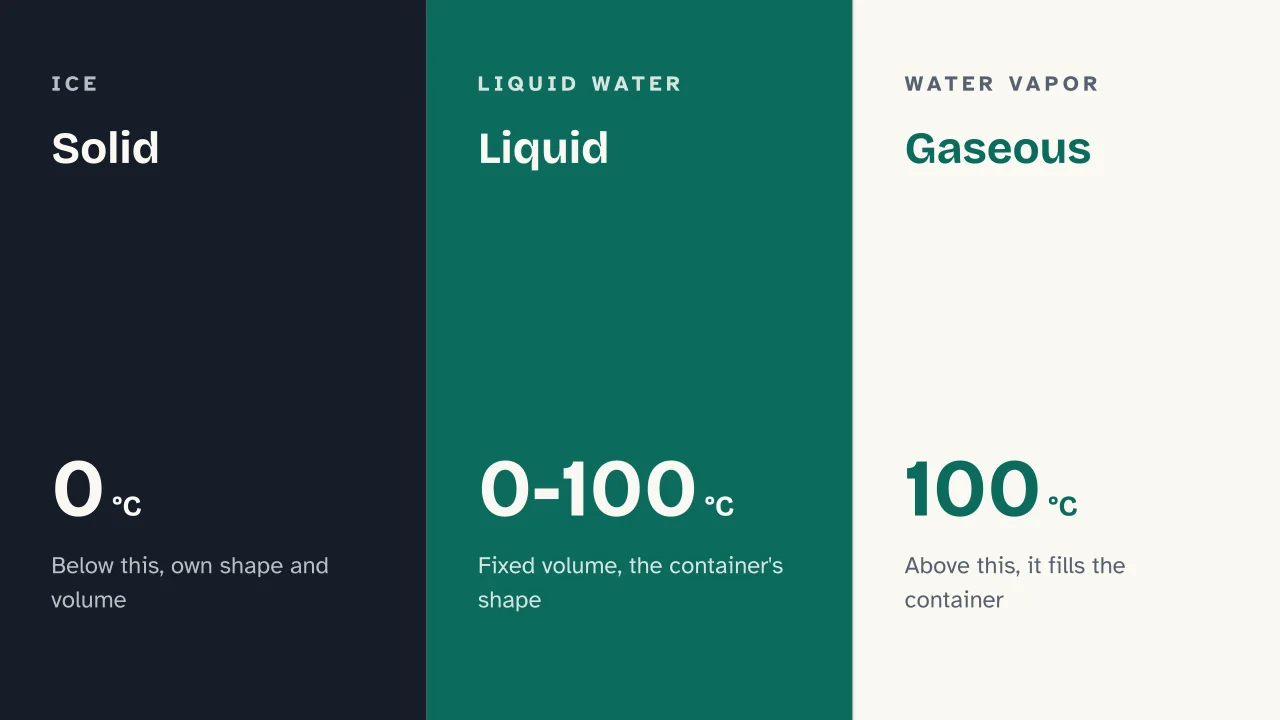 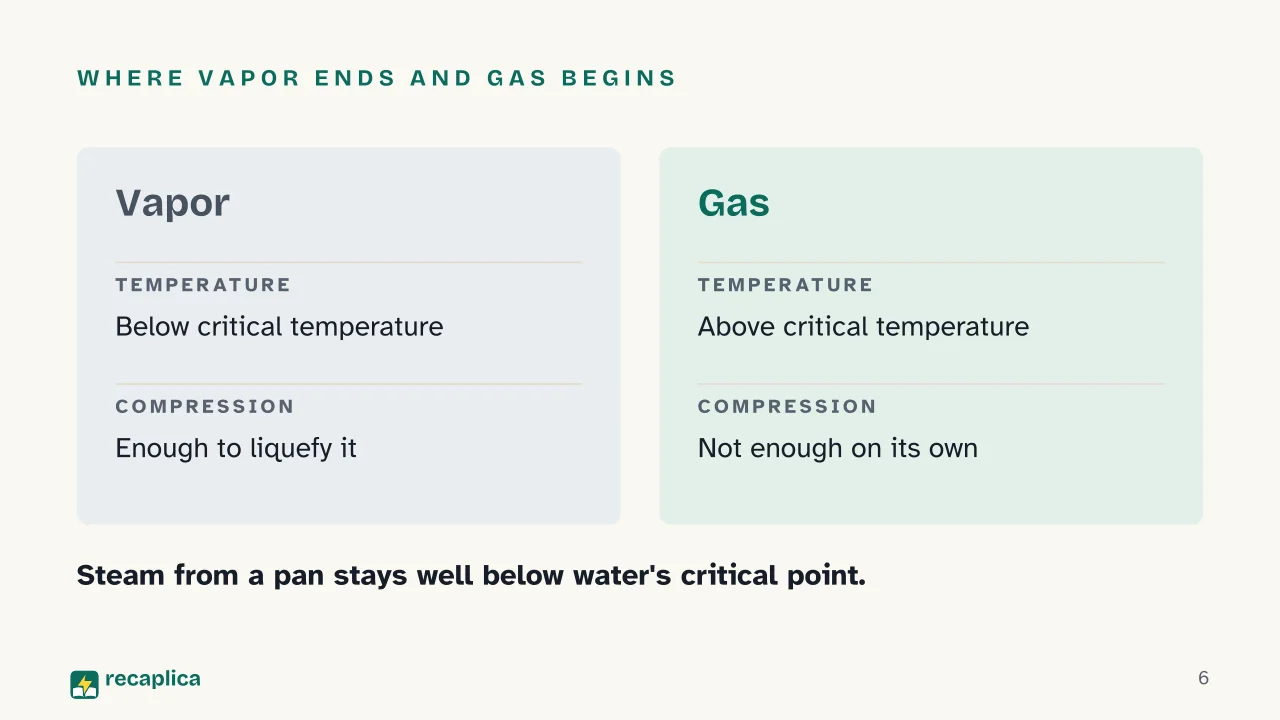  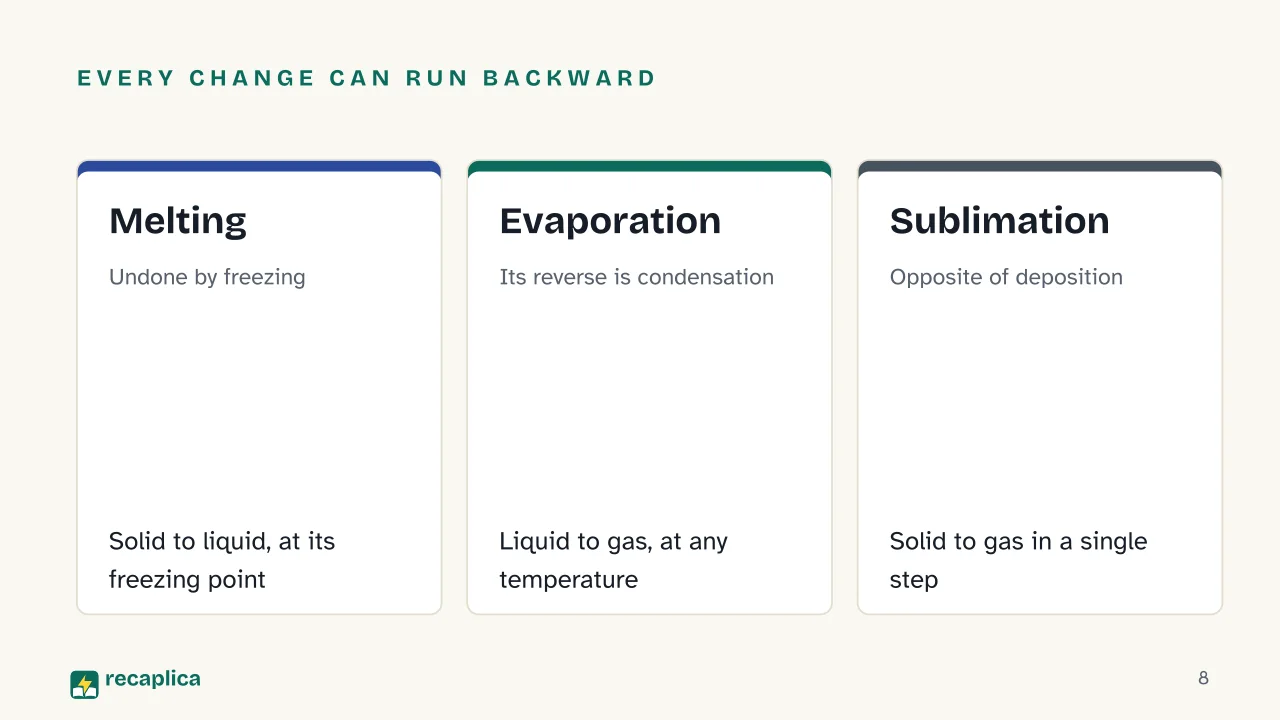  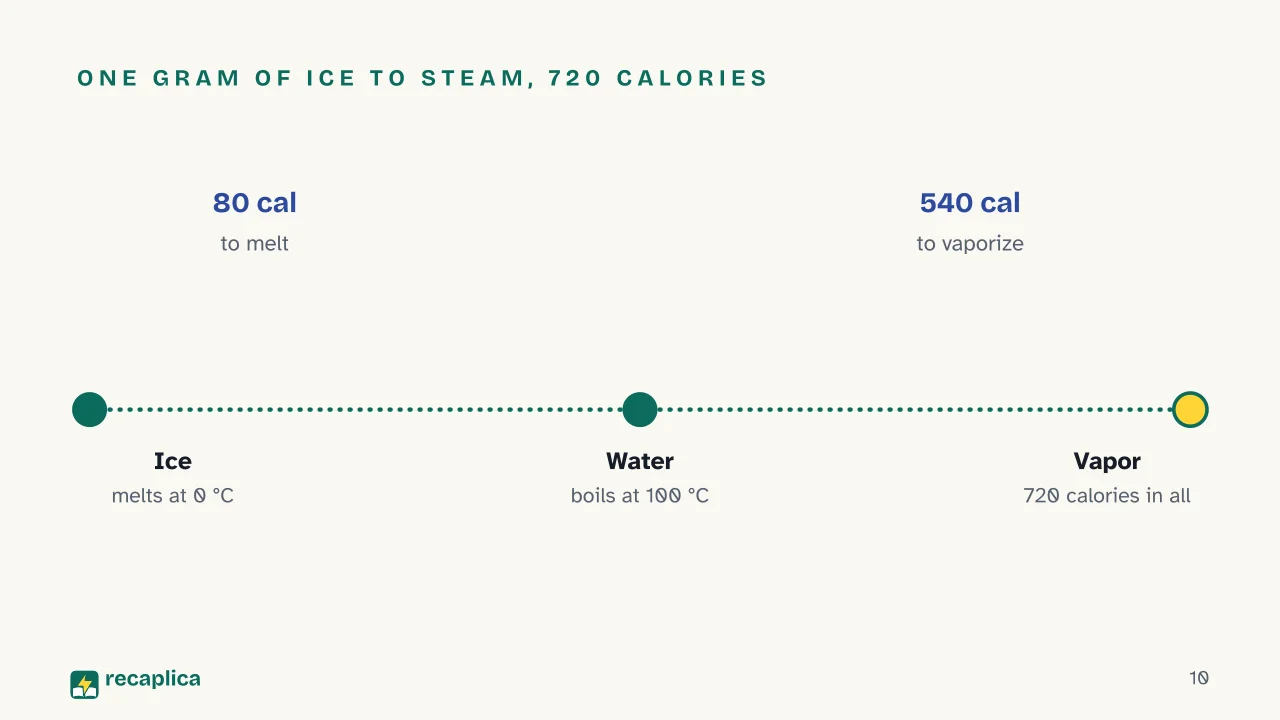 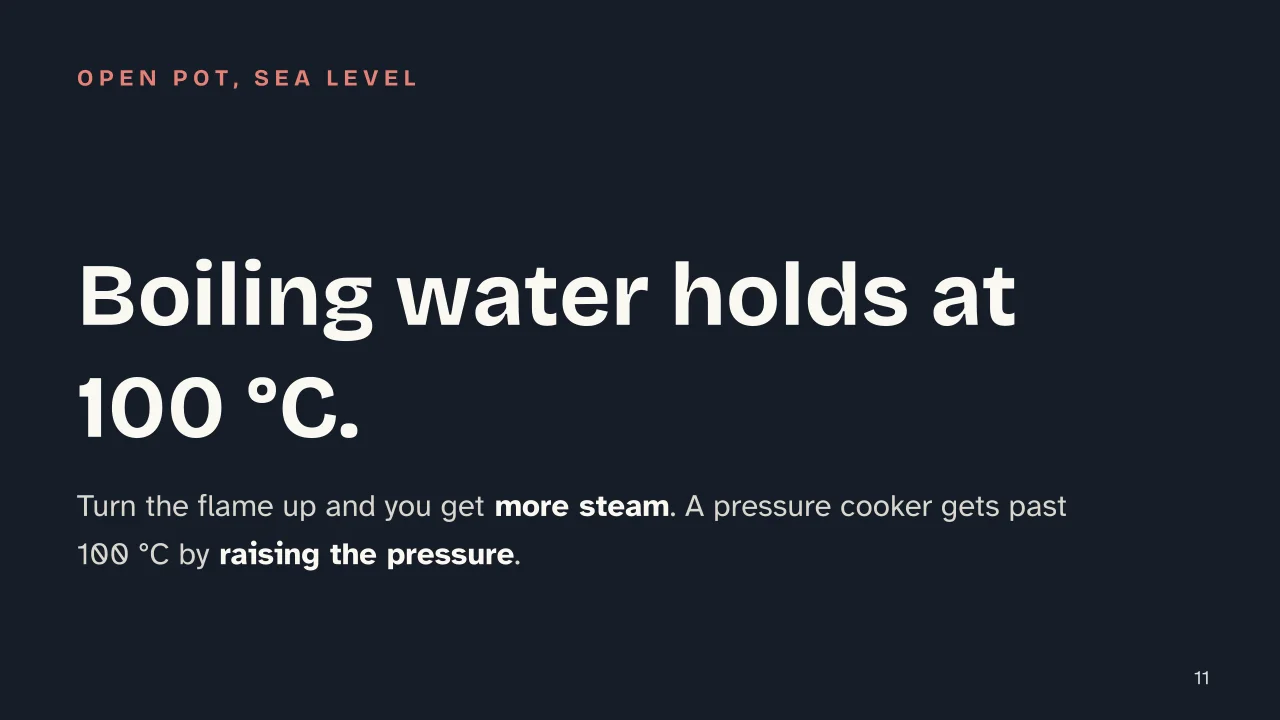  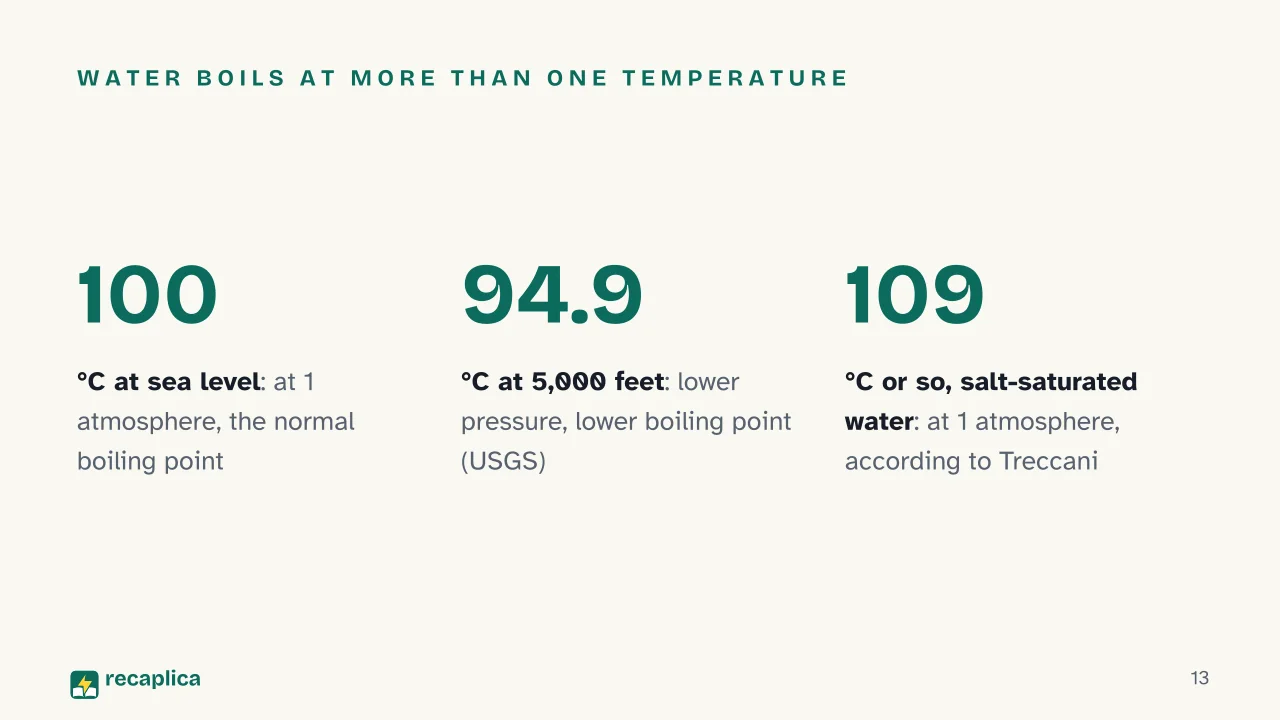 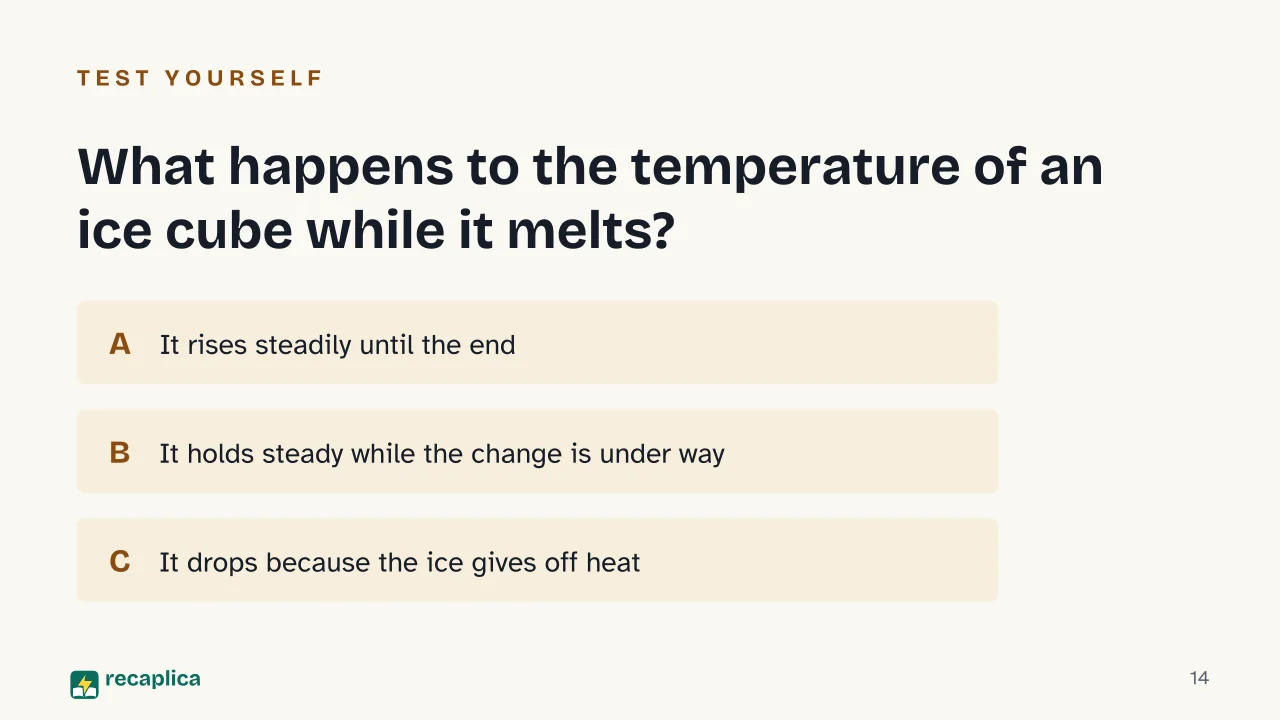  Common myths
Mind mapDrag the background to move around and the nodes to reposition them; use − and + to collapse and expand branches. 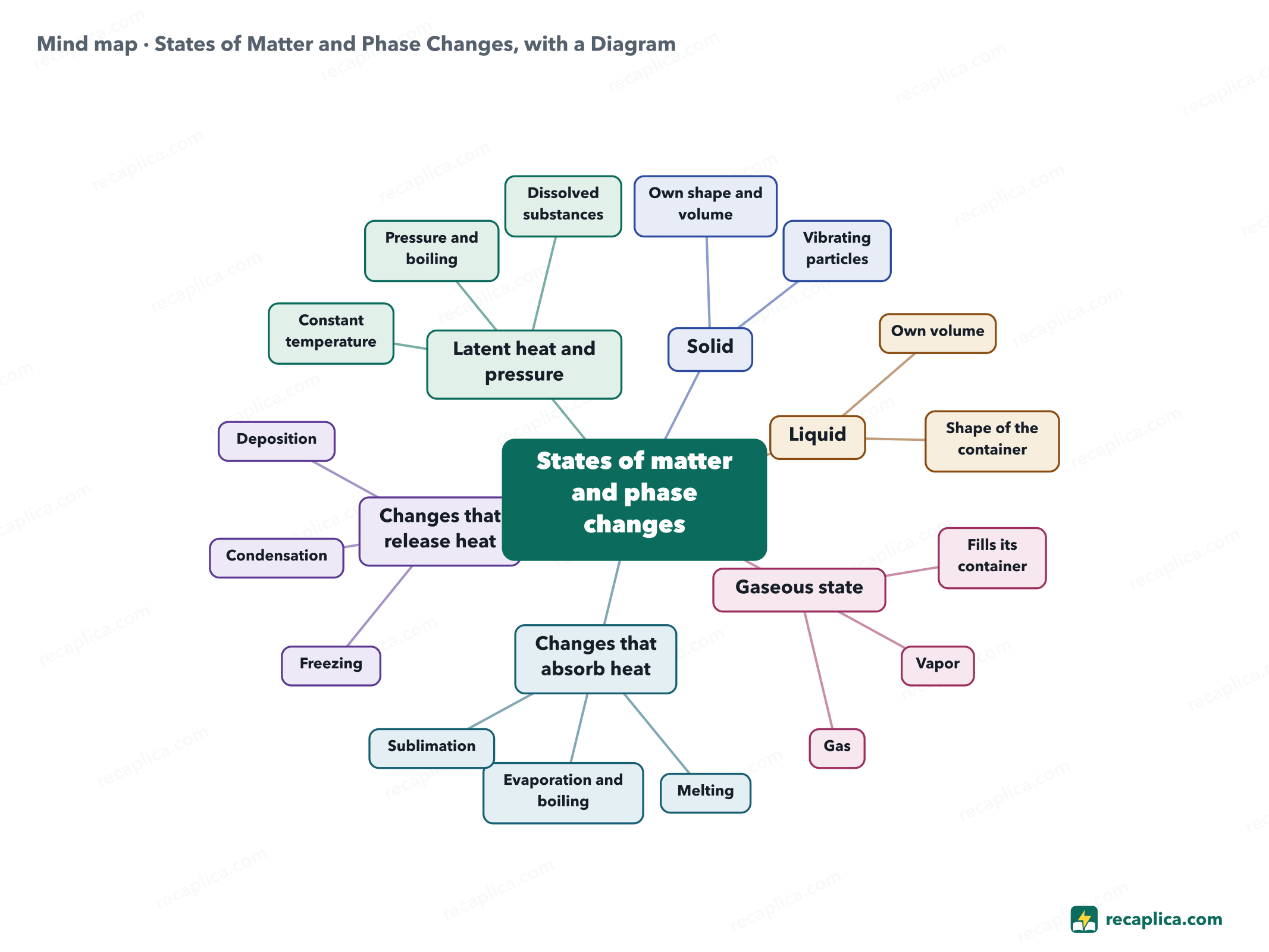
Quiz: test yourselfAnswer the questions to check what you have learned: you get instant feedback and a short explanation. Grade 0/10 0/5
FlashcardsTap the card to flip it and check whether you remember the answer, then move to the next one. 1 / 7 Explain it in your own wordsThe ultimate test: if you can explain it in simple words, you've truly understood it. Write your explanation, then compare it with the Recap. Your explanation is saved only on this device.
Frequently asked questionsWhat is the difference between solid, liquid and gas?It comes down to how tightly the particles are bound. In a solid, molecular forces hold them close, so an object keeps both its shape and its volume. In a liquid the forces are weaker; the volume stays the same and the shape follows the container. In a gas the forces are very weak, and the substance expands to fill any container you put it in. What are examples of a solid, a liquid and a gas?Water is the easiest example because it takes all three forms. NASA notes that at normal atmospheric pressure it is ice below 0 °C, a liquid between 0 and 100 °C and water vapor above 100 °C. Rubbing alcohol is another everyday liquid, and dry ice is a solid made of carbon dioxide. How many states of matter are there?Everyday experience shows three: solid, liquid and gas. NASA describes plasma as a fourth, which forms at very high temperatures and pressures, as on the Sun, when atoms lose electrons. Then there is the Bose-Einstein condensate, first produced in 1995 by cooling a gas of atoms to extremely low temperatures, and the Royal Swedish Academy of Sciences called it a new state of matter when it awarded Cornell, Ketterle and Wieman the 2001 Nobel Prize in Physics. Why does water boil at a lower temperature at high altitude?The boiling point depends on the outside pressure, and air pressure falls as you climb. According to the USGS, water that boils at 100 °C at sea level boils at 94.9 °C at 5,000 feet. That is why hard-boiling an egg takes longer up there. What is dry ice?Dry ice is frozen carbon dioxide. The USGS gives −78.5 °C as the temperature at which it sublimates, going straight from solid to gas. Every Recap goes through an independent review before publication. |