|
recaplica
Bose-Einstein Condensate: What It Is and How It Is Made |
| © 2026 Recaplica · recaplica.com — All rights reserved |
Bose-Einstein Condensate: What It Is and How It Is MadeWhat to print Page numbers appear when printing with default margins. SlidesChoose a cut Flash10 slidesThe essential thread, to present in classFull15 slidesEvery chapter and the deeper detailBoth come with speaker notes. In 30 seconds quick readA Bose-Einstein condensate is what a gas of atoms becomes when it is chilled to within a few hundred nanokelvin of absolute zero. At that temperature the atoms settle into the same quantum state, and a single wave function describes them all, as if it were one big atom. Einstein predicted it in 1924, building on a calculation by S. N. Bose. The first one was made on 5 June 1995 at JILA, with about 2,000 rubidium atoms. You will often see it called the fifth state of matter, which is the common label. Key Points
Key figures
Deep DiveIn a Bose-Einstein condensate, or BEC, a gas of atoms sits only a few hundred billionths of a degree over absolute zero. There the atoms stop acting as individuals. They fall into the same quantum state and behave, on paper, like a single atom. That is why people sometimes call it a superatom. It also goes by the name “fifth state of matter”, which is a common label. Our Recap on states of matter covers how matter moves between solid, liquid and gas. Here the change is of another kind: it concerns the quantum state the atoms are in. Bosons and fermionsParticles with whole-number spin are called bosons, and those with half-integer spin are fermions. At low temperatures bosons tend to pile into the lowest-energy quantum state. Fermions keep away from each other. They cannot occupy the same state, so some of them have to take higher-energy ones. Electrons in the shells of atoms are fermions, which accounts for the order of the periodic table. Bose and Einstein, 1924In 1924 the Indian physicist S. N. Bose did a statistical calculation on the kind of particles that would later be named after him, bosons, and more specifically on photons. He sent the work to Einstein, who saw its value, translated it into German and got it published. Einstein went further. He extended the theory to particles with mass and, in two papers close together, predicted that if enough particles get close and slow down enough, they drop together into the lowest-energy state. That collective state is the condensate. NIST dates the prediction to 1924. Why extreme cold is neededThe Royal Swedish Academy of Sciences explains it through the wavelength associated with atoms, the same idea as the matter waves of de Broglie. If a gas of cold atoms is dense enough, that wavelength becomes comparable to the distance between the atoms. The matter waves start to feel each other and coordinate their state. This is condensation. At realistic densities the atoms have to move at only a few millimetres per second. That corresponds to temperatures around 100 nanokelvin, one tenth of a millionth of a kelvin, measured from absolute zero, which is -273.15 °C. The starting material is a dilute gas of alkali atoms. Similar behaviour had already been seen in more complicated systems. Superconductors carry pairs of electrons and have no electrical resistance, and superfluids have no internal friction. How a condensate is madeTwo cooling stages run one after the other. The first is laser cooling, proposed in 1975 by Hänsch and Schawlow for neutral atoms: photons are absorbed only when they head toward the atom, and that slows it down. The second is evaporative cooling, which works in a purely magnetic trap. Wieman pointed to this route around 1990, with lasers in a magneto-optical trap first and then a magnetic trap for the evaporation.
5 June 1995The JILA group, a joint institute of NIST and the University of Colorado Boulder, led by Cornell and Wieman, reached the condensation threshold on 5 June 1995 at 10:54. They began with rubidium gas at room temperature, slowed and caught in a trap of laser light. Laser cooling got the atoms down to roughly 10 millionths of a degree, still too warm for condensation, with some 10 million atoms in the trap. In the magnetic trap the atoms cooled further as the hottest ones were removed. One last improvement was needed: Cornell’s upgraded magnetic trap, with a rotating field, kept the coldest atoms from slipping out of the centre. The team started at about 170 nK and, by making the evaporation more efficient, ended with a pure condensate at 20 nK. The result was a condensate of about 2,000 rubidium-87 atoms that lasted 15 to 20 seconds. On a video camera it showed up as a small sphere of rubidium about 20 microns across. NIST notes that the search had lasted 71 years and that many physicists compared it to the quest for the Holy Grail. What a condensate showsKetterle’s group was independent of the Colorado one and used sodium. It published its condensate four months after JILA’s. His condensates held hundreds of times more atoms, which made it possible to measure their properties. One of these is interference. Two separate condensates expanding into each other form sharp fringes, the sign of coherent matter waves. The 2001 Nobel Prize in Physics went to the realisation of Bose-Einstein condensation in dilute alkali gases and to early studies of how condensates behave. According to the Swedish Academy, the extreme conditions of a BEC in dilute gases are found nowhere else in the universe. Slide deckSlides ready to download and make your own in PowerPoint or Google Slides, with speaker notes. Pick the Flash cut or the Full one.     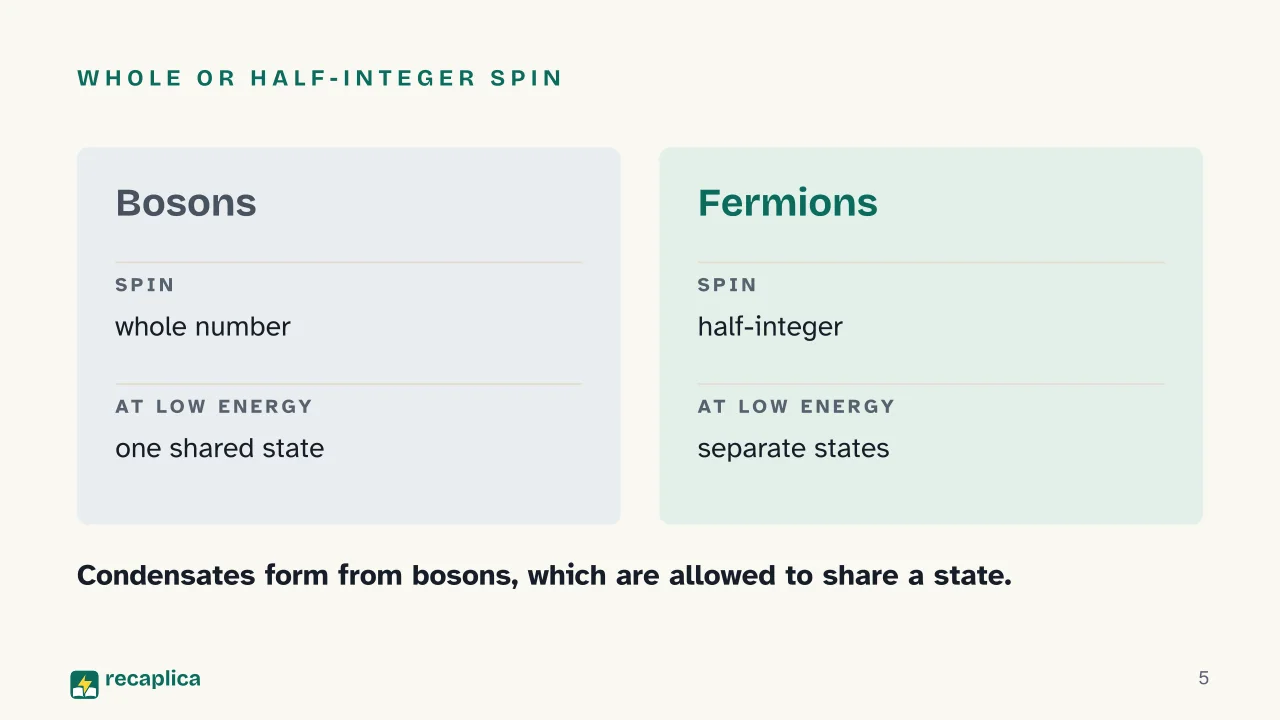  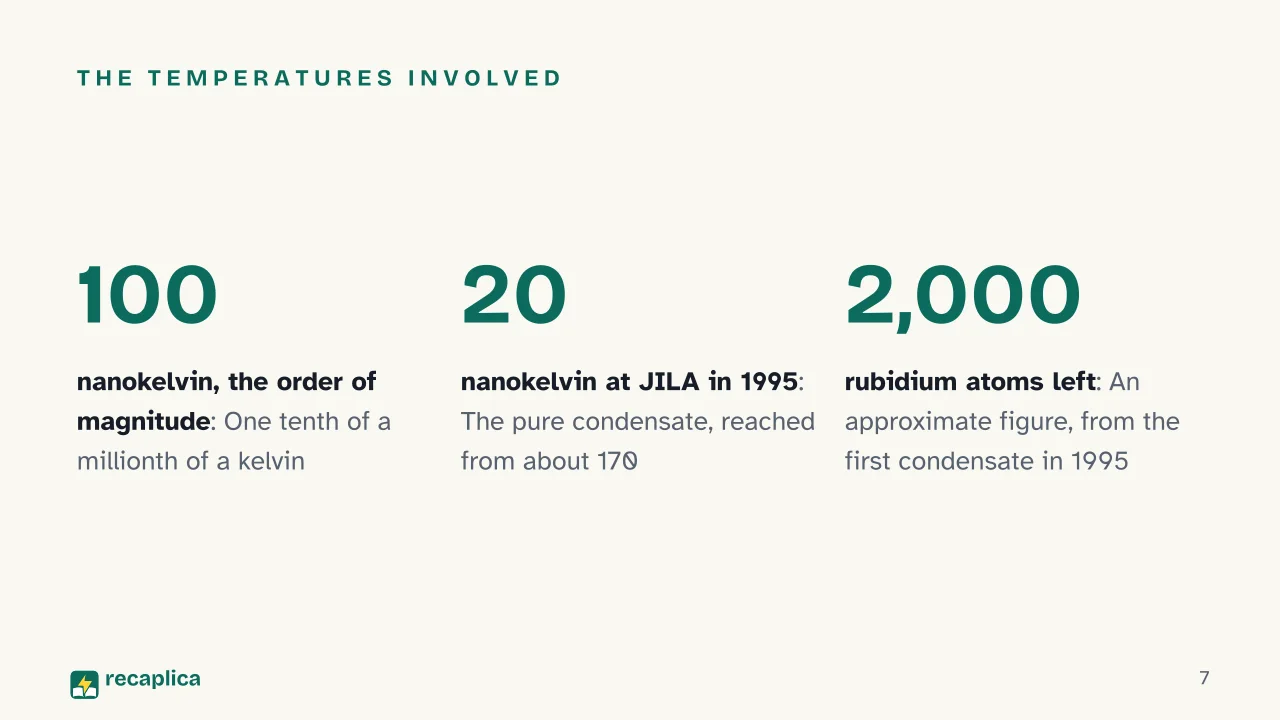 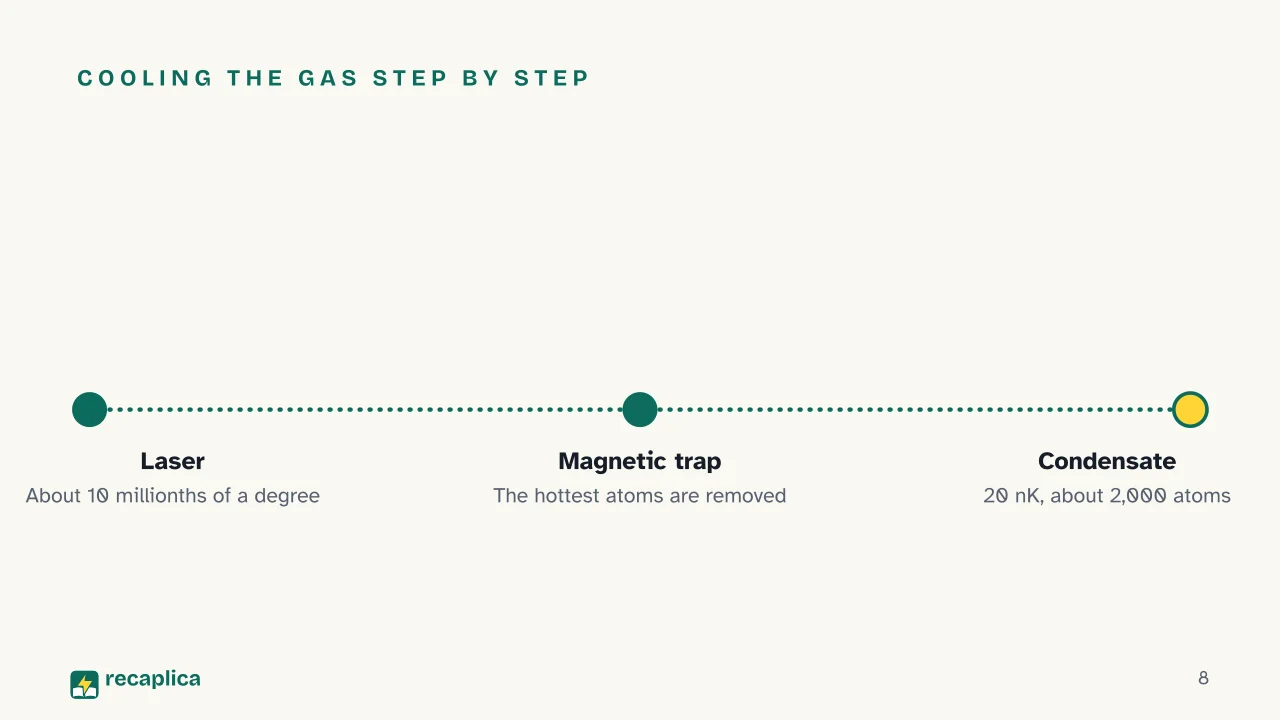  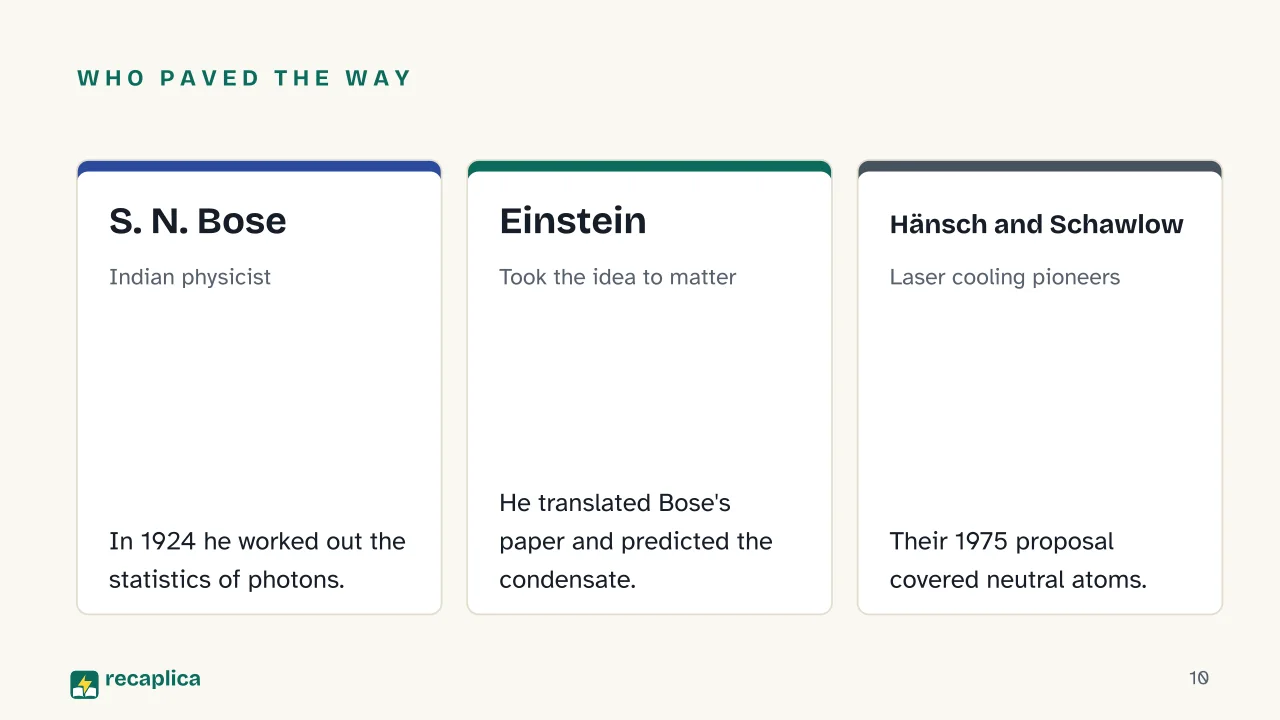 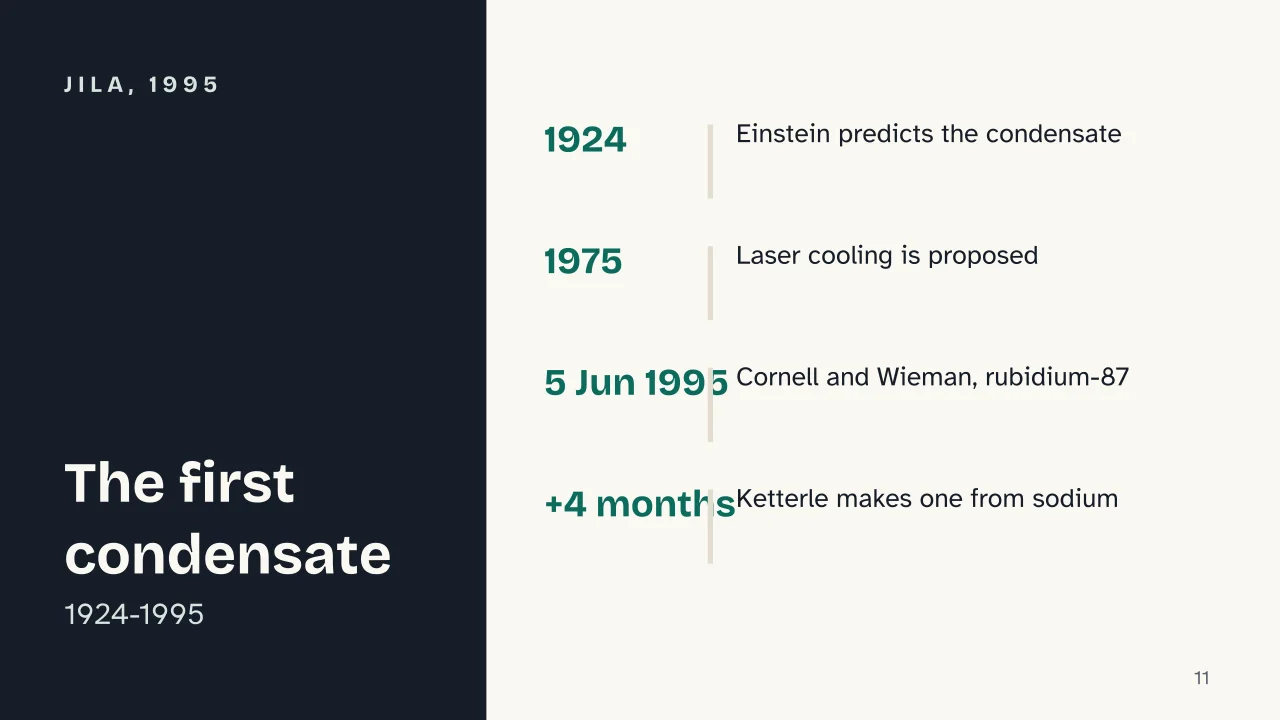  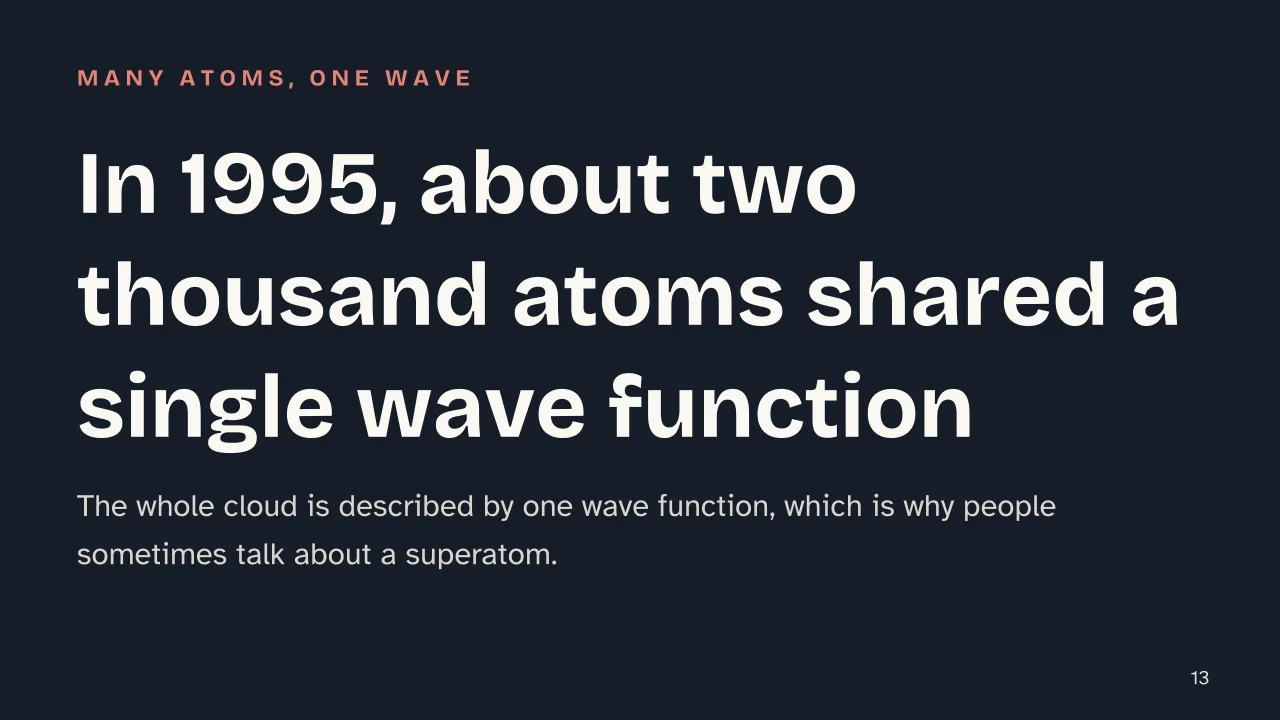 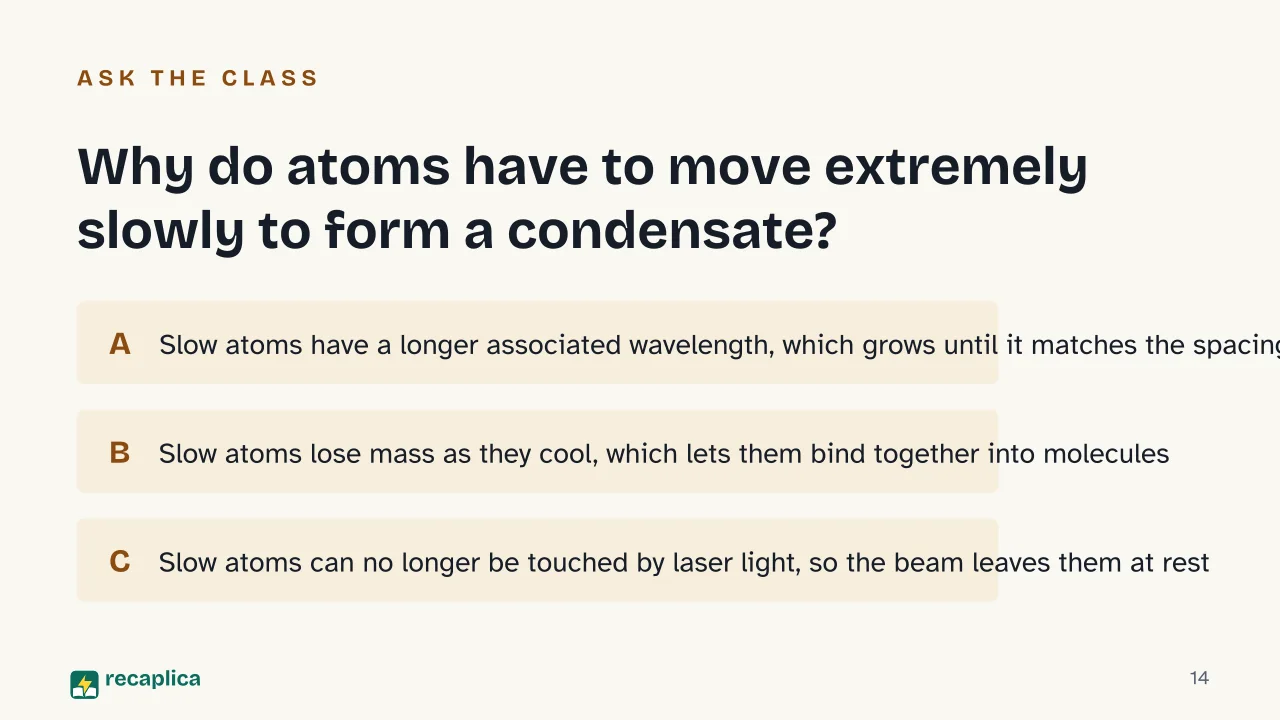  Common myths
Mind mapDrag the background to move around and the nodes to reposition them; use − and + to collapse and expand branches. 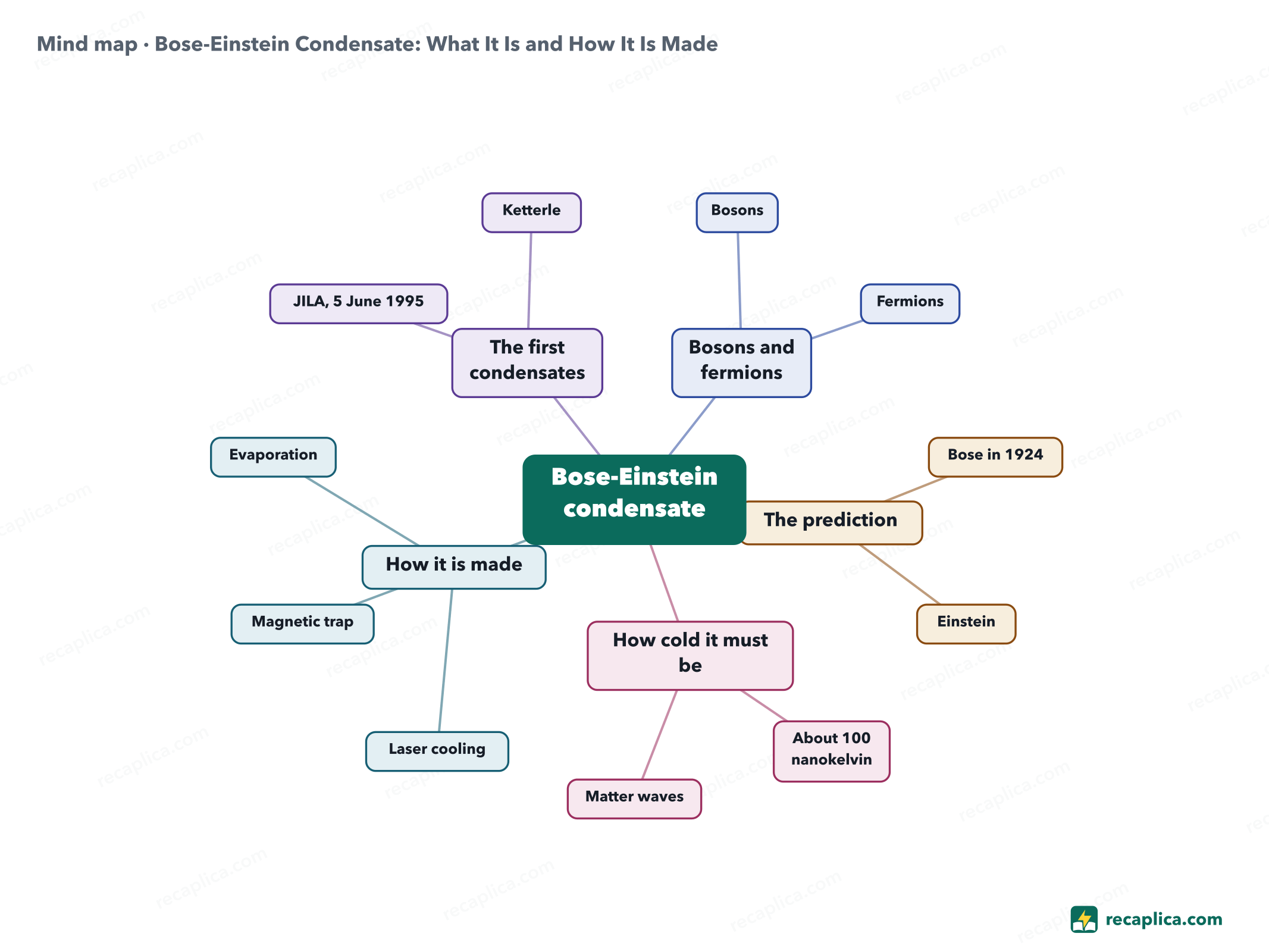
Quiz: test yourselfAnswer the questions to check what you have learned: you get instant feedback and a short explanation. Grade 0/10 0/5
FlashcardsTap the card to flip it and check whether you remember the answer, then move to the next one. 1 / 7 Explain it in your own wordsThe ultimate test: if you can explain it in simple words, you've truly understood it. Write your explanation, then compare it with the Recap. Your explanation is saved only on this device.
Frequently asked questionsWhat is a Bose-Einstein condensate?It is a cloud of atoms chilled to just above absolute zero, where all of them occupy the same quantum state. One wave function describes the entire cloud, which is why people sometimes call it a superatom. Why is the Bose-Einstein condensate called the fifth state of matter?It is the common label. NIST presents it as a new form of matter in which atoms merge into a superatom that acts as a single entity. How cold is a Bose-Einstein condensate?At JILA in 1995 the team started from about 170 nanokelvin and reached a pure condensate at 20 nanokelvin. NIST gives a few hundred nanokelvin, measured from absolute zero, which is -273.15 °C. How is a Bose-Einstein condensate made?You start with a gas of atoms, rubidium for example, slowed and caught in laser light. Laser cooling alone is not cold enough, so the atoms move to a magnetic trap where the hottest ones are removed. At JILA the result was a condensate of about 2,000 atoms that lasted 15 to 20 seconds. What did Bose have to do with Einstein's condensate?Bose sent Einstein a statistical calculation on photons in 1924. Einstein had it published in a German translation, then applied the idea to particles with mass and predicted the condensate. Every Recap goes through an independent review before publication. |