Skip to content
recaplica

    One moment: security check

    Cloudflare wants to make sure you're not a robot. Tick the box below and your search will continue on its own.

    IT
    recaplica Phone Addiction: What It Is and What Happens to Teens' Brains
    © 2026 Recaplica · recaplica.com — All rights reserved
    Home › Science

    Phone Addiction: What It Is and What Happens to Teens' Brains

    By Recaplica Newsroom · Updated on September 27, 2026

    This Recap is about health. It explains what research and regulators say: it is not medical advice, nor a supplement or training programme. For decisions about yourself, talk to a doctor; if you are under 18, to your parents too. Legal notes

    What to print

    Page numbers appear when printing with default margins.

    Slides

    Choose a cut

    Flash10 slidesThe essential thread, to present in classFull15 slidesEvery chapter and the deeper detail

    Both come with speaker notes.

    Telegram channel
    recaplica Clear in 30 seconds, yours in 10 minutes.
    In 30 seconds Key points Figures Deep dive Slides Myths Mind map Quiz Flashcards FAQ

    In 30 seconds quick read

    Phone addiction, which many studies call problematic smartphone use, means excessive phone use that slips out of a person's control; it isn't listed in the DSM, psychiatry's diagnostic manual. A 2019 meta-analysis puts it at roughly one in four of the young people studied, and finds an association — not a proven cause — with anxiety, depressive symptoms, and worse sleep. A 2024 review reports that in people with this behavior the brain's reward system, a circuit involving dopamine and serotonin, is less active. The same review names teenagers as the age group most at risk but doesn't say why; the American Psychological Association, writing about social media, notes that the brain regions behind self-control aren't fully developed until adulthood. Studies measure nomophobia, discomfort at being without a phone, separately and with a questionnaire; it isn't a diagnosis either.

    Key Points

    • "Phone addiction," which many studies call problematic smartphone use (PSU), is excessive use that slips out of a person's control; a 2024 review notes it isn't included in the DSM, psychiatry's diagnostic manual.
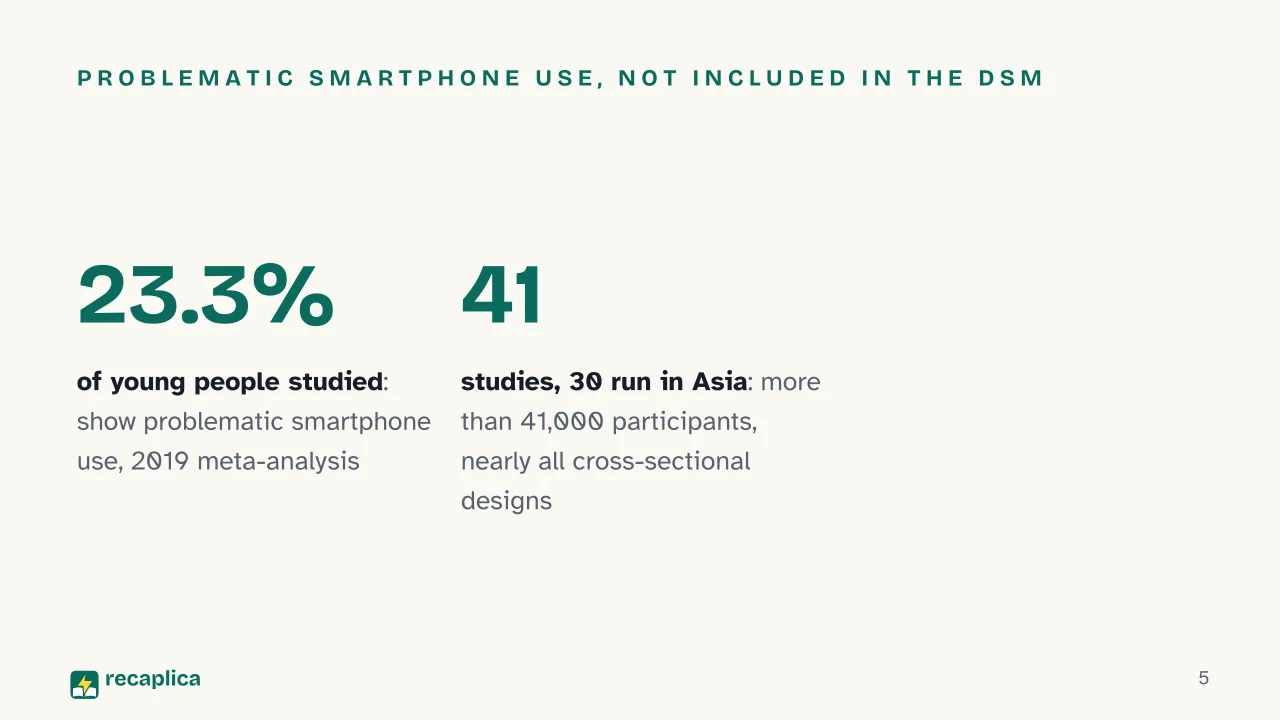
    • A 2019 meta-analysis covering more than 41,000 young people put the median rate of problematic use at 23.3%, roughly one in four of those studied.
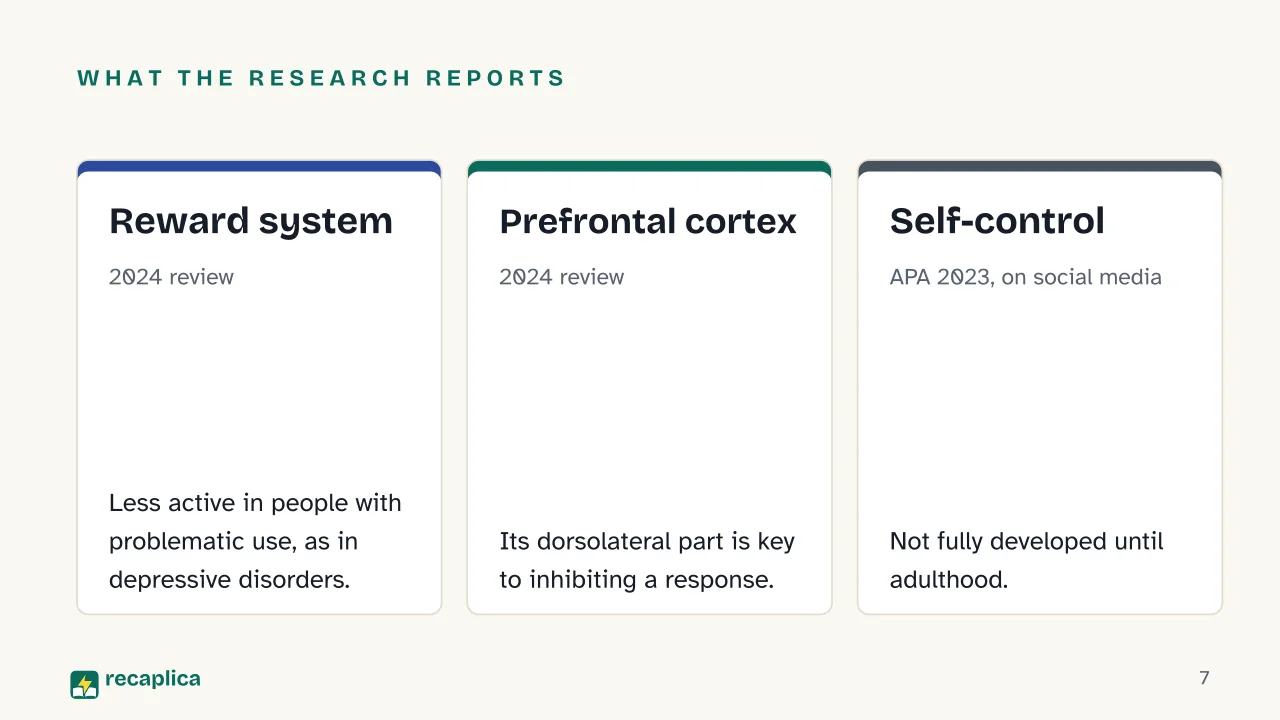
    • A 2024 review reports that in people with this behavior the brain's reward system (dopamine and serotonin) is less active, and that the dorsolateral prefrontal cortex is key to inhibiting a response. These differences come mostly from cross-sectional studies, which can't establish cause.
    • According to the American Psychological Association, writing about social media, brain regions tied to attention and approval from peers grow more sensitive from early adolescence, while self-control regions aren't fully developed until adulthood.
    • Nomophobia, discomfort at being without a phone, is measured with a questionnaire. In a 2022 meta-analysis, whose participants had a mean age of 22, the pooled share with severe symptoms was 20.35%; its authors suggested adding nomophobia to the DSM and the ICD, neither of which listed it.
    • Studies link problematic use to anxiety, depressive symptoms, and disrupted sleep, mostly from data collected at a single point in time, which can't show what came first.

    Key figures

    • 23.3% median share of children and young people with problematic smartphone use in a 2019 meta-analysis of 41 studies, 30 of them conducted in Asia, and more than 41,000 participants (only studies with a mean participant age of 25 or under were eligible), measured with 24 different questionnaires Source: Sohn et al., BMC Psychiatry, 2019
    • OR 3.17 odds ratio between problematic smartphone use and depression in a 2019 meta-analysis, calculated from four studies; the highest of the four it reports, and a measure of association between groups of young people Source: Sohn et al., BMC Psychiatry, 2019
    • 20.35% pooled share of participants with severe nomophobia symptoms, in a 2022 meta-analysis of 52 studies from 20 countries, nearly all built on the same questionnaire; participants' mean age was 22 Source: Jahrami et al., Behavioral Sciences, 2022

    Deep Dive

    The phenomenon appears in the literature under more than one name. A 2024 review calls it “mobile phone addiction” and notes that other studies prefer “problematic smartphone use” (PSU). The review defines it as excessive use that slips out of a person’s control, with knock-on effects on social life and psychological or behavioral problems, and describes it through three traits: withdrawal, tolerance, and loss of control. The same review points out that it isn’t included in the DSM, psychiatry’s standard diagnostic manual, and that no single diagnostic standard is accepted worldwide: assessment rests mainly on scales built by different researchers for different populations.

    A 2019 meta-analysis published in BMC Psychiatry pooled 41 studies, 30 of them run in Asia, covering more than 41,000 children and young people; the authors included only studies whose participants had a mean age of 25 or under. It puts the median rate of problematic use at 23.3%, roughly one in four of the young people studied. Ranked from the lowest rate to the highest, the middle half of the studies fell between 14.0% and 31.2% (the interquartile range), and 31 of the 41 found a rate between 10% and 30%. Those studies used 24 different questionnaires and widely varying definitions of problematic use.

    Why it develops

    The studies reviewed up to 2024 don’t give a complete answer. The 2024 review in Frontiers in Psychiatry summarizes what researchers have observed in the brains of people with this behavior. It names dopamine and serotonin as key neurotransmitters in the reward system and reports that in people with phone addiction that system is less active, a finding it sets alongside what is seen in depressive disorders. The dorsolateral prefrontal cortex is involved in cognitive control and emotion regulation, and the review describes it as central to inhibiting a response. Among the interventions it surveys is electrical stimulation of this area: the review says it could strengthen that ability, and the study it cites was run on college students with smartphone addiction.

    The same review names teenagers as the age group most at risk. It doesn’t explain why, and it flags a limitation of its own: the research so far is mostly cross-sectional, relies on self-reported data, and draws largely on Asian participants, so it can’t establish what causes what.

    The American Psychological Association’s advisory, published in May 2023, is about social media, which is one part of phone use, and it adds a point about development. From early adolescence, it says, the brain grows steadily more sensitive in the areas tied to wanting attention, feedback, and reinforcement from peers; the regions that self-control depends on, by contrast, aren’t fully developed until adulthood. The APA therefore recommends that in early adolescence, roughly ages 10 to 14, an adult keep track of how a child uses social media. The same document doesn’t treat social media as good or bad in itself: a lot depends on what a teenager does there and on the environment they grow up in.

    Practical example: a thirteen-year-old is studying when the phone lights up with a like. They put the homework aside for a second, and the second turns into much longer than planned. Both behaviors, when they keep recurring, are on the APA’s list of indicators of problematic social media use: carrying on even when you realize it’s getting in the way of something you need to do, and spending more time online than you meant to.

    The same advisory asks that teenagers get dedicated training before they start using social media. One of the skills it lists is learning how mis- and disinformation are spread. In a separate passage it describes algorithms as the instructions that decide which posts reach each user.

    The warning signs

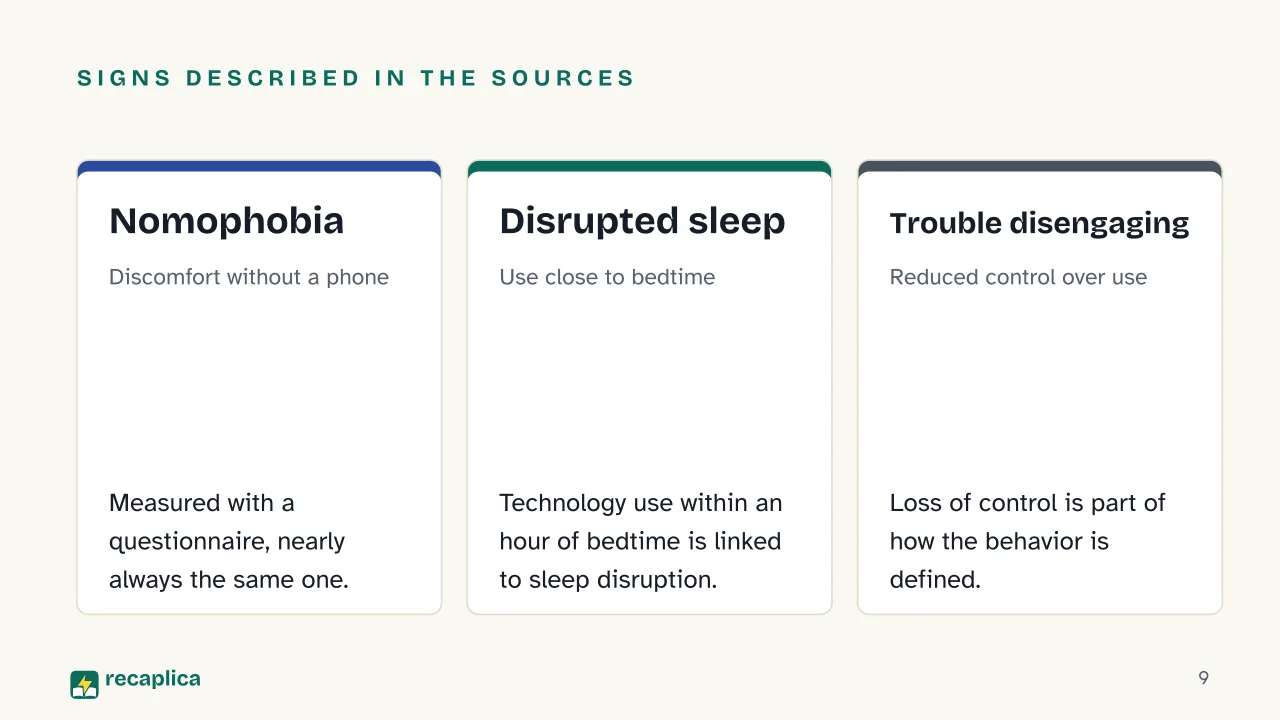
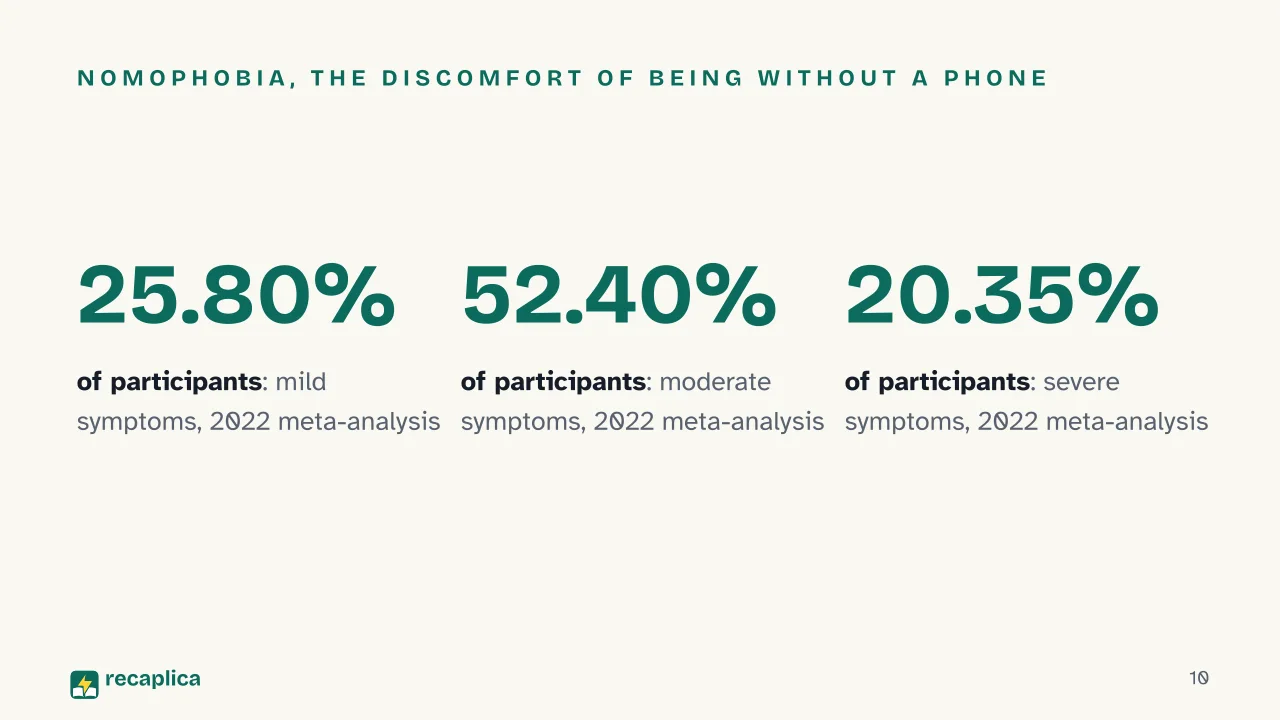
    Since the behavior isn’t in the DSM, there’s no diagnostic checklist to go by. One thing studies do measure is nomophobia, a term coined in 2008 in a UK Post Office study (from “no-mobile-phone phobia”) to describe the discomfort tied to the fear of being without a phone. A systematic review with meta-analysis and meta-regression published in 2022 estimates how common the symptoms are, by level, among participants in 52 studies from 20 countries:

    Symptom levelShare of participants (2022 meta-analysis)
    Mild25.80%
    Moderate52.40%
    Severe20.35%

    These percentages count people who score above a cut-off on a questionnaire, not people who have been diagnosed. Nine studies in ten use the same tool, the Nomophobia Questionnaire, which picks up higher rates than other instruments when symptoms of any level are counted (97.59% versus 66.52%). Participants had a mean age of 22, and most fell within a narrow age range; in the authors’ analysis, severe symptoms were most likely among university students in non-Western cultures. Results vary widely from one study to the next: the index the meta-analysis uses to gauge that spread (I²) is above 99% for the estimates at all three levels, and the authors treat anything over 75% as high heterogeneity.

    The authors describe nomophobia as a behavioral addiction and suggest adding it to future editions of three diagnostic manuals: the DSM, the International Classification of Diseases (ICD), and the International Classification of Sleep Disorders (ICSD). As of 2022, then, it wasn’t in any of those.

    Then there’s sleep. The APA advisory notes that technology use, especially in the hour before bed, is associated with disrupted sleep. For teenagers, it adds, too little sleep is associated with disruptions to neurological development and emotional functioning, and with suicide risk.

    Effects on psychological wellbeing

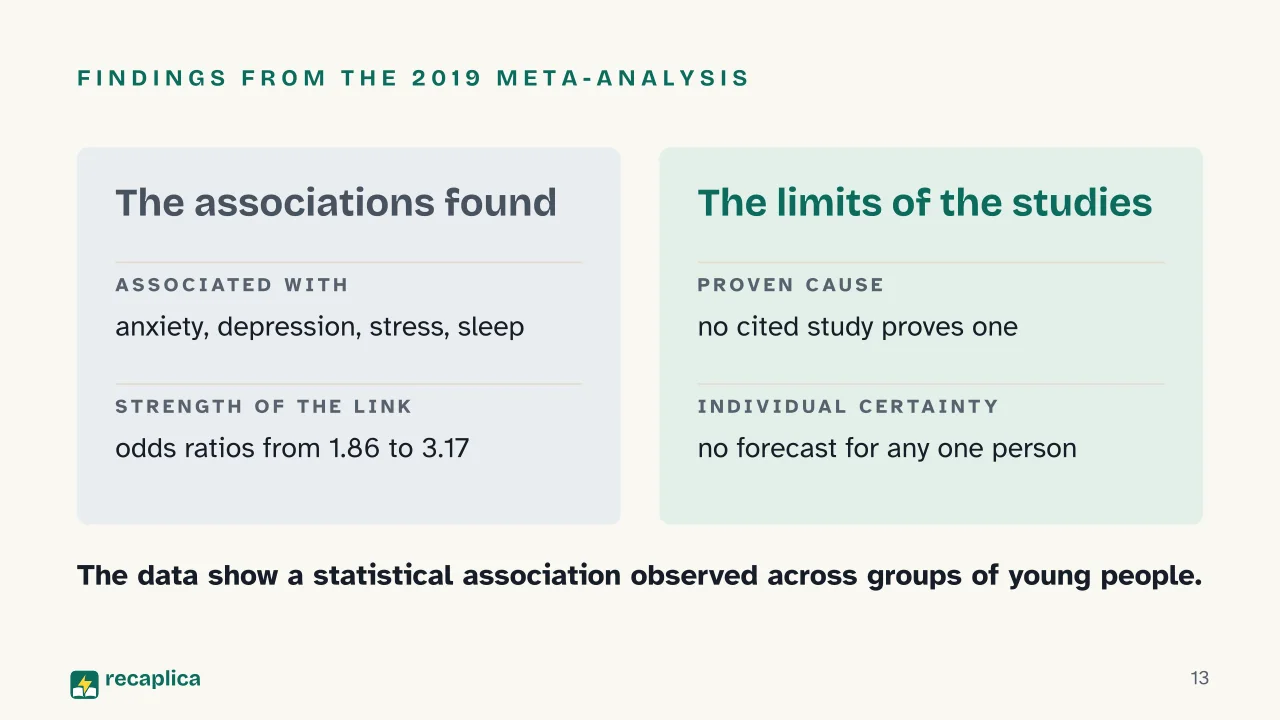
    The 2019 meta-analysis found that problematic smartphone use is associated with higher odds of depression (odds ratio 3.17), anxiety (OR 3.05), higher perceived stress (OR 1.86), and worse sleep quality (OR 2.60). An odds ratio is a measure of statistical association. The four values rest on a subset of the 41 studies: 20 looked at mental health, and the odds ratio for depression was calculated from four. The authors rate the methodological quality of the individual studies as poor in 22 cases and moderate in 19; the quality of the evidence, which they assess outcome by outcome with a method called GRADE, they put at moderate for depression and low for anxiety, stress, and sleep.

    Of the 41 pooled studies, 38 have a cross-sectional design: they capture a population at a single point in time and can’t establish what came first. The authors themselves write that reverse causality can’t be ruled out, meaning that feeling unwell may be what drives heavier phone use. In these studies anxiety, depression, stress, and sleep are measured with questionnaires the participants filled in, and the authors say the symptoms may fall below the clinical threshold.

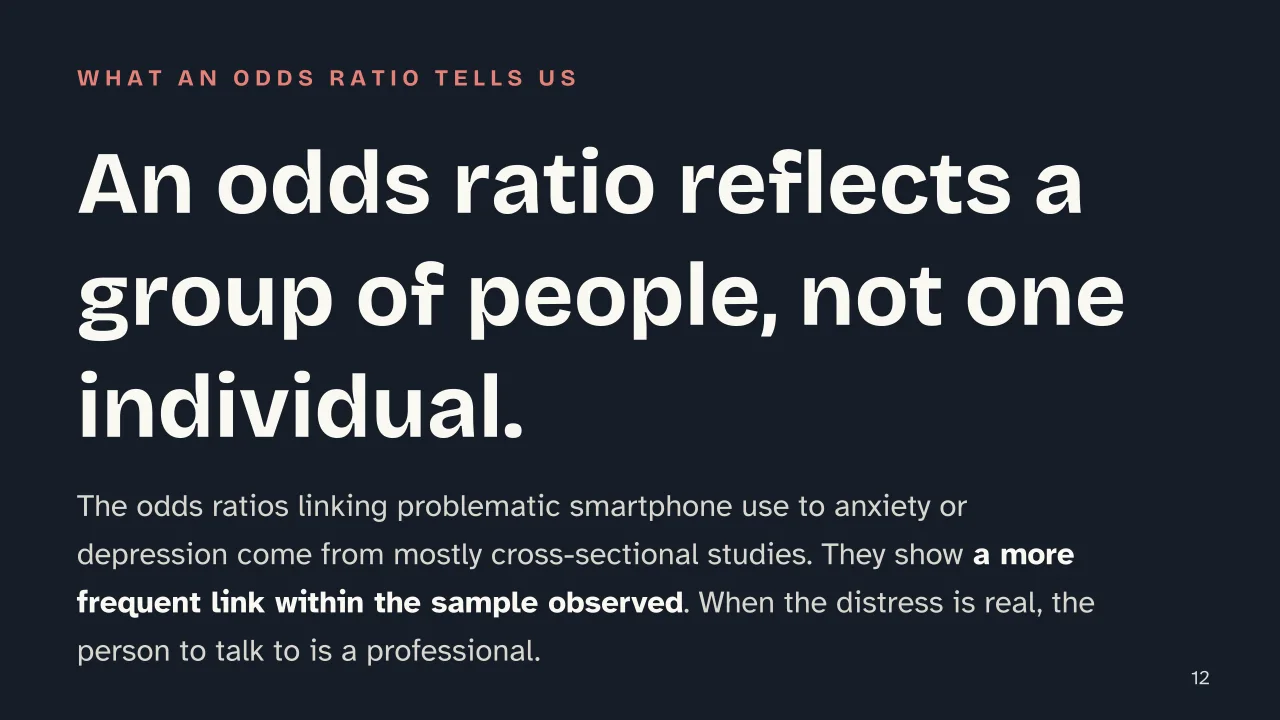
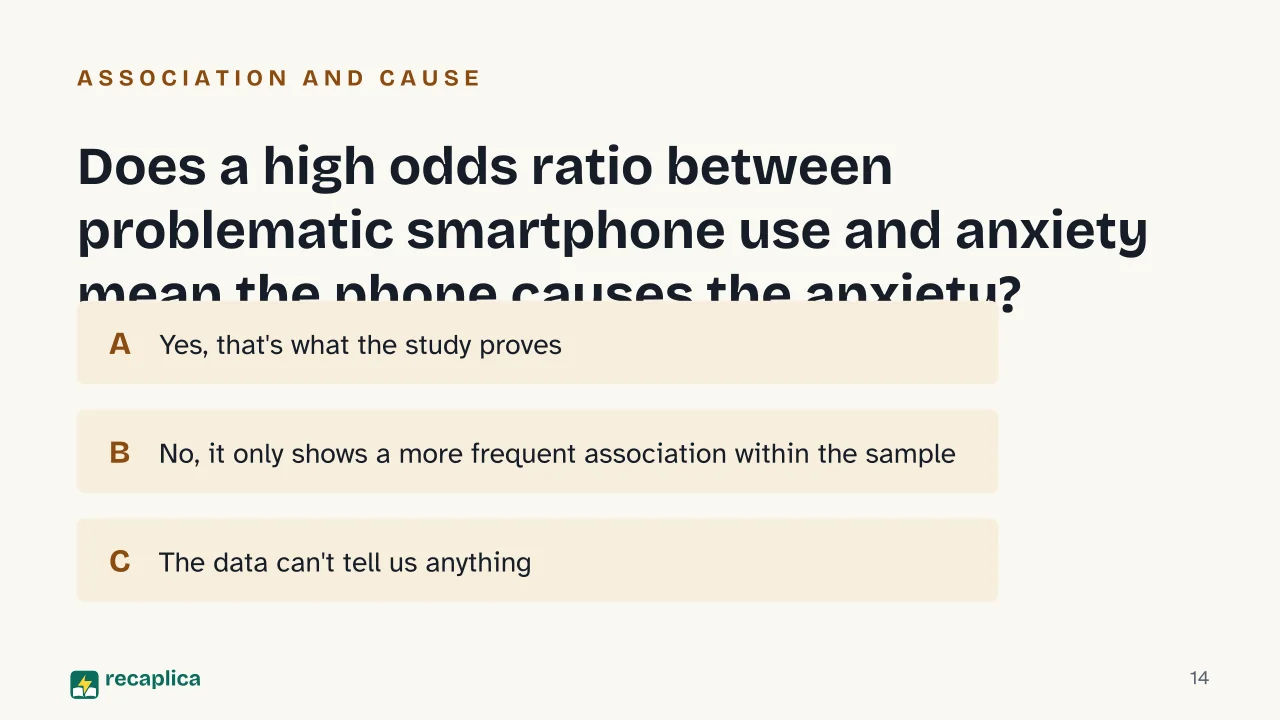
    An OR of 3.17 indicates that, within the sample observed, people with problematic smartphone use report depressive symptoms more often; it doesn’t show that the phone causes the depression, and it can’t predict what will happen to any one person.

    In the same meta-analysis, the group most likely to show problematic use was girls aged 17 to 19; that is a frequency seen in the samples studied.

    Who to turn to

    This Recap doesn’t offer a self-help approach. For young people, the APA recommends routine screening for signs of problematic social media use. When the distress is real, for yourself or for a teenager in your care, the next step is to talk to a professional: a psychologist, pediatrician, or family doctor.

    Slide deck

    Slides ready to download and make your own in PowerPoint or Google Slides, with speaker notes. Pick the Flash cut or the Full one.
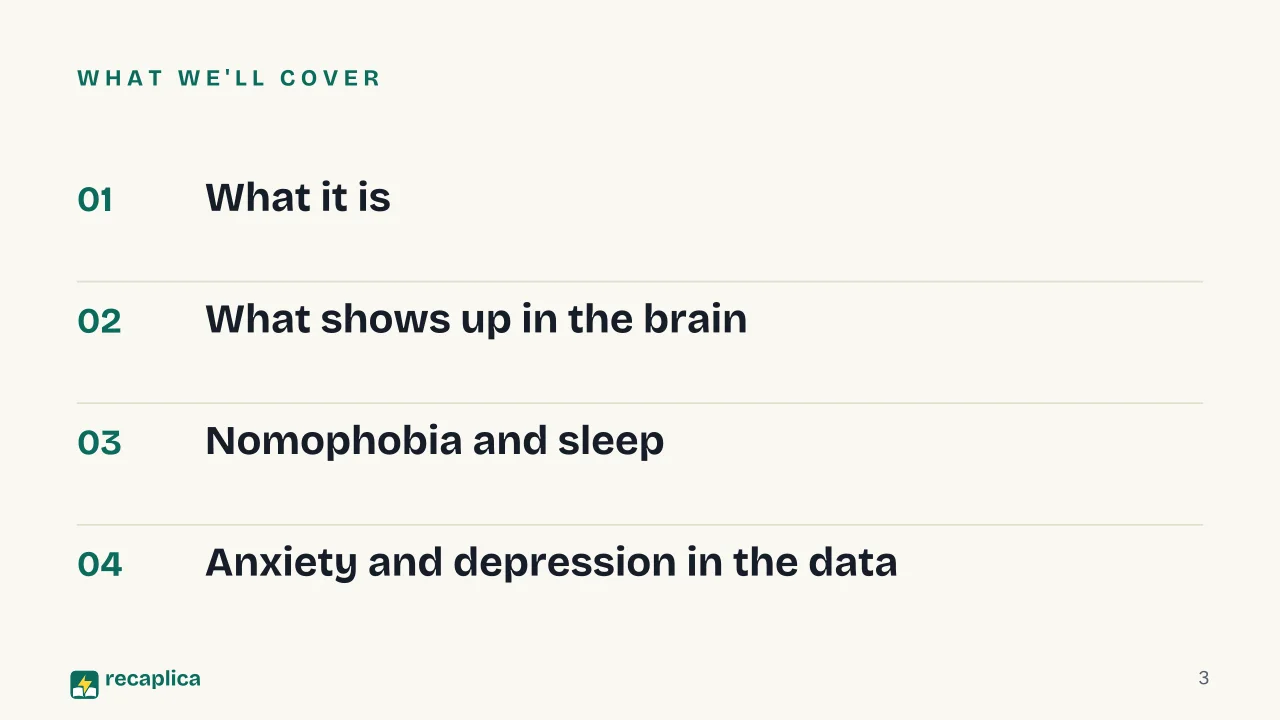
    Slide 1 of the presentation on Phone Addiction: Phone AddictionSlide 2 of the presentation on Phone Addiction: How many times today did you check your phone without deciding to?Slide 3 of the presentation on Phone Addiction: What we'll coverSlide 4 of the presentation on Phone Addiction: Chapter 01: What it isSlide 5 of the presentation on Phone Addiction: Problematic smartphone use, not included in the DSMSlide 6 of the presentation on Phone Addiction: Chapter 02: What shows up in the brainSlide 7 of the presentation on Phone Addiction: What the research reports: Reward system, Prefrontal cortex, Self-controlSlide 8 of the presentation on Phone Addiction: Chapter 03: Nomophobia and sleepSlide 9 of the presentation on Phone Addiction: Signs described in the sources: Nomophobia, Disrupted sleep, Trouble disengagingSlide 10 of the presentation on Phone Addiction: Nomophobia, the discomfort of being without a phoneSlide 11 of the presentation on Phone Addiction: Chapter 04: Anxiety and depression in the dataSlide 12 of the presentation on Phone Addiction: An odds ratio reflects a group of people, not one individual.Slide 13 of the presentation on Phone Addiction: Findings from the 2019 meta-analysisSlide 14 of the presentation on Phone Addiction: Does a high odds ratio between problematic smartphone use and anxiety mean the phone causes the anxiety?Slide 15 of the presentation on Phone Addiction: Read more
    Flash10 slidesThe essential thread, to present in classFull15 slidesEvery chapter and the deeper detail

    Common myths

    • ✗ Myth Nomophobia is an officially recognized psychiatric disorder.

      ✓ Reality In 2022 the authors of a meta-analysis of nomophobia's prevalence suggested adding it to future editions of the DSM and the International Classification of Diseases (ICD), neither of which listed it. They describe it as a behavioral addiction rather than a true phobia. Nearly all the percentages in the meta-analysis come from studies using one questionnaire, the Nomophobia Questionnaire, and they count people who score above a cut-off.

    • ✗ Myth A high odds ratio between phone use and anxiety proves the phone causes the anxiety.

      ✓ Reality The odds ratios in the 2019 meta-analysis come mostly from cross-sectional studies, meaning data collected at one point in time. They show that people with problematic smartphone use report anxiety or depressive symptoms more often within the sample studied. The authors themselves write that reverse causality can't be ruled out, meaning that feeling unwell may be what drives heavier phone use.

    • ✗ Myth The problem is the device itself.

      ✓ Reality On social media, which is one part of phone use, the American Psychological Association's position is that it is neither good nor bad for young people in itself. The effects, it says, likely depend on what a teenager actually does and comes across online, along with the strengths and vulnerabilities they already had and the environment they grow up in. For phones in general, the 2024 review notes that the available studies can't establish what causes what.

    Mind map

    Drag the background to move around and the nodes to reposition them; use − and + to collapse and expand branches.
    Customize
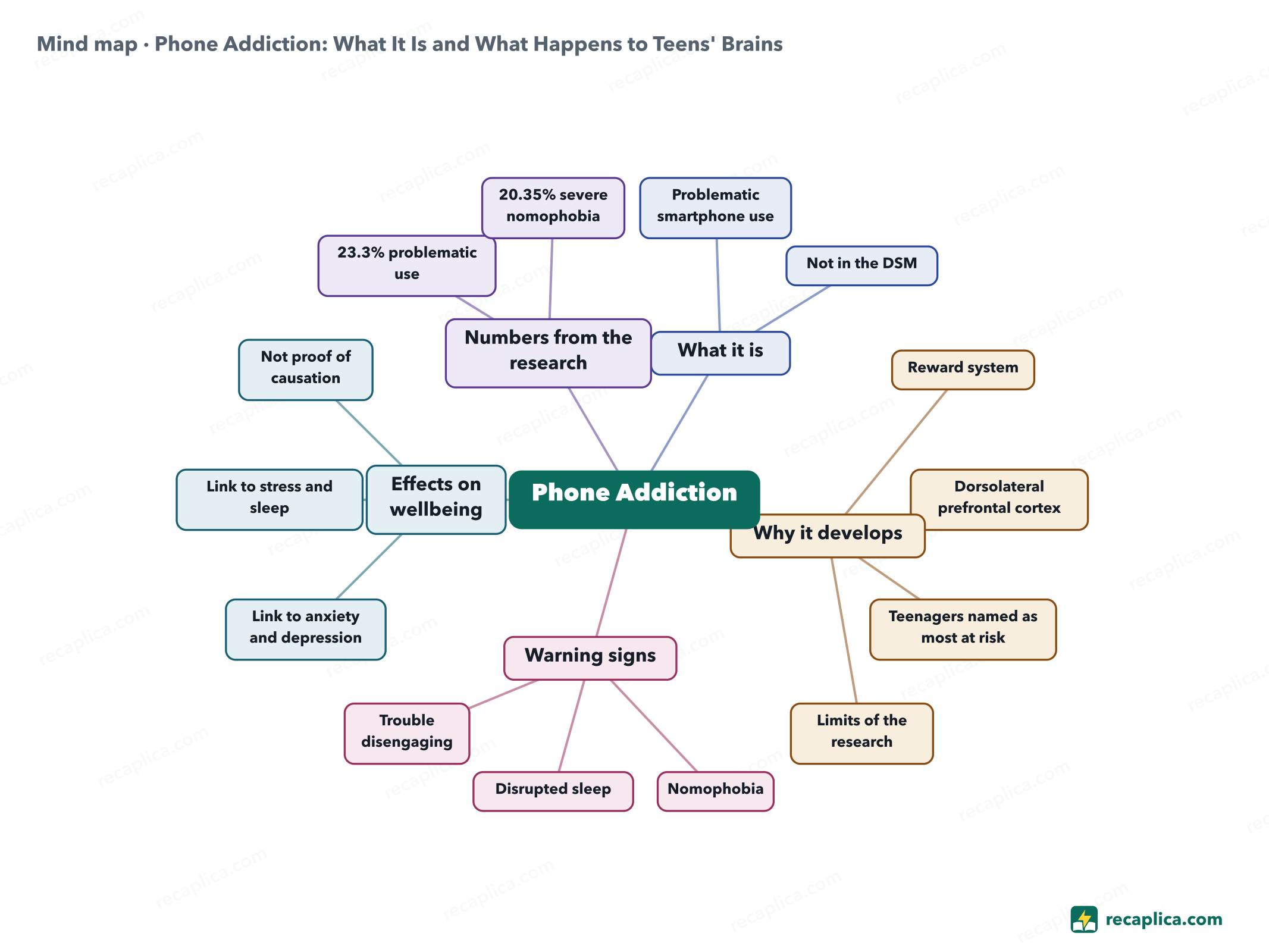
    Mind map: Phone Addiction: What It Is and What Happens to Teens' Brains
    • Phone Addiction
      • What it is
        • Problematic smartphone use excessive use that slips out of a person's control
        • Not in the DSM psychiatry's diagnostic manual doesn't include it, per a 2024 review
      • Why it develops
        • Reward system dopamine and serotonin, less active in people with problematic use
        • Dorsolateral prefrontal cortex key to inhibiting a response, per a 2024 review
        • Teenagers named as most at risk by the 2024 review, which doesn't say why; the APA, writing about social media, notes self-control isn't fully developed until adulthood
        • Limits of the research mostly cross-sectional studies, which can't establish what causes what
      • Warning signs
        • Nomophobia discomfort at being without a phone, measured with a questionnaire
        • Disrupted sleep technology use within an hour of bedtime
        • Trouble disengaging loss of control is part of how the behavior is defined
      • Effects on wellbeing
        • Link to anxiety and depression odds ratios between 3.05 and 3.17 in the 2019 meta-analysis
        • Link to stress and sleep smaller but still present odds ratios
        • Not proof of causation mostly cross-sectional, not experimental, studies
      • Numbers from the research
        • 23.3% problematic use 2019 meta-analysis, over 41,000 young people
        • 20.35% severe nomophobia share of participants, 2022 meta-analysis of 52 studies

    Quiz: test yourself

    Answer the questions to check what you have learned: you get instant feedback and a short explanation.

    Grade 0/10 0/5
    1 What does the term "phone addiction" refer to in scientific research?

    Many studies use the term "problematic smartphone use" (PSU). A 2024 review notes that the behavior isn't included in the DSM, psychiatry's diagnostic manual.

    2 What does the 2024 review report about the reward system in people with problematic smartphone use?

    The 2024 review reports a less active reward system in people with phone addiction, as in depressive disorders. It also points out that the research so far is mostly cross-sectional, which can't establish what causes what.

    3 True or false: the odds ratios found between problematic smartphone use and depression prove that phones cause depression.

    These are statistical associations from mostly cross-sectional studies, meaning data collected at one point in time. They say the two things turn up together more often in the sample observed, and the authors write that reverse causality can't be ruled out.

    4 What does the American Psychological Association say about the teenage brain in its 2023 advisory on social media?

    The APA's 2023 advisory says that regions tied to wanting attention and reinforcement from peers grow more sensitive from early adolescence, while self-control regions aren't fully developed until adulthood. The document, which covers social media only, recommends adult guidance in early adolescence.

    5 What is nomophobia, according to the definition used in the research?

    "Nomophobia" comes from "no-mobile-phone phobia," a label coined in 2008 for the discomfort of being without a phone. It is measured with a questionnaire, and as of 2022 it wasn't a diagnosis in the DSM or the ICD.

    Answers: 1-B · 2-A · 3-B · 4-B · 5-B

    Flashcards

    Tap the card to flip it and check whether you remember the answer, then move to the next one.

    1 / 7

    Explain it in your own words

    The ultimate test: if you can explain it in simple words, you've truly understood it. Write your explanation, then compare it with the Recap.

    Your explanation is saved only on this device.

    Phone addiction, which many studies call problematic smartphone use, means excessive phone use that slips out of a person's control; it isn't listed in the DSM, psychiatry's diagnostic manual. A 2019 meta-analysis puts it at roughly one in four of the young people studied, and finds an association — not a proven cause — with anxiety, depressive symptoms, and worse sleep. A 2024 review reports that in people with this behavior the brain's reward system, a circuit involving dopamine and serotonin, is less active. The same review names teenagers as the age group most at risk but doesn't say why; the American Psychological Association, writing about social media, notes that the brain regions behind self-control aren't fully developed until adulthood. Studies measure nomophobia, discomfort at being without a phone, separately and with a questionnaire; it isn't a diagnosis either.

    Frequently asked questions

    What are the symptoms of phone addiction?

    The 2024 review describes the behavior through three traits, withdrawal, tolerance, and loss of control over use, and the 2019 meta-analysis found it associated with worse sleep quality. For social media, the American Psychological Association lists among the indicators of problematic use a tendency to carry on even when you want to stop, repeatedly spending more time online than you meant to, and lying to keep access. Nomophobia, discomfort when the phone is missing, is measured separately with a questionnaire. None of these signs amounts to a diagnosis.

    What should someone do about phone addiction?

    This Recap describes the phenomenon but doesn't offer a self-help approach. For early adolescence, typically ages 10 to 14, the American Psychological Association advises that an adult stay involved in how a child uses social media. When the distress is real, the next step is to talk to a professional, such as a psychologist, a pediatrician, or a family doctor.

    What is smartphone addiction?

    It's the everyday name for what many studies call problematic smartphone use (PSU): excessive phone use that slips out of a person's control, with knock-on effects on social life and psychological or behavioral problems. A 2024 review notes that it isn't included in the DSM, psychiatry's diagnostic manual.

    Why are teenagers more at risk of phone addiction?

    A 2024 review names teenagers as the age group most at risk, without explaining why. The American Psychological Association, whose advisory covers only social media, says that brain regions tied to attention and approval from peers grow more sensitive from early adolescence, while self-control regions aren't fully developed until adulthood. That is why it advises that, in early adolescence, an adult stay involved in how a child uses social media.

    Does phone addiction cause anxiety and depression?

    Studies find an association, measured with odds ratios between 1.86 and 3.17 in a 2019 meta-analysis. Most of the studies collected their data at a single moment, so they can't establish what came first. The authors themselves write that reverse causality can't be ruled out, meaning that feeling unwell may be what drives heavier phone use. They rate the quality of this evidence as moderate for depression and low for anxiety, stress, and sleep.

    Sources

    • Sohn S., Rees P., Wildridge B., Kalk N.J., Carter B. (2019), Prevalence of problematic smartphone usage and associated mental health outcomes amongst children and young people: a systematic review, meta-analysis and GRADE of the evidence, BMC Psychiatry
    • Unveiling the grip of mobile phone addiction: an in-depth review (2024), Frontiers in Psychiatry
    • American Psychological Association (May 2023), Health Advisory on Social Media Use in Adolescence
    • Jahrami H. et al. (2022), The Prevalence of Mild, Moderate, and Severe Nomophobia Symptoms: A Systematic Review, Meta-Analysis, and Meta-Regression, Behavioral Sciences

    Every Recap goes through an independent review before publication.

    Every evening, the day's new Recaps on our Telegram channel. Join the channel →

    Keep learning

    • Science How the Immune System Works: Barriers, Cells, and Memory The immune system isn't a single organ — it's a network of barriers, cells and organs scattered across the whole body. Skin and mucous membranes form the outer wall, stopping most invaders before they get anywhere. Anything that gets past this wall runs into innate immunity, fast but generic, and then adaptive immunity, slower but aimed at that one invader specifically. Adaptive immunity also leaves something behind: memory, which is why a second encounter with the same pathogen gets a much quicker response. Read the Recap →
    • Science Indigestion Remedies: Symptoms, Causes, and What Really Helps Indigestion, which doctors call dyspepsia, isn't one disease but a group of symptoms that show up together after meals, according to the NIDDK (National Institutes of Health): pain or burning in the upper abdomen, feeling full too soon, bloating. The causes fall into three families, per the same source: a misfiring gut-brain conversation, certain common medications, and organic or infectious stomach problems. Heartburn from acid reflux is a different condition, with a different mechanism. Remedies range from everyday habits to over-the-counter medicine, with a doctor's visit when specific warning signs show up. Read the Recap →
    • Science The First 1000 Days of Life: Why They Shape a Child's Development The first 1000 days of life is the stretch from conception to a child's second birthday, a window the World Health Organization and researchers single out as unusually important for development. During those roughly 1000 days the brain builds new neural connections at a fast pace, while nutrition, health and the surrounding environment help set the stage for later physical and cognitive growth. Sources link malnutrition in this period to a large share of child deaths in low- and middle-income countries, though the numbers vary sharply from one setting to another. WHO frames interventions during this window around the "nurturing care" model, which covers health, protection, early learning and affectionate relationships, not nutrition alone. Read the Recap →

    recaplica

    Clear in 30 seconds, yours in 10 minutes.

    Recaps Mind maps Request a Recap Telegram channel Mind map maker Our method About Privacy & cookies Legal notes & terms of use

    © 2026 Recaplica · A project by Curi S.r.l. — VAT IT05472000750

    Statistics, only if you say so

    To learn which Recaps help most we would use Google Analytics, with aggregate, anonymous data. It starts only with your OK, and you can change your mind anytime. Privacy policy