Skip to content
recaplica

    One moment: security check

    Cloudflare wants to make sure you're not a robot. Tick the box below and your search will continue on its own.

    IT
    recaplica Indigestion Remedies: Symptoms, Causes, and What Really Helps
    © 2026 Recaplica · recaplica.com — All rights reserved
    Home › Science

    Indigestion Remedies: Symptoms, Causes, and What Really Helps

    By Recaplica Newsroom · Updated on September 17, 2026

    This Recap is about health. It explains what research and regulators say: it is not medical advice, nor a supplement or training programme. For decisions about yourself, talk to a doctor; if you are under 18, to your parents too. Legal notes

    What to print

    Page numbers appear when printing with default margins.

    Slides

    Choose a cut

    Flash10 slidesThe essential thread, to present in classFull15 slidesEvery chapter and the deeper detail

    Both come with speaker notes.

    Telegram channel
    recaplica Clear in 30 seconds, yours in 10 minutes.
    In 30 seconds Key points Figures Deep dive Slides Myths Mind map Quiz Flashcards FAQ

    In 30 seconds quick read

    Indigestion, which doctors call dyspepsia, isn't one disease but a group of symptoms that show up together after meals, according to the NIDDK (National Institutes of Health): pain or burning in the upper abdomen, feeling full too soon, bloating. The causes fall into three families, per the same source: a misfiring gut-brain conversation, certain common medications, and organic or infectious stomach problems. Heartburn from acid reflux is a different condition, with a different mechanism. Remedies range from everyday habits to over-the-counter medicine, with a doctor's visit when specific warning signs show up.

    Key Points

    • Indigestion (dyspepsia) is a group of gastrointestinal symptoms that occur together, according to the NIDDK.
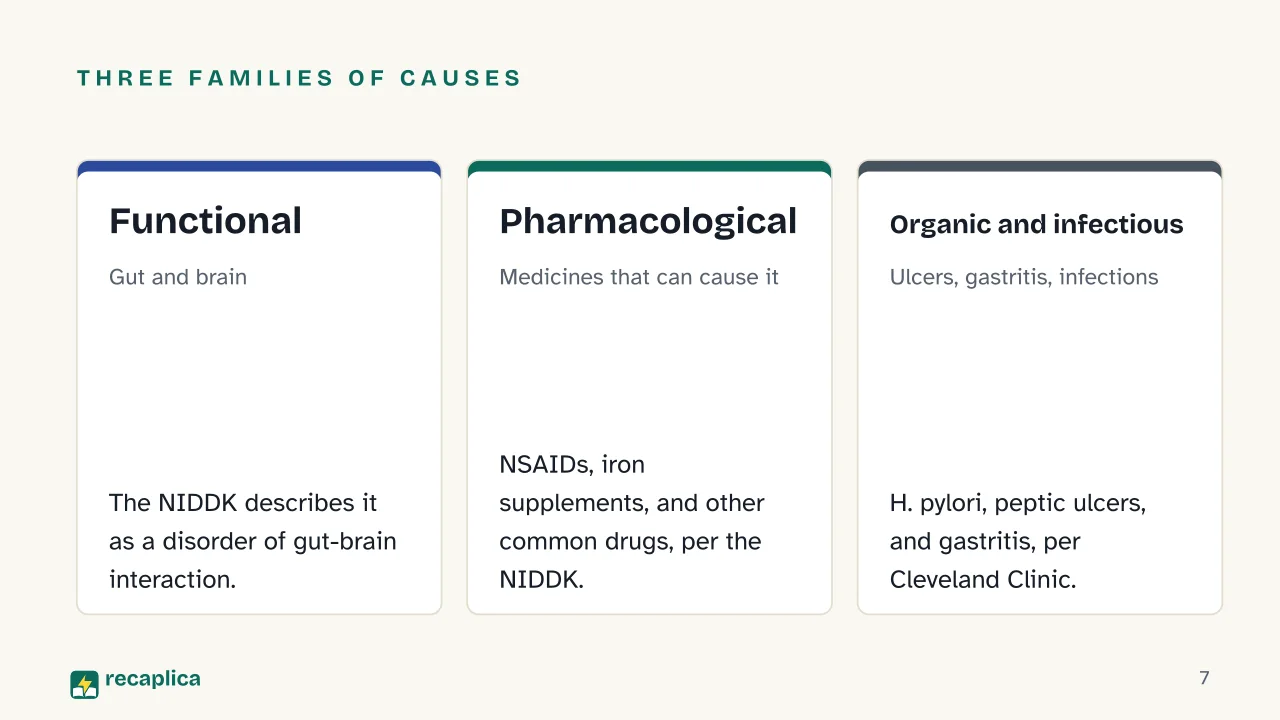
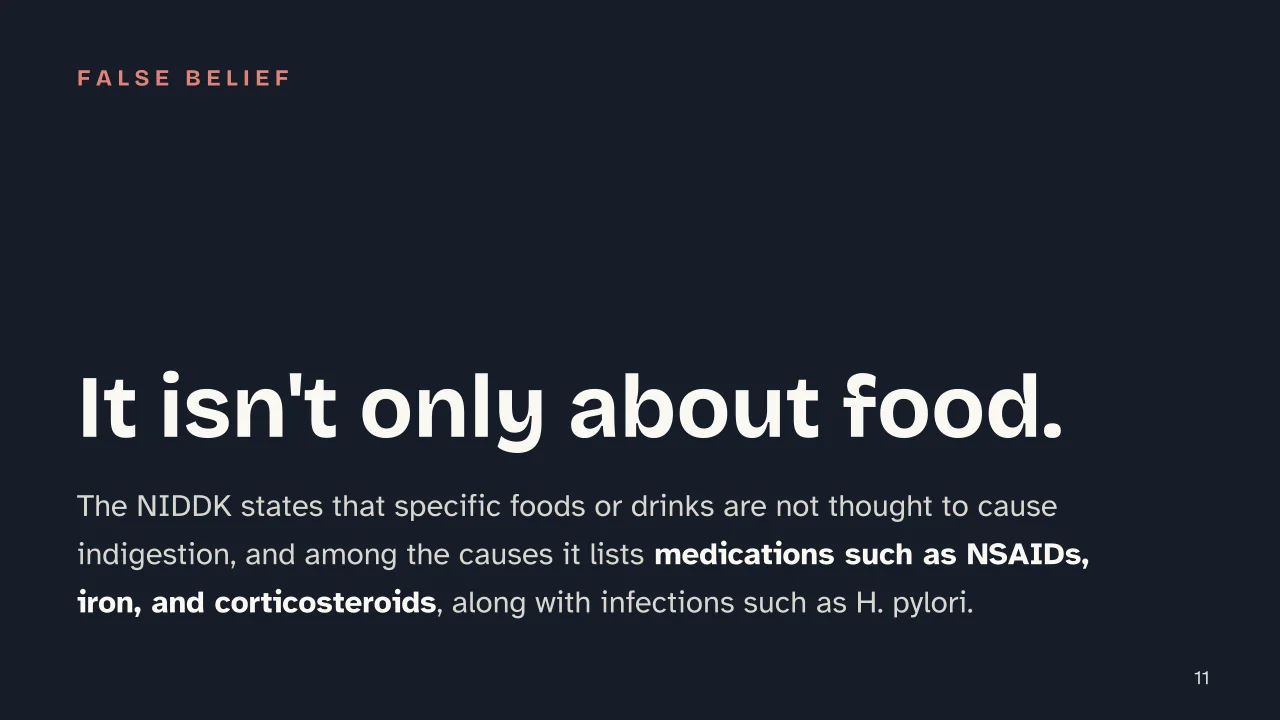
    • The NIDDK groups the causes into three families: functional (gut-brain), pharmacological (NSAIDs, iron, corticosteroids), and organic-infectious (ulcers, H. pylori).
    • Gastroesophageal reflux is a different condition from dyspepsia, even though some general-audience pages lump the two together.
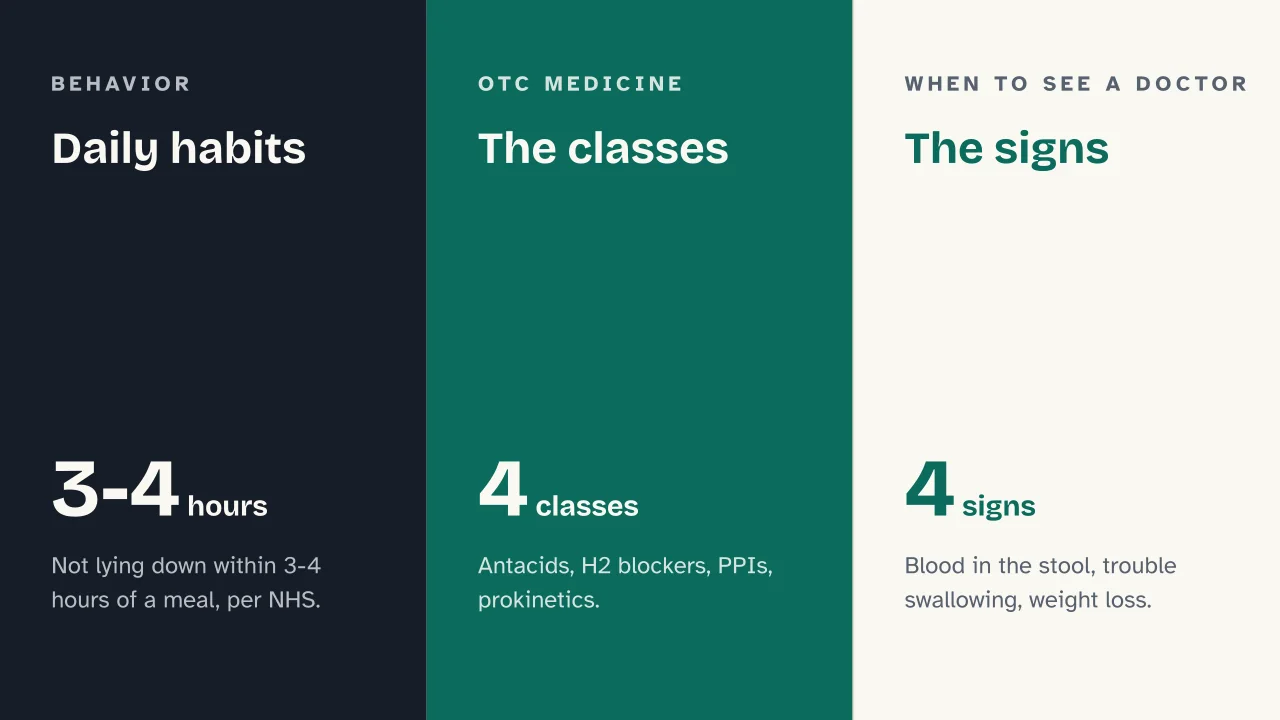
    • Over-the-counter medicines for indigestion work through different mechanisms: antacids, H2 blockers, proton pump inhibitors, and prokinetics.
    • Blood in the stool, difficulty swallowing, and unintentional weight loss are signs to bring to a doctor, confirmed independently by both NHS and Cleveland Clinic.
    • A 2024 meta-analysis in Scientific Reports estimates that functional dyspepsia affects 8.4% of people worldwide, more often women.

    Key figures

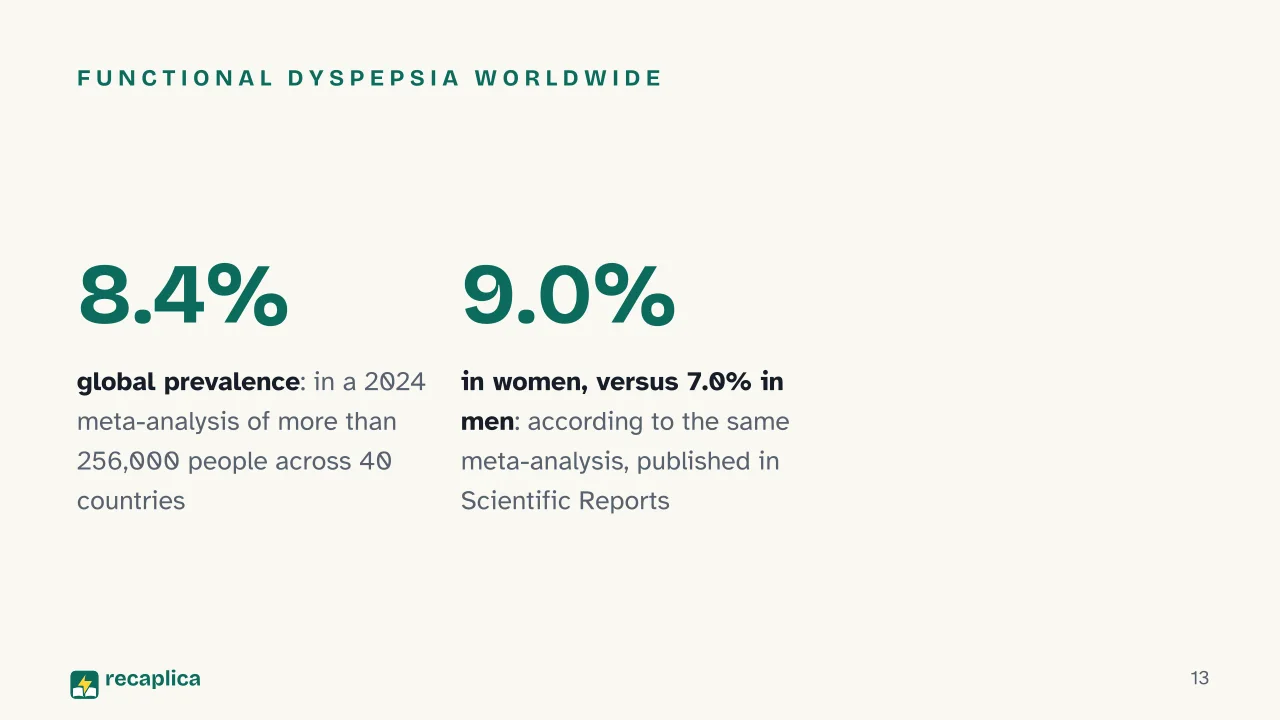
    • 8.4% the estimated global prevalence of functional dyspepsia, calculated from more than 256,000 people across 40 countries in a meta-analysis published in 2024 Source: Scientific Reports, 2024
    • 9.0% vs. 7.0% the prevalence of functional dyspepsia in women compared with men, according to the same 2024 meta-analysis Source: Scientific Reports, 2024

    Deep Dive

    Indigestion, what doctors call dyspepsia, is a group of symptoms that show up together after meals. That’s how the NIDDK, the US institute that handles digestive disease, defines it: “a general term that describes a group of gastrointestinal (GI) symptoms that occur together.” Tracing where it comes from, in any given case, is almost always a matter of more than one factor.

    Indigestion symptoms

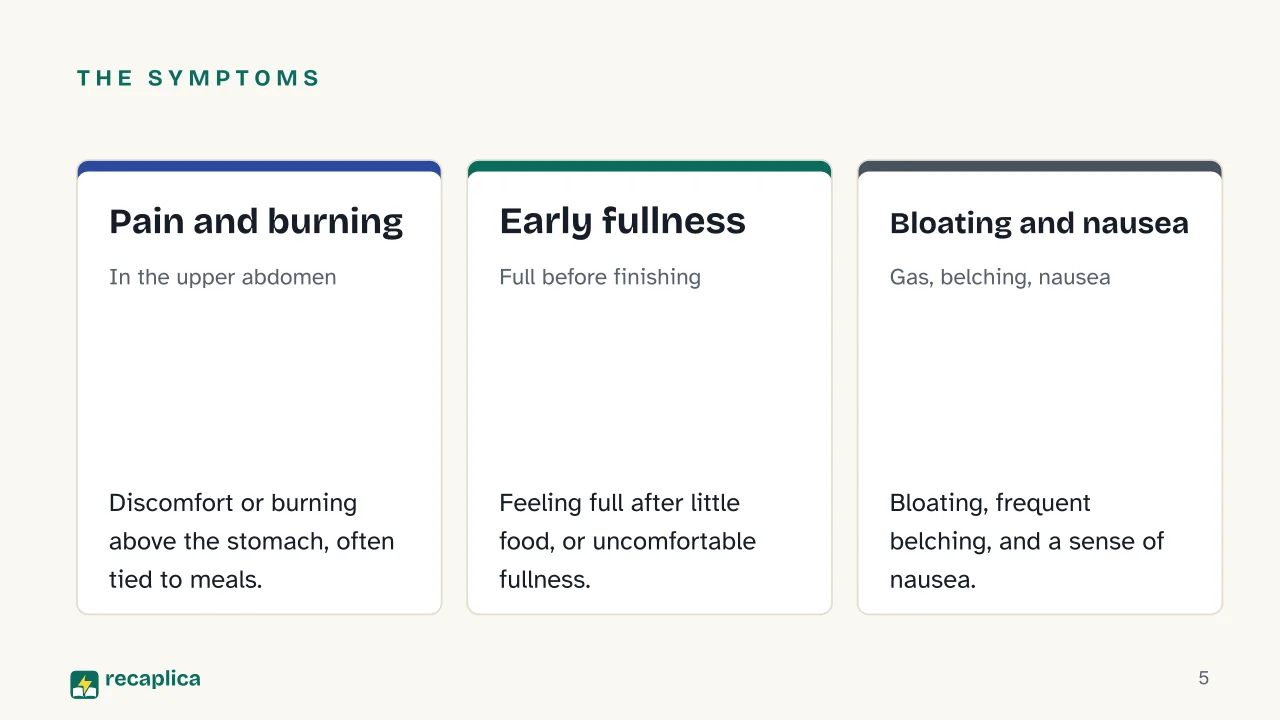
    The NIDDK lists pain, a burning feeling, or discomfort in the upper abdomen; feeling full too soon while eating a meal; uncomfortable fullness after a small amount of food; bloating, nausea, or frequent belching. Cleveland Clinic describes the same picture in similar terms, adding that the burning can come from stomach acid, digestive enzymes, or inflammation of the stomach lining.

    Not all these symptoms show up together, and they don’t all share the same cause: early fullness says something about how fast the stomach empties, while upper abdominal pain says something about the stomach lining or the nerves running through it.

    The causes, in three families

    The NIDDK groups the causes of indigestion into three families, and it’s a useful way to think about the problem.

    The first is functional: functional dyspepsia is described as “a disorder of gut-brain interaction,” a problem in how the gut and the brain communicate. The potential factors the NIDDK cites include certain foods and drinks, problems in the first part of the small intestine (inflammation or being overly sensitive to stomach acids), the stomach’s reduced ability to relax and expand, mental health factors such as anxiety and depression, and a genetic component.

    The second is pharmacological. Several common medications show up among the causes the NIDDK lists: certain antibiotics, NSAIDs (nonsteroidal anti-inflammatory drugs such as ibuprofen, also cited by NHS), iron supplements, osteoporosis medications, GLP-1 agonists used for diabetes and obesity, and corticosteroids.

    The third is organic and infectious. Cleveland Clinic cites peptic ulcers, gastritis (inflammation of the stomach lining caused by acid), and infections, including Helicobacter pylori (H. pylori); the NIDDK adds other possible infections such as Salmonella, Escherichia coli, Campylobacter, Giardia, or norovirus.

    Lifestyle factors sit alongside these: NHS points to being overweight, smoking, stress, and anxiety, plus foods and drinks that some people find worsen their symptoms, such as coffee, tomatoes, alcohol, chocolate, rich or spicy dishes, carbonated drinks, fruit and fruit juice, or wheat- and grain-based foods.

    A practical example: someone who regularly takes an anti-inflammatory for joint pain and notices bloating and early fullness after meals is experiencing, per the NIDDK, one of the more common digestive side effects of that drug class — not necessarily a problem tied to what they ate that day.

    Anyone looking at the link between diet, wheat and grains, and slow digestion finds a direct pointer in the NIDDK: wheat-based foods are among those the source associates with worsening symptoms in some people, alongside coffee and fatty foods.

    Slow digestion or reflux? Two different conditions

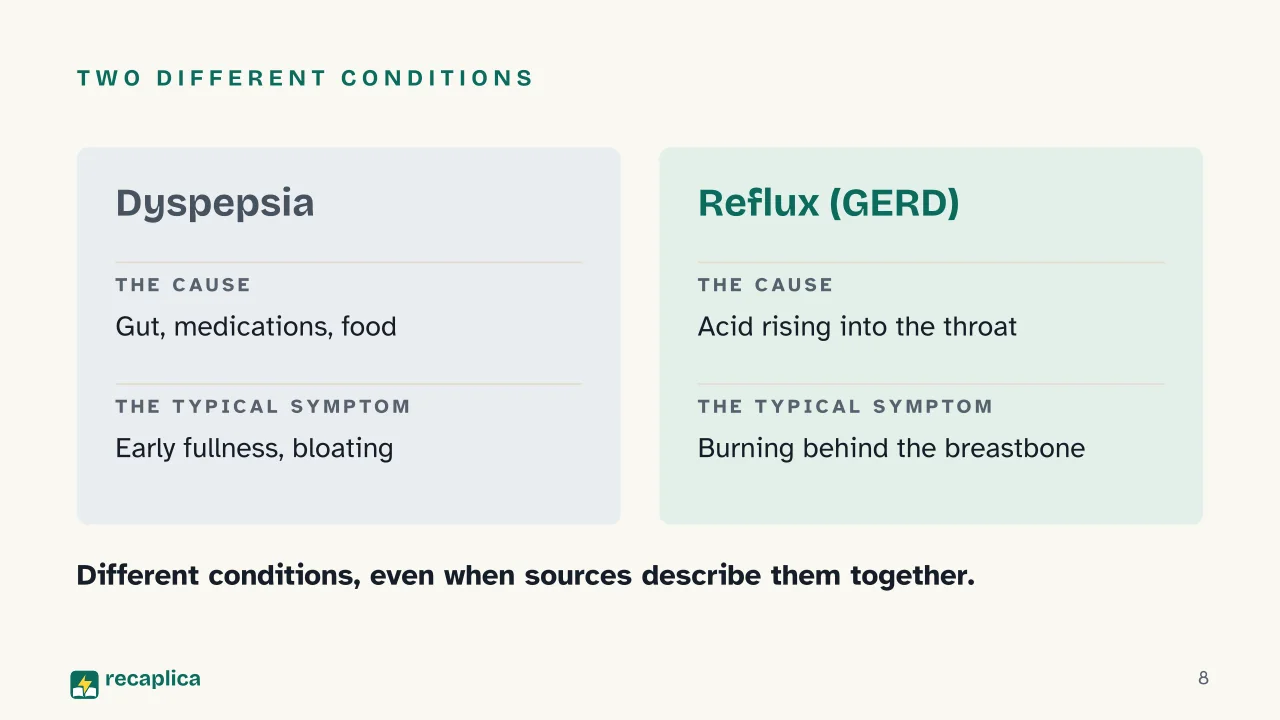
    Several general information pages, including NHS, list the symptoms of indigestion and those of heartburn from acid reflux together. Cleveland Clinic, by contrast, separates them by mechanism: in gastroesophageal reflux (GERD), stomach acid rises into the esophagus; in functional dyspepsia, the problem lies in oversensitive gut nerves that interpret normal digestion as pain.

    These are distinct clinical pictures, even though they can show up together in the same person. This Recap focuses on indigestion (dyspepsia): heartburn from acid reflux, with its own causes and remedies, deserves a separate discussion.

    What to take for indigestion (and how it works)

    Cleveland Clinic explains the mechanism of four classes of over-the-counter medicine for indigestion, each aimed at a different cause. The table below summarizes the difference.

    ClassMechanism, per Cleveland Clinic
    AntacidsNeutralize stomach acid already present
    H2 blockersReduce acid production by blocking histamine signals
    Proton pump inhibitors (PPIs)Strongly block acid and help heal tissue damage
    ProkineticsHelp the stomach empty faster

    The NIDDK notes that many of these medicines are available without a prescription, but it also flags prescription options for specific cases: antidepressants or anti-anxiety medications, which may ease the pain of dyspepsia; psychological therapies such as meditation, relaxation exercises, or counseling, when stress is a relevant factor; and, for H. pylori infection, more than one antibiotic given together.

    Among supplements, the NIDDK cites two with some supporting evidence: peppermint oil and caraway oil. Which option makes sense in a given case is a decision to work through with a doctor or pharmacist, not one to make alone when the problem persists.

    Home remedies for indigestion, from medical sources

    For occasional symptoms, NHS lists a few behavioral steps. Avoiding tea, coffee, cola, or alcohol in the hours around the discomfort; not lying down for 3-4 hours after a meal; propping the head and shoulders up in bed; losing weight if overweight, a factor NHS also cites among the causes; and avoiding rich, spicy, or fatty foods at the next meal.

    The link between body weight and digestion, which NHS flags as both a cause and a possible remedy, is the same link the Recap on body fat, what it is and how it’s measured approaches from a different angle — the body’s composition rather than its symptoms.

    A practical example: someone who eats a late dinner and lies down almost immediately afterward, per NHS’s guidance, raises the odds of waking up with indigestion symptoms: leaving a few hours between the meal and sleep is one of the few behavioral steps the source calls out explicitly.

    When stalled digestion is a warning sign

    NHS and Cleveland Clinic, independently of each other, list a set of warning signs (so-called red flags) for which indigestion is worth a doctor’s attention: blood in vomit or stool, difficulty swallowing, unintentional weight loss, recurring vomiting, anemia. NHS also adds the case of someone who keeps getting indigestion that doesn’t settle on its own, or who has severe pain.

    These signs show up with the same meaning across both sources, consulted independently: that’s a cross-check that makes them a solid reference point, more so than a single general-audience source.

    How common functional dyspepsia is

    A meta-analysis published in 2024 in Scientific Reports, the Nature-group journal, pooled data from 44 studies conducted between 1990 and 2020, covering more than 256,000 people in 40 countries across six continents. The pooled global prevalence of functional dyspepsia comes out to 8.4% (95% confidence interval 7.4% to 9.5%), higher in women (9.0%) than in men (7.0%).

    The same study also reports a trend: the pooled prevalence calculated from studies in 1990-2002 was 12.4%, against 7.3% in studies from 2013-2020 — a difference that may reflect changes in diagnostic criteria over time, alongside a possible real shift in the condition itself. These numbers measure functional dyspepsia specifically, the form with no identifiable organic cause, not the full range of indigestion cases, which also includes the pharmacological, organic, and infectious causes described above.

    On how the whole digestive system works, from mouth to intestine, the Recap Digestive System: How It Breaks Down Food, Step by Step describes the process that, when something stalls, produces the symptoms covered in this guide.

    Slide deck

    Slides ready to download and make your own in PowerPoint or Google Slides, with speaker notes. Pick the Flash cut or the Full one.
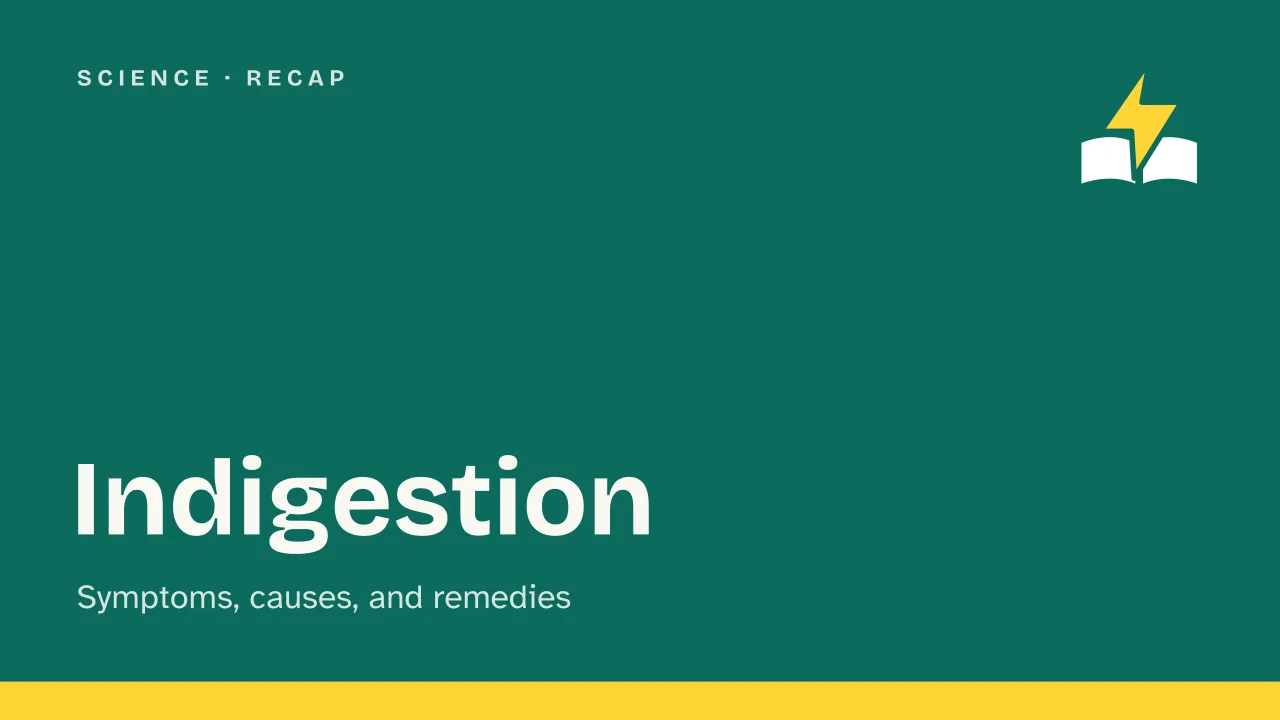
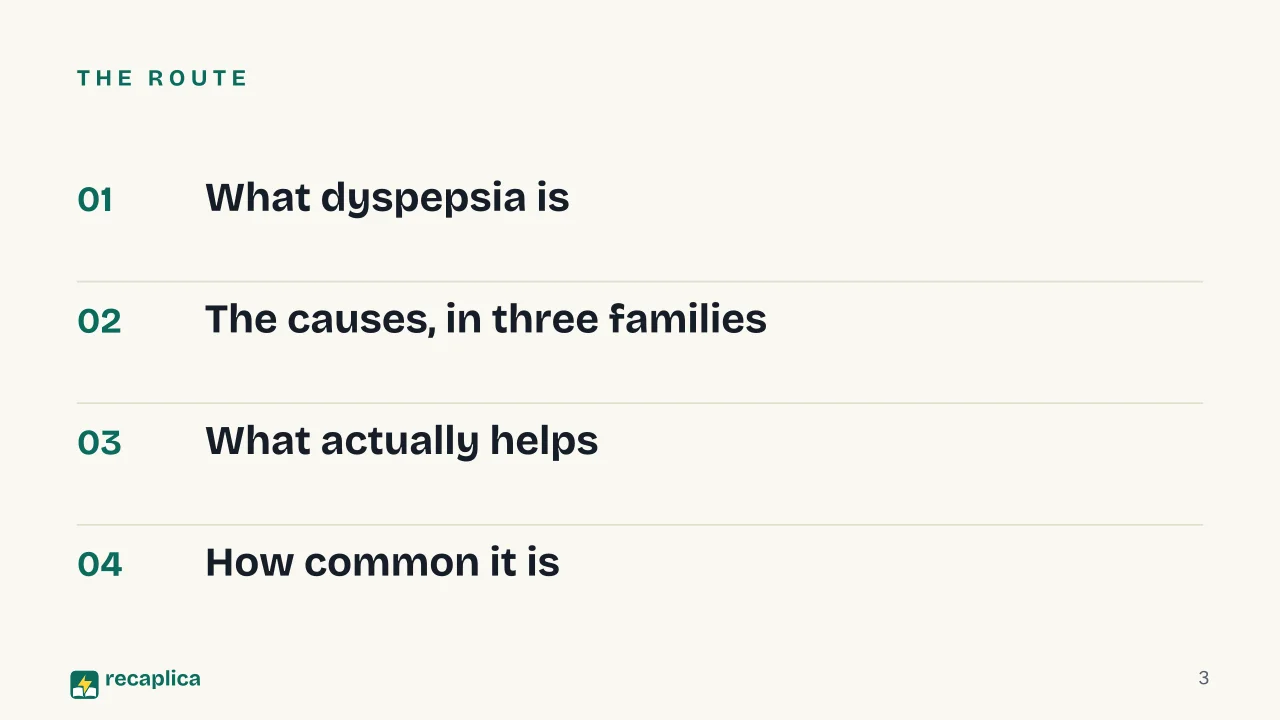
    Slide 1 of the presentation on Indigestion Remedies: IndigestionSlide 2 of the presentation on Indigestion Remedies: Why does digestion sometimes stall?Slide 3 of the presentation on Indigestion Remedies: The routeSlide 4 of the presentation on Indigestion Remedies: Chapter 01: What dyspepsia isSlide 5 of the presentation on Indigestion Remedies: The symptoms: Pain and burning, Early fullness, Bloating and nauseaSlide 6 of the presentation on Indigestion Remedies: Chapter 02: The causes, in three familiesSlide 7 of the presentation on Indigestion Remedies: Three families of causes: Functional, Pharmacological, Organic and infectiousSlide 8 of the presentation on Indigestion Remedies: Two different conditionsSlide 9 of the presentation on Indigestion Remedies: Chapter 03: What actually helpsSlide 10 of the presentation on Indigestion Remedies: Daily habits · The classes · The signsSlide 11 of the presentation on Indigestion Remedies: It isn't only about food.Slide 12 of the presentation on Indigestion Remedies: Chapter 04: How common it isSlide 13 of the presentation on Indigestion Remedies: Functional dyspepsia worldwideSlide 14 of the presentation on Indigestion Remedies: Which medications can cause indigestion, according to the NIDDK?Slide 15 of the presentation on Indigestion Remedies: The full Recap
    Flash10 slidesThe essential thread, to present in classFull15 slidesEvery chapter and the deeper detail

    Common myths

    • ✗ Myth Indigestion only comes down to what you eat

      ✓ Reality The NIDDK states that specific foods or drinks are not thought to cause indigestion as a general rule. Among the causes the same source lists are a misfiring gut-brain conversation, common medications such as NSAIDs, iron supplements and certain antibiotics, and infections such as H. pylori. Food can make symptoms worse for a given person, but it's rarely the only source of the problem.

    • ✗ Myth Any antacid fixes the problem

      ✓ Reality Cleveland Clinic describes medicines with different mechanisms: antacids neutralize acid that's already there, H2 blockers and proton pump inhibitors reduce how much acid the stomach makes, and prokinetics help the stomach empty faster. A medicine built for one mechanism doesn't necessarily act on the others, which is why the same sources point people toward a doctor when symptoms don't improve.

    • ✗ Myth Heartburn and indigestion are the same thing

      ✓ Reality Cleveland Clinic separates the two conditions by mechanism: in gastroesophageal reflux, acid rises from the stomach into the esophagus, while functional dyspepsia comes from gut nerves that misread normal digestion as pain. Some general information pages, such as NHS, list both symptom groups together, but they remain two distinct clinical pictures.

    Mind map

    Drag the background to move around and the nodes to reposition them; use − and + to collapse and expand branches.
    Customize
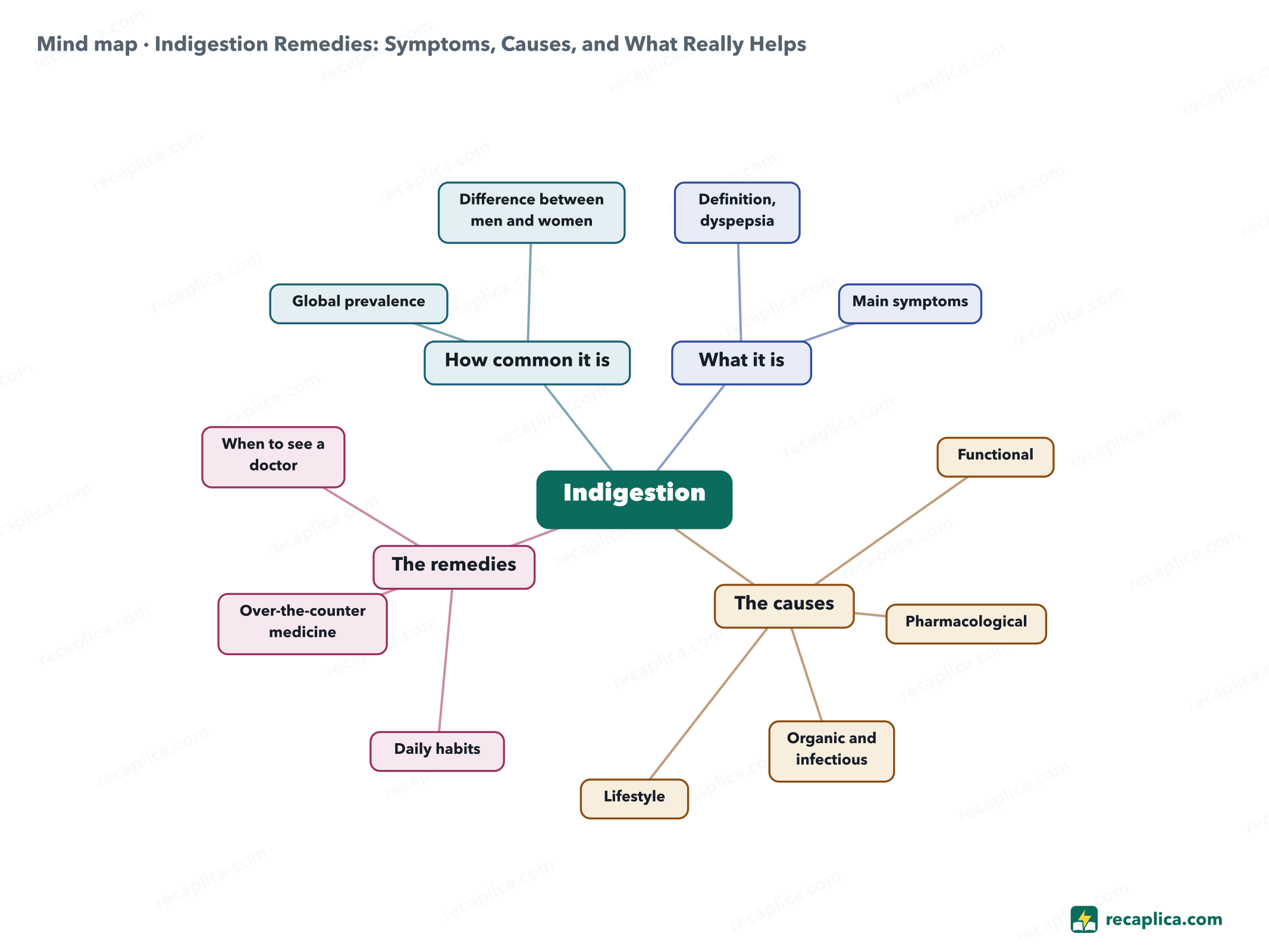
    Mind map: Indigestion Remedies: Symptoms, Causes, and What Really Helps
    • Indigestion
      • What it is
        • Definition, dyspepsia A group of gastrointestinal symptoms that occur together, per the NIDDK
        • Main symptoms Upper abdominal pain or burning, early fullness, bloating
      • The causes
        • Functional A misfiring gut-brain conversation
        • Pharmacological NSAIDs, iron, corticosteroids, and other common medicines
        • Organic and infectious Ulcers, gastritis, H. pylori
        • Lifestyle Certain foods, being overweight, smoking, stress
      • The remedies
        • Daily habits Meal timing, sleeping posture
        • Over-the-counter medicine Antacids, H2 blockers, PPIs, prokinetics
        • When to see a doctor The warning signs not to ignore
      • How common it is
        • Global prevalence 8.4% in 2024, meta-analysis in Scientific Reports
        • Difference between men and women 9.0% in women, 7.0% in men

    Quiz: test yourself

    Answer the questions to check what you have learned: you get instant feedback and a short explanation.

    Grade 0/10 0/5
    1 What is functional dyspepsia, according to the NIDDK?

    The NIDDK describes functional dyspepsia as a disorder of gut-brain interaction, also linked to factors such as anxiety and depression.

    2 Indigestion can also be caused by medications such as NSAIDs. True or false?

    The NIDDK lists NSAIDs, iron supplements, certain antibiotics, osteoporosis medications, and corticosteroids among the pharmacological causes.

    3 What distinguishes heartburn from acid reflux and functional dyspepsia, mechanism-wise?

    Cleveland Clinic describes reflux as acid rising from the stomach into the esophagus, while functional dyspepsia comes from oversensitive gut nerves.

    4 How many classes of over-the-counter medicine for indigestion does Cleveland Clinic describe?

    Cleveland Clinic explains the mechanism of antacids, H2 blockers, proton pump inhibitors, and prokinetics, each acting differently.

    5 According to the 2024 meta-analysis published in Scientific Reports, what is the global prevalence of functional dyspepsia?

    The study, covering more than 256,000 people across 40 countries, estimates a pooled prevalence of 8.4% (95% confidence interval 7.4-9.5).

    Answers: 1-A · 2-A · 3-A · 4-A · 5-A

    Flashcards

    Tap the card to flip it and check whether you remember the answer, then move to the next one.

    1 / 8

    Explain it in your own words

    The ultimate test: if you can explain it in simple words, you've truly understood it. Write your explanation, then compare it with the Recap.

    Your explanation is saved only on this device.

    Indigestion, which doctors call dyspepsia, isn't one disease but a group of symptoms that show up together after meals, according to the NIDDK (National Institutes of Health): pain or burning in the upper abdomen, feeling full too soon, bloating. The causes fall into three families, per the same source: a misfiring gut-brain conversation, certain common medications, and organic or infectious stomach problems. Heartburn from acid reflux is a different condition, with a different mechanism. Remedies range from everyday habits to over-the-counter medicine, with a doctor's visit when specific warning signs show up.

    Frequently asked questions

    What are the symptoms of indigestion?

    The NIDDK lists pain, burning, or discomfort in the upper abdomen, feeling full too soon while eating, uncomfortable fullness after a small amount of food, bloating, nausea, and belching. Symptoms typically show up around meals.

    What to take for indigestion?

    According to the NIDDK and Cleveland Clinic, over-the-counter medicines work through different mechanisms: antacids, which neutralize acid; H2 blockers and proton pump inhibitors, which reduce how much acid the stomach makes; and prokinetics, which speed up stomach emptying. Which option makes sense depends on the cause, and it's a question for a doctor or pharmacist, not a decision to make alone when symptoms persist.

    What are some home and natural remedies for indigestion?

    NHS lists a few behavioral steps for occasional symptoms: avoiding tea, coffee, cola, or alcohol close to the discomfort; not lying down for 3-4 hours after a meal; propping the head and shoulders up in bed; losing weight if overweight, a factor NHS also lists among the causes; and avoiding rich, spicy, or fatty foods at the next meal. The NIDDK also cites two supplements with some supporting evidence, peppermint oil and caraway oil, plus stress-reduction approaches such as meditation, relaxation exercises, or counseling for cases where stress plays a role. These are everyday steps, not a substitute for medical advice when symptoms keep coming back.

    What can cause slow stomach emptying?

    The NIDDK links a slow-emptying stomach to functional dyspepsia, describing it as a disorder of gut-brain interaction where the stomach has trouble relaxing and expanding normally. Prokinetics are the medicine class Cleveland Clinic describes as working specifically on this mechanism, by helping the stomach empty faster.

    Is indigestion the same thing as heartburn?

    No. Cleveland Clinic describes them as different mechanisms: in gastroesophageal reflux, stomach acid rises into the esophagus, while functional dyspepsia comes from gut nerves interpreting normal digestion as pain. Some general information pages treat the two symptom groups together, but they remain distinct conditions.

    Sources

    • NIDDK (NIH), Definition & Facts for Indigestion (Dyspepsia)
    • NHS, Indigestion
    • Cleveland Clinic, Indigestion (Dyspepsia): What It Is, Symptoms & Causes
    • Ha, Jung, Jo et al., Global prevalence of functional dyspepsia according to Rome criteria, 1990-2020, Scientific Reports, 2024

    Every Recap goes through an independent review before publication.

    Every evening, the day's new Recaps on our Telegram channel. Join the channel →

    Keep learning

    • Science How the Immune System Works: Barriers, Cells, and Memory The immune system isn't a single organ — it's a network of barriers, cells and organs scattered across the whole body. Skin and mucous membranes form the outer wall, stopping most invaders before they get anywhere. Anything that gets past this wall runs into innate immunity, fast but generic, and then adaptive immunity, slower but aimed at that one invader specifically. Adaptive immunity also leaves something behind: memory, which is why a second encounter with the same pathogen gets a much quicker response. Read the Recap →
    • Science The First 1000 Days of Life: Why They Shape a Child's Development The first 1000 days of life is the stretch from conception to a child's second birthday, a window the World Health Organization and researchers single out as unusually important for development. During those roughly 1000 days the brain builds new neural connections at a fast pace, while nutrition, health and the surrounding environment help set the stage for later physical and cognitive growth. Sources link malnutrition in this period to a large share of child deaths in low- and middle-income countries, though the numbers vary sharply from one setting to another. WHO frames interventions during this window around the "nurturing care" model, which covers health, protection, early learning and affectionate relationships, not nutrition alone. Read the Recap →
    • Science How Tanning Works: Melanin, UV Rays and Why Skin Darkens A tan is not a healthy process in its own right: it is skin's response to UV damage that is already underway. Melanocytes produce more melanin to absorb radiation and protect the DNA of the cells below. It happens in two stages: a quick darkening that fades within hours, and the real tan, which shows up after a couple of days and lasts. UVA and UVB rays act on skin in different ways, with different consequences for sunburn, skin aging and cancer risk. Several widespread myths, from 'you need to burn before you can tan' to the idea that tanning beds are safe, don't hold up against the scientific sources. Read the Recap →

    recaplica

    Clear in 30 seconds, yours in 10 minutes.

    Recaps Mind maps Request a Recap Telegram channel Mind map maker Our method About Privacy & cookies Legal notes & terms of use

    © 2026 Recaplica · A project by Curi S.r.l. — VAT IT05472000750

    Statistics, only if you say so

    To learn which Recaps help most we would use Google Analytics, with aggregate, anonymous data. It starts only with your OK, and you can change your mind anytime. Privacy policy