|
recaplica
Apollo 11: How the 1969 Moon Landing Happened | ||||||||||||||||||||||||||||||||
| © 2026 Recaplica · recaplica.com — All rights reserved | ||||||||||||||||||||||||||||||||
Apollo 11: How the 1969 Moon Landing HappenedWhat to print Page numbers appear when printing with default margins. In 30 seconds quick readOn 20 July 1969 the lunar module Eagle from Apollo 11 touches down in the Sea of Tranquility, and a few hours later Neil Armstrong becomes the first person to walk on the Moon, followed by Buzz Aldrin, while Michael Collins stays in orbit aboard the command module Columbia. It comes after years of a space race with the Soviet Union, opened by the 1957 launch of Sputnik and given a fresh target by President John F. Kennedy in 1961, and after the rehearsals flown under Project Mercury and Project Gemini. The Apollo program is not without accidents — a crew dies on the ground in 1967, another nearly fails to return in 1970 — but it puts twelve astronauts on the Moon in all, across six successful missions between 1969 and 1972. Key Points
Key figures
Deep DiveWhy the United States went to the MoonOn 4 October 1957 the Soviet Union puts Sputnik 1 into orbit, a sphere about 58 centimetres across, not much bigger than a beach ball. It is the first artificial satellite in history, and for the United States it is a shock: it opens the space-age chapter of the Cold War, with NASA founded the following year in response. Four years later, on 12 April 1961, Soviet cosmonaut Yuri Gagarin becomes the first human in space — another blow to the United States in the space race. Six weeks after that, on 25 May 1961, President John F. Kennedy stands before a special joint session of Congress and announces the goal of landing an American on the Moon before the decade is out. In the speech he explicitly ties the initiative to the shock of Sputnik, recalling how far that launch had reached into public opinion around the world. It is not the only reason behind the space race — there is also the broader military and technological rivalry between the two blocs — but it is the one Kennedy chooses to put at the centre of his speech. The goal is met eight years later, on 20 July 1969, when Apollo 11 commander Neil Armstrong sets foot on the Moon. Mercury and Gemini: rehearsing for the MoonBefore attempting a Moon landing, the United States first has to learn how to send people into space and bring them home alive. Project Mercury, the country’s first crewed spaceflight program, flies six astronauts between 1961 and 1963. Alan Shepard makes a 15-minute suborbital hop in 1961; John Glenn becomes the first American to orbit the Earth on 20 February 1962, completing three full orbits aboard Friendship 7; the program’s last flight, Gordon Cooper’s in May 1963, reaches 22 orbits and 34 hours and 20 minutes aloft. Mercury proves that a person can survive and work in orbit. That alone is not enough to reach the Moon, though: astronauts also need to bring two spacecraft together in orbit (rendezvous) and lock them to one another (docking), since the lunar module and the command module will have to separate near the Moon and later reconnect. That is the job of Project Gemini, ten crewed missions flown starting in 1965 that bridge Mercury and Apollo. Gemini 6 and Gemini 7 pull off the first space rendezvous in history; Gemini 8 completes the first docking with another orbiting vehicle, an Agena rocket stage. In the same stretch, Gemini 4 carries out the first American spacewalk, and later flights stretch mission length out to 14 days. These are years in which ground-based technology races alongside the spaceflight program: the same labs and firms building the guidance systems for Mercury and Gemini belong to an electronics and computing industry going through a revolution of its own in that decade — one worth tracing through the history of computers. Setbacks along the wayThe Apollo program does not run smoothly. On 27 January 1967 a fire breaks out in the Apollo 1 command module during a ground test on the launch pad at Cape Canaveral, with the crew strapped inside. Astronauts Gus Grissom, Ed White and Roger Chaffee die: the cabin, pressurized with pure oxygen, holds flammable materials, and a likely electrical short in a faulty wire sets off the flames. It is the first time American astronauts die aboard a spacecraft, and the tragedy leads to major safety changes in the Apollo modules that follow. Less than two years later, between 21 and 27 December 1968, Apollo 8 becomes the first crewed spacecraft to leave low Earth orbit and the first crewed flight to reach the Moon. Frank Borman, William Anders and James Lovell orbit the Moon ten times without landing, then head back to Earth. During the flight, Anders photographs “Earthrise”, the Earth rising over the lunar horizon, an image often credited with helping inspire the environmental movement. 20 July 1969Apollo 11 lifts off on 16 July 1969 atop a Saturn V rocket, with Neil Armstrong as commander, Michael Collins piloting the command module Columbia and Buzz Aldrin piloting the lunar module Eagle. On 20 July, Armstrong and Aldrin descend aboard the Eagle while Collins stays in orbit aboard Columbia; at 4:18 p.m. EDT the lunar module touches down in the Sea of Tranquility. Armstrong climbs out first, about six and a half hours after touchdown: at 10:56:20 p.m. EDT on 20 July 1969 he takes the first human step on the Moon, and coming down the ladder he speaks one of the most celebrated lines in the history of space exploration, linking the smallness of one person’s step to what it means for the species as a whole. Over 500 million people around the world watch it live on television. The moonwalk lasts 2 hours, 31 minutes and 40 seconds: Armstrong and Aldrin stay within about 100 metres of the lunar module, gather roughly 21.3 kilograms of rock and dust samples, set up four science experiments and plant a flag. On the descent stage of the lunar module they also leave a commemorative plaque explaining the mission’s peaceful purpose.
The lunar module Eagle stays on the surface for 21.6 hours in total before lifting off to redock with Columbia in orbit. The trip back to Earth runs at a speed of roughly 40,000 kilometres an hour; splashdown in the Pacific Ocean, southwest of Hawaii, comes at 12:51 p.m. EDT on 24 July 1969. After Armstrong: the other Apollo missionsApollo 11 opens the way, but it does not close it. Between November 1969 and December 1972, five more missions manage to land, while a sixth, Apollo 13, has to give up partway there.
The most dramatic case is Apollo 13. On 13 April 1970, roughly 200,000 miles from Earth, the service module’s second oxygen tank explodes: the cause, pieced together afterward, traces back to damage in the wiring insulation carrying the electric current inside the tank, done years earlier during a ground test in which the tank’s heater elements had been left on too long. Commander Jim Lovell reports the problem to mission control in a line that becomes famous; the planned landing in the Fra Mauro region is abandoned, and the crew and ground engineers work out, in a matter of hours, emergency procedures never tested before, which let Apollo 13 splash down in the Pacific on 17 April 1970, four days after the explosion. The final mission, Apollo 17, in December 1972, puts Eugene Cernan and Harrison Schmitt on the Moon, where they spend a combined 22 hours and 5 minutes on the surface. Counting Cernan and Schmitt, twelve astronauts in all have walked on the Moon over the course of the program. What it costThe most authoritative account of the Apollo program’s cost is a written NASA testimony to the United States Congress, delivered in early 1973: it puts the total at $25.4 billion, in contemporary dollars and not adjusted for inflation. Direct costs, from fiscal year 1960 through 1973, come to $20.6 billion; adding indirect costs — ground infrastructure, civil-service salaries, the tracking and data network — brings the total to roughly $25.8 billion. What is left, beyond the figures, is the rock and dust brought back from six different landing sites, and the proof that it was possible to do, in under a decade, what in 1961 had been only the promise of a speech to Congress. Common myths
Mind mapDrag the background to move around and the nodes to reposition them; use − and + to collapse and expand branches. 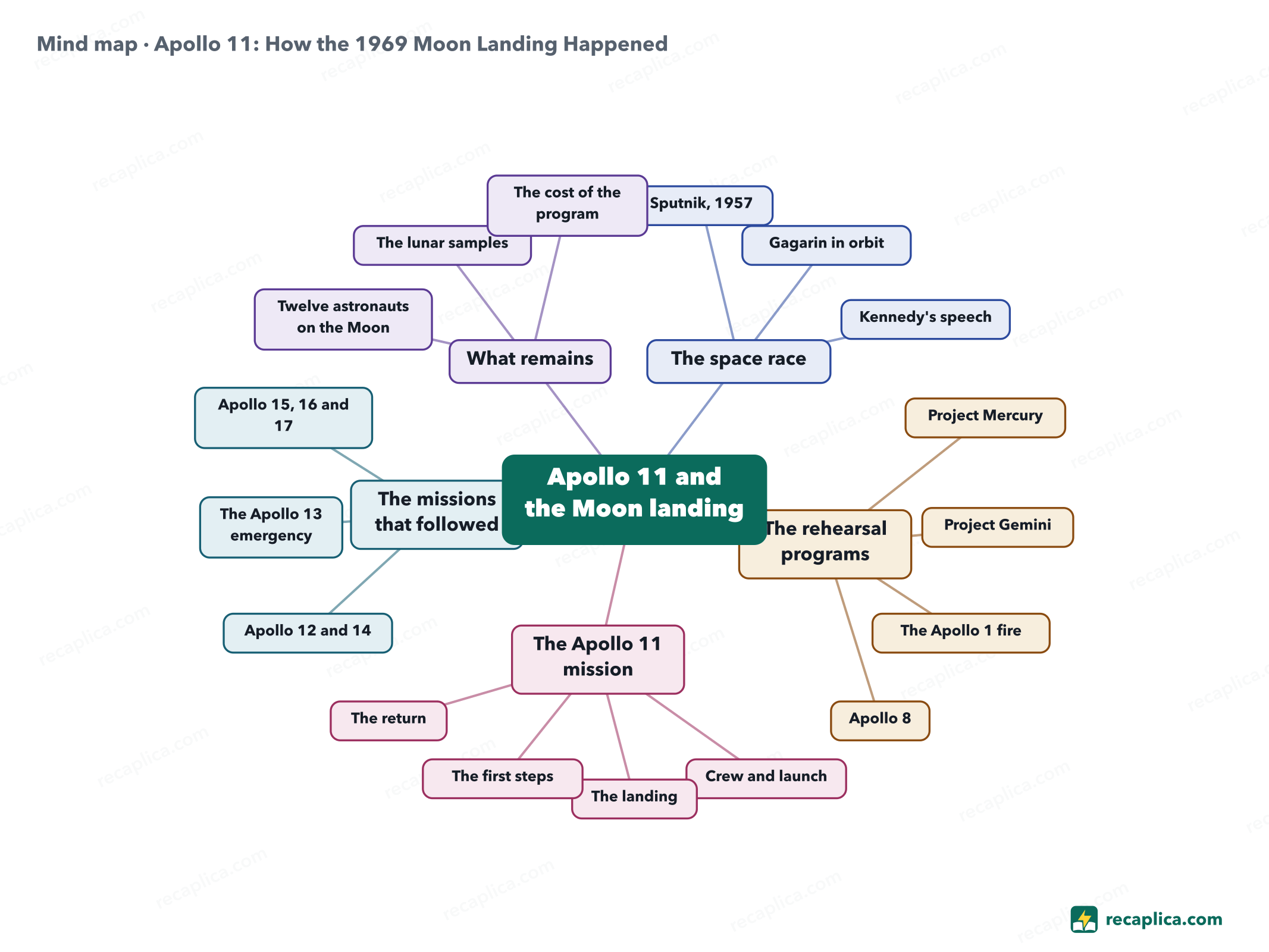
Quiz: test yourselfAnswer the questions to check what you have learned: you get instant feedback and a short explanation. Grade 0/10 0/5
FlashcardsTap the card to flip it and check whether you remember the answer, then move to the next one. 1 / 8 Explain it in your own wordsThe ultimate test: if you can explain it in simple words, you've truly understood it. Write your explanation, then compare it with the Recap. Your explanation is saved only on this device.
Frequently asked questionsWhen and where did Apollo 11 land?The lunar module Eagle touched down on 20 July 1969 at 4:18 p.m. EDT, in the Sea of Tranquility, at coordinates 0.67409° N, 23.47298° E. Armstrong stepped out about six and a half hours later, at 10:56:20 p.m. EDT that same day. Who were the first men to walk on the Moon?Neil Armstrong and Buzz Aldrin, on 20 July 1969. The third crew member, Michael Collins, stayed in lunar orbit aboard the command module Columbia and never went down to the surface. How many people have walked on the Moon in total?Twelve, all during the Apollo program between 1969 and 1972, on missions Apollo 11, 12, 14, 15, 16 and 17; Apollo 13 never landed, after an in-flight failure. Why did the United States decide to go to the Moon?The goal was announced by Kennedy on 25 May 1961 before Congress, against the backdrop of the space race with the Soviet Union; in the speech the president explicitly linked the initiative to the shock of the 1957 Sputnik launch. How much did the Apollo program cost?The program, which put twelve men on the Moon in all between July 1969 and December 1972, cost about $25.4 billion in contemporary dollars, according to NASA's 1973 testimony to the United States Congress. Every Recap goes through an independent review before publication. |