recaplica
Clear in 30 seconds, yours in 10 minutes.
In 30 seconds quick read
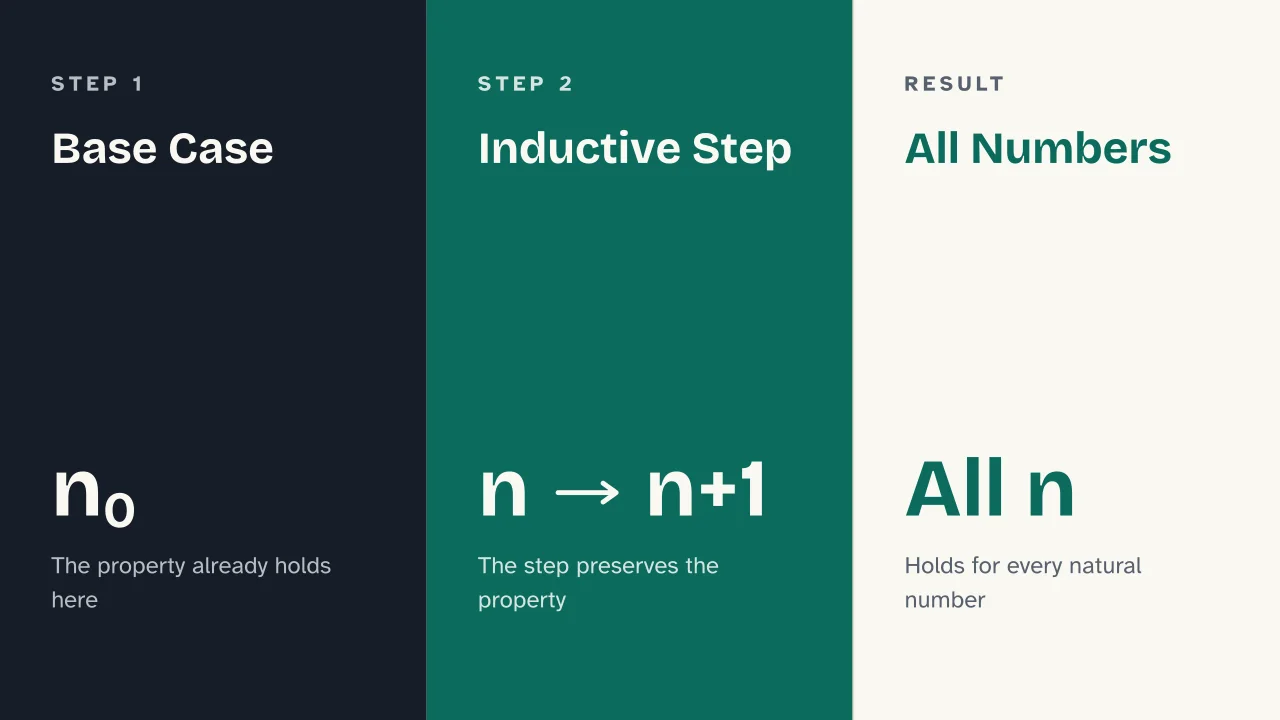
Mathematical induction proves that a property holds for every natural number, through a two-step check. The first step, the base case, confirms the property on the first number of the sequence. The second step, the inductive step, shows that moving from any number n to the next number n+1 preserves the property. Together the two steps replace checking every single number one by one; Giuseppe Peano listed the principle among the axioms that defined the natural numbers in 1889, where it also goes by the name complete induction.
Key Points
A proof by mathematical induction covers every number in the natural sequence, starting from the first one.
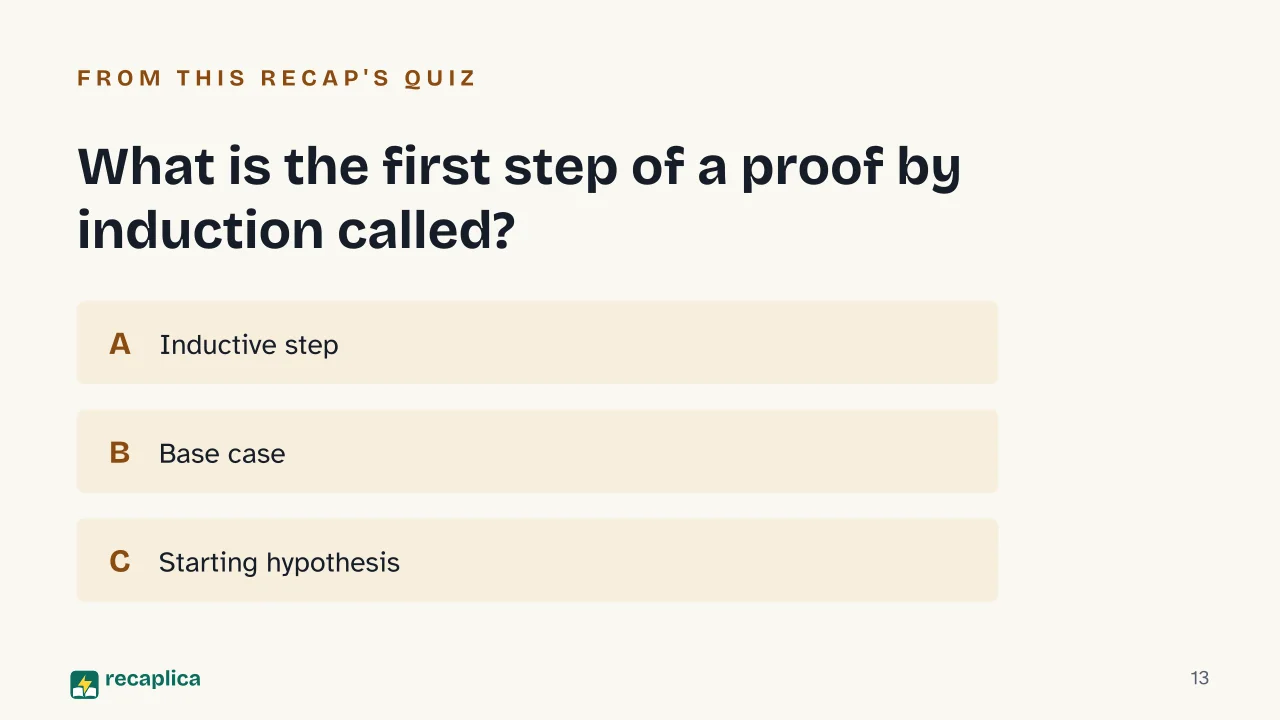
The base case, the proof's opening move, settles the property on a single starting number, either 0 or 1.
The second step, the inductive step, links any number n to the next number, n+1.
Both steps work together: neither one alone would cover the whole sequence.
Giuseppe Peano listed this principle among the 1889 axioms that define the natural numbers.
The sum 1 + 2 + ... + n, equal to n(n+1)/2, is the most common classroom example of a proof by induction.
Deep Dive
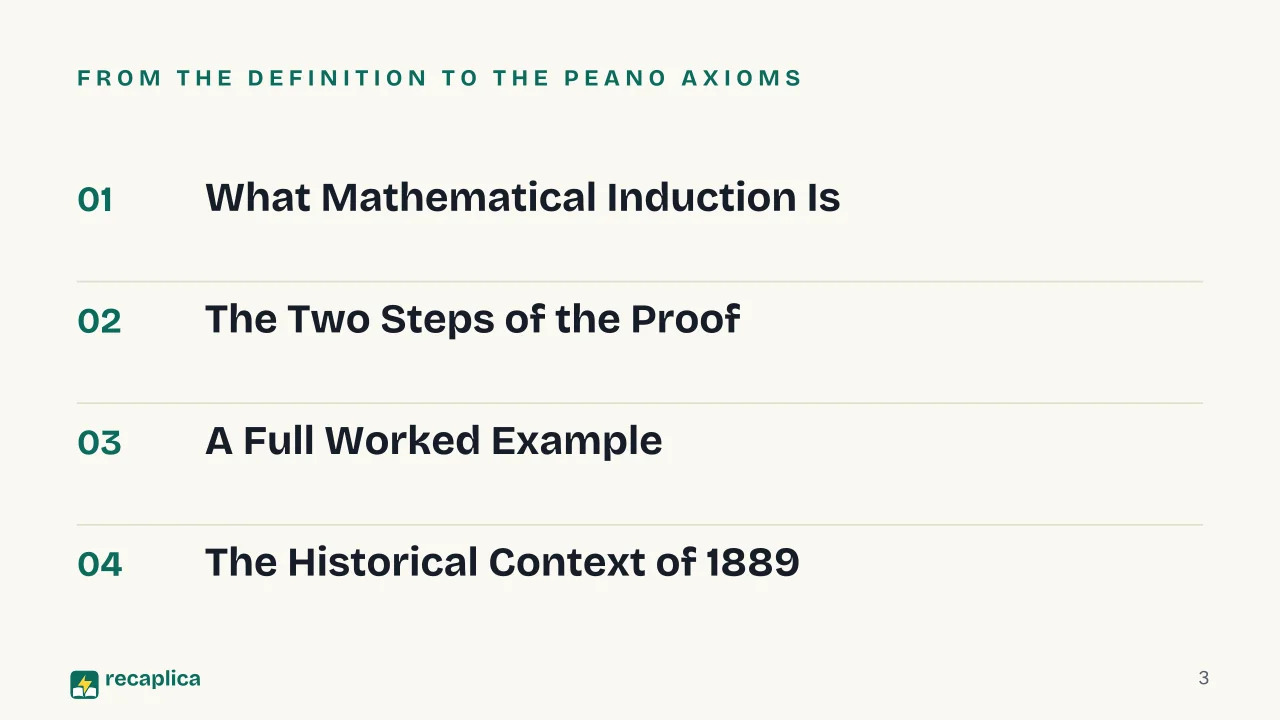
What Mathematical Induction Is
Mathematical induction establishes the truth of a property for the entire sequence of natural numbers, through a two-part check. Treccani also calls it complete induction, and it ranks among the Peano axioms for arithmetic.
The Base Case and the Inductive Step
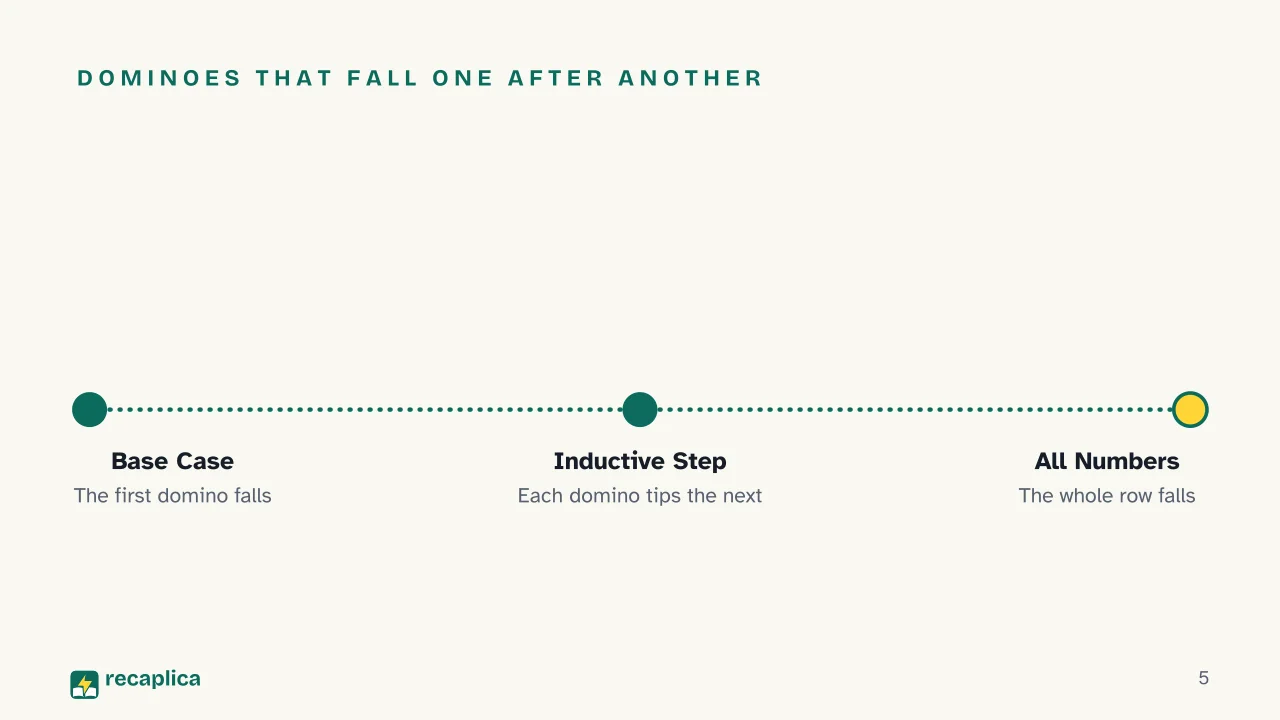
The first check is the base case: it confirms that the property is true for the first number in the sequence, typically 0 or 1. The second check is the inductive step, where a generic number n is taken and the property is shown to carry over to the next number, n+1. Treccani turns to the image of falling dominoes to describe what happens once both checks hold: the first domino falls because of the base case, and the rule that each domino tips the next one, the inductive step, carries the fall through the entire row, number after number.
Taken on its own, the inductive step only describes a rule for moving between two generic numbers. It needs the base case to supply a starting point from which that rule can run.
A Full Worked Example: the Sum of the First n Natural Numbers
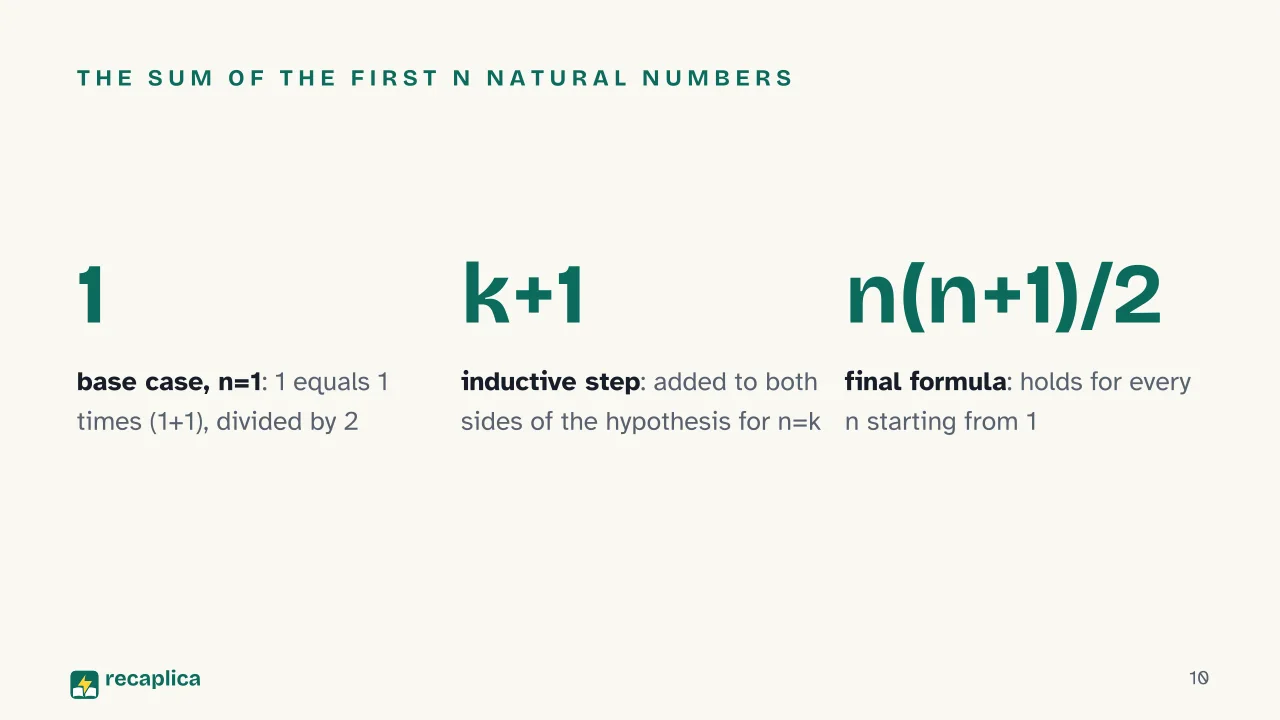
Esempio pratico: suppose we want to prove that, for every natural number n starting from 1, the sum of the first n numbers is 1 + 2 + 3 + … + n = n(n+1)/2. The base case checks n=1: the formula becomes 1 = 1(1+1)/2 = 1, an equality true by direct calculation. The inductive step assumes the formula true for n=k, the inductive hypothesis, that is 1 + 2 + … + k = k(k+1)/2, and adds the term k+1 to both sides. The left side becomes the sum of the first k+1 numbers; the right side, after the algebraic factoring k(k+1)/2 + (k+1) = (k+1)(k+2)/2, turns out to be exactly the formula expected for n=k+1. The base case and the inductive step together prove the formula for every n starting from 1.
Step
What It Proves
In This Example
Base case
The property holds for the first number
n=1: 1 = 1(1+1)/2
Inductive step
If it holds for n=k, it holds for n=k+1
k(k+1)/2 + (k+1) = (k+1)(k+2)/2
The same technique supports properties of sequences built one term after another, such as the Fibonacci sequence: each term is defined from the ones before it, and several of its properties are proved by checking the first few terms and then the step from one term to the next. The sum above is also the total of an arithmetic sequence: induction gives it a formal proof, one step beyond the ready-made formula.
An Axiom Among the Peano Axioms
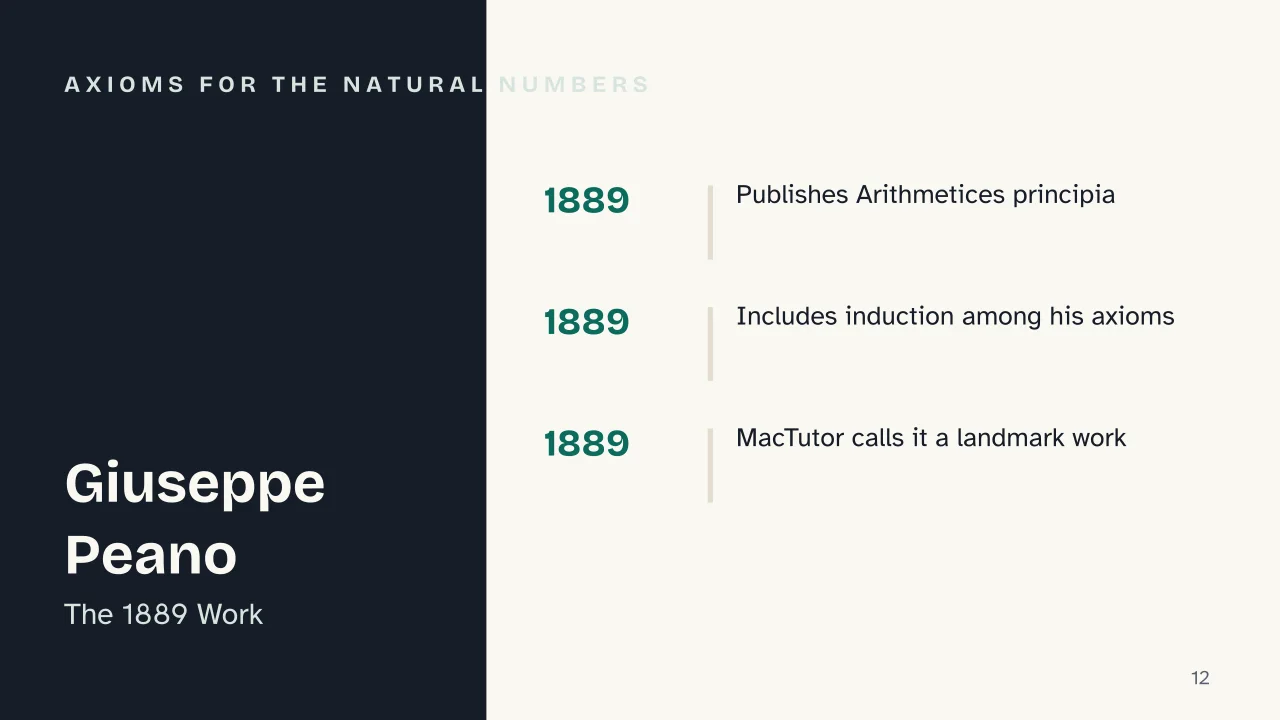
In 1889 Giuseppe Peano published, in the booklet Arithmetices principia, nova methodo exposita, the axioms that today bear his name and that define the natural numbers. Among those axioms, according to Treccani, is the principle of mathematical induction. MacTutor treats that work as a cornerstone for logic and for the foundations of mathematics. The source adds a detail about the same historical period: the title of father of mathematical logic goes today to Gottlob Frege, a German philosopher and mathematician active in those years, while Peano remains a central figure of the period thanks to the axioms he published in 1889.
Mathematical induction carries out a logical proof: the base case and the inductive step cover every natural number, one after another. It is a different procedure from the one described in the scientific method, which generalizes a law from repeated observations of individual cases.
Slide deck
Slides ready to download and make your own in PowerPoint or Google Slides, with speaker notes. Pick the Flash cut or the Full one.
✗ Myth Many assume mathematical induction proves a property by checking numbers one at a time, as many as possible.
✓ Reality The principle covers infinitely many natural numbers with two checks: the base case handles the first number, and the inductive step links each number to the next. That second check extends the property to the entire sequence.
✗ Myth Many assume mathematical induction is a theorem, derived from simpler principles.
✓ Reality It is one of the Peano axioms for arithmetic, according to Treccani: one of the starting points assumed without proof inside the theory of the natural numbers.
✗ Myth Many assume Giuseppe Peano is regarded as the father of mathematical logic.
✓ Reality According to MacTutor, that title belongs today to Gottlob Frege, a German philosopher and mathematician active in the same period; Peano's 1889 work remains a landmark reference for mathematical logic all the same.
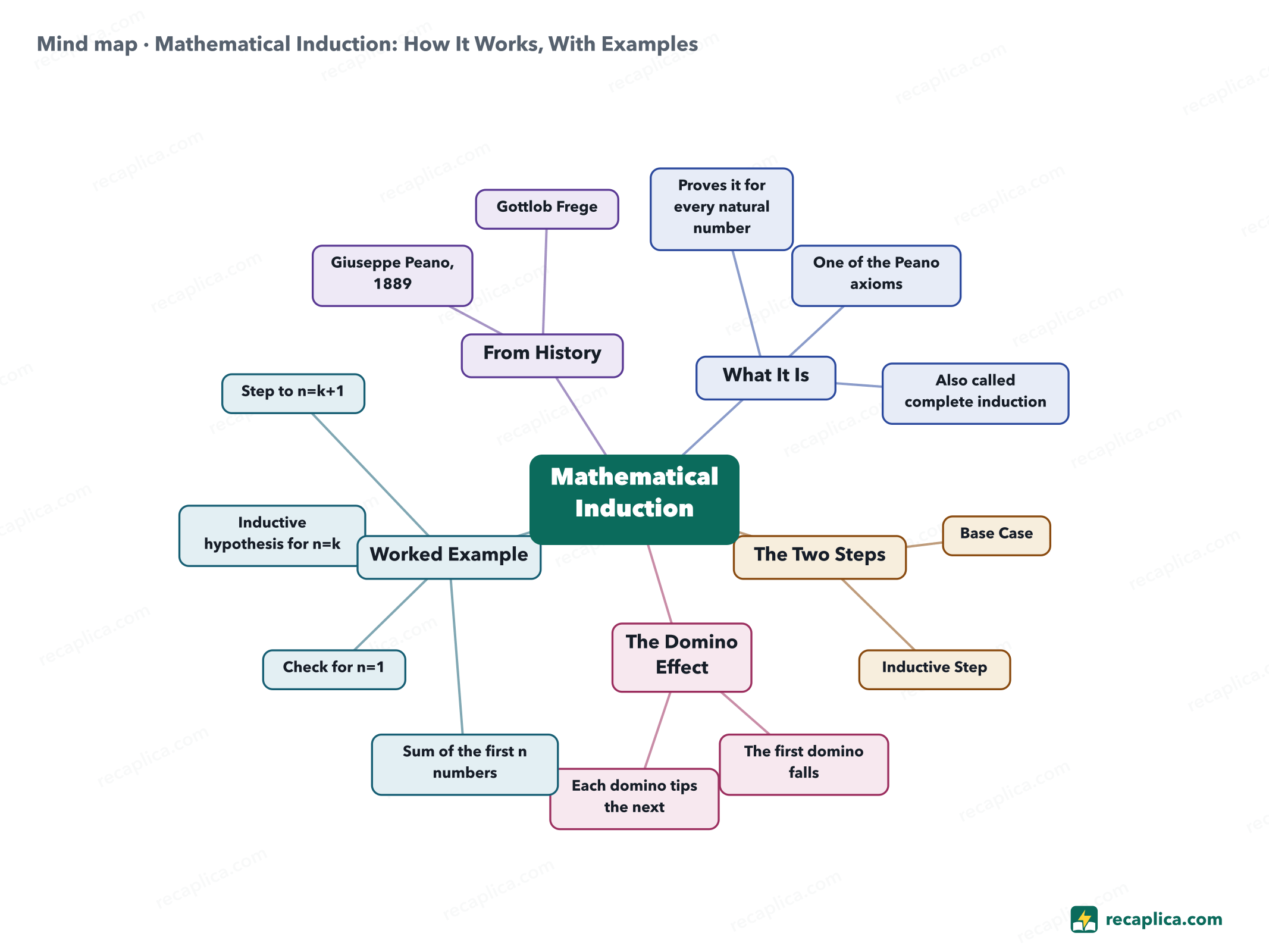
Mind map
Drag the background to move around and the nodes to reposition them; use − and + to collapse and expand branches.
Base Caseconfirms the first number in the sequence
Inductive Steplinks n to the next number
The Domino Effect
The first domino fallsthis is the base case
Each domino tips the nextthis is the inductive step
Worked Example
Sum of the first n numbers
Check for n=1
Inductive hypothesis for n=k
Step to n=k+1
From History
Giuseppe Peano, 1889Arithmetices principia, nova methodo exposita
Gottlob Fregefather of mathematical logic, according to MacTutor
Quiz: test yourself
Answer the questions to check what you have learned: you get instant feedback and a short explanation.
Grade0/100/5
Answers: 1-A · 2-B · 3-B · 4-A · 5-B
Flashcards
Tap the card to flip it and check whether you remember the answer, then move to the next one.
1 / 7
Explain it in your own words
The ultimate test: if you can explain it in simple words, you've truly understood it. Write your explanation, then compare it with the Recap.
Your explanation is saved only on this device.
Mathematical induction proves that a property holds for every natural number, through a two-step check. The first step, the base case, confirms the property on the first number of the sequence. The second step, the inductive step, shows that moving from any number n to the next number n+1 preserves the property. Together the two steps replace checking every single number one by one; Giuseppe Peano listed the principle among the axioms that defined the natural numbers in 1889, where it also goes by the name complete induction.
Frequently asked questions
What is mathematical induction?
It is the method that proves, with just two steps, that a property holds for every natural number: the base case and the inductive step.
What are the two steps of a proof by induction?
The first is the base case, which checks the property on the first number. The second is the inductive step, which proves the move from a number n to the next one, n+1.
Why do two steps prove infinitely many cases?
Because the inductive step carries the proof forward one number at a time: once the base case is checked, that chain reaches the entire sequence of natural numbers, all the way to any case.
Is mathematical induction an axiom or a theorem?
According to Treccani, it is one of the Peano axioms for arithmetic, one of the starting points on which the theory of the natural numbers rests.
What is an example of a proof by induction?
A classic example concerns the sum 1 + 2 + ... + n, equal to n(n+1)/2: the proof checks the case n=1 first, then the step from the value for n=k to the one for n=k+1.
Every Recap goes through an independent review before publication.
Statistics, only if you say so
To learn which Recaps help most we would use Google Analytics, with aggregate, anonymous data. It starts only with your OK, and you can change your mind anytime. Privacy policy