|
recaplica
Kinetic and Potential Energy: What's the Difference | ||||||||||||||||||
| © 2026 Recaplica · recaplica.com — All rights reserved | ||||||||||||||||||
Kinetic and Potential Energy: What's the DifferenceWhat to print Page numbers appear when printing with default margins. SlidesChoose a cut Flash10 slidesThe essential thread, to present in classFull15 slidesEvery chapter and the deeper detailBoth come with speaker notes. In 30 seconds quick readKinetic energy is the energy a body has because it is moving, and in its formula the speed appears squared. Potential energy is stored energy that depends on how the parts of a system are arranged, for instance an object and the Earth. Add the two together and you get mechanical energy, which stays the same over time wherever only conservative forces act: on the way down, one form turns into the other. That is why a stone sitting still at the top of a cliff already holds energy. Key Points
Deep DiveThe energy of movementA body in motion holds kinetic energy, and it holds it because it is moving. HyperPhysics, the teaching collection of Georgia State University, calls it the energy associated with movement, and adds that making a body acquire it means doing work on it: applying a force that sets it going or speeds it up. Physics textbooks call that link between work and energy gained the work-energy theorem, or the work-energy principle. It runs in both directions, since a moving object can in turn do work on whatever it strikes, shoving it or denting it. The formula taught at school, reported by OpenStax, is KE = ½ m v², where m is the mass and v the speed, and it holds while the speed stays far below the speed of light, the territory of classical mechanics. Double the speed, then, and the kinetic energy becomes four times as large.
Energy that depends on positionPotential energy is measured on position instead. The University of Oregon, in the glossary of its Earth Sciences department, describes it as energy stored in the arrangement of a system’s parts: a squeezed or stretched spring holds more of it than one left alone, and a steel ball lifted off the floor holds more than once it has landed. That is why the word system keeps coming up, and why the quantity is not pinned on one isolated body. The form studied most at school is gravitational potential energy, which OpenStax presents as the energy stored in the object-Earth system when the object is carried up to a certain height, and which depends on the distance between the two bodies that gravity pulls towards each other. The formula is PE = m g h, with m the mass, g the acceleration of gravity and h the height, and the change in potential energy grows in proportion to each of the three. The potential energy of a system follows only from the starting arrangement and the finishing one, never from the journey travelled in between. Gravity is a conservative force, and this is one of their traits. The two energies side by side
The sum of the two has a name of its own. HyperPhysics calls it total mechanical energy, meaning kinetic energy plus potential energy, and OpenStax adds the condition that makes the quantity useful when solving problems: if only conservative forces act, as gravity does when friction is negligible, that total stays the same over time. This is why the two energies are studied as a couple, and the Recap on work, energy and the conservation of mechanical energy follows that balance step by step. The forces that enter these balances, for that matter, are the same ones described by Newton’s three laws of motion. Practical examplesEvery textbook starts from a descent. When a body comes down and friction is negligible, OpenStax writes, the fall in its potential energy matches the rise in its kinetic energy exactly: on a roller coaster the energy gained while climbing to the top shows up as speed at the bottom, and the same thing happens to a swing on its way back down.
Even small amounts of potential energy come out as real numbers. OpenStax works out almost 5 joules for a half-kilo weight raised by one metre, like the weights of a cuckoo clock, which hand that energy back as they descend. From the dam to the power gridThe large-scale example is the water behind a dam, and the University of Oregon traces the chain: water held high up has potential energy, coming down through the turbines that energy becomes kinetic, and the turbines convert it into electrical energy, with part of the amount escaping as heat. The electrical energy is then the same energy that reaches homes in the form of electric current. The same accounting between position and movement comes back in the study of the orbits of the solar system. Slide deckSlides ready to download and make your own in PowerPoint or Google Slides, with speaker notes. Pick the Flash cut or the Full one.   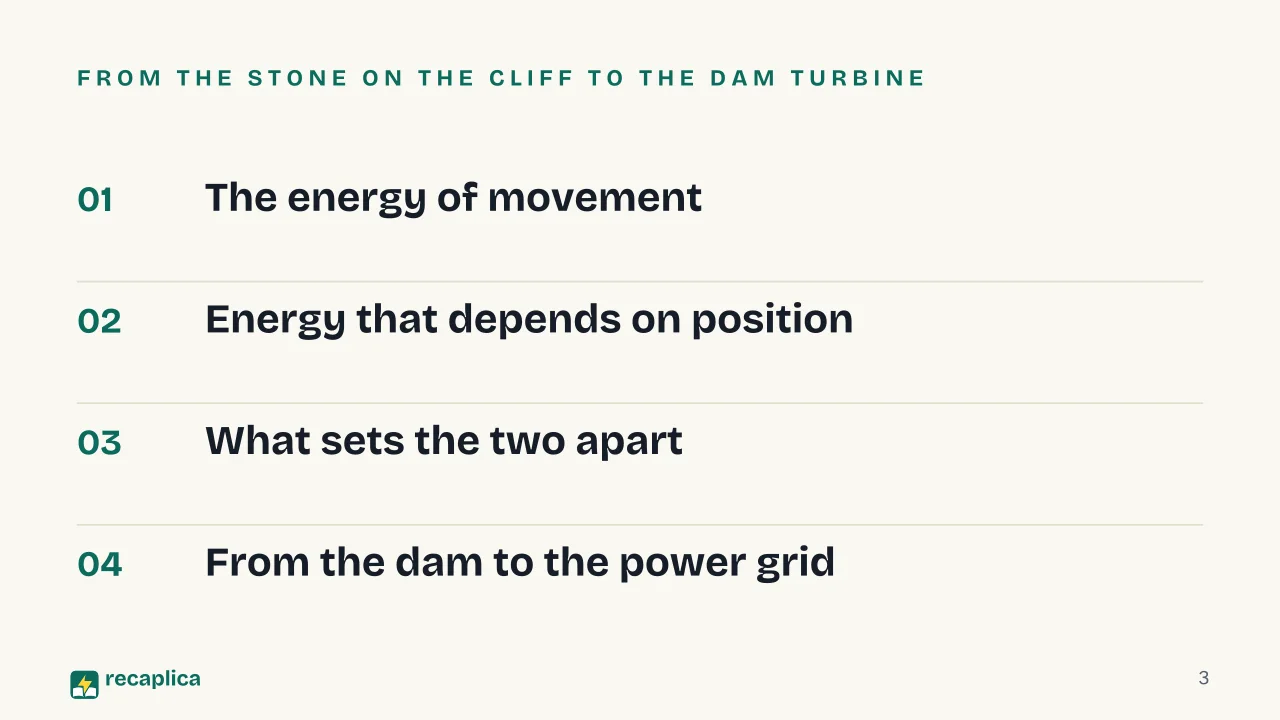  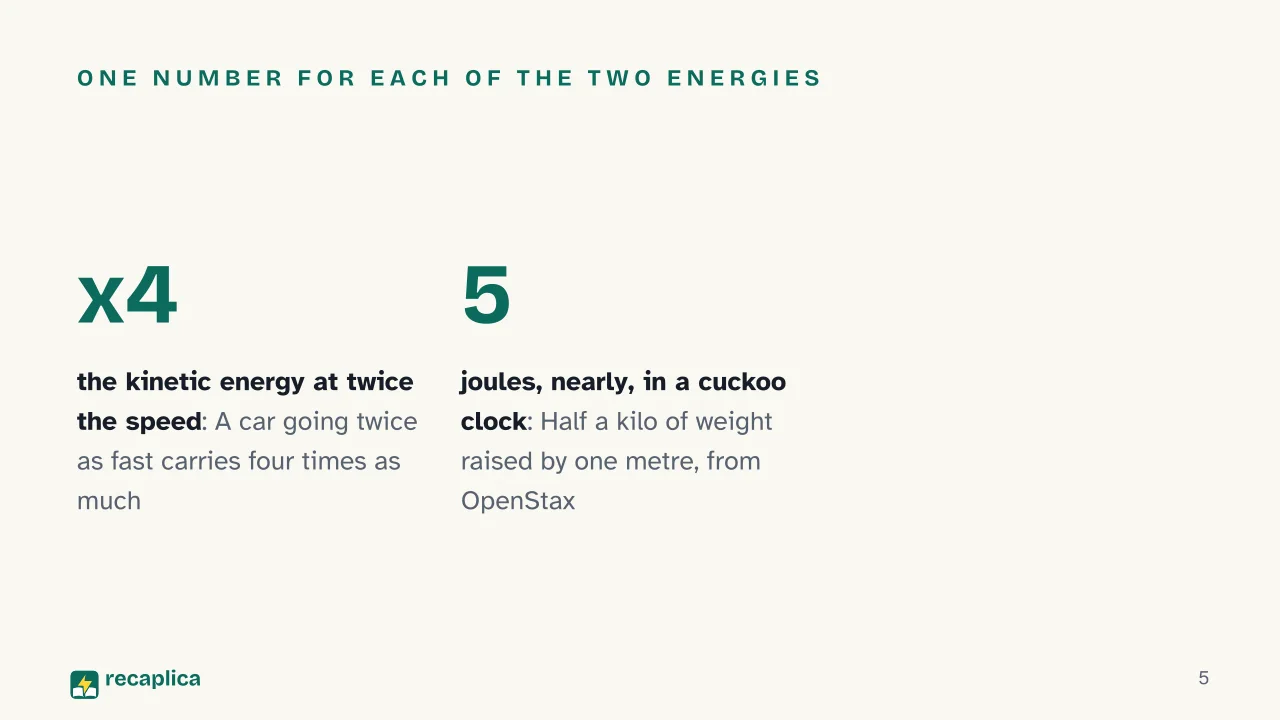  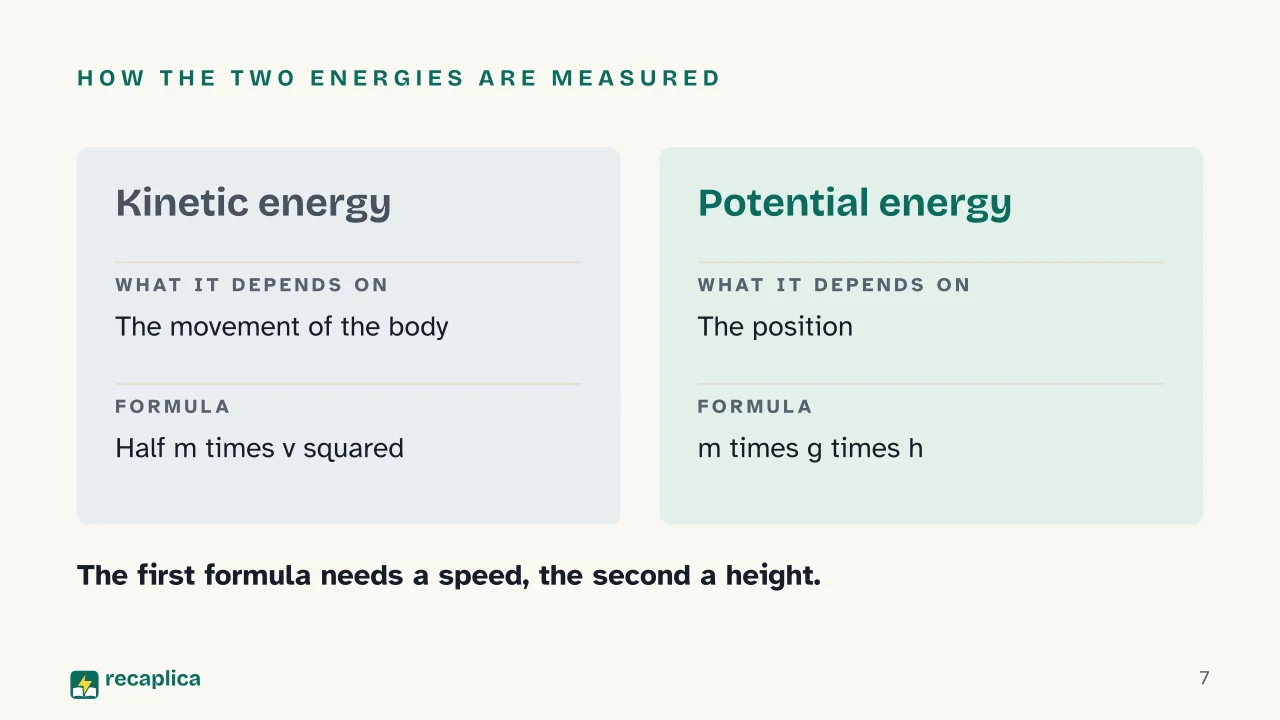 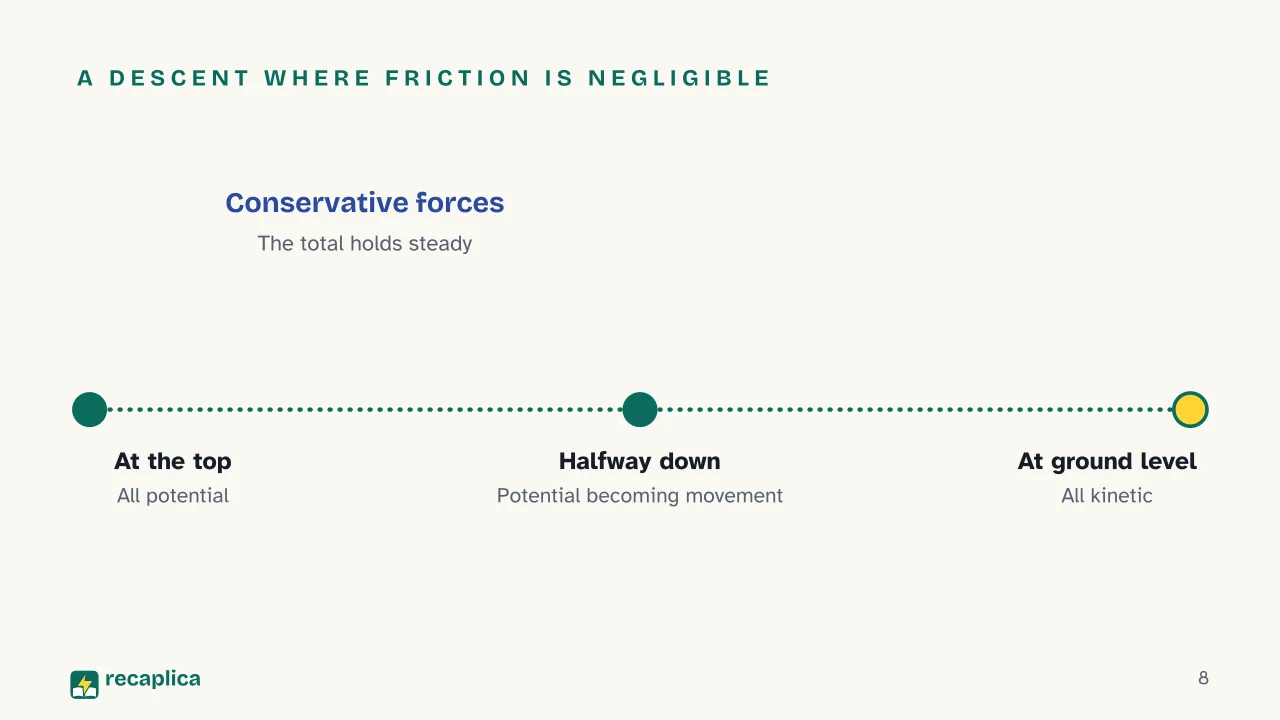   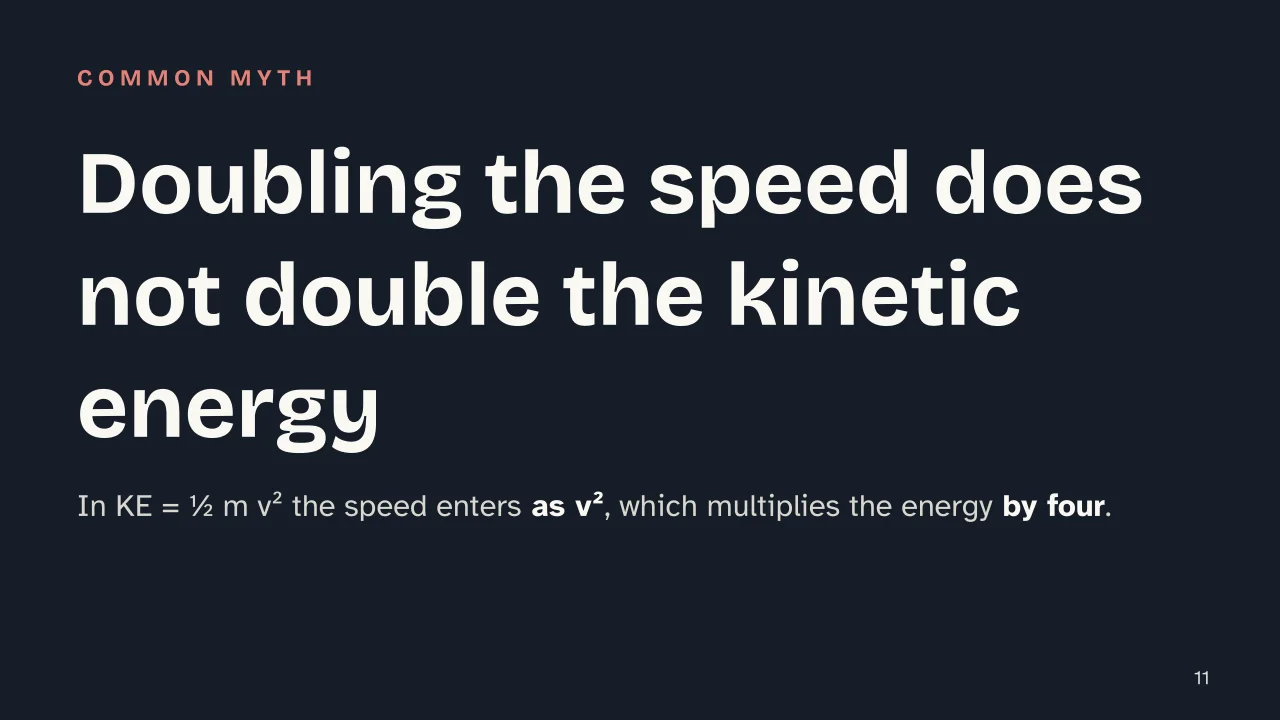  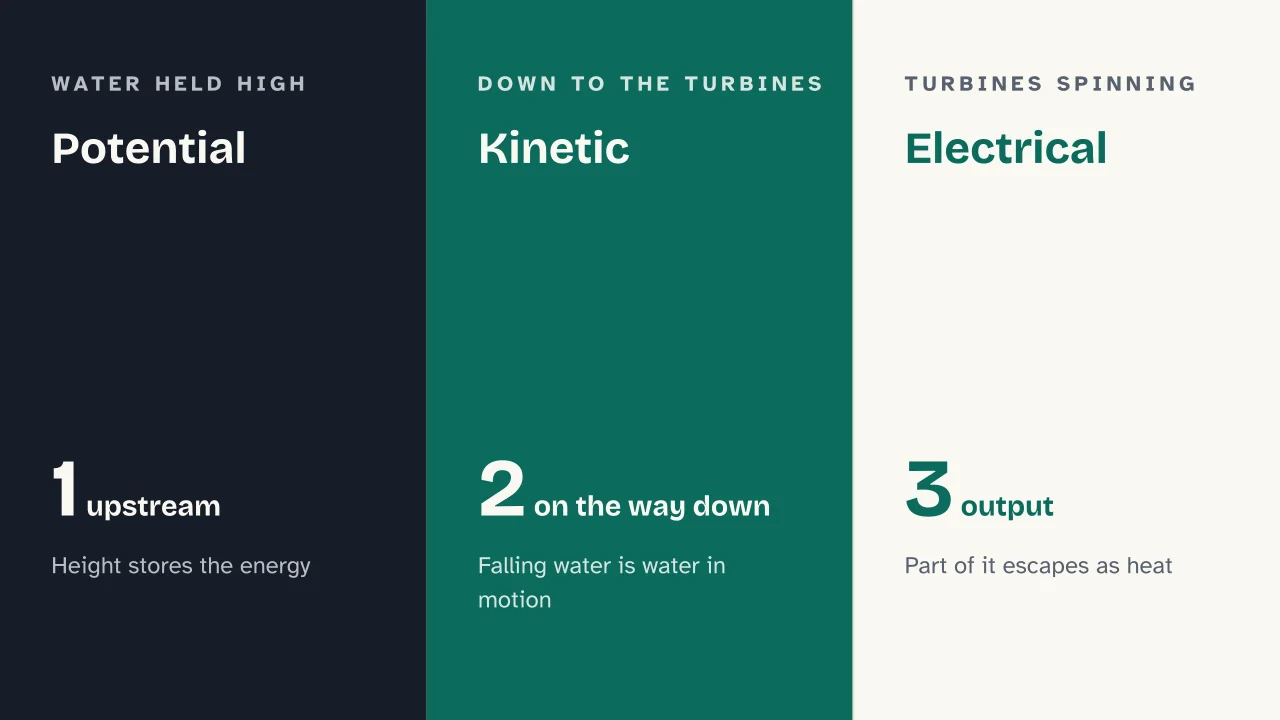 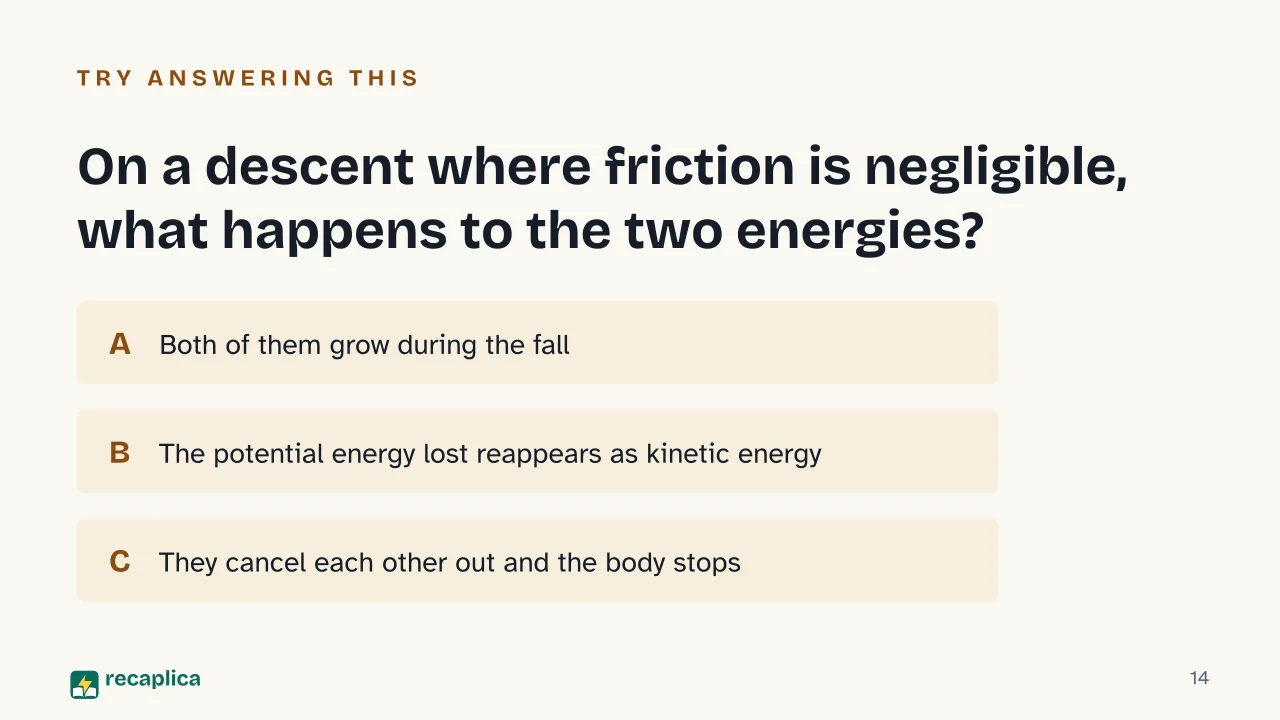  Common myths
Mind mapDrag the background to move around and the nodes to reposition them; use − and + to collapse and expand branches. 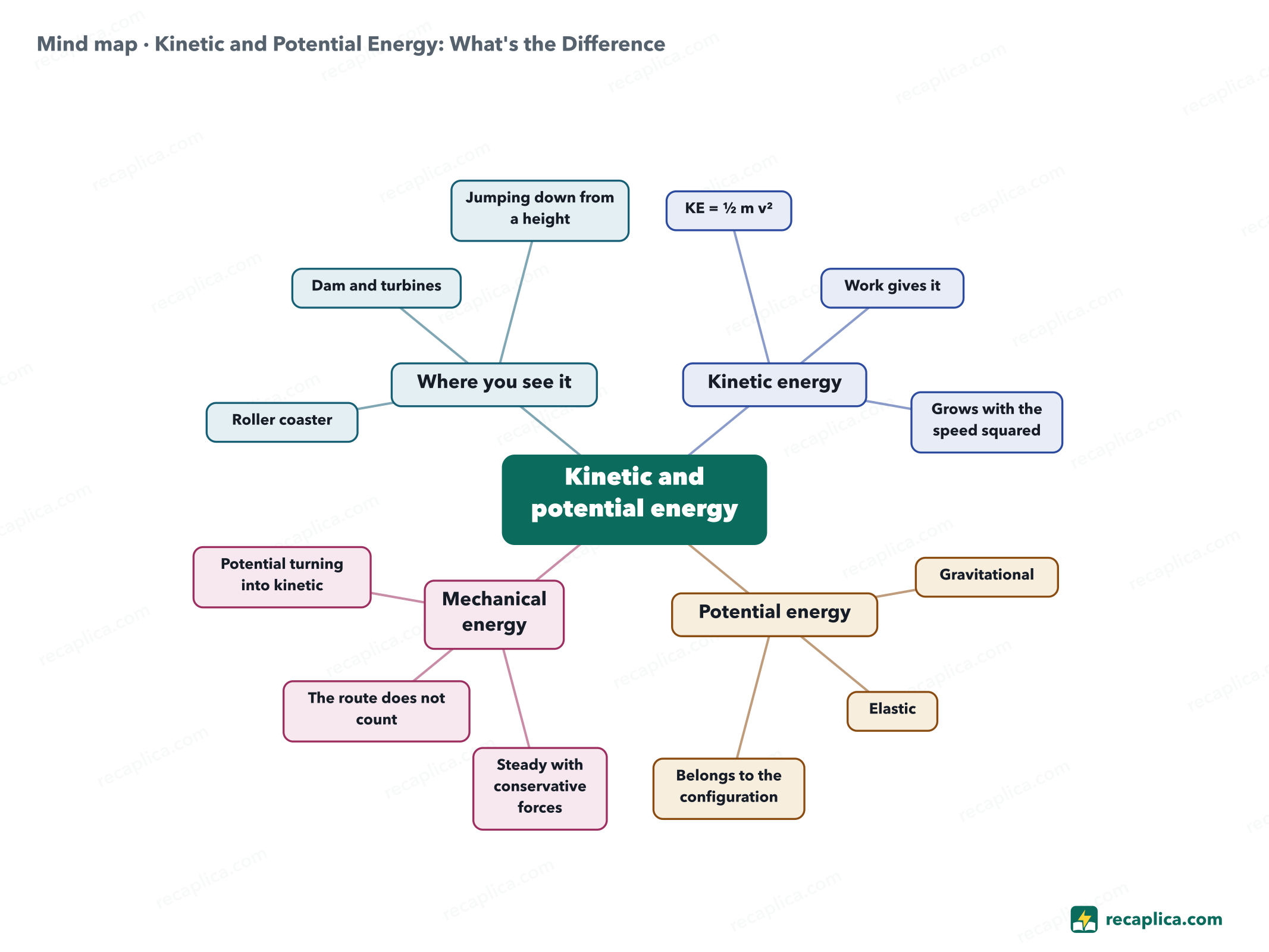
Quiz: test yourselfAnswer the questions to check what you have learned: you get instant feedback and a short explanation. Grade 0/10 0/5
FlashcardsTap the card to flip it and check whether you remember the answer, then move to the next one. 1 / 7 Explain it in your own wordsThe ultimate test: if you can explain it in simple words, you've truly understood it. Write your explanation, then compare it with the Recap. Your explanation is saved only on this device.
Frequently asked questionsWhat is the difference between kinetic and potential energy?Kinetic energy follows from the movement of the body, potential energy from the position of the parts of the system. A moving car has kinetic energy; a book on a shelf has gravitational potential energy relative to the floor. Put them together and you have mechanical energy. Can a body have kinetic and potential energy at the same time?Yes. A stone halfway through a fall is moving, so it has kinetic energy, and it is still some distance above the ground, so it has potential energy too. As it drops the first grows and the second shrinks, and where friction is negligible the total holds steady. Why does kinetic energy depend on the square of the speed?Because KE = ½ m v² multiplies the speed by itself. The practical consequence is that the energy climbs far faster than the speed, as the car that doubles its speed and ends up with four times the kinetic energy shows. Does potential energy exist only because of gravity?The form studied most at school is the gravitational one, tied to height, but a spring that is squeezed or stretched also banks potential energy, called elastic. More generally, potential energy is about the configuration of the parts of a system. What is mechanical energy?It is the total you get by adding the kinetic and the potential energy of a body. According to OpenStax, if only conservative forces act — gravity with negligible friction, for example — that total does not change over time, which explains why the two energies always arrive as a pair in the classroom. Every Recap goes through an independent review before publication. |