Skip to content
recaplica

    One moment: security check

    Cloudflare wants to make sure you're not a robot. Tick the box below and your search will continue on its own.

    IT
    recaplica Elastic Collision vs. Inelastic Collision: What's the Difference
    © 2026 Recaplica · recaplica.com — All rights reserved
    Home › Science

    Elastic Collision vs. Inelastic Collision: What's the Difference

    By Recaplica Newsroom · Updated on October 17, 2026

    What to print

    Page numbers appear when printing with default margins.

    Slides

    Choose a cut

    Flash10 slidesThe essential thread, to present in classFull14 slidesEvery chapter and the deeper detail

    Both come with speaker notes.

    Telegram channel
    recaplica Clear in 30 seconds, yours in 10 minutes.
    In 30 seconds Key points Deep dive Slides Myths Mind map Quiz Flashcards FAQ

    In 30 seconds quick read

    A collision is elastic when the system's momentum and kinetic energy both stay the same before and after. It's inelastic when only momentum survives, while kinetic energy drops. In most real collisions, part of the kinetic energy turns into heat and into the deformation of the bodies involved. The limiting case, where the two bodies end up moving as a single body, is a perfectly inelastic collision. A perfectly elastic collision, on the other hand, is an idealization: no real macroscopic collision is free of friction or deformation.

    Key Points

    • Inside an isolated system, total momentum is always conserved, in every type of collision.
    • An elastic collision also conserves the system's total kinetic energy.
    • In an inelastic collision, the system ends up with less kinetic energy than it had before the impact: the missing part becomes heat and deformation.
    • A perfectly inelastic collision is the limiting case where the two bodies move together after impact, with the largest possible kinetic energy loss.
    • A perfectly elastic collision is an idealization: every real macroscopic collision loses at least a small share of kinetic energy.
    • Newton's cradle works because the collisions between its balls are, to a good approximation, elastic.

    Deep Dive

    What Is an Elastic Collision

    According to HyperPhysics, a collision is elastic when both the momentum and the kinetic energy of the system are conserved. There’s no kinetic energy loss at all: everything present before the collision shows up again, unchanged, afterward.

    A perfectly elastic collision assumes no dissipative forces act during the impact — no internal friction, no permanent deformation of the bodies. It’s an ideal limiting case: in practice, every real macroscopic collision converts at least some kinetic energy into internal energy, meaning heat or deformation of the materials involved.

    What Is an Inelastic Collision

    Real macroscopic collisions are almost always of this kind, HyperPhysics notes: they don’t conserve kinetic energy. The system’s total energy, including its non-kinetic forms, is always conserved under the general principle of energy conservation, but the kinetic share drops.

    The missing part becomes internal energy — heat and deformation of the colliding bodies. A telling case, from the same source, is a much more massive body hitting a small, stationary one: the large body loses only a negligible share of its own kinetic energy, the way a car barely changes speed after hitting an insect. The limiting case is the perfectly inelastic collision: the two bodies stay joined after impact, and the kinetic energy loss is the largest one possible while momentum stays conserved. OpenStax describes it the same way in the chapter on collision types in University Physics: any collision that leaves the bodies joined together carries the maximum kinetic energy loss consistent with that conservation.

    What Always Stays Conserved

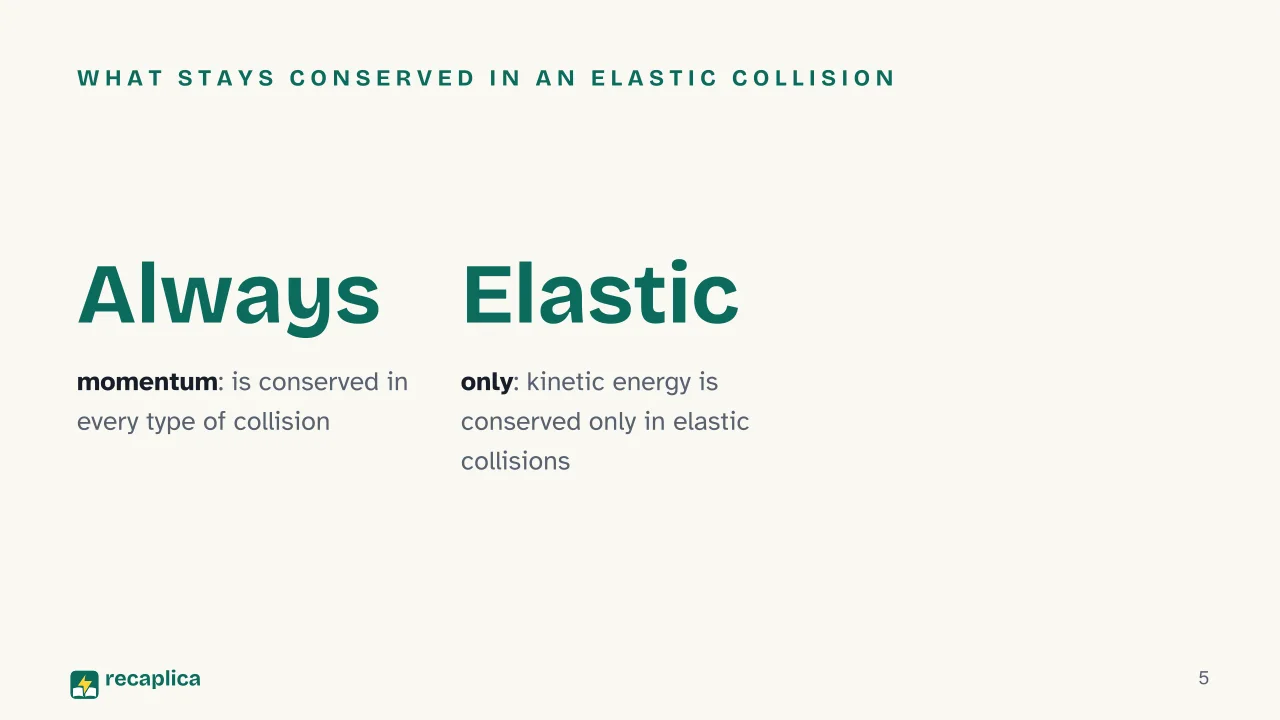
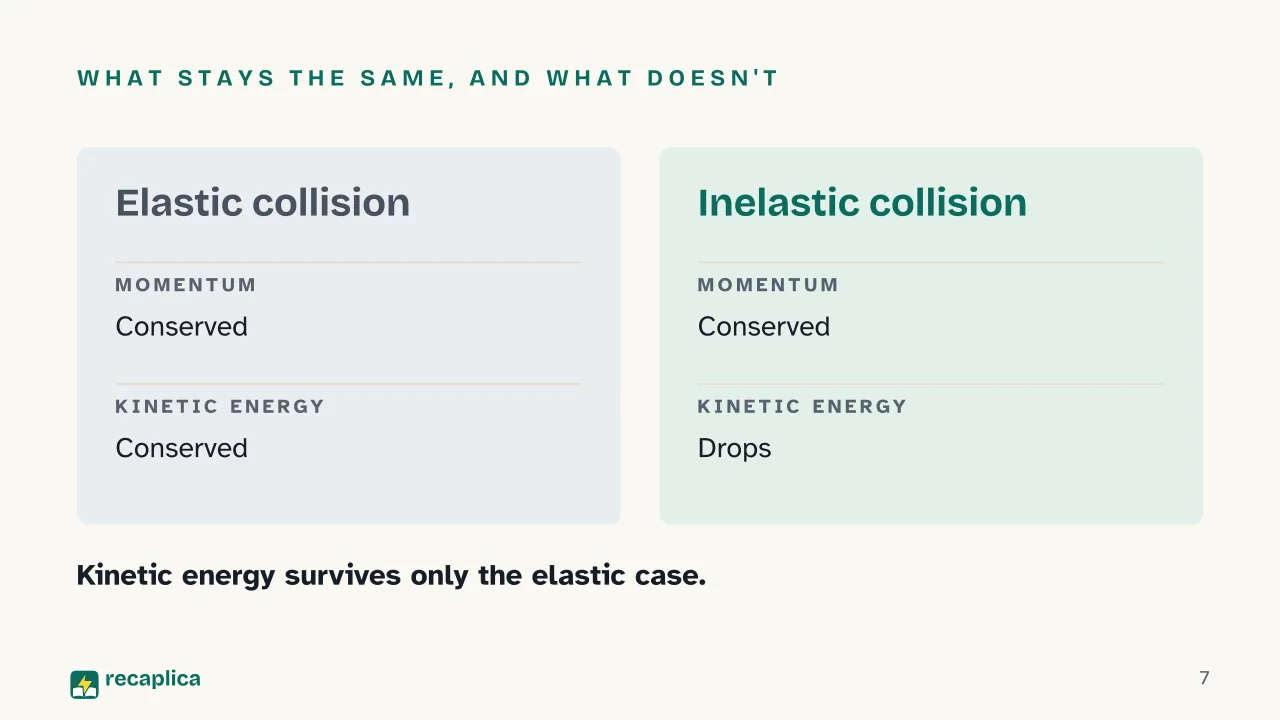
    Momentum, inside an isolated system, is conserved in every type of collision — elastic, inelastic or perfectly inelastic — without exception. Kinetic energy is conserved only in the particular case of an elastic collision; in most real collisions, it isn’t.

    The Conservation Formulas

    The conservation of momentum is written as the sum of the bodies’ momenta before the collision, equal to the sum of their momenta after it:

    m₁v₁ + m₂v₂ = m₁v₁’ + m₂v₂’

    Here m₁ and m₂ are the masses of the two bodies. The unprimed letters denote velocities before the collision, the primed ones the velocities afterward. This equation holds for any collision, elastic or inelastic.

    An elastic collision adds a second condition: the system’s total kinetic energy before the collision equals the total after it. That second equation doesn’t hold for an inelastic collision, where final kinetic energy is lower than the initial value.

    Elastic collisionInelastic collision
    MomentumConservedConserved
    Kinetic energyConservedDrops
    Bodies after impactSeparateSeparate, or stay joined in the perfectly inelastic case

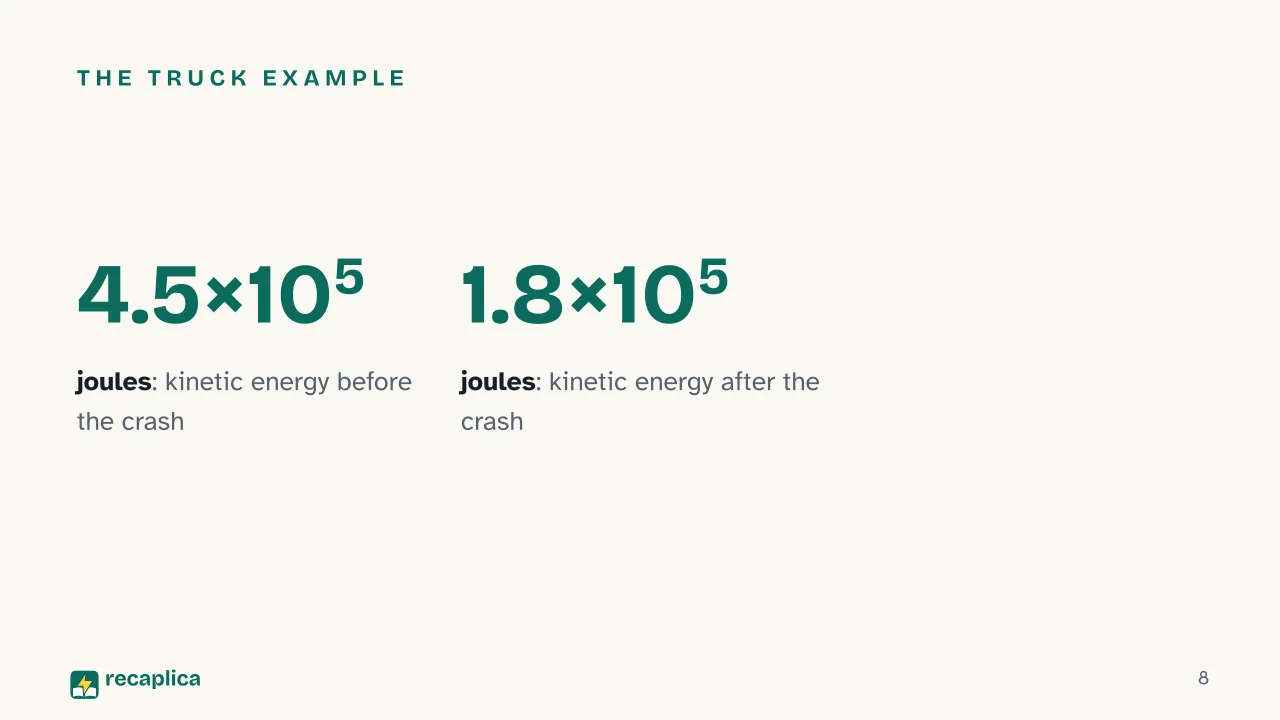
    Practical example: OpenStax describes an inelastic collision between a 1,200 kg car traveling at 27.5 m/s and a stationary 3,000 kg truck. After the collision, the truck moves at 11.0 m/s, a figure the source derives from the friction built up over the 10 meters it skids once hit. The system’s kinetic energy before the collision is 4.5×10⁵ J; after it, 1.8×10⁵ J. The difference, 2.7×10⁵ J, turns into heat and deformation during the impact and the skid that follows it.

    Newton’s Cradle: Nearly Elastic Collisions

    Newton’s cradle, the device with metal balls suspended in a row, familiar from desks everywhere, demonstrates both the conservation of momentum and, to a good approximation, of kinetic energy. The Department of Physics at the University of California, Santa Barbara describes it this way in its collection of lecture demonstrations.

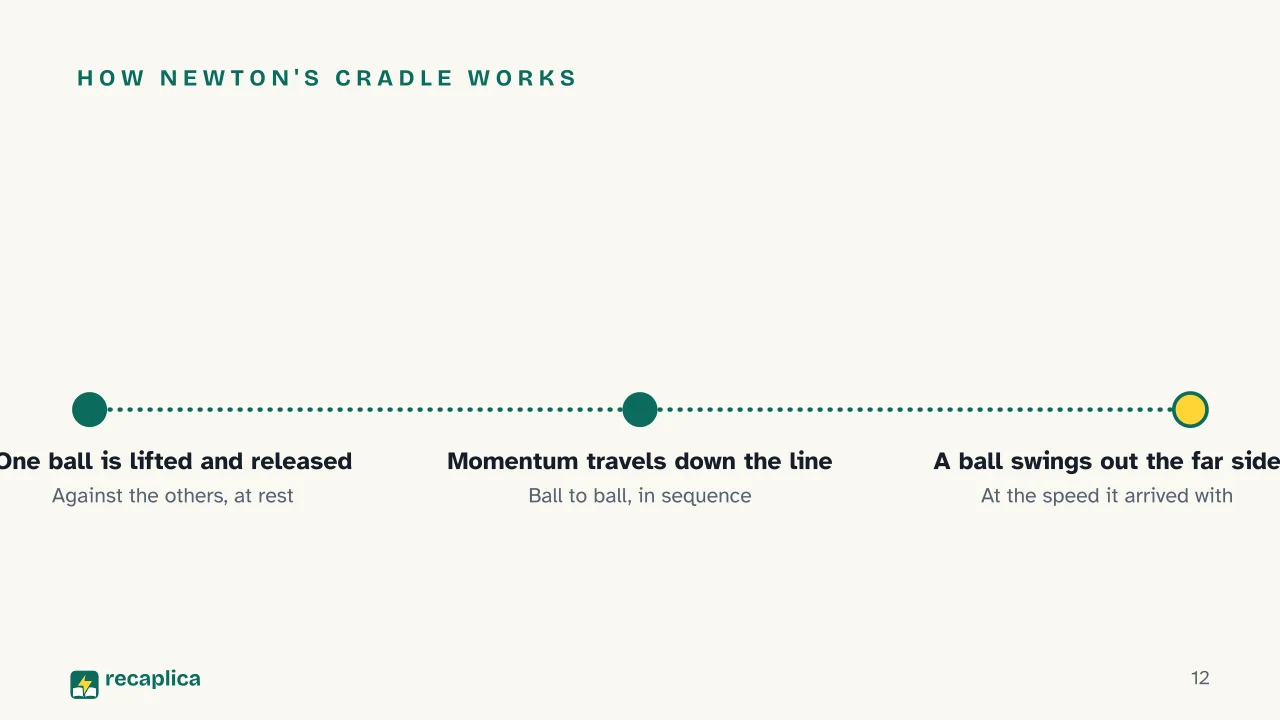
    When a number of balls is lifted and released against the others at rest, momentum travels down the row: the same number of balls swings out the far side, at the same speed. The whole thing runs on a series of approximately elastic collisions.

    In reality, the cradle gradually loses height with every cycle. The collisions between the balls are never perfectly elastic: part of the kinetic energy turns into heat, on top of friction losses in the supports.

    The idea connects to mechanical energy: across nearly elastic collisions, the system’s mechanical energy stays close to constant from one collision to the next, while in an inelastic collision part of it converts into other forms of energy already at the first impact. For how bodies move between one collision and another, Newton’s three laws of motion matter too: it’s the second law, together with the conservation of momentum, that describes the force acting during the brief instant of the collision.

    Slide deck

    Slides ready to download and make your own in PowerPoint or Google Slides, with speaker notes. Pick the Flash cut or the Full one.
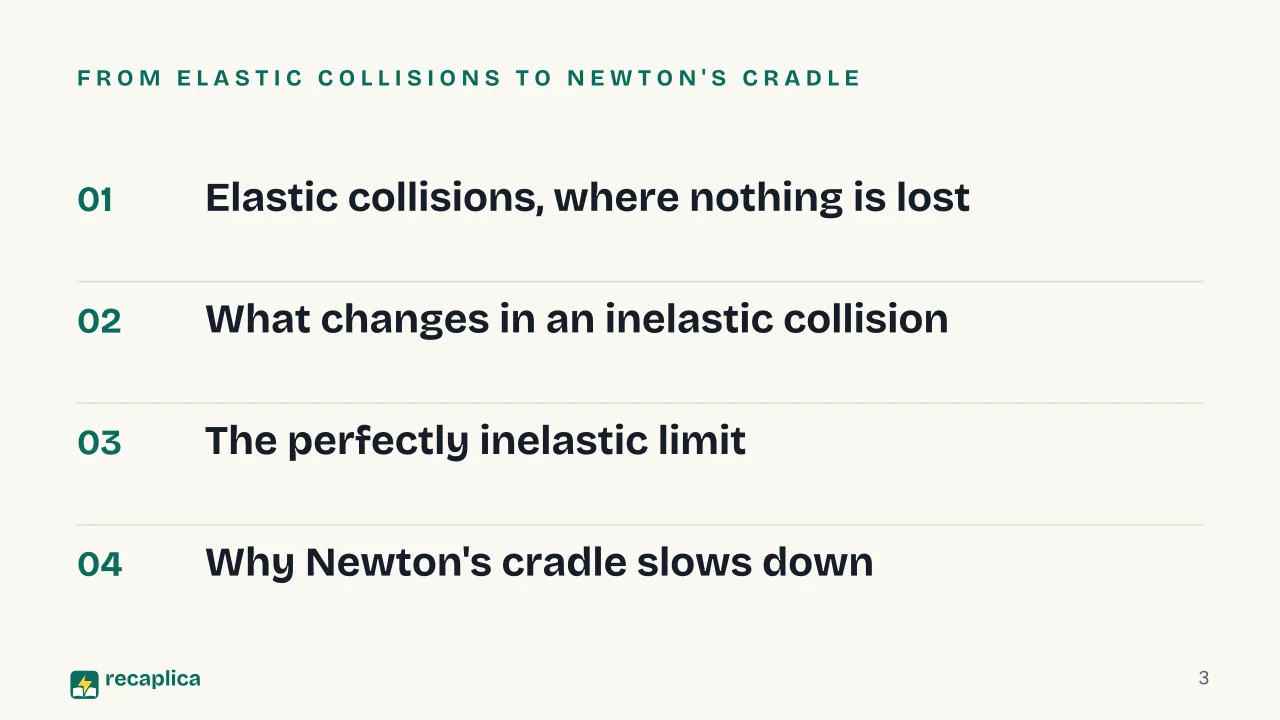
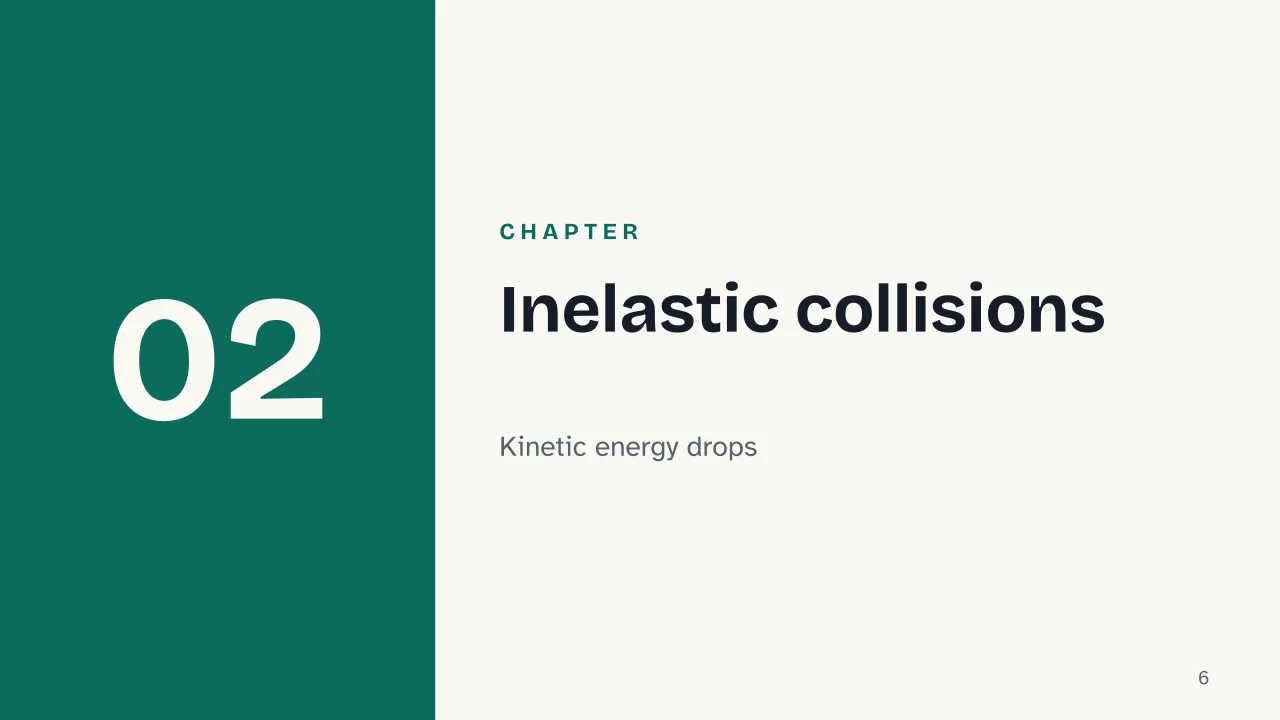
    Slide 1 of the presentation on Elastic Collision vs. Inelastic Collision: Elastic Collision vs. Inelastic CollisionSlide 2 of the presentation on Elastic Collision vs. Inelastic Collision: What happens to kinetic energy in an inelastic collision?Slide 3 of the presentation on Elastic Collision vs. Inelastic Collision: From elastic collisions to Newton's cradleSlide 4 of the presentation on Elastic Collision vs. Inelastic Collision: Chapter 01: Elastic collisionsSlide 5 of the presentation on Elastic Collision vs. Inelastic Collision: What stays conserved in an elastic collisionSlide 6 of the presentation on Elastic Collision vs. Inelastic Collision: Chapter 02: Inelastic collisionsSlide 7 of the presentation on Elastic Collision vs. Inelastic Collision: What stays the same, and what doesn'tSlide 8 of the presentation on Elastic Collision vs. Inelastic Collision: The truck exampleSlide 9 of the presentation on Elastic Collision vs. Inelastic Collision: Chapter 03: The limiting caseSlide 10 of the presentation on Elastic Collision vs. Inelastic Collision: An inelastic collision loses energy.Slide 11 of the presentation on Elastic Collision vs. Inelastic Collision: Chapter 04: Newton's cradleSlide 12 of the presentation on Elastic Collision vs. Inelastic Collision: How Newton's cradle worksSlide 13 of the presentation on Elastic Collision vs. Inelastic Collision: Where does the missing kinetic energy go in an inelastic collision?Slide 14 of the presentation on Elastic Collision vs. Inelastic Collision: Now, time to review
    Flash10 slidesThe essential thread, to present in classFull14 slidesEvery chapter and the deeper detail

    Common myths

    • ✗ Myth Many assume an elastic collision is just a textbook abstraction with no real counterpart.

      ✓ Reality Newton's cradle behaves, to a good approximation, like a sequence of elastic collisions. The idealization exists because no real macroscopic collision is completely free of losses, not because the phenomenon itself is fictional.

    • ✗ Myth A common assumption is that energy simply vanishes in an inelastic collision.

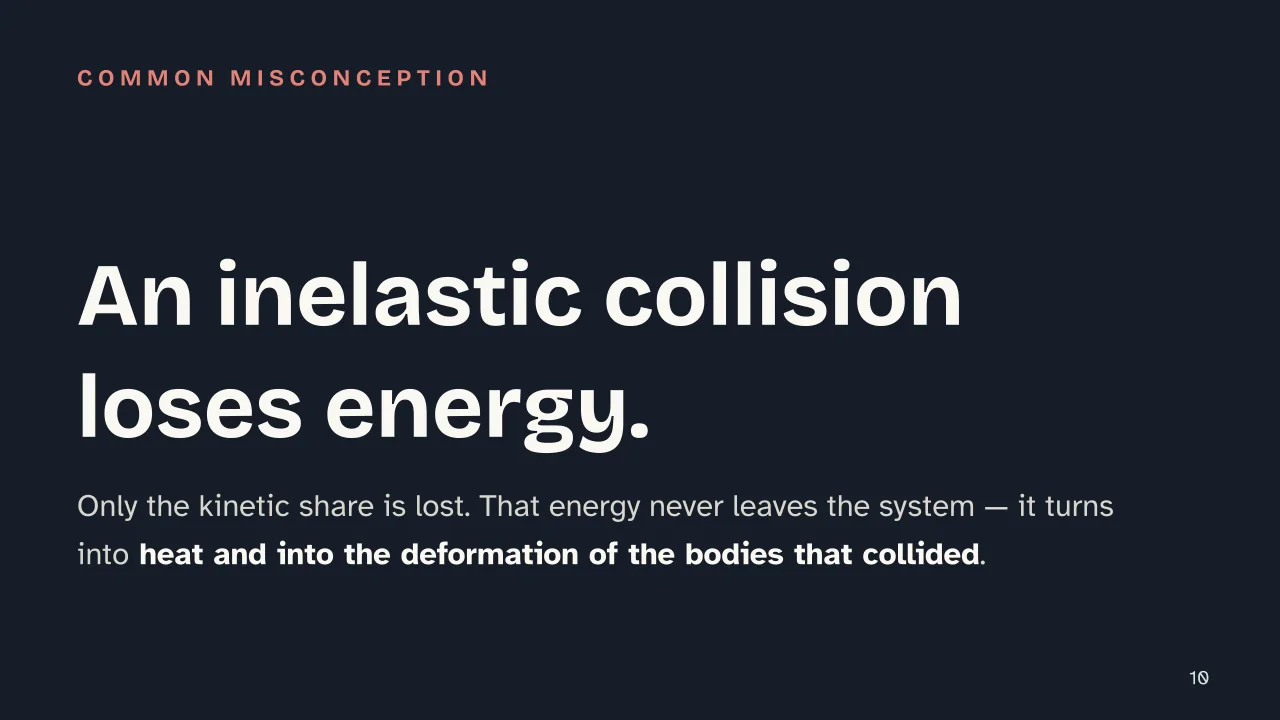
      ✓ Reality Total energy doesn't decrease at all. Only the kinetic share drops, surfacing afterward as heat and as a dent, a crumple, or a tear in the bodies that collided.

    Mind map

    Drag the background to move around and the nodes to reposition them; use − and + to collapse and expand branches.
    Customize
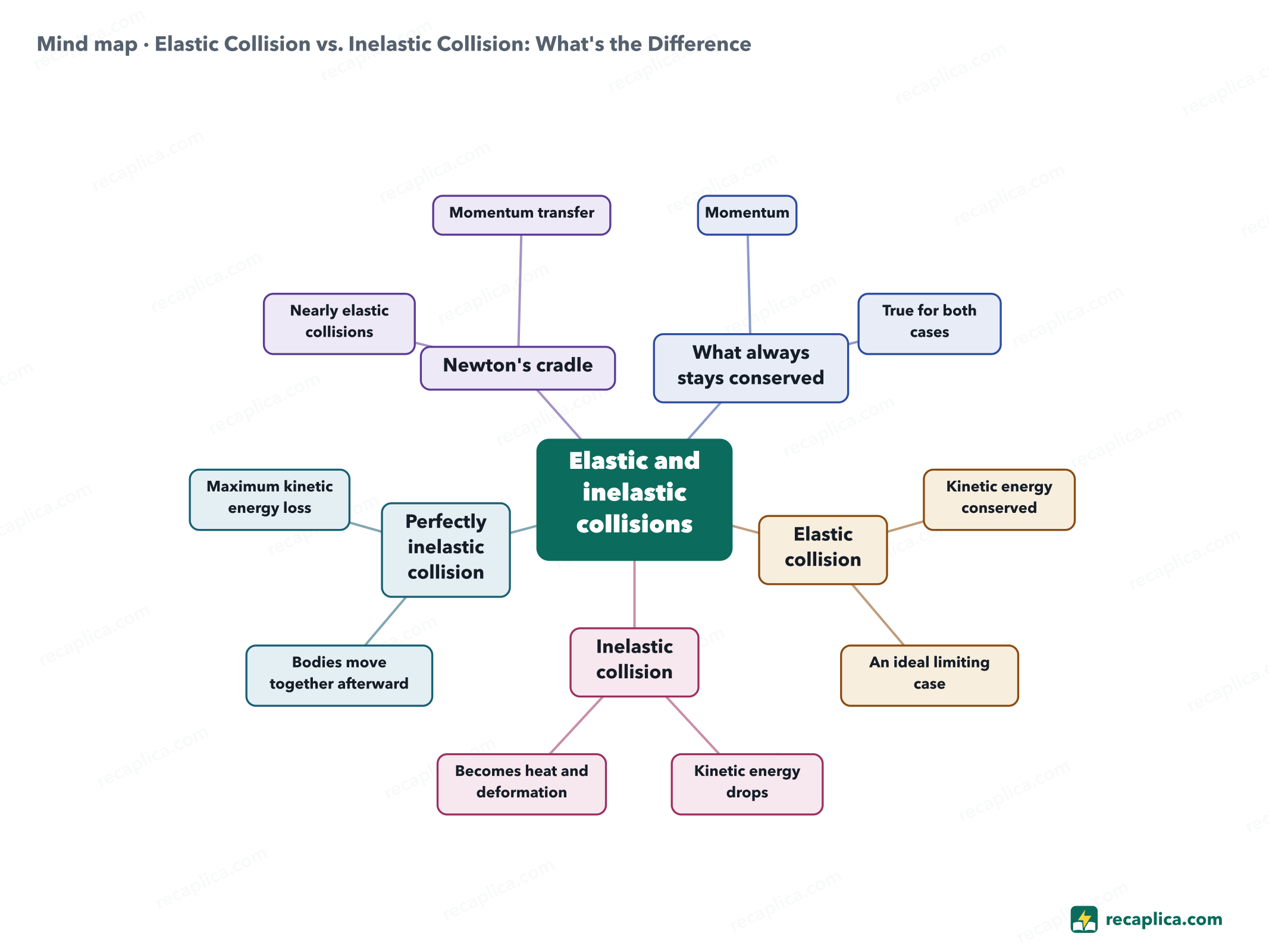
    Mind map: Elastic Collision vs. Inelastic Collision: What's the Difference
    • Elastic and inelastic collisions
      • What always stays conserved
        • Momentum In every type of collision, inside an isolated system
        • True for both cases Elastic and inelastic, without exception
      • Elastic collision
        • Kinetic energy conserved No loss, before and after the collision
        • An ideal limiting case No real collision is entirely free of losses
      • Inelastic collision
        • Kinetic energy drops Final energy is lower than initial energy
        • Becomes heat and deformation The missing part never leaves the system
      • Perfectly inelastic collision
        • Bodies move together afterward The limiting case of an inelastic collision
        • Maximum kinetic energy loss Still consistent with momentum conservation
      • Newton's cradle
        • Nearly elastic collisions The cradle loses height over time
        • Momentum transfer Travels down the row of balls

    Quiz: test yourself

    Answer the questions to check what you have learned: you get instant feedback and a short explanation.

    Grade 0/10 0/5
    1 What is always conserved in a collision, inside an isolated system?

    Momentum is always conserved; kinetic energy is conserved only in an elastic collision.

    2 In an elastic collision, what happens to the system's kinetic energy?

    In an elastic collision, total kinetic energy before the collision equals total kinetic energy after it.

    3 True or false: in a perfectly inelastic collision, the two bodies move together after impact.

    That's exactly the definition of the limiting case: the two bodies move as one after the collision, and no more kinetic energy can be lost while momentum stays conserved.

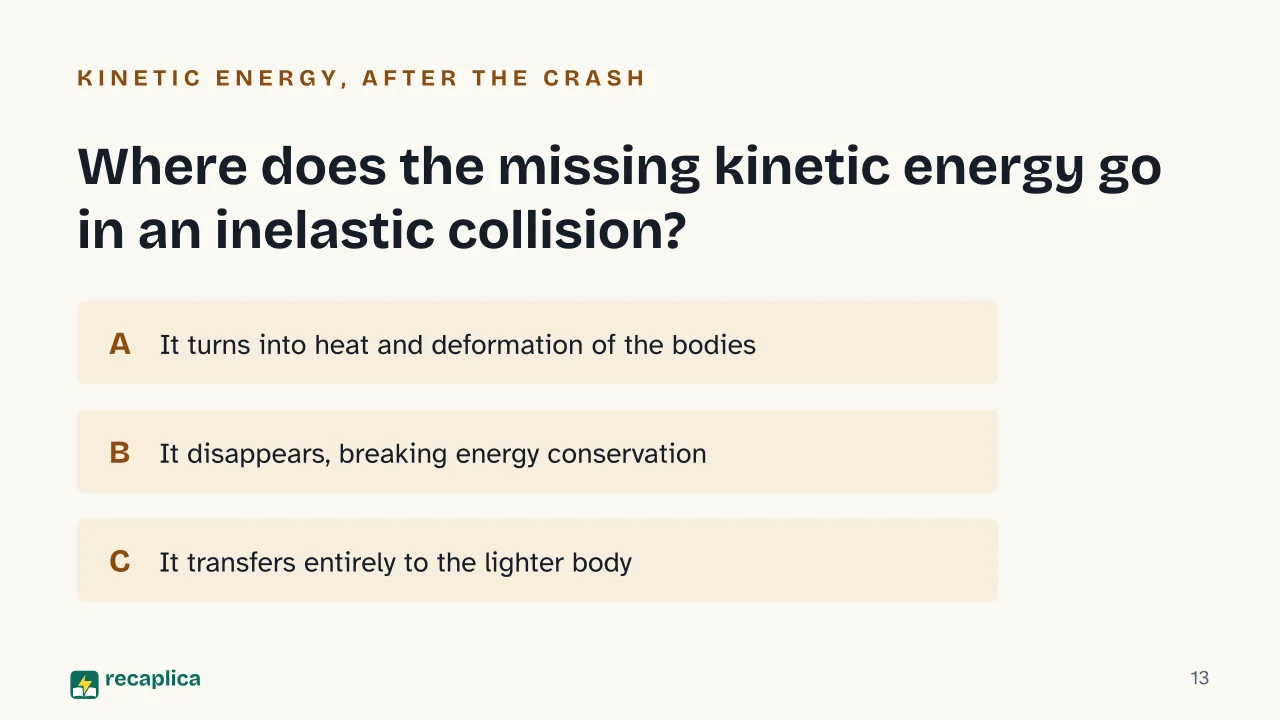
    4 Where does the missing kinetic energy go in an inelastic collision?

    Total energy is always conserved: the missing share of kinetic energy becomes internal energy, that is, heat and deformation.

    5 Why does Newton's cradle gradually lose height over time?

    Part of the kinetic energy turns into heat at every collision, on top of friction losses in the supports.

    Answers: 1-A · 2-A · 3-A · 4-A · 5-A

    Flashcards

    Tap the card to flip it and check whether you remember the answer, then move to the next one.

    1 / 7

    Explain it in your own words

    The ultimate test: if you can explain it in simple words, you've truly understood it. Write your explanation, then compare it with the Recap.

    Your explanation is saved only on this device.

    A collision is elastic when the system's momentum and kinetic energy both stay the same before and after. It's inelastic when only momentum survives, while kinetic energy drops. In most real collisions, part of the kinetic energy turns into heat and into the deformation of the bodies involved. The limiting case, where the two bodies end up moving as a single body, is a perfectly inelastic collision. A perfectly elastic collision, on the other hand, is an idealization: no real macroscopic collision is free of friction or deformation.

    Frequently asked questions

    What is the difference between elastic and inelastic collision?

    In an elastic collision, both momentum and kinetic energy end up exactly where they started; in an inelastic collision, only momentum does, because part of the kinetic energy ends up as heat and leaves the material deformed.

    What is the formula for elastic collision, and how does an inelastic collision formula differ?

    Momentum is always conserved: the total before a collision equals the total after it (m1v1 + m2v2 = m1v1' + m2v2'). An elastic collision adds a second equation: total kinetic energy is the same before and after. An inelastic collision formula keeps only the momentum equation — the kinetic energy one no longer holds.

    What is a perfectly inelastic collision?

    It's the limiting case of an inelastic collision: after impact, the two bodies move together as a single body, with the highest kinetic energy loss possible while momentum stays conserved.

    Does a perfectly elastic collision exist in reality?

    No real macroscopic collision is entirely free of losses. A perfectly elastic collision is a useful idealization for calculations; in practice, even collisions that come closest to it, like those in Newton's cradle, consume a small share of kinetic energy to friction.

    Is energy really lost in an inelastic collision?

    Not overall: energy as a whole is still conserved. What's missing in an inelastic collision is only the kinetic share, which shows up afterward as heat and as deformation of the colliding bodies.

    Sources

    • HyperPhysics (Georgia State University) — Elastic Collisions
    • HyperPhysics (Georgia State University) — Inelastic Collisions
    • OpenStax — University Physics Volume 1, 9.4 Types of Collisions
    • University of California, Santa Barbara, Dept. of Physics — Newton's Cradle

    Every Recap goes through an independent review before publication.

    Every evening, the day's new Recaps on our Telegram channel. Join the channel →

    Keep learning

    • Science Kinematics: What It Is and the Equations of Motion Kinematics is the branch of physics that tracks how a body moves: its position, velocity, and acceleration over time. The forces that explain why it moves belong to dynamics instead. Pinning down where an object is at a given instant always needs a fixed frame of reference, a set of measuring axes. Position-time and velocity-time graphs show the same motion as a line, with the slope telling velocity in one graph and acceleration in the other. Free fall and uniform circular motion are the two examples students meet first. Read the Recap →
    • Science Kinetic and Potential Energy: What's the Difference Kinetic energy is the energy a body has because it is moving, and in its formula the speed appears squared. Potential energy is stored energy that depends on how the parts of a system are arranged, for instance an object and the Earth. Add the two together and you get mechanical energy, which stays the same over time wherever only conservative forces act: on the way down, one form turns into the other. That is why a stone sitting still at the top of a cliff already holds energy. Read the Recap →
    • Science Mechanical Energy: Definition and the Conservation Formula Mechanical energy is the kinetic energy of a moving object plus its potential energy, the energy tied to its position. Changing an object's speed takes work, and work is what shifts energy from one form into another. When the only forces acting are conservative, like gravity, mechanical energy stays constant as the object moves: one form grows while the other shrinks, but their sum never changes. Friction and air resistance break that balance and dissipate part of the mechanical energy. The formula that captures this is Em = KE + PE = constant. Read the Recap →

    recaplica

    Clear in 30 seconds, yours in 10 minutes.

    Recaps Mind maps Request a Recap Telegram channel Mind map maker Our method About Privacy & cookies Legal notes & terms of use

    © 2026 Recaplica · A project by Curi S.r.l. — VAT IT05472000750

    Statistics, only if you say so

    To learn which Recaps help most we would use Google Analytics, with aggregate, anonymous data. It starts only with your OK, and you can change your mind anytime. Privacy policy